Journal of Chemical and Pharmaceutical Research, 2013, 5(12):358-363
Research Article
CODEN(USA) : JCPRC5
ISSN : 0975-7384
Separation and analysis of bacteriostatic components from cumin essential oil
Liu Bing
Department of Chemistry and Chemical Engineering, Xinxiang University, Xinxiang, China
_____________________________________________________________________________________________
ABSTRACT
Cumin essential oil was extracted from cumin seeds with low boiling-point organic solvents by Soxhlet extraction method. In this paper, the extraction technology conditions were explained in detail. The cumin essential oil was separated and identified by Column Chromatography and GC-MS. Results showed that optimum petroleum ether
extraction conditions for essential oil were as follows: extraction temperature is 33 , extract time ℃ is 10h and the
Cumin essence oil of maximum yield is about 82 mg/g. Through the component separation and analysis of the main chemical components, the biochemically active bases of essential oil which can inhibit bacterium in foodstuff antisepsis were ascertained. The method was Soxhlet extraction and gas chromatography-mass spectrometry, which can effectively determine the bacteriostatic components of cumin essential oil.
Keywords: cumin essential oil; Soxhlet extraction; column chromatography; gas chromatograph-mass spectrometer; bacteriostatic effect
_____________________________________________________________________________________________
INTRODUCTION
Cumin belongs to umbelliferae. It is an excellent plant resource that has the concomitant function of both medicine and foodstuff. Cumin contains various active ingredients. Present foreign and domestic research focuses on the extraction of cumin essential oil and on the analysis of the components of essential oil. Although the components and contents of cumin essential oil vary from each other, all the researchers agree that the Ingredients of cumin essential oil are cuminal, γ-terpinene, p-cymene and β-pinene, etc. Researches show that cumin essential oil has the function of bacteriostat and antioxidant, which can retard lipid peroxidation[1,2]. At present, the main methods to extract cumin essential oil are as following:steam distillation,organic solvent extraction, supercritical extraction and microwave-assisted extraction[3-9]. Due to the complexity, energy-wasting and high cost of the equipment, it is difficult for us to put these methods into practice. At the same time, because the ingredients of cumin essential oil are relatively complex, and if the preparation methods and technological conditions are changed, the composition of the ingredients will differ from each other. Under such circumstances, the bacteriostasis, antibiosis and peroxidization also varies from each other. Therefore, it is of significance for us to further isolate and purify the active ingredients in cumin essential oil, and it is necessary to make a detailed study on the function and mechanism of the active compounds[10,11].
______________________________________________________________________________
EXPERIMENTAL SECTION
Raw material, Reagent and Instrument
Before the experiment, cumin seeds produced in the Xinjiang Uygur Autonomous Region are dried and smashed. Petroleum ether (boiling range between 30°C and 60°C), n-hexane, dichloromethane (DCM), methanol, silica gel for chromatography purpose (200 ~ 300 mesh) and neutral alumina (100 ~ 200 mesh) are prepared. They are all analytical grade.
Electronic balance ( type BT224S), soxhlet extractor (250mL), rotary evaporators ( type RE-52), high pressure steam sterilization pot, drying oven, constant temperature incubator, super clean workbench, biological microscope, Trace DSQ GC – MS (American Finnigan Corporation).
Experimental method
A certain amount of cumin powder after pretreatment is taken, and then Soxhlet extraction is proceeded with petroleum ether and n-hexane as the solvent for 12h. The leaching liquor is dried with anhydrous sodium sulfate, and then cumin essential oil is attained after the removal of the solvent by rotary evaporators.
All the reagents used for compartment analysis are purified after repeated distillation and they are inspected by chromatographic detector. Adsorbent used for chromatography column is prepared after activation treatment. silica gel is activated for 4h at 150°C. Aluminium trioxide is activated for 4h at 400°C. In term of polarity, the components of cumin essential oil are detached by the method of column chromatography as follows: saturated hydrocarbons (labeled as A), aromatic hydrocarbon (labeled as B), non-hydrocarbon (labeled as C), and colloid (labeled as D).
GC-MS analysis conditions: chromatographic column is TR-5MS(30m×0.32 mm×0.25µm). The temperature of injection port is 220°C. The initial temperature is 60°C. The sample has been reserved for 1min, then its temperature rises to 180°C with the heating speed of 8°C /min. And then its temperature rises to 220°C with the heating speed of 10℃/min. The sample has been reserved for 1 min. The sample load is 0.5 µL. The flow rate of carrier gas (helium) is 1 mL/min. The split ratio is 60:1. The condition of mass spectrometry is as follows: mass range is m/z = 30~600 amu. Scanning interval is 0.5 s. Detecting voltage is 1.2 kV. ionizing voltage is 70 eV. Electron impact ion source is EI.
RESULTS AND DISCUSSION
Cumin essential oils extracted is a light yellow transparent liquid with the perfume of cumin, which is soluble in most organic solvents. After the solvent evaporated, its physical property parameter is as follows: the relative density is 0.912~0.962 g/cm3 below 25°C, and its acid value is less than or equal to 20 mg.KOH/g ( ≤ 20 mg.KOH/g).
After the column chromatography of silica gel assembled in the laboratory and three alumina, cumin essential oils, extracted by the solvent of petroleum ether and normal hexane, underwent the separation of the components. The eluents used in the chromatography are: normal hexane for the separation of saturated hydrocarbon, normal hexane and DCM for the separation of aromatic hydrocarbon, normal hexane and carbinol for the separation of nonhydrocarbon, and the rest fall into colloid. The Product yield and constitute properties of essential oil are showed in table 1.
Table-1 Product yield and constitute properties of essential oil
solvent
product yield /(mg ּ◌g-1)
Gross saturated hydrocarbon aromatic hydrocarbon nonhydrocarbon colloid saturated hydrocarbon / aromatic hydrocarbon petroleum ether 81.9 0.06 52.3 18.4 0.40 0.0011
normal hexane 79.1 0.07 52.4 12.7 0.15 0.0011
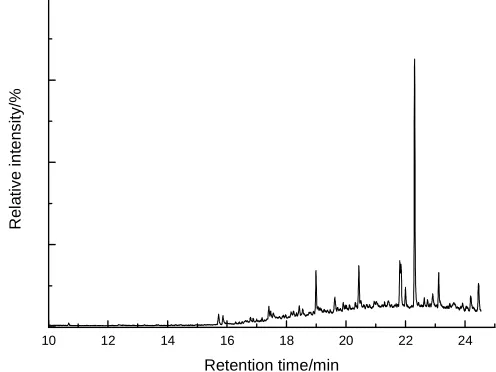
After the qualitative and quantitative analysis of the the major separation components by using gas chromatography-mass spectrometry instrument, it can be concluded that about 130 chromatographic peaks are separated from cumin essential oil. After the scanning of mass spectra of all the peaks in RIC, we retrieved all the mass spectrometric data in the data system and reviewed all the related documents, and the chemical components were identified. At last, we determined their relative contents by area normalization method. The total ion chromatogram and mass spectrum of the three chief constituents are as follows (figure 1 to figure 6):
10 12 14 16 18 20 22 24
R
e
la
ti
v
e
i
n
te
n
s
it
y
/%
[image:3.595.181.429.159.345.2]Retention time/min
Fig. 1 Total ion current chromatogram of Cuminum cyminum L. essential oil Component A
60 80 100 120 140 160 180 200 220 240
m/z 0
10 20 30 40 50 60 70 80 90 100
R
e
la
ti
v
e
A
b
u
n
d
a
n
c
e
161.0
104.9
118.9
121.0 90.9
92.9
78.9
162.0 132.9
54.9 134.1 204.0
77.1 81.3
64.9 135.8
189.2 205.3
175.0 238.6
______________________________________________________________________________
6 8 10 12 14 16 18 20 22 24
R
e
la
ti
v
e
i
n
te
n
s
it
y
/%
Retention time/min
Fig-3 Total ion current chromatogram of Cuminum cyminum L. essential oil Component B
60 80 100 120 140 160 180 200 220 240 m/z
0 10 20 30 40 50 60 70 80 90 100
R
e
la
ti
v
e
A
b
u
n
d
a
n
c
e
80.9
66.9
108.9
78.7 82.0
124.1 55.0 90.9
77.0
121.9 65.1
125.1
177.0 208.2 162.0 199.2
148.2 218.9
Fig-4 Mass spectrogram of Cuminum cyminum L. essential oil Component B
4 6 8 10 12 14 16 18 20 22 24
R
e
tl
a
ti
v
e
i
n
te
n
s
it
y
/%
Retention time/min
60 80 100 120 140 160 180 200 220 240 m/z
0 10 20 30 40 50 60 70 80 90 100
R
e
la
ti
v
e
A
b
u
n
d
a
n
c
e
104.8
76.8
121.8
50.8 149.8
106.0 78.0
73.8 148.6 151.0
52.0 91.2 106.9 170.2 181.7 197.5 214.4 239.2
Fig-6 Mass spectrogram of Cuminum cyminum L. essential oil Component C
Mass spectrum was attained after the MS scanning of each peak in the total ion chromatogram. Then we retrieved all the mass spectrometric data in the data system and reviewed all the related documents[12-15], and the chemical components of cumin essential oil were identified as follows: saturated hydrocarbon mainly contains alkane (C12~C24), p-cymene for example, which accounts for 20% of all the key components. Aromatic hydrocarbon mainly contains γ-terpinene, β- pinene, α- pinene, β- Platycladus orientalis, β- myrcene, α- phellandrene, cuminal, and 4- terpineol, etc. which accounts for 40% of all the key components. Nonhydrocarbon mainly contains cumin acid and cuminyl alcohol, which accounts for 30% of all the key components. The main chemical compounds of cumin essential oil are monoterpene, sesquiterpenes, aromatic aldehydes, ketones and ethers. The non-essential oil compounds of extracted cumin are glycoside and fat, etc.
Cumin essential oil has inhibitory effect on bacteria, mold and yeast. In the research, the researchers have had evaluated the antibacterial activity of staphylococcus aureus and escherichia coli extracted from cumin essential oil. In aseptic condition the researchers dropped little petroleum ether extract to the medium of staphylococcus aureus and escherichia coli, and the researchers made a blank control of the extract solvent. Then the researchers put the petri dish into the constant temperature incubator, which lasted for 24~48 h. After that the researchers measured the diameter of inhibition zone by cross bonded method, and calculated the bacteriostasis rate, with the average size of colony standing for the bacterial colony. The experiments showed that escherichia coli is more sensitive to the compounds in group B than to staphylococcus aureus, which means that cumin essential oil has great inhibitory effect on staphylococcus aureus.
And staphylococcus aureus has potent tolerance, which shows that bacteriostatic activity of cumin essential oil is of certain degree of selectivity. The antibacterial active ingredient of cumin essential oil is cuminal, but we can not rule out the synergy of low content components.
Therefore, it is of significance for us to have a further research on the antibacterial activity of monomeric compounds of cumin essential oil, which is valuable for the application of cumin essential oil into the exploitation of preservatives.
CONCLUSION
______________________________________________________________________________
property, to find out the law that how the molecular structure of food antiseptics affects antimicrobial activity. The author expects that the study will contribute to the molecular designing, molecular modification and the forecast of antibacterial property of broad spectrum, efficient and low toxicity food antiseptics.
REFERENCES
[1] Singh G, Upadhyay R K. Fitoterapia, 1991, 62 (1) : 86.
[2] Aruna K, Rukkumani R, Suresh P, et al. Phytotherapy Research, 2005, 19(5): 416-421 [3] Li Wei, Feng Dan, Lu Zhan Guo. Food Science and Technology, 2008, (5): 182-186. [4] Hashemi P, Shamizadeh M, Badiei A, et al. Chromatographia, 2009, 70(7/8): 1147-1151 [5] Gan Zhilin, Yu Ming, Hu Xuefang. Science and Technology of Food, 2010, 31(8):283-285. [6] Hou Xujie, Li Xinming. Food Science and Technology , 2006, 27(7):132-135
[7] Yang Yan, Wu Suling, Zhang Weiming. Food Sience, 2009, 30(8): 42-46. [8] Yang Wenju, Yang Tao, Liu Long. Analytical Chemistry, 2009, 30(6): 208-212. [9] Yu Yong, Wang Yutang, Wang Ziming. Analytical Chemistry, 2008, 36(12):1756.
[10] Shetty S, Singhal R S , Kulkarni P R. World Journal of Microbiology & Biotechnology, 1994, 10 (2): 232-233 [11] Allahghadri T, Rasooli I, Owlia P, et al. Journal of Food Science, 2010, 75(2): 54-61
[12] Martineztome M, Jimenez A M, Ruggieri S, et al. Journal of Food Protection, 2001, 64 (9): 1412-1419. [13] Gurdip S, Inder P S K, Santosh K P. Journal of Scientific & Industrial Research, 1998, 57 (3): 139-142 [14] Chen Qinqin, Li Shuyan, Gan Zhilin. Food Science, 2011, 32(3):301-304.