Deep Learning the Dynamic Appearance and Shape of Facial Action Units
Shashank Jaiswal
The University of Nottingham
Michel Valstar
The University of Nottingham
[email protected]Abstract
Spontaneous facial expression recognition under uncon-trolled conditions is a hard task. It depends on multiple fac-tors including shape, appearance and dynamics of the facial features, all of which are adversely affected by environmen-tal noise and low intensity signals typical of such condi-tions. In this work, we present a novel approach to Facial Action Unit detection using a combination of Convolutional and Bi-directional Long Short-Term Memory Neural Net-works (CNN-BLSTM), which jointly learns shape, appear-ance and dynamics in a deep learning manner. In addition, we introduce a novel way to encode shape features using binary image masks computed from the locations of facial landmarks. We show that the combination of dynamic CNN features and Bi-directional Long Short-Term Memory ex-cels at modelling the temporal information. We thoroughly evaluate the contributions of each component in our system and show that it achieves state-of-the-art performance on the FERA-2015 Challenge dataset.
1. Introduction
Automatic facial expression recognition has attracted con-siderable attention in the past few years [6, 18, 20, 23] due to their potential application in the field of psychol-ogy, mental health, human-computer interaction, etc. The Facial Action Coding System (FACS) developed by Ek-man and Friesen [4], provides a systematic and objective way to study any kind of facial expression, by representing them as a combination of individual facial muscle actions known as Action Units (AU). Automatic detection of facial Action Units is a challenging problem primarily due to the high degree of variation in the visual appearance of human faces (caused by person specific attributes, multiple poses, etc.), low intensity activation of spontaneous expressions, non-additive effects of co-occurring AUs and the scarcity of training data.
Recently, deep learning algorithms have shown signifi-cant performance improvements for object detection tasks [13,7]. The recent success of deep learning algorithms has
been attributed to three main factors: (a) Efficient methods for training deep artificial neural networks, (b) Availabil-ity of high performance computational hardware e.g. GPUs and (c) Availability of large amounts of labeled training data. Although deep learning algorithms have been shown to produce state of the art performance on object recognition tasks, there has been considerably less work on using deep learning techniques in action recognition, facial expression recognition, and in particular facial AU recognition. With the increasing availability of large databases for AU recog-nition [16,23,29], it would be interesting to see if deep learning algorithms can give a similar leap in performance in the field of facial expression/AU recognition.
Traditional AU recognition algorithms have used hand-crafted appearance features (e.g. Gabor, HoG, LBP) and/or shape/geometric features computed from the locations of fa-cial landmarks. Since these hand-crafted features are not tuned to a specific task, they limit the performance of the classifier learnt on these features. Deep learning techniques on the other hand allow a multistage approach in which the features are learnt directly from the pixel values in combi-nation with the classifier. Therefore, in addition to provid-ing an algorithm which can be trained directly from pixels to labels, the features learnt in the intermediate stages are designed specifically for the target task.
Instead we make full use of past progress in face and facial point detection to guide our CNN.
We introduce a novel way to encode shape of facial parts by computing binary image masks using the locations of fa-cial landmarks. This enables us to learn the relevant shape features instead of using hand-crafted geometric features. We also use a novel method to model the temporal infor-mation using a combination of time-windowed CNN and Bi-directional Long Short-Term Memory (BLSTM) [10,8]. BLSTM is a recurrent neural network architecture which is capable of storing information over extended time inter-vals. It consists of memory enabled blocks to which access is controlled by multiplicative gates. BLSTMs have pre-viously been used for continuous emotion prediction from audio-visual data [25,17] and have shown promising per-formance. It has also been used in combination with CNNs for activity recognition and predicting visual description [3]. To the best of our knowledge, our work is the first to use CNN in combination with BLTSM for facial expression recognition. We show that both BLSTMs and dynamic fea-tures extracted from a time-windowed CNN improve recog-nition accuracy, independently from each other, and with best result achieved when both are used. Our final system outperforms the winners of the recent FERA 2015 challenge [23] by a margin of 10%.
In summary, our main contributions are:
• A deep CNN based framework for jointly learning dy-namic appearance and shape features for facial Action Unit detection.
• A novel way to encode shape features in a CNN, by us-ing binary image masks computed from the locations of automatically detected facial landmarks.
• Learning temporal information for facial AU detec-tion, using a combination of time-windowed CNN and BLSTM.
• Achieving new state-of-the-art performance on the FERA-2015 Challenge dataset.
2. Previous work
Fasel [5] was one of the first to use CNNs for the task of facial expression recognition. He used a 6 layer CNN archi-tecture (2 convolutional layers, 2 sub-sampling layers and 2 fully connected layers) for classifying 7 facial expressions (6 basic emotions + 1 neutral). He experimented with 2 ver-sions of his architecture. In the first version, the filter size in the first convolutional layer was fixed to 5x5 pixels, i.e. the features at the first layer were extracted at a single scale. In the second version, the features at the first layer were ex-tracted at multiple scales, using filters of 3 different sizes (5x5, 7x7 and 9x9 pixels). This CNN consisted of 3 differ-ent data streams corresponding to the three scales which are
connected to each other only at the fully connected layer of the network.
Gudi et al.[9] used a deep CNN consisting of 3 convo-lutional layers, 1 sub-sampling layer and 1 fully connected layer to predict the occurrence and intensity of Facial AUs. A similar architecture was used by Tang [21], but replacing the softmax objective function with L2-SVM.
Liu et al.[15], used 3-dimensional CNN for dynamic learning of facial expressions in a video. They proposed a CNN architecture which can jointly localise certain dy-namic parts of a face (action parts) and encode them for facial expression classification. In their CNN architecture, the resulting feature maps from the first convolutional layer were convolved with a bank of class (of facial expression) specific part filters to compute part detection maps. These part detection maps and a set of deformation maps are summed together (with learned weights), to enforce spa-tial constraints on the part detections. The resulting feature maps are passed through a partially connected layer before obtaining the decision values for each basic emotion.
Kahaou et al.[12] combine face models learnt using a deep CNN architecture with various other models for fa-cial expression classification. They combined a CNN face model with a bag of words model for the mouth region, a deep belief network for audio information and deep au-toencoder for modelling spatio-temporal information. A weighted average of the predictions from all the models was used to classify the emotion expressed.
Jung et al.[11] used a deep CNN to learn temporal ap-pearance features for recognising facial expressions. Ad-ditionally, they also employed a deep Neural network to learn temporal geometric features from detected facial land-marks. Both the networks were learned independently to predict facial expression. The output decision values from each of the networks were combined (linear combination) to compute the final score for any example face image.
Liu et al.[14] learn receptor fields which simulates AU combinations on convolutional feature maps. From each re-ceptor field, they learn features using multilayer Restricted Boltzmann Machines (RBM), which are concatenated to learn a linear Support Vector Machine (SVM).
learnt so as to jointly reconstruct the input. The discrimi-native features from the first block are then used to train a SVM for facial expression classification.
Most of the above methods (e.g. [5,9,15,14], do not utilise all the key facial features i.e. face shape, appearance and dynamics. Those which do utilise all three of them (e.g. [11]), do not learn them jointly. We believe that in order to find the most optimum combination of these features, it is necessary to model them jointly. Also, almost all the above CNN based approaches use a fixed time window to learn the temporal information. This limits the access to tem-poral information within a specific time window only. On the other hand, different facial AUs can occur over different time scales. For e.g., a smile (AU12) can last much longer compared to a blink (AU45) ,which occurs only for a pe-riod. Even within a specific AU, the variation in its duration of occurrence can be quite large. In contrast, our method uses all key features (shape, appearance and dynamics) and attempts to jointly learn them in a single CNN. Addition-ally, we also overcome the problem of a fixed time window in CNN by employing BLSTM for learning long term tem-poral dependencies.
3. Methodology
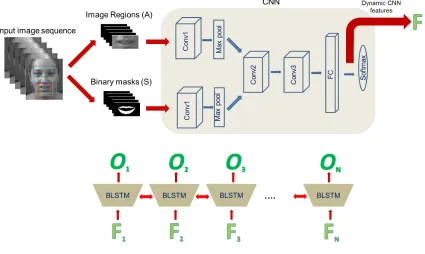
Our system uses small rectangular image regions and corre-sponding binary image masks to learn the relevant appear-ance and shape features respectively. We use a sequence of consecutive images in order to model the dynamics. A transformed sequence of image regions and binary image masks are used as input to train a CNN. The dynamic fea-tures learnt from this CNN are further used for training a BLSTM neural network. The output from this BLSTM neu-ral network serves as the final decision value for the occur-rence of an AU.
3.1. Image Regions
Learning facial action unit models can be a difficult task be-cause only a small part of the face is responsible for the oc-currence of a specific Action Unit. Automatically learning the facial regions which are responsible for a particular Ac-tion Unit is as difficult task due to the high dimensionality of the input image data and the limited amount of training examples available. To solve this problem, the relevant im-age imim-age region for particular Action Unit is pre-selected according to domain knowledge.
In order to define image regions, the face images are first pre-processed by automatically tracking facial land-marks [27,22] and aligning the face images with a reference shape. The alignment is done using a Procrustes transform of the shape defined by facial landmarks on the eyes corners and the nose. The locations of these facial landmarks are in-variant to facial expressions and hence are suitable for the purpose of face alignment. A small set of facial points in the
aligned face images are used to define a rectangular image region. The facial points that define these regions are se-lected by an expert according to the target AU. The mean of the selected facial points is taken as the center around which a rectangular image region of a fixed widthwand heighth, is defined. The rectangular image region is cropped from the original image and is denoted asf (see Fig.1).
3.2. Binary masks
In order to obtain better alignment between different train-ing examples and to automatically encode the shape of dif-ferent parts of a face, we compute a binary maskbi, each
corresponding to an image regionfi. To compute the
bi-nary masks, the facial points selected for defining the im-age regions (see Section3.1) are joined together in a pre-determined order to form a set of polygons. The binary mask imagebicorresponding to the image regionfiis
com-puted by setting all the pixel values offiwhich lie inside a
polygon to 1 and all the pixel values which lie outside a polygon to0(see Fig.1).
3.3. Dynamic encoding
Temporal information can provide vital features for recog-nition of any facial action unit [24,1]. We encode tempo-ral information in our features by extracting image regions
{ft−n, ..., ft+n}and their corresponding binary masks
im-ages{bt−n, ..., bt+n}from a sequence of2n+ 1
consecu-tive frames of a video centered at the current framet. The resulting sequence of image regions are transformed to a sequenceA={Ai}where
Ai=
(
fi, ifi=t
fi−ft, otherwise
(1)
Similarly, the sequence of binary mask images are trans-formed to a sequenceS ={Si}where
Si =
(
bi, ifi=t
bi−bt, otherwise
(2)
The resulting image sequencesAandS are used as input to a deep Convolutional Neural Network (CNN). This is in contrast to the previous approaches [15,11] which directly use the images within a time window around the current frame. Our method of transforming the image sequences by taking difference from the current frame, makes it easier to learn the dynamics in a CNN framework.
3.4. CNN architecture
Figure 1. A graphical overview of our training pipeline: The colored rectangles in the input image sequence shows the different image regions selected for different AUs. Here we show the extraction of image regions (A) and binary masks (S) for AU 12. These are used as input to the train the CNN. Features extracted from the trained CNN (at the fully connected layer) denoted here asF, are used to train a BLSTM network to get final output prediction valuesO.
a convolutional layer (Conv1) which consists of 32 filters of size 5x5x(2n+1). This convolutional layer is followed by a max-pooling layer of size 3x3x1.
The outputs from both streams are merged after max-pooling into a single stream. This merged stream passes through 2 more convolutional layers and 1 fully connected layer. The first convolutional layer in the merged stream (Conv2) consists of 64 filters of size 5x5x64. The second convolutional layer in this stream (Conv3) consists of 128 filters of size 4x4x64. The fully connected layer (F C) has 3072 units and it uses dropout with a probability of 0.2. The output layer consists of 2 units, one for the positive class and another for negative class. In this network, we use Rectified Linear Unit (ReLU) as the activation function. We experi-mented by increasing the dropout probability parameter and adding max-pooling layers after theConv2andConv3 lay-ers, but observed no significant change in performance.
3.5. CNN training
The sequence of image regionsAand the sequence of bi-nary shape masks S for each training example are fed as input to the CNN described in section3.4. The2n+ 1 im-ages of both sequencesAandSare stacked along the tem-poral dimension and fed into two input streams of the CNN as2n+ 1channel inputs. Since the size of theConv1
fil-ters in the temporal direction is equal to size of sequenceA andS, the network is fully connected in the temporal direc-tion at the first convoludirec-tional layer and only one feature map is computed per filter atConv1for each training example. The network is trained with logarithmic loss function us-ing mini-batch gradient descent method. The trainus-ing data is normalised so as to have a zero mean and one standard deviation for each pixel across all training examples.
3.6. Training BLSTM with CNN features
4. Evaluation
Databases: We evaluated our proposed method on the FERA-2015 Challenge dataset [23]. The FERA 2015 chal-lenge dataset consists of 2 separate databases: SEMAINE and BP4D. Both databases consist of videos in which the facial Action Units of the subjects are labeled. The SE-MAINE database was recorded to study social signals that occur when people interact with virtual humans. It consists of videos in which users are interacting with emotionally stereotyped characters. A total of 6 Facial Action Units are labeled for each frame in the videos. The dataset is divided into a fixed training, development and test set. The par-titioning is subject independent, i.e. the subjects present in the training set are not present in the test set and vice versa. The training partition consists of 16 sessions, the de-velopment partition has 15 sessions, and the test partition has 12 sessions. There are a total of approximately 48,000 images in the training partition, 45,000 in the development and 37,695 in the test partition.
The BP4D dataset consists of recorded videos in which the subjects are responding to emotion elicitation tasks. Like SEMAINE, BP4D dataset is also divided into a fixed set of training, development and test data. The training set consists of 21 subjects while the development and the test set consists of 20 subjects each. There are 8 sessions for each subject. In total, the training partition contains 75,586 images, the development contains 71,261 images and the test contains 75,726 images. Each of these images are an-notated with 11 Action Units. For 6 of these Action Units, only occurrence labels are available. For the other 5 Action Units occurrence as well as intensity levels are available. It should be noted that in our experiments, we used the in-tensities (wherever available) instead of occurrence labels to train our models by switching to Mean-squared error as loss function rather than log-loss.
We chose these 2 databases for our experimental evalua-tions because, firstly, it contains large number of annotated images which benefits deep learning algorithms. Secondly, since these databases are divided into a fixed training and test set, they provide a good platform for a fair evaluation and benchmarking of different AU detection algorithms. Experiments: A number of experiments were carried out to evaluate the effect of various aspects of our method and to compare the performance of our approach to that of other existing approaches. We conducted 4 sets of experiments: One for evaluating the effectiveness of various features of our CNN training method, another for exploring the effect of CNN architecture parameters and a third for evaluating the effect of adding BLSTM. The final set of experiments serves to compare the performance of our models with other existing methods reporting on the same dataset.
For evaluating the effectiveness of various aspects of our CNN training method, we performed a number of
experi-ments on the SEMAINE dataset. We trained a number of baseline models each having some features of our proposed approach. Our first baseline model consists of a CNN simi-lar to the CNN in our approach except that the input to this CNN is the full image of a face (aligned) defined by the face bounding box and the temporal window parametern= 0. There are no image regions (defined by facial landmarks) or binary masks as input to this CNN. Since n = 0 for this model, it does not use any temporal information. We denote this baseline method as CFn=0. Our second
base-line method (CFn=2) uses the same CNN but with temporal
window parametern = 2. Hence this baseline uses tem-poral information within a time window of 2n+ 1 = 5
frames. Our third baseline (CRn=2) uses the same CNN
ar-chitecture but uses image regions (see section3.1) as input and the temporal window parametern= 2for this baseline. Our fourth and final method (CRMn=2) is our proposed
ap-proach which takes as input the image regions and binary shape masks in 2 different streams of the CNN. The tempo-ral window sizen = 2for this method as well. It should be noted that we do not use BLSTM training for this set of experiments and the performances are evaluated based on CNN output only.
For this set of experiments, we used the 2 Alternative Forced Choice (2AFC) scores as performance measure. The 2AFC score is a good approximation of the area under the receiver operator characteristic curve (AUC). It is defined as follows:
2AF C( ˆY) =
n
X
i=0
p
X
j=0
σ(Pj, Ni)
1
n×p, (3)
σ(X, Y) =
1, ifX > Y
0.5, ifX ==Y
0, ifX < Y
whereYˆ is a vector of output decision values from a classi-fier,PandN are subsets ofYˆ corresponding to all positive and negative instances, respectively. nis the total number of true negatives andpis the total number of true positives. Fig. 2 shows a comparison of the performance of our method (CRMn=2) and the other baseline methods, on the
SEMAINE dataset. In this plot we can observe that the performance of CFn=2is higher than that of CFn=0which
shows that our method of encoding the temporal informa-tion works leading to a significantly improved performance. The difference in the performance of CRn=2 and CFn=2
also shows that using image regions as input instead of the entire face image, improves the performance consider-ably. Similarly, the improved performance of our method CRMn=2over CRn=2shows that our method of encoding
in-2AFC S
cores CFn=0
CFn=2
CRn=2
[image:6.612.72.264.73.154.2]CRMn=2
Figure 2. 2AFC scores on the SEMAINE test set, showing a com-parison of the performance of the baseline methods and our pro-posed method CRMn=2.
corporates all our proposed features achieves the best over-all performance among over-all baseline models.
In our second set of experiments, we experimented with the architectural parameters of the CNN. More specifically, we evaluated the effect of adding more max-pooling (mp) layers (adding one after each convolutional layer) and vary-ing the dropout factor (dp) at the fully connected layer. We took our proposed approach CRMn=2and evaluated its
performance under different combination of the parameters (mp,dp). For this set of experiments we again used the SE-MAINE dataset for performance evaluation and 2AFC as the performance measure. We observed that the average performance on the SEMAINE test set, does not changes significantly on adding max-pooling layers after the second and third covolutional layers. Increasing the dropout proba-bility factor from 0.2 to 0.5 also did not make any significant change in the average performance. Hence we can conclude that our proposed method is more or less invariant to these architecture parameters, at least for this amount of data.
For evaluating the effect of adding BLSTM to our train-ing pipeline, we conducted a series of experiments on the SEMAINE database. We computed the performance of our approach with BLSTM (CRMLn=2) along with 3 other
methods. Our first baseline is the CRMn=0, which does
not use any temporal window and hence does not use dy-namics. Our second baseline is CRMLn=0which does not
use any temporal window during CNN training but employs BLSTM after CNN training. Our third baseline is CRMn=2
which uses a2n+ 1 = 5frame temporal window during CNN training, but does not use BLSTM.
Fig. 3 shows the relative performance of our final ap-proach CRMLn=2 and the other 3 baseline methods. We
observe that the performance of CRMLn=0 is higher than
that of CRMn=0, indicating that BLSTM is able to learn the
dynamics resulting in an improved performance even with-out using a temporal window during CNN training. The performance of CRMn=2 over that of CRMn=0 indicates
the extent to which, using a temporal window of 5 frames while training the CNN, can improve the performance even without using BLSTMs. However, the best performance is achieved with CRMLn=2, which uses a 5 frame temporal
2AFC S
cores CRMLn=0CRMn=0
CRMn=2 CRMLn=2
Figure 3. Performance (2AFC scores) comparison on the SE-MAINE test set when using BLSTMs with CNNs.
Figure 4. Weighted average performance on BP4D and SEMAINE for AU occurrence.
window during CNN training and also employs BLSTM for training with features extracted from CNN. This indicates that BLSTMs perform better with dynamic features (ex-tracted using a fixed temporal window) compared to non-dynamic features (extracted using a single image).
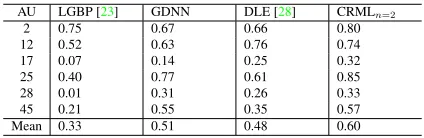
In our final set of experiments, we compare the perfor-mance of our method (CRMLn=2) with 3 other existing
methods on the SEMAINE and BP4D dataset. For this set of experiments, we used the F1 scores as the performance measure in order to directly compare with the performance reported in the literature. We compared the performance of our method with the Local Gabor Binary Pattern (LGBP, [26]) and SVM based approach described in [23]. An-other method that we compare against is a geometric feature based approach which uses a deep neural network (GDNN). For computing the performance of this method we trained a deep neural network with 4 hidden layers (all fully con-nected). The input to this network were the locations of 49 facial landmarks within a time window of 5 frames. We also compared our method with the multi-label Discrim-inant Laplacian Embedding (DLE) approach proposed by Y¨uce et al.[28] (FERA-2015 Challenge winner).
[image:6.612.330.522.77.158.2] [image:6.612.333.517.213.365.2]AU LGBP [23] GDNN DLE [28] CRMLn=2
2 0.75 0.67 0.66 0.80
12 0.52 0.63 0.76 0.74
17 0.07 0.14 0.25 0.32
25 0.40 0.77 0.61 0.85
28 0.01 0.31 0.26 0.33
45 0.21 0.55 0.35 0.57
[image:7.612.62.274.70.139.2]Mean 0.33 0.51 0.48 0.60
Table 1. Performance (F1 scores) comparison on SEMAINE test set.
AU LGBP [23] GDNN DLE [28] CRMLn=2
1 0.18 0.33 0.25 0.28
2 0.16 0.25 0.17 0.28
4 0.22 0.21 0.28 0.34
6 0.67 0.64 0.73 0.70
7 0.75 0.79 0.78 0.78
10 0.80 0.80 0.80 0.81
12 0.79 0.78 0.78 0.78
14 0.67 0.68 0.62 0.75
15 0.14 0.19 0.35 0.20
17 0.24 0.28 0.38 0.36
23 0.24 0.33 0.44 0.41
Mean 0.44 0.48 0.51 0.52
Table 2. Performance (F1 scores) comparison on BP4D Test set.
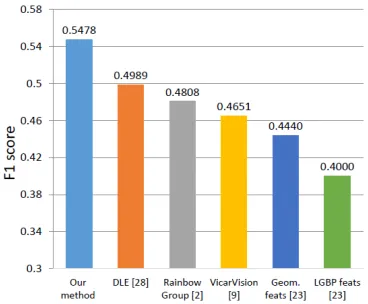
can see that the performance from our approach is signif-icantly higher on the SEMAINE dataset, as compared to other approaches. Similarly, we outperform the other 3 ap-proaches, on the BP4D dataset as well (see table2). Fig.4 shows the weighted average performance on SEMAINE and BP4D dataset. In this Fig. we compare the performance of our method with all other approaches ([28],[2],[9], [23]) of the partcipants of FERA-2015 Challenge. In this Fig. we can see that our method significantly outperforms other ap-proaches on the FERA-2015 Challenge dataset.
5. Conclusions
We presented a novel CNN-BLSTM based approach which learns the dynamic appearance and shape of facial regions for Action Unit detection. The appearance and shape are learnt through local image regions and corresponding bi-nary masks respectively. The dynamics are learnt through a combination of dynamic features (extracted from a time-windowed CNN) and BLSTM. We show that each compo-nent of our system contributes towards an improvement in performance and achieves new state-of-the-art performance on the FERA-2015 Challenge databases.
6. Acknowledgments
The work of Valstar and Jaiswal is supported by MindTech Healthcare Technology Co-operative. The work of Val-star is also funded by European Union Horizon 2020 re-search and innovation programme under grant agreement No 645378. We are also grateful for access to the Univer-sity of Nottingham High Performance Computing Facility.
References
[1] T. R. Almaev and M. F. Valstar. Local gabor binary pat-terns from three orthogonal planes for automatic facial ex-pression recognition. InAffective Computing and Intelligent Interaction (ACII), 2013 Humaine Association Conference on, pages 356–361. IEEE, 2013.3
[2] T. Baltrusaitis, M. Mahmoud, and P. Robinson. Cross-dataset learning and person-specific normalisation for automatic ac-tion unit detecac-tion. InFacial Expression Recognition and Analysis Challenge, in conjunction with IEEE Int‘l Conf. on Face and Gesture Recognition, 2015.6
[3] J. Donahue, L. A. Hendricks, S. Guadarrama, M. Rohrbach, S. Venugopalan, K. Saenko, and T. Darrell. Long-term recur-rent convolutional networks for visual recognition and de-scription.arXiv preprint arXiv:1411.4389, 2014.2
[4] P. Ekman, W. Friesen, and J. Hager. Facial Action Coding System (FACS): Manual. A Human Face, Salt Lake City (USA), 2002.1
[5] B. Fasel. Head-pose invariant facial expression recognition using convolutional neural networks. InMultimodal Inter-faces, 2002. Proceedings. Fourth IEEE International Con-ference on, pages 529–534, 2002.2,3
[6] B. Fasel and J. Luettin. Automatic facial expression analysis: A survey.PATTERN RECOGNITION, 36(1):259–275, 1999.
1
[7] R. B. Girshick, J. Donahue, T. Darrell, and J. Malik. Rich feature hierarchies for accurate object detection and semantic segmentation. In2014 IEEE Conference on Computer Vision and Pattern Recognition, CVPR 2014, Columbus, OH, USA, June 23-28, 2014, pages 580–587, 2014.1
[8] A. Graves and J. Schmidhuber. Framewise phoneme clas-sification with bidirectional lstm and other neural network architectures.Neural Networks, pages 5–6, 2005.2,4
[9] A. Gudi, H. E. Tasli, T. M. den Uyl, and A. Maroulis. Deep learning based facs action unit occurrence and intensity es-timation. In Facial Expression Recognition and Analysis Challenge, in conjunction with IEEE Int‘l Conf. on Face and Gesture Recognition, 2015.2,3,6
[10] S. Hochreiter and J. Schmidhuber. Long short-term memory.
Neural Comput., 9(8):1735–1780, November 1997.2
[11] H. Jung, S. Lee, S. Park, I. Lee, C. Ahn, and J. Kim. Deep temporal appearance-geometry network for facial expression recognition. http://arxiv.org/abs/1503.01532.
2,3
[12] S. E. Kahou, C. Pal, X. Bouthillier, P. Froumenty, c. G¨ulc¸ehre, R. Memisevic, P. Vincent, A. Courville, Y. Bengio, R. C. Ferrari, M. Mirza, S. Jean, P.-L. Car-rier, Y. Dauphin, N. Boulanger-Lewandowski, A. Aggarwal, J. Zumer, P. Lamblin, J.-P. Raymond, G. Desjardins, R. Pas-canu, D. Warde-Farley, A. Torabi, A. Sharma, E. Bengio, M. Cˆot´e, K. R. Konda, and Z. Wu. Combining modality spe-cific deep neural networks for emotion recognition in video. InProceedings of the 15th ACM on International Conference on Multimodal Interaction, ICMI ’13, pages 543–550, New York, NY, USA, 2013. ACM.2
F. Pereira, C. Burges, L. Bottou, and K. Weinberger, edi-tors,Advances in Neural Information Processing Systems 25, pages 1097–1105. Curran Associates, Inc., 2012.1
[14] M. Liu, S. Li, S. Shan, and X. Chen. Au-aware deep net-works for facial expression recognition. InAutomatic Face and Gesture Recognition. FG 2013. IEEE, pages 1–6. IEEE, 2013.2,3
[15] M. Liu, S. Li, S. Shan, R. Wang, and X. Chen. Deeply learning deformable facial action parts model for dynamic expression analysis. In D. Cremers, I. Reid, H. Saito, and M.-H. Yang, editors,Computer Vision – ACCV 2014, volume 9006 ofLecture Notes in Computer Science, pages 143–157. Springer International Publishing, 2015.2,3
[16] S. Mavadati, M. Mahoor, K. Bartlett, P. Trinh, and J. Cohn. Disfa: A spontaneous facial action intensity database. Affec-tive Computing, IEEE Transactions on, 4(2):151–160, April 2013.1
[17] M. A. Nicolaou, H. Gunes, and M. Pantic. Continuous pre-diction of spontaneous affect from multiple cues and modali-ties in valence-arousal space.IEEE Transactions on Affective Computing, 2(2):92–105, 2011.2
[18] M. Pantic and L. J. M. Rothkrantz. Automatic analysis of facial expressions: The state of the art. IEEE Trans. Pattern Anal. Mach. Intell., 22(12):1424–1445, December 2000.1
[19] S. Rifai, Y. Bengio, A. Courville, P. Vincent, and M. Mirza. Disentangling factors of variation for facial expression recognition. In A. Fitzgibbon, S. Lazebnik, P. Perona, Y. Sato, and C. Schmid, editors,Computer Vision ?ECCV 2012, volume 7577 ofLecture Notes in Computer Science, pages 808–822. Springer Berlin Heidelberg, 2012.2
[20] G. Sandbach, S. Zafeiriou, M. Pantic, and L. Yin. Static and dynamic 3d facial expression recognition: A compre-hensive survey. Image and Vision Computing, 30(10):683 – 697, 2012. 3D Facial Behaviour Analysis and Understand-ing.1
[21] Y. Tang. Deep learning using linear support vector ma-chines. InWorkshop on Challenges in Representation Learn-ing, ICML, 2013.2
[22] G. Tzimiropoulos and M. Pantic. Gauss-newton deformable part models for face alignment in-the-wild. InCVPR 2014, 2014.3
[23] M. Valstar, J. Girard, T. Almaev, G. McKeown, M. Mehu, L. Yin, M. Pantic, and J. Cohn. Fera 2015 - second fa-cial expression recognition and analysis challenge. InFacial Expression Recognition and Analysis Challenge, in conjunc-tion with IEEE Int‘l Conf. on Face and Gesture Recogniconjunc-tion, 2015.1,2,5,6,7
[24] M. F. Valstar and M. Pantic. Fully automatic recognition of the temporal phases of facial actions. Systems, Man, and Cybernetics, Part B: Cybernetics, IEEE Transactions on, 42(1):28–43, 2012.3
[25] M. Wllmer, M. Kaiser, F. Eyben, B. Schuller, and G. Rigoll. Lstm-modeling of continuous emotions in an audiovisual af-fect recognition framework. Image and Vision Computing, 31(2):153 – 163, 2013. Affect Analysis In Continuous Input.
2
[26] T. Wu, N. J. Butko, P. Ruvolo, J. Whitehill, M. S.Bartlett, and J. R. Movellan. Multi-layer architectures of facial action unit
recognition. IEEE Trans. Systems, Man and Cybernetics, Part B, 2012. In print.6
[27] X. Xiong and F. De la Torre Frade. Supervised descent method and its applications to face alignment. InIEEE Inter-national Conference on Computer Vision and Pattern Recog-nition (CVPR), May 2013.3
[28] A. Y¨uce, H. Gao, and J.-P. Thiran. Discriminant multi-label manifold embedding for facial action unit detection. In Fa-cial Expression Recognition and Analysis Challenge, in con-junction with IEEE Int‘l Conf. on Face and Gesture Recog-nition, 2015.6,7