© 2018, IRJET | Impact Factor value: 6.171 | ISO 9001:2008 Certified Journal | Page 2255
STATIC ANALYSIS OF MULTI-STORIED BUILDING AS PER IS 1893-2002
AND IS 1893-2016
P.S. Girigosavi
1, Prof. M. S. Kakamare
21ME student, Civil-structure Engineering Department, Padmabhooshan Vasantraodada Patil Institute of
Technology, Sangli, Maharashtra, India
2Associate Professor, Civil-structure Engineering Department, Padmabhooshan Vasantraodada Patil Institute of
Technology, Sangli, Maharashtra, India
---***---Abstract -
This paper concerned with study on revision of IS 1893-2016.The static analysis of multi-storied building is done by using FEM based software. In present study, the static analysis is carried out as per IS 1893-2016 and results such as lateral displacement, base shear, storey drift are compared with IS1893-2002. This paper deals with the comparison of design forces for multi-storied buildings, obtained by using IS 1893-2016 code, with those obtained by the previous IS1893-2002 version.From the results of seismic analysis of buildings it is concluded that the IS1893-2016 is more conservative for earthquake analysis of multi-storey buildings.Key Words: Multi-storied building, static analysis, IS1893-2016, IS1893-2002.
1. INTRODUCTION
When earthquakes occur, a building undergoes dynamic motion. This is because the building is subjected to inertia forces that act in opposite direction to the acceleration of earthquake excitations. These inertia forces, called seismic loads, are usually dealt with by assuming forces external to the building. So, apart from gravity loads, the structure will experience dominant lateral forces of considerable magnitude during earthquake shaking. It is essential to estimate and specify these lateral forces on the structure in order to design the structure to resist an earthquake. Indian seismic code IS: 1893 has also been revised in year 2016. This paper presents the seismic load estimation of multi storied buildings as per IS: 1893(part) -2016. The process gives static analysis of multi-storied building by using FEM based software and the results are used to compare old codal provions viz. lateral displacement, base shear, storey drift computed as per the two versions of seismic code. So, this paper deals with comparative study of IS 1893-2002 and IS 1893-2016. Model considered for this paper is 15 storied residential building using FEM based software. The height of each storey is taken as 3 meter and base height 0.45 m making the total height of the structure 45.45 meter. Static Analysis of the structure is done and results generated by software are compared as per IS 1893:2002 and IS 1893-2016.
2. LITERATURE SURVEY
S. Farrukh Anwar, A. K. Asthana (2013) “Evaluation of Seismic Design Forces of Indian Building Code” [1]: The recent fifth revision of Indian Seismic Code, IS: 1893 has
been split into five separate parts for different types of structures. The new code IS: 1893 (Part-1)? 2002 contains provisions specific to buildings only, along with general provisions applicable to all structures. This paper deals with the comparison of seismic design forces for multi-storied buildings, obtained by using the new code, with those obtained by the previous 1984 version. From the results of seismic analysis of buildings it is concluded that the new code is more conservative for buildings resting on soft and medium soils.
S.K. Ahirwar, S.K. Jain and M. M. Pande (2008)
“earthquake loads on multistorey buildings as per is: 1893-1984 and is: 1893-2002: a comparative study” [2]: As a result Indian seismic code IS: 1893 has also been revised in year 2002.This paper presents the seismic load estimation for multi-storey buildings as per IS: 1984 and IS: 1893-2002 recommendations. Four multistorey RC framed buildings ranging from three storied to nine storied are considered and analyzed. The process gives a set of five individual analysis sequences for each building and the results are used to compare the seismic response viz. storey shear and base shear computed as per the two versions of seismic code. The seismic forces, computed by IS: 1893-2002 are found to be significantly higher, the difference varies with structure properties. It is concluded that such study needs to be carried out for individual structure to predict seismic vulnerability of RC framed buildings that were designed using earlier code and due to revisions in the codal provisions may have rendered unsafe.
Sudhir K Jain (2003) “Review of Indian seismic code, IS 1893 (Part 1) : 2002”[3] : The Indian seismic code IS 1893 has now been split into a number of parts and the first part containing general provisions and those pertaining to buildings has been released in 2002. There has been a gap of 18 years since the previous edition in 1984. Considering the advancements in understanding of earthquake-resistant design during these years, the new edition is a major upgradation of the previous version. This paper reviews the new code; it contains a discussion on Clauses that are confusing or vague and need clarifications immediately. The typographical and editorial errors are pointed out. Suggestions are also included for next revision of the code.
International Research Journal of Engineering and Technology (IRJET) e-ISSN: 2395-0056
Volume: 05 Issue: 04 | Apr-2018 www.irjet.net p-ISSN: 2395-0072
© 2018, IRJET | Impact Factor value: 6.171 | ISO 9001:2008 Certified Journal | Page 2256 Dimensional Analysis of Building Systems. The main purpose
of this software is to design multi-storied building in a systematic process. The effective design and construction of earthquake resistant structures have great importance all over the world. This project presents multi-storied residential building analysed and designed with lateral loading effect of earthquake using ETABS. This project is designed as per INDIAN CODES- IS 1893-part2:2002, IS 456:2000 and analysis is carried out by considering severe seismic zones and behaviour is assessed by taking type-II Soil condition,
Mahesh Patil, Yogesh Sonawane (2015) “Seismic Analysis of Multistoried Building”[5] : The effective design and the construction of earthquake resistant structures have much greater importance in all over the world. In this paper, the earthquake response of symmetric multistoried building is studied by manual calculation and with the help of ETABS 9.7.1 software. The method includes seismic coefficient method as recommended by IS 1893:2002. The responses obtained by manual analysis as well as by soft computing are compared. This paper provides complete guide line for manual as well software analysis of seismic coefficient method.
Following methods are adopted for analysis of building for design earthquake loads.
1. Equivalent Static Method, and 2. Dynamic Analysis Method.
Dynamic analysis can be performed in three ways,
1. Response Spectrum Method, 2. Modal Time History Method, and 3. Time History Method.
For Tall Buildings, Response Spectrum Method and Time History Method are adopted
3. PROBLEM FORMULATION
Consider the residential multi-storey building having strength greater than 200 people. Building details are as follows.
Building Plan:
a) Colum Size: 400mm x 600mm up to 8 storeys. 400 mm x 400mm up to 15 storeys.
b) Beam size: 230mm x 450 mm
c) Storey Height: base height 0.45 m,3 m each floor d) Live load: 2 KN/m2
e) Floor finish: 1KN/m2 f) Seismic: V
g) Colum Material Grade: M30
h) Beam and slab concrete Grade: M25
2. To analyse G+ 14 residential multi-storey building having capacity greater than 200 people.
3. To study parameters such as lateral displacement, Base shear, storey drifts multi-storied building.
4. To compare analysis results obtained for new and old codes.
5. MODELING AND ANALYSIS
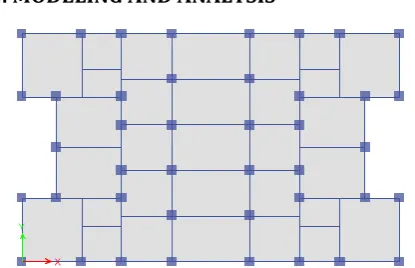
Fig -1: structural plan of G+14 residential building
Load Combinations for code IS 1893-2002.
1.5(DL +IL)
1.2[DL + LL + (ELx+0.3Ely)] 1.2[DL + LL - (ELx+0.3Ely)] 1.2[DL + LL + (ELy+0.3Elx)] 1.2[DL + LL - (Ely+0.3Elx)] 1.5[DL+ (ELx+0.3Ely)] 1.5[DL- (ELx+0.3Ely)] 1.5[DL+ (ELy+0.3Elx)] 1.5[DL- (Ely+0.3Elx)] 0.9DL+1.5(ELx+0.3Ely)] 0.9DL-1.5(ELx+0.3Ely)] 0.9DL+1.5(ELy+0.3Elx)] 0.9DL-1.5(Ely+0.3Elx)]
Load Combinations for code IS 1893-2016.
1.2[DL+LL+ (ELx+0.3Ely+0.3ELz)] 1.2[DL+LL-(ELx+0.3Ely+0.3ELz)] 1.2[DL+LL+ (ELy+0.3Elx+0.3ELz)] 1.2[DL+LL-(Ely+0.3Elx+0.3ELz)] 1.5[DL+ (ELx+0.3Ely+0.3ELz)] 1.5[DL-(ELx+0.3Ely+0.3ELz) 1.5[DL+ (Ely+0.3ELx+0.3ELz)] 1.5[DL-(Ely+0.3ELx+0.3ELz)] 0.9DL+1.5(ELx+0.3ELy+0.3ELz) 0.9DL-1.5(ELx+0.3Ely+0.3ELz) 0.9DL+1.5(Ely+0.3ELx+0.3ELz) 0.9DL-1.5(Ely+0.3ELx+0.3ELz) 4. OBJECTIVES:
[image:2.595.314.522.604.738.2]© 2018, IRJET | Impact Factor value: 6.171 | ISO 9001:2008 Certified Journal | Page 2257
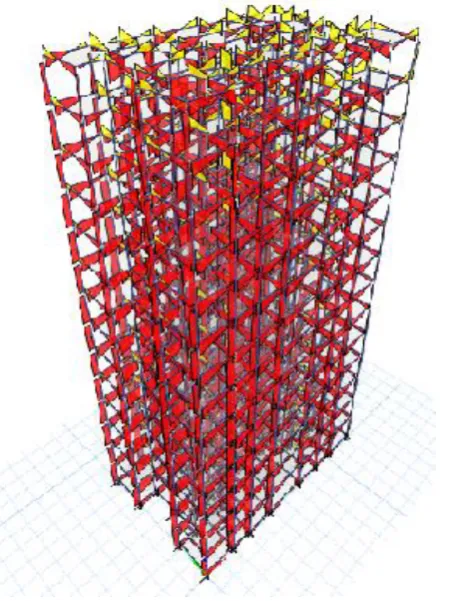
Fig -2: 3D view G+14 residential building
Fig -3: Displacement along X direction.
Fig -4: Displacement along Y direction.
Fig -5: Shear force of G+14 residential building
[image:3.595.41.553.59.746.2] [image:3.595.326.552.80.381.2] [image:3.595.43.286.90.382.2] [image:3.595.52.265.413.563.2] [image:3.595.303.545.426.741.2]International Research Journal of Engineering and Technology (IRJET)
e-ISSN: 2395-0056Volume: 05 Issue: 04 | Apr-2018 www.irjet.net p-ISSN: 2395-0072
© 2018, IRJET | Impact Factor value: 6.171 | ISO 9001:2008 Certified Journal | Page 2258 6. RESULTS
Consider results for Equivalent static method
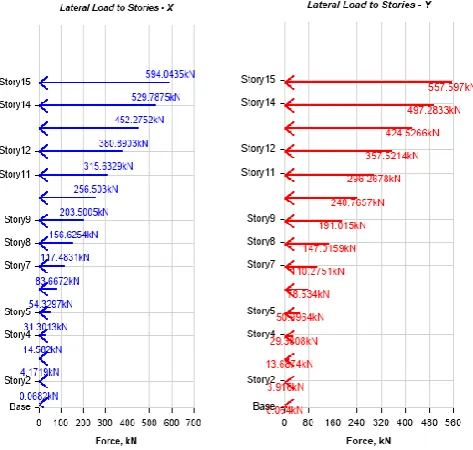
[image:4.595.38.267.125.358.2]Fig-7: Lateral load for different stories as per IS 1893-2002.
Fig-8: Lateral load for different stories as per IS 1893-2016.
Base shear
Table: Base shear in X- direction and Y Direction
Sr. No IS Codes Direction X Direction Y
1 IS 1893-2002 2582.49 2647.07
2 IS 1893-2016 3194.86 2998.84
3 % INCREASE 23.71 13.28
Chart 1: Maximum displacement along EQx as per IS 1893-2002
Chart 2: Maximum displacement along EQy as per IS 1893-2002
[image:4.595.307.563.311.503.2] [image:4.595.40.277.396.621.2]© 2018, IRJET | Impact Factor value: 6.171 | ISO 9001:2008 Certified Journal | Page 2259
Chart 4: Maximum displacement along EQy as per IS 1893-2016
[image:5.595.40.492.68.282.2]Maximum Lateral displacement
Table: maximum lateral displacement along EQx and EQy
Storey IS Codes EQX(mm) EQY(mm)
15 IS1893-2002 93.2 101.9
15 IS1893-2016 104 109.3
% INCREASE 11.59 7.26
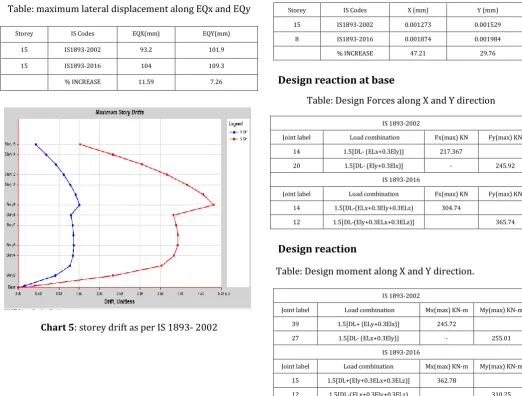
Chart 5: storey drift as per IS 1893- 2002
Chart 6: storey drift as per IS 1893- 2016.
[image:5.595.255.545.71.276.2]Storey Drift
Table: Storey Drift in X- direction and Y Direction
Storey IS Codes X (mm) Y (mm)
15 IS1893-2002 0.001273 0.001529
8 IS1893-2016 0.001874 0.001984
% INCREASE 47.21 29.76
Design reaction at base
Table: Design Forces along X and Y direction
IS 1893-2002
Joint label Load combination Fx(max) KN Fy(max) KN
14 1.5[DL- (ELx+0.3Ely)] 217.367
20 1.5[DL- (Ely+0.3Elx)] - 245.92
IS 1893-2016
Joint label Load combination Fx(max) KN Fy(max) KN
14 1.5[DL-(ELx+0.3Ely+0.3ELz) 304.74
12 1.5[DL-(Ely+0.3ELx+0.3ELz)] 365.74
Design reaction
Table: Design moment along X and Y direction.
IS 1893-2002
Joint label Load combination Mx(max) KN-m My(max) KN-m
39 1.5[DL+ (ELy+0.3Elx)] 245.72
27 1.5[DL- (ELx+0.3Ely)] - 255.01
IS 1893-2016
Joint label Load combination Mx(max) KN-m My(max) KN-m
15 1.5[DL+(Ely+0.3ELx+0.3ELz)] 362.78
[image:5.595.32.555.352.748.2] [image:5.595.41.361.368.669.2]International Research Journal of Engineering and Technology (IRJET)
e-ISSN: 2395-0056Volume: 05 Issue: 04 | Apr-2018 www.irjet.net p-ISSN: 2395-0072
© 2018, IRJET | Impact Factor value: 6.171 | ISO 9001:2008 Certified Journal | Page 2260 7. CONCLUSIONS
1. Maximum lateral displacement, lateral load to stories increases when storey height increases. In case of storey drift displacement value is high at top storey as compare to bottom storey.
2. Maximum displacement found along EQx and EQy.As per IS1893-2002 is 93.2 mm and 101.9 mm and as per IS 1893-2016 is 104 mm and 109.3 mm.
3. Storey drift found along x and y direction. As per IS1893-2002 is 0.001273 mm and 0.001529 mm and as per IS 1893-2016 is 0.001874 mm and 0.001984mm.
4. Design forces obtained at base along x and y direction. As per IS1893- 2002 is 217.367 KN and 245.92 KN whereas for new code IS1893-2016 is obtained is 304.74 KN and 365.74 KN along x and Y direction
5. Design moment obtained at base along x and y direction as per IS1893- 2002 is 245.72 KN-m and 255.01 KN-m whereas for new code IS1893-2016 it is 362.78 KN-m and 310.25 KN-m along x and Y direction
8. REFERENCES
[1] S. Farrukh Anwar, A. K. Asthana (2013) “Evaluation of Seismic Design Forces of Indian Building Code” International Journal of Engineering Research & Technology (IJERT)( ISSN: 2278-0181, Vol. 2 Issue 6, June – 2013).
[2] S.K. Ahirwar, S.K. Jain and M. M. Pande (2008) “Earthquake loads on multistorey buildings as per is:1893-1984 and is: 1893-2002: a comparative study” The 14th World Conference on Earthquake Engineering October 12-17, 2008, Beijing, China.
[3] Sudhir K Jain (2003) “Review of Indian seismic code, IS 1893 (Part 1): 2002” The Indian Concrete Journal , November 2003.
[4] C.V.S. Lavanya, Emily.P.Pailey, Md. Mansha Sabreen (2017) “Analysis and design of g+4 residential building using Etabs” International Journal of Civil Engineering and Technology (IJCIET) Volume 8, Issue 4, April 2017, pp. 1845– 1850.
[5] Mahesh Patil, Yogesh Sonawane (2015) “Seismic Analysis of Multistoried Building” International Journal of Engineering and Innovative Technology (IJEIT) Volume 4, Issue 9, March 2015.
[6] IS: 1893 (Part – 1) – 2016, “Criteria for Earthquake Resistant Design of Structures”, Part – 1 General Provisions of Buildings, 6-th Rev., BIS, New Delhi.
[7] IS: 1893 (Part – 1) – 2002, “Criteria for Earthquake Resistant Design of Structures”, Part – 1 General Provisions of Buildings, 5-th Rev., BIS, New Delhi.
BIOGRAPHIES
Mr. prashant s Girigosavi,