Expectation as a factor in the perception of
soundscapes
Bruce, NS, Davies, WJ and Adams, MD
Title
Expectation as a factor in the perception of soundscapes
Authors
Bruce, NS, Davies, WJ and Adams, MD
Type
Conference or Workshop Item
URL
This version is available at: http://usir.salford.ac.uk/2466/
Published Date
2009
USIR is a digital collection of the research output of the University of Salford. Where copyright
permits, full text material held in the repository is made freely available online and can be read,
downloaded and copied for noncommercial private study or research purposes. Please check the
manuscript for any further copyright restrictions.
Edinburgh, Scotland
EURONOISE 2009
October 26-28
Expectation as a factor in the perception of soundscapes
Neil S Brucea
William Davies Mags D Adams
Acoustics Research Centre University of Salford
Greater Manchester, M5 4WT, UK
ABSTRACT
This paper discusses how expectation and experience form a contributory factor in the perception of soundscapes. The research used fieldwork carried out in London and Manchester, and also a soundscape simulator in a laboratory. Through the use of an enhanced version of soundwalking, respondents are led on a walk around an urban space focusing on the soundscape, whilst answering questions in a semi-structured interview. The questions aim to investigate a participant’s experience of a number of different spaces, and their pre-determined environmental expectation and how this impacts on their evaluation and perception of the soundscape. This concept expands on Truax’s notion of soundscape competence. Attitudes towards safety, social norms, accepted behaviour, visual aesthetics and control attributed to the space, form the basis of place expectation and relate to overall perception of the soundscape for each space. When one or more of these factors conflict with a perceived place expectation, then the soundscape is rated less favourably. This work forms part of the Positive Soundscape Project.
1. INTRODUCTION
The concept of soundscape is currently gaining importance within the acoustic community[1] [2] and has resulted in a number of high profile projects, such as the Positive Soundscape Project. Recently, there has been a move away from traditional acoustic methods of understanding environmental sound towards a more holistic, and interdisciplinary, approach to the sound environment[3]. In particular there has been much research into understanding how people perceive the soundscape.[4] The aim of this research is to investigate a subject’s experience and expectation in a number of different spaces, and see how this impacts on their evaluation and perception of the soundscape.
The starting point for this work is the concept of soundscape ‘competence’ proposed by Truax[5]. Competence is described as the “tacit knowledge that people have about the structure of environmental sound”[6].Competence suggests that soundscape structures, that is the relationship between sound and it's meaning[7] have been learnt, and it is this learnt behaviour which facilitates soundscape expectation. Key to this research is the understanding of what is meant by 'expectation', in particular the expectation of urban environments, and the effect that subjective expectation has on the perception on the soundscape. Existing soundscape studies have investigated subjective response to soundscapes using a number of techniques, including interview, rating scales and questionnaires in the field[8][9][10][11] and by the playback of field recordings in the laboratory[12][13].This research uses both qualitative and quantitative methods to produce a combined methodology for understanding and measuring soundscape expectation. The research looks at what respondents expect within a space, whether the space matches their expectation and if expectation influences perception of the sound environment, in particular, looking at sound sources and overall noise levels.
2. BACKGROUND
Currently there is no existing work explicitly investigating expectation or the concept of competence as factors in soundscape perception. The term 'competence' was defined by Chomsky [14] in relation to linguistic competence. Chomsky’s Universal Grammar theory [14] states that basic language structure is innate within us, and the brain contains a series of limited rules for organising languages, which provide a common structural basis independent of a specific language. It is this structure which leads to the theory of competence. Whilst people maybe exposed to sounds within the womb, it is hard to say (or test) that sonic structures and meaning are innate. It would seem that through the constructionist view of learning that sonic meaning and competence are developed. Traux explains linguistic competence as being “tacit knowledge that a native speaker has about a language”[15]. Chomsky states that structural relationships which represent knowledge about a language are stored in memory, rather than as set sentences[14]. Truax [15] further proposes a “musical competence”, this is similar in principle, but relates to musical structures. Huron writes extensively about expectation within music, trying to address some of the issues such as “why do clichés work?”[16] It is this question that Huron develops the theories around expectation, in particular when referring to music “that the principle content of music arises through the composer’s choreographing of expectation”.[17]
Knowledge of musical structure and expectation would dictate a response when provided with a new melody. This knowledge then allows the listener to judge if the music is well formed on not. If the structure does not make sense in their knowledge or experience of existing structures, then this would change the listeners perception of the piece[15]. Truax, suggests that this method could be applied to the theory of “soundscape competence”[15]. This suggests that the soundscape is in some way ”organised” and through this structure of organisation then meaning and expectation can be inferred. Structure has a mediating role between sound and meaning. Research into meaning within the soundscape, in particular is something which has been addressed by Dubois[6][8][9], as part of her work on semantics. It is semantic meaning which Truax used the model[18], shown in Figure 1, which he calls micro level preference to describe how structure fits into perception of the soundscape. Therefore by investigating the component parts of micro preference, should provide an insight into if the the relationship between the acoustical stimulus and the subjective response of the listener.
Figure 1 : Micro Preference
By considering competence as a factor in the perception of the soundscape, this research has investigated what tacit knowledge subjects have of their sound environment. This involves examining their expectation and understanding of the environment. One example of competence in action is, for example, if a noise is heard late at night, depending on the current context and situation would cause the hearer to act in a number of ways. If they are expecting someone to visit, they would have a different reaction to this sound event that if they were not. This is referred to a ‘meta-knowledge’[20], knowledge about what constitutes structurally correct communication even when the communication has never been experienced.
To explore expectation in music, Huron developed his Imagination, Tension, Prediction, Reaction and Appraisal.[21] or ITPRA theory, in which he proposes that “emotions evoked by expectation involve five functionally distinct physiological systems”[22] Importantly, Huron states that expectations are not only related to music but “a constant part of mental life”[21]. Expectation is both part of biology and culture at the same time. These ideas form the basis on which to develop the theory of expectation within the soundscape and how this
Structure
expectation may relate to a respondents appraisal and acceptance of the soundscape. The theory relates to five responses pre and post the outcome of a given stimulus. These responses are Imagination, Tension, Prediction, Reaction and Appraisal.[22] Using these responses, it is possible to examine how conscious thought can incorporate appraisal responses and how this leads to a positive or negative emotion, although the basis “often draws from complex social and contextual factors”[23]. This link to social and contextual factors and emotion when presented with music, provides a link to the social and contextual factors as explored by Dubois[8][9] and Kang[26] in regards to the soundscape. By analysing expectation within the soundscape as well as these factors, should provide a greater insight into how expectation of a space in addition to social and contextual affects the perception of the soundscape.
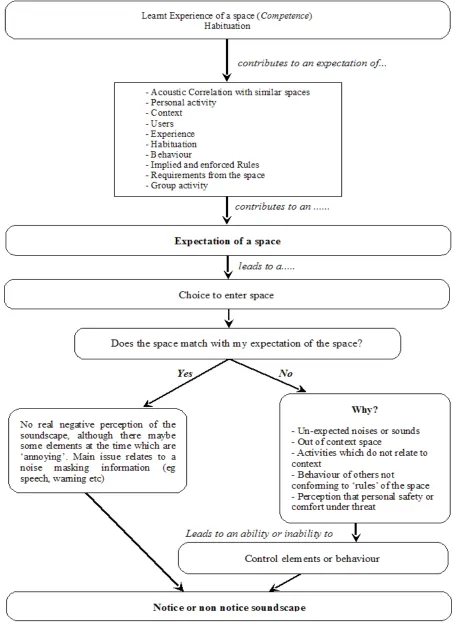
Pre-dating Schafer[24], Southworth states that assessment of a sound environment depends on the information content of the sound and the context in which it is perceived [25]. An investigation into individual and group experience of soundscapes based on representation shared in language and knowledge[8][12][13],showed that the soundscape accounts for the relationship between ‘individual experience and subjectivity with a physical and social-cultural context’[6]. Furthering this work, Dubois,carried out work into semantic categorisation , in particular understanding the knowledge based on [in 2006] “converging evidence that people categorise urban soundscape into semantic categories related to social activities”. Semantics ‘lies in the emphasis on the exploration of the concept and categories we use’[9], as part of the wider field of structuralism which forms part of the expectation of a soundscape, as part of the theory of competence. Kang further showed that “cultural background and long-term environmental experience”[26] are important aspects when determining respondent’s judgement of sound preference. Kang defined this as, “macro-preference”. [26] By considering the existing work of Dubois and Kang on social factors and context, the diagram shown in Figure 2 is proposed as how a process map of expectation may work and how it may lead to perception of a space.
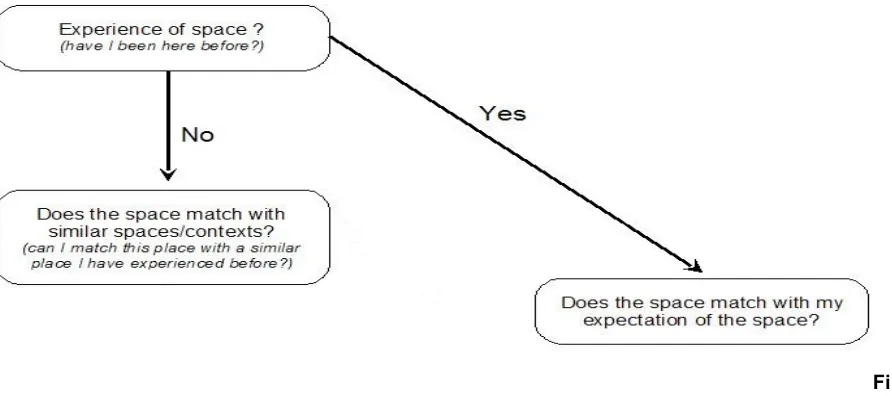
Figure 2, shows how experience of a space links expectation of a space, it is these questions that this research hopes to answer. Within expectation, it is important to note that other sensory data and the current context of the space at the time of interview is to be interpreted as part of expectation. The aim is to see which factors of a space go against what is expected in that space. With this proposed process in mind, two distinct methodologies were used in this research, the first involved collecting primarily qualitative from soundwalking and interviews, in the field. The second was laboratory based and used a soundscape simulator to investigate correlations in expectation when respondents were set the task of designing a soundscape.
[image:4.595.76.522.443.641.2]3. METHOD
Soundwalking as a methodology was used to gain knowledge of expectation. The soundwalk methodology involves going on a silent walk, the timing of which can vary[24]. The respondent is asked to walk in silence observing the soundscape and the environment. This method has been used and examined on pilot and test studies[27][28]. The method differs form a traditional Schaferian model[24], based on walking in silence for an hour or more, followed by a discussion at the end to discuss the experience. The developed methodology involves stopping the respondent in a number of pre-determined locations throughout the walk and then facilitating an interview.[27] During the soundwalk interviews conducted in Manchester and London in 2008 and 2009, respondents were asked questions relating to a set of specific spaces they visited.
Using a semi-structured interview methodology allowed for rich semantic data to be gathered, as well as reasoning behind answers to be developed. The questions related to the general environment of the space and focused on details such as 'is this as you would expect, or is is there anything missing or out of place?' and more perceptual questions e.g. 'is this space louder, quieter or as you would expect it to be?' and 'what influence the materials and layout of the space had on the soundscape?'. The soundwalk also provided data which was to be used in the laboratory based experiments. An analysis of the interview data highlighted sound sources which need to be recorded for use in the simulator. Once highlighted, field recordings of the sources took place, this also involves the recording of sound level measurements, these measurements allow the calibration on the simulator during the second phase.
The soundscape simulator allows the subject the ability to manipulate a simulated soundscape via a series of controls. Using data collected from soundwalk, it was possible to extract the primary soundscape components for space under test. Respondents answers were used to inform which sound sources would be included for manipulate them to measure the effect this has on preference and expectation. Numeric correlates such as level and frequency content can also be compared to see if these have any impact on the perception of the space. The soundscape simulator results are not discussed here, as it is due to be presented later this year[29].
4. RESULTS
Analysing data taken from soundwalks is performed using qualitative methods to provide “theories and concepts for further testing”[30]. Interviewing respondents using an open-ended questionnaire format also allows the exploration of meaning[31] within their answers. Although using a social constructionism [32] epistemology, may never be a true indication of environmental conditions (which we could measure at the same time) it provides a “specific reading”[33] of these conditions. Interviews were recorded during the soundwalk and then transcribed. The transcriptions were then entered into AtlasTi qualitative analysis software and coded. Coding is the process by which themes within the data are examined and extracted, for example, examining any themes or trends in words used to describe a place.
are experiencing with soundscapes they have experienced in similar settings, ergo the layout of buildings, materials, users and the effect it has on what they can hear.
Further analysis showed that there are also a number of other factors which contribute to the expectation factor. These are summarised in Figure 3. In particular, the following, does the space conform to a set of ‘rules’ which the listener has experienced from similar spaces, these rules relate not only to perceptual features for all the senses, but also rules relating to activity, time of day/night, acceptable behaviour and users of the space. Crucial to this point is the respondents ability to control their activity within the soundscape. Could they remove themselves or particular sounds from the current soundscape space or have the ability to control their interaction with the space? There seems to be an expectation of 'controllability', for example, subjects could not control the 'noisy, dirty' traffic on London's Oxford Street, but they could remove themselves from Oxford Street and use 'quieter' back streets. Although such a change in space to another still led to an expectation of how it should sound, for example, in a city square (Soho Square, less that 100m from Oxford Street), the expectation is to still be hearing the traffic noise, albeit at a reduced level. This traffic noise in this instance was sometimes seen as a positive, ‘traffic noise in the distance makes me feel that I am still part of the city and can re-enter at any point’, once again these types of statements suggest the importance of control. Likewise, in Soho Square, the expectation of users and control had an effect on perception, the subjects could not control the behaviour of the 'drunks' in the park, but they could leave the park or ask them to be quiet. Annoyance seems to stem from spaces where the subject cannot easily leave (e.g. train carriage, bus, home) and has no influence over the sound-maker (either a person or machine).
This suggests there is an expectation of behaviour of other users of the space. In particular, do other users of the space behaviour conform with the subjects expectation of the space? A visual annoyance can be removed by looking away, but an auditory annoyance can not, without having to leave the space or move further away. Some degree of annoyance also arises from the situation where a subjects feels that ’I am conforming to the rules’ for this location (e.g. quiet zone on a train, not shouting in a park) so why can’t others, this also goes along with the idea of rudeness and other subjective anti-social behaviours. This not only applies people but to mechanical/construction sources, but with these sources, the expectation leads to a greater degree of acceptance, for example. ‘I dislike the sound of a street cleaner, but I know that it will only last for a certain period of time’. This example has the positive association with a number of subjects of a process which keeps the location clean and expectation leads to the fact that the source will be temporal, and thus is accepted. The same goes from construction noise, ‘I don’t like it, but it is progress and has to happen’, but conversely there is the expectation of time constraints applying to the soundscape. A subject may accept the source in the day, but would not expect and therefore accept it at night.
As well as expectation relating to the structure of the soundscape of the space, expectation extends a subjects activity within the space. Activities in the spaces researched range from spaces where a person would pass through to those where a person can retreat from the urban noise. In the 'transitory' or 'getting from A to B' spaces, such as the corner of Oxford Street and Soho Street, the soundscape has a low impact on annoyance, although these spaces were noted as sounding as expected. In the 'oasis' or 'tranquil' spaces, such as Soho Square, the soundscape has a high impact on annoyance, where expectation is higher, although again these spaces were noted as sounding as expected. Other statements from subjects seem to give an indication of acceptance and expectation of soundscape which is independent of sound level measurements (LAeq), which were also taken at the time.
A combination of activity and source expectation relates to an expectation of obtaining information. An example of this is how traffic noise prevents the hearing impaired in hearing conversation, ‘I have to go somewhere quieter to hear conversation’. Other examples of prevention of information transfer are ‘I can’t hear my phone ring’, ‘I can’t hear the station announcement’, ‘I can’t hear myself think’. These are forms of information transfer to which the soundscape has an impact on and seem to be analogous to signal to noise (SNR) ratio in digital signal processing, where information (signal) is related to the person
With analysis of the soundwalk data, details of sound sources and structures can were integrated with the soundscape simulator to investigate how a subject's structure and expectation affect the design of a soundscape, with only auditory clues present. In particular the ability to investigate if groups of subjects selected the same parameters which presented with the design task. This work is currently still on going at the time of writing.
On the whole, the data from the soundwalks has shown that most spaces sounded as the subject expected and the level was as expected for the given space/context. There was also an understanding of how the space impacted on what was being heard. This suggests a learnt competence for spaces, as well as behavioural expectation for those spaces. Crucially, as highlighted above, expectation extends beyond the soundscape competence to how subjects can interact with the environment as well as expected 'rules' which govern the space. This links in and extends the work on social and contextual factors and provides another dimension to be addressed when undertaking subjective evaluations of the soundscape.
At no point were respondent's asked to sit and perform other tasks, such as reading, taking a test. These factors should be taken into consideration in further work, as they contribute to different listening contexts [34] within a space.
6. CONCLUSION,
In conclusion, it can be suggested that the soundscape is generally not something that is given much attention by most subjects, and the fact of being on a soundwalk seemed to change attitudes to listening to environmental sound. Crucially, this 'non-attention' becomes 'attention', when sound activity starts to go against a learnt expectation of a space. Explicitly, the soundscape becomes an issue when it does not conform to a subjects ‘perceived’ sense of normality or interferes with information (semantic listening) transfer. This concept is analogous to the issues which surround Signal to Noise Ratio (SNR) in DSP, but once again this is subject to subjective interpretation, as information transfer may not only be be sound communication, but also visual, such as reading. As we can see, it would seems from the soundwalks that a subjects rating of a soundscape, is based on a number of other factors, of which expectation seems to be prominent. These include type of activity occurring and expected activity in the space, for example just passing through the space, choosing to sit and linger or read in the space.
ACKNOWLEDGMENTS
[image:8.595.69.524.78.701.2]This work is carried through an EPSRC studentship funding (EP/E011624/1) as part of the Positive Soundscapes Project.
REFERENCES
1. Schulte-Fortkamp, B. (2007). Soundscape : An approach to rely on human perception and expertise in the post-modern community noise era. Acoustics Today: 7-14.
2. Davies, W. J., Adams, M., Bruce, N. S., Cain, R., Carlyle, A., Cusack, P., Hume, K. I., Jennings, P. J., & Plack, C. J. (2007, 2-7 September). The Positive Soundscape Project. Paper presented at the 19th International Conference on Acoustics, Madrid.
3. Kull, R. C. (2006). "Natural and Urban Soundscapes : The Need for a Multi-Disciplinary Approach." Acta Acustica United With Acustica 92: 898-902.
4. Schafer, R. M. The tuning of the world. (Alfr ed a. Knopf, Inc. New York, 1977) p206 5. Truax, B. Acoustic Communication (Westport, Connecticut, Ablex Publishing, 2001) p59
6. Dubios D and Guastavino C (2006). In Search of soundscape indicators : Physical descriptions of semantic categories, Internoise 2006, Hawaii
7. Truax, B. Acoustic Communication (Westport, Connecticut, Ablex Publishing, 2001) p54 8. Dubois D and Raimbault M, Urban Soundscapes : Experiences and knowledge, Cities The
International Journal of Urban Policy and Planning 22, No 5 p340
9. Dubois et al, A cognitive approach to soundscape, Acta Acustica United with Acustica, 92, 2006 p870
10. Ge, J. and Hokao, K. (2004) Research on the Sound Environment of Urban Open Space from the Viewpoint of Soundscape – A Case Study of Saga Forest Park, Japan. Acta Acustica United With Acustica 90, 555 – 563.
11. Jeon, J.-H., G.-S. Jang, et al. (2004). Soundscape proposal for theme street in Gwangju. International Congress on Acoustics, Kyoto.
12. Lavandier, C. and B. Defreville (2006). "The Contribution of Sound Source Characteristics in the Assessment of Urban Soundscapes." Acta Acustica United With Acustica 92: 912-921.
13. Chomsky, N. Aspects of the Theory of Syntax, MIT Press, p 4
14. Gustavino C & Dubois, D. (2005) Ecological Validity of Soundscape Reproduction. Acta Acustica United with Acustica, 91, 333-341.
15. Truax, B. Acoustic Communication (Westport, Connecticut, Ablex Publishing, 2001) p57
16. Huron, D. (2007). Sweet Anticipation : Music and the Psychology of Expectation. Massachusetts, MIT Press. p2
17. Huron, D. (2007). Sweet Anticipation : Music and the Psychology of Expectation. Massachusetts, MIT Press. p2
18. Truax, B. (1996) Soundscape, Acoustic Communication and Environmental Sound Composition. Contemporary Music Review, 15, 49-65.
19. Truax, B. (2001) Acoustic Communication, Westport, Connecticut, Ablex Publishing. p56 20. Truax, B. (2001) Acoustic Communication, Westport, Connecticut, Ablex Publishing. p57
21. Huron, D. (2007). Sweet Anticipation : Music and the Psychology of Expectation. Massachusetts, MIT Press. p3
22. Huron, D. (2007). Sweet Anticipation : Music and the Psychology of Expectation. Massachusetts, MIT Press. p7
23. Huron, D. (2007). Sweet Anticipation : Music and the Psychology of Expectation. Massachusetts, MIT Press. p15
24. Schafer, R. M. The tuning of the world. (Alfred a. Knopf, Inc. New York, 1977)
25. Southworth, M. (1969). The sonic environment of cities. Environment and Behavior, 1(1), 49-70 26. Kang, J. & Yang, W. (2003) Sound preferences in urban open public spaces. Journal of the
Acoustical. Society of America, 114, 2352
27. Adams, M and Bruce, N (2008)– Soundwalking as methodology for understanding soundscape, IOA spring conference, Reading.
28. Bruce, N - Semio-acoustics, Soundscape, Meaning and Values, Lancaster Sociology Summer Conference,2008
29. Bruce, N (2009). Development of a soundscape simulator tool, Internoise 2009, Canada 30. Silverman, D. (1993) Interpreting Wualatative Data : Methods of Analysing Talk, Text and
Interaction. London : Sage
31. 31)25 Kidder, L.H. and Fine, M. (1987) Qualitative and quantitative methods: When stories converge, in M.M. Mark and L.Shortland (eds) New Directions in Program Evaluation. San Francisco, CA: Jossey-Bass}
32. Burr, V. (1995) An introduction to Social Constructionism. London Routledge.
33. Willing, C. (2001) Introducing Qualitative Research in Psychology : Adventures in theory and Method Maidenhead OUP