International Journal of Emerging Technology and Advanced Engineering
Website: www.ijetae.com (ISSN 2250-2459, ISO 9001:2008 Certified Journal, Volume 5, Issue 2, February 2015)
20
Modeling of the Customs Clearance and Control Processes
Based on Combining Use of the IDEF Methodology and
Theory of Queuing Systems
A. Saidov
11Department of Information Technology, State Customs Committee Republic of Uzbekistan 1Address: Prospect Uzbekistanskya-3, 100003, Tashkent city, Republic of Uzbekistan
Abstract – In this paper provides the results of research on the development of the method of constructing a model of customs procedures in terms of the theory of queuing systems based on their description by means of functional modeling IDEF0. The technique is based on use of the integrated IDEF0 models and theory of queuing systems with the ability to transition from a description of the system in IDEF0 to discrete-event models.
Keywords – Automation of industrial processes,
information technology, decision-making system, customs procedures, IDEF0, discrete event simulation, queuing system.
I. INTRODUCTION
It is known that IDEF-models has been used successfully in the solving applied problems of modeling and automation of production processes, the development of automated processes and multi-service networks, modeling and optimization of supply and logistics, and many problems [1,2]. IDEF methodology is also well recommended themselves and for the simulation of customs procedures as a business process.
They can be used effectively to display and analyze models of the customs authorities and customs control procedures and workflow.
However, IDEF0 methodology does not allow to directly construct adequate IDEF0 models for complex production processes, where there is a need to predict the behavior of the system in response to control impacts and the development of preventive and corrective measures. This is primarily due to the presence of a system of logical and linguistic conflicts in determining the source of primitives [3].
For constructing a simulation models of complex manufacturing processes and systems based on IDEF0 methodology is required, firstly, an adequate interpretation of the purposes of modeling standards, secondly, a set of rules under which the original IDEF0 primitives are mapped to the basic concepts of the selected mathematical apparatus of modeling.
Thus in this paper we propose a methodology for integrated use of IDEF0 models and theory of queuing systems with the ability to transition from a description of the system in IDEF0 to discrete-event model for the construction of an adequate simulation model of the customs procedures.
II. SIMULATION OF CUSTOMS PROCEDURES BASED ON
IDEF0METHODOLOGY
Process of customs control on the whole period of the imported goods under customs control can be divided into 3 stages:
Customs procedures when crossing the border;
Customs escort cargo within the country to the
destination;
Customs clearance at the place of arrival.
Similarly, the goods in question, under other customs regimes, given the characteristics of the customs regime under consideration.
In turn, according to the national legislation at every stage to undertake certain customs procedures.
1. In the border customs posts:
Documentary control;
Control of risks for the national economic security
risks (prohibited goods; dual-use goods; goods requiring special permit, the search of vehicles and
of responsible carrier, the authenticity of
documents);
Provision of customs fees and charges;
Сustoms inspection, sealing and delivery of control
of delivery;
Appointment route and support;
Permission to enter.
2. When the movement of cargo within the country:
International Journal of Emerging Technology and Advanced Engineering
Website: www.ijetae.com (ISSN 2250-2459, ISO 9001:2008 Certified Journal, Volume 5, Issue 2, February 2015)
21
3. In foreign trade customs posts:
Documentary control;
Removal from the delivery control and placement in
a customs warehouse;
Control for national economic security risks
(covering goods, customs valuation, accrual rates and customs duties);
Provision of customs duties;
Customs inspection;
Permission to travel.
Fig.1.Gradual organization of customs control for imported goods
Fig.2. Decomposition block of IDEF0 model of the organization of customs controls at the border post
Given the 3 stages of customs control processes for imported goods and the network schedule of customs procedures we can developed IDEF0 model considering the business process (Fig. 1 and Fig. 2.) [4,5].
III. DESCRIPTION OF THE MAIN ELEMENTS OF THE IDEF0 MODEL OF CUSTOMS PROCEDURES IN TERMS OF QUEUING
SYSTEMS
The technological process of customs control at the customs post can be considered as a set of technological operations, consisting in the processing of applications for customs clearance of foreign trade goods of varying intensity. Modeling and study of such processes is possible with the assistance of queuing theory.
The subject of queuing theory is to establish relationships between the nature of the flow of requests, the number of service points, the performance of individual item and ways to manage these processes.
In the role of customs activity requests for services performed goods and vehicles across the customs border. Traders of Hotels way or the other information required for customs clearance, act as the applicant. And the role of service delivery points assigned to Customs officials performing their duties in the process of customs clearance. By posing the problem must describe rules of transition from abstraction to the standard IDEF0 by main terms used in describing the system as queuing systems (QS). In this way:
Inputs customs procedures are considered as incoming requests. Obviously, the IDEF0 diagrams of display inputs as object classes, while inputs for QS models specific instances of these classes (this is true for the other elements of the model).
The outputs of customs procedures are considered as outflows applications.
In accordance with the concept of decomposition is considered a hierarchy of applications corresponding to different levels of detail customs procedures in the diagrams IDEF0. In particular, the context diagram are assigned to the application 0-level, dependent block diagram of context - the application level 1, and so on. D. Then customs procedures s- level logically understood as a process service requests S-level.
Served by the application of this class leaves the system, instead of it coming into the system (as an input), generally speaking, several other classes of applications (obviously opposite situation is possible), as the number of inputs and outputs of the process may be different.
International Journal of Emerging Technology and Advanced Engineering
Website: www.ijetae.com (ISSN 2250-2459, ISO 9001:2008 Certified Journal, Volume 5, Issue 2, February 2015)
22
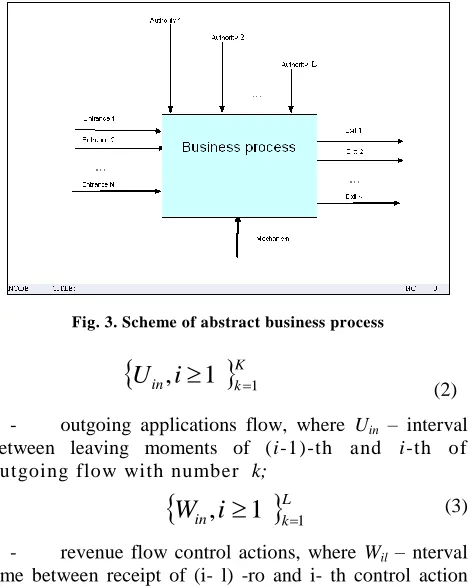
If we consider the mandatory customs procedures at border posts as a business process, it said can be illustrated as follows. Consider a business process model with N
inputs to outputs
and L offices:
Define:
(1)
- incoming flows of application, where Zin – interval
between arrival of (i-1)-th and i-th application of
[image:3.612.334.556.146.297.2]incoming flow with number n;
Fig. 3. Scheme of abstract business process
(2)
- outgoing applications flow, where Uin – interval
between leaving moments of (i-1)-th and i-th of
outgoing flow with number k;
(3)
- revenue flow control actions, where Wil – nterval
time between receipt of (i- l) -ro and i- th control action type l.
To compare the incoming / outgoing flows and their respective departments require additional information about the structure of the system, rather than a diagram of the business process level considered. Its source, apparently, is a diagram of dependent processes (for convenience in Fig.4 diagram dependent processes are superimposed on the diagram of the parent process).
Fig.4. Business Process diagrams superimposed with dependent processes
In this example, the incoming stream corresponding to the input 1, compared with the outgoing flows 1, 2 and K; incoming stream corresponding to input 2 is compared with the output stream 2 and K. It should be noted that the comparison may not be direct, i.e. in one dependent process, and indirectly, i.e. a few dependent processes for which output one of them is input or manipulated variable to another.
Thus, each incoming stream or control action may correspond to not one, but several outflows, as, indeed and vice versa.
The above comparison is conveniently represented as a matrix M of size (N + L) x K, whose elements:
(4)
where: i=1,…,(N+L), j=1,…,K
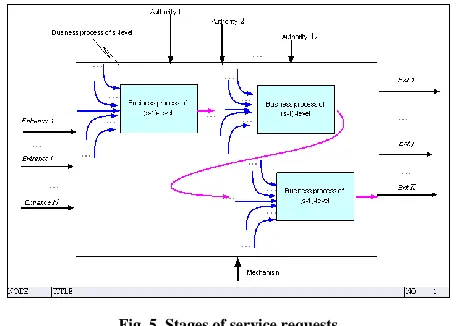
Consider now that the most important element of the QS: service time applications. Let incoming entities in the business process service goes through a series of steps (t. E. Associated with outbound application indirectly through a number of subsidiaries business processes), and the input of each of them served several external flow applications (from the parent business process) and several - from other subsidiaries of business processes (Fig. 5).
These steps form a chain of transitions incoming application type i parent business process in the application of its subsidiaries business processes before its release as an outbound application type j parent business process.
Nn in
i
Z
,
1
1
Kk in
i
U
,
1
1
Lk in
i
W
,
1
1
therwise 0,
nput 1,
o
j output to s correspond i
ng /controlli i
[image:3.612.54.289.273.566.2]International Journal of Emerging Technology and Advanced Engineering
Website: www.ijetae.com (ISSN 2250-2459, ISO 9001:2008 Certified Journal, Volume 5, Issue 2, February 2015)
23
[image:4.612.54.287.188.351.2]If the chain splits in any of the stages (corresponding, for example, several alternative decision-making procedures), we consider two chains, each of which corresponds to the different paths of transition applications.
Fig. 5. Stages of service requests
Enter values:
- moment generating outgoing requests p-th
dependent business process included in the chain connecting the i-th input parent business process and its j-th output;
- when generating the output of the above
subsidiary business process in response to the received inputs;
- the time of receipt of incoming applications
s-flux;
- waiting time application s-th stream in line due
to a busy device.
So the ratio will be apparent
(5)
Where: Rp -a plurality of incoming flows p-th dependent
of a business process, is an outgoing flows of other subsidiaries of business processes;
Sp - a plurality of incoming flows p-th dependent of a
business process that are external to the parent business process.
Then the moment of generation of output j parent business process in response to its input i will be determined by the relation
(6)
or
(7)
for each of the chains of dependent business processes, corresponding to the transition i → j.
Further, since each of the business process, the previously standing in the chain, and the relation
(8)
So
(9)
There was one important assumption made on the determination of the level of detail of model and taking into account points to incoming/outgoing requests. Namely, the generation of dependent exit the business process begins only after the receipt of all inputs associated with it. In other words, the standby situation at any stage of the incoming external application impossible. This allows not detail when considering the business process level s below the model s-1.
It is necessary to make a comment about the management of customs procedures, despite the fact that the control actions, as well as the application presented inbound events, they have important differences. Firstly, the residence time in the feedback control system is zero, since it has an impact on system state variables and does not require any "pending", therefore, secondly, it does not
participate in the computation of the operating
characteristics of the system as QS.
r r s s ps R к
p
t
t
t
p
' ' ' S ',
max
p
r r s s p sR r p
j
t
t
t
t
p
' ' ' S ' ',
max
p
r r s s p is R r i j
j
t
t
t
t
t
p
' ' ' S ',
max
p
r r s s ps R r
p
t
t
International Journal of Emerging Technology and Advanced Engineering
Website: www.ijetae.com (ISSN 2250-2459, ISO 9001:2008 Certified Journal, Volume 5, Issue 2, February 2015)
24
Since the customs posts at the same time are treated in several applications for customs clearance service system are, generally speaking, multi-channel.
IV. CONCLUSION
Thus, we can draw the conclusion that the proposed methodology the integrated use of IDEF0 models and the theory of queuing systems provides the possibility of transition from the description of the system in the IDEF0 model for discrete event simulation for construction of an adequate model of customs procedures.
Also, the obtained QS models are given the opportunity to allow a computational experiments and definitions of certain functional characteristics of the organization and for implementation of customs procedures associated to the presence of queues and the customs service of downtime.
And the QS models can be useful for solving problems of the planning and optimization of performance of customs procedures and automating them.
REFERENCES
[1] Integration Definition for Function Modeling (IDEFO). Draft Federal Information. Processing Standards Publication 183. 1993, December 21.
[2] David Mark, Clement McGowan. Methodology structural analysis and designing. M.: 1993, 240 pp. , ISBN 5-7395-0007-9.
[3] Tikhonov S. Methodology transition from IDEFO model in terms of the theory of queuing systems in the study of business processes of the organization. Jour. Managing large systems. # 21, 2008 pp.5-15. [4] Labsker L.G, Babeshko L.O. Queueing theory in the economic
sector. Moscow, 1998. - 319 p.