EDS and TG Analysis of Composite Cathode Powders LSCF-SDCC for
Low Temperature Solid Oxide Fuel Cells (LTSOFC)
M.S.A. Bakar
1,a, S. Ahmad
1,b, H.A. Rahman
1,c, H. Basri
2,dand A. Muchtar
3,e 1Faculty of Mechanical and Manufacturing Engineering, University Tun Hussein Onn Malaysia,Batu Pahat, 86400, Parit Raja, Johor, Malaysia.
2Faculty of Science, Technology and Human Development, Universiti Tun Hussein Onn Malaysia,
86400, Batu Pahat, Johor, Malaysia.
3Fuel Cell Institute, Universiti Kebangsaan Malaysia, 43600, UKM Bangi, Selangor, Malaysia.
Email: [email protected], [email protected], [email protected],
d[email protected], e[email protected]
Keywords: Stoichiometry coefficient, number of moles, wet milling, dry milling and composite cathode.
Abstract. Energy dispersion spectroscopy (EDS) and thermogravimetric (TG) analysis has been conducted on composite cathode powder LSCF-SDCC. Composite cathode powder LSCF-SDCC has been produced via dry and wet milling method then calcined at 700, 750 and 800˚C with soaking time of 2 hours. EDS analysis shows that LSCF-SDCC composite cathode powder both for dry and wet milling method able to maintain the composition of each elements after being calcined. The TG analysis also shows that composite cathode powder LSCF-SDCC experiencing minor weight loss (below 9%) when heated up to 800˚C. Both dry and wet milling method produced composite cathode powder LSCF-SDCC with desired characteristic based on EDS and TG analysis.
Introduction
Solid oxide fuel cells (SOFC) are an efficient energy conversion device coupled with environmental advantages of low emissions. Since high temperature SOFC (1000-1300˚C) are not feasible to be commercialized affecting by the cost of materials that need to endure with high temperature [1], researches on SOFC moved on development of intermediate to low temperature SOFC (IT-LTSOFC) operates at temperature between 600-800˚C. At this stage, stay still the material selection was limited and needs to improve by lowering the operational temperature below 600˚C. The efforts to lower the operational temperature also widen the material selection in producing SOFC [2]. Nowadays, researches were working extensively on low temperature SOFC (LTSOFC) in which fuel cells working on temperature between 400-600˚C aiming to commercialized the SOFC.
As the operational temperature was reduced, the output power also has experiencing the substantial performance decline. With a high activation enthalpy for oxygen self-diffusion in LSCF [3], the ionic conductivity of a LSCF cathode drops rapidly as the temperature decreases. To enhance the ionic conductivity of the cathode electrode and prevent the coarsening of the cathode, the addition of a second phase such as SDC has been reported [4-7]. It has been confirmed that the formation of a composite cathode can beneficially reduce the polarization resistance of a pure LSCF cathode; this performance is related to the sintering temperature, microstructure (such as the grain size and porosity), and the composition of the LSCF and the SDC as well [8]. Research was conducted to increase the performance of fuel cells in terms of power output during the low operational temperature [9].
functioning ell during the low temperature operation (400-600˚C). SO in this paper, EDS analysis on composite cathode powder LSCF-SDCC have been studied and TG analysis has been conducted to analyzed the composite cathode powder LSCF-SDCC according to dry and wet milling techniques and various calcinations temperatures.
Method
A mixture of 80 weight percent (wt.%) SDC nanopowder and 20 wt.% carbonates was prepared in producing SDCC powder [11]. The SDC, Li2CO3 and Na2CO3 powder were ball-milled for 24 hours and dried overnight in oven then heat-treated at 680˚C.
Next, commercial LSCF powder was mixed with SDCC (50:50 (wt.%)) in planetary ball-milled (Fritsch Pulverisette 6, Germany) using zirconium oxide jar via dry and wet milling techniques. For dry milling, the composite cathode powders were ball-milled at rotational speed of 550 rpm for 2 hours meanwhile for wet milling, the composite cathode powder were ball-milled in propanol medium using zirconium oxide balls with diameter 1 mm with same speed as well as dry milling. The mixture was dried overnight in oven at 60˚C. The resultant of milled composite cathode powder for both, dry and wet milling techniques were then grinded using agate mortar and calcined in furnace at 700, 750 and 800˚C with soaking time of 2 hours.
The compositions of each element exist in LSCF-SDCC powders before and after calcined were analyzed using scanning electron microscopy-EDS (SEM-EDS) (JEOL-JSM 6380LA, Japan) . The weight loss of the uncalcined and calcined composite cathode powders LSCF-SDCC as a function of temperature was obtained via thermogravimetric (TG) measurements (Linseis Thermobalance STA, USA) up to 800˚C in air at a heating rate of 10˚Cmin-1.
Results
Table 1 and Table 2 show the weight percentage of elements for dry and wet milling method respectively before calcine and after calcined at 700˚C, 750˚C and 800˚C as detected via EDS analysis. Quantitatively, the weight percentage of each element were evaluated in atom percentage value. Element weight percentage of LSCF powder after the mixing process with SDC via dry and wet milling were evaluated based on stoichiometry coefficient of LSCF in which La (0.6 mol), Sr (0.4 mol), Co (0.2 mol) and Fe (0.8 mol). Based on the evaluation, it is shown that both dry and wet milling LSCF-SDCC powder retain their original composition without significant increament or decreament in their atomic weight percentage corresponding with the stoichiometry coefficient (number of moles) of original La0.6Sr0.4Co0.2Fe0.8O3-δ (LSCF6428).
Table 1. Weight percentage of elements for dry milling method before calcine and after calcined at 700˚C, 750˚C and 800˚C.
Elements
Weight percentage of elements (%) Before
calcine
Calcine 700˚C
Calcine 750˚C
Calcine 800˚C
Lanthanum, La 25.84 22.17 26.97 29.5
Strontium, Sr 13.33 8.24 9.52 11.05
Cobalt, Co 2.81 2.13 2.49 3.44
Ferit, Fe 10.86 8.43 9.33 10.34
Samarium, Sm 2.90 4.01 2.49 1.66
Ceria, Ce 27.96 37.62 34.44 29.00
Natrium, Na 0.65 0.76 0.35 0.42
Carbon, C 2.22 2.13 1.44 1.12
Table 2. Weight percentage of elements for wet milling method before calcine and after calcined at 700˚C, 750˚C and 800˚C.
Elements
Weight percentage of elements (%)
Before calcine
Calcine 700˚C
Calcine 750˚C
Calcine 800˚C
Lanthanum, La 15.26 24.54 23.66 25.15
Strontium, Sr 9.21 9.12 9.11 9.24
Cobalt, Co 1.90 1.98 1.95 2.60
Ferit, Fe 6.13 8.59 8.84 9.20
Samarium, Sm 2.30 3.86 3.90 4.81
Ceria, Ce 25.41 36.45 37.35 36.05
Natrium, Na 0.65 0.31 0.32 0.15
Carbon, C 26.28 5.16 5.11 2.87
Oxygen, O 12.85 9.99 9.78 9.92
For samarium (Sm) and cerium (Ce), the atomic weight percentage after the mixing process via dry and wet milling were in the range of their original compound Sm (0.1 mol) and Ce (0.9 mol). The other elements consist in LSCF-SDCC powder were sodium (Na) resulting from the Na2CO3, oxygen (O) from the air in SEM-EDX spectroscopy’s chamber and carbon (C) resulting from carbon tape used to hold the powder on the sample stage. Both LSCF-SDCC powders were maintaining their original compound when compared the atomic weight percentage of LSCF-SDCC produce via dry and wet milling process with the original number of moles or LSCF and SDCC.
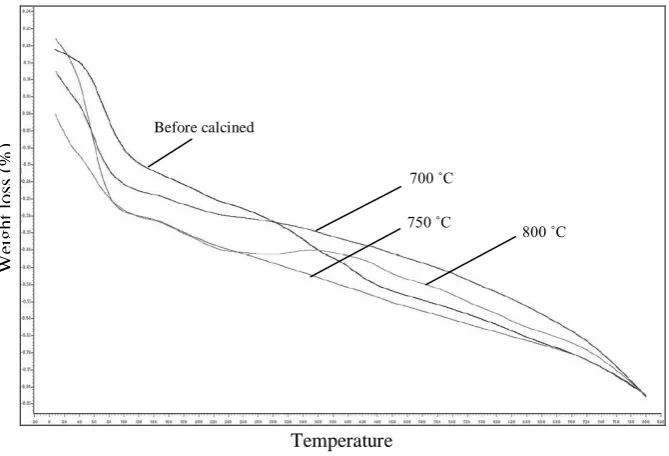
Figure 1 shows TG weight loss versus temperature of LSCF-SDCC composite cathode powder before and after calcine for soaking time 2 hours produced via wet milling method while Figure 2 shows the TG weight loss versus temperature of LSCF-SDCC composite cathodes powder before and after calcined for soaking time 2 hours produced via dry milling method.
Fig. 1. TG weight loss of LSCF-SDCC composite cathode powder before and after calcine for soaking time 2 hours (wet milling).
Fig. 2. TG weight loss of LSCF-SDCC composite cathode powder before and after calcine for soaking time 2 hours (dry milling).
Conclusion
Composite cathode powders LSCF-SDCC via dry and wet milling method were developed. Composite cathode powders LSCF-SDCC for both methods were able to maintain the composition of each element before and after calcinations process. TG weight loss shows all the composite cathode powder LSCF-SDCC calcined at various temperature only had minor weight loss (below 9%) up to 800˚C. This was an acceptable value since it is not exceeding over 20% weight loss which will affect the performance of cathode materials.
Temperature (˚C) 750 ˚C 800 ˚C Before calcined
700 ˚C
W
ei
ght
l
os
s
(%)
Temperature (˚C)
750 ˚C
800 ˚C Before calcined
700 ˚C
W
ei
ght
l
os
s
[image:4.595.126.461.347.575.2]Acknowledgement
The authors are grateful to Universiti Tun Hussein Onn Malaysia (UTHM) for Multi-Disciplinary Research Grant (MDR-1103) and Postgraduate Students Scholarship (Vot 1155).
References
[1] N.A. Baharuddin, H.A. Rahman, A. Muchtar, A.B. Sulong, H. Abdullah, Journal of Zhejiang University. 14(1) (2013) 11-24.
[2] Y.J. Leng, S.H. Chan, S.P. Jiang, K.A. Khor, Low-temperature SOFC with thin film GDC electrolyte prepare in-situ by solid state reaction, Solid State Ionics. 170 (2004) 9-15
[3] Y. Leng, S.H. Chan, Q. Liu, Int. Journals of Hydrogen Energy. 33 (2008) 3808-3817.
[4] Harris, J. Metcalfe, C. Marr, M. Kuhn, J. Kesler, O. Fabrication and characterization of solid oxide fuel cell cathodes made from nano-structured LSCF-SDC composite feedstock. Journal of Power Sources, 239 (2013) 234-243.
[5] Lee, S. Song, H.S. Hyun, S.H. Kim, J. Moon, J. LSCF-SDC core-shell high-performance durable composite cathode. Journal of Power Sources, 195(1) (2010) 118-123.
[6] Fu, C. Sun, K. Zhang, N. Chen, X. Zhou, D. Electrochemical characteristic of LSCF-SDC composite cathode for intermediate temperature SOFC. Electrochimica Acta, 52 (2007) 4589-4594.
[7] Jarot, R. Muchtar, A. Wan Daud, W.R. Muhamad, N. Majlan, E.H. La0.6Sr0.4Co0.2Fe0.8O3-δ – based cathodes for SDC Carbonate Composite. 3rd International Conference on Fuel Cell & Hydrogen Technology (2011b) A13.
[8] J.H. Kim, H. Kim, Ce0.9Gd0.1O1.95 supported La0.6Sr0.4Co0.2Fe0.8O3-δ cathodes for solid oxide fuel cells. Ceramic International 38 (2012) 4669-4675
[9] V.A.C. Haanappel, J. Mertens, D. Rutenbeck, C. Tropartz, W. Herzhof, D. Sebold, F. Tietz, Optimisation of processing and microstructural parameters of LSM cathodes to improve the electrochemical performance of anode- supported SOFCs, J. Power Sources 141 (2005) 216–226.
[10] Rahman, H.A. Muchtar, A. Muhamad, N. Abdullah, H. Structure and thermal properties of La0.6Sr0.4Co0.2Fe0.8O3-δ – SDC carbonate composite cathodes for intermediate to low temperature solid oxide fuel cells. Ceramics International, 38 (2012) 1571-1576.
[11] H.A. Rahman, A. Muchtar, N. Muhamad, H. Abdullah, Ceram. Int. 38 (2012) 1571-1576.
[12] T. Hungria, A. Hungria, A. Castro, Mechanosynthesis and mechanical activation processes