AN ANALYSIS OF THE PROCESS OF INFORMATION
SYSTEMS DEVELOPMENT ACROSS TIME AND SPACE:
THE CASE OF OUTSOURCING TO INDIA
Brian Nicholson
T.I.M.E Research Institute
Information Systems Research Centre
University of Salford, Salford, UK
Submitted in Partial Fulfilment of the Requirements of the
Contents
List of Figures 6
Acknowledgements 8
Declaration 9
Abstract 10
CHAPTER ONE The Area of Concern
1.1 Introduction 12
1.2 Research Argument 13
1.3 Theoretical Framework and Research Questions 14
1.4 Globalising Tendencies 15
1.5 An Information Society? 19
1.6 Changes In The Nature Of Work 21
1.7 Globalisation Of IS Development 25
1.8 Approaches To The Process of IS Development 28
1.9 Summary and Organisation of the Thesis 34
CHAPTER TWO The Globalisation of Information Systems Development
2.1 Introduction 36
2.2 Information systems outsourcing 38
2.3 Global software outsourcing (GSO) 41
2.3.1 GSO to India 43
2.3.2 India's Software Industry 46
2.3.3 Projects and Relationships in Indian Software Outsourcing 48
2.4 Computer Mediated Communication (CMC) 52
2.4.1 Place And Related Technology 54
2.4.2 Media Choice and Effects 55
2.4.3 Cross Cultural Dimensions To CMC 62
2.5 Software and Information Systems Development Across Time and Space 64
2.5.1 IS Development Methodology 65
2.5.2 Cross Cultural IS Development 70
2.6 Virtual organisation 77
CHAPTER THREE Theoretical Framework
3.1 Introduction 85
3.2 Theoretical Frameworks in IS Research 87
3.3 Culture and Organisations 90
3.3.1 Cross Cultural Issues 96
3.4 Power in Organisations 103
3.5 Globalisation Tendencies 111
3.5.1 Separation of Time & Space 117
3.5.2 Disembedding Mechanisms 118
3.5.3 Trust 119
3.5.4 Self Identity 120
3.6 Initial Theoretical Basis 124
3.6.1 Culture and Cross Culture 124
3.6.2 Power and Politics 125
3.6.3 Globalisation 126
3.7 Summary 128
CHAPTER FOUR Research Methodology
4.1 Introduction 129
4.2 Research Paradigms in IS 130
4.2.1 Positivism: The Scientific Paradigm 134
4.2.2 The Interpretivist Paradigm 137
4.3 Justification for Choice of Research Methodology 143
4.4 Research Design 146
4.4.1 Context Process Analysis 148
4.4.2 Site Selection 155
4.4.3 Data Collection 156
. 4.4.4 Analysis Strategy 159
4.4.5 Role Of The Researcher 161
CHAPTER FIVE The Case Study: Information Systems Outsourcing to India
5.1 Introduction 165
5.2 Overview Of The Companies 166
5.3 Historical Reconstruction Of Events 1993 - 1996 170
5.4 Events 1996 - 1998 173
5.4.1 Project Team Organisation 1996 -1998 174
5.4.2 Technology For Team Communication 1996 - 1998 175
5.4.3 Human Resource Development (HRD) Strategies
At Mastek 1996- 1998 176
5.5 Analysis Of Issues And Relationships 178
5.5.1 Academy And Onsite Mastek Development Staff 178
5.5.2 Academy Management And Offshore Mastek Development Staff 180
5.5.3 Offshore And Onsite Mastek Development Staff 181
5.6 Cultural Analysis 1995 - 1998 182
5.6.1 Cultural Context 183
5.6.2 Cultural Analysis Period 1995 - 1996
"Inception Of Outsourcing" 185
5.6.3 Cultural Analysis Period 1996 - 1998
"Offshore And Onsite Operations" 191
5.7 Political Analysis 1995 -1998 194
5.7.1 Political Analysis 1995 -1996
"Inception Of Outsourcing" 194
5.7.2 Political Analysis 1996 - 98
"Offshore And Onsite Operations" 199
5.8 Globalising Tendencies 202
5.8.1 Time And Space 205
5.8.2 Disembedding Mechanisms 208
5.8.3 Trust And Risk 210
5.8.4 Issues Of Identity 214
5.9 Summary And Recommendations For
CHAPTER SIX Summary and Evaluation
6.1 Introduction 219
6.2 Summary & Evaluation Of The Thesis Objectives 220
6.3 Evaluation Of The Research Process 221
6.4 Review Of The Research Methodology
And Some Problems With Context Process Analysis 232
6.5 Discussion Of The Refined Framework 236
6.6 Summary Of The Fieldwork 239
6.7 Contribution, Lessons And Implications Of The Findings 243
6.7.1 Lesson 1 There Is A Need To View The
Broader Social Context In GSO Relations 244
6.7.2 Lesson 2 Cross Cultural Dimensions Are Important 245
6.7.3 Lesson 3 The Nature Of Work In The Process
Reflects A Reversion To Scientific Management 246
6.7.4 Lesson 4 Management In Virtual Teams Is Potentially Coercive 247
6.7.5 Lesson 5 Globalisation Is Not Uni Directional In Its Effects 248
6.7.6 Lesson 6 The Potential For ICT's Is Significant For GSO 249
6.7.7 Lesson 7 New IS Development Approaches
Are Needed for IS Development Across Time and Space 250
6.7.8 Lesson 8 Those Who Would Engage In GSO
Should "Open The Black Box" 252
6.7.9 Lesson 9 The "Trust Curve" Can Go Into Reverse 252
6.7.10 Lesson 10 Information Systems Development Cannot
Be Completely Independent Of Time - Space 253
6.7.11 Lesson 11 The Framework Has Proved Useful 254
6.8 Further Work And Recommendations 254
6.8.1 Recommendation One The Global And Local Effects 255
6.8.2 Recommendation Two Moving To More Sophisticated
Low Structure Work In India 255
6.8.3 Recommendation Three The Ethical Dimension Of GS0 256
6.8.4 Recommendation Four Achieving Mutual Understanding
In The Process Of IS Development Between UK and India 256
Appendix 257
List Of Figures and Tables
2.1 Disciplines Of Relevance To The Study
2.2 Examples of Companies Doing Major Development in India 2.3 "Pull" Factors For GS0
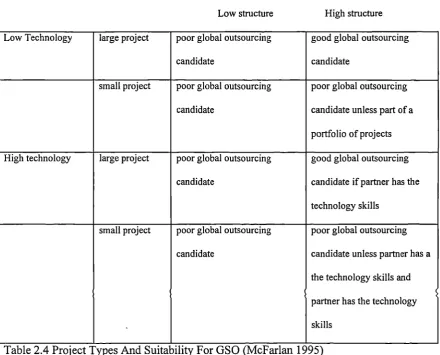
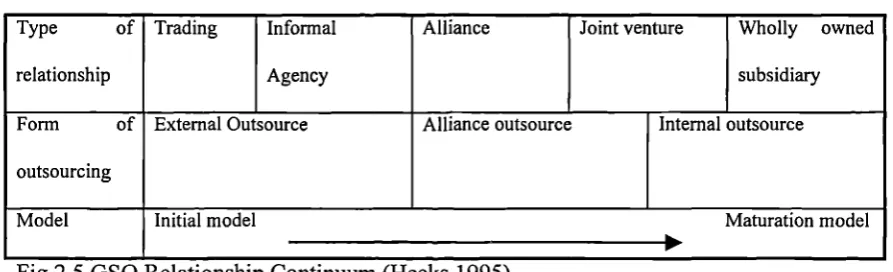
2.4 Project Types And Suitability For GSO 2.5 GS0 Relationship Continuum
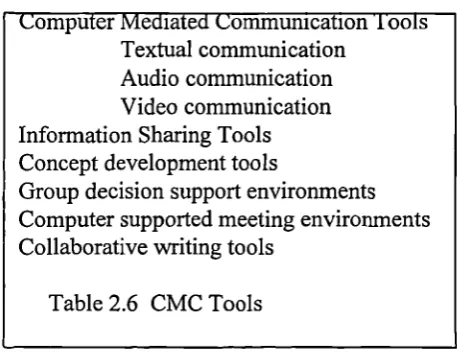
2.6 CMC Tools
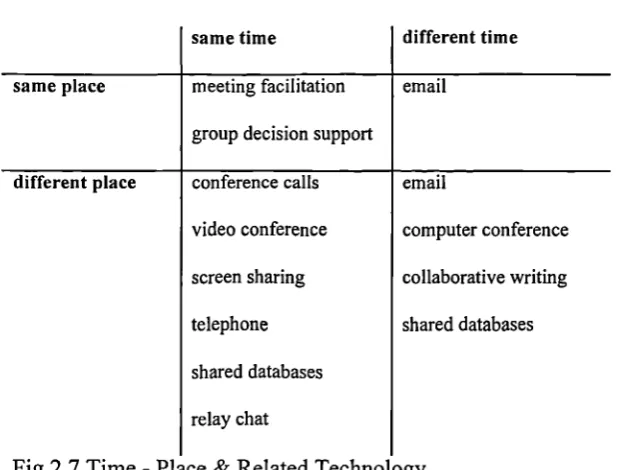
2.7 Time - Place & Related Technology 2.8 Classification Of CMC Literature
2.9 Communication And Information Richness
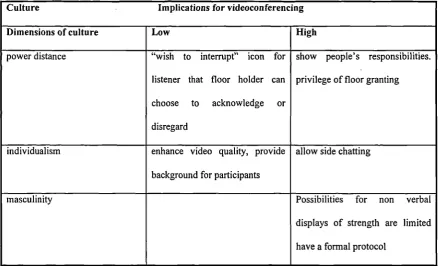
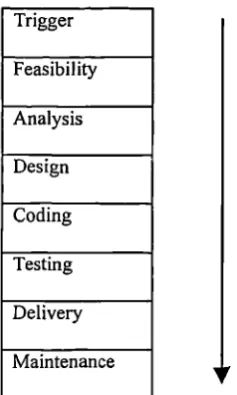
2.10 Implications Of Culture For Floor Control Policies 2.11 The Software Development Lifecycle Prevalent In GSO 2.12 National Cultural Factors in Information Systems 2.13 Effect of Culture on Systems Development Lifecycle 2.14 The Evolution of Organisational Structures
3.1 The Elements Of Research 3.2 Initial Framework for Analysis 3.3 Model Of Cultural Analysis
3.4 Social System And The Structural Basis For Management In India 3.5 Theoretical Constructs of Pfeffer's Political Model
3.6 Sources Of Power In Organisations 3.7 Initial Framework For Analysis
4.1 Key Differences Between Interpretivist And Positivist Position 4.2 Elements of Research
4.3 Summary of Justification for Research Design 4.4 Features of Context Process Analysis
4.5 Component Of Analysis: Context And Process 4.6 Six Steps in Contextualist Analysis
4.7 Levels Of Analysis Within The Process 4.8 Interviews: Number and Level of Interviewee 4.9 Generation Of Research Themes
4.10 Diagram Showing The Theoretical Framework (F), Vertical And Horizontal Levels Of Analysis (M) To Investigate The Process Of Software Development At Academy & Mastek.(A)
5.1 Capita Organisation Chart 5.2 Evolution Of Capita 5.3 Capita Services
5.4 Academy Organisation 5.5 Mastek Organisation
5.6 Mastek Software Development Process 5.7 Summary Of Cultural Analysis
5.8 Political Issues 1995 - 98
5.9 Diagram Showing Existing Project Group Structure (1)And Planned Multi Vendor "Switching"Capability (2)
5.10 Academy's Risks Of Globalising Software Development
5.11 The Revised Framework Showing Methodology, Framework and Area of Application Together With Analysis Strategy
6.2 Summary of the Principles for Interpretive Field Research (Klein and Myers 1999) 6.3 Criteria For Judging Contextualist Research
6.4 The Theoretical Framework In Action 6.5 Summary Of Themes From The Research 6.6 Contribution of the Research
Acknowledgements
I would like to acknowledge the advice and encouragement of my ex colleague and friend Dr. Sundeep Sahay without whom I would never have begun this intellectual journey and many travels to and within India. This thesis would never have been started
Declaration
The thesis draws on the following papers that have been produced during the period 1996 - 1998:
Nicholson, B. and Hughes, J. (1996) Virtual Organisations: The Future for Human Oriented Information Systems Methodology "Proceedings of the 2nd Projectics
Abstract
The processes of globalisation have led to a world which is more closely connected and
interdependent than ever before. The use of information technology has been
instrumental in facilitating these interconnections and as the processes of globalisation
have unfolded, whole industries have developed which are not dependent upon location
to trade with their customers across the globe. There is no industry more seemingly
suited to the notion of time and place independence than software development and the
relative labour costs have meant that some developing countries have become popular
locations for the outsourcing of information systems development. There is no country
more involved in the outsourcing of software than India which has rapidly emerged as a
world leader in the provision of outsourced software development. There have been few
studies which have holistically and longitudinally examined this form of software
development as a process. This thesis is the result of such a study. The aim of this
research is to investigate the process of information systems development across time
and space involving teams located in different countries. The research is undertaken
with an interpretivist approach and methodology derived from Context Process analysis.
The analysis of data is informed by the sociologist Anthony Giddens's later writings on
globalisation as well as theory derived from the study of culture and power in
organisations. The data collection was undertaken using a range of qualitative
techniques. The outcomes of the research include an improved understanding of the
implications for information systems development involving teams located in different
countries collaborating with information technology across time and space, with
relevance to the context of Indian outsourcing. Theoretical outcomes include an
information systems development using teams separated by time and space. The
implications for management include an exposition of the issues involved in
undertaking projects where teams are separated by time and space and guidance for
CHAPTER ONE
THE AREA OF CONCERN
"I simply want to tell the story of my numerous experiments with truth.. .as my life
consists of nothing but these experiments...I believe or at any rate flatter myself with the
belief that a connected account of these experiments will not be without benefit to the
reader." M.K. Gandhi An Autobiography
1.1 Introduction
The purpose of this chapter is to provide the reader with an overview of the context to
the research and the problems and ideas which have formed a basis for this study.
Central to the work which is described is an attempt to fulfil a general need in the field
of information systems to consider software development when teams are separated by
time, distance, culture and organisational boundaries. The extent to which the process
of software development can be independent of time and space is of interest. The
chapter will attempt to answer the questions of what the research is concerned with and
a rationale as to why the research was undertaken. To this end, the chapter is organised
as follows: consideration of the research argument, research questions and theoretical
framework is followed by examination of themes of globalisation and identification of
cultural dissimilarity in the "information age". Following this is a consideration of
changes in the nature of work and a discussion of the globalisation of information
The final part of the chapter provides a summary and details the organisation of the
thesis.
1.2 Research Argument
Avison and Wood-Harper (1990) make the point that for some the development of
software and information systems has been viewed as a wholly technical endeavour.
However, it is increasingly being recognised that the process contains many
sophisticated issues beyond the purely technical. Jayaratna (1994), for instance, points
out that IS development involves a complex interaction between the user, the analyst,
the methodology, the task itself and the problem context. The scenario of information
systems development becomes increasingly problematic when extended across time and
space possibly involving development teams located in different countries who are from
different cultural backgrounds. Interaction thus may be with "absent others" across
time, space, national and cultural boundaries. The implications of managing such
teams, the development methodology and the effects on the nature of work are areas
considered in this inquiry. Jayaratna's (1994) analysis assumes an organisation which is
operating within a "local" or national culture and it reveals a highly sophisticated set of
issues within the process of IS development. Globalisation adds the dimensions of time
and space, culture, cross culture and brings into question issues of identity. At a time
when organisations are rushing to capture the benefits of- advanced communications
technology, analysis of the issues involved when teams are developing information
systems across time and space is becoming extremely important. An improved
exposition of the technical, managerial, methodological and social issues involved with
1.3 Theoretical Framework and Research Questions
The key exploratory research questions informing the research are:
What are the cultural and political issues involved in the process of information systems
development across time and space?
How are these issues affecting the process of information systems development when
teams are separated by time and space?
A broad theoretical framework combining ideas and research from organisational
culture (Allaire and Firsirotu 1984, Morgan 1986), cross culture (Hofstede 1980, Sahay
and Walsham 1997) and power in organisations (Morgan 1986) served as a general
guide to the fieldwork. The later writings of Anthony Giddens (1990, 1991) on the
implications of globalisation were also combined into the theoretical framework to
assist in the process of conceptualising the findings. The inquiry is guided by the
principles of interpretivist case study (Klein and Myers 1999, Walsham 1995) in the
contextualist manner suggested by Walsham and Sahay (1999).
In order to commence a response to these questions, it is necessary to discuss some key
debates in the context to the research issue. The following section will discuss some of
the dimensions of globalisation relevant to a study of the process of information systems
development across time and space. A key argument is introduced which concerns the
independence of time and space which is subject to critique throughout the inquiry. A
the issues around and importance of an investigation into the process of information
systems development across time and space.
1.4 Globalising Tendencies
It is interesting to consider the position in the late 1990s which according to Anthony
Giddens (1990, 1991) has involved an intensification of the processes of globalisation to
the point when many organisations would claim to be operating globally. On the face of
it, organisation designers and managers are able to exploit information and
communication technology to enable teams to collaborate independent of time and
distance. Giddens (1990) describes globalisation as:
"an intensification of world-wide social relations which link distant localities in such a
way that local happenings are shaped by events occurring many miles away and vice
versa" (p64).
Although Giddens never fully engages with the importance of the use of information
technology, it is fair to say that the use of IT is implicit in these developments, an
obvious example being the phenomenon of social relations with absent others across
time and space. For the purpose of justifying the fundamental arguments for this thesis it
is important to critique the debate concerning globalisation and "one world"
convergence. To accept the convergence thesis would suggest that information systems
development across time and space is limited only by the capacity of technology to
connect teams and individuals together. Thus the discussion will consider arguments
argue that far from becoming homogenous and independent of time and space, global
social relations are becoming increasingly problematic.
In 1964, McLuhan famously argued that the modern media has made irrelevant the role of
time and space in separating human experience and created a global village - a common
global experience. It is believed by many optimistic proponents of globalisation (for
example, Ohmae 1994) that the global organisation can and ought to be based on
electronic technology creating a global corporate life. Following this line of argument
leads to the proposition that information systems development across time and space and
between cultures will eventually no longer be problematic and will thus be independent of time and space. This argument is simplistic as it assumes both equal access to technology
and also presumes the national culture and state to be an obsolete notion in that
geographical boundaries have or will lose all present relevance. Ohmae is an advocate of
the idea that "cultural convergence" is taking place and the process of cultural
convergence over time will largely eradicate issues of cross cultural difference. This
optimistic view ignores the resilience and "embeddedness" of culture, for instance Couger
(1986) reports that modern organisations are converging in terms of technology, but
peoples' behaviour is continuing to display cultural dissimilarity. With regard to
organisational life, Levinson and Asahi (1995) argue that many levels of culture are
relevant and would need to be taken into account when considering any convergence
thesis. Acceptance of the existence of national, organisational, occupational and small
group culture makes the suggestion of the convergence ideal simplistic and facile. Even if
organisational culture can be manipulated, Levinson and Asahi argue that national culture
is more resistant. The deep "embeddedness" of structural factors such as tradition, ritual
management undertaken by Hofstede (1980) suggests that national culture shapes the
nature of social structures and thus organisations.
A further stream of the cultural convergence argument concerns the "Americanisation of
the globe", a thesis which rests on the assumption that the American media, products and
lifestyle are gradually encroaching on other cultures and ways of life. Circumstances in
1998 led to the collapse of the economies of east Asia which demonstrated the
interdependencies between countries with economic repercussions being felt around the
globe. However, this does not imply that the US model of capitalism and free enterprise
is becoming global, the Japanese mode of organising government and administration for
instance is still vastly different to the US. Arguably, US biased global culture, the
"McWorld" or "Coca-Cola" effect is reflected only in superficial symbols, consumption
and of course in the media but countries still display large cultural dissimilarities. A vision
of a culturally homogenised "McWorld" (Ritzer 1995) rests on the notion that once a
position is achieved when all peoples wear Reebok trainers, have watched the film
"Titanic" and eat at McDonalds they would be unlikely to go to war with each other.
However, it is argued that the effects of globalisation lead to increased nationalism.
There are currently dozens of armed conflicts going on in different parts of the world often
fuelled by religious and territorial disputes and thus the "nation-state" and national culture
concept is far from obsolete. It would be difficult to formulate an argument which would
convince anyone that globalisation will bring together the warring factions in Yugoslavia
or iron out deep rooted differences in Northern Ireland. Nations such as France for instance are taking considerable effort to ensure that the Nation State, national culture and
identity are preserved. The 1998 devolution of Scotland and Wales in the UK is another
splitting of governmental structures, remarkable in so small a country as the UK. It could
be argued that nationalistic tendencies are becoming stronger as nations compete in a
global economy characterised by more uncertainty and pressure. Far from converging, it
could be argued that people yearn for a local identity to hold out against the neutering,
diluting effect on culture of superficial Americanised broadcasting (e.g. MTV etc.). Thus
a strategic belief in the emergence of a common global experience is a naive view of a
complex reality.
This suggests that the process of information systems development taking place across
time - space is likely to be affected by a range of factors beyond that which would be
encountered when participants are physically co located. The notion of time-space
independence of information systems development is a highly problematic concept worthy
of critique.
Another strand of the globalisation debate concerns the impact of the practice of major
corporations in moving production of goods around the world usually to the cheapest
centre. Harvey (1989) points out the Marxist argument of the exploitation of time and
space capital. The ease with which goods are transported and disparity in labour costs
around the world often means that final processing of goods in a far away country is
cheaper than local production. Thus the switching of production centres is
commonplace and there are numerous case studies of the exploitation of workers in
sweatshop conditions producing toys and clothes for Western consumption. This
argument is often countered by pointing out that multinational involvement in such
countries actually contributes to the local economy and the majority of people benefit
globalised economy. For instance, Waterford Crystal is made in the Czech republic and
most of Nike footwear production is outsourced to cheap suppliers in developing
countries.
This lack of "rooting" is strongly demonstrated in the ease with which information
systems production is moved between centres. These centres represent major growth
industries for countries such as India, Ireland and China. The exploitation of time and
space capital has lead some companies to 24 hour software production by staff in
different time zones and production facilities in different countries to exploit cost
differential. This activity has led to the transformation of cities such as Bangalore, India
which exists as India's "silicon valley" with software services a major feature.
Regardless of the optimism, writers such as Madon (1997) express concern with the
transformation of Bangalore. It is worth briefly examining Madon's arguments as they
are relevant to the effects of the process of information systems development across
time and space.
1.5 An Information Society?
According to Madon (1997) Bangalore has been fragmented by the emergence of the
"information elite" who have rapidly rising salaries. There exists gross inequality
between groups of different socio-economic status with extreme poverty among many
inhabitants of the city. The rapid emergence of the electronics and information
technology sector in Bangalore are a facet of globalisation and the impact on developing
countries. Conversely, Castells (1996) makes the point that other developing countries,
for instance the African republic of Chad, are largely ignored leading to inequality at a
global level. These themes of inequality and fragmentation are commonly referred to in
towards informational goods and services. It is worthwhile examining some of the key
themes around the information society thesis. Alvin Toffler's (1980) well known "third
wave" concept is perhaps the clearest example of the idea. Toffler describes the first
wave of the economy as being agricultural which lasted roughly until the eighteenth
century. The industrial revolution created the industrial city, destroyed an existing job
market based on the land, and set in its place a new one based on the factory. The
period also led to new form of government and moves to "massification" in production.
The latter day "third wave" is concerned with the "information society". Fuelled by
high bandwidth telecommunications and computing together with drastically reduced
size and cost of computing, information technology is steadily becoming more
pervasive throughout society.
One way of differentiating the streams of literature is to consider "optimistic" and
"pessimistic" strands concerning the societal impact of the "information society".
Daniel Bell (1974) takes a technological determinist position and suggests that the
information society will see an information economy replacing the manufacturing sector
and there will be a shift in the economy to the provision of information services. Rea
also argues that there will be an increased role of science and technology, and technical
people will be the sources of power. The new breed of "Knowledge Workers" will be
valued for what is in their heads and the old class divisions between bourgeoisie and
proletariat will be replaced by a new opposition represented by the knowledge and
service workers. Bell's arguments are interesting and worthy of examination in the
context of India's "software factories" and whether knowledge workers will be
empowered in the way he suggests. Bell argues that there will be a new social
social and economic exchanges will be built around this infrastructure. Bell sees the
computer as playing a pivotal role in this revolution.
Other authors which fall into the optimistic category include Gates (1996) and
Negroponte (1995). David Lyon (1990) critiques Bell for his deterministic position and
discusses the resilience of some of the familiar features of modern societies in the face
of technology and also how conflicts and struggles could arise within this "information
society". For instance, Lyon's analysis draws attention to the capitalist motives of big
business which is unlikely to be concerned with the social implications of their
endeavours in cheap labour countries. Critically, Lyon is of the belief that the
optimism of Bell ignores the capacity for domination and power through surveillance,
invasion of privacy, control and coercion. Lyon's critique is interesting as it provides
an examination of some of the negative effects of the processes of globalisation relevant
to a critique of the process of software development. The next section builds on the
preceding discussion and concerns changes in the nature of work and work methods in
the "information society".
1.6 Changes In The Nature Of Work
This section will consider some of the technological determinist orientation in the
literature around changes in the nature of work and teleworking which argues that work
is becoming independent of time and space. The purpose is to uncover this determinism
and make a case for a wider ranging analysis of the social, cultural and political
dimensions.
"As I survey the workplace, the one, single, indisputable fact of the workplace that we
can see today and that will transform the office of tomorrow is mobility of work, and of
the people that do that work."
The traditional concepts of the "where" and "when" of doing work are rooted in the
distant past. Before the industrial revolution agricultural workers went to fields to tend
crops. After the industrial revolution workers migrated to the towns, and lived in close
proximity to the factories that provided work. The pervasiveness and use of IT has
undermined many of the assumptions behind this 'geographical blueprint'. However, it
is argued by some (e.g. Peters 1995) that knowledge work can be independent of space,
since communications technology allows the almost instantaneous transmission of data
across world wide networks. Since work is no longer dependant on place, in some cases
it is no longer dependant on time as workers can operate flexible schedules and the work
itself can be done across time zones. IT is viewed detenninisticagy as changing the
fundamentals upon which organisations have based their very existence. In the same
vein, Birchall and Lyons (1996) discuss Tecent yes NA-len ST capadty Was Czyttn
"catching up" with business needs, whereas today's businesses are having to catch up
with IT. They describe this as a 'negative gap' (Birchall and Lyons 1996) where there
is a surplus of available computing power. Exploiting this gap is, for many businesses,
the key to competitive and profit advantage. This idea of a "surplus of computing
power" "providing an independence of time and space" is seductive and deterministic.
It hides many problems which cannot be "solved" by the application of IT and an
Birchall and Lyons (1996) point out that we are in the era of "knowledge workers"
whose added value lies in the intelligence and knowledge they apply to the business,
rather than any physical work. "Mobile workers" are said to be able to undertake work
in any number of locations, thus mobile work may consist of work that can be
transmitted to any part of the globe for processing. These concepts are embraced by the
term 'future work' (Birchall and Lyons 1996). The abstract notion of "work" described
by Birchall and Lyons (1996) is treated at a very high level and the idea of IT stripping
away the task from the person and the place is seen as unproblematic. They view it as a
technical problem rather than social, political or organisational.
Literature around teleworking has been of relevance to the debate on the independence
of time and space in knowledge work. As early as 1976 Nilles recognised the potential
for IT to substitute electronic communication for the physical commute to work. He
coined the term `telecommuter' which is still used in the USA to describe teleworkers
(Nilles 1998). However, it was not until the 1980s, when convergence of inexpensive
yet powerful computers, better telecommunications media, ISDN, Internet access, and
lower telephone charges prompted the real growth in teleworking. At the same time,
non technological factors also promoted interest in teleworking. The political climate
encouraged entrepreneurial activity. Natural disasters (Los Angeles earthquake),
pollution, congestion and terrorist activity (London and Manchester bombs) also
focused the minds of large companies on the need to separate the ability to do work
from the occupation of fixed offices.
such as teleworking reflect the change in cost of telecommunications and also the
change in attitude to work methods. However, the trend to new forms of work extends
to teams which are based in different countries with team members who do not
necessarily meet face to face depending largely on IT to communicate. The globalisation
of work has involved the alteration of social relations of production by means of a
reorganisation of labour processes using people from different countries and time-zones.
The success stories of flexible forms of work are seductive, IBM achieved a 75%
reduction in both space and costs in New Jersey by consolidating its five offices into
one low cost space and adopting telecommuting strategies. AT&T's experience is
similar, in 1992 the company decided to move one entire business unit, home to
10,000 account executives nation-wide, into a teleworking scheme. After 18 months,
the company found it had already saved US$21 million and the account executives'
customer contact had increased by 15% (Ogilvie 1994).
Despite the benefits to corporations, teleworkers operating in a national context
complain of isolation, fragmentation of their role and concerns over career progression.
The blurring of home work boundaries has also been seen to have negative effects on
the family (Miranda 1996).
The dogma associated with "independence of time and space" in knowledge work is
significant and relevant to an investigation into software development. Issues such as
the tasks which require copresence and the management methods used to control the
independence in the context of software development. The most significant example of
this activity concerns the expanding global software outsourcing phenomenon.
1.7 Globalisation Of Information Systems Development
This section will consider the importance of IT and software outsourcing and the fast
growing industry supporting this activity across the globe. The section discusses the
importance of India in this trade and builds a case for Indian outsourcing as relevant to a
study into the process of software development across time and space.
Information technology outsourcing is not a new concept as it has been in existence in
facilities management and time sharing deals for several decades. However, the
pervasiveness, improved efficiency and reduction in cost of communications
technologies has meant that European and US companies are no longer bound by their
local expertise because international resources are within reach. Resource issues are also
of considerable importance as many countries, for example the USA, continue to
experience a shortage of experienced programmers. The increased attention given to
global software outsourcing (GSO) has been popularised by the experiences of
companies such as Xerox and Kodak who have internationally outsourced major pieces
of their IT operations. The GS0 trend is encouraging collaborative software
development because unlike material goods, digital information can be transported
cheaply and easily. Software development tasks can be exported abroad for advanced
technological expertise or for a reduction in cost (Minoli 1995). Apte (1994) identifies
two major categories of GS0 and divides them into "information systems related" and
the development and maintenance of software. The second category includes activities
such as routine data entry and transaction processing. Activity can take place onsite
known as "bodyshopping" which involves importing staff into the host country.
Alternatively work can be undertaken offshore or in some cases a mixture of both. The
common feature of all types of GS0 is that activities can take place off shore as opposed
to onsite.
The world-wide global software outsourcing industry is developing very quickly.
McFarlan (1995) points out that a number of countries are entering into the GSO arena,
such as the Philippines, China and Russia who are involved in a range of activities
including large projects or sustained maintenance of legacy systems. The outsourcing of
software development to off shore development companies outside the clients' home
location has emerged as an important strategic option for managers. There are key
benefits to be gained by multi national firms in establishing GS0 arrangements in off
shore sites like India, Israel and Singapore. These include improved access to global
markets, access to a large pool of skilled professionals, lower labour costs and a reduced
cycle time for systems development (Barret et al 1996, Heeks 1996, Willcocks et al 1995).
India remains the unquestioned leader for offshore development (McFarlan 1995).
Growth of the Indian software industry is spectacular, according to India's NASSCOM
(1998) the industry registered an overall growth of 58% during 1997 - 98. Future
growth predictions have a solid basis as recently the Indian Government has been
pressing for an integrated strategic plan for the development of IT. The plan for a
"comprehensive national informatics policy" aims to "enable India to emerge as an
inspire confidence in foreign companies that India will have a commitment to building
and maintaining an IT infrastructure to meet their future needs. Notably in 1997-8 there
were 590 leased lines providing 64 KBPS or more, in 1992 there were only 10 such
links (NASSCOM 1998). With regard to software exports, analysis by NASSCOM
(1998) of software destination shows that by far the biggest market for the export of
software is to USA (59%) and to Europe (22%). As the communication infrastructure
becomes more reliable and bandwidth increases, it is likely that many more European
companies will be involved in GSO to India.
By way of examples, Singapore Airlines, Swiss Air and many other companies from
different industries are moving their bacicroom operations to India to cut costs. The
London Tube and North West Water are using software developed in India. Exporting of
coding has been done for some time and it is becoming increasingly popular due to
differential levels of payment, ease of data transfer and high educational standards in some
developing countries (Barret et al 1996). Interestingly, due to increasing levels of trust
between vendor and supplier, improvements in the reliability of communication links and
affordable high bandwidth, more sophisticated work is being outsourced. However, many
organisations are nervous about outsourcing important work to these far distant sites and
issues of control, intellectual property, staff attrition and realising deadlines detract from
the sales pitch offered by most companies selling their GS0 services (McFarlan 1995).
Forecasts show that outsourcing trends are set to continue (e.g. NASCOMM) meaning that
increasingly software development will be undertaken by development teams in different
countries. As these companies advance up the "trust curve" more sophisticated tasks will
be undertaken leading to closer collaboration (Barret et al 1997, Heeks 1996). The
India's software market rising by more than 50% for a seventh successive year. An
increasing share of exports - worth US$1.75 bn - came from companies in India serving
clients abroad over high speed data links (Financial Times 10/7/98). Software services
now account for more than 5% of India's export earnings and predictions for the next 5
years are as high as 25%. Offshore services accounted for 41% of exports against 5% in
1990 indicating a large and increasing amount of development taking place across time
and distance (Financial Times 10/7/98). Clearly, the practice of software development
across time and space is going to continue and become more important as other counties
such as Sri Lanka, Pakistan, Nepal and Bangladesh enter into the market (Financial Times
South Asian Software special report 1/7/98).
The next section is concerned with a discussion of the importance of development
methodology, differing views on the problem of software development and the
implications of time and space.
1.8 Approaches To The Process of IS Development
This section will provide some background and argument around the area of approaches
to IS development. An argument is presented that the dominant paradigm adopts a
technical and rational view of the process which is important to the inquiry into the
process of IS development taking place across time and space:
For some time there has been a "grail - like" quest for the ultimate super methodology
which has led the information systems community to witness a veritable "babble of
(Jayaratna, 1994) methodologies available. All of these methodologies claim to have
advantages over others and jostle for position in an overcrowded, confused marketplace.
The "voices" come from many directions each advocating its own philosophy which it
attempts to sell as the ultimate "silver bullet" or universal approach. There are strong
differences of opinion over how information systems should be developed. Wood
Harper and Fitzgerald (1982) identify 6 different approaches each of which "views the
world in a different way". Episkopou and Wood Harper (1986) go on to discuss the
human activity, participative and data analysis approaches:
"corresponding to the 'soft', 'cybernetic' and 'rational' views identified by M.C.Jackson."
In the same paper, Episkopou and Wood Harper (1986) use the metaphor of the
problem solver "changing spectacles" when switching between the world views held by
particular methodologies. Therefore, the "spectacles" which are being worn by the
problem solver dictate whether the project is:
"seen as a logical, technical or people problem" Avison and Wood Harper (1990).
This approach has been extended into Multiview 2 (Avison et al 1996) which attempts
to incorporate even more potential perspectives. Jayaratna (1994) diversifies the debate
by discussing the need for information systems practitioners to "acquire the richest
possible understanding of organisations if they are to become effective problem solvers"
(p61) and earlier states that "one of the major weaknesses of most current information
systems methodologies is that they are not concerned with what really happens in
reflective practice (Schon 1983), greater attention to the contextual backdrop of the
proposed information system. In the face of this diversity, theorists and practitioners
yearn for a "discipline" of IS:
"The whole field of information systems lacks its Newton to bring it conceptual clarity"
Checkland (1988).
The search for a "Newton" in IS is to some extent a straw man and masks the
complexity of IS development across time and space. IS practice has been influenced
strongly by its computer science parent which has moulded the dominant mode of
practice in IS. The underpinnings of the youthful discipline of IS are centred on what
was at its genesis considered to be the relevant theory. Lewis (1994) identifies the
intellectual foundations of IS as being a combination of two primary fields, computer
science and management, with supporting disciplines such as psychology, sociology,
statistics, political science, economics, philosophy and mathematics (p25). This would
appear to give IS a multidisciplinary feel, with influences from varied disciplines
forming a coherent mix of the best of the theories from each field.
It is however worthwhile considering the enduring influences on information systems
focusing on the two primary fields of influence identified by Lewis. Brady (1977)
argues that since the 1950s computer science has evolved significantly into a discipline_
in its own right and in the area of systems development made valued contributions to,
for example, the field of software engineering and safety critical systems. The term
computer science implies a technical, scientific base akin to the engineering tradition
"What has come to be called the 'theory' of computer science relates to studies of
abstract mathematical models of computing phenomena" Brady (1977)
It is argued that mainstream IS has been influenced to a greater extent by its computer
science parent (the nearest IS has to Checkland's "Newton") and has remained aloof to
the richness of influence and change in the management, organisation theory and social
science areas. This is profound now that the additional dimensions of time and space
are added.
In the 1950's, management and computer science thought and practice was preoccupied
with the tradition of rationalism, notably the American RAND corporation with its
advances in systems analysis were major influences on the way early systems were built
(Flood and Carson 1992). The use of hard, RAND style systems analysis has since been
discredited by writers in the management area particularly when used in a social
systems context displaying "wicked" problem characteristics (Rittel & Webber 1972).
Ironically the hard systems paradigm is embedded in many popular lifecycle led
structured information systems design methodologies such as SSADM, Information
Engineering, Jackson Structured Design and DeMarco's Structured Design
Methodology.
"It was perhaps inevitable then that guidance was sought from the methods of RAND
style systems analysis and systems engineering.. .It is these that continue to influence IS
The limitations of the approach are acknowledged (Avison and Wood Harper 1990,
Checkland 1981, Jayaratna 1994, Walsham 1993) however these approaches are widely
used in practice partly because of ignorance of other methods, Goverment approbation,
political protection, a feeling of "ontological security" (Waste11 1996) and the received
wisdom that mathematical rigour should be the first priority (Fitzgerald 1996). If
mainstream IS in the 1990's is still largely influenced by the 1950's model of positivist
rationality, this implies a continuing focus on the technical aspects of development as
opposed to the political or social.
The emergence of a more complex environment to systems development, rapid
technological change coupled with more sophisticated users has facilitated the
emergence of approaches which deal with the social and organisational aspects. The
work of Mumford (1983) for instance concentrates on the human, social and job
satisfaction needs as well as the obvious technical issues. These developments when
coupled with the emergence and credibility of Soft Systems Methodology (Checldand
1981) and methodologies which purport to be emancipatory (Hirschheim and Klein
1994) have led to multi paradigm approaches to development using a contingency
approaches. This is demonstrated in Multiview 2 (Avison et al 1996).
The implication of this is that although scientific methods still dominate IS practice,
there is a recognition of the importance of the social and organisational aspects. A
recognition of the essentially social nature of IS has given increased credibility to
research into the social and organisational dimensions in all dimensions of IS leading to
methodology (Hirschheim and Klein 1994) and implications of IT on society (Dunlop
and Kling 1991).
To date, "human centred" methodologies for the development of information systems
across time and space have not been fully formulated or documented in the IS literature.
Heeks (1996) makes the point that structured methods have contributed to the success of
GS0 by offering a standard development approach which lends itself to a division of
labour and discipline in the process. However, structured methodologies such as
SSADM (Downs et al 1992) assume a physical organisation located in the same time
and place. They do not take into account the complex cross cultural issues identified by
authors such as Couger (1986). They also do not take into account emancipatory, job
satisfaction and power issues (Fitzgerald 1996, Middleton 1994). When extended
across time and space, treating information systems development as a wholly technical
activity is likely to be problematic as organisations attempt to move into more
sophisticated forms of relationships.
This section has identified a need to question the dominant paradigm of practice in IS
given the complex global context and for a thorough exposition of the human,
managerial, technical and methodological issues around information systems
development taking place across time and space. The importance of methodology is
profound but a growing number of authors are questioning the rigid conception of
methodology. Introna (1997) for instance draws attention to the need for tacit
knowledge in IS development and Schon (1983) questions the appropriateness of rigid
1.9 Summary and Organisation of the Thesis
By way of summary, the discussion will focus on the what and why questions identified
in the introduction. The subject of the thesis concerns information systems development
which is taking place when teams are separated by time and space. The research is
concerned with an analysis of the process of information systems development using the
case of software outsourcing to India, an activity which is becoming increasingly
important. The rationale for the research is concerned with several areas. A technical
orientation towards IS development is becoming increasingly outdated given the
additional dimensions imposed by the processes of globalisation. The various approaches
to IS development were considered but none took into account the additional dimensions
of time and space. Current practice in Global Software Outsourcing is dominated by the
structured approaches which have been subject to critique. Sociologists such as Giddens
identify the importance and implications of the phenomenon of globalisation and yet a
view from some authors is that the process of information systems development can or
shortly will become independent of time and space. This view is compounded by
optimistic literature concerning changes in the nature of work and technological
determinism surrounding the potential to transform work to a state of independence of
time and space. This view was shown to be problematic, far from converging, societies
are diverging and national identity remains strong. A further argument concerned the need
for an holistic perspective of the effects of the globalisation of software development both
in terms of the empowerment or otherwise of "knowledge workers" in the information
society. The impact of globalisation of software development was highlighted with regard
to the case of Bangalore, a city which Madon (1997) argues is ravaged by globalisation.
Further chapters in the thesis are organised in the following way. Chapter two includes
GS0 and India's software industry moving to a discussion on virtual teams,
development methodology and cross cultural implications. The themes which emerged
from the literature search together with initial interviews informed the choice of
supporting theory in chapter three. Chapter three covers issues of the theoretical
framework, culture and cross culture, power in organisations and the effects of
globalisation. The chapter concludes with an initial theoretical basis. Chapter four
describes and justifies the research approach examining research paradigms and
methods. Chapter five provides background and analysis of the major case study
involving a Mumbai based software house "Mastek" and the UK based software house
"Academy Information Systems". Chapter five also contains an analysis of the case
study using the framework generated in chapter four. The final chapter contains an
evaluation of the thesis objectives and analysis. There is also some discussion of the
CHAPTER TWO
THE GLOBALISATION OF
INFORMATION SYSTEMS DEVELOPMENT
2.1 Introduction
This chapter aims to review the literature associated with information systems
development taking place across time and space. This chapter is concerned with placing
the topic in context and providing an assessment of previous relevant work. This is
followed in chapter three by an assessment of supporting theory and literature which has
assisted in the choice of theoretical framework which is articulated therein. A purpose of
this chapter is to identify the themes of investigation and lines of inquiry which
informed the choice of reference theory discussed in chapter three.
To undertake this task it has been necessary to consult literature from different
disciplines. The IS domain has been of use when considering software outsourcing
trends and issues. Also the IS literature has been important in constructing a critique of
methodological issues and the range of communication mechanisms available to
facilitate team working across time and space. The literature from organisation theory
has also been consulted with regard to the interest in virtual teams and virtual
organisations. The theoretical literature around international management and in
International Management
I S Development
Organisation studies: culture, cross culture and power
Outsourcing and global software outsourcing
Sociology: modernity and globalisation
CMC & CSCW An Analysis Of The Process
Of IS Development Across Time And Space: The Case Of
Outsourcing To India
potential impact on the information systems development process using teams who are
[image:37.595.94.493.135.406.2]located in different countries.
Fig 2.1 Disciplines Of Relevance To The Study
The discussion is organised as follows: firstly there is a discussion of software
outsourcing and examination of the concept of outsourcing and Global Software
Outsourcing (GS0) with particular regard to India's software industry. Several key
papers are reviewed and a number of theoretical models introduced which attempt to
categorise projects and relationships in GSO. GS0 is seen as an ideal activity to study
the process of information systems development across time and space and this section
provides background, critique and commentary.
Following this, literature regarding Computer Mediated Communication (CMC) and
Computer Supported Collaborative Work (CSCW) is reviewed including several
space. This section identifies the range of communication technologies available to
teams engaging in the development of software across time and space as well as a
critique of theoretical frameworks for categorisation of media and their effects.
The next area reviewed is concerned with information systems and software
development. The section attempts to engage with the consequences and problematic
issues caused by the additional dimensions of time and space on the process of
information systems development. Specifically, the section examines issues of
development methodology and the implications of cross cultural information systems
development. The final section reviews literature on the theme of virtual organisation.
2.2 Information Systems Outsourcing
It is possible to identify two major bodies of literature regarding outsourcing of IS. The
first deals essentially with outsourcing within a firm's home country, this literature is
quite extensive and reflects the importance of this area and the relative maturity of
outsourcing arrangements. The second is a much smaller body of literature and deals
with the outsourcing of IS to offshore companies, the practice of which is known as
Global Software Outsourcing (GS0). This literature is smaller because it has only
recently been technologically possible to economically and efficiently outsource
software development to far distant countries. This section will review the literature
around information systems outsourcing, the discussion will be concerned with issues in
a national context. Two influential studies are reviewed which display the importance
of issues beyond the merely technical. This is followed in section 2.3 by consideration
There has been a great deal of interest in issues surrounding IS outsourcing and it is
worth reviewing the work of Lacity and Hirschheim (1993) and more recently
Willcocks and Kern (1997). In their book on IS outsourcing, Lacity and Hirschheim
(1993) identify that executives have for some time been advised by many practitioners,
academics and consultants to outsource their IT services along with their cafeteria and
mail delivery. This reflects a burgeoning interest in achieving efficiency and cost
savings. The term "outsourcing" is overused and applies to everything from the use of
contract programmers to third party facilities management. Lacity and Hirschheim
provide a rough categorisation of the types of outsourcing activity from body shopping
which often goes little further than obtaining extra contract programmers for a project,
project management where management outsources all or part of a project to a third
party and total outsourcing where the third party vendor is completely in charge of the
project or even taking on the hardware, staff and in some cases the whole datacentre
including support. Their study of 13 sites represented a variety of industries, venues
and sizes and the outsourcing decisions span a variety of functions and decision
outcomes. The tasks were concerned with piecemeal outsourcing of data processing and
telecommunications through to consideration of outsourcing the whole IS department.
The outsourcing of "data processing" has existed for many years and can be traced back
to the 1960's. However the scope of outsourcing, especially to the total outsourcing
model, is a relatively new and as yet poorly understood phenomenon. Lacity and
Hirschheim's approach was to interview 36 participants from the 13 companies
producing a number of short case studies. These cases were informed by a theoretical
concern was with understanding the organisational decision making, the costs were
analysed due to an underlying economic rationale for outsourcing. The political model
was selected because it "offers an alternative interpretation that focuses on power and
politics". Used together these models were presumed to offer alternative ways of
viewing the outsourcing phenomenon. They draw on Williamson (1975) which
considers the transaction costs between monitoring an outside vendor and insourcing.
The model draws on the work of Simon (1976) with its inherent rationalistic bias. To
analyse the political dimension, Lacity and Hirschheim drew on Pfeffer (1981) who
points out that organisational politics play a significant role in outsourcing decisions and
it is necessary to consider aspects of power and political tactics in organisational
decision making.
The themes from these cases produced a set of useful guidelines and recommendations
aimed at managers approaching outsourcing perhaps for the lust time. This appoath
insightful but the case studies are short and lack depth of insight which could be gained
by more in depth longitudinal study. For instance, the case studies do not form a full
analysis of the process and the changing relationships over time. However, the political
perspective used in this approach is interesting and at the time was a novel way of
viewing outsourcing relations which are highly politically entangled. The concentration
on matters of decision making though has an implicit assumption equating management
with decision making. This is a characteristic of the rationalistic view of management
put forward by writers such as Simon (1976). The case studies focus only on the
decisions which were made with regard to outsourcing and do not provide any long term
process analysis taking into account the political implications of events other than
followed by others such as Kern and Silva (1998) who have further identified the
importance of power issues in such relations.
The second study of outsourcing in a national context which is reviewed concerns an in
depth longitudinal case study analysis of IT outsourcing at the UK inland revenue
undertaken by Willcocks and Kern (1997). In a very thorough demonstration of the
case study approach, this paper focused on three areas: what is outsourced; the contract
and the relationship dimension. They also explored the process and management
issues, this was done through the use of a framework which took into account the
contractual and co-operative dimensions of the outsourcing relationship. This was used
to guide data collection and informed the detailed analysis. This approach is effective
and the case study raises many important issues reflecting the strengths of the in depth
case study approach.
Thus, academics and practitioners are recognising the comglexity of outsourcing wit2zia
a national context. Some of the complexities encountered with the additional
dimensions of time and space when the arrangement becomes international and thus
spans the globe are reviewed in the next section.
2.3 Global Software Outsourcing (GSO)
-McFarlan (1995) points out that there is an increasing trend towards outsourcing of
software development and therefore a number of countries are entering into the GSO
arena. He points out that as well as India and Ireland, companies in the Philippines,
China and Russia are involved in a wide range of projects including large projects or
for many companies. The pervasiveness, improved efficiency and reduction in cost of
communications technologies has meant that companies are no longer bound by their
local expertise because international resources are within reach. Use of information and
communication technology has played a large part in this, McFarlan (1995) draws
attention to the improvements in IT between 1992 and 1995 which he summarises as a
sustained drop in the price of hardware, explosion in availability of broad band fibre
networks and the internet. The increased attention given to global outsourcing issues
has been popularised by the experiences of Xerox and Kodak which have internationally
outsourced major pieces of their IT operations (Gupta and Raval 1999). As the
technological infrastructure is put in place, technological possibilities are ahead of any
understanding of the social consequences. Companies are eager to reap the economies
offered by developing abroad as opposed to onsite. Therefore the main drivers behind
strategic moves to GS0 tend to focus on the technological possibilities, the "me too"
attempt to follow Xerox and Kodak and of course the potential economic benefits. This
overshadows many issues of a cultural, social and political nature which have yet to be
fully investigated and understood.
The GS0 trend is encouraging collaborative software development because unlike
material goods digital information can be transported cheaply and easily. Software
development tasks can be exported abroad for advanced technological expertise or for a
reduction in cost (Minoli 1995). Another factor which has lead to GS0 generally is the
move towards structured methods and the burgeoning demand for ISO 9000 approval.
Heeks (1995) points out that structured methods have led to an increase in deskilling
and a division of labour but have contributed to overcoming risk factors and enabled
McFarlan (1995) provides a useful categorisation of the issues involved in global
software outsourcing and Heeks (1995, 1996) provides a focus on India's software
industry. There is a collaborative study being undertaken by researchers at the
University of Alberta and JIM Bangalore respectively which is concerned specifically
with in depth longitudinal study of GS0 to Bangalore. The study undertaken by Heeks
in 1996 together with NASSCOM (National Association of Software and Service
Companies) research on software trends still forms the basis of any thorough
understanding of the pressures, trends and forces affecting India's software industry.
2.3.1 GS0 to India
The Indian software industry has grown at a phenomenal rate and is now one of the top
exporters of software along with Ireland, Singapore and Israel. The factors for choosing
India remain powerful including a large English speaking labour pool, market
opportunities; British legal system, development track record, cost differential and a
good scientific education system. This has meant that increasing numbers of American
and European companies are outsourcing their software development to India. In 1997
-8, more than 158 companies out of the Fortune 500 outsourced their software to India
indicating an unprecedented global outsourcing shift towards India (NASSCOM 1998).
Over 100 000 people in India were dedicated to the development of software in India for
the US and European markets (McFarlan 1995). India is still the favoured location for
many over the major competitors of Singapore, Ireland and the newer competitors of
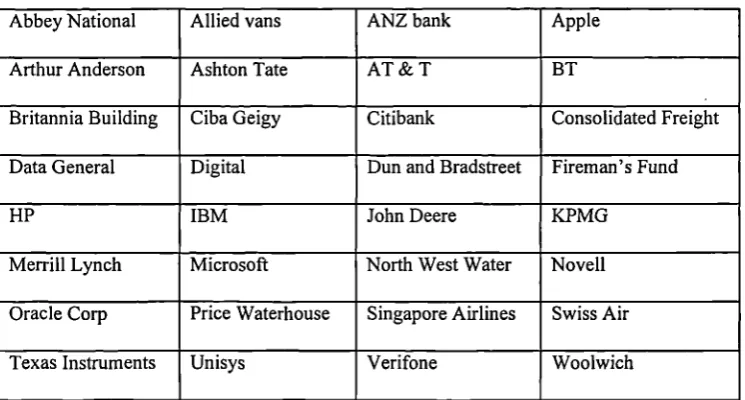
Philippines and Russia. Table 2.2 below indicates some of the major companies who
Abbey National Allied vans ANZ bank Apple
Arthur Anderson Ashton Tate AT & T BT
Britannia Building Ciba Geigy Citibank Consolidated Freight
Data General Digital Dun and Bradstreet Fireman's Fund
HP IBM John Deere KPMG
Merrill Lynch Microsoft North West Water Novell
Oracle Corp Price Waterhouse Singapore Airlines Swiss Air
[image:44.595.81.454.86.286.2]Texas Instruments Unisys Verifone Woolwich
Table 2.2 Examples Of Organisations Doing Major Development In India (McFarlan
1995)
Heeks (1995) examines the motivation of companies for Indian outsourcing and divides
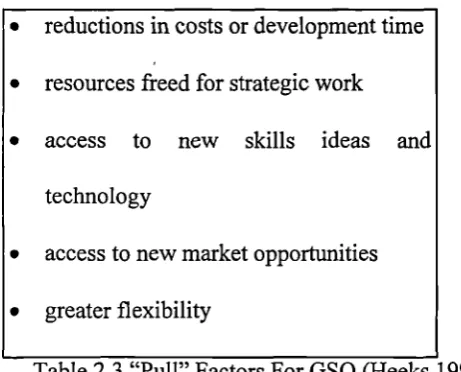
the factors into "push" and "pull" factors. The pull factors, shown in table 2.3, concern
flexibility, cost and availability of a highly educated pool of labour. The flexibility
means that companies can quickly divest excess staff but maintain their core staff
thereby cutting costs and risks. The cost factor is significant, considering the cost of a
client server programmer in India being roughly US$7500 compared with a similar
individual in the USA who would cost US$75000 (McFarlan 1995). Since McFarlan's
paper the cost differential has narrowed sharply and the author's interviews indicate
roughly a third difference in price between India and UK. Also these costs narrow
further when work is taking place onsite as higher rates apply as well as subsistence
costs but are still regarded as around 10% cheaper than equivalent local sourcing, if
• reductions in costs or development time
• resources freed for strategic work
• access to new skills ideas and
technology
• access to new market opportunities
• greater flexibility
Table 2.3 "Pull" Factors For GS0 (Heeks 1995)
The Indian education system is excellent, the author has taught at one of the elite Indian
Institutes of Management (JIM) and could not fail to be impressed with the commitment
and dedication applied by students. Discussion with JIM students indicated that they
perceived that there are fewer opportunities for the cream of the educational system in
India than in for instance the USA which has a relatively greater number of options
available which could attract top class graduates. JIM students seemed to perceive that
software development is an attractive career option in India and attracts those who
might have in the past opted for a career in medicine or engineering. The implication of
this would be a concentration of talent heading into the software industry. Another
factor is that many senior staff in Indian software houses have been educated abroad
having returned home for family or other reasons and thus have experience of living and
working abroad.
The "push" drivers are divided into "external" and "internal" factors. External factors
for engaging in GS0 include declining demand, increased competition, shortening
production cycles, labour problems or even pressures from governments. Internal
[image:45.595.82.313.58.244.2]