Journal of Chemical and Pharmaceutical Research, 2014, 6(5):297-302
Research Article
CODEN(USA) : JCPRC5
ISSN : 0975-7384
ENO morphological wavelet and its application in image processing
Lin Yong*
1and Ge Xinfeng
21
Zhejiang University of Technology, China
2
Xuchang University, China
_____________________________________________________________________________________________
ABSTRACT
The two dimensional ENO (essentially non-oscillatory) MW (morphological wavelet) algorithm is proposed, using the characteristics of ENO interpolation basically without oscillation, and improved reconstruction strategy. The original signal is decomposed by MW algorithm, and reconstructed according to ENO interpolation method. The algorithm is applied to image processing, results show the mentioned ENO MW algorithm has better profermance than the existing MW and has good application value.
Key words: Morphological wavelet (MW); essentially non-oscillatory (ENO) interpolation; ENO MW;
mathematical morphology; image processing
____________________________________________________________________________________________
INTRODUCTION
In 2000, Goustias [1] proposed the concept of morphological wavelet (MW), unified the most linear and nonlinear wavelet successfully and formed a united framework for multi-resolution analysis. MW [2-4] as a branch of wavelet theory nonlinear extension studies is based the mathematical morphology description methods of the nonlinear characteristics and which can be completely reconstructed and non-redundant on the image shape and morphological decomposition. MW transform is used to the time-frequency characteristics of image by combining of wavelet transform linearity and morphological operator non-linearity, and can describe the image shape feature, and has an extremely important significance in theory and in application. MW analysis is a nonlinear analysis; it is closer to the nonlinear characteristics of the image itself, the sub-images are better reflected the original image after decomposed. At present, there are two branches in the MW researching, one is the MW that proposed based on [1], which is a non-dual wavelet essentially; the other is a dual wavelet that based on various mathematical morphology operators, which is a multi-level morphological filters essentially that meeting pyramid reconstruction conditions, which is the generalized MW. MW notable feature is non-linear and can well reflect the linear and non-linear characteristics of the original image, that is the approximate image got by decomposition, can well describe the details of the original image. However, MW reconstruction strategy is interpolation in every two points for approximation image, the newly inserted point value is the same as the previous point, and then the detail image is joined in the odd and even bits using different methods, which naturally ensures the image perfect reconstructed, so when the detail signal is intercepted through the threshold value, the modified detail signal bits are mostly zero, resulting the next data is identical with the previous data in the reconstructed image, that is a stepped waveform appearing in the reconstruction, this phenomenon is extremely unfavorable in two dimensional image processing. ENO (Essentially Non-Oscillatory) interpolation technique [5] provides a good reference for the non-linear reconstruction of data-dependent; the advantage of this method has no data concussion basically after interpolated, and also avoid the Kyrgyzstan Booth effects of discontinuity. Multi-resolution analysis is proposed based on ENO interpolation in [6], however, it is not a wavelet technique essentially, and the frequency invariant characteristics are not guaranteed in image analyzing.
reconstruction. The image process is expanded into a two dimensional ENO MW algorithm, and its characteristics and effects were analyzed.
TWO-DIMENSIONAL ENO MW
MATHEMATICAL MORPHOLOGICAL BASIC TRANSFORMATION
Mathematical morphology is mathematical methods that developed on the basis of set theory and is different from the time, frequency [7].the target signal is describe by set, a structure element, called "probe", is designed in signal processing, the useful information can be extracted to characterize and describe through which the probe is constantly moving in the signal. The common operations are erosion, dilation, opening, closing, etc., are defined as follows.
Definition 1 assume A is a set, B is the structuring element, then the corrosion transform A to B is defined as:
{ : }
A BΘ = x B+ ⊃x A (1)
Definition 2 assume A is a set, B is the structuring element, then the expansion transform A to B is defined as: { : : } A⊕ =B Ux A b b+ ∈B (2)
Definition 3 assume A is a set, B is the structuring element, then the opening transform A to B is defined as: ˆ ( ) A Bo = Θ ⊕A B B (3)
Definition 4 assume A is a set, B is the structuring element, then the closing transform A to B is defined as: ˆ ( ) A B• = A⊕ ΘB B (4)
Four operations as above is the morphological basic operation. The realization of morphological transformation generally only contains Boolean operations, addition and subtraction from the above definitions, calculation is simple and computing speed is fast. TWO-DIMENSIONAL MW The image point coordinates (m, n), (2m, 2n), denoted by n, 2n; analogously, (2m+1, 2n), (2m, 2n+1), (2m+1, 2n+1) denoted by 2n+, 2n+, 2n++ respectively. The two-dimensional MW decomposition methods such as formula (5), (6) ψ↑(x)(n)=x(2n)∧x(2n+)∧x(2n +) ∧x(2n+ +) (5)
ω↑(x)(n)=( ωv(x)(n), ωh(x)(n), ωd(x)(n)) (6)
ωv, ωh, ωd represent the detail signals in direction of vertical, horizontal, diagonal respectively, definition as follows: ωv(x)(n)=0.5×((x)(2n)-x(2n + )+ x(2n+)-x(2n+ + )) (7)
ωh(x)(n)= 0.5×((x)(2n)-x(2n+)+x(2n +) -x(2n+ +)) (8)
ωd(x)(n)= 0.5×((x)(2n)-x(2n+)-x(2n +)+x(2n ++)) (9)
Reconstruction program: ψ↓(x)(2n)=ψ↓(x) (2n+) =ψ ↓ (x) (2n+)=ψ↓(x) (2n++)= x(n) (10)
ω↓(y) (2n)=( yv(n)+yh(n))∨( yv(n)+yd(n))∨( yh(n)+yd(n))∨0 (11)
ω↓(y) (2n+)=( yv(n)-yh(n))∨( yv(n)-yd(n))∨( yh(n)-yd(n))∨0 (12)
ω↓(y) (2n+)=( yh (n)-yv (n))∨(-yv(n)-yd(n))∨( yh(n)-yd(n))∨0 (13)
ω↓(y) (2n+ + )=(-yv (n)-yh (n))∨(yd(n)-yv(n))∨(yd(n)-yh(n))∨0 (14)
ENO INTERPOLATION
ENO interpolation method is used to calculate shock capturing in the hydrodynamic. The method is that the piecewise polynomial is defined adaptively to approach a given signal function according to this signal function smoothness.
Definition 4 assume Hm(xj;w)isthecontinuous m order interpolation function at the point {xi} and w piecewise, that
is
Hm(xj;w)=w(xj) (15)
Hm(x;w)=qm,j+1/2(x;w) xj≤x≤xj +1 (16)
qm,j+1/2(x;w)isthe m order interpolation polynomial that obtained by interpolated to w (x) on m +1 consecutive nodes
{xi}, im(j) is grid cell number of the leftmost in interpolation base frame.
im(j) ≤i≤im(j)+m
qm,j+1/2(xi;w)=w(xi), 1-m≤im(j)-j≤0 (17)
There have different reconstruction polynomial correspond to different im(j), so there are m polynomials of order m.
the most smooth base frame is selected as the interpolation base frame from m base frames including xj,xj+1, so w(x)
is the most smooth distribution to gradual sense on (xim(j),xim(j)+m).
The most crucial idea of ENO method is interpolation base frame selected by using adaptive technology, thus ensuring the method has ENO properties. The smoothness of w(x) distribution is reflected by the difference quotient of w. the difference quotient table as follows is established by recursive method.
w[xj]=w(xj)
w[xj, …, xj+k]=(w[xj, …, xj+k]-w[xj, …, xj+k-1])/(xj+k-xj) (18)
If w is C∞on [xj, xj+k], then there has
,
1
[ ,..., ] ( )
!
k
i i k k i k
d
w x x w
k dx ξ
+ = ,
, i i k i k
x ≤ξ ≤x+ (19)
However, when the p-order derivative is discontinuity on the interval,
( )
[ ,...,i i k] ( k p[ p ])
w x x+ =ο h− + w (20)
[w(p)] represents the p-order derivative is in intermittent
Formula (20) and (21) show that|w[xi, …, xi+k]|is smooth distribution criterion of w to gradual sense on (xi, xi+k),
that is w is smooth distribution on
1 2
(x xi, i+k),and there has intermittent on (xi2,xi2+k).There will always
have
1 1 2 2
[ i,..., i k] [ i ,..., i ]
w x x+ < w x x +k when h is small enough, thus the interpolated base frame is determined, im(j)
can be determined by recursive method in programmer. Basic steps as follows:
1) A first-order reconstruction polynomial is q1,j+1/2 on (xj, xj+1),there has i1(j)=j;
2) A k-order reconstruction polynomial is qk,j+1/2 onxik( )j,...,xik( )j+k, the base frame start point is ik(j)
.
3) A k +1 order reconstruction polynomial qk+1,j+1/2 is constructed by joining a cell on the left or right of ( ),..., ( )
k k
i j i j k
x x + ,that is ik+1(j)= ik(j)-1or ik+1(j)= ik(j).
The interpolation base frame is determined by selecting the minimum absolute difference quotient of w on these two base frames.
( ) 1 ( )
1 ( ) ( ) 1
( ) 1 [ ,..., ]
( ) [ ,..., ] ( ) others
k k
k k
k i j i j k
k i j i j k
k
i j w x x
i j w x x
i j
− +
+ + +
− <
=
(21)
substantially.
TWO DIMENSIONAL ENO MW ALGORITHMS
Two dimensional ENO MW algorithm is that ENO interpolation is carried out in approximate signal of image two-dimensional MW using ENO algorithm, the reconstructed signal can effectively keep the characteristics of highlighting the details had by MW decomposition signal, and also make ENO interpolation play almost no oscillation characteristics, the image is clearer reflected on the image processing effect.
Two-dimensional ENO MW algorithm consists of two main steps:
1) Image X0 with size of M×N (M, N=2a, a is non-zero positive integer), X0 is decomposed according to formula
(23)-(27), approximate signal X1, the vertical detail signal Y1v, the horizontal detail signal Y1h, the diagonal detail
signal Y1d, are obtained(the size is M /2×N/2);
2) approximate signal X1 is taken and expanded, and the expanded signal X1′is obtained(the size is (M
/2+1)×(N/2+1)), every point interpolation is achieved as above mention according to ENO interpolation algorithm to all rows of signal X1′and X1″(the size is (M /2+1)×(N+1))will be got; every point interpolation is achieved as
above mention according to ENO interpolation algorithm to all columns of signal X1′and X1’’’(the size is (M
+1)×(N+1))will be got. Interception the first M × N points, that is ENO reconstructed signal of approximation signal decomposed by the two-dimensional MW.
11 12 1 2 21 22 2 2 1 1 2
2 2 2 2
... ... ... ... ... ... ... N N
M M M N
x x x
x x x
X
x x x
= ⇒ 11 12 1 1 2 2 21 22 2 2 2 2 1 1 2
2 2 2 2 2 2
1 2
2 2 2 2 2 2
... ... ' ... ... ... ... ... ... ... N N N N
M M M N M N
M M M N M N
x x x x
x x x x
X
x x x x
x x x x
=
Above is one layer of two-dimensional ENO MW decomposition and reconstruction algorithm, multi-resolution of two-dimensional ENO MW decomposition and reconstruction algorithm is expanded based on one layer’s.
TWO-DIMENSIONAL ENO MW ALGORITHMS IN IMAGE PROCESSING
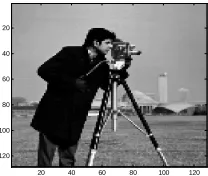
Wavelet image compression is the typical application of the wavelet transforms in image processing. Cameraman image as an example, the image compression effects of the ENO MW algorithm are analyzed.
Figure 6(a), (b), (c) is original image (cameraman), two layer decomposition by two dimensional MW and Haar wavelet.
In order to observe and compare conveniently, the image grayscale range of figure 6 (a), (b), (c) are mapped to 0-255, the distant high-rise buildings are visible in Figure 6 (c), and it is not visible in Figure 6 (b), and the grayscale of Figure 6 (b) degenerate seriously, which proved that MW decomposition is better to retain the border details of original image.
50 100 150 200 250 50
100
150
200
250
50 100 150 200 250 50
100
150
200
250
50 100 150 200 250 50
100
150
200
250
a) Original images b) 2-layer decomposition by Haar wavelet analysis c) 2-layer decomposition by MW analysis
Fig.6 Original images (cameraman) and 2-layer decomposition by Haar wavelet analysis and MW analysis
50 100 150 200 250 50
100 150 200 250
50 100 150 200 250 50
100
150
200
250
a) MW reconstruction b) ENO MW reconstruction
Figure 7 Image compression methods with invariant scale
In order to evaluate the processing methods to Figure 7 (a), (b) quantitatively, peak signal to noise ratio (PSNR), mean square error (MSE) and storage of image are analyzed which obtained by two compressed methods, the results as shown in Table 1.It should be noted that all the images are saved as jpg format, and then compared the image storage space. As can be seen from Table 1, three indices above mentioned of ENO MW compressed images are better than the MW compressed images’. It worth mentioning that, the storage space of ENO MW compressed image is also smaller than the storage space of MW compressed image. However, for the whole, the image compressed ratio of image compressed methods is not high.
Table 1 Comparison of compressed image on aspects of PSNR, MSE and image size
MW compression image ENO-MW compression image
PSNR 30.4187 52.6053
MSE 59.0487 0.3569
Image size(original size)256×256,10.1kb 256×256,7.37kb 256×256,6.49kb
The second image compression method can be used if only the image storage space is requested without considering the size of the image. The reconstruction is carried by approximate signal from low level to high level using ENO MW, of course, MW decomposition method also can be used. The difference is that the former is used for smaller image restoring into larger, and the latter is used for larger image decomposed into smaller, which method to use, as the case may be.
Figure 8 (a), (b) are images obtained by reconstructing the upper approximation signal according to ENO MW algorithm respectively, the second layer and the third layer approximation signal is decomposed by MW. The image size is 128 × 128 of figure 8 (a), the storage space is 3.51kb; the image size is 64 × 64 of figure 8 (b), and the storage space is 1.44kb, high image compressed ratio has been achieved.
20 40 60 80 100 120 20
40
60
80
100
120
10 20 30 40 50 60 10
20
30
40
50
60
[image:5.595.166.446.67.186.2]a) 2 layer approximation signal ENO MW reconstruction b) 3 layer approximation signal ENO MW reconstruction
Fig.8 Image compression methods with smaller scale
In summary, the more satisfactory results are achieved in image processing by ENO MW algorithm is proposed in this paper.
CONCLUSION
MW as a nonlinear wavelet, and is better to extract detail characteristics of the image, and ENO interpolation method can realize interpolation no oscillation on the whole, two-dimensional ENO MW algorithm is proposed combining the both advantages in this paper and applied to two dimensional image processing, the results show that the algorithm is better than MW algorithm and has better results.
[image:5.595.123.227.490.578.2] [image:5.595.384.492.490.578.2]with respect to the linear wavelet, and worthy of further study. ENO MW algorithm improves MW performance proposed in this paper, and is the rich of MW theory.
Acknowledgments
This work was supported in part by a grant from the Education Department Zhejiang Province (the number is Y201018585), to express my gratitude.
REFERENCES
[1] H.J.A.M. Heijmans, J. Goutsias. EEE Transactions on Image Processing, v.9, n.11, pp. 1897-1913, November,
2000.
[2] M XR. G YT. T JC. Transactions of China Electrotechnical Society,v.29, n.3, pp. 237-244, June, 2014. [3] L X.G QW.J JJ. Power System Protection and Control, v.39, n.15, pp. 57-63, 2011.
[4] J.F. Zhang, J.S. Smith, Q.H. Wu.IEEE Trans. on Circuits and Systems, v 53, n 6, p 1395-1402, June 2006. [5] A. Harten, B.Engquist, S. Osher. Journal of Computational Physics, vol.131, no.1, pp. 3-47, January, 1997. [6] Francesc Ar andiga, Rosa Donat. Numerical Algorithms, v. 23, p. 175-216, 2000.