Jensen, Sarah K.G. and Dumontheil, Iroise and Barker, Edward D. (2014)
Developmental inter-relations between early maternal depression, contextual
risks, and interpersonal stress, and their effect on later child cognitive
functioning. Depression and Anxiety 31 (7), pp. 599-607. ISSN 1091-4269.
Downloaded from:
Usage Guidelines:
Please refer to usage guidelines at or alternatively
This is the peer reviewed version of the following article: Jensen SKG, Dumontheil I, and Barker ED. "Developmental inter-relations between early maternal depression, contextual risks, and interpersonal stress, and their effect on later child cognitive functioning. Depression and Anxiety
(2014), 31(7):599-607, which has been published in final form at
[http://onlinelibrary.wiley.com/doi/10.1002/da.22147/full]. This article may be used for non-commercial purposes in accordance with Wiley Terms and Conditions for Self-Archiving.
Developmental inter-relations between early maternal depression, contextual risks, and interpersonal
stress, and their effect on later child cognitive functioning
Sarah K. G. Jensen M.Sc.a,b
Iroise Dumontheil Ph.D.b
Edward D. Barker Ph.D.a,b
aDepartment of Psychology, Institute of Psychiatry, King’s College London
b Department of Psychological Sciences, Birkbeck, University of London, London, UK.
Correspondence to Dr. Edward D. Barker, Department of Psychology, Institute of Psychiatry, King’s
College London, 16 De Crespigny Park, London, SE5 8AF, Email: [email protected]
Short title: Impact of risks on cognitive functioning
Abstract
Background: Maternal depression and contextual risks (e.g., poverty) are known to impact
children’s cognitive and social functioning. However, few published studies have examined how
stress in the social environment (i.e., interpersonal stress) might developmentally inter-relate
with maternal depression and contextual risks to negatively affect a child in these domains. This
was the purpose of the current study. Method: Mother-child pairs (n= 6979) from the Avon
Longitudinal Study of Parents were the study participants. Mothers reported on depression,
contextual risks and interpersonal stress between pregnancy and 33 months child age. At age 8,
the children underwent cognitive assessments and the mothers reported on the children’s social
cognitive skills. Results: Maternal depression, contextual risks, and interpersonal stress showed
strong continuity and developmental inter-relatedness. Maternal depression and contextual risks
directly predicted a range of child outcomes, including executive functions and social cognitive
skills. Interpersonal stress worked indirectly via maternal depression and contextual risks to
negatively affect child outcomes. Conclusion: Maternal depression and contextual risks each
increased interpersonal stress in the household, which, in turn, contributed to reduced child
Introduction
Maternal depression can negatively impact a range of cognitive functions[1] and verbal
abilities,[2] as well as children’s abilities to regulate their own emotions and behaviours[3]. The
effects of maternal depression are often attributed to impaired parenting. That is, depressed
mothers can show decreased sensitivity in interactions with a child, and a lack of contingency in
the response to the child’s actions[4,5]. Such developmental circumstances are thought to impede
the ability of a child to achieve developmental milestones in the cognitive[6] and socio-emotional
domains[5].
Similar to maternal depression, contextual risks can negatively impact children’s
cognitive functioning, including executive functions such as attention[7], inhibitory control[8],
IQ[9], and language development[10]. Contextual risks are defined as factors that affect an
individual’s basic living conditions (e.g., poverty and housing inadequacy). The effect of
contextual risks on child cognitive functioning is believed to work through parents having lower
levels of education and fewer resources with which to engage their children in cognitively
stimulating interactions[11].
Still, it may be that the effect of both maternal depression and contextual risks on
children is at least partially explained by factors relating to the immediate social environment a
child experiences[12] . This is particularly important since, early in the life course, the mother
constitutes the primary social environment for the child[13]. With regard to depression,
Hammen’s Stress Generation Model[14] posits that depressed persons can generate interpersonal
stress (i.e., interpersonal conflict and low levels of social and practical support)[15], which can
then work in a bidirectional manner to increase and maintain depression[16]. Three studies have
adolescents[16,17] and children[18]. Still, these studies largely did not assess the relative impact of
contextual risks. This is an important limitation since maternal depression co-occurs, both
cross-sectionally[19] and longitudinally[18], with interpersonal stress and contextual risks[20]. Therefore,
both contextual risks and interpersonal stress may affect the development of a child via
depression in a mother. For example, contextual risks (e.g., income) are reported to be more
strongly associated with low levels of maternal sensitivity in depressed compared with
non-depressed mothers[21].
A limited number of studies have examined the combined effect of maternal depression
and contextual risks on children’s cognitive functioning, and findings are mixed. For example,
certain studies report that maternal depression and contextual risks independently affect child
cognition[4,6,8,22], whereas other studies suggest that the effect of maternal depression is
particularly pronounced when co-occurring with contextual risks[13,23]. Some studies have
related the effect of maternal depression on children’s development to impaired mother-infant
interactions[5,13,21]. Yet, as stated above, these studies have largely not considered the additional
impact of interpersonal stress.
The present study examined the extent to which maternal depression, contextual risks,
and interpersonal stress early in development can inter-relate to negatively impact children’s
cognitive functioning and social cognitive skills. We investigated four developmental pathways.
Two pathways (paths A and B) tested the bidirectional relationships between maternal
depression and interpersonal stress suggested by Hammen’s Stress Generation Model[24]. The
remaining two pathways (paths C and D) investigated the effect of contextual risks increasing
either maternal depression or interpersonal stress, each of which then increases the other (i.e.,
and social functioning. Pathways C and D followed research that has reported contextual risks to
prospectively associate with maternal depression and interpersonal stress[18,20,21]; these two
pathways tested the degree to which contextual risk can affect child development through
associating with higher levels maternal symptoms of depression, and interpersonal stress.
Materials and Methods
Sample
The Avon Longitudinal Study of Parents and Children (ALSPAC) is an ongoing
population-based study designed to investigate the effects of an array of influences on the
development and health of children. Pregnant women residing in the former Avon Health
Authority in South-West England, who had an estimated date of delivery between 1 April 1991
and 31 December 1992, were invited to participate in the study. This resulted in a cohort of
14,541 pregnancies, of which 13,988 singletons/twins were alive at 12 months of age[25]. The
overall ALSPAC sample has been found to be representative of the UK population as a whole[26].
Ethical approval for the current study was obtained from the ALSPAC Law and Ethics
Committee and the Local Research Ethics Committees. More information on the ALSPAC
sample is available from the website: http://www.bris.ac.uk/alspac/.
Risk measures
Mothers completed questionnaires at multiple time points during their pregnancy
and their child’s infancy and childhood. The early risk factors examined here were drawn
from questionnaires completed between birth and approximately 3 years of child age. Our
previous research has demonstrated the validity of the risk measures specified below[27,28] .
repeatedly postnatally (at 8 weeks, 8 months, 21 months, and 33 months) with the Edinburgh
Postnatal Depression Scale[29]. EPDS is a widely used 10-item self-report questionnaire that has
been shown to be valid both in and outside of the postnatal period[29]. We used a measure of
summed symptoms, where higher scores corresponded to higher levels of depressive symptoms.
Continuous measures of psychopathology have shown high reliability and validity, even
compared with categorical (i.e., clinical) measures[30].
Contextual risk. Measures ofcontextual risks were drawn from the family adversity
measure[31], and obtained from maternal questionnaires at 18 weeks in pregnancy and at 33
months postnatally. Contextual risks were grouped into three time points: pregnancy, 0-2 years,
and 2-4 years. We assessed seven contextual risks resulting in a cumulative risk index ranging
from 0 to 7. Indication of any risk, at any time point, was scored as 1. The seven risks were: (1)
inadequate basic living conditions (e.g., not having a working bath/shower, no hot water, no
indoor toilet and/or no working kitchen) (assessed 8 weeks in pregnancy, and at 2, 8, 21, 33, and
47 months postnatally); (2) inadequate housing conditions (e.g., indication of crowding)
(assessed at 8 weeks in pregnancy and at 21 and 33 months postnatally) and/or homelessness
(assessed at 18 weeks in pregnancy and at 2, 8, 21, and 33 months postnatally); (3) housing
defects (e.g., indication of mold, roof leaks, and rats, mice or cockroaches) (assessed at 18 weeks
in pregnancy; and 8, 21, and 33 months postnatally); (4) poverty coded via the Registrar
General’s social class scale[32] (assessed at 32 weeks in pregnancy and at 8, 21, and 33 months
postnatally); (5) single caregiver status (e.g., not cohabiting and not in a relationship) (assessed
at 32 weeks in pregnancy and at 6, 21, 33, and 47 months postnatally); (6) early parenthood (one
parent being 19 years or younger) (assessed at 18 weeks in pregnancy); and (7) low parental
pregnancy and at 21 and 33 month).
Maternal interpersonal stress.Measures of maternal interpersonal stress were collected
simultaneously with contextual risks (i.e., in pregnancy, 0-2 years and 2-4 years child age). We
used five categories of interpersonal stress resulting in a cumulative index ranging from 0 to 5.
Again indication of any risk, at any age-stage, was scored as 1. The five categories of
interpersonal stress were (1) mother experiencing partner cruelty (e.g., any indication of
emotional and/or physical abuse from partner) (assessed at 18 weeks in pregnancy and at 2, 6,
21, 33, and 47 months postnatally); (2) low partner affection towards the mother (e.g., partner
shows no affection, does not hug/kiss, low intimate bond) (assessed at 12 weeks in pregnancy
and at 8 and 33 months postnatally); (3) low partner social support (e.g., partner does not discuss
feelings, lack of emotional support) (assessed at 18 weeks in pregnancy and at 2 and 8 months
postnatally); (4) low practical support (i.e., no one could lend the mother £100 and/or the
absence of someone the mother could turn to if in trouble) (assessed at 12 weeks in pregnancy
and at 8 months postnatally); and (5) major family problems examined via social services data
(e.g., a child in the household taken into extra-familial care or registration with at-risk register)
(assessed at 18 weeks in pregnancy and at 21, 33, and 47 months postnatally).
Child cognitive functioning at age 8
Verbal and performance Intelligence Quotient (IQ). Verbal and performance IQ were
measured with the Wechsler Intelligence Scale for Children (WISC) (3rd UK edition) using an
edition consisting of alternate items for all subtests except for the coding subtest, which was
administered in full-length. Scores were age-normed in accordance with standard procedures[33].
validity[34].
Attention and inhibition. Attentional and inhibitory control was measured by the Test of
Everyday Attention for Children (TEA-ch)[35]. We used the Sky Search Task to measure
selective attention, and inhibition was measured in the Opposite Word Task. In the Sky Search
Task the child was given a printed display containing rows of pairs of spacecrafts and instructed
to identify pairs of two identical crafts by circling them on the sheet (20 target pairs among 108
distractor pairs). The task was self-paced and selective attention was calculated as the time spent
per identified target (the total time spent on the task divided by the number of identified space
crafts). We adjusted for motor speed by subtracting time spent per identified spacecraft in a
display that contained no distractors. The Sky Search task has shown high convergence validity
with other commonly used measures of attention[35]. Moreover, the task has been used to
distinguish between healthy children and children with attention deficit disorders[35].The
Opposite Word Task required the child to inhibit a pre-learned response. The child was presented
with a list of 24 numbers (“1” or “2”) in a random sequence and asked to read the numbers out as
quickly as possible (same word condition). In a second run, the child was required to inhibit the
prepotent response by saying “2” whenever “1” was printed and vice versa (opposite word
condition). Reaction time in the opposite word condition was used as a measure of inhibitory
control. The Opposite Word Task has also shown high convergence validity with other measures
of inhibition, and performance on this task is significantly correlated with the Stroop task[35].
Child social cognitive skills. Social cognitive skills were evaluated using the Social
Cognition Scale[36]. The scale was completed by the mother who responded to questions
exploring various aspects of her child’s social cognitive skills e.g., awareness of other people’s
that an item is not true, 1 indicates that an item is sometimes true and 2 indicates that an item is
very or often true. Higher scores are indicative of decreased social cognitive skills[36]. The scale
has shown high re-test reliability and high construct validity when scores are compared with
other measures of social cognitive competences[37]. Moreover, the scale has been found to
discriminate children with conditions characterized by social cognitive deficits such as Autism
Spectrum Disorders[37].
Attrition and Missing Data.
Of the original 14,541 mothers enrolled in the study, we included only the children (and
corresponding mothers) who had data for the verbal IQ task on WISC, since this task that had the
highest number of completions (n=6979). Within the selected subsample, complete data was
available for maternal depression, contextual risks, and interpersonal stress. For performance IQ,
0.4% of the children (n = 30) were missing. For attention and inhibition, 3.5% of the children (n
= 246) were missing. For social cognitive skills, 15% of the children (n = 1045) were missing.
Because listwise deletion of cases with partial complete data can increase sample bias[38],
missing data on the outcomes was replaced using full information maximum likelihood[38]. In
accordance with Little and Rubin’s theory[39], Mplus includes respondents with missing data
using full information maximum likelihood estimation, which treats missing data as missing at
random and allows the use of all available data[40].
We tested, in a multivariate logistic regression, the degree to which the study variables
predicted exclusion from the sample. Odds ratios (ORs) showed that mothers who were excluded
from the current analysis had higher symptoms of depression (OR=1.06; 95% CI=1.05-1.07),
interpersonal stress (OR=1.09; 95% CI=1.05-1.13). Of note, all three risks (i.e., maternal
depression, contextual risk and interpersonal stress) were included in the overall analyses, which
helps decrease bias related to missing data[39].
Analysis
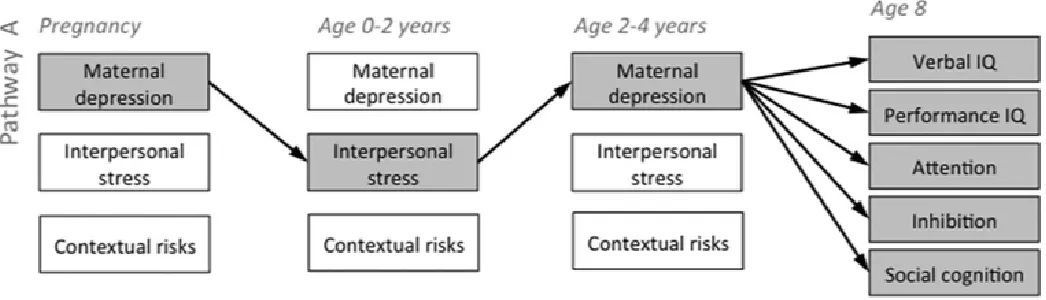
The analysis proceeded in two steps. In the first step an autoregressive cross-lag (ARCL)
model was estimated (see Figure 1, top portion). The ARCL model allows for the simultaneous
estimation of four basic parameters of interest: (1) auto-regressions, i.e., continuity in maternal
depression, contextual risks, and interpersonal stress; (2) cross-lags, i.e., the effect of maternal
depression on subsequent contextual risks and interpersonal stress, and vice versa; (3)
within-time covariance of maternal depression, contextual risks, interpersonal stress, and the cognitive
outcomes; and (4) predictions from maternal depression, contextual risks, and interpersonal
stress to later child cognitive functioning. The ARCL model provides a conservative estimate of
child outcome predictions given the auto, the cross and within-time measures.
In the second step of the analysis we examined four indirect pathways that could lead to
decreased cognitive functioning (see Figure 1). The first two pathways (A and B) investigated
Hammen’s model[24], which suggests a bidirectional inter-relation between maternal depression
and interpersonal stress. The subsequent two pathways (C and D) investigated paths going from
increased contextual risks to either maternal depression or interpersonal stress, which then in
turn increased the other. In Pathway A, maternal depression increased interpersonal stress, which
in turn, increased maternal depression which negatively affected child cognitive functioning. In
Pathway B, interpersonal stress increased maternal depression, which in turn, increased
interpersonal stress, leading to decreased cognitive functioning. In Pathway C, contextual risks
impacted child cognitive functioning. Finally, in Pathway D, contextual risks increased
interpersonal stress, which then increased maternal depression, which negatively affected child
cognitive functioning.
PLEASE INSERT FIGURE 1
Indirect pathways were programmed in model constraint statements and were
bootstrapped 10,000 times with bias-corrected confidence intervals. All analyses were carried
out in Mplus version 5.1[41]. Model fit was assessed through the Comparative Fit Index, the
Tucker-Lewis Index (CFI and TLI; acceptable fit determined as ≥ .09[42]) and root mean square
error of approximation (RMSEA; acceptable fit determined by ≤ .08[43]).
Results
Descriptive statistics
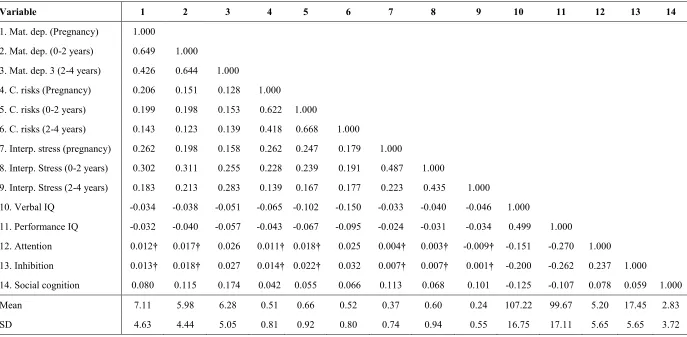
Correlations. Table 1 shows the correlations (and means and standard deviations) among
the study variables. Firstly, maternal depression, contextual risks, and interpersonal stress were
significantly correlated both within and between time points. Maternal depression and
interpersonal stress were more highly correlated with each other, than they were with contextual
risks.Correlations between the three risk factors (measured at age 2-4 years) and the outcome
variables showed that,verbal and performanceIQ were correlated with all three risks, but most
highly correlated with contextual risks. Attention and inhibition were both highly correlated with
maternal depression and contextual risks. Social cognitive skills were correlated with all three
risk factors. All correlations indicated that higher levels of risks were associated with worse child
PLEASE INSERT TABLE 1
Step 1: Autoregressive cross-lags
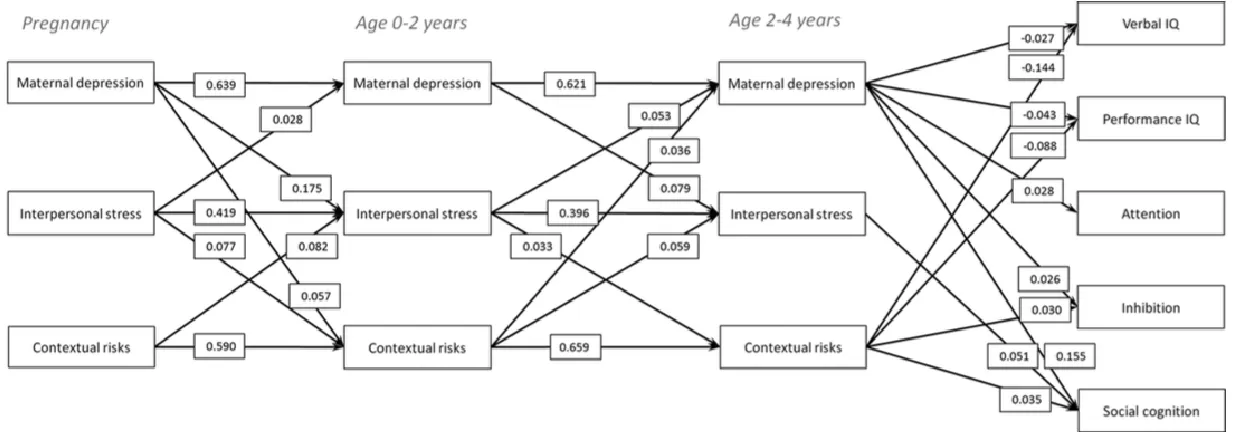
The ARCL model (Figure 2) with the five child outcomes (verbal IQ, performance IQ,
attention, inhibition and social cognitive skills) showed acceptable fit to the data. χ2(39)
=1016.984 , p<.0001; CFI = 0.958; TLI= 0.906; RMSEA = 0.060, 90% CI 0.057 -0.063; SRMR
= 0.031.
PLEASE INSERT FIGURE 2
Interrelations among risks. Maternal depression, contextual risks, and interpersonal stress
showed strong between-time continuity (i.e., auto-regressions). The cross-lagged predictions
showed that maternal depression, contextual risk, and interpersonal stress largely predicted each
other at subsequent time points. More specifically, maternal depression in pregnancy predicted
both interpersonal stress and contextual risks at child age 2; maternal depression at child age
0-2 predicted subsequent (age 0-2-4) interpersonal stress, but not contextual risks; and contextual
risks predicted interpersonal stress at subsequent time points.
Direct risk associations with cognitive outcomes at age 8. Three results are highlighted.
Firstly, maternal depression significantly predicted all cognitive outcomes, but was most strongly
associated with social cognitive skills. Secondly, contextual risks significantly predicted social
cognitive functioning and cognitive outcome on all measures except for attention. In addition
interpersonal stress predicted social cognitive skills only.
Step 2: Indirect effects
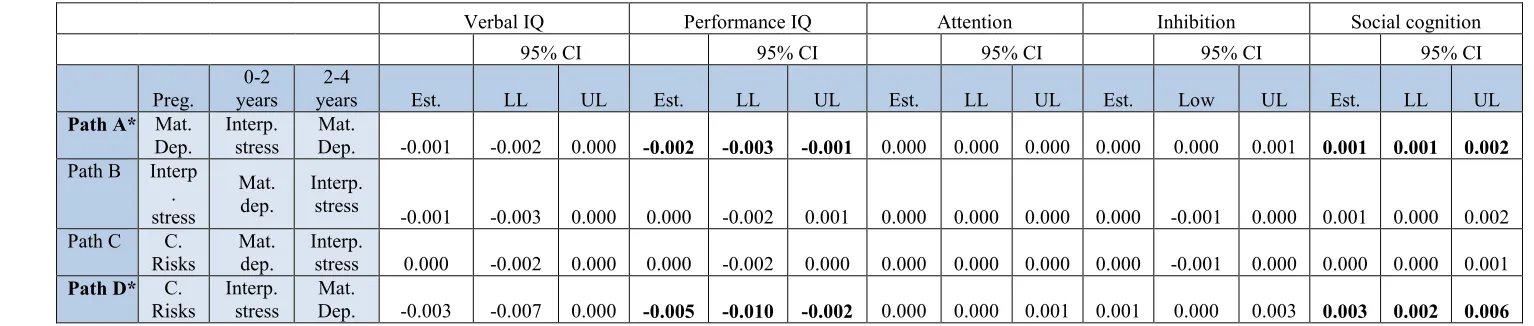
The indirect effects (Table 2) showed that two pathways were significantly associated
with decreased performance IQ and social cognitive skills: (1) Pathway A, which tested the
effect of maternal depression increasing interpersonal stress, which then increased maternal
depression; and (2) Pathway D, which tested contextual risks increasing interpersonal stress
which then increased symptoms of maternal depression.
PLEASE INSERT TABLE 2
Discussion
Within an integrated developmental model, which controls for a variety of potential
confounds (i.e., auto regressions, cross-lags and within-time associations), we examined four
developmental pathways through which maternal depression, contextual risks and interpersonal
stress may impact on child cognitive and social cognitive skills. A strength of the current study is
that we tested the developmental inter-relationships amongst risks that may affect child
functioning in different manners[22]. Furthermore, we tested these developmental associations for
a range of cognitive functions including executive functions and social cognitive skills. Our
findings increase the current knowledge on risk-to-outcome association on child cognitive
abilities in three main ways.
First, the present study examined the developmental inter-relationships of maternal
within each risk factor, and strong inter-relations among risks such that one risk factor (e.g.,
maternal depression during pregnancy) predicted other risk factors (e.g., interpersonal stress) at
subsequent time points. Hence, this research lends an important perspective on how risk factors
may developmentally maintain and reinforce each other. Importantly, we note that the
inter-relations among risks suggest that risks that are distal to the child’s social environment (i.e.,
contextual risks), can work to maintain risks that are more proximal to the child’s social
environment (i.e., maternal depression and interpersonal stress).
Second, with regard to direct associations, the present study found that maternal
depression and contextual risks negatively impacted almost all of the cognitive abilities assessed,
as well as the children’s social cognitive skills. This finding supports previous research where
maternal depression and contextual risks have been found to each independently affect child
cognition[8,10,22]. More specifically, however, we found that the main difference between
maternal depression and contextual risks was that only maternal depression (which is more
proximal to the child’s immediate social environment) was associated with child attention. This
may support previous suggestions that the child's social environment is key to the development
of attentional capacities[44]. This finding is intriguing since attention, as measured here, has
previously been associated with attention deficit disorder[45], which has also been associated with
risks relating to the social environment[46].
Maternal depression and interpersonal stress were found to have a larger effect on the
child’s social cognitive skills than contextual risks. Hence, social cognitive functioning, which is
known to relate to autism[47], depression[48] and conduct problems[49], appears to be particularly
sensitive to disruptions in the immediate social environment of children (i.e., maternal
depression, contextual risks were most strongly associated with verbal IQ. The contextual risks
index used in the current study includes factors relating to parental education and economic
resources, which have previously been associated with below average language development in
children[50]. Our findings may support the notion that crystalized measures of intelligence, such
as verbal IQ, are strongly associated with factors related to contextual risks, such as the
decreased amount of cognitive stimulation related to the education and resources of the parents,
as measured in the current contextual risks variable[51,52].
The third way the current research contributes to the extant knowledge on risk exposure
and child cognitive abilities is through the examination of the four developmental pathways (i.e.,
indirect effects). In reminder, we investigated four developmental pathways through which
maternal depression, contextual risks, and interpersonal stress could interrelate to affect
children’s cognitive and social functioning. Indirect pathways give an important perspective on
how risks developmentally inter-relate to affect child outcomes[48]. Of note, we found that
although interpersonal stress did not directly affect children’s cognitive functioning, it was
implicated in two indirect pathways (A and D). First, in support of Hammen's Stress Generation
Model[24], we identified a bidirectional relationship between maternal depression and
interpersonal stress[16] where maternal depression increased interpersonal stress, which, in turn
increased maternal depression, which then impacted child performance IQ and social cognitive
skills. The second significant developmental pathway was contextual risks increasing
interpersonal stress, which increased maternal depression, which then associated with decreased
performance IQ and social cognitive skills. This pathway underscores that contextual risks can
affect factors related to the social environment (i.e., interpersonal stress and maternal
study found that unfavorable economic conditions in the first year of life had adverse impactions
for children’s psychological development and behavioral problems[53]. Future studies could look
into whether such effects are related to the effect of contextual risks on risks that are more
proximal to the social environment of the child.
Limitations. The current study should be interpreted in light of five main limitations.
First, measures of maternal depression, contextual risks, interpersonal stress, and the child’s
social cognitive skills were based on maternal reports, introducing the problem of shared
methods variance. Second, maternal reports on child social cognition may be affected by the fact
that some mothers qualified for a clinical diagnosis of depression[18] and may consequently rate
their children more negatively. Still, a recent meta-analysis showed no difference in maternally
rated child outcomes in depressed and non-depressed mothers[48]. Third, the risk measures were
collected at least 4 years prior to the cognitive assessments at age 8, therefore, unmeasured
factors more proximal to the assessments may have influenced the cognitive outcomes. Still, it is
important to note that, given the strong continuity of the risk variables over time, these risks
undoubtedly still negatively affected the child at times proximal to the age 8 assessments.
Fourth, the present study is correlational in nature and the indirect pathways should not be
considered causative. Relatedly, all of the significant prospective associations (direct and
indirect) between risk exposures and child outcomes were small in effect size, and hence should
no be considered deterministic of a child’s cognitive or social functioning. Fifth, similar to most
large longitudinal cohorts, the Avon Longitudinal Study of Parents and Children has faced
attrition over time. As might be expected, mothers high in depressive symptoms with
co-occurring contextual risk and interpersonal stress were more likely to have children who did not
the highest risk. However, a recent study based on the Avon Longitudinal Study of Parents and
Children cohort[54] confirmed that although attrition affected the prevalence rates of antisocial
behaviors and related disorders, associations between risks and outcomes remained intact
(although conservative estimates of the likely true effects).
Conclusion
The current study adds to the extant knowledge of how risk factors during pregnancy,
infancy, and early childhood are developmentally associated with decreased cognitive
functioning in childhood. Such developmental understanding of early risk exposure is critical for
our understanding of risk-to-outcome relations, and may have important direct implications for
early intervention strategies[48]. Our results indicate that early maternal depression and contextual
risks directly affect children’s cognitive and social functioning later in life. Moreover, we found
that interpersonal stress contributed to developmental pathways that enhanced the effects of
maternal depression and contextual risks on children’s cognitive outcome and social cognitive
skills. Our results illustrate the importance of both contextual risks, and risks that are more
proximal to the social environmental of the child (i.e., maternal depression and interpersonal
stress), supporting the notion that the social environment represents an important developmental
context during early development[55]. Given the dependence of children on the mother early in
development[9,44], environmentally focused interventions often address the circumstances of the
mother as a proxy for the social environment of the child[57]. The current research adds to the
field by suggesting that helping mothers in high-risk environments manage their interpersonal
stress may benefit the child by reducing the effect of maternal depression and contextual risks on
Acknowledgements: we are extremely grateful to all the families who took part in this study, the
midwives for their help in recruiting them, and the whole ALSPAC team, which includes
interviewers, computer and laboratory technicians, clerical workers, research scientists,
volunteers, managers, receptionists and nurses, and The UK Medical Research Council (grant ref:
74883), the Wellcome Trust (grant ref: 0754567) and the University of Bristol provide core support
for ALSPAC. Sarah K. G. Jensen had full access to all of the data in the study and takes responsibility
for the integrity of the data and the accuracy of the data analysis. Research reported in this publication
was supported by the Eunice Kennedy Shriver National Institute Of Child Health & Human Development
of the National Institutes of Health under Award Number R01HD068437 to E. D. Barker. The content is
solely the responsibility of the authors and does not necessarily represent the official views of the
National Institutes of Health. Sarah K. G. Jensen was supported by the Economics and Social Research
References
1. Hughes C, Roman G, Hart MJ, Ensor R. Does maternal depression predict young children’s executive function? - a 4-year longitudinal study. J Child Psychol Psychiatry 2013;54(2):169– 177.
2. Barker ED, Jaffee SR, Uher R, Maughan B. The contribution of prenatal and postnatal maternal anxiety and depression to child maladjustment. Depress Anxiety. 2011;28(8):696–702.
3. Feldman R, Eidelman AI. Biological and environmental initial conditions shape the trajectories of cognitive and social-emotional development across the first years of life.
Developmental Sci 2009;12(1):194–200.
4. Hay DF, Pawlby S, Sharp D, Asten P, Mills a, Kumar R. Intellectual problems shown by 11-year-old children whose mothers had postnatal depression. J Child Psychol Psychiatry
2001;42(7):871–889.
5. Cox A, Puckering C, Pound A, Mills M. The impact of maternal depression in young children.
J Child Psychol Psychiatry 1987;28(6):917–929.
6. Lyons-Ruth K, Connell DB, Grunebaum HU, Botein S. Infants at Social Risk: Maternal depression and family support services as mediators of infant development and security of attachment. Child Dev 1990;61(1):85–98.
7. Rueda MR, Posner MI, Rothbart MK. The development of executive attention: contributions to the emergence of self-regulation. Dev Neuropsychol 2005;28(2):573–594.
8. Farah MJ, Shera DM, Savage JH, et al. Childhood poverty: specific associations with neurocognitive development. Brain Res 2006;1110(1):166–174.
9. Duncan GJ, Brooks-Gunn J. Family poverty, welfare reform, and child development. Child Dev 2000;71(1):188–196.
10. Noble KG, McCandliss BD, Farah MJ. Socioeconomic gradients predict individual differences in neurocognitive abilities. Developmental Sci 2007;10(4):464–480.
11. Conger RD, Donnellan MB. An interactionist perspective on the socioeconomic context of human development. Annu Rev Psychol 2007;58:175–199.
12. Rutter M, Quinton D. Parental psychiatric disorder: effects on children. Psychol Med
2009;14(04):853–880.
13. Murray L, Kempton C, Woolgar M, Hooper R. Depressed mothers’ speech to their infants and its relation to infant gender and cognitive development. J Child Psychol Psychiatry
14. Hammen C. Generation of stress in the course of unipolar depression. J Abnorm Psychol. 1991;100(4):555–561.
15. Brown GW, Craig TKJ, Harris TO. Parental maltreatment and proximal risk factors using the Childhood Experience of Care & Abuse (CECA) instrument: a life-course study of adult chronic depression - 5. J Affect Disorders. 2008;110(3):222–233.
16. Hammen C, Shih JH, Brennan P. Intergenerational transmission of depression: test of an interpersonal stress model in a community sample. J Consult Clin Psychol 2004;72(3):511–522.
17. Garber J, Cole D a. Intergenerational transmission of depression: a launch and grow model of change across adolescence. Dev Psychopathol 2010;22(4):819–830.
18. Barker ED. The duration and timing of maternal depression as a moderator of the
relationship between interpersonal stress, contextual risk and early child dysregulation. Psychol Med. In press.
19. Barker ED, Copeland W, Maughan B, Jaffee SR, Uher R. Relative impact of maternal depression and associated risk factors on offspring psychopathology. Br J Psychiat
2012;200(2):124–129.
20. Cicchetti D, Rogosch FA, Sheree TE. Maternal depressive disorder and contextual risk: Contributions to the development of attachment insecurity and behavior problems in toddlerhood. Dev Psychopathol. 1998;10(2):283–300.
21. NICHD Early Child Care Research Network. Chronicity of maternal depressive symptoms, maternal sensitivity, and child functioning at 36 months. Dev Psychol. 1999;35(5):1297–1310.
22. Hughes C, Roman G, Hart MJ, Ensor R. Does maternal depression predict young children’s executive function? - a 4-year longitudinal study. J Child Psychol Psychiatry 2013;54(2):169– 177.
23. Kurstjens S, Wolke D. Effects of maternal depression on cognitive development of children over the first 7 years of life. J Child Psychol Psychiatry 2001;42(5):623–636.
24. Hammen C. Depression runs in families: The social context of risk and resilience in children
of depressed mothers. New York: Springer-Verlag; 1991.
25. Fraser A, Macdonald-Wallis C, Tilling K, et al. Cohort Profile: The Avon Longitudinal Study of Parents and Children: ALSPAC mothers cohort. Int J Epidemiol 2012:1–14.
27. Barker ED, Oliver BR, Maughan B. Co-occurring problems of early onset persistent, childhood limited, and adolescent onset conduct problem youth. J Child Psychol Psychiatry
2010;11:1217–1226.
28. Barker ED, Maughan B. Differentiating Early-Onset Persistent Versus ChildhoodLimited Conduct Problem Youth. Am J Psych. 2009;166:900–908.
29. Murray L, Carothers a. D. The validation of the Edinburgh Post-natal Depression Scale on a community sample. Brit J Psychiat 1990;157(2):288–290.
30. Markon KE, Chmielewski M, Miller CJ. The reliability and validity of discrete and
continuous measures of psychopathology: a quantitative review. Psychol Bull 2011;137(5):856– 879.
31. Bowen E, Heron J, Waylen A, Wolke D. Domestic violence risk during and after pregnancy: findings from a British longitudinal study. BJOG - Int J obstet Gy 2005;112(8):1083–1089.
32. Surveys OoPCa: HMSO. Standard Occupational classification, Vol. 3. London; HMSO; 1991.
33. Wechsler D. Wechslers Intelligence Scale for Children. 3rd ed. San antonio, TX, USA: The Psychological Corporaion; 1992.
34. Witta E, Keith T. Hierarchical and Cross-Age Confirmatory Factor Analysis of the WISC-III: What Does it Measure? School Psychol Quart 1997;12(2):89–107.
35. Manly T, Anderson V, Nimmo-Smith I, Turner A, Watson P, Roberts IH. The differential assessment of children’s attention: The Test of Everyday Attention for Children (TEA-Ch), normative sample and ADHD performance switch. J Child Psychol psychiatry 2001;42(8):1065– 1081.
36. Skuse DH, Creswell C, Mcgurk R. Evidence from Turner ’ s syndrome of an imprinted X-linked locus affecting cognitive function. Nature 1997;387:705–708.
37. Skuse DH, Mandy WPL, Scourfield J. Measuring autistic traits: heritability, reliability and validity of the Social and Communication Disorders Checklist. Brit J Psychiat 2005;187:568–72.
38. Enders CK. Applied missing data analysis. The Guilford Press; 2010.
39. Little RJA, Robin DB. Statistical Analysis with Missing Data. 2nd ed. New York, NY, US: John Wiley & Sons Inc; 2002
40. Johnson D, Whisman M, Robin P, Hewitt J, Rhee S. Association Between Depressive Symptoms and Negative Dependent Life Events from Late Childhood to Adolescence. Journal
41. Muthen LK, Muthen BO. Mplus. Syatistical analyses with latent variables. User’s guide. Los Angeles: Muthen & Muthen
42. Bentler PM, Bonett DG. Significance tests and goodness of fit in the analysis of covariance structures. Psychological Bulletin. 1980;88(3):588–606. doi:10.1037//0033-2909.88.3.588.
43. Browne MW, Cudeck R. Alternative ways of assessing model fit. (Bollen KA, Long JS, eds.). Newbury Park, CA: Sage; 1993:136–162.
44. Lipina SJ, Posner MI. The impact of poverty on the development of brain networks.
Frontiers in human neuroscience. 2012;6(238):1–11. doi:10.3389/fnhum.2012.00238.
45. Sroubek A, Kelly M, Li X. Inattentiveness in attention-deficit/hyperactivity disorder.
Neuroscience bulletin. 2013;29(1):103–110.
46. Chang L-R, Chiu Y-N, Wu Y-Y, Gau SS-F. Father’s parenting and father-child relationship among children and adolescents with attention-deficit/hyperactivity disorder. Comprehensive
psychiatry. 2013;54(2):128–140. doi:10.1016/j.comppsych.2012.07.008.
47. Baron-Cohen S, Leslie A, Frith U. Does the autistic child have a “theory of mind”?
Cognition. 1985;21(1):37–46. Available at:
http://www.sciencedirect.com/science/article/pii/0010027785900228. Accessed March 4, 2013.
48. Goodman SH, Rouse MH, Connell AM, Broth MR, Hall CM, Heyward D. Maternal depression and child psychopathology: a meta-analytic review. Clinical child and family
psychology review. 2011;14(1):1–27. doi:10.1007/s10567-010-0080-1.
49. Oliver BR, Ph D, Barker ED, Mandy WPL, Skuse DH, Maughan B. Social Cognition and Conduct Problems: A Developmental Approach. Journal of the American Academy of Child and
Adolescent Psychiatry. 2011;50(4):385–394.
50. Davis-Kean PE. The influence of parent education and family income on child achievement: the indirect role of parental expectations and the home environment. Journal of family
psychology. 2005;19(2):294–304. doi:10.1037/0893-3200.19.2.294.
51. Cattell RB. Intelligence: Its Structure, Growth and Action: Its Structure, Growth and Action. Amsterdam: Elsevier; 1987.
52. Rindermann H, Flores-Mendoza C, Mansur-Alves M. Reciprocal effects between fluid and crystallized intelligence and their dependence on parents’ socioeconomic status and education.
Learning and Individual Differences. 2010;20(5):544–548. doi:10.1016/j.lindif.2010.07.002.
53. Ramanathan S, Balasubramanian N, Krishnadas R. Macroeconomic environment during infancy as a possible risk factor for adolescent behavioral problems. JAMA psychiatry (Chicago,
54. Wolke D, Waylen A, Samara M, et al. Selective drop-out in longitudinal studies and non-biased prediction of behaviour disorders. The British journal of psychiatry : the journal of mental
science. 2009;195(3):249–56. doi:10.1192/bjp.bp.108.053751.
55. Vygotsky L. Mind in society: the devlopment of higher psychological processes. Cambridge, MA: Harvard University Press; 1978.
56. Gelfand D, Teti D. The Effect of Maternal Depression on Children. Clinical Psychology
Review. 1990;10:329–353. Available at:
http://www.sciencedirect.com/science/article/pii/027273589090065I. Accessed February 13, 2013.
57. Benasich AA, Brooks-Gunn J, Beatriz CC. How Do Mothers Benefit From Early
Intervention Programs ? Journal of applied developmental psychology. 1992;13(3):311–362.
1. Hughes C, Roman G, Hart MJ, Ensor R. Does maternal depression predict young children’s executive function? - a 4-year longitudinal study. Journal of child psychology and psychiatry,
and allied disciplines. 2013;54(2):169–177. doi:10.1111/jcpp.12014.
2. Barker ED, Jaffee SR, Uher R, Maughan B. The contribution of prenatal and postnatal maternal anxiety and depression to child maladjustment. Depression and anxiety.
2011;28(8):696–702. doi:10.1002/da.20856.
3. Feldman R, Eidelman AI. Biological and environmental initial conditions shape the trajectories of cognitive and social-emotional development across the first years of life.
Developmental science. 2009;12(1):194–200. doi:10.1111/j.1467-7687.2008.00761.x.
4. Hay DF, Pawlby S, Sharp D, Asten P, Mills a, Kumar R. Intellectual problems shown by 11-year-old children whose mothers had postnatal depression. Journal of child psychology and
psychiatry, and allied disciplines. 2001;42(7):871–89. Available at:
http://www.ncbi.nlm.nih.gov/pubmed/11693583.
5. Cox A, Puckering C, Pound A, Mills M. The impact of maternal depression in young children.
Journal of child psychology and psychiatry. 1987;28(6):917–929. Available at:
http://onlinelibrary.wiley.com/doi/10.1111/j.1469-7610.1987.tb00679.x/abstract. Accessed February 19, 2013.
6. Lyons-Ruth K, Connell DB, Grunebaum HU, Botein S. Infants at Social Risk: Maternal Depression and Family Support Services as Mediators of Infant Development and Security of Attachment. Child development. 1990;61(1):85–98.
8. Farah MJ, Shera DM, Savage JH, et al. Childhood poverty: specific associations with neurocognitive development. Brain research. 2006;1110(1):166–174.
doi:10.1016/j.brainres.2006.06.072.
9. Duncan GJ, Brooks-gunn J. Family Poverty , Welfare Reform , and Child Development. Child
Development. 2000;71(1):188–196.
10. Noble KG, McCandliss BD, Farah MJ. Socioeconomic gradients predict individual differences in neurocognitive abilities. Developmental science. 2007;10(4):464–480. doi:10.1111/j.1467-7687.2007.00600.x.
11. Conger RD, Donnellan MB. An interactionist perspective on the socioeconomic context of human development. Annual review of psychology. 2007;58:175–199.
doi:10.1146/annurev.psych.58.110405.085551.
12. Rutter M, Quinton D. Parental psychiatric disorder: effects on children. Psychological
Medicine. 2009;14(04):853–880. doi:10.1017/S0033291700019838.
13. Murray L, Kempton C, Woolgar M, Hooper R. Depressed mothers’ speech to their infants and its relation to infant gender and cognitive development. Journal of child psychology and
psychiatry, and allied disciplines. 1993;34(7):1083–1101. Available at:
http://www.ncbi.nlm.nih.gov/pubmed/8245134.
14. Hammen C. Generation of stress in the course of unipolar depression. Journal of abnormal
psychology. 1991;100(4):555–561. Available at: http://www.ncbi.nlm.nih.gov/pubmed/1757669.
15. Brown GW, Craig TKJ, Harris TO. Parental maltreatment and proximal risk factors using the Childhood Experience of Care & Abuse (CECA) instrument: a life-course study of adult chronic depression - 5. Journal of affective disorders. 2008;110(3):222–233.
doi:10.1016/j.jad.2008.01.016.
16. Hammen C, Shih JH, Brennan P. Intergenerational transmission of depression: test of an interpersonal stress model in a community sample. Journal of consulting and clinical
psychology. 2004;72(3):511–522. doi:10.1037/0022-006X.72.3.511.
17. Garber J, Cole D a. Intergenerational transmission of depression: a launch and grow model of change across adolescence. Development and psychopathology. 2010;22(4):819–830.
doi:10.1017/S0954579410000489.
18. Barker ED. The duration and timing of maternal depression as a moderator of the relationship between interpersonal stress, contextual risk and early child dysregulation.
Psychological medicine. In press.
psychiatry : the journal of mental science. 2012;200(2):124–129. doi:10.1192/bjp.bp.111.092346.
20. Cicchetti D, Rogosch FA, Sheree TE. Maternal depressive disorder and contextual risk: Contributions to the development of attachment insecurity and behavior problems in toddlerhood. Development and psychopathology. 1998;10(2):283–300. Available at:
http://journals.cambridge.org/production/action/cjoGetFulltext?fulltextid=43552. Accessed May 17, 2013.
21. NICHD E. Chronicity of maternal depressive symptoms, maternal sensitivity, and child functioning at 36 months. Developmental Psychology. 1999;35(5):1297–1310. Available at: http://psycnet.apa.org/journals/dev/35/5/1297.html. Accessed May 16, 2013.
22. Hughes C, Roman G, Hart MJ, Ensor R. Does maternal depression predict young children’s executive function? - a 4-year longitudinal study. Journal of child psychology and psychiatry,
and allied disciplines. 2013;54(2):169–77. doi:10.1111/jcpp.12014.
23. Kurstjens S, Wolke D. E ects of Maternal Depression on Cognitive Development of Children Over the First 7 Years of Life. 2001;42(5):623–636.
24. Hammen C. Depression runs in families: The social context of risk and resilience in children
of depressed mothers. New York: Springer-Verlag; 1991.
25. Fraser A, Macdonald-wallis C, Tilling K, et al. Cohort Profile : The Avon Longitudinal Study of Parents and Children : ALSPAC mothers cohort. International Journal of
Epidemiology. 2012:1–14. doi:10.1093/ije/dys066.
26. Boyd A, Golding J, Macleod J, et al. Cohort Profile: The “Children of the 90s”--the index offspring of the Avon Longitudinal Study of Parents and Children. International journal of
epidemiology. 2012:1–17. doi:10.1093/ije/dys064.
27. Barker ED, Oliver BR, Maughan B. Co-occurring problems of early onset persistent, childhood limited, and adolescent onset conduct problem youth. Journal Child Psychology and
Psychiatry. 2010;11:1217–1226. doi:10.1111/j.1469-7610.2010.02240.x.
28. Barker ED, Maughan B. Differentiating Early-Onset Persistent Versus ChildhoodLimited Conduct Problem Youth. American journal of Psychiatry. 2009;166(August):900–908.
29. Murray L, Carothers a. D. The validation of the Edinburgh Post-natal Depression Scale on a community sample. The British Journal of Psychiatry. 1990;157(2):288–290.
doi:10.1192/bjp.157.2.288.
31. Bowen E, Heron J, Waylen A, Wolke D. Domestic violence risk during and after pregnancy: findings from a British longitudinal study. BJOG : an international journal of obstetrics and
gynaecology. 2005;112(8):1083–1089. doi:10.1111/j.1471-0528.2005.00653.x.
32. HMSO. Office of Population and surveys, Standard Occupational classification (vol. 3).; 1991.
33. Wechsler D. Wechslers Intelligence Scale for Children. 3rd ed. San antonio, TX, USA: The Psychological Corporaion; 1992.
34. Witta E, Keith T. Hierarchical and Cross-Age Confirmatory Factor Analysis of the WISC-III: What Does it Measure? School Psychology Quarterly. 1997;12(2):89–107. Available at:
http://www.eric.ed.gov/ERICWebPortal/recordDetail?accno=EJ555254. Accessed May 17, 2013.
35. Manly T, Anderson V, Nimmo-Smith I, Turner A, Watson P, Roberts IH. The Differential Assessment of Children’s Attention: The Test of Everyday Attention for Children (TEA-Ch), Normative Sample and ADHD Performance switch. Journal of child psychology and psychiatry. 2001;42(8):1065–1081. Available at:
http://onlinelibrary.wiley.com/doi/10.1111/1469-7610.00806/full. Accessed May 16, 2013.
36. Skuse DH, Creswell C, Mcgurk R. Evidence from Turner ’ s syndrome of an imprinted X-linked locus affecting cognitive function. Nature. 1997;387(June):705–708.
37. Skuse DH, Mandy WPL, Scourfield J. Measuring autistic traits: heritability, reliability and validity of the Social and Communication Disorders Checklist. The British journal of
psychiatry : the journal of mental science. 2005;187:568–72. doi:10.1192/bjp.187.6.568.
38. Enders CK. Applied missing data analysis. The Guilford Press; 2010.
39. Little RJA, Robin DB. Statistical Analysis with Missing Data. 2nd ed. New York, NY, US: John Wiley & Sons Inc; 2002.
40. Johnson D, Whisman M, Robin P, Hewitt J, Rhee S. Association Between Depressive
Symptoms and Negative Dependent Life Events from Late Childhood to Adolescence. J Abnorm
Child Psychol 2012;40(8):1385–1400.
41. Muthen LK, Muthen BO. Mplus. Syatistical analyses with latent variables. User’s guide. Los Angeles: Muthen & Muthen
42. Bentler PM, Bonett DG. Significance tests and goodness of fit in the analysis of covariance structures. Psychol Bull 1980;88(3):588–606.
44. Lipina SJ, Posner MI. The impact of poverty on the development of brain networks. Front
Hum Neurosci 2012;6(238):1–11.
45. Sroubek A, Kelly M, Li X. Inattentiveness in attention-deficit/hyperactivity disorder.
Neurosci Bull 2013;29(1):103–110.
46. Chang L-R, Chiu Y-N, Wu Y-Y, Gau SS-F. Father’s parenting and father-child relationship among children and adolescents with attention-deficit/hyperactivity disorder. Compr psychiat
2013;54(2):128–140.
47. Baron-Cohen S, Leslie A, Frith U. Does the autistic child have a “theory of mind”?
Cognition 1985;21(1):37–46.
48. Goodman SH, Rouse MH, Connell AM, Broth MR, Hall CM, Heyward D. Maternal depression and child psychopathology: a meta-analytic review. Clin Child Fam Psychol Rev
2011;14(1):1–27.
49. Oliver BR, Barker ED, Mandy WPL, Skuse DH, Maughan B. Social cognition and conduct problems: A developmental approach. J Am Acad Child Psy 2011;50(4):385–394.
50. Davis-Kean PE. The influence of parent education and family income on child achievement: the indirect role of parental expectations and the home environment. J Fam Psychol
2005;19(2):294–304.
51. Cattell RB. Intelligence: Its Structure, Growth and Action: Its Structure, Growth and Action. Amsterdam: Elsevier; 1987.
52. Rindermann H, Flores-Mendoza C, Mansur-Alves M. Reciprocal effects between fluid and crystallized intelligence and their dependence on parents’ socioeconomic status and education.
Learn Individual Differ 2010;20(5):544–548.
53. Ramanathan S, Balasubramanian N, Krishnadas R. Macroeconomic environment during infancy as a possible risk factor for adolescent behavioral problems. JAMA psychiatry (Chicago,
Ill.). 2013;70(2):218–225.
54. Wolke D, Waylen A, Samara M, et al. Selective drop-out in longitudinal studies and non-biased prediction of behaviour disorders. Brit J Psychiat 2009;195(3):249–56.
55. Vygotsky L. Mind in society: the development of higher psychological processes. Cambridge, MA: Harvard University Press; 1978.
56. Gelfand D, Teti D. The effect of maternal depression on children. Clin Psychol Rev
1990;10:329–353.
Table 1. Correlations of the study variables across time of measurement. All correlations are significant unless indicated otherwise. Means and SD of the study variables are also reported.
Variable 1 2 3 4 5 6 7 8 9 10 11 12 13 14
1. Mat. dep. (Pregnancy) 1.000
2. Mat. dep. (0-2 years) 0.649 1.000
3. Mat. dep. 3 (2-4 years) 0.426 0.644 1.000
4. C. risks (Pregnancy) 0.206 0.151 0.128 1.000
5. C. risks (0-2 years) 0.199 0.198 0.153 0.622 1.000
6. C. risks (2-4 years) 0.143 0.123 0.139 0.418 0.668 1.000
7. Interp. stress (pregnancy) 0.262 0.198 0.158 0.262 0.247 0.179 1.000
8. Interp. Stress (0-2 years) 0.302 0.311 0.255 0.228 0.239 0.191 0.487 1.000
9. Interp. Stress (2-4 years) 0.183 0.213 0.283 0.139 0.167 0.177 0.223 0.435 1.000
10. Verbal IQ -0.034 -0.038 -0.051 -0.065 -0.102 -0.150 -0.033 -0.040 -0.046 1.000
11. Performance IQ -0.032 -0.040 -0.057 -0.043 -0.067 -0.095 -0.024 -0.031 -0.034 0.499 1.000
12. Attention 0.012† 0.017† 0.026 0.011† 0.018† 0.025 0.004† 0.003† -0.009† -0.151 -0.270 1.000
13. Inhibition 0.013† 0.018† 0.027 0.014† 0.022† 0.032 0.007† 0.007† 0.001† -0.200 -0.262 0.237 1.000
14. Social cognition 0.080 0.115 0.174 0.042 0.055 0.066 0.113 0.068 0.101 -0.125 -0.107 0.078 0.059 1.000
Mean 7.11 5.98 6.28 0.51 0.66 0.52 0.37 0.60 0.24 107.22 99.67 5.20 17.45 2.83
SD 4.63 4.44 5.05 0.81 0.92 0.80 0.74 0.94 0.55 16.75 17.11 5.65 5.65 3.72
Significant pathways are denoted by a star and highlighted in bold, significant effects on outcomes are highlighted in bold.
Verbal IQ Performance IQ Attention Inhibition Social cognition
95% CI 95% CI 95% CI 95% CI 95% CI
Preg. years 0-2 years 2-4 Est. LL UL Est. LL UL Est. LL UL Est. Low UL Est. LL UL
Path A* Mat.
Dep. Interp. stress Dep. Mat. -0.001 -0.002 0.000 -0.002 -0.003 -0.001 0.000 0.000 0.000 0.000 0.000 0.001 0.001 0.001 0.002
Path B Interp
. stress
Mat.
dep. Interp. stress -0.001 -0.003 0.000 0.000 -0.002 0.001 0.000 0.000 0.000 0.000 -0.001 0.000 0.001 0.000 0.002
Path C C.
Risks Mat. dep. Interp. stress 0.000 -0.002 0.000 0.000 -0.002 0.000 0.000 0.000 0.000 0.000 -0.001 0.000 0.000 0.000 0.001
Path D* C.
Risks Interp. stress Dep. Mat. -0.003 -0.007 0.000 -0.005 -0.010 -0.002 0.000 0.000 0.001 0.001 0.000 0.003 0.003 0.002 0.006
[image:30.792.10.777.97.260.2]Figures
Figure 1. Schematic representation of the models used in the current study. The top portion of the figure illustrates the full ARCL
model and highlight within it the indirect pathway A. Arrows represent predictions tested in the model, and grey scaling is used to
highlight the risk variables tested within this pathway. The bottom portion of the figure illustrates the remaining three indirect
Figure 2. ARCL model showing interrelations among the three risk factors (maternal depression, interpersonal stress and contextual
risks), and predictions from risks age 2-4 years to the five cognitive outcomes at age 8. Arrows represent predictions. Values are the