0095-1137/02/$04.00⫹0 DOI: 10.1128/JCM.40.6.1963–1971.2002
Copyright © 2002, American Society for Microbiology. All Rights Reserved.
Multilocus Sequence Typing Scheme for
Enterococcus faecium
Wieger L. Homan,
1* David Tribe,
2Simone Poznanski,
2Mei Li,
2Geoff Hogg,
3Emile Spalburg,
1Jan D. A. van Embden,
1and Rob J. L. Willems
1Research Laboratory for Infectious Diseases, National Institute of Public Health and the Environment, Bilthoven, The Netherlands,1
and Department of Microbiology and Immunology2and Microbiological Diagnostic Unit,3University of Melbourne,
Parkville, Victoria, Australia
Received 28 November 2001/Returned for modification 18 February 2002/Accepted 21 March 2002
A multilocus sequence typing (MLST) scheme has been developed forEnterococcus faecium. Internal frag-ments from seven housekeeping genes of 123 epidemiologically unlinked isolates from humans and livestock and 16 human-derived isolates from several outbreaks in the United States, the United Kingdom, Australia, and The Netherlands were analyzed. A total of 62 sequence types were detected in vancomycin-sensitiveE.
faecium(VSEF) and vancomycin-resistantE. faecium(VREF) isolates. VSEF isolates were genetically more
diverse than VREF isolates. Both VSEF and VREF isolates clustered in host-specific lineages that were similar to the host-specific clustering obtained by amplified fragment length polymorphism analysis. Outbreak isolates from hospitalized humans clustered in a subgroup that was defined by the presence of a unique allele from the housekeeping genepurKand the surface protein geneesp. The MLST results suggest that epidemic lineages of
E. faecium emerged recently worldwide, while genetic variation in both VREF and VSEF was created by
longer-term recombination. The results show that MLST ofE.faeciumprovides an excellent tool for isolate characterization and long-term epidemiologic analysis.
Vancomycin-resistantEnterococcus faecium(VREF) has
re-cently emerged as an important threat in U.S. hospitals (5, 24). In Europe, VREF isolates are found relatively frequently in the community and farm animals, while prevalence in hospitals is generally low (14). The latter observation was explained by the use of the glycopeptide avoparcin as an antimicrobial growth promoter in animal feeding operations.
Several molecular typing schemes have been developed to study the epidemiology of VREF. Of these, pulsed-field gel electrophoresis analysis of genomic restriction fragments has been considered the “gold standard” for the study of hospital outbreaks because of its high degree of isolate differentiation (15, 17, 20, 23). However, due to this high degree of isolate differentiation, pulsed-field gel electrophoresis typing is less suitable for determining the degree of relatedness among ep-idemiologically unrelated isolates. Recently, amplified frag-ment length polymorphism (AFLP) analysis was applied as a new method for the typing of VREF (1, 33). AFLP analysis is a robust and fast typing technique with high intra- and inter-experimental reproducibilities and appears to be discrimina-tory enough for the recognition of hospital outbreaks (1, 32, 33). In addition, AFLP analysis has allowed the detection of
associations among differentE. faeciumgenetic lineages and
different human and animal hosts (33), suggesting the exis-tence of host-specific VREF lineages. Whether this is also true
for vancomycin-sensitive E. faecium (VSEF) is not known,
since VSEF isolates were not included in that study. AFLP typing also disclosed two different human-associated lineages. One lineage comprised epidemic-related isolates recovered
from hospitalized patients, while isolates of the other lineage were mainly from nonhospitalized persons. Interestingly, the
epidemic lineage was characterized by the presence of theesp
virulence gene (32). Recently, the existence of host-specific
lineages and an epidemicesp-bearing lineage was confirmed by
ribotyping analysis of VREF isolates (4).
Although AFLP data generated within a given laboratory appear reproducible and were successfully used in identifying
clusters of closely relatedE.faeciumisolates, the method may
be less suitable for global epidemiologic analysis. Variations in band intensities can easily occur and can be a source of ambi-guities when curve-based similarity coefficients, such as the Pearson correlation, are used to compare banding patterns (27).
An unambiguous international database of E. faecium
ge-netic lineages could be a powerful resource for global epide-miologic study, recognition, and tracking the worldwide inter-hospital spread of virulent, epidemic, and multiresistant clones. The most appropriate technique for such studies is multilocus sequence typing (MLST), as MLST is based on identifying alleles from DNA sequences of internal fragments of housekeeping genes. This technique is preeminently useful for electronic data exchange. MLST has been used successfully for the study of the molecular epidemiology and the explora-tion of the populaexplora-tion structure and evoluexplora-tion of virulence of various bacterial species (6, 8, 10, 11, 18, 22).
In this study, we describe an MLST scheme forE.faecium
based on the nucleotide sequences of seven housekeeping genes. Previous studies focused only on vancomycin-resistant isolates; therefore, we included vancomycin-sensitive isolates as well. We show that MLST discerns the same main genetic lineages as were previously disclosed by ALFP typing and that VSEF isolates are grouped within these lineages. Furthermore, we show that epidemic VREF isolates have been disseminated
* Corresponding author. Mailing address: Research Laboratory for Infectious Diseases (LIO), National Institute of Public Health and the Environment (RIVM), P.O. Box 1, 3720 BA Bilthoven, The Nether-lands. Phone: 31.30.2742909. Fax: 31.30.2744449. E-mail: wieger [email protected].
1963
on May 15, 2020 by guest
http://jcm.asm.org/
Downloaded from
on May 15, 2020 by guest
http://jcm.asm.org/
Downloaded from
on May 15, 2020 by guest
http://jcm.asm.org/
worldwide in the recent past and that recombination plays an
important role in the generation of diversity inE.faecium.
MATERIALS AND METHODS
Bacterial isolates and bacteriological determinations.A total of 123E.
fae-ciumisolates were used for establishing the MLST scheme; the main properties
of these isolates are described in Table 1. These isolates were not known to have an epidemiological link (32). Isolates from nonhospitalized humans and animals were derived from the feces of healthy hosts. Isolates from hospitalized humans consisted of representative clinical isolates from hospital outbreaks in the United States, the United Kingdom, The Netherlands, and Australia; isolates from clinical sites not related to outbreaks; and fecal isolates from screenings in hospitals. The samples included previously described vancomycin-resistant iso-lates (33). Another 16 isoiso-lates were derived from hospitalized individuals
in-volved in the outbreaks. Species identification ofE.faeciumwas performed by
D-alanine:D-alanine ligase (ddl) gene-specific PCR (7). Susceptibility testing for
vancomycin and determination ofvanAandvanBgenes were performed as
described earlier (33).
MLST.Seven housekeeping loci were selected for the characterization ofE. faeciumisolates by MLST (Table 2). The choice of these housekeeping genes was based on their putative function, on their use in MLST schemes for other bacterial species (9, 12, 31) and, in most cases, on the availability of sequence
data fromE.faecalis. These loci are separated by at least 160 kb inE.faecalis
(preliminary sequence data from The Institute for Genomic Research; www.tigr
.org). Although the complete sequence of theE.faeciumgenome has not yet
been determined, all seven housekeeping genes are located on differentE.
faeciumcontigs; therefore, these loci are likely to be genetically unlinked. With
the exception of the sequences of the primers forD-alanine:D-alanine ligase (ddl),
the primer sequences for the housekeeping genes were taken from homologues
in theE.faecalisgenome database (The Institute for Genomic Research).
Internal 400- to 600-bp fragments of the following genes were amplified by
PCR:adk(adenylate kinase),atpA(ATP synthase, alpha subunit),ddl(D
-ala-nine:D-alanine ligase), gyd (glyceraldehyde-3-phosphate dehydrogenase), gdh
(glucose-6-phosphate dehydrogenase),purK(phosphoribosylaminoimidazol
car-boxylase ATPase subunit), andpstS(phosphate ATP-binding cassette
transport-er). Fragments were amplified from bacterial lysates by PCR with the following
sets of primers: adk, 5⬘-TAT GAA CCT CAT TTT AAT GGG-3⬘, and adk2,
5⬘-GTT GAC TGC CAA ACG ATT TT-3⬘; atpA1, 5⬘-CGG TTC ATA CGG
AAT GGC ACA-3⬘, and atpA2, 5⬘-AAG TTC ACG ATA AGC CAC GG-5⬘;
ddl1, 5⬘-GAG ACA TTG AAT ATG CCT TAT G-3⬘, and ddl2, 5⬘-AAA AAG
AAA TCG CAC CG-3⬘; gdh1, 5⬘-GGC GCA CTA AAA GAT ATG GT-3⬘, and
gdh2, 5⬘-CCA AGA TTG GGC AAC TTC GTC CCA-3⬘; gyd1, 5⬘-CAA ACT
GCT TAG CTC CAA GG C-3⬘, and gyd2, 5⬘-CAT TTC GTT GTC ATA CCA
AGC-3⬘; purK1, 5⬘-GCA GAT TGG CAC ATT GAA AGT-3⬘, and purK2,
5⬘-TAC ATA AAT CCC CCT GTT TY-3⬘; and pstS1, 5⬘-TTG AGC CAA GTC
GAA GCT GGA G-3⬘, and pstS2, 5⬘-CGT GAT CAC GTT CTA CTT CC-3⬘.
PCR conditions for all amplification reactions were as follows: initial dena-turation at 94°C for 3 min; 35 cycles at 94°C for 30 s, 50°C for 30 s, and 72°C for
30 s; and extension at 72°C for 5 min. Reactions were performed in 50-l
volumes with buffers andTaqpolymerase from SphaeroQ (Leiden, The
[image:2.587.42.548.85.208.2]Neth-erlands). PCR products were purified with a PCR purification kit from Qiagen Inc. (Hilden Germany) and sequenced with PCR forward or reverse primers, an ABI PRISM Big Dye Cycle Sequencing Ready Reaction kit (Perkin-Elmer, TABLE 1. Origins and characteristics ofE. faeciumisolates
Origin
No. of isolates
Total VSEFb VREF From
a:
vanA vanBc NL Aus UK USA F
Healthy humans 17 7 10 0 17 0 0
Hospitalized humansd 50 14 26 10 21 19 3 4 3
Calves 18 5 13 0 18
Pigs 9 3 6 0 8 1
Poultry 24 12 12 0 17 6 1
Cats or Dogs 5 0 5 0 5
Total 123 41 72 10 86 25 5 4 3
aNL, The Netherlands; Aus, Australia; UK, United Kingdom; USA, United States; F, France.
bExcept for nine isolates from hospitalized humans and six isolates from poultry in Australia, all VSEF isolates were from The Netherlands.
cOnevanB-carrying isolate was from a hospitalized patient in the United States; the remainder were from Australia.
dIsolates from hospitalized humans included 10 outbreak-associated (epidemic) isolates, 29 isolates from clinical sites without a known linkage to outbreaks, and 11
fecal isolates from hospital screenings.
TABLE 2. Allelic variation in seven housekeeping genes from VSEF and VREF isolates
Locus Sequence length(bp)
No. of alleles in the following strainsa:
Avg no. of nucleotide differences between alleles
(n⫽123)
All (n⫽123) VSEF (n⫽41)
VREF vanA
(n⫽72) (nvanB⫽10)
gdh 530 12 (9) 11 (9) 5 2 17.0
purK 492 12 (9) 11 (9) 6 2 14.5
pstS 583 17 (12) 14 (11) 5 2 17.6
atpA 556 17 (13) 15 (12) 9 2 11.0
gyd 395 11 (6) 7 (4) 5 2 3.0
adk 437 7 (6) 4 (4) 4 2 2.8
ddl 465 9 (7) 8 (7) 5 2 6.5
Total no. of alleles 85 (62) 70 (56) 39
Mean allelic diversity 0.6 (0.57) 0.71 (0.64) 0.53
aValues in parentheses are the numbers of alleles determined with the exclusion of the genetically divergent isolates (118 and 37 isolates in the all and VSEF isolate
groups, respectively).
on May 15, 2020 by guest
http://jcm.asm.org/
[image:2.587.42.546.553.711.2]Applied Biosystems, Foster City, Calif.), and an ABI 3700 DNA sequencer (Perkin-Elmer). Different sequences of a given locus were given allele numbers, and each unique combination of alleles (the allelic profile) was assigned a sequence type (ST).
AFLP analysis and sequence analysis of 16S ribosomal DNA were performed by previously described methods (3, 33). 16S ribosomal DNA sequences were analyzed by a BLAST search of the GenBank database.
Computer analysis of MLST data.Clustering of 123 isolates from the matrix of pairwise similarities between the allelic profiles was performed with BioNu-merics software (Applied Maths) by the unweighted pair-group method with arithmetic averages (UPGMA) and the categorical coefficient of similarity.
The MEGA suit of programs (version 2.1; http://www.megasoftware.net) (21) was used to calculate average numbers of nucleotide differences between alleles and to construct gene trees by the neighbor-joining (NJ) method. The signifi-cance of branching of the NJ trees was evaluated by bootstrap analysis of 500 computer-generated trees.
Ratios of nonsynonymous to synonymous substitutions were calculated to test the degree of selection operating on a locus by using START
(http://www.mlst-.net). Allelic diversity was calculated with the equation [n/(n⫺1)](1⫺ ⌺xi2),
wherexiis the frequency of theith allele andnis the number of isolates (25).
The measure of linkage equilibrium between alleles at the seven housekeeping
genes was assessed by calculating the index of association (Ia) with the program
at the MLST website (http://www.mlst.net). TheIais defined as the observed
variance in the distribution of allelic mismatches in all pairwise comparisons of the allelic profiles divided by the expected variance in a freely recombining
population, minus 1 (30). When the alleles are in linkage equilibrium, theIais
expected not to deviate significantly from zero. The significance ofIawas
esti-mated by comparing the observed variance obtained from the actual data with the maximum variance calculated from 1,000 data sets under the assumption of the random association of loci. Significant linkage disequilibrium was established when the observed variance obtained from the actual data was greater than the
calculated maximum variance after 1,000 randomizations (P⬍0.001).
Nucleotide sequence accession numbers.The sequences of the alleles from the E.faeciumhousekeeping genes have been given the following GenBank
acces-sion numbers: AF443299 to AF443305 (adk); AF443306 to AF443322 (atpA);
AF443323 to AF443331 (ddl); AF443332 to AF443343 (gdh); AF443344 to
AF443354 (gyd); AF443355 to AF443367 (purK); and AF443368 to AF443384
(pstS).
RESULTS
Allelic variation inE.faecium.The set ofE.faeciumisolates subjected to MLST analysis comprised 123 epidemiologically
unlinked isolates (41 vancomycin sensitive and 72vanAand 10
vanBcontaining) originating from hospitalized and
nonhospi-talized humans, veal calves, pigs, poultry, dogs, and cats. The number of unique alleles found for each of the seven
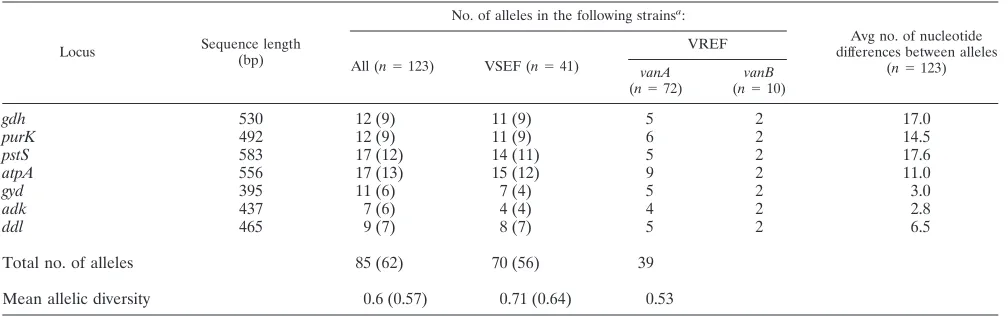
house-keeping genes ranged from 7 foradkto 17 forpstSandatpA
(Table 2). The average number of nucleotide differences
be-tween alleles of a given locus varied from 2.8 (foradk) to 17.6
(for pstS) among the 123 E. faecium isolates analyzed. The
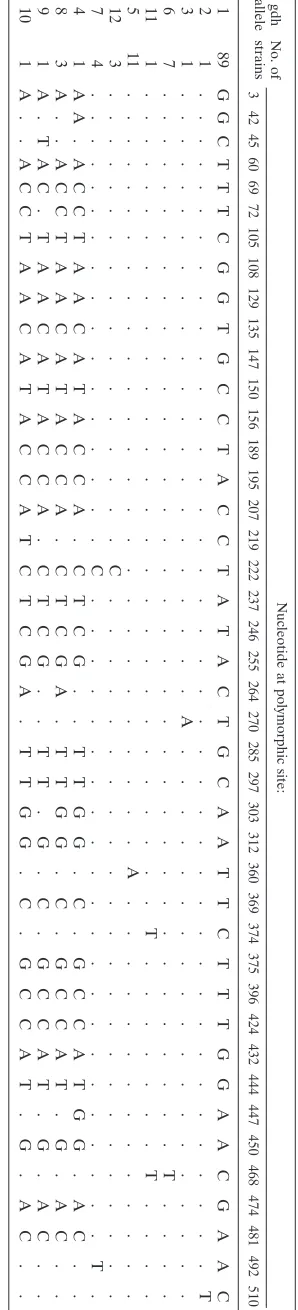
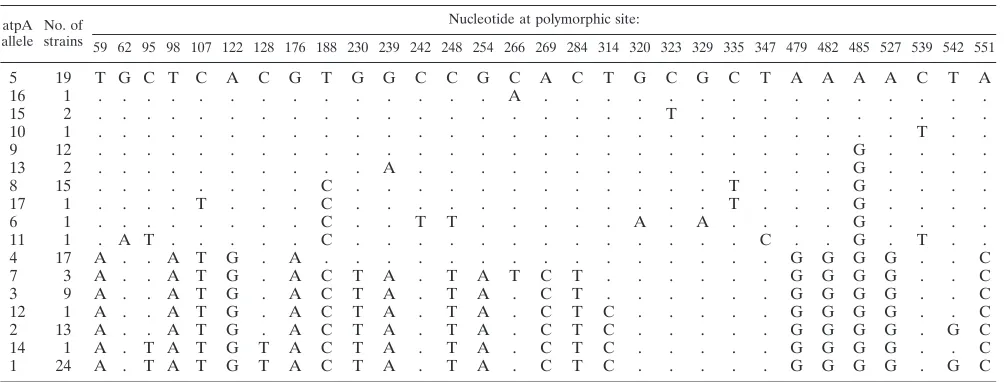
variations in the sequences extended over the whole stretch of the sequenced portion of each of the seven genes investigated,
as shown in Tables 3 and 4 for thegdhandatpAallelic variants.
Most polymorphisms resulted in synonymous substitutions. The ratios of nonsynonymous to synonymous substitutions
var-ied from 0 foratpAandddlto 0.07 forpstS. The average ratio
for all loci was 0.02 (results not shown). These low ratios indicate a very limited contribution of environmental selection to the sequence variations in the seven housekeeping genes used in this study; therefore, these housekeeping genes are assumed to be suitable for a population-genetic study.
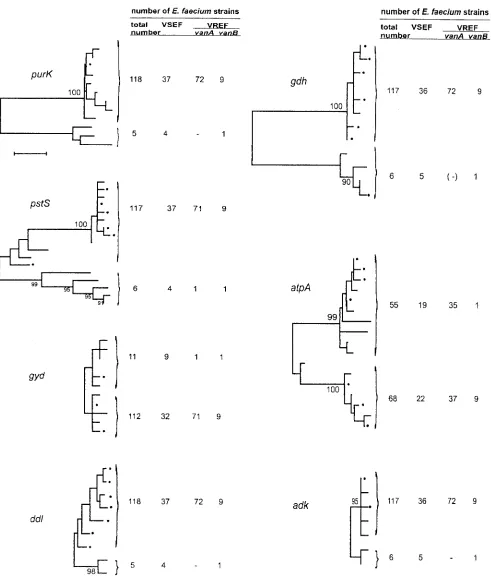
Dendrograms of the alleles of the separate housekeeping gene targets are shown in Fig. 1. Interestingly, a clear bifurca-tion into majority and minority allelic populabifurca-tions was
ob-served for all the genes, except foratpA. The alleles ofatpA
also clustered into two populations, but the populations had
[image:3.587.344.493.74.729.2]TABLE 3. Polymorphic nucleotide sites in the gdh locus a gdh allele No. of strains Nucleotide at polymorphic site: 3 42 45 60 69 72 105 108 129 135 147 150 156 189 195 207 219 222 237 246 255 264 270 285 297 303 312 360 369 374 375 396 424 432 444 447 450 468 474 481 492 510 1 89 G G C T T T C G G T G C CT A C CT A T A C T G C A A T TCT T T G G A A C G A A C 2 1 . ... ... T 3 1 . ... ... A ... 6 7 . ... ... T .... 11 1 . ... ... T ... T .... 5 11 . ... ... A ... 12 3 . ... ... C ... 7 4 . ... ... C ... T . 4 1 A A . A C C T A A C A T A C C A . C T C G. . T T G G. C . G C C A T G G. A C . . 8 3 A . . A C C T A ACA T AC CA . C T C G A . T TG G . C . G C CA T . G . AC . . 9 1 A . T A C . T A A C A T A C C A . C T C G. . T T . G. C . G C C A T . G. A C . . 10 1 A . . A C C T A A C A T A CC A T C T C G A . T T G G . C . G CC A T . G . A C . . a Nucleotides present in the variable sites are shown for the first allele. In the other alleles, only the sites that dif fer are shown. A period means that the site is the same as that in the first allele.
on May 15, 2020 by guest
http://jcm.asm.org/
approximately equal numbers of isolates and both comprised VREF and VSEF isolates. The significance of the observed bifuractions is strongly supported by bootstrap analysis. The average numbers of nucleotide differences between the major-ity and the minormajor-ity group populations were 30, 29, 33, 10, 4.3,
and 4.1 forpurK,pstS,gdh,ddl,adk, andgyd, respectively. Only
five isolates were shared among the minority allelic popula-tions of these six housekeeping genes. Based on MLST data,
these five isolates, four VSEF isolates and onevanB-harboring
E.faeciumisolate, are most distantly related to the other iso-lates, clustering at the bottom of the dendrogram constructed from the allelic profiles (Fig. 2, isolates represented by STs 39, 60, 40, 61, and 62). They differed in six of the seven alleles from all of the remaining isolates investigated in this study. Further-more, these isolates also clustered separately from the four major lineages determined by AFLP analysis (data not shown). Therefore, these isolates are genetically the most divergent of the isolates analyzed in this study, and much of the allelic variation shown in Table 2 is due to variations in these five genetically divergent isolates.
To test whether these five isolates might have been
misdi-agnosed asE.faeciumby the standard bacteriological
deter-mination, sequencing of their 16S rRNA genes was under-taken. This analysis revealed that the three isolates with STs
40, 60, and 61 differed in only one residue from bothE.faecium
andE. durans, whereas the sequences of isolates with ST 39
and ST 62 were identical to the sequence ofE.durans.
How-ever, species determination by ddl gene analysis, a method
generally used for enterococci (7, 26), grouped the sequences of the five divergent isolates in a cluster having 98% similarity
with allE.faecium ddl sequences, well separated (83%
simi-larity) from theE.duranssequence (GenBank accession
num-ber AF170804) and theE.hiraesequence (GenBank accession
number U39788) (results not shown). Furthermore, all
poly-morphisms in theddl alleles were silent, coding for peptide
fragments with identical amino acid compositions which
dif-fered by 3% from the compositions of the fragments in E.
durans and E. hirae. These data suggest that three of the
divergent isolates can be consideredE.faeciumand that
clas-sification of two of the isolates is ambiguous.
Genetic diversity of VSEF and VREF isolates.Among the 123 epidemiologically unlinked isolates investigated, 62 STs were found; the majority of these, 44 STs, were represented by single isolates (Fig. 2). The types most frequently encountered were ST 17 (17 isolates), ST 6 (14 isolates), ST 4 (9 isolates), and ST 16 (6 isolates). Isolates with ST 16 and ST 17, which shared six of the seven housekeeping alleles, were from hos-pitalized individuals. All ST 16 isolates and two of the ST 17 isolates were representatives from outbreaks; the remaining ST 17 isolates were taken from clinical sites and were not known to have an epidemiological link. Three of the 14 ST 6 isolates were from feces derived from hospitalized humans and were not outbreak related. The remaining ST 6 isolates origi-nated from healthy humans (six isolates) and pigs (five iso-lates). All ST 4 isolates originated from calves (Fig. 2).
Thirty-six different STs were found among 41 VSEF isolates, and 31 were found among 82 VREF isolates. VSEF and VREF isolates sharing the same ST were present only among the five allelic types ST 4, ST 5, ST 6, ST 17, and ST 44; however, the majority of the isolates belonging to these STs (40 of 47 iso-lates) were vancomycin resistant. The most prevalent allelic
type, ST 17, was the only one comprising both vanA- and
vanB-carrying isolates (Fig. 2). Although the number of VSEF
isolates (n⫽41) examined was considerably smaller than the
number of vanA-carrying E. faecium isolates (n ⫽ 72), the
VSEF isolates contributed disproportionately more to the al-lelic diversity of the whole sample of isolates analyzed: 70 different alleles were present among the vancomycin-sensitive
isolates, and only 39 were identified among thevanA-carrying
isolates. Consistent with this difference is the higher mean allelic diversity value of the vancomycin-sensitive isolates
(0.71) than of thevanA-carrying isolates (0.53) (Table 2). Even
after exclusion of the five divergent isolates, the vancomycin-sensitive isolates were genetically more diverse than the
van-TABLE 4. Polymorphic nucleotide sites in theatpAlocusa
atpA
allele No. ofstrains
Nucleotide at polymorphic site:
59 62 95 98 107 122 128 176 188 230 239 242 248 254 266 269 284 314 320 323 329 335 347 479 482 485 527 539 542 551
5 19 T G C T C A C G T G G C C G C A C T G C G C T A A A A C T A
16 1 . . . A . . . .
15 2 . . . T . . . .
10 1 . . . T . .
9 12 . . . G . . . .
13 2 . . . A . . . G . . . .
8 15 . . . C . . . T . . . G . . . .
17 1 . . . . T . . . C . . . T . . . G . . . .
6 1 . . . C . . T T . . . A . A . . . . G . . . .
11 1 . A T . . . C . . . C . . G . T . .
4 17 A . . A T G . A . . . G G G G . . C
7 3 A . . A T G . A C T A . T A T C T . . . G G G G . . C
3 9 A . . A T G . A C T A . T A . C T . . . G G G G . . C
12 1 A . . A T G . A C T A . T A . C T C . . . G G G G . . C
2 13 A . . A T G . A C T A . T A . C T C . . . G G G G . G C
14 1 A . T A T G T A C T A . T A . C T C . . . G G G G . . C
1 24 A . T A T G T A C T A . T A . C T C . . . G G G G . G C
aNucleotides present in the variable sites are shown for the first allele. In the other alleles, only the sites that differ are shown. A period means that the site is the
same as that in the first allele.
on May 15, 2020 by guest
http://jcm.asm.org/
[image:4.587.43.545.82.273.2]FIG. 1. Dendrograms showing the genetic relationships among the allele sequences of individual loci used for MLST. The trees were established by analysis of the allele sequences from the seven housekeeping loci by the NJ method. Numbers of VSEF and VREF strains in the different clusters are given to the right of the dendrograms. The scale bar indicates five nucleotide differences. Dots indicate the alleles associated with allelepurK6. Bootstrap values of greater than 90% are indicated.
on May 15, 2020 by guest
http://jcm.asm.org/
on May 15, 2020 by guest
http://jcm.asm.org/
comycin-resistant isolates, although the difference in mean al-lelic diversity decreased after exclusion of the divergent isolates (values of 0.64 and 0.53 for the vancomycin-sensitive and vancomycin-resistant isolates, respectively) (Table 2).
There were only 10vanB-carrying isolates in the collection;
9 originated from Australia and 1 was from the United States. Nine of the isolates had the most prevalent allelic type, ST 17 (Fig. 2). The remaining isolate was one of the five genetically divergent isolates described above.
Epidemiology of genetic lineages.The results of the cluster-ing by UPGMA of the allelic profiles are shown in Fig. 2. Four
major groups, containing isolates with⬎40% similarity in
al-lelic profiles, were discernible; a residual group included the five genetically most divergent isolates. Groups were desig-nated MLST lineages A through D (Fig. 2). These lineages corresponded well with the previously established genogroups A through D obtained by clustering based on AFLP typing of
E. faecium (33). Interestingly, the relationship between lin-eages and host specificity was found not only among the van-comycin-resistant isolates, as described previously, but also among the vancomycin-sensitive isolates (Fig. 2). Lineage D isolates were mainly from calves (16 of 18 isolates), lineage A isolates were mainly from nonhospitalized humans and pigs (17 of 25 isolates), lineage B isolates were mainly from poultry (15 of 20 isolates), and lineage C isolates were from hospital-ized humans (37 of 47 isolates) and a variety of sources, such as dogs, cats, and poultry (10 of 47 isolates).
All four major lineages contained both vancomycin-sensitive and vancomycin-resistant isolates. Isolates from humans were distributed among all lineages; however, isolates related to hospital outbreaks in The Netherlands, Australia, the United Kingdom, and the United States all clustered in a genetically closely related subgroup of lineage C with ST 16, 17, 18, or 20
(Fig. 2, lineage C1). Theespgene, which has been associated
with virulence and epidemicity in hospitals (29, 32), was uniquely present in isolates with these STs (Fig. 2). The re-maining isolates in subgroup C1 (STs 19 and 31) were sporadic isolates from patients in different hospitals and were not known to be related to an outbreak. Both isolates lacked the
espgene, a finding consistent with the idea thatespis a
requi-site for epidemicity. All isolates belonging to subgroup C1
shared allelepurK1, which was not found among any of the
other isolates. This result confirms the previous observation
that thispurKallele invariably was correlated with the presence
ofespin vancomycin-resistant isolates (32).
To investigate how MLST performs with epidemiologically related isolates, we analyzed 16 additional isolates (not belong-ing to the sample of 123 isolates) involved in different out-breaks in the United States, The Netherlands, Australia, and the United Kingdom and belonging to STs 16, 17, 18, and 20.
The analysis revealed that all isolates involved in a particular outbreak exhibited the same allelic profile as the representa-tive isolate (data not shown).
Evidence for recombination in E. faecium. As described
above, the gene tree of theatpAalleles is not congruent with
the trees of the other loci. The noncongruence between the
gene trees suggests a weak linkage between theatpA alleles
and the other loci, and this characteristic is indicative of a role
for recombination in the generation of divergence inE.
fae-cium. The poor linkage between alleles from different loci is
directly obvious from Fig. 2 and is further illustrated forpurK6
in Fig. 1. The latter figure shows that allelepurK6is associated
with several alleles from the other loci. A more quantitative analysis of the association between alleles from different loci
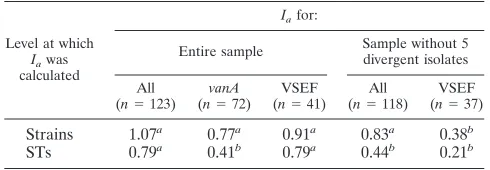
was performed by calculating theIa (30). Significant linkage
disequilibrium was detected when all 123 isolates or STs were
included in the analysis (Ias, 1.07 and 0.79, respectively) (Table
5). Also, after exclusion of the five genetically most divergent isolates, the alleles of the 118 remaining isolates were found to
be in linkage disequilibrium (Ia, 0.83;P⬍0.001). However, no
evidence for linkage was detected when the analysis was
per-formed at the level of STs (Ia, 0.44; P ⬎ 0.05) (Table 5).
Analysis of VSEF isolates andvanA-containing isolates
sepa-rately showed that, at the level of STs, there was no evidence
for linkage between loci of thevanA-containing isolates (Ia,
0.41; P ⬎ 0.05). Loci of the VSEF isolates were in linkage
disequilibrium at the levels of both isolates and STs. However, no significant linkage between loci was detected at both isolate and ST levels when the most divergent isolates were excluded from the VSEF group (Table 5). These observations imply that horizontal transfer of DNA plays an important role in the
generation of genetic variations in both VSEF andvanA
-con-taining isolates.
[image:7.587.299.544.84.169.2]An approximate estimation of the relative contributions of recombination and mutation to clonal divergence was made by using the method and criteria described by Feil et al. (13).
TABLE 5. Ias forvanA-carrying and VSEF isolates
Level at which Iawas
calculated
Iafor:
Entire sample Sample without 5divergent isolates
All
(n⫽123) (nvanA⫽72) (nVSEF⫽41) (n⫽All118) (nVSEF⫽37)
Strains 1.07a 0.77a 0.91a 0.83a 0.38b
STs 0.79a 0.41b 0.79a 0.44b 0.21b
aThePvalue was⬍0.001; theI
adeviates significantly from zero (linkage
disequilibrium); see Materials and Methods.
bThePvalue was⬎0.05; theI
adoes not deviate significantly from zero (no
evidence for linkage); see Materials and Methods.
FIG. 2. Dendrogram (categorical, UPGMA) showing the genetic relatedness among the STs ofE.faecium. The following data are included: ST; number of strains with the same ST; AFLP group (genogroup determined by AFLP analysis; R, non-A, -B, -C, or -D); host origin (C, calf; H, human; HF, fecal sample from a hospitalized human; HC, clinical sample from a hospitalized human, not outbreak related; HO, clinical sample from a hospitalized human, outbreak related; S, pig; P, poultry); presence ofvanAorvanB(A,vanAresistant strain; B,vanBresistant strain; S, sensitive strain); presence of theespgene; and country (NL, The Netherlands; UK, United Kingdom; USA, United States; Aus or Austr., Australia). The dendrogram is divided by dotted lines into a number of lineages, labeled A to D, similar to the genogroups detected by AFLP analysis (33). Genetically divergent isolates are indicated in bold. n.d., not determined.
on May 15, 2020 by guest
http://jcm.asm.org/
Clonal complexes consisting of STs that differed in one or two alleles and that were part of the UPGMA lineages were made, and the contribution of recombination or mutation was calcu-lated. It was estimated that recombinational exchange gener-ated new alleles at a frequency fivefold higher than point mu-tation, while single nucleotide sites were 24 times more likely to change through recombination than through mutation (re-sults not shown). The per-site recombination-to-mutation ratio
was about one-half the ratio forStreptococcus pneumoniaeand
one-fourth the ratio forNeisseria meningitidis(13).
DISCUSSION
One of the main objectives of this study was to provide a
reference scheme for the typing ofE.faeciumto allow
unam-biguous comparison of data between different laboratories. We determined the degree of allelic variations in seven
housekeep-ing genes of E. faecium by using a sample of 123 isolates
originating from human and animal sources in various coun-tries. The degree of isolate differentiation by MLST appears adequate for use in epidemiological investigations, as the num-ber of different types obtained by MLST was comparable to that obtained by AFLP analysis, a technique with proven dis-criminatory power for VREF isolates (1, 32, 33). Further con-firmation of the classification of VREF isolates by AFLP anal-ysis and MLST was recently provided by ribotyping analanal-ysis
(4). Genogrouping ofE.faeciumisolates by MLST was highly
congruent with grouping by AFLP analysis. In previous studies with AFLP analysis, the majority of VREF isolates were grouped into four different lineages, designated genogroups A through D (33). The majority of the isolates investigated by MLST also were grouped into four corresponding lineages. In contrast to previous studies, this study included VSEF isolates, and the majority of these isolates belonged to one of the four lineages established by typing of VREF isolates. The VSEF
isolates were overall genetically more diverse than thevanA
-carrying isolates. However, this difference was largely due to a few genetically highly divergent isolates not belonging to lin-eages A through D.
Assuming that the dissemination of thevanAgene amongE.
faeciumstarted with the introduction of vancomycin and
re-lated antibiotics about only 40 years ago implies thatvanAwas
rapidly disseminated among the four main lineages ofE.
fae-cium. Dissemination of vancomycin resistance in E. faecium
has been extensively described and is mediated by the inter-cellular spread of self-transferable plasmids and conjugative transposons harboring vancomycin resistance genes (2).
In this study, we included only representative isolates from hospital outbreaks and excluded other isolates that were epi-demiologically related to any of these outbreaks. Nevertheless, 78% (64 of 82) of the VREF isolates shared allelic profiles, whereas only 22% (9 of 41) of the VSEF isolates did so. Although the number of isolates included in this study was small, these data suggest strongly that vancomycin-resistant isolates recently spread epidemically. Because isolates with shared allelic profiles originated from different countries and continents, this dissemination is worldwide.
It was previously shown that epidemic strains are exclusively
found within AFLP genogroup C, share allelepurK1, and carry
theespgene, irrespective of the country of origin (32). In the
current study, all epidemic VREF strains were found in MLST
lineage C1, which is characterized by allelepurK1, and all share
the esp gene, confirming the classification based on AFLP
analysis. The remaining hospitalized human-derived strains present in lineages A, B, and C were taken from clinical sites or obtained from fecal screenings and did not have a known relationship to outbreaks. Most likely, a subpopulation of lin-eage C gave rise to an epidemic VREF subpopulation,
equipped with virulence factors such asesp, enablingE.
fae-ciumto preferentially colonize and spread in hospitalized
hu-man patients worldwide (28, 29, 32).
The previously observed relationship between VREF geno-group and host was confirmed in this study. In addition, this study indicates that this relationship holds true for VSEF as well. This result is not unexpected, because the introduction of
the mobile vancomycin resistance genes into the E. faecium
population would not be expected to affect a preexisting spe-cific host-bacterium relationship, which presumably is the re-sult of long-term coevolution of the bacterium and host.
Single-locus phylogenetic trees were noncongruent, suggest-ing that recombination plays an important role in the
genera-tion of diversity of the E. faeciumpopulation. Consistently,
based onIas between alleles, random association between gene
loci was detected at the level of STs but not at the level of
isolates, suggesting thatE.faeciumhas an epidemic population
structure (30). Because the VSEF population was in linkage equilibrium at the level of all isolates (when divergent isolates were excluded), the epidemic population structure seems to be mainly due to lineages in the resistant population. These re-sults suggest that horizontal transfer of genetic information in
E.faeciumplayed a role in long-term evolution, while clonal lineages emerged and disseminated recently as a consequence of antibiotic pressure. Confirmation of the importance of re-combination for the generation of alleles in housekeeping
genes from E. faecium was derived from a sequence-based
approach described by Feil et al. (13). Enterococci contain several efficient systems for exchanging genetic information, including pheromone-responsive plasmids, broad-host-range plasmids, and conjugative transposons. Horizontal transfer of resistance genes in enterococci with these systems is well
doc-umented (16). In addition, horizontal transfer of tuf
house-keeping genes encoding elongation factor Tu, involved in pro-tein synthesis, among enterococci was recently reported (19). TheE.faeciumMLST scheme developed in this study pro-vides a universal and portable method for isolate typing and addressing long-term epidemiological questions. Laboratories worldwide can build a virtual isolate collection that will enable disclosure of the emergence of epidemic clones that may be disseminated among different hospitals in different countries and continents. By comparison of patient-related information with molecular genetic data, novel genetic lineages with spe-cific properties relating to pathogenicity and epidemiology may be revealed.
ACKNOWLEDGMENTS
J. Davis, M. Veitch, J. Straughan, N. Cooper, M. Whipp, and A. Zaia from the MDU are sincerely thanked for their valuable input, as are Z. Manztioros and P. L. Soong from the Department of Microbi-ology and ImmunMicrobi-ology, University of Melbourne, and Marga van Santen-Verheuvel and Janetta Top from the National Institute of Public Health and the Environment. The Australian analysis would not
on May 15, 2020 by guest
http://jcm.asm.org/
have been possible without support from the Victorian Department of Human Services and the generous cooperation of a network of clinical microbiology laboratories. We thank Leo Schouls (National Institute of Public Health and the Environment) for critical review of the manu-script and Brian Spratt for welcome assistance.
REFERENCES
1.Antonishyn, N. A., R. R. McDonald, E. L. Chan, G. Horsman, C. E. Wood-mansee, P. S. Falk, and C. G. Mayhall.2000. Evaluation of fluorescence-based amplified fragment length polymorphism analysis for molecular typing in hospital epidemiology: comparison with pulsed-field gel electrophoresis
for typing strains of vancomycin-resistant Enterococcus faecium. J. Clin.
Microbiol.38:4058–4065.
2.Arthur, M., C. Molinas, F. Depardieu, and P. Courvalin.1993.
Character-ization of Tn1546, a Tn3-related transposon conferring glycopeptide
resis-tance by synthesis of depsipeptide peptidoglycan precursors inEnterococcus
faeciumBM4147. J. Bacteriol.175:117–127.
3.Bergmans, A. M., J. W. Groothedde, J. F. Schellekens, J. D. van Embden, J. M. Ossewaarde, and L. M. Schouls.1995. Etiology of cat scratch disease: comparison of polymerase chain reaction detection of Bartonella (formerly Rochalimaea) and Afipia felis DNA with serology and skin tests. J. Infect.
Dis.171:916–923.
4.Brisse, S., V. Fussing, B. Ridwan, J. Verhoef, and R. J. L. Willems.2002.
Automated ribotyping of vancomycin-resistant Enterococcus faecium
iso-lates. J. Clin. Microbiol.40:1977–1984.
5.Centers for Disease Control and Prevention.1999. National nosocomial infections surveillance (NNIS) system report, data summary from January
1990–May 1999, issued June 1999. Am. J. Infect. Control27:520–532.
6.Dingle, K. E., F. M. Colles, D. R. Wareing, R. Ure, A. J. Fox, F. E. Bolton, H. J. Bootsma, R. J. Willems, R. Urwin, and M. C. Maiden.2001. Multilocus
sequence typing system forCampylobacter jejuni. J. Clin. Microbiol.39:14–
23.
7.Dutka-Malen, S., S. Evers, and P. Courvalin.1995. Detection of glycopep-tide resistance genotypes and identification to the species level of clinically
relevant enterococci by PCR. J. Clin. Microbiol.33:1434.
8.Enright, M. C., N. P. Day, C. E. Davies, S. J. Peacock, and B. G. Spratt.2000. Multilocus sequence typing for characterization of methicillin-resistant and
methicillin-susceptible clones ofStaphylococcus aureus. J. Clin. Microbiol.
38:1008–1015.
9.Enright, M. C., and B. G. Spratt.1998. A multilocus sequence typing scheme for Streptococcus pneumoniae: identification of clones associated with
seri-ous invasive disease. Microbiology144:3049–3060.
10.Enright, M. C., and B. G. Spratt.1999. Multilocus sequence typing. Trends
Microbiol.7:482–487.
11.Enright, M. C., B. G. Spratt, A. Kalia, J. H. Cross, and D. E. Bessen.2001.
Multilocus sequence typing ofStreptococcus pyogenesand the relationships
betweenemmtype and clone. Infect. Immun.69:2416–2427.
12.Feil, E. J., M. C. Maiden, M. Achtman, and B. G. Spratt.1999. The relative contributions of recombination and mutation to the divergence of clones of
Neisseria meningitidis. Mol. Biol. Evol.16:1496–1502.
13.Feil, E. J., J. M. Smith, M. C. Enright, and B. G. Spratt.2000. Estimating recombinational parameters in Streptococcus pneumoniae from multilocus
sequence typing data. Genetics154:1439–1450.
14.Goossens, H.1998. Spread of vancomycin-resistant enterococci: differences between the United States and Europe. Infect. Control. Hosp. Epidemiol.
19:546–551.
15.Gordillo, M. E., K. V. Singh, and B. E. Murray. 1993. Comparison of ribotyping and pulsed-field gel electrophoresis for subspecies differentiation
of strains ofEnterococcus faecalis. J. Clin. Microbiol.31:1570–1574.
16.Huycke, M. M., D. F. Sahm, and M. S. Gilmore.1998. Multiple-drug
resis-tant enterococci: the nature of the problem and an agenda for the future.
Emerg. Infect. Dis.4:239–249.
17.Issack, M. I., E. G. M. Power, and G. L. French.1996. Investigation of an
outbreak of vancomycin-resistantEnterococcus faeciumby random amplified
polymorphic DNA (RAPD) assay. J. Hosp. Infect.33:191–200.
18.Kalia, A., M. C. Enright, B. G. Spratt, and D. E. Bessen.2001. Directional gene movement from human-pathogenic to commensal-like streptococci.
Infect. Immun.69:4858–4869.
19.Ke, D., M. Boissinot, A. Huletsky, F. J. Picard, J. Frenette, M. Ouellette, P. H. Roy, and M. G. Bergeron.2000. Evidence for horizontal gene transfer
in evolution of elongation factor Tu in enterococci. J. Bacteriol.182:6913–
6920.
20.Kuhn, I., L. G. Burman, S. Haeggman, K. Tullus, and B. E. Murray.1995. Biochemical fingerprinting compared with ribotyping and pulsed-field gel electrophoresis of DNA for epidemiological typing of enterococci. J. Clin.
Microbiol.33:2812–2817.
21.Kumar, S., K. Tamura, and M. Nei.1994. MEGA: Molecular Evolutionary
Genetics Analysis software for microcomputers. Comput. Appl. Biosci.10:
189–191.
22.Maiden, M. C., J. A. Bygraves, E. Feil, G. Morelli, J. E. Russell, R. Urwin, Q. Zhang, J. Zhou, K. Zurth, D. A. Caugant, I. M. Feavers, M. Achtman, and B. G. Spratt.1998. Multilocus sequence typing: a portable approach to the identification of clones within populations of pathogenic microorganisms.
Proc. Natl. Acad. Sci. USA95:3140–3145.
23.Morrison, D., N. Woodford, S. P. Barrett, P. Sisson, and B. D. Cookson.
1999. DNA banding pattern polymorphism in vancomycin-resistant
Entero-coccus faeciumand criteria for defining strains. J. Clin. Microbiol.37:1084– 1091.
24.Murray, B. E.2000. Vancomycin-resistant enterococcal infections. N. Engl.
J. Med.342:710–721.
25.Nei, M., and F. Tajima.1981. DNA polymorphism detectable by restriction
endonucleases. Genetics97:145–163.
26.Ozawa, Y., P. Courvalin, and M. Galimand.2000. Identification of
entero-cocci at the species level by sequencing of the genes forD-alanine:D-alanine
ligases. Syst. Appl. Microbiol.23:230–237.
27.Savelkoul, P. H., H. J. Aarts, J. de Haas, L. Dijkshoorn, B. Duim, M. Otsen, J. L. Rademaker, L. Schouls, and J. A. Lenstra.1999. Amplified-fragment
length polymorphism analysis: the state of an art. J. Clin. Microbiol.37:3083–
3091.
28.Shankar, N., C. V. Lockatell, A. S. Baghdayan, C. Drachenberg, M. S. Gilmore, and D. E. Johnson.2001. Role ofEnterococcus faecalissurface protein Esp in the pathogenesis of ascending urinary tract infection. Infect.
Immun.69:4366–4372.
29.Shankar, V., A. S. Baghdayan, M. M. Huycke, G. Lindahl, and M. S. Gil-more.1999. Infection-derivedEnterococcus faecalisstrains are enriched in
esp, a gene encoding a novel surface protein. Infect. Immun.67:193–200.
30.Smith, J. M., N. H. Smith, M. O’Rourke, and B. G. Spratt.1993. How clonal
are bacteria? Proc. Natl. Acad. Sci. USA90:4384–4388.
31.Suerbaum, S., M. Lohrengel, A. Sonnevend, F. Ruberg, and M. Kist.2001.
Allelic diversity and recombination inCampylobacter jejuni. J. Bacteriol.
183:2553–2559.
32.Willems, R. J., W. Homan, J. Top, M. van Santen-Verheuvel, D. Tribe, X. Manzioros, C. Gaillard, C. M. Vandenbroucke-Grauls, E. M. Mascini, E. van Kregten, J. D. van Embden, and M. J. Bonten.2001. Variantespgene as
a marker of a distinct genetic lineage of vancomycin-resistantEnterococcus
faeciumspreading in hospitals. Lancet357:853–855.
33.Willems, R. J. L., J. Top, N. Van Den Braak, A. Van Belkum, H. Endtz, D. Mevius, E. Stobberingh, A. Van Den Bogaard, and J. D. A. Van Embden.
2000. Host specificity of vancomycin-resistantEnterococcus faecium. J.
In-fect. Dis.182:816–823.
on May 15, 2020 by guest
http://jcm.asm.org/
0095-1137/02/$04.00⫹0 DOI: 10.1128/JCM.40.9.3548.2002
ERRATA
Stx2 Subtyping of Shiga Toxin-Producing
Escherichia coli
Isolated from Cattle in
France: Detection of a New Stx2 Subtype and Correlation with Additional
Virulence Factors
Yolande Bertin, Karima Boukhors, Nathalie Pradel, Valerie Livrelli, and Christine Martin
Laboratoire de Microbiologie, Centre de Recherche INRA de Clermont-Ferrand-Theix, 63122 St-Gene`s Champanelle, and Groupe de Recherche Pathoge´nie Bacte´rienne Intestinale, Faculte´ de Pharmacie, Universite d’Auvergne,
Clermont-Ferrand, France
Volume 39, no. 9, p. 3060–3065, 2001. Page 3065: References 11 to 29 should be numbered 10 to 28, respectively.
Multilocus Sequence Typing Scheme for
Enterococcus faecium
Wieger L. Homan, David Tribe, Simone Poznanski, Mei Li, Geoff Hogg, Emile Spalburg,
Jan D. A. van Embden, and Rob J. L. Willems
Research Laboratory for Infections Diseases, National Institute of Public Health and the Environment, Bilthoven, The Netherlands, and Department of Microbiology and Immunology and Microbiological Diagnostic Unit,
University of Melbourne, Parkville, Victoria, Australia
Volume 40, no. 6, p. 1963–1971. Page 1964, column 2: The sequences for the primers gyd1 and purK2 should read as follows:
for gyd1, “5⬘-CAA ACT GCT TAG CTC CAA TGG C-3⬘,” and for purK2, “5⬘-TAC ATA AAT CCC GCC TGT TTY-3⬘.”