A Monthly Double-Blind Peer Reviewed Refereed Open Access International e-Journal - Included in the International Serial Directories.
GE-International Journal of Engineering Research (GE-IJER) ISSN (O):(2321-1717), ISSN(P):(2394-420X) 14 | P a g e
DE-EMULSIFICATION EFFICIENCY OF THE NIGER DELTA
CRUDE OIL USING DIFFERENT DE-EMULSIFIERS
Igwilo K.C1., Ogbudu R.E2., Anawe P.A.L3.,Orodu O.D4., Okolie T.A.5 1,3,4,5
Covenant University, Ota, Ogun State, Nigeria 2 Chevron Oil and Gas Company, Nigeria.
ABSTRACT
This technical paper evaluates the separation efficiency of water from Niger Delta crude oil
using five different de-emulsifiers: two commercial ones, that is, RP6000, and Chimec 2439,
PPA prepared by polymerization, LAS and HAS both prepared by sulfonation. Chemical
de-emulsification was then carried out at the temperature of 65OC, using different
concentrations for the period of 120 minutes. Alcohol were added as a modifier agent to
enhance the performance of de-emulsifications at different concentrations. And the results
depicts that water separation increases with increase in de-emulsifier concentration. Also,
HAS and LAS prepared by sulfonation gave 90% and 88.3% of water separation
respectively. PPA prepared by polymerization gave 75%, while commercial LP6000 and
Chem2439 produced the same value of 87.5%. This shows that HAS is the best while PPA is
the least in terms of water separation efficiency.
Key words: De-emulsifiers, Polymerization, Sulfonation, Chemical de-emulsification,
Alcohol, Separation Efficiency.
INTRODUCTION
Emulsion is a heterogeneous system, containing at least immiscible liquid intimately
dispersed in another in the form of droplets with a diameter ranging between (0.1-20)
microns, and it is stabilized by an emulsifying agent, asphaltenes, resins and finely divided
solids. The dispersed droplets are known as the internal phase. The liquid surrounding the
dispersed droplets is the external or continuous phase. The emulsifying agent separates the
dispersed droplets from the continuous phase (Kenneth, 1998). Water-in-oil emulsion is
formed during the production of oil, which is often accompanied with water. The stability of
GE-International Journal of Engineering Research
Vol. 5, Issue 3, March 2017 Impact Factor- 5.613 ISSN(O): 2321-1717, ISSN(P): 2394-420X
© Associated Asia Research Foundation (AARF) Publication
A Monthly Double-Blind Peer Reviewed Refereed Open Access International e-Journal - Included in the International Serial Directories.
GE-International Journal of Engineering Research (GE-IJER) ISSN (O):(2321-1717), ISSN(P):(2394-420X) 15 | P a g e the emulsion is ranging from a few minutes to years depending on the nature of the crude oil
(Bhardwaj et al, 1998). Crude oils consist of, in any case, a series of hydrocarbons such as
alkenes, naphtenes, and aromatic compounds as well as phenols, carboxylic acids, and
metals. A major fraction of sulfur and nitrogen compounds may be present as well. The
carbon numbers of all these components range from 1 (methane) through 50 or more
(asphaltenes). Some of these components (asphaltenes, resins, wax, and naphtenic acids) can
form films at oil surfaces. So, the tendency to form stable or unstable emulsions of different
kinds varies greatly among different oils ( Schramm, 1992).
The natural petroleum emulsion resulting from the secondary production consists of crude oil
as dispersion medium and brine as dispersed phase, normally stabilized by natural chemicals
such as asphaltenes, resins, and solids such as clays and waxes (Bhardwaj,1998). Emulsion
stability is the ability of the dispersed phase of the emulsion to resist coalescence or sticking
together of droplets. Emulsions are stabilized by the presence of a film between dispersed
droplets and the continuous phase. According to MacBain, 1950 this film is of many
molecules thick, on the other hand Fischer and Harkins, 1966 showed that this film is only
mono-molecular. Emulsion resolution is therefore an important element in handling the
petroleum, from the time it is produced until it enters the refining process. In order to
minimize the production problems related with crude oil emulsions and environmental
concerns, petroleum operators need to prevent emulsion formation or to break it (Gafonova,
2000). The treatment of water-in-crude oil emulsions involves the application of mechanical,
thermal, electrical, and chemical processes (Grace, 1992). Chemical method of resolving
crude oil emulsions are based on the addition of reagents (de-emulsifiers) which destroy the
protective action of hydrophobic emulsifying agents and allow the water droplets to coalesce.
There are anionic, cationic and nonionic surfactants that have been used as de-emulsifiers
(Selvarajan et al., 2001). Success of chemical demulsifying method is dependent upon the
adequate quantity of a properly selected chemical that must be added into the emulsion,
through mixing of the chemical with the emulsion, adequately heat may be required to
facilitate or fully resolve an emulsion. Demulsifiers permit agglomeration, coalescence and
gravity settling of the water droplets (Staiss et al., 1991).
MATERIALS/METHODOLOGY
A Monthly Double-Blind Peer Reviewed Refereed Open Access International e-Journal - Included in the International Serial Directories.
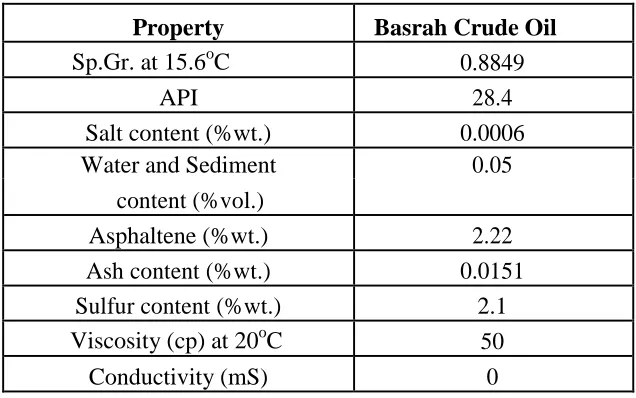
GE-International Journal of Engineering Research (GE-IJER) ISSN (O):(2321-1717), ISSN(P):(2394-420X) 16 | P a g e Table 1: Physical Properties of the Niger Delta crude oil
Property Basrah Crude Oil
Sp.Gr. at 15.6oC 0.8849
API 28.4
Salt content (%wt.) 0.0006
Water and Sediment 0.05
content (%vol.)
Asphaltene (%wt.) 2.22
Ash content (%wt.) 0.0151
Sulfur content (%wt.) 2.1
Viscosity (cp) at 20oC 50
Conductivity (mS) 0
Five types of de-emulsifiers were used in the laboratory measurements and their explanations and compositions were shown in tables 3 and 4 and they are:
1. RP6000 (commercial) and the chemical composition of this de-emulsifier is not
known .The PERTROLITE Company adopted this de-emulsifier in desalting process in
East Baghdad oil field.
2. Chimec2439 (commercial), which is a blend of non-ionic oil soluble surfactants and
the physical properties given from (CHIMEC S.P.A, Italy) Company, are shown in Table
[image:3.612.138.456.94.293.2]2:
Table 2: Physical Properties of Chimec2439 (CHIMEC S.P. Company, Italy).
Appearance Brown liquid
Sp.Gr.at 20 oC 0.94±0.02
Viscosity at 20 oC (cp) <50
Pour point oC <-30 oC
A Monthly Double-Blind Peer Reviewed Refereed Open Access International e-Journal - Included in the International Serial Directories.
GE-International Journal of Engineering Research (GE-IJER) ISSN (O):(2321-1717), ISSN(P):(2394-420X) 17 | P a g e 3. PAA (prepared by polymerization method).
4. LAS and HAS (prepared by sulfonation LAB and HAB were brought from ARADET
[image:4.612.67.545.218.305.2]Company, Iraq), are given in Table 3:
Table 3: Properties of LAB and HAB (ARADET Company, Iraq).
Substance Molecular Weight Density at
20oC
Viscosity at 20 oC
Flash point oC
Linear Alkyl benzene LAB
242
0.8573
7.7 145
Heavy Alkyl benzene HAB
— 0.8825 95 188
Emulsion Preparation
In this research, the brine solution was used in preparing the emulsion system. The brine
solution was prepared by dissolving 3gm NaCl in 100 ml water in order to obtain the
required salinity similar to crude oil field. The emulsion was prepared by adding water 30%
vol. (3% wt. NaCl) to the crude oil at room temperature. The de-emulsification was carried
out by using a mixer at a speed of 5000 rpm for 60 minutes to until a stable emulsion was
obtained.
Chemical De-emulsification Method (Bottle test)
The de-emulsification tests were performed on emulsion and the de-emulsifiers were then
tested by using bottle test method (Lissant, 1983).The purpose of this testing process is to
test the effectiveness of de-emulsifiers in breaking the Niger Delta crude oil as per the
procedures stated below:
• Four beakers of capacity 100ml each, was filled with the (W/O) emulsion samples,
de-emulsifier or chemical compound was added in different concentrations
(10-80)ppm to the contents of the beakers.
A Monthly Double-Blind Peer Reviewed Refereed Open Access International e-Journal - Included in the International Serial Directories.
GE-International Journal of Engineering Research (GE-IJER) ISSN (O):(2321-1717), ISSN(P):(2394-420X) 18 | P a g e pumped from the reservoir tank at 65 oC into condensers, at the same time the
contents of the beakers were added to the condensers to separate water from crude
oil emulsion for 120minutes.
RESULTS AND DISCUSSION
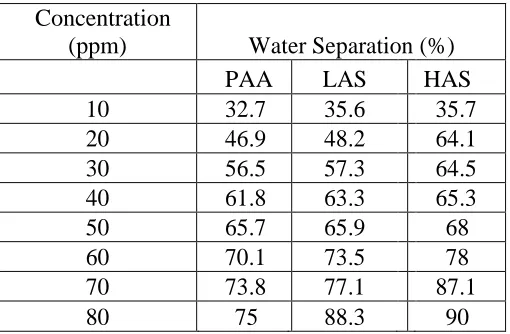
[image:5.612.145.449.243.397.2]The following data were obtained from the experimental runs as shown in tables 4 and 5 using different de-emulsifiers.
Table 4 : De-emulsifier concentration on water separation Efficiency at 120 minutes for both
RP6000 and Chimec2439.Temperature(65oPC) Pand water content(30% volume), 3%wt.
NaCl.
Concentration Water Separation (%)
(ppm) RP6000 Chimec2439
10 45.6 17.6
20 57.4 18
30 63.5 28.6
40 66.7 36
50 77.8 44.7
60 83.5 58.3
70 86.4 64.1
[image:5.612.171.426.458.625.2]80 87.5 72.2
Table 5: De-emulsifier dose on water Separation Efficiency at time 120 minutes for PAA,
LAS and HAS. Temperature( 65OC), water content( 30% volume),3%wt. NaCl.
Concentration
(ppm) Water Separation (%)
PAA LAS HAS
10 32.7 35.6 35.7
20 46.9 48.2 64.1
30 56.5 57.3 64.5
40 61.8 63.3 65.3
50 65.7 65.9 68
60 70.1 73.5 78
70 73.8 77.1 87.1
80 75 88.3 90
Result Discussion
Tables 4 and 5 above show the effect of de-emulsifiers concentrations on water separation
A Monthly Double-Blind Peer Reviewed Refereed Open Access International e-Journal - Included in the International Serial Directories.
GE-International Journal of Engineering Research (GE-IJER) ISSN (O):(2321-1717), ISSN(P):(2394-420X) 19 | P a g e below, It can be observed that water separation increases with increasing de-emulsifiers
concentrations. The maximum removal of 87.5% water was obtained at 80 ppm of RP6000,
which gave higher separation than Chimec2439 at the same concentration and time. Three
types of de-emulsifiers had been prepared PAA by polymerization, both LAS and HAS by
sulfonation, used in water separation tests were all compared together with maximum value
of 90% separation obtained from HAS. That means HAS has a good ability to promote
separation of water than other types due to its chemical and physical properties especially its
structural formula. This behavior is similar to the trend obtained by (Nimat, 1998 and
Hanapi, 2006).
100
80
Water Content = 30%
S
ep
ar
at
ion Salt in Water = 3%
T= 65 oC, 120 min 60
%Wat
er 40 Chimec24
39
20 PAA
LAS
0 RP6000
0 20 40 60 80 100 HAS
Concentrations (ppm)
Figure 1: Effect of Concentrations on Water Separation for
RP6000, Chimec2439, PAA, LAS and HAS at 120 minutes
CONCLUSION:
The following conclusions could be obtained:
1. Water separation efficiency increases with increasing concentration of de-emulsifiers
where maximum separation for water obtained was at (80ppm) for all types of
A Monthly Double-Blind Peer Reviewed Refereed Open Access International e-Journal - Included in the International Serial Directories.
GE-International Journal of Engineering Research (GE-IJER) ISSN (O):(2321-1717), ISSN(P):(2394-420X) 20 | P a g e
2. Two types of commercial de-emulsifiers has been used (RP6000 and Chimec2439),
where they gave (87.5%) and (72.2%) water separation efficiency, respectively. Three
types of prepared de-emulsifiers has been used (PAA, LAS and HAS). HAS gave
higher removal efficiency of (90%), and (88.3%, 75%) for LAS and PAA respectively.
Recommendations
The followings to be recommended for future research:
1. Study the effect of changing temperature on water separation process.
2. Work needs to be carried out using natural crude oil emulsion.
REFERENCES
1. Bhardwaj, A. and Hartland, S., Studies on Build up of Interfacial Film at the Crude
Oil/Water Interface. J. Dis. Sci. Tech., 19(4):465-473, (1998).
2. Fischer, E.K. and Harkins, W.D., J. Phys. Chem., 36, 98, (1932), P. (1966).
3. Gafonova, O.V., MSc Thesis," Role of Asphaltenes and Resins in the Stabilization
of Water- in-Hydrocarbon Emulsions", The University of Calgary,(2000).
4. Grace, R., Commercial Emulsion Breaking. In.: Schramm, L.L. Emulsions
Fundamentals and Applications in the Petroleum Industry. American Chemical Society, Washington DC. 313-338,(1992).
5. Kenneth J. Lissant, "Emulsification and De-emulsification, A Historical Overview", Colloids and surfaces, Vol. 29, P. 15(1988).
6. Lissant K. J. "Demulsfication Industrial Application," Marcel Dekker Ins., New York, USA, (1983).
7. Nimat B. Abu Al-Soof, Ph.D.Thesis,"Invstigating Conditions And Factors
Affecting Oil/Water Separation Processes", Baghdad University, (1998).
8. Schramm, L. L. Petroleum Emulsion. In.: Schramm, L.L. Emulsions
Fundamentals and Applications in the Petroleum Industry. American
Chemical Society, Washington DC. 1-45., (1992).
9. Selvarajan Radhakrisnan, Anantha subramaniam Sivakumar and Robert A. M.
A Monthly Double-Blind Peer Reviewed Refereed Open Access International e-Journal - Included in the International Serial Directories.
GE-International Journal of Engineering Research (GE-IJER) ISSN (O):(2321-1717), ISSN(P):(2394-420X) 21 | P a g e
10.Staiss, F., Bohm, R. and Kupfer, R., ''Improved Demulsifier Chemistry: A Novel