BIOMETRIC BASED STRONG REMOTE USER
AUTHENTICATION USING SMART CARD
1
S.RAMESH, 2DR.V.MURALI BHASKARAN
1Assistant Professor, Department of Computer Science and Engineering, Tamilnadu, India. 2Principal, Dhirajlal Gandhi College of Technology, Tamilnadu, India.
E-mail: [email protected], [email protected]
ABSTRACT
Remote user authentication is one of the major issues in the rapid growing internet era. In this paper we propose a biometric based remote user authentication scheme using smart cards. The existing methods failed to be safe in remote user authentication as the secret values in either end of the communication could be guessed by the intruder. In our scheme we introduce an addition security at the user side as an extra nonce by which the intruders will be unable to guess the users secret data. Hence our proposed scheme proves to provide a strong authentication and non-repudiation even in an insecure communication by sending and receiving messages with timestamps.
Keywords: Biometrics, Smart card, Cryptography, Authentication, Security
1. INTRODUCTION
The rapid development of Internet technologies legitimate users access the remote resources over the insecure communication channel by the use of user identity and password. User authentication is an essential security mechanism for remote system to assure one communicating party that validates the corresponding party. Three factors are considered before authentication take place.
1. What you know (password, PIN) 2.What you have (token, smart card, portable storage devices) 3.What you are (fingerprint, iris, face)[11]. There are numerous upcoming remote schemes are all are based on identity and password. In password authentication scheme the simple and easily breakable passwords are hacked by impersonation and dictionary attack. The long and random generated cryptographic keys are difficult to remember and stored in storage devices. Easily forgettable, lost and shared password, random generated cryptographic keys are unable to provide non repudiation and there is no way to know who the actual user is [1].
Biometric authentication is a procedure to identify the individuals based on biological and behavioral traits(finger print ,iris, face, palm print, retina, hand geometry, voice, signature and gait).Biometric authentication are reliable and
secure than traditional password based authentication. Using biometric keys in the user authentication process have many advantages [3]
- Bio metric keys cannot be lost or forgotten
- Bio metric keys are very difficult to copy or share
- Bio metric keys are extremely hard to forge or distribute
- Bio metric keys cannot be guessed easily - Bio metric keys are not easily to break
encryption and decryption is similar to hash function.
A secure and improved efficient biometrics based remote user authentication usually meet the following essential requirements
1.1 Security requirement:
To design remote user authentication that should be threatened by several security attacks at the same time to achieve the security goals such as confidentiality, integrity and availability. We discuss the following security attacks in order to analyze the remote user authentication scheme withstand the following attacks.
• Resist masquerade user attacks: An illegal user to impersonate as a legitimate user to correspond with a legitimate system.
• Resist masquerade server attacks: Attacker pretense as a legal system communicates with legal users. User assumes that attacker is a legal system.
• Resist parallel session attacks: Attacker and user access the system parallel manner.
• Resist stolen verifier or insider attacks: user’s smart card has been lost or stolen by the attackers. Smart card contain contains significant information such as biometrics, hash algorithm and computed values.
• Resist password guessing attacks: Attackers assume the password using some dictionary words. During the communication between the server and client the password cannot leak out. • Resist DOS attacks: Simultaneously access the
system by multiple users but the system cannot respond to any incoming request.
• Resist replay attacks: Adversary intercepts the message between the user and the system and resend with modified message to the intend user.
• Resist man in middle attack: An attacker to impersonate as legitimate user while message interaction and create fake message as original message.
• Infringed account attack: An adversary intercept the login message and make use the significant information for re registration. • Resembling account attack: An attacker creates
attacks without limited number of times during registration process.
1.2 Functionality requirements:
• Users are allowed freely select and change the password in his/her side without the consultation of registration center or server this will reduce communication overheads and few security attacks in between both end of the communication parties. In a public insecure network.
• Certain remote schemes use timestamps to resist replay attack. It also lead to synchronization clock .problem
• Mutual authentication between client and server is established by generating session key on both ends.
• Do not maintain password and identity table in the system.
• Provide non repudiation by storing personal biometric information in a secured storage media.
1.3 Performance requirements:
Remote user authentication scheme use smart cards that do not assist high computational capacity. Hence scheme will not use exponential operation which incurs high computational cost. In message transmission on either end of communication take communication cost in terms of bits. Hence a good remote scheme will provide • Low computational cost.
• Less communication cost.
2. LITERATURE REVIEW
Remote user authentication is a security mechanism in a distributed network environment to identify the authenticated user by the remote server through identity and password. The first remote authentication scheme that store passwords in a verification table was proposed by Lamport(1981) for the public insecure network. In such scheme an adversary attempts to break the authentication mechanism by changing the password table at the server side. Later many schemes were modified to improve security, cost and efficiency.
Smart card based non interactive password authentication scheme without using verification table was proposed by Hwang Chen and Laih (1990). Other enhanced password authentication schemes were proposed by Chang and Wu (1991), Haller (1994) and Wang, Cheng (1996) modified the Lamport scheme that cannot resist the interpolation attacks. Many of the proposed schemes improved the computational cost and security (Yeh and Li 1997) but they were unable to withstand the impersonation attack. A scheme without using password table and introducing a computation on both of the communication parties that make the mutual authentication was proposed by Jan and Chen (1998).Hwang and Li (2000) introduced smart card to identify the individual in the client side in remote user authentication scheme. Collision resist hash functions were used for secured communication in an insecure network by Peyravian and Zunic (2000).Server maintains a public key for security improvement in authentication scheme proposed by Hwang and Yeh (2002). Smart card store the fingerprint, hash function and few computations for personal verification at user side was incorporated for further level of security development in remote user authentication scheme by Lee (2002). Yoon (2005) proposed efficient and secure fingerprint based remote user authentication scheme using smart card that resist the vulnerability to forgery attack that was not easily repairable. In 2006 MK Khan and Zang redefined the authentication scheme that resist server spoofing attack and supported for mutual authentication. Secure remote user authentication scheme proposed by Kim (2009) eliminate the insidious attacks such as masquerade user and server attacks. Parallel session attack and password guessing attack in the previous schemes were eliminated by Hsiang and Shih (2009). In
2010, Li Hwang proposed an efficient biometric based remote user authentication scheme using smart cards. Efficiency is achieved by using one way hash functions, bio metrics, smart card and nonce instead of time stamp. Li et al (2010) pointed out that Li Hwang et al did not provide proper authentication and could not resist man in middle attacks (2011). Li et al scheme was insecure in terms of password communication and changing it locally without consulting registration center. A.K...Das et. al (2011) showed that flaws in login and authentication phases of Li-Hwang’s remote authentication scheme can be avoided with biometrics verification using hash function. Eon(2011) described an enhanced biometrics remote user scheme that use symmetric encryption with hash function to reduce the computational cost and remove the man in the middle attack without the use of database. The remote user authentication was improved by exploiting hash functions which removed the infringed account attack and resembling account was proposed by Wen.(2012).Our proposed scheme provide the facility of encrypting message while the messages transmit over insecure channel that avoid the man in middle attack and eliminate replay attack. Introduce extra nonce at the user side also facilitate our scheme withstand against any guessing attack.
3. REVIEW OF LI-ET AL.’s REMOTE USER AUTHENTICATION SCHEME
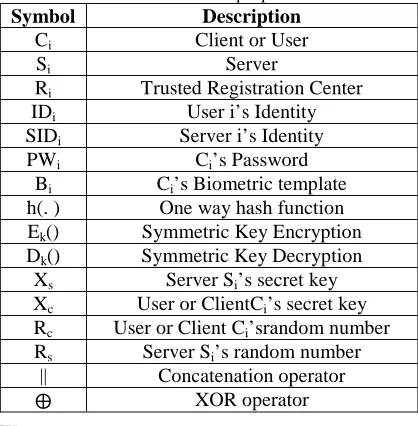
[image:3.612.314.523.529.742.2]The notations are used throughout this paper can be summarized in Table 1.We review Li et al.’s biometrics based remote user authentication scheme using smart cards.
Table 1: Notations used in the proposed scheme
Symbol Description
Ci Client or User
Si Server
Ri Trusted Registration Center
IDi User i’s Identity
SIDi Server i’s Identity
PWi Ci’s Password
Bi Ci’s Biometric template h(. ) One way hash function Ek() Symmetric Key Encryption Dk() Symmetric Key Decryption
Xs Server Si’s secret key Xc User or ClientCi’s secret key Rc User or Client Ci’srandom number Rs Server Si’s random number
|| Concatenation operator
Li et al.’s scheme consists of four phases that are registration phase, login phase, authentication phase and password change phase
3.1 Registration phase
The remote user Ci login to the system the user initially registered with server and performs the following activities.
Step 1:Ci select a random number N and computes the masked password RPWi = h(N || PWi) then input his/her personal biometrics on the specific device.
Offer identity IDi and masked password RPWi to registration centre Rivia a secure channel.
Step 2: The Registration centreRi compute ri and eias follows
ri =h(RPWi||fi)
ei=h(IDi||Xs)⨁ri where fi=h(Bi)and ,Xs is Server secret key shared between Ri and Si
Step 3: Ri store IDi,h(.),fi,eiand y on the user smart card and sends it to the user Ci via a secure channel.
Step 4: Client Ci put N into his/her smart card.
3.2 Login phase
User login to remote server user perform the following activities.
Step 1 .User Ci inserts his/her smart card into the card reader and input his/her personal biometrics Bi on a specific device for verification. The fi in the smart card has been compared with Bi. If the condition does not satisfy user Ci does not pass the biometric verification and the user authentication scheme is terminated. Condition satisfies means user passes the biometric verification.
Step 2: Then user Ci inputs the IDi and the password PWi..The smart card receives the password PWi, it perform the following computations
RPWi = h(N||fi) ri=h(RPWi||fi) M1=ei⨁r.=h(IDi||Xs)
M2=M1⨁Rc where Rc is Ci generate a random number.
M3= h(y || Rc) M4= RPWi⨁ M3 M5= h (M2 || M3 || M4)
Step 3: Ci sends the message <IDi,M2,M4,M5>to the remote server Si.
3.3 Authentication phase
Server receive the request login message from the user, it verify the user is legal or not and perform the following actions.
Step 1: Server Si validate the format of IDi or not. Step 2: If IDi is valid one Si compute the following message for mutual communication between the server and user.
M6 =h (IDi||Xs) M7 =M2⨁M6=Rc M8=h (y||M7)
Verify M5 = h (M2 || M8 || M4).If both are equal Si stores (IDi, M7) in the data base. Server receive Ci’s next request login message, server Si compute M7’.Server compare M7’ against M7 stored in the database. If both values are same then the server assumes there is a chance of replay attack. Hence it rejects the request the login message. If not Si stores M7’ in the database to restore M7. . By using this database technique to resist the replay and man in middle attacks.
Step 3: If step 2 does not hold, server rejects login request and conclude the current session. Otherwise Si accepts Ci is an authenticated user. Si computes
M9= M4⨁ M8,
M10= h(M9 || SID || y) ⨁ M8⨁Rs M11=h (M6 || M9 || y || Rs) Where Rs is server generates a random number.
Step 4: Si sends the message (M10, M11) to the user Ci.
Step 5: User Ci receive the message from Server SiCicomputesM12= h (RPWi || SIDi || y) ⨁ M3⨁ M10and verifiesM11 = h(M1 || RPWi || y || M12). Step 6: If it holds User Ci accepts Si is an authenticated server .Otherwise Ci ends the scheme. After the mutual authentication phase, User Ci and Server Si compute h(RPWi || SIDi || M3 || M12) and h(M9 || M8 || Rs || SIDi) ,these are considered as session key respectively. In this computation if<IDi,M2,M4,M5> and <M10,M11> are valid messages M9=RPWi,M8=M3,M12=Rs and h(RPWi || SIDi || M3 || M12) = SK = h(M9 || M8 || Rs || SIDi)
3.4 Password change phase
If user Ci wants to change his/her old password PWi to a new password PWnew freely without the consulting Registration center Ri. Then user Ci does the following steps.
Step 2: Next input his/her biometric template Bi on the specific device to verify user Ci biometrics. .
Step3: If h (Bi) matches with fi then passes the verification process happens.
Step 4: User Ci enters his/her old password PWi and new password PWinew. Next smartcard will perform the following operations
RPW’ = h (N||PWi) ri’=h(PWi||fi) ei’=ei⨁ri’
RPWinew= h (N|| PWinew) ri’’ = h(PWinew|| fi) ei
new = ei
’⨁ ri
’’
Finally einew is replaced with newly calculated value ei on the smartcard.
4 CRYPTANALYSIS OF LI-ET. AL’S REMOTE USER SCHEME
In this remote scheme attackers create attacks by intercepting and interpolating the messages while transmitted via insecure channel in login and authentication phases.
Fail to provide strong authentication:
In login phase of Li et al.’s scheme the user Ci enter his/her biometrics on specific device to verify whether his/her biometrics passes or not. If verification is correct then Ci enters his/her identity IDi and password PWi. There is no password checking process in login phase. [3]. If the user enters wrong password the login and authentication phase still continue. At the end of authentication phase Si rejects the login request. In this juncture extra communication and computational cost were increased in login and authentication phases. These events may not know by the user Ci.
By crypt analysis Ci enters wrong password (PW’). PW≠PW’ [5]
RPWi= h (N||PWi’) ≠ h(N||PWi) ri
’
=h(RPWi‘||fi) = h( h(N||PWi‘) || fi)
≠h (h(N||PWi‘) || fi) M1=ei⨁ri’≠h(IDi||Xs) M2=M1⨁Rc≠ h(IDi||Xs)⨁Rc M3= h(y || Rc)
M4= RPWi⨁ M3≠h(N||PWi)⨁h(y || Rc) M5= h (M2 || M3 || M4)
≠h(IDi||Xs)⨁Rc||h(y||Rc)||h(N||PWi)
⨁h(y || Rc)))
After sending message <IDi, M2, M4, M5> Si compute
M6 =h (IDi||Xs) M7 =M2⨁M6≠Rc
M8=h(y||M7)≠h(y || Rc) Si compares M5 with h (M2 || M3 || M4)
Si does not store <IDi, M7> in the database and reject the login request and terminate the session. Ci does not authenticate as a valid by user Si. Man in Middle attack or Impersonation attack
Attacker captures the message in login and authentication phase in order to impersonate as one of the communicating party. Both the end parties of the communication think that the other end is a authenticated one. The messages are transmitted over an insecure channel. Therefore there is a chance for man in middle attack or impersonation attack. Attacker proceeds like as User and Ci sends the message <IDi, M2> to Si. An adversary A eavesdrops the message <IDi, M2’> and send this message as <IDi, MA2> to Si. Si received the message and selects a random number RAS
Password Guessing attack:
An adversary A try to guess or steal the password of the user in the login phase. There is no password check before the computation of ri and ei..Even the user enter wrong password in the login and the authentication phase still continues. This includes extra communication and computational overheads [5]. In the cryptanalysis user enter the wrong password PWi’ in the login phase and calculation the messages M1, M2, M3, M4 and M5. There is no password checking procedure before the messages were calculated. The incorrect messages sent to the server and compute the messages M6, M7, M8 using M2 in the authentication phase.
Replay attack:
In the authentication phase the eavesdropper intercept the login message <IDi,M2,M4,M5> from the previous session which one is not most recent session of the user. The eavesdropper login to the server Si with the eavesdropped message ,Si check the validity of IDi and compute M6,M7 and M8.The Si verifies the equation M5 and compares recent M7 to M7’ in the database. If M7 differs from M7’ Si considers the login request as a legal one and store current sessions M7 to the database. At last Si authenticates the attacker and computes M10, M11 and sends to attacker. So that attacker can act as Ci through replay attack.
Stolen verifier attack:
by an attacker easily manipulate the other computation such as fi,eiand ri..
5. PROPOSED SCHEME
Our proposed remote user authentication scheme contains 6 phases which is described in the following section
5.1 Setup phase
Setup phase consist of 3 steps.
Step 1: Server setup: This process is performed by Server Si the Random number Rs chosen by Si. Step 2: Client Setup: Client initializes the Random Number (Xc) for masking password and the number Rc chosen by Ci.
Step 3: System Setup: The Registration center R setup the overall environment to publish hash function h (.), symmetric encryption, decryption function Ek()/Dk() and message authentication code(MAC).Distribute Xs to Server Si through secure channel.
5.2 Registration phase
An interaction between Registration Centre Ri and Client Ci done before the login process starts. The remote user performs the following steps.
Step 1: Ci selects the random number Xc and it is depicted in Figure 1.
Step 2: Ci inputs his/her personal biometrics Bi on the specific device and provides the password PWi, identity of the user IDi..
Step 3: User Ci provides IDi,PWi to registration center Ri via a secure channel (in person).
Step 4: Registration center Ri compute fi,ri and ei fi= h(Bi)
ri = h(PWi⨁Xc|| fi) ei= h(IDi||Xs) ⨁ri
Step5:Registration enter Ri stores fi,ri,ei,vi,h(.),Ek()/Dk() on Ci’s smart card and sends it to Civia secure channel.
Step 6: User Ci enters Xc into his/her smart card.
Figure 1: Registration Phase
5.3 Reregistration phase
Step 1: If user Ci loses or misses his/her smart card and need to re-register to server Si.
Step 2: User chooses a new random number Xc’. Step 3: User sends IDi, PWi to the registration center Ri.
Step 4: Registration center Ri compute fi,ri and ei fi = h(Bi)
ri = h(PWi⨁Xc|| fi) ei = h(IDi⨁Xs) ⨁ri
Step5: Registration center Ri stores fi,ri,ei,h(.),Ek()/Dk() on Ci’s smart card and sends it to Ci via secure channel.
Step 6: User Ci enters Xc into his/her smart card.
5.4 Login phase
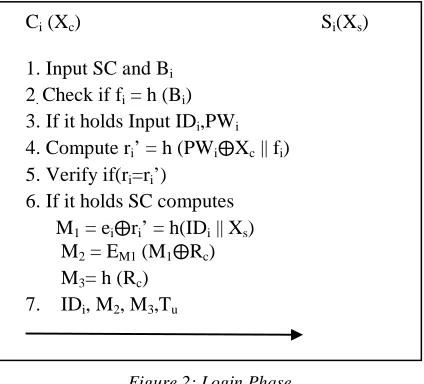
After registration gets over the user Ci wants to logon to the remote server Si, he/she perform the following steps and represented diagrammatically in Figure 2.
Step 1: Ci inserts his/her smart card into the card reader.
Step 2: Next input his/her personal biometrics Bi on the specific device.
[image:6.612.316.528.451.643.2]Step 3: Verify his/her biometrics by h (Bi) = fi. Step4: If the above verification does not hold Ci terminate the current remote user authentication. Step5: Or else the verification was success Ci passes biometric verification and then Ci input his/her login id IDi, and password PWi.
Figure 2: Login Phase
Step 6: The smart card computes the following r’i = h (PWi⨁Xc|| fi)
Step7: Compare ri and ri’ . If ri’≠ri then password verification fails and terminate current user session.
Ci(Xc) Ri (Xs)
1. Bi
2. Issue IDi,PWi 3. Compute ri and ei fi = h(Bi)
ri = h(PWi⨁Xc || fi) ei= h(IDi || Xs) ⨁ri
4. SC [fi,ri,ei,h(.),Ek()/Dk()]
Ci (Xc) Si(Xs)
1. Input SC and Bi 2. Check if fi = h (Bi) 3. If it holds Input IDi,PWi 4. Compute ri’ = h (PWi⨁Xc || fi) 5. Verify if(ri=ri’)
6. If it holds SC computes M1 = ei⨁ri’ = h(IDi || Xs) M2 = EM1 (M1⨁Rc) M3= h (Rc)
Step8: If ri = ri’ the smart card compute the following operations
M1=ei⨁ri’ = h (IDi || Xs)
M2= EM1 (M1⨁Rc) Where Rc is user generated random number.
M3=h (Rc), Where M3 is the authentication code for M2.
Step9: Lastly Ci sends <IDi, M2, M3,Tu> message. Where Tu is the user’s current time stamp.M3 is used to achieve message integrity while the communication takes place. Any attacker does not eavesdropping the message.
5.5 Authentication/Verification phase
This is an agreement between the user and server after the successful completion of login process before the message communication starts. The server receive the login request message<IDi, M2, M3, Tu> from the user to identify Ci is a legal user or not.
Step 1: Server check the format of IDiorTu is invalid or Ts-Tu<=0.If it holds S rejects user login request.
Step 2: If it does not holds Si computes M4 = h (IDi||Xs) (= M1) M2’=DM4 (M2) (= M1’ ⨁Rc) M5 = M2’⨁ M4= Rc
Step 3: Server Si verify whether if M3 equals h(M5)
Step4: If it does not holds then Server Si reject user request. If it holds Server Sicomputes
M6 = EM4 (M4⨁Rs) M7= h (Rs)
Step 5: Si sends the message <M6, M7, Ts> to user Ci. Where M7is the authentication code for M6 Step 6: If either Ts is invalid or Ts=Tu, the session comes to end by user Ci.
Step 7: Otherwise user decrypts M6. M6’ = DM1 (M6).
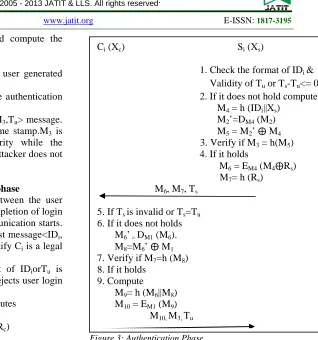
[image:7.612.230.548.61.401.2]Step 8: User compute M8=M6’ ⨁ M1 = Rs The diagrammatic explanation is given as below
Figure 3: Authentication Phase
Step 9: User verifies whether M7=h(M8) .If it does not hold terminate the user session.
Step 10: If it holds user Ci compute M9=h (M6||M8) M10 = EM1 (M9)
Step 11: User Ci sends messageM10, M3,Tu to Si. Here M3is the authentication code for M10.
Step 12: Or else ends the user’s current session.
5.6 Secret key Generation phase
Step 1: After receiving users message, Si verifies if Ts is invalid or Ts-Tu<= 0 terminate the user session.
Step 2: Otherwise Si decrypts M10 M10’=DM4 (M10)
Step 3: Another verification by whether M10’ = h(M6 || Rs) and M3 = h(M5)
Step 4: if it holds accept Ci login request else reject user login request.
Step 5: After the mutual authentication the user compute the session key as h(M1⨁Rc⨁ M8⨁ SID) and server compute the session key as h(M4⨁ M5⨁Rs⨁ SID) .
Step 6: By the use of the session key the user and server further continue with their communication.
Ci (Xc) Si (Xs)
1. Check the format of IDi & Validity of Tu or Ts-Tu<= 0 2. If it does not hold compute M4 = h (IDi||Xs)
M2’=DM4 (M2) M5 = M2’ ⨁ M4
3. Verify if M3 = h(M5) 4. If it holds
M6 = EM4 (M4⨁Rs) M7= h (Rs) M6, M7, Ts
5. If Ts is invalid or Ts=Tu 6. If it does not holds M6’ = DM1 (M6). M8=M6’ ⨁ M1 7. Verify if M7=h (M8) 8. If it holds
Figure 4: Session key generation Phase
5.7 Password change or updating phase
When the user wants to change his/her password with new password freely without contacting the remote center Ri he/she have to enter into this phase. After the biometric verification there is a chance to enter wrong old password by mistake. Then the value of ei was updated that have incorrect value. If the user wants to login the system with new password, the server rejects the users request and reports that that it is incorrect password and ask again to re login. But the smart card verify the old password entered by the user before update ei,ri in it. This phase perform the following steps.
Step 1: Insert his/her smart card and input his/her biometric template.
Step 2: Compare h (Bi) with fi.
Step 3: Both values are same Ci passes the biometric verification.
Step 4: Send a User request to Server to offer to change password by make use of session key. Step 5:.If it accepts Ci enter his/her old password PWi and new password PWinew.
Step 6: Smart card compute ri’=h(PWi⨁Xc || fi) Step 7: If ri’≠ri then Cienter his/her wrong old password.
Step 8: If ri=ri’ ri’’ = (PWinew⨁Xc || fi) ei’= ei⨁ri’
ei’’= ei’⨁ri’’
Step 9: Replace ei with ei’’ and ri with ri’’ on the smart card.
6 SECURITY ANALYSIS
In this section we analyze the security of the proposed scheme and discuss the security features involved in it.
6.1 Secret Key Security
In our system the remote server maintains two pieces of secret information Xs and Rs. Xs is only manipulated by Si. Client also maintains its own secret key Rc and Xc which is not publicly available. An attacker may try to derive Xs from the login message <IDi, M2,M3, Tu> in the login phase and <M6,M7,Ts> in authentication phase. Hence it is infeasible to compute the hash function and break the symmetric encryption.
6.2 Impersonate Attack/ Masquerade On Client And Server Side
In our proposed system an illegal user try to intercept and fabricate the login request message <IDi,M2,M3,Tu> of Ci in the login phase that cheat the remote server as a valid user . It is impossible to compute the message M2 and M3 by the illegal user in order to convince Si unless he/she knows the secret information Rc. The server also reply with <M6, M7, Ts> message to the user. Again there is no possibility of any invalid user impersonate as like server because all are encrypted messages with secret values maintain on both end.
6.3 Resist Replay Attack
To perform a replay attack an adversary E eavesdropped message M2from Ci which is not the last session .E create a fake message M2’ and send to Si. Si respond to E with M6’ = EM4 (M4⨁Rs) .But E cannot decrypt M6’ without knowing the value of Rs..Here we do not use database that store the ID and Rc values that can be easily attacked by the adversaries. So there is a chance for trace the client secret number Rc.
6.4 Resist Man In Middle Attack
The adversary cannot dissect the login and authentication messages because all the messages are encrypted with unknown hash code as key value. These messages are sent along with the message authentication code. No messages are altered that can be easily detect at the other end.
6.5 Strong Mutual Authentication
Our scheme can provide strong mutual authentication that can enable by client Ci send Ci (Xc) Si(Xs)
1. Verify invalid Ts or Ts-Tu<=0 2. If it does not hold Compute
M10’=DM4 (M10)
3. Verify if M10’= h(M6 || Rs) and M3 = h(M5)
4. If it holds
Si accept Ci’s login request else
Si reject Ci’s login request
the login message <IDi, M2, M3> to server Si. The server Si checks the validity of IDi and timestamps that ensure the authenticity of the client. Then compute M4, M5 and again authenticate Ci by verifying M3 with h(M5). If it holds user Ci is a valid user. Otherwise user Ci does not pass the authentication. Any fake message cannot pass in the authentication phase. Server Si sends messages M6 and M7 to the user Ci. Next Ci compute M8 and compare h(M8) with M7 to provide a level of authentication. User Ci calculates M10 and encrypted it and sends it to the server Si .Final level of authentication is done by compare h(M6 || Rs).Therefore any fabricated message cannot pass the authentication.
6.6 Stolen verifier attack
In Li et al. and Das et al. scheme store identity and Rc into user database. Hence there is a chance for replay attack. The proposed scheme is not used any user database that store the users identity, passwords and users nonce value. Hence there is no threat against stealing any significant information from the system.. In our scheme we do not maintain any table but we use timestamps to withstanding the replay attack.
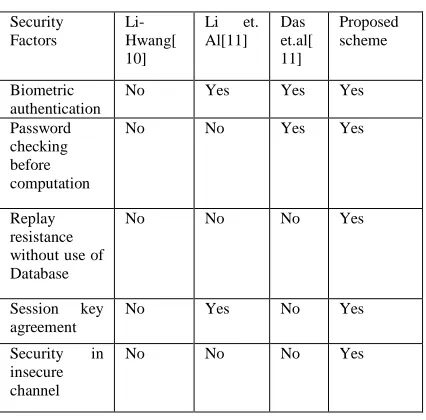
[image:9.612.85.298.457.667.2]Table 2 shows the security comparison of our scheme with other related schemes.
Table 2: Security Comparisons
Security Factors
Li-Hwang[ 10]
Li et. Al[11]
Das et.al[ 11]
Proposed scheme
Biometric authentication
No Yes Yes Yes
Password checking before computation
No No Yes Yes
Replay resistance without use of Database
No No No Yes
Session key agreement
No Yes No Yes
Security in insecure channel
No No No Yes
7 PERFORMANCE AND FUNCTIONALITY ANALYSIS
In this section we evaluate the performance and functionality of the proposed scheme and compare with those of Li-Hwang et al.’s scheme and Li et al.’s scheme. We analyze the results of computation and communication cost in terms of hash function but without exclusive OR operation and concatenation operation. Because XOR and concatenation operations require very few computations it is usually negligible considering its computational cost. In our scheme we use a symmetric key cryptosystem for communicating message over a insecure communication channel. The computational complexity of a symmetric key encryption or decryption operation is similar to the hash function operation. The AES-256 scheme is more efficient than SHA-256 scheme in resource constrained devices. The message communication between user and server of our scheme is same as that of Li-Hwang scheme and Das et al.’s scheme which have 3 insecure communications. But in Li et al.’s scheme has 2 insecure communications. If communication cost is low then that leads to vulnerable in parallel attack and replay attack. Table 3 shows the performance comparison of our scheme with other related schemes.
Table 3: Performance Comparisons
Phases Li-Hwang et.al [10]
Li et. al [11]
Das et.al [11]
Proposed scheme
RP 3H 4H 3H 3H LP 2H 4H 2H 2H AP 5H 7H 8H 4H⨁4E Total 10H 15H 13H 9H⨁4E
H – one way hash function
E - Symmetric encryption for insecure channel RP – Registration Phase
LP-Login Phase
AP – Authentication Phase
memory needed in the smart card for each parameter is 128 bits. Our scheme provides the user anonymity by an attacker intercepted the login message <IDi,M2,M3>,then the attacker may try to retrieve any static parameter from these messages, but M2,M3 are all session variant and indeed random strings due to the randomness of Rc..This scheme has session key agreement phase for generating session keys at the both ends.. In that client generate a session key and server produce a session key. If both the session keys are same then further communication continues. In our scheme the session key SK =
h(M
1⨁
R
c⨁
M
8⨁
SID) = h(M
4⨁
M
5⨁
R
s⨁
SID)
is associated with Rs, Rc and hash values. In this scheme the adversary cannot trace the user activity as all the messages are transmitted in encrypted form. It prevents any adversary acquiring sensitive information such as server identity in the session agreement phase. The proposed method also has the facility to change the password freely by using new password to replace the new values of ri and ei. in the smart card. In our scheme in all phases client Ci and server Si communicate each other by creating a timestamp and sender’s identity’s hash value for achieving non repudiation. Moreover we summarized the functionality of the proposed scheme and compare with other schemes in Table 4, which clearly shows that our scheme is more secure than others.Table 4: Functionality Comparisons
Functional Factors
Li-Hwang[ 10]
Li et. al.[11]
Das et.al[11]
Proposed scheme
Password Change freely
Yes Yes Yes Yes
Strong Mutual authenticatio n
No Yes No Yes
Provide non repudiation
Yes No No Yes
User anonymity
No Yes Yes Yes
Provide session key agreement
No Yes No Yes
8. CONCLUSION
In this paper a new biometric based user authentication scheme using smart card has been proposed. The proposed scheme improves Li et al.’s scheme in order to provide strong authentication and non-repudiation and defend against the replay attacks, man in middle attacks, and stolen verification attacks. The proposed scheme updates the password freely without the knowledge of registration center. Our scheme has double security protection mechanism where message are transmitted over an insecure channel. When compared with other schemes our scheme enhances the security in terms of security goals.
REFRENCES:
[1] Lamport.L., , “Password authentication with in secure communication“, Communications of the ACM, Vol 24, No 11,1981, pp. 770-772 [2] Li C-T, Hwang M S, “An online biometrics
based secret sharing scheme for multiparty cryptosystem using smartcards”, Journal of Innovative Computing Information and Control “, Vol. 6, No. 5, 2010a, pp. 2181-2188.
[3] Chun-Ta Li, Min-Shiang Hwang, “An efficient biometrics based remote user authentication scheme using smart cards”, Journal of Network and Computer Applications”, Vol. 33, No. 1, 2010b, pp. 1-5.
[4] Li X, Niu J-W, Ma J., Wang W-D, Liu C.L “Cryptanalysis and improvement of a
biometrics- based remote user authentication scheme using smart cards”, Journal of Network and Computer Applications,Vol. 34, No 1, 2011,pp.73-79.
[5] A.K.Das “Analysis and improvement on an efficient biometric based remote user authentication scheme using smart cards“,IET Information Security”, Vol 5, No 3, 2011,pp. 145-151.
[6] Sandeep K Sood, Anil K Sarie and KuldipSingh, “A Secure dynamic identity based authentication protocol for multiserver environment”, Journal of Network and Computer Applications”, Vol. 34, No. 2, 2011, pp. 609-618.
Communications, Springer, Vol 70,2013 Issue 1 pp 323-320.
[8] Jing Chao “An improved remote password authentication scheme with smart card”, Journal of Electronics(China), Springer, Vol 29,Issue 6,2012 pp 550-555.
[9] Younghwa An “Improved biometrics based remote user authentication scheme with session key agreement”, Communications in Computer and Information Science ,Vol 351,2012 pp. 307-315.
[10] Chun-I Fan and Yi-HuiLin “Provably secure remote truly three factor authentication scheme with privacy protection on biometrics”, IEEE Transactions on information and forensics and security, Vol4 ,No 4 2009 pp. 933-945.
[11] Wang Ding MA Chun guang “Cryptanalysis and security enhancement of a remote user authentication scheme using smart cards”, Journal of China Universities of Posts and Telecommunications, Vol 19, No. 5 2012 pp. 104-114.
[12] A.K.Awasthi and S.Lal“ An enhanced remote user authentication scheme using smart cards”, IEEE Transaction on Consumer Electronics ,Vol 50 2,May 2004 pp. 307-315.
[13]Eun-Jun Yoon ,Kee-Young Yoo “Secure Fingerprint based remote user authentication scheme using smart cards”,Internet and Network Economics LNCS Springer,vol 3828,2005, pp. 405-413.
[14] M K Khan ,JiashuZiang“An efficient and practical fingerprint based remote user authentication scheme with smart cards”, Information Security Practice and Experience LNCS Springer, Vol 3903,2006 pp. 260-268. [15] Ali A.Yassin ,Ha Jin, Ayad Ibrahim,
DeqingZou“Encrypted remote user authentication scheme using smartcards”, Web Information Systems and Mining LNCS Springer, Vol 7529,2013 pp. 314-323. [16] Youngwa An “Security analysis and
enhancement of an effective biometric based remote user authentication scheme using smartcards”, Journal of Biomedicine and Biotechnology , Vol 2012 ,2012 pp. 314-323. [17] Kuo-HuiYeh, ChunhuaSu,N.W.Lo,Yingjiu Li,
Yi-Xiang Hung “Two robust remote user authentication scheme using smartcards”, Journal of Systems and Software , Vol 83(12),2010, pp. 2556-2565.
[18] Cheng-Chi Lee, Cheng-Wei Hsu“ A Secure biometric based remote user authentication scheme with key agreement using chaotic maps”, Journal of Nonlinear Dynamics, Vol71(1) ,2013 pp. 201-211.
[19] Sang-KyunKim, Min Gyo Chung “Moresecure remote user authentication
scheme”, Journal of Computer
Communications, Vol32 ,2009 pp 1018-1021. [20] Wen-Bin Hseih, Jenq-ShiouLeu ,”Exploiting