•
Digital
Technical
Journal
I
ALPHASERVER 4100 SYSTEM
ORACLE AND SYBASE DATABASE PRODUCTS FOR VLM
INSTRUCTION EXECUTION ON ALPHA PROCESSORS
Editorial
Jane C. Blake, Managing Editor Kathleen M. Stetson, Editor Helen L. Patterson, Editor
Circulation
Catherine M. Phillips, Administrator Dorothea B. Cassady, Secretary
Production
Christa W. Jessica, Production Editor Anne S. Katzcff, Typographer Peter R. Woodbury, lllustrator
Advisory Board
Samuel H. Fuller, Chairman Richard W. Beane
Donald Z. Harbert Richard J. Hollingsworth William A. Laing Richard F. Lary Alan G. Nemeth Robert M. Supnik
Cover Design
The performance advantage of very large memory teclUlology for commercial applica tions is a major theme in this issue of the journal. The cover is a collage of images from the development of the AlphaScrver 4100 four-processor symmetric multipro cessing system, which offers 8 gigabytes of memory and industry leadership per formance. This four-processor symmetric multiprocessing system is not only charac terized by very large memory but by low latency, high bandwidth, and 400-megaherrz microprocessors.
The cover design is by Lucinda O'Neill of DIGITAL's Corporate Design Group.
The Digital Technical journal is a refereed journal published quarterly by Digital Equipment Corporation, 50 Nagog Park, AK02-3/B3, Acton, MA 017 20-9843. Hard-copy subscriptions can be ordered by sending a check in U.S. funds (made payable to Digital Equipment Corporation) to the published-by address. General subscription rates are $40.00 (non-U.S. $60) for four issues and $75.00 (non-U.S. $115) for eight issues. University and college profes sors and Ph.D. students in the electrical engineering and computer science fields receive complimentary subscriptions upon request. DIGITAL's customers may qualifY for gifi: subscriptions and are encouraged to contact their account representatives.
Electronic subscriptions are available at
no charge by accessing URL
http://www.cligital.com/infojsubscription. This service will send an electronic mail notification when a new issue is available on the Internet.
Single copies and back issues are available for $16.00 (non-U.S. $18) each and can be ordered by sending the requested issue's volume and number and a check to the published-by address. See the Further Readings section in the back of this issue for a complete listing. Recent issues are also available on the Internet at http://www.cligital.com/i nfo/dtj. DIGITAL employees may order subscrip tions through Readers Choice at URL http:/ /webrc.das.dcc.com or by entering VfX PROFILE at the Open VMS system
prompt.
Inquiries, address changes, and compli mentary subscription orders can be sent to the Digital Technical]ournal at the published-by address or the electronic mail address, [email protected]. Inquiries can also be made by calling rJ1eJournal office at 508-264-7549.
Comments on the content of any paper and requests to contact authors are welcomed and may be sent to rJ1e managing editor at rJ1e published-by or electronic mail address. Copyright© 1997 Digital Equipment Corporation. Copying without fcc is per mitted provided that such copies are made for use i11 educational institutions by faculty members and are not distributed for com mercial advantage. Abstracting with credit of Digital Equipment Corporation's aurJ1or ship is permitted.
The information in rJ1ejourna./is subject to change wirJ10ut notice and shonld not be construed as a commitment by Digital Equipment Corporation or by the compa nies herein represented. Digital Equipment Corporation assumes no responsibility for any errors that may appear in the journal. ISSN 0898-901X
Documentation Number EC-N7629-l8 Book production was done by Quantic Communications, Inc.
The following arc trademarks of Digital Equipment Corporation: AlphaServer, AlphaStation, DEC, DECnet, DIGITAL, the DIGITAL logo, VAX, VMS, and ULTIUX.
Contents
ALPHASERVER 4100 SYSTEM
Alpha Server 4100 Performance Cha racterization
The AlphaServer 4100 Cached Processor Module Architecture and Design
The AlphaServer 4100 Low-cost Clock Distribution System
Design and Implementation of the Alpha Server 4 1 00 CPU and Memory Architecture
High Performance 1/0 Design in the Alpha Server 4100 Symmetric Mu ltiprocessing System
ORACLE AND SYBASE DATABASE PRODUCTS FOR VLM
Design of the 64-bit Option for the Orade7 Relational Database Management System
VLM Capabilities of the Sybase System 1 1 SQL Server
INSTRUGION EXECUTION ON ALPHA PROCESSORS
Measured Effects of Adding Byte and Word Instructi ons to the Alpha Architecture
Zarka Cvetanovic and Darrel D. Donaldson
Maurice .B. Stcinm;m, George J. Harris, Andrej Kocev, Virginia C. Lamere, and
Roger D. Pannell
Roger A. Dame
Glenn A. Herdeg
SJmuel H. Duncan, Craig D. Keefer, and
Thomas A. NlcL1ughlin
Vipin V. GokhJie
T.K. Rengarajan, Maxwell Berenson,
Ganesan Gop;!], Bruce lvlcCrc.Jd)', Sa pan Panigrahi, Srikanr Subram;1niam, and Marc B. SugiyamJ
David P. Hunter and Eric 13. Bcrrs
3
21
38
48
61
76
83
89
2
Editor's
Introduction
Just 40 years ago, a machine called the TX-0-a successor to Whirlwind was built at MIT's Lincoln Laboratory to find out, among other things, if a core memory as large as 64 Kwords could be built. Over tJ1e years mem ory sizes have grown so large that, in the '90s, tJ1e industry has felt the need to characterize memory in big machines as uery large. At five orders of magnitude greater in size than the TX -0 memory, the AlphaServer 4100 8-gigabyte memory is indeed very brgc, even by today's standards. \Vhole databases can be designed to reside in memory. Very large memory technol ogy, or VLM, is a key to rJ1e system and application performance discussed in this issue of the.fournal, which fea tures the AlphaServer 4100 system, database enhancements from Oracle Corporation and !Tom Sybase, Inc., and extensions to the Alpha architccwre.
The AJphaServcr 4100 is a mid range, symmetric multiprocessing system designed tor industry-leading performance at a low cost. The sys tem accommodates up to four 64-bit Alpha 21164 microprocessors operat ing at 400 megahertz, four 64-bit PCI bus bridges, and 8 gigabytes of main memory. Opening the section about rJ1e 4100 system, Zarka Cvetanovic and Darrel Donaldson describe tJ1e project te:un 's performance characteri zation of different Alph�,server 4100 models under technical and commer cial workloads. Both the process and the findings are of interest. As one example set of data demonstrates, tJ1e model 5/300 is not only faster tJ1an its DIGITAL predecessors but 30 to 60 percent taster rhan a com parative industry platform when run ning memory-intensive workloads ti-om the SPECtp95 benchmark.
The four papers that follow exam ine areas of the system rhat challenged designers to keep costs low and at the same time deliver high performance.
The AlphaScrvcr 4100 cached pro cessor module design is presented by Mo Steinman, George Harris, Andrej
Kocev, Ginny Lamere, <llld Roger Pannell. Built around the Alpha 211 64 64-bit !USC microprocessor, the module is the first ti·om DIGITAL to employ a high-performance, cost etkctive synchronous cache rather than a traditional asynchronous cache. Next, Roger Dame reviews the clock distribution system, the use of off� the-shelf phase-locked loop circuits
as the basic building block to keep costs low, and the signal integrity techniques developed to optimize performance of the clock distribution system for a worst-case clock skew of 2.2 nanoseconds, a goal which the team far exceeded. A unique memory architecture for the model 5/300£ is the subject. of Glenn Herdeg's paper. This memory design incorporates a processor module that has no external cache and instead takes advantage
of the multiple-issue tearure of the Alpha 211 64 microprocessor. Closing the section on the 4100 design is the 1/0 subsystem's contribution to the system goals of low latency and high memory and 1/0 bandwidth. Sam Duncan, Craig Keefer, �md Tom McLaughlin present several innova tive techniques developed f()r the sys tem bus-to-PC! bus bridge design, including partial cache line writes, peer-to-peer transactions across PC! bridges, and support t(Jr large bursts of data.
All efforts to make the hardware run taster are t(x the benefit of the applications that run on those sys tems. A paper fi·om Oracle Corpora tion and another from Sybase, Inc., examine ways in which their respec tive database systems take advantage of VLM. V ipin Gokhalc describes the 64 Bit Option implememation for the Oracle7 relational database system. A primary project goal was to
Vol. 8 No.4 1 996
demonstrate a clear performance ben efit tor decision support systems and online transaction processing. The author summarizes data that show
a clear benefit for a database with the 64 Bit Option enabled running on the AlphaServer 8400 with 8 gigabytes of memory; in some cases, the pertor mance increase was 200 times that ofrhe standard configuration. Sybase engineers T.K. Renga.rajan, Max Berenson, Ganesan Gop�1l, I>rucc McCready, Sapan Panigrahi, Srikam Subramaniam, and Marc Sugiyama examine the technology of the System 1 1 SQL Server that was spc citically designed for VLM systems.
In addition to achieving record results with the SQL Server running on rhc
AJphaServer 8400, the engineers have laid the groundwork for ti.Iturc main memory database systems.
RecenrJy, byte and word instruc tions were added to DIGITAL's 64-bit Alpha architecture. Dave Hunter and Eric Betts describe the process of analvzing bow these addi tions aftect the pertormance of a commercial database. �or resting, the team used prototype harci\v,ue, rebuilt Microsoti: Corporation's SQL Server to use rhe new instructions, and ran the TPC-B benchmark.
The editors thank Darrel Donaldson of the AlphaServer 4100 team and Kuk Chung of the Dat<lbase Applica tion Partners group tor rheir dlixts
to acquire the papers presented in this issue. Our upcoming issue will k:nure CMOS-6 process technologies.
Alpha Server 4100
Performance
Characterization
The AlphaServer 4 1 00 is the newest four processor symmetric multiprocessing addition to DIGITAL's line of midrange Alpha servers. The DIGITAL AlphaServer 4100 fa m ily, which consists of models 5/300E, 5/300, and 5/400, has major platform perfor mance adva ntages as compared to previous-generation Alpha plat forms and leading industry midrange systems. The primary performa nce strengths are low memory latency, high bandwidth, low-latency 1/0, and very large memory (VlM) technology. Evaluating the characteristics of both tech nical and commercial workloads against each fa mi ly member yielded recommendations for the best application match for each model. The perfor mance of the model with no modu le-level cache and the advantages of using 2- and 4-megabyte module- level caches are quantified. The profiles based on the built-in performance monitors are used to evaluate cycles per instruction, stall time, multiple-issuing benefits, instruction frequen cies, and the effect of cache misses, branch mispredictions. and replay traps. The authors propose a time allocation-based model for eval uati ng the performance effects of various sta ll components and for predicting future per formance trends.
I
Zarka Cvetanovic Darrel D. Donaldson
The AlphaServer 4100 is DIGITAL's latest four processor symmetric multiprocessing (SMP) midrange Alpha server. This paper characterizes the performance of the AlphaServer 4 100 tamily, which consists of three models: 1-5
I. AlphaServer 4 1 00 mode l 5/300E, which has up to four 300- megahertz (MHz) Alpha 2 1 1 64 micro processors, each without a mod ule-level, third level, write-back cache (B-cache) (a design referred to as uncached in this paper)
2. AJphaServer 4 100 model 5/300, which has up to
tour 300-M Hz Alpha 21164 microprocessors, each with a 2-megabyte ( M B) B -cache
3. AlphaServer 4100 model 5/400, which has up to four 400-MHz Alpha 2 1 1 64 microprocessors, each with a 4-MB B-cache
The performance analysis undertaken examined a number of workloads with d i fferent character istics, including the SPEC9 5 benchmark sui tes (floating-point and integer), the UNPACK bench mark, AIM Suite VII (UNIX multiuser benchmark) , the TPC-C transaction processi ng benchmark, image rendering, and memory latency and bandwidth tests-" 15 Note that both commercial (AlJ\1 and TPC-C) and tech nical/scientific (SPEC, UNPACK, and image re nderi ng) classes of workloads were included i n this analysis.
The results of the analysis ind icate that the major AJphaServer 4 100 pertormance advantages result from the to! lowi ng server rcatures:
• Significantly higher bandwidth (up to 2 .6 times)
and lower latency compared to the previous generation midrange AJphaServer plattorms and leading i ndustry midrange systems. These improve ments benefit the large, multistrcam applica tions that do not fit in the B-cache. For example, the AlphaServer 4 1 00 5/300 is 30 to 60 percent faster than the HP 9000 K420 server in the memory-intensive workloads from the SPECf1.)95 benchmark suite . (Note that all competitive per formance data presented in this paper is val id as
4
of the submission of this paper in July 1996. The references cited rekr the reader to the literature and the appropriate Web sites for the latest ped(>r nunce information.)
• An expanded very large memory (VLM). The max
imum memory size increased from 2 gig<1bytes (GB) to 8GB without sacrificing CPU slots. This increase in memory size benefits primarily the com me!-cial, multistream applications. For example, the AJphaServer 4100 5/300 server achieves approxi mately r..vice the throughput of the Compaq ProLiant 4500 server and 1.4 times the throughput of the AJphaServer 2100 on the AIM Suite Vll benchmark tests.
• A 4-M 13 B-cache and a clock speed of 400 M Hz
in the AJphaServer 4100 5/400 system. The larger B-cache size and 33 percent faster clock resulted in a 30 to 40 percent performance improvement over the AlphaServer 4100 5/300 system.
The performance improvement rrom rhe IJrger B-cache increases with the number of CPUs. For example, rhe AJphaServer 4100 5/300 system with its 2-M13 R-cache design performs 5 to 20 percent raster with one CPU and 30 to 50 percent raster with four CPUs than the uncached 5/300£ system. The majority of workloads included in this analysis benefit ri·om the B-cache; however, the uncached sys tem ourperr(mns the cached implementation by 10 to
20 percent f(>r large applications that do nor fit in the 2-MB B-cache.
The pertc>rmance counter profiles, based on rhe built-in h::�rdware monitors, indicate that the nnjor ity of issuing time is spent on single and dual issuing and that a small number of Aoating-point workloads take advantage of triple and quad issuing. The load/store instructions make up 30 to 40 percent of all instructions issued. The stall time associated with waiting ror data that missed in the various levels of cache hierarchy accounts ror the most significant por tion of the time the server spends processing com mercial workloads.
Memory latency
Memory IJrency and bandwidth have been recog nized as important perr(mnance factors in the earJy Alpha-based implementations. "'·'7 Since CPU speed is
increasing at a much higher rate than memory speed, the "memory wall" limitation is expected to become even more important in the future. Therdore, reduc ing memory latency and increasing bandwidth have been major design goals ror the AlphaServer 4100 platrorm.' The AlphaServer 4100 achieved the lowest memory latency of all DIGITAL products based on
Vol. 8 No.4 1996
the Alpha 21164 microprocessor Jnd all multiproces
sor products by leading industrv vendors. The major benefits come ri·om the simpler intcrhce, rhe use of synchronous dvnamic random-access memun· (DRMvl) chips (i.e., svnchronous memorv), and rhe lower fill time." Figure 1 shows the measured mem ory load latencv using the lmbench benchm::�rk with a 512-byte stride.'" In this benchmark, each load depends on the result ri·om the previous load' and therd()re l:!tency is nor a good measure of pnr(>r mance rc>r systems that can have multiple outstanding loads. (AiphaServer 4100 systems can have up to two outst:rnding requests per CPU on the bus.) The lmbench benchmark data indic1tes rhar the AlphaServer 4100 has the lowest memory latency of :rll industry-leading reduced-instruction set comput ing (RISC) vendors' sen·ers.
As shown in Figure 2 , using a slightlv dii"fi..Tel1t worklo:�d where there is no dependencv bel:\1-een consecutiYe loads, the AJphaSen·er 4100 achie1·es c1 en lower per-Joad latency, since the iateilC\" r(>r the l:\1"0 consecutive lo:�ds can be overbpped. The platc1lls in Figure 2 sholl" rhe load latency at each ofrhe r(>llow ing levels of cache/memory hierarclw: R-kilobne (KB) on-chip data cache (D-cache), 96-KB on-chip secondary instruction/data cache (S-cache), 2- and 4-MB offchip B-eaches (except rl.lr model 5/300 E),
:�nd memory. The uncached AlphaServer 4100 5/300E :�chieves Jn 85 percent lower memory load latency than the previous-generation Alph:�Server 2100. The AJphaServer 4100 5/300, with its 2-MB B-cache, increases memorv latency 30 percent r(>r load operations and 6 percent for store oper:�tions
compared to the uncachcd 5/300E svsrem because of
the time spent checking for data in the B-c1che. The svnchronous memorv shows one cvcle lower Lltencv than the asvnchronous extended dar:� out ( EDO)
DRAM (i.e., asynchronous memorv), ll"hich results in 9 percent bster load operations and 5 percent bster store operations. "Note that the cached AlphaSnl'er 4100 and AI phaSe rver 8200 SI'Stems, ll'hich ha\·e the same clock speeds of 300 lv!Hz, achieve com par:�ble B-c:�che latencv, while the memory Lnenc1· r(>r :�II AlphaServer 4100 S\'Stems is signific:�ntlv
lower than on both the AlphaServer 8200 and the Alph:.1Server 2100 systems. The latency to the B-cKhe in this rest is lower on the AlphaServer 2 J 00 th:ll1 on the other AlphaServer systems due to 32-byte blocks (compared to 64-byte blocks in the 4100 �111d 8200 systems). Although not shown in this rest, many applications can benefit from the larger uche block size. The 400-IV!Hz AlphaSen·er 4100 svsrem uses
J 33 percent raster CPU and Khiei"CS 11 percent
LMBENCH: DEPENDENT LOAD MEMORY LATENCY (STRIDE= 512 BYTES)
Figure 1
ALPHASERVER 8200 (300 MHZ)
ALPHASERVER 4100 5/400 (400 MHZ)
ALPHASERVER 4100 5/300 (300 MHZ)
ALPHASERVER 4100 5/300E (300 MHZ)
INTEL PENTIUM PRO (200 MHZ)
SUN ULTRASPARC (167 MHZ)
HP 9000 K210 (119 MHZ)
SGI POWER CHALLENGE R1 0000 (200 MHZ)
IBM RS/6000 43P POWERPC (133 MHZ)
0 200 400 600 BOO
MEMORY LATENCY (NANOSECONDS)
1,000 1,200
lmbench Benchmark Test Results Showing Memory Latency for Dependenr Loads
Memory Bandwidth
The AJphaServer 4 100 system bus achieves a peak bandwidth of 1 . 06 gigabytes per second ( GB/s). The STREAM McCalpin benchmark measures sustainable memory bandwidth in megabytes per second (MB/s) across four vector kernels: Copy, Scale, Sum, and SAXPY." Figure 3 shows measured memory band width using the Copy kernel from the STREAM benchmark. Note that the STREAM bandwidth is 33 percent lower than the actual bandwidth observed on the AJphaServer 4100 bus because the bus data cycles are allocated for three transactions: read source, read destination, and vvrite destination. The AlphaServer 4 1 00 shows the best memory bandwidth of all multiprocessor platforms designed to support up to four CPUs. The platforms designed to support more than fou r CPUs (i.e., the AJphaServer 8400, the Silicon Graphics POWER CHALLENGE R10000, and the Sun Ultra Enterprise 6000 systems) show a higher bandwidth for fou r CPUs than the AlphaServer 4 100. The STREAM bandwidth on the AlphaServer 4 1 00 5/300 is 2.2 times higher than on the previous generation AlphaServer 2100 5/250 ( 2 . 6 times higher
with the AJphaServer 4100 5/400). The uncached AJphaServer 4 100 model shows 22 percent higher memory bandwidth than the cached model 5/300.
The AJphaServer 4 1 00 memory bandwidth improvement from synchronous memory compared to EDO ranges from 8 to 1 2 percent. The synchro nous memory benefit i ncreases with the number of CPUs, as shown in Table l.
Low memory latency and high bandwidth have a significant dtect on the performance of workloads that do not fit in 2- to 4-MB B-eaches. For example, the majority of the SPECtp9 5 benchmarks do not fit in the 2 - M B cache. (Figure 20, which appears later in this paper, shows the cache misses.) The SPECtp95 performance comparison presented in Figure 4 shows that the uncached AlphaServer 4100 5/3 00£ system outperforms the 2-MB B -cache model 5/300 i n the benchmarks with the highest number of B-cache misses (tomcatv, swim, applu , and hydro2d). The per formance of the uncached mod el 5/300£ is compar able to that o f the 4 - M B B-cache model 5/400 for the swim benchmark. However, the benchmarks that fit better in the 4-MB cache (apsi and waveS) run signifi cantly slower on the 5/300£ than on the 5/400.
6
(jJ 0 z 0
u w (J) 0
z
<(
�
>-u z
w
� _j
300
250
200
150
100
50
INDEPENDENT LOAD LATENCY (STRIDE= 64 B YTES)
0
�
�
�
�
�����4 KB 8 KB 1 6 KB 32 KB 64 KB 1 28 KB 256 KB 512 KB 1 MB 2 MB 4 MB 8 MB 16 MB DATA SET SIZE
Figure 2
KEY:
--- ALPHASERVER 4100 5/300E
- ALPHASERVER 4100 5/300 ALPHASERVER 4100 5/400 ALPHASERVER 8200 5/300 -- ALPHASERVER 2100 5/300
Cache/Memory Latency for 1ndepencknt Loc1ds
1.000
900
0 800
z 0
u
w (J)
700 a:
w
CL (J)
w 600
f-- >-en <( <.9 500
w
6 I
f--0 3:
0 z 300 <( en
0
Figure 3
2 3
NUMB ER OF CPUs 4
STREAM t'vlcCalpin Memory Copy Bandwidth Comparison
Digital Technical journal Vol. 8 No.4 l996 5
KEY:
---+-- ALPHASERVER 8400 5/300
- ALPHASERVER 8400 5/350 IB M RS/6000-990
SGI POWER CHALLENGE R10000 - ALPHASERVER 4100 5/300E - ALPHASERVER 4100 5/300 - ALPHASERVER 4100 5/400
HP 9000 J210
ALPHASERVER 2100 5/250 ----<>---- SUN SPARCSERVER 2000E
INTEL ALDER PENTIUM PRO SUN ULTRA ENTERPRISE 6000
Table 1
Bandwidth Improvement from Synchronous Memory to Asynchronous Memory
Bandwidth
improvement 8%
Number of CPUs
2 3
8% 9%
4
12%
Figure 4 shows that the AlphaServcr 4100 5/300 system has a significant (up to t\vo times) performance advantage over the previous-generation AlpbaServer 2100 system in the SPEC!p95 benchmark tests with the highest number of B -cache misses. The SPEC!p95 tests indicate that the 300-MHz AlphaServer 4100 is more than 50 percent faster than the HP 9000 K420 server, and the 400-MHz AlphaServer 4100 is twice as fast as the HP 9000 K420 in the SPECtp95 bench marks that stress the memory subsystem.
SPEC95 Benchmarks
The SPEC95 benchmarks provide a measure of pro cessor, memory hierarchy, and compiler pert(Jrmance. These benchmarks do not stress gr<lphics, net\vork, or l/0 pertormance. The integer SPEC95 suite
SPECFP95
146.WAVE5
145.FPPPP
141.APSI
125.TURB3D
110.APPLU
107.MGRID
1 04.HYDR02D
103.SU2COR
102.SWIM
101.TOMCATV
0
KEY:
• HP 9000 K420
5 10
• ALPHASERVER 2100 5/300 • ALPHASERVER 4100 5/400
0 ALPHASERVER 4100 5/300 ALPHASERVER 4100 5/300E
Fig ure 4
SPECFP95
15 20 25 30
SPECtp95 Benchmarks Performance Comparison 35
( CINT95) contains eight compute-intensive integer benchmarks written in C and incl udes the benchmarks shown in Table 2.''·12
The floating- point SPEC95 su ite ( CFP95) contains 10 compute- intensive floating-point benchmarks writ ten in FORTRAN and includes the benchmarks shown in Table 3."·12
The SPEC Homogeneous Capacity Method (SPEC95 rate ) measures how t:\st an SMP system can perform multiple CINT95 or CFP95 copies (tasks). The SPEC95 rate metric measures the throughput of the system running a number of tasks and is used tor evaluating multiprocessor system performance.
Table 2
CINT95 Benchmarks (SPECint95)
Benchmark
099.go
124.m88ksim
126.gcc
129.compress
130.1i 132.ijpeg
134.perl
147.vortex
Table 3
Description
Artificial intelligence, plays the game of Go
A Motorola 88100 microprocessor simulator
A GNU C compiler that generates SPARC assembly code
A program that compresses large text files (about 16 MB)
A LISP interpreter
A program that compresses/ decompresses an image
A Perl interpreter that performs text and numeric manipulations A database program that builds and manipulates three interrelational databases
CFP95 Benchmarks (SPECfp95)
Benchmark
1 01.tomcatv
102.swim
1 03.su2cor
1 04.hydro2d
107.mgrid
110.applu
125.turb3d
141.apsi
145.fpppp
146.wave5
Description
A fluid dynamics mesh generation program
A weather prediction shallow water model
A quantum physics particle mass computation (Monte Carlo) An astrophysics hydrodynamical Navier-Stokes equation
A multigrid solver in a 3-D potential field (electromagnetism)
Parabolic/elliptic partial differential equations (fluid dynamics)
A program that simulates turbulence in a cube
A program that simulates tempera ture, wind, velocity, and pollutants (weather prediction)
A quantum chemistry program that performs multielectron derivatives A solver of Maxwell's equations on a Cartesian mesh (electromagnetics)
8
Figure 5 compares the SPEC95 performance of the AlphaServer 4 1 00 systems to that of the other industry-leadi n g vend ors using published results as of July 1 996. Figure 6 shows the same comparison in the multistream SPEC95 rates u Note that all the SPEC95 comparisons in this paper are based on the peak results that i nclude extensive compiler optimiza tions. 1 2 Figure 5 indicates that even the uncached AlphaServer 4100 5/300£ performs better than the HP 9000 K420 system, and the AlphaServer 4 100 5 I 400 shows approximately a two times performance advantage over the HP system. The AlphaServer 4 100 5/300 SPECin t95 performance exceeds that of the Intel Pentium Pro system, and the Al phaServer 4 100 5/300 SPECtp95 performance is double that of the Pentium Pro. The AlphaServer 4100 5/400 is 1 . 5 times (SPECint9 5 ) and 2 . 5 times (SPECfp95 ) faster th::m the Pentium Pro system. The multiple processor SPECtp95 on the AlphaServer 4 100 is obtai ned by decomposin g benchmarks using the KAP preprocessor from Kuck & Associates. Note that the c:Khed tour- CPU AlphaServer 4 I 00 5/300 outper tCll'IllS the Sun Ultra Enterprise 3000 with six CrUs in the S r ECtp95 parallel test. The performance benefit of the cached versus the u ncached AlphaServer 4 100 is greater in multiprocessor configurations than in uni processor configurations.
SPEC95 Multistream Performance Scaling
Figures 7 and 8 show srEC95 multistrcam perfor mance as the number of CrUs increases. The SMr scaling on the AlphaServer 4 100 is comparable to that
SPEC95 35
30
25
20
15
1 0
5
0
450
400
350
300
250
200
150
1 00
50
0
KEY:
SPEC95 RATES
SPEC INT _RATE95 SPECFP _RATE95
• ALPHASERVER 4100 5/300E (4 CPUs) Iii ALPH ASERVER 4100 5/300 (4 CPUs)
0 ALPHASERVER 4100 5/400 (4 CPUs)
• HP 9000 K420 PA-RISC 7200 1 20 MHZ (4 CPUs)
0 SUN ULTRA ENTERPRISE 3000 ULTRASPARC 167 MHZ (4 CPUs) 0 INTEL C ALDER PENTIUM PRO 200 MHZ (1 CPU)
0 IB M RS/6000 J40 POWERPC 604 112 MHZ (6 CPUs)
Figure 6
SPEC95 Throughput Results (S PEC95 Rates)
KEY
• ALPHASERVER 4100 5/300E ALPHASERVER 4100 5/300
0 ALPHASERVER 4100 5/400
• HP 9000 K420 PA-RISC 7200 ( 1 20 MHZ) 0 SUN ULTRA ENTERPRISE 3000
ULTRASPARC (167 MHZ)
0 SGI POWER CHALLENGE R10000 (195 MHZ) 0 INTEL C ALDER PENTIUM PRO (200 MHZ)
0 IBM RS/6000 43P POWERPC 604E (166 MHZ)
SPECINT95 1 CPU SPECFP95 1 CPU SPECFP95 4 CPUs (SUN SYSTEM 6 CPUs)
Figure 5
SPEC95 Speed Results
SPECINT _RATE95
450
O L---�---�---� 1
KEY:
-
---2 3
NUMBER OF CPUs
ALPHASERVER 4 1 00 5/300E ALPHASERVER 4 1 00 5/300
ALPHASERVER 4 1 00 5/400 ALPHASERVER 2 1 00 5/300 HP 9000 K420
SUN ULTRA ENTERPRISE 3000
---o--- IBM RS/6000 J40
Figure 7
S PECi nt_rate95 Performance Scaling
SPECFP _RATE95
450
400
350
300
250
200
1 50
1 00 , ..
4
5
:
['---'---'---'--
2 3NUMBER OF CPUs KEY:
- ALPHASERVER 4 1 00 5/300E ALPHASERVER 4 1 00 5/300 ALPHASERVER 4 1 00 5/400
- ALPHASERVER 2 1 00 5/300
--- HP 9000 K420
SUN ULTRA ENTERPRISE 3000 ---o-- IBM RS/6000 J40
Figure 8
SPECfp_rate95 Pertonnancc Scal i ng
4
on the AJphaServer 2 100 for integer workloads ( that fit in the 5/300 2 -M B B-cache ) . Note that SPECint_rate95 scales proportionally to t he number of CPUs in the majority of systems, since these work loads do not stress the memory su bsystem. The SMP scaling in SPECfP_rate95 is lower, since the majority of these workloads do not fit i n 1 - to 4-MB caches.
I n the majority of applications, the AJphaServer 4100 5/300 and 5/400 systems improve SMP scaling compared to the uncached AJphaServer 4 100 5 /300E by reducing the bus traffic ( from fewer B-cache misses) and by takjng advantage of the duplicate tag store ( DTAG ) to reduce the number of S -cache probes. The cached 5/300 scaling, however, is lower than the u ncached 5/300E scali ng in memory bandwidth-intensive applications (e.g., tomcat\' and swi m ) . The analysis of traces collected by the logic analyzer that monitors system bus traffic indicates that the lower scaling is caused by ( 1 ) Set Dirty overhead, where Set Dirty is a cache coherency operation used to mark data as modified in the initiating CPU's cache; ( 2 ) stall cycles on the memory bus; and ( 3 ) memory bank conflicts.2·3
Symmetric Multiprocessing Performance Scaling for Parallel Workloads
Parallel workloads have higher data sharing and lower memory bandwidth requirements than multistream workloads. As shown in Figu res 9 and 10, the AJphaServer 4 1 00 models with module-level caches i mprove the SMP scaling compared to the uncached AJphaServer 4 1 00 model in the U N PACK 1000 X
1 000 ( mil lion floating-point operations per second [MFLOPS ] ) and the parallel S PECfP95 benchmarks that benefit from 2- and 4-M.B B -eaches. Figure 9 indicates that tl1e AJphaServer 4 1 00 5/400 outper forms the SGJ Origin 2000 system in the UNPACK 1 000 X 1 000 bench mark by 40 percent. Figure 10 indicates that the four-CPU AlphaServer 4 100 5/400 shows better scaling than any other system in its class and outperforms the six-CPU Sun U ltra Enterprise 3000 system by more than 70 percent.
Very Large Memory Advantage: Commercial Performance
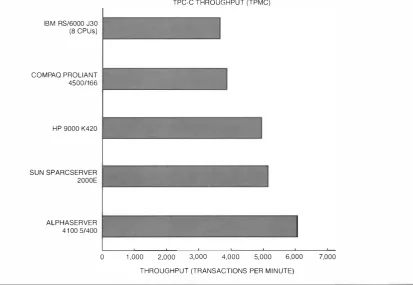
As shown in Figures l l and 1 2 , the AJphaServer 4 100 performs well in the commercial benchmarks TPC-C and AIM Suite VI I . 13•14 In addition to the low memory and ljO latency, the AJphaServer 4 1 00 takes advan tage of the VLM design i n these I/O-intensive work loads: with four CPUs, the platform can support up to 8 GB of memory compared to l GB of memory on the AJphaServer 2 100 system with four CPUs and 2 G B with three crus.
! 0 2,000
1 ,800
1 ,600
1 ,400
1 ,200
1 ,000
800
600
400
200
KEY:
UNPACK 1 000 x 1 000
2 3
NUMBER OF CPUs
- ALPHASERVER 4 1 00 5/300E - ALPHASERVER 4 1 00 5/300
ALPHASERVER 4 1 00 5/400 -- ALPHASERVER 2 1 00 5/300 - SGI ORIGIN 2000 R 1 0000 { 1 95 MHZ)
IBM ES/9000 VF
[image:12.596.74.292.52.352.2]HP EXEMPLAR S-CLASS PA 8000 { 1 80 MHZ)
Figure 9
UNPACK lOOO x l OOO Parallel Pcrtonmncc Scaling
IBM RS/6000 J30 (8 CPUs)
COMPAQ PROLIANT 4500/166
HP 9000 K420
SUN SPARCSERVER 2000E
ALPHASERVER 4 1 00 5/400
0 1 ,000 4
PARALLEL SPECFP95
35
30
25
20
1 5
1 0
KEY:
2 3 4
NUMBER OF CPUs
- ALPHASERVER 4 1 00 5/300E ALPHASERVER 4 1 00 5/300 ALPHASERVER 4 1 00 5/400 - ALPHASERVER 2 1 00 5/300
- HP 9000 K420
SUN ULTRA ENTERPRISE 3000
Fig u re 1 0
P;�ul lcl SPECfp95 Pcrtixmance Sc1 ling
TPC-C THROUGHPUT (TPMC)
2,000 3,000 4,000 5,000 6,000 7,000
THROUGHPUT (TRANSACTIONS PER MINUTE)
Fig u re 1 1
Transaction Processing Pcrtorrnancc (TPC-C Using a n OrJCic D<lt:tbJsc )
Digiral Technic.1l Jou rnal Vol . 8 No. 4 lY%
[image:12.596.317.536.54.357.2] [image:12.596.121.535.418.703.2]COMPAQ PROLIANT 4500 PENTIUM ( 1 66 MHZ)
COMPAQ PROLIANT 5000 6/200 PENTIUM PRO (200 MHZ)
ALPHASERVER 2 1 00 5/300
ALPHASERVER 4 1 00 5/400
ALPHASERVER 4 1 00 5/300"
ALPHASERVER 4 1 00 5/300E"
AIM SUITE VII THROUGHPUT
0 500 1 ,000 1 ,500 2,000 2,500 3,000 3,500 THROUGHPUT (JOBS PER MINUTE)
"These internally generated results have not been AIM certified.
Figure 1 2
AJ M Su ite V I I Jvlul riuser/S hared U N I X M i x Performance
Figures 1 1 and 1 2 show the AlphaServer 4 100 sys tem's TPC-C performance ( using an Oracle database) and AIM Suite V I I throughput pertormance as com pared to other industry-leading vendors. Note that the performance of the uncached AlphaServer 4 100 5/300E is comparable to that of the 300-MHz AlphaServer 2 100. (The AlphaServer 2 100 system used in this test had three CPUs and 2 GB of memory, whereas the AlphaServer 4 100 system had four CPUs and 2 GB of memory. )
With its 2 - M B B-cache, the AlphaServer 4 100 5/300 improves throughput by 40 percent in the AIM Suite V I I benchmark tests as compared to the uncached AlphaServer 4 100 5 /300E. The AlphaServer 4 1 00 5/400, with its 4-MB B -cache, benefits from its 33 percent taster clock and two times larger B -cache and provides 40 percent improvement over the A lp haServer 4 100 5/300. Note that the AlphaServer 4 100 5/300 and 5/300E results were obtained through internal testing a nd have n ot been AIM certified . The AlphaServer 5/400 results have AIM certification.
Compared to the best published industry AIM Suite VI I pertorma nce, the AlphaServer 4 1 00 5/300 throughput is almost twice that of the Compaq ProLiant 4500 server, and the AlphaServer 4 100 5/400 throughput is more than 50 percent higher than that of the Compaq ProLiant 5000 server. 14 At
the October 1 996 U N I X Expo, the AipbaServer 4 100 family won three AIM Hot I ron Awards: for the best performance on the vVindows NT operating system ( for systems priced at more than $50,000) and tor the best price/performance i n two UNIX mixes multi user shared and file system ( tor systems priced at more than $ 1 50,000 ) . 14
Cache Improvement on the Alpha Server 41 00 System
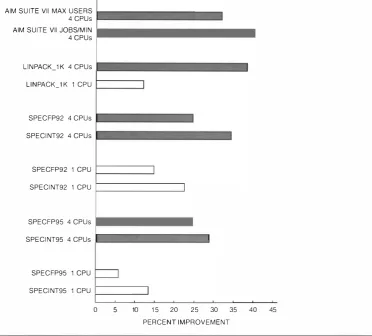
Figures 1 3 and 1 4 show the percentage performance improvement provided by the 2-MB B - cache in the AlphaServer 4 100 5/300 as compared to the uncached AlphaServer 4 100 5 /300E. Figure 1 3 shows the improvement across a variety of workloads; Figure 1 4 shows the improvement in i nd ividual SPEC95 benchmarks for one and tour CPUs.
As shown in Figure 1 3, the 2-MB B - cache in the Alp baSe rver 4 100 5/300 improves the performance by 5 to 20 percent for one CPU and 2 5 to 40 percent for tour CPUs as compared to the uncached AlphaServer 4 100 5/300E system . The benefits derived from having larger caches are significantly greater tor tour CPUs compared to one CPU, since large caches help alleviate
bus traffic in multiprocessor systems.
The workloads that do not fit in the 2- to 4-MB B - cache ( i.e., tomcat\', swim, applu) in Figure 1 4
1 2
PERFORMANCE IMPROVEMENT FROM 2-MB CACHE
AIM SU ITE VII MAX USERS 4 CPUs AIM SUITE VII JOBS/M IN 4 CPUs
LINPACK_1 K 4 CPUs
LINPACK_1 K 1 CPU
SPECFP92 4 CPUs
SPECI NT92 4 CPUs
SPECFP92 1 CPU
SPECI NT92 1 CPU
SPECFP95 4 CPUs
SPECI NT95 4 CPUs
SPECFP95 1 CPU
SPECI NT95 1 CPU
I
I
I
I
�
I0 5 10 1 5 20 25 30 35 40 45
PERCENT IMPROVEMENT
Figure 1 3
PcrrormatKe I m pro,·cmcnt ;lcross VJrious Wol'i<ioads ti·om a 2 - lv! B B - C1ehc
run raster on the u ncached AlphaServer 4 100 than on the cached AJphaServer 4 tOO ( u p to 10 percent taster on one CPU and 20 percent faster on f()ur CPUs) d ue to the overhead f(>r probing the B-cache and the increase i n Set Dirty bandwidth . The majority of the other workloads benefit fi·om larger caches.
The AiphaServcr 4 100 5/400 flt rther improves the ped(mnance by increasing the size of the B-cache fi·om 2 MB to 4 MB. In Jddition, the CPU clock improvement of 33 percent, B-cache improvement of 7 percent in !Jrency and l l percent in bandwid th, and
the memory bus speed improvement of 1 1 percent
together yield an ovec11l 30 to 4 0 percent improve
ment in the Alp haServer 4 1 00 model 5/400 perfor mance as compared to that of the AlphaScrver 4 100 model 5/300.
Large Scientific Applications: Sparse UNPACK
The SpJrse UNPACK benchmJrk solves a large, sparse symmetric svsrem of linear equations using the con jugate grJd ient ( C G ) iterative method . The bench mark has three cases, each with a d i fferent tvpe of precond irioncr. Cases 1 and 2 usc the incomplete
Digital Tcchnic1l journal VoL 8 No. 4 1 996
Cholesky ( ! C) t:<ctorizarion as the preconditioner, whereas Case 3 uses the diagonal preconditioner.
This workload is representative of l:trge scientific :tppliotions that do not fi t in megabyte-size caches. The workload is importallt in large applications, e.g., models of electrical ncrworks, economic systems, d i ffltsion, radiation, and clasticirv. It was decomposed to run on multiprocessor systems using the KAP preprocessor.
[image:14.596.164.537.62.398.2]PERFORMANCE I MPROVEMENT FROM 2-MB CACHE IN SPEC95
SPECINT95 1 47.VORTEX
1 34 . PERL 1 32.1JPEG
1 30 . LI
1 29.COMPRESS
1 26.GCC 1 24.M88KSIM 099.GO
SPECFP95
1 46WAVE5
1 45.FPPPP
1 4 1 .APSI
1 25.TURB3D
1 1 0.APPLU
1 07.MGRID
1 04.HYDR02D
-�
--
...
--1 03.SU2COR
1 02.SWIM 1 0 1 .TOMCATV
KEY:
0 1 CPU • 4 CPUs
- 20 0 20 40 60 80 1 00 1 20
PERCENT IMPROVEMENT
Figure 1 4
SPEC95 Performance I m provement ti·01n a 2 - M B B- Cacl1e
Image Rendering
The AlphaServer 4 100 shows significant performance advantage in image rendering applicatjons compared to the other industry-leading vendors. Figure 16 shows that the AlphaServer 4 1 00 5/400 system is approxi mately 4 rimes taster than the Sun SPARC system that was used in the movie Toy Story, as measured in RenderMarks.'5 The AJphaScrver 4 1 00 is 2.6 times taster than the Silicon Graphics POWER CHALLENGE system and 2 .4 times faster than the HP /Convex Exemplar S PP- 1 200 system on the M ental Ray image rendering application tt·om Mental Images. These image rendering applications rake advantage of larger caches, and the performance improves as the cache size increases, particularly with four C:PUs.
Performance Counter Profiles
The figures in this section, Figures 1 7 through 22, show the performance statistics collected using the buil t-in Alpha 2 1 1 64 performance cou nters on the AlphaServer 4 100 5/400 system. These hardware monitors collect various events, incl uding the num ber
and type of i nstructions issued, mul tiple issues, single
issues, branch mispred ictions, stall components, and cache misses.'·"'.l ' These statistics are usdi.d for analyz ing the system behavior under various workJoads. The results of this analysis can be used by computer architects to drive hardware design trade-oHs in fi.1ture system designs.
The S PEC95 cycles per i nstruction ( C P I ) d ata presented in Figure 1 7 shows lower C:PI val ues for the i nteger benchmarks ( CPI values of 0.9 to 1 . 5 ) than tor the floating-point benc hmarks ( CPI val ues of 0.9 to 2 . 2 ). The C P I in commercial workloads (e.g., TPC- C ) is higher than in the SPEC bench marks, primarily because commercial workloads have a higher stal l time, as shown in Figure 1 8 . Note that the performance counter statistics were collected
with tou r CPUs running TPC-C (with a Sybase data base) , while S PEC95 statistics were collected on a single CPU.
The Alpha 2 1 1 64 has two i nteger and two floating point pipelines and is capable of issuing up to four instructions simultaneously. The i nteger pipeline 0
executes arithmetic, logical , load/store, and shift operations. The integer pipeline l executes arithmetic, logical, load , and branch/jump operations. The floating-point pipel i ne 0 executes add, subtract,
1 4
Figure 1 5 70
60
50
(f)
�
40_J u. ::;;;;
30
20
1 0
0
Sparse LIN PAC K l\:d(mnc1ncc
SPARSE U N PACK
2 3
NUMBER OF CPUs 4
KEY:
D ALPHASERVER 4 1 00 5/300E
D ALPHASERVER 4 1 00 5/300
Ill ALPHASERVER 4 1 00 5/400
• ALPHASERVER 8400
PIXAR RENDERMARKS IBM RS/6000 390
HP 9000 735 ( 1 25 MHZ)
SGI CHALLENGE R4400 (200 MHZ)
KEY: D 1 CPU • 4 CPUs
0 500 1 ,000 1 ,500 2,000 2,500 RENDERMARKS
Figure 1 6
I mage Rendering Pcrr(mnance
compare, and floating-point branch instructions. The floating-point pipeline 1 executes multiply i nstruc tions. The time d istribu tion ill ustrated in Figure 1 8 ind icates that most of the issu i ng time is spent in single
Digir�l Tcchnic1l )ourn:1l Vol . ::> No. 4 1 996
CPI
TPC-C
SPECINT9S VORTEX
PERL M88KSIM Ll IJPEG GO GCC COMPRESS
SPECFP9S WAVES TURB3D TOMCATV
SWIM SU2COR MGRID HYDR02D
FPPPP A PSI APPLU
0 o.s 1 .0 1 .S 2.0 2.S 3.0 3.S 4.0 CYCLES PER INSTRUCTION
Figure 1 7
S PEC95 Cycles-per-instruction Comparison
TIME DISTRIBUTION
TPC-C
SPECINT9S
VORTEX
PERL M88KSIM Ll IJPEG GO GCC COMPRESS
SPECFP9S WAVES TURB3D TOMCATV
SWIM KEY:
SU2COR
MGRID • • SINGLE ISSUE DUAL ISSUE
HYDR02D D TRIPLE ISSUE
FPPPP D QUAD ISSUE
A PSI • DRY STALL
APPLU D FROZEN STALL
0% 20% 40% 60% 80% 1 00%
TIME
Figure 1 8
Issuing and Stall Time
1 6
The stall time (dry plus frozen stalls in Figure 1 8 )
i s higher i n the floating-point benchmarks than in the integer benchmarks and higher i n the TPC-C benchmarks than in the SPEC95 benchmarks. Dry stalls include instruction stream ( ! -stream ) stal ls caused by the branch mispredictions, program counter ( PC) mispredictions, replay traps, I -stream cache misses, and exception drain. Frozen stalls include data stream ( D -strea m ) stalls caused by D-stream cache m isses as well as register conflicts and unit busy. Dry stalls are h igher in SPECint95 and TPC-C ( mainly because of I -stream cache misses and replay traps), whereas frozen stalls are h igher i n SPEC!p95 a nd TPC-C ( mainly because of D-stream cache misses).
The Alpha 2 1 1 64 microprocessor reduces the per formance penalty due to cache misses by implement ing a brge, 96-KB on-chip S-cache:' ' This cache is three-way set associative and contains both instruc tions and data . The four-entry prde tch bufter allows prefetching of the next four consecutive cache blocks on an i nstruction cache ( I -cache) miss. This reduces the penalty tor ! -stream stalls. The six-entry m iss add ress file (MAF) merges loads in the same 32-bytc block and allows servicing multiple load misses with one data fill. A six-entry write buffe r is used to red uce the store bus traffic and to aggregate stores into 32-byte blocks.'"'
Figure 19 shows the instruction mix in SPEC9 5 . The Alpha instructions are grouped into the fol lowing
TPC-C
SPECINT95 VORTEX PERL M88KSIM Ll IJPEG GO
GCC COMPRESS
SPECFP95 WAVES TURB3D TOMCATV
SWIM
SU2COR MGRID
HYDR02D
FPPPP A PSI APPLU
0%
Fig ure 1 9
S PEC95 I nsrrucrion Profiles
Dig;i t.ll Tcdl ll icll )ourn;ll
20%
INSTRUCTION STATISTICS
40% 60%
INSTRUCTIONS
Vol . 8 No. 4 1 9')6 80%
categories: load ( both floating-point and i nteger), store ( both floating-point and integer), integer (all integer instructions, excluding ones with only R3 l or literal as operands), branch ( all branch instructions including u ncond itiorral ), and floati ng-point ( except floating-point load and store instructions) . Figure 1 9 shows the percentage o f instructions i n each category relative to the total number of instructions executed. Note that load/store i nstructions account for 30 to 40 percent of all instructions issued. I nteger instruc tions are present in both integer and floating-point benchmarks, but no floating-point i nstructions exist in the SPECint95 and commercial TPC-C workloads. The i nteger and commercial workloads execute more branches, while the branch instructions make up only a kw percent of all i nstructions issued in the floating point workloads.
The cache misses shown in Figure 20 are higher in the floating-point benchmarks than i n the inte ger benchmarks. The I -cache misses arc low in the floati ng-point benchmarks ( except tor !pppp) :111d higher in the SPECi nt95 benchmarks and the TPC-C benchmark. The D-cache m isses are high in the major ity of the benchmarks, which indicates that a larger D cachc would reduce D-stream m isses. The TPC-C benchmark wou ld benefit from a larger 5-cache ami taster R -oche, since the n umber of 5-cachc misses is high . The B -cache m isses are negligi ble i n the S P ECint95 benchmarks and higher in the majority of
1 00% KEY:
• STORES LOADS
0 I NTEGER OPERATIONS
0 FLOATING-POINT OPERATIONS
TPC-C
SPECI NT95 VORTEX PERL M88KSIM Ll
IJPEG GO GCC COMPRESS
SPECFP95
WAVES
TURB3D TOMCATV SWIM SU2COR MGRID
HYDR02D
FPPPP
A PSI
APPLU
CACHE MISSES
....
-KEY:
• I-CACHE MISSES
• D-CACHE MISSES 0 S-CACHE MISSES • B-CACHE MISSES
0 � 100 1� �0
CACHE MISSES PER 1 ,000 INSTRUCTIONS
Figure 20 Cache Misses
the SPECfP95 TPC-C bench marks. This data indicates that complex commercial workloads, such as TPC-C, are more profoundly affected by the cache design than simpler workloads, such as SPEC9 5.
The replay traps are generally caused by (
l )
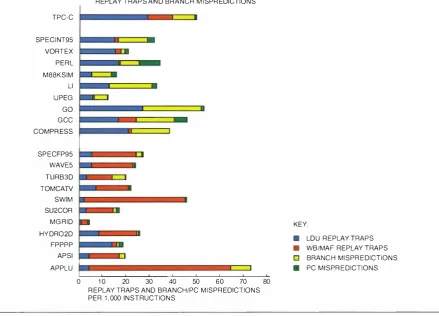
full write-buffer (WB ) traps (a full write buffer when a store instruction is executed) and ful l miss address file ( MAF) traps (a full MAF when a load instruction is executed ); and (2) load traps (speculative execution of an instruction that depends on a load instruction, and the load misses in the D -cache) and load-after-store traps (a load following a store that hits in the D-cache, and both access the same location ).3 The replay traps and branch/PC mispredictions shown in Figure 21 are not the major reason for the high stall time i n the commercial workloads (TPC-C), since traps and m is predictions are h igher in some of the SPECint95 benchmarks than in TPC-C. Instead, a high number of cache misses (see Figure 20) correlates well with the high stall time and CPI (see Figure 1 7 ) in TPC-C.Figure 22 shows the estimated stall components in
SPEC95 and TPC-C. A time-allocation model is used to analyze the performance effect of different stall compo nents. The total execution time is divided into t\vo com ponents: the compute component ( where the CPU is issuing instructions) and the stall component (where
the CPU is not issuing instructions). The stall compo nent is further divided into the dry and fi·ozen stalls:
time = compute + stal l
compute = single + dual + aiple + quad issuing
stall = dry + frozen
dry = branch mispredictions + PC mispredictions
+ replay traps + I -stream cache misses + exception drain stalls
frozen = D-su·eam cache misses
+ register conflicts and unit busy
The branch and PC mispredictions affect the per formance of SPECint95 workloads ( 6 percent of the time is spent in branch and PC mispredictions in SPECint9 5 ) and have little effect on the performance of SPECfP95 workloads ( less than 1 percent of the time) and the TPC-C benchmark ( 1.4 percent of the time). The SPECint95 workloads are affected pri marily by the load traps, whereas the SPECfP95 benchmarks are affected by both load and WB/MAF traps. Note that the time spent on a load replay trap is overlapped with the load -miss time.
The S-cache and B-cache stalls are high i n the SPECfP95 and TPC-C benchmarks, where the stall time is dominated by the B -cache and memory laten cies. Note the high stall time resulting from waiting tor
1 8
Fig ure 2 1
TPC-C
SPECI NT95 VORTEX PERL M88KSIM Ll IJPEG GO GCC COMPR ESS
SPECFP95 WAVES TURB3D TOMCATV SWIM SU2COR MGRID HYDR02D FPPPP A PSI APPLU
REPLAY TRAPS AND BRANCH M ISPR EDICTIONS
____,
�
0 10 20 30 40 50 60 70 80
REPLAY TRAPS AND BRANCH/PC MISPREDICTIONS PER 1 , 000 INSTRUCTIONS
Replay Traps and Bmnch/PC Mispredictions
SPEC95 STALL TIME COMPONENTS
TPC-C
SPECINT95 VORTEX PERL M88KSIM Ll IJPEG GO GCC COMP RESS
SPECFP95
WAVES TURB3D TOM CATV
SWIM SU2COR MGRID HYDR02D FPPPP A PSI APPLU
[image:20.596.91.531.56.372.2]0 1 0 20 30 40 50 60 70 80 PERCENT OF TOTAL TIME
Fig ure 22
Estimated Stal l Time Distribution
Dip:itJI Technical JournJI Vol . 8 No. 4 1996
90 1 00 KEY:
• LDU REPLAY TRAPS • WB/MAF REPLAY TRAPS 0 BRANCH MISPREDICTIONS • PC MISPREDICTIONS
KEY:
• BRANCH AND PC MISPREDICTIONS • LDU REPLAY TRAPS
0 WB/MAF REPLAY TRAPS
0 I-CACHE MISS TO S-CACHE • D·CACHE MISS TO S-CACHE 0 S-CACHE MISS TO B·CACHE • B·CACHE MISS TO MEMORY 0 REGISTER CONFLICT AND
[image:20.596.83.538.406.725.2]data from memory (close to 40 percent) in several of the SPECfp95 benchmarks that do not fit i n a 4-MB cache. Although it contributes to the high SPECfP95 stall time, the memory component h as a negligible effect on SPECint95 performance, since these bench marks generate only a small number of B-cache misses (see Figure 20). Figure 22 indicates t hat stalls caused by cache misses are the largest component of the total stall time; therefore, red ucing cache misses and improving cache and memory latencies woul d yield the largest performance benefit.
Once calibrated and validated with measurements, this model is an effective tool for evaluating the perfor mance impact of various components on the overall system design . System architects can vary parameters, like the cache or memory access times or cache size, and adjust the appropriate stall component to predict performance of alternative designs without carrying out detailed and often time-consuming architectural simulations.
Conclusion
Using several performance metrics and a variety of workloads, we have demonstrated that the D I GITAL AJphaServer 4 100 family of midrange servers provides significant pertormance improvements over the previous-generation AJphaServer platform and pro vides performance leadership compared to the leading i ndustry vendors' platforms. The major AJphaServer 4 100 performance strengths are the low memory and
I/0 latency and high memory bandwidth, the large memory support (Vl,M ), and the fast Alpha 2 1 1 64 microprocessor. The work described in this paper has led ro design changes that are expected to be imple mented i n tlHu re versions of the AJphaServer 4 100 platform. The anticipated performance benefits will come ti-om a faster CPU, faster and larger caches, faster memory, and i mproved memory bandwidth.
Acknowledgments
The authors would l i ke to acknowledge the contribu tions of John Shakshober, Dave Stanley, Greg Tarsa, Dave Wilson, Paula Smith, John Henning, M ichael Delaney, and Huy Phan for providing many of the benchmark measurements. In addition, special thanks go to Maurice Steinman, Glenn Herdeg, and Ted Gent for dedicating system resources and to Masood Heydari tor supporting this work.
References
l . G . He:rdeg, " Design and I mplementation of the AlphaSe:rver 4 100 CPU and Memory Architecture," Digital Technical journal, vol . 8, no. 4 ( 1 996, this issue): 48-60.
2. M. Steinman, G. Harris, A. Kocev, V. Lamere, and
R. Pannel l , "The AlphaServer 4 1 0 0 Cached Processor J'vlodule Architecture and Design," Digital Technical Journal, vol . 8, no. 4 ( 1 996, this issue): 2 1-37.
3. A lpha 21 1 64 Microprocessor Hardware Reference J\!/anual( Maynard , Mass . : Digi tal Equipment Corpo ration , Order No. EC-QAEQA-TE, 1 994).
4. J. Edmondson, P. Rubinfeld, and V. Rajagopalan, "Su perscalar I nstruction Execution in the 2 1 1 64 Alpha Microprocessor," Il::tl:: Jl1icro, vol . 1 5 , no. 2 ( April 1 995 ) .
5 . R . Sires, cd . , A lpha A rchitecture Reference Manual
( Burlington, Mass.: Digital Press, ISBN 1 -5 55 58-098-X, 1 992).
6 . SPEC9 5 Benchmarks ( Manassas, Va. : Standard Perfor mance Evaluation Corporation, 1 995 ) .
7. J . Dongarra, " Performance of' Various Compu ters Using Standard Li near Equation Sofrware" ( Oak Ridge, Tenn . : Oak Ridge National Laboratory, 1 996 ) .
8 . UNIX System Price Performance Guide (Menlo Park, Calif.: AIM Technology, Summer 1 996 ) .
9 . J . Gray, ed . , The Handbool< for Database a nd Transaction Processing Systems (San M a teo, Calif. :
JVlorgan Kau ftinan, 1 99 1 ) .
10. I n formation about the 1m bench suite o f bench marks is available at h ttp:/ /realiry.sgi .com/employees/
I m_engr /lm bench/wha tis_l m bench . htm l .
1 1 . T h e STREAM bench mark program i s described on-line by the U niversity of Virginia, Department of Computer Science ( Charl ottesville, Va. ) at http:/ jww\v.cs.virgi nia .ed u/stream .
1 2 . T h e Standard Performance Evaluation Corporation (SPEC) makes avai lable submitted results, benchmark descriptions, backgro u nd i n formation , and tools at http:/ jwww.specbench .org.
1 3 . I n formation about the Transaction Processing Performance Cou ncil ( TPC) is available ar http://
www. tpc.org.
1 4 . Information about system performance benchmarking products from AIM Technology, I nc. ( Menlo Park, Cal i f ) is avai lable at http:/ jwww.aim.com.
1 5 . I n formation about Pixar Animation Studio's RenderMark benchmark is available at http:// www. e u rope . d igital . com/i n fo/alphaserver/news/ pixar.htm l .
1 6. Z. Cvetanovic a n d D . B handarkar, "Characterization of Alpha f\.,'\P Performance Usi ng TP and SPEC Work loads," 77Je 21st A nnual International Symposium on Computer A rchitecture (April 1 994 ) : 60-70 .
1 7. Z. Cvetanovic and D . B handarkar, "Performance Characterization of the Alpha 2 1 1 64 Microprocessor Using TP a nd SPEC Workloads," 77Je Second International Symposium on High-Performance Computer A rchitecture ( February 1 996 ): 270-280.
20
Biographies
Zarka Cvetanovic
A consulti ng cngin<.:n in D I G ITAL's Server Product De1 elopmcn t Grou p, Zarka l\·ctanovic 11·as responsible
for the pedorniJnce duracterizatiun and anail'sis ot' thc
AlphaScn cr 4 100, AlpluSen et· 8400/8200, AlphaSenu
2 1 00, DEC: 7000, VAX 7000, and VA.\ 6000 s1 stcms, c111d for the perlornunce mod eling and definition �fti.tturc AlphaSen-cr plattonm. Since joining D I G ITAL in I 986,
she h:�s been i m·oh·ed i n the de1·clopment of fist (btabasc
appl ications and efllciclll para l l e l .1pplications tor multi processor s1·stems. /,arb recei1·ed a P h . D . i n electrical and
computer cnsinccring ti·om the Unii'CI'Sin· o f ,\-Llssc!Chusetts, Amhct·st. She has published m er a dozen t<.:chnical pa�Krs at compu ter architecture conferences and in leading i ndus tn· jou n1Jls.
Darrel D . Donaldson
Darrel Donaldson is a senior consu lti ng engineer and the tech nical leader and engineeri ng matugcr tiJr the
Alpha.Scrver 4 1 00 project. He joined D I G ITA L i n 1 983 and served as the lead technologist tor the VAX 6000,
VAX 7000, AJphaScrver 7000, and AJphaServer 4 1 00
projects. Darrel has ;1 bachelor's degree in mathematics/
physics ti·om Miami University and a master's degrc<.: in electrical eng,inec6ng from Ci nci nnati Un iversity, Cincinnati, Ohio. He holds 1 2 patents and hc1s 1 0 patents pending, all related to protocols, signal i ntegrity, and chip transceiver design tor multiprocessor systems and non volati le memory chip design. Darrel maint c1 i ns member �hip in rhe I EEE Electron Devices Sociery and the Solid S tate Circuits Society.
The AlphaServer 4100
Cached Processor Module
Architecture and Design
The DIGITAL AlphaServer 4100 processor module uses the Alpha 21 1 64 microprocessor series com bined with a large, modu le-level backup cache (B-cache). The cache uses synchronous cache memory chips and includes a duplicate tag store that allows CPU modu l es to monitor the state of each other's cache memories with minimal disturbance to the microprocessor. The synchro nous B-cache, which can be easily synchronized with the system bus, permits short B-cache access times for the DIG ITAL Alpha Server 4100 system. It a lso provides a smooth transition from accessing the B-cache to transferring data to or from main memory, without the need for re-synchronization or data buffering.
I
Maw·ice B. Steimnan George J. Harris Andrej Kocev
Virginia
C. Lamere Roger D. PannellThe DIGITAL AlphaScrvcr 4100 series of servers repre sents the third generation of Alpha microprocessor based , mid-range computer systems. Among the technical goals achieved in the system design were the use oftour CPU modules, 8 giga bytes (GR) of memorv, and partial block writes to improve 1/0 pertonnann.:. Unlike the previous gmcration of mid-range servers, the AJphaServcr 4 1 00 series em accommodate tour processor modu les, while retaining the maxi mum memory capacity. Using m u l tiple crus to shJre the workload is known <lS symmt:tric mu ltiprocessi ng (SMP) . As more CI'Us ;m.: added, the performance of an SMP system increases. This ability to increase performance by adding CPUs is known as scalability. To achieve perkct scalabilitv, the performance offc>ur crus would have to be C\Jctly t(>ur times that of a sin gle CPU system. One of the goals of the design was to keep scalabilitv as high as possible yet consistem with low cost. For example, the AlphaServer 4100 system ach ieves a scalability bctor of 3 . 3 3 on the Linp<Kk 1000 X 1000, J large, parJI Icl scientific benchmark. The same benchmark achieved 3.05 scal ability on the previous-gcnec1tion pi:Jtt(mn .'
The 8-GB memory in the AlphaScrvcr 4100 system represents a bctor oft(>Lu· improvement compared with the previous generation of mid-range servers.2 The new memory is also faster in terms of the data volume flow ing over the bus ( b:mdwidth) and data access time ( l atency). Again, compared with the previous genera tion, a\'ailable memory bandwidth is improved bv a be tor of2 . 7 and latency is reduced bv a fKtor of0.6.
I n systems ofrhis class, memory is usually addressed in large blocks of 32 to 64 bytes. This can be ineffi cient when one or two bytes need to be modified because the entire block might have to be read o u t ti·om memory, modified , a n d then written back into memory to achievt.: this mi nor modi fication. The abil ity to modif)' a small fi·Jction of the block withou t hav ing to extract the entire block fi·om memory results in partial block writes. This capability also represents an advance over the pr�.:vious gcm:ration of servers.
To take fi.dl advantage of the Alpha 2 1 164 series of microprocessors, a nc,,· system bus was needed . The bus used in the pt-c,·ious generation of servers was not bst
22
enough, and the cost and size of the bus used in high end servers was not adaptable to mid-range servers.
Three separate teams worked on the project. One ream defined the system architecture and the system bus, and designed the bus control logic and the mem ory modules.3 The second team designed the periph eral interface ( I/O ) , which consists of the Peripheral Component Interconnect ( PCI ) and the Extended Industry Standard Architecture ( EI SA) buses, and its interface to the system bus ( I/0 bridge) .' The third team designed the CPU module. The remainder of this paper describes the CPU module design i n detail. Before delving into the discussion ofthc CPU mod ule, however, it is n ecessary to briefly describe bow the sys tem bus functions.
The system bus consists of 1 28 data bits, 16 check bits with the capability of correcting single- bit errors, 36 address bits, and some 30 control signals. As many as 4 CPU modules, 8 memory modu les, and l l/0 module plug i nt o the bus. The bus is 1 0 i nches l on g and, with a l l modules i n p lace, occupies a space o f 1 1 b y 1 3 b y 9 i nches. With power supplies a n d the console, the entire system fits into an enclosure that is 26 by 1 2 by 1 7. 5 inches in dimension .
CPU Module
The CPU module is built around the Alpha 2 1 1 64 microprocessor. The module's main fu nction is to provide a n extended cache memory tor the m icro processor and to allow it to access the system bus.
The m icroprocessor has its own i nternal cache memory consisting of a separate primary data cache ( D-cache), a primary instruction cache ( ! -cache), and a second- level data and i nstruction cache ( S -cache) . These internal caches are relatively small , ranging in size from 8 kilobytes ( KB) for the primary caches to 96 KB for the secondary cache. Although the internal cache operates at microprocessor speeds in the 400-megahcrtz ( MHz) range, i ts s mall size would limit performance in most applications. To remedy this, the microprocessor has the controls t(x an optional exter nal cache as large as 64 megabytes ( M B ) in size. As implemented on the CPU mod ule, the external cache, a lso known as the backup cache or 13-cachc, ranges from 2 MB to 4 MB in size, depending on the size of the memory chips used . In this paper, all references to the cache assume the 4-MB impl ementation .
The cache is organized as a physical, direct-mapped, write-back cache with a 1 44-bit-wide data bus consist ing of 1 2 8 data bits and 1 6 check bits, which matches the system bus. The check bits protect data integrity by providing a means for single-bit-error correction and double-bit-error detection . A physical cache is one in which the address used to address the cache mem ory is translated by a table i nside the microprocessor that converts software addresses to physical memory
Digital Technical journal Vol . 8 No. 4 l996
locations. Direct- mapped refers to the way the cache memory is addressed, in which a subset of the p hysical address bits is used to u niquely place a main memory location at a particular location in the cache. When the microprocessor modifies data in a write- back cache, it only updates its local cache. Main memory is updated later, when the cache block needs to be used tor a dif ferent memory address. ·when the microprocessor needs to access data not stored in tbe cache, it performs a system bus transaction ( fil l ) that brings a 64-byte block of data from main memory into the cache. Thus the cache is said to have a 64-byte block size.
Two types of cache chips are in common use in modern computers: synchronous and asynchronous. The synchronous memory chips accept and deliver data at discrete times l i n ked to an external clock. The
asynchronous memory elements respond to i nput
signals as they arc received, without regard to a clock. Clocked cache memory is easier to interface to the clock-based system bus. As a result, all transactions involving data flowing ti-om the bus to the cache ( fi l l transactions) and from t h e cache t o the bus (write microprocessor- based system transactions) are easier to i mp lement and faster to execute.
Across the industry, personal computer and server vendors have moved from the traditional asynchro nous cache designs to the higher-pertorming synchro nous solutions. Smal l synchronous caches provide a cost-effective performance boost to personal com puter designs. Server vendors push sync hronous memory technology to i ts limit to achieve data rates as high as 200 MHz; that is, the cache provides new data to the microprocessor every 5 nanoscconds.'·6 The AJphaScrver 4100 server is D I GITAL's first prod uct to employ a synchronous modu le-level cache.
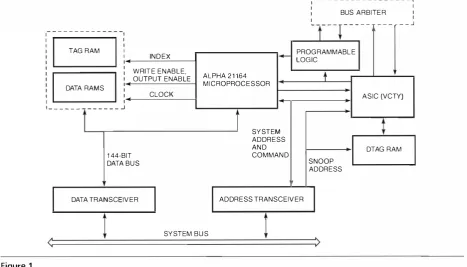
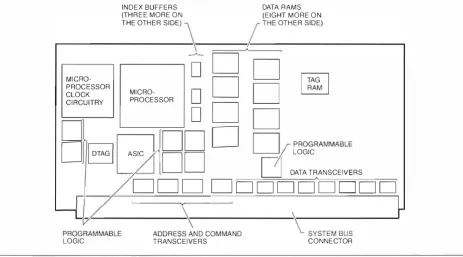
At power-up, the cache contains no useful data, so the first memory access the microprocessor makes results i n a miss. I n the block diagram shown in Figure l , the m icroprocessor sends the address out on t\vo sets of lines: the i ndex l i nes connected to the cache and the add ress l ines connected to the system bus address transceivers . One of the cache chips, called the TAG, is not used for data but i nstead contains a table ofvalid cache-block addresses, each of which is associated with a valid bit. When the microprocessor addresses the cache, a subset of the high-order bits add resses the tag table. A miss occu rs when either of the fol lowing conditions has been met.
l . The addressed valid bit is clear, i.e., there is n o valid data at that cache location.
2 . The add ressed valid bit is set, but the block address stored at that location does not match the address requested by the microprocessor.