AN INTEGRATED CLUSTERING METHOD FOR HOLISTIC
SCHEMA MATCHING
ADEL A. ALOFAIRI, KAMSURIAH AHMAD
Faculty of Information Science and Technology, Universiti Kebangsaan Malaysia, Malaysia
E-mail: [email protected] , [email protected]
ABSTRACT
Schema matching is an interesting research topic which had been paid considerable attention by many researchers in the database community. It aims at identifying semantic correspondences between two schemas. Holistic schema matching was proposed to match many schemas at the same time. As an active research topic in the field of schema integration, holistic schema matching tackles the challenge of matching large scale schema. Matching the complete input schemas may not only lead into taking a long execution time, but also poor quality matching results. Therefore, achieving good performance for the schema matching in a large search space is difficult and challenging process. Recently, a number of methods were proposed to solve this schema matching using popular clustering techniques namely k-means or agglomerative hierarchical clustering techniques. These techniques are usually used to reduce the search space, albeit with some drawbacks. However, the existing methods still can to be improved. In order to improve the matching efficiency and clustering process, this paper aims at finding an effective method for holistic schema matching in terms of reducing the searching space. The combination of clustering techniques was proposed. To achieve the main objective, the methodology includes two phases: pre-processing and clustering. The findings of the study revealed that the matching method proposed in this study reduced the searching space by using an integrated clustering technique that rapidly groups the most correspondences attributes in the same clusters. The results of the study prove that this method is effective and promising in holistic schema matching.
Keywords: Holistic Schema Matching, Clustering, Search Space Reduction.
1 INTRODUCTION
Due to the remarkable augmentation of diverse data sources, the integration of data has become vital and challenging [8]. The most problematic elements of the integration process are the divergence in naming and the dissimilarity of data structures. These disparities make the integration process more challenging [12]. Nevertheless, schema matching is one of the issues that have drawn the attention of researchers who mainly deal with databases. Traditionally, small scale integration processes were dealt by identifying pair-wise attributes and due to it’s limitation these methods did not yield high quality results and thus cannot scale well [9]. The process of schema matching has become more a prominent aspect in variety of applications such as query processing, e-business, data warehouses and semantic web [5]. Matching is the basic manoeuvre in schema information process which involves in producing a map of semantically corresponding elements from any two schema inputs [9]. Usually the schema matching is done
Clustering is the process of grouping data based on their similarities. It is used to spot matching schemas very quickly. Holistic schema matching problem is a combinatorial problem with an exponential complexity, and clustering works as an intermediate technique for a large scale schema matching to improve the efficiency in matching. It reduces the workload for the mapping but this reduction comes with the cost effectiveness [10]. In particular, achieving both effectiveness and efficiencies are two major challenges for large scale schema matching. To address this issue, recently a number of clustering-based approaches are used. The clustering-based approaches used either the K-means [8] or agglomerative hierarchical clustering techniques were proposed to reduce the search pace in order to improve the efficiency of holistic schema matching [8]. However these methods reduce the effectiveness on the matching result. Hence new methods that balance between effectiveness and efficiencies need to be developed [10]. In this study, an integrated clustering method will propose and evaluate toward the enhancement of the clustering performance and effectiveness based on the improvements in the clustering of the attributes.
2 HOLISTIC SCHEMA MATCHING
Holistic schema matches a lot of schemas simultaneously by taking all the schemas as input and finding all the matching among the input schemas. Generally the traditional schema matching works concentrates on small scale integration by identifying pair-wise feature associations between two schemas. The standard approach for pair-wise schema matching is to compare all the elements of the first schema with the elements of the second schema to determine matching schema elements. Apart from having efficiency problems on large scale schema matching, the existence of large search space makes it difficult to accurately identify matching element pairs. Motivated by the needs of integrating large scale data sources, such as the deep Web [3], a new type of schema matching known as holistic schema matching is proposed to improve discover matching in a large set of schemas.
2.1 Web Query Interfaces Matching
With the growing number of data sources accessible over the Web, the integration of these sources is obviously an important problem. It has been observed that at the back of query interfaces are actually hidden a large number of data sources
on the Web. In order to integrate the query interface, it is essential to overcome the heterogeneous semantics problem among query interfaces before querying the data. This problem is the most important step is the interface matching. Interface matching is a process of identifying similar fields over multiple query interfaces. Each interface field represents the attribute in the database. The semantic similarity of two fields is evaluated on the similarity of their properties. Two fields are linguistically similar if they have similar names or labels. The clustering approaches or statistical approaches are used for holistic schema matching.
2.2 Search Space Reduction
Due to large search space, holistic schema matching and particularly in matching all input elements may lead to long execution times and poor quality [5]. The process of schema matching is
explained as follows: To decide whether elements s
in schema S matches element t in schema T. The
matches must typically examine all other elements
in T and to make sure that there is no other element
3 CLUSTERING FOR HOLISTIC SCHEMA MATCHING
Clustering is a process that divides the data into groups of similar objects. Each group, called a cluster, consists of objects that are similar to one another and dissimilar to objects of other groups. Elements within the same cluster share some common property while the elements from different clusters do not. It represents many data objects by few clusters, and hence, it models data by its clusters. Clustering is used to quickly identify regions in the schema repository, which are likely to comprise good mappings for the smaller schema. The schema matcher then looks for mappings only within these regions or clusters. This reduces the matching workload and improves the efficiency.
Holistic schema matching problem is a
combinatorial problem with an exponential complexity, and clustering works as an intermediate technique for a large scale schema matching to improve the efficiency in matching. Clustering process partitions the mapping elements into clusters. Consequently, this process reduces the size of the search space for the mappings combiner and improves the efficiency. But this reduction may raise issues on cost effectiveness [10].
3.1 CLUSTERING ALGORITHMS
Data clustering research is under vigorous development. Contributing areas of research include data mining, statistics, machine learning, spatial database technology, biology and marketing. Many clustering algorithms exist in the literature [1], [2], [3], [9] and most of the clustering algorithms are built around the three concepts: elements, distance measure, and cluster abstraction. In general, the major clustering methods can be classified into:
i. Partitioning methods
The clusters are formed to optimize an objective partitioning criterion, such as a dissimilarity function based on distance, so that the objects within a cluster are similar, whereas the objects of different clusters are dissimilar [7]. The most well known and commonly used partitioning methods are the k-means and k-medoids.
ii. Hierarchical methods
A hierarchical clustering method works by grouping data objects into a tree of clusters and
they can be further classified as either
agglomerative or divisive, depending on whether the hierarchical decomposition is formed in a bottom-up (merging) or top-down (splitting) fashion.
Hierarchical clustering is often portrayed as the better quality clustering approach, but is limited because of its quadratic time complexity. In contrast, k-means and its variants have a time complexity, but are thought to produce inferior clusters. Sometimes k-means and agglomerative hierarchical approaches are combined to get the best of both. Indeed, the search of more flexible clustering technique is the important reason of combining both techniques in order to improve the quality of results and the clustering performance [7].
3.2 Clustering Approaches for Holistic Schema Matching
Holistic schema matching essentially applies data mining techniques to discover matching candidates. Recently, a number of clustering-based approaches for holistic schema matching were proposed to improve the matching process performance. These approaches have achieved a remarkable accuracy. They also reduced the workload for a part of the schema matching process by means of search space and execution time. Wu et.al [13] proposed an interactive clustering-based approach to matching query interfaces that captures the hierarchical nature of interfaces. The approach employed a hierarchical agglomerative clustering
algorithm. This approach incorporates user
interactions to learn the parameters, handled both simple and complex mappings of fields. The approach is highly effective and reduced the search space. It defined the query interface as a problem of identifying semantically similar fields over different query interfaces and identified that any field of interface has three properties: name(f), label(f), and dom(f). To find the 1:1 mappings over the input schemas, a hierarchical agglomerative clustering algorithm is employed. The experiment exploited the name, label, and the domain information for every field. The semantic similarity of two fields is evaluated on the similarity of their properties.
the similarity between the attributes in different schemas.
To improve the efficiency of holistic schema matching the clustering technique works as an intermediate step into existing schema matching algorithms. The clustering technique will partition the schemas into small groups (clusters) and reduces the overall matching load. In this work they proved that clustering effectively contribute the search space reduction in case of large schema matching and improved efficiency. They conclude
that clustering can be balanced between
effectiveness and efficiency in matching process by tuning the clustering parameters [1].
4 An Integrated Clustering Method
In recent years the holistic schema matching has drawn much attention, due to its efficiency in
exploring the contextual information and
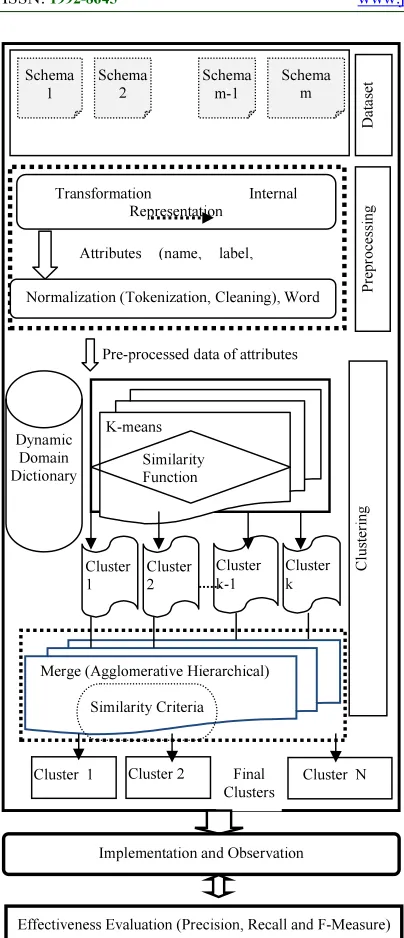
scalability. This capacity would be useful to automate the process, but as the holistic schema matching is partly subjective, the full automation is not feasible. Based on the literature review, clustering is the most promising techniques used to improve the holistic schema matching performance. Therefore, the main goal is to propose an effective integrated clustering method for holistic schema matching. The proposed method will reduce the matching search space, the matching execution time and improves the clustering process that balance between efficiency and effectiveness. There are a number of stages that should be traversed to achieve the objective of this research. It consists of two phases pre-processing phase and clustering phase as shown in Figure 1.
4.1 Pre-Processing Phase
The dataset used in this work consists of a number of web interfaces schemas that are collected by utilizing the online directories. The Airfare dataset to be used in this work is chosen from the ICQ Query Interface data sets in the UIUC Web Integration repository [11]. These schemas are represented by a text files that contains the attribute’s names and labels. The schema of each interface converted to the text file which consist of the attribute name and attribute label for each field in related schema as strings, hence the work in this research exploits the linguistic information (element-based) and the data type (constraint-based) to do the experiments. As in string processing to enhance the similarity measurement, a number of pre-processing steps should be done
Figure 1: The Proposed Integrated Clustering Method
A. Schemas Transformation
For pre-processing and clustering, the dataset must be converted into the appropriate format.
B. Domain Dictionary
The majority of the modern systems for schema matching use assisting information such as, a synonym dictionary, an abbreviation dictionary, or a specific-domain dictionary to improve the matching results.
C. Data Normalization
The names of attributes frequently contain non-benefited words or characters for matching. Thus, they initially need to be normalized before they are used to compute the similarity of them as strings. For that purpose the following normalizations steps will be applied:
• Tokenization and Cleaning: to deal with
concatenated words.
• Stop Word Removing: To improve the similarity
measure, the unnecessary stop words likes (“or”, “of” , “on”, “in”, “us”) should be eliminated from the input strings
• Word Transformation: to expand the
abbreviations using the domain dictionary
4.2 Clustering Phase
In schema matching, effectiveness is a term which is concerned with the accuracy and the correctness of matching the results. Whereas efficiency is a term concerned with reducing the execution time and matching space [1]. Recently, a number of methods were proposed to solve this
schema matching using popular clustering
techniques namely K-means or Agglomerative hierarchical clustering techniques. These techniques are usually used to reduce the search space, albeit with some drawbacks. To improve the matching efficiency and clustering process, the current study aims to combine the k-means or agglomerative hierarchical clustering techniques to produce an effective matching method. This phase integrates two clustering steps: partitioning and merging steps.
4.2.1 THE PARTITIONING STEP
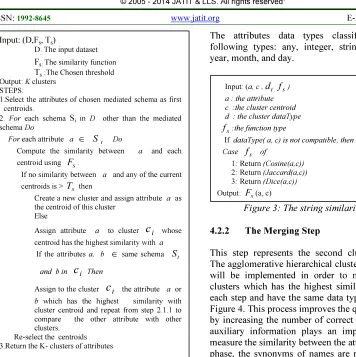
This step represents the first clustering stage. It aims to group the attributes from different schemas that have similarity of names, more than the specified threshold into the same cluster. In this work the input data is divided rapidly by using the k-means local search algorithm as shown in Figure 2.
Flat Schem
as (web
Final Clusters
D
at
a
se
t
Schema 1
Schema 2
Schema m-1
Schema m
K-means
Similarity Function
Cluster 1
Cluster 2
Cluster k-1
Cluster k
Merge (Agglomerative Hierarchical)
Cluster N
Cluster 1 Cluster 2
Similarity Criteria Dynamic
Domain Dictionary
Transformation Internal Representation
Normalization (Tokenization, Cleaning), Word Transformation
P
re
p
ro
ce
ss
ing
Implementation and Observation
Effectiveness Evaluation (Precision, Recall and F-Measure)
C
lus
te
ri
ng
Attributes (name, label,
[image:5.595.87.289.116.585.2]Figure 2: Clustering algorithm using k-means
The traditional work needs to compare each attribute in each schema, with all the attributes in the other schemas. This procedure increases both the search space and the matching execution time. Hence, the k-means is proposed to find the initial solution (clusters). The clustering process in this
work starts by selecting the 14th elements of the
first schema as first centroids. The schema which has most of the attributes needs to be matched among all schemas and also has the attribute’s names that are similar to other attributes and this called the mediated schema. The system in this work gives the user facility to choose an appropriate threshold value. User can choose different correspondences attributes from different input schemas and measure the similarity between them using similarity measures which are Cosine, Jaccard and Dice [6]. The function for this process is shown in Figure 3. The experiments in this phase exploited the element-based information (names) and the constraint-based (data type) of attribute [8].
[image:6.595.95.451.97.454.2]The attributes data types classified into the following types: any, integer, string, date, time, year, month, and day.
Figure 3: The string similarity function
4.2.2 The Merging Step
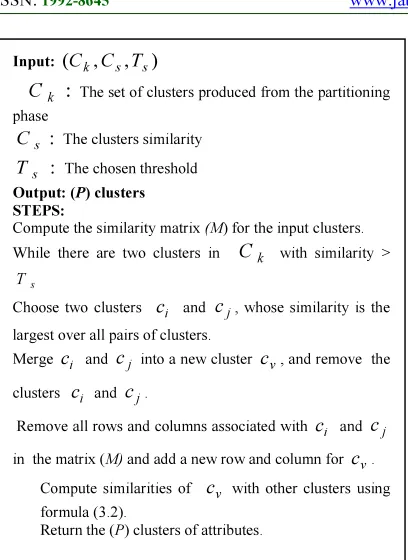
This step represents the second clustering stage. The agglomerative hierarchical clustering technique will be implemented in order to merge the two clusters which has the highest similarity values in each step and have the same data type as shown in Figure 4. This process improves the quality of result by increasing the number of correct matching. The auxiliary information plays an important role to measure the similarity between the attributes. In this phase, the synonyms of names are replaced, using the domain dictionary. The attributes’ labels as an additional description will be used to measure the similarity between any two attributes. Each attribute in the dataset is characterized by two properties: name and label. The semantic similarity of two attributes will be evaluated on the similarity of their properties. In this stage the aggregate similarity of two attributes, are calculated based on the linguistic similarity using function in Figure 3. Each of the clusters which resulted from the partitioning phase includes one or more attribute. The combining between the two clustering algorithms in a sequential mode aims to produce the robust clusters and improve the clustering process performance.
5. Experiments and Result
To evaluate the effectiveness of the proposed clustering method, the popular performance measurement in schema matching and information retrieval fields such as precision, recall and F-measure are used. The experiment result of the proposed approach are compared with the result produced by the existing methods such as methods
Input: (a, c ,dt
s
f ) a : the attribute c :the cluster centroid d : the cluster dataType fs:the function type
If dataType(a, c) is not compatible, then return 0
Case
s f of
1: Return (Cosine(a,c))
2: Return (Jaccard(a,c))
3: Return (Dice(a,c)) Output: Fs(a, c)
Input: (D,Fs, Ts)
D: The input dataset
Fs: The similarity function
Ts :The Chosen threshold
Output: K clusters
STEPS:
1.Select the attributes of chosen mediated schema as first centroids.
2. For each schema Si in D other than the mediated
schema Do
For each attribute a ∈ Si Do
Compute the similarity between a and each
centroid using Fs.
If no similarity between a and any of the current
centroids is >
s
T then
Create a new cluster and assign attribute a as
the centroid of this cluster Else
Assign attribute a to cluster
c
i whosecentroid has the highest similarity with a
If the attributes a, b ∈ same schema Si
and b in
c
i ThenAssign to the cluster
c
i the attribute a orb which has the highest similarity with
cluster centroid and repeat from step 2.1.1 to compare the other attribute with other clusters.
Figure 4: Agglomerative hierarchical clustering technique
proposed by Pei et al. [8] and Wu et al. [13]. These methods are chosen as comparison because the methods used are similar with the one that proposed in this study. Method proposed by Pei et al. [8] only used k-mean clustering, method proposed by Wu et al. [13] only used hierarchical agglomerative clustering technique, whereas the proposed method combines both of these techniques. The experiment result is shown in Table 1. As shown in the table, the proposed method achieved high similarity values in F-measure and recall compared with techniques proposed by Pei et al. [8] and Wu et al. [13]. It shows that the proposed method improves the schema matching method.
Table 1 Experiment Result
Technique Precision Recall F-measure
[8] 0.99 0.80 0.88
[14] 0.82 0.83 0.82
Proposed method
0.82 0.97 0.89
6. CONCLUSION
For holistic schema matching most of the matching systems that integrates the clustering techniques to the matching process use the clustering techniques to improve the match process performance (efficiency). The main aim of this work is to propose a novel clustering method that reduces the search space for a holistic schema matching into small clusters, which enhances the efficacy and precision. This integrated method was proposed based on the literature review. It blends the widely used and popular clustering techniques. The combination of the k-means and agglomerative hierarchical clustering techniques was implemented and evaluated. The promising outcome proves the quality and effectiveness of the proposed method. In addition this hybrid techniques improves the clustering method performance and gives a new opportunity to solve the existing complexities of matching search space.
REFERENCES
[1] A. A. Alofairi, "An integrated clustering method for holistic schema matching," Master Master thesis, Faculty of information science
and technology, Universiti kebangsaan
malaysia, Malaysia, 2012.
[2] A. Algergawy, E. Schallehn, and G. Saake. “A schema matching-based approach to XML
schema clustering“. In Proceedings of the 10th
International Conference on Information Integration and Web-based Applications \& Services. Austria: ACM. 2008, pp. 131-136. [3] S. Chuang, and K. Chang.. Integrating web
query results: holistic schema matching. Proceedings of the 17th international conference on Information and Knowledge management (CIKM’08), ACM, 2008, pp. 33-42.
[4] R. Dhamankar, Y. Lee, A.H. Doan, A. Halevy, and P. Domingos, “iMAP: discovering complex semantic matches between database
schemas“. Proceedings of the International
Conference on Management Data SIGMOD,
ACM, 2004, pp. 383-394.
[5] H. Do, and E. Rahm, “Matching large
schemas: Approaches and evaluation“,
Information Systems journal 2007, 32(6), pp. 857-885.
[6] J. Han, M. Kamber, and J. Pei, “Data mining:
concepts and technique“,Morgan Kaufmann Publishers, USA. 2011.
Input: (Ck,Cs,Ts)
:
k
C The set of clusters produced from the partitioning
phase
:
s
C The clusters similarity
: s
T The chosen threshold
Output: (P)clusters STEPS:
Compute the similarity matrix (M) for the input clusters.
While there are two clusters in Ck with similarity >
s
T
Choose two clusters ci and
j
c , whose similarity is the
largest over all pairs of clusters.
Merge ci and cj into a new cluster
v
c , and remove the
clusters ci and
j
c .
Remove all rows and columns associated with ci and
j c
in the matrix (M) and add a new row and column for
v
c .
Compute similarities of cv with other clusters using
formula (3.2).
[image:7.595.91.295.115.395.2][7] M. Hadjieleftheriou, and D. Srivastava,
“Weighted Set-Based String Similarity“. IEEE
Data Eng. Bull. 2010. 33(1), pp. 25–36 . [8] J. Pei, J. Hong, and D. Bell, “A Novel
Clustering-Based Approach to Schema
Matching“. Advances in Information Systems.
In. Yakhno, T. & Neuhold, E. (eds.) 2006, pp. 60-69 Springer Berlin / Heidelberg.
[9] Y. Qian, H. Zhang, J. Song, and Z. Liu, “A new complex schema matching system“. Proceedings of International Conference on International Conference on Innovative Computing and Communication and Asia-Pacific Conference on Information Technology and Ocean Engineering CICC-ITOE, IEEE, 2010, pp. 292-299.
[10] S. Sellami, A. Benharkat, and Y. Amghar, “Towards a More Scalable Schema Mtching:A
Novel Approach“. International Journal of
Distributed Systems and Technologies, 1(1), 2010, pp. 17-39.
[11]http//metaquerier.cs.uiuc.edu/repository/dataset s/icq/index.html)
[12] O. Unal, and H. Afsarmanesh,
“Semi-automated schema integration with
SASMINT“, Knowledge and Information
Systems 23: 2010, pp. 99-128.
[13] W. Wu, C. Yu, A.H. Doan, W. Meng, “An
interactive clustering-based approach to
integrating source query interfaces on the deep
web“. Proceedings of the ACM-SIGMOD
International Conference on Management