MODELING AND SIMULATION OF SHUNT APF WITH
HYSTERISIS AND FUZZY LOGIC CONTROLLER WITH AND
WITHOUT FAULTS
1BHARATH KUMAR NARUKULLAPATI, 2P.V.S.SOBHAN, 3CH.N.NARSIMHA RAO,
4A.SRIHARIBABU
1, 3, 4
Asstt Prof., School of Electrical Engineering, Vignan University 2
Assoc. Prof., School of Electrical Engineering, Vignan University
E-mail: [email protected], [email protected], [email protected], 4
ABSTRACT
Active power filtering constitutes one of the most effective proposed solutions for solving the harmonics problem in electric power systems. A shunt active power filter that achieves low current total harmonic distortion THD, reactive power compensation, and power factor correction is presented in this paper. The topology is based on IGBT's VSI, intended to damp harmonics produced by a diode rectifier. The notch filter method, consisting solely of two serial band-pass filters, is used for reference current calculation, and the application of hysteresis band controller and fuzzy logic controller for better active filter current control accuracy. The compensation process is based on sensing line currents only, an approach different from conventional methods, which require sensing of harmonics or reactive power components of the load. Simulation works of the studied model, using SIMULINK under MATLAB software, revealed satisfying results in transient and steady states.
Keywords: Shunt Active Power Filter (SAPF), Voltage Source Inverter (VSI), Fuzzy Logic Controller, Hysteresis Band Controller, Total Harmonic Distortion (THD), Notch Filter.
1. INTRODUCTION
The two or multilevel shunt, series and hybrid active power filters (APF's), besides
their capability cancel harmonics with
minimum drawbacks and also contribute in the reactive power compensation, power factor correction and DC voltage regulation [2-7]. The shunt-connected active power filter, with a self-controlled dc bus, has a
topology similar to that of a static
compensator.
In this case the shunt active power filter operates as a current source injecting the harmonic components generated by the load but phase-shifted by 180°.
Multilevel inverters are being investigated and recently used for active filter topologies. Three-level inverters are becoming very popular today for most inverter applications, such as:
i) Machine drives
ii) Power factor compensators.
The advantage of multilevel converters is that:
i) They can reduce the harmonic content generated by the active filter because they can
produce more levels of voltage than
conventional converters (more than two levels),
ii) They can reduce the voltage or
current ratings of the semiconductors and the switching frequency requirements.
.
2. VOLTAGE SOURCE CONVERTERS
can be applied to synthesize an ac voltage, for
most applications requiring dynamic
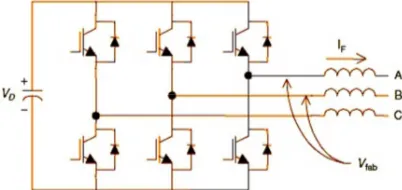
[image:2.595.89.290.277.372.2]performance, pulse width modulation (PWM) is the most commonly used today. PWM techniques applied to a voltage source inverter consist of chopping the dc bus voltage to produce an ac voltage of an arbitrary waveform. There are a large number of PWM techniques available to synthesize sinusoidal patterns or any arbitrary pattern. With PWM techniques, the ac output of the filter can be controlled as a current or voltage source device
Figure 1: Voltage Source Converter for Active Filters
The modulation strategy, shown in Figure 2, uses a triangular carrier, which is one of many strategies applied today to control power inverters. The modulation techniques not only allow controlling the inverters as voltage sources but also as current sources. Figure 2 shows the compensating current generated for a shunt active power filter using three different modulation techniques for current-source inverters.
These three techniques are: i) Periodic Sampling (PS), ii) Hysteresis Band (HB), iii) Triangular Carrier (TC).
The PS method switches the power transistors of the active filter during the transitions of a square wave clock of fixed frequency: the sampling frequency. The HB method switches the transistors when the
error exceeds a fixed magnitude: the
hysteresis band. The TC method compares the output current error with a fixed amplitude and fixed triangular wave: the triangular carrier. Figure 2 shows that the HB method is the best for this particular waveform and application because it follows more accurately the current reference of the filter. When sinusoidal waves are required, the TC method has been demonstrated to be better.
Figure 2: Current waveforms obtained using different modulation techniques for an active power filter: (a) PS method, (b) HB method, (c)
TC method
.
Voltage source converters are preferred over current source converter because it is higher in efficiency and lower initial cost than the current source converters. They can be readily expanded in parallel to increase their combined rating and their switching rate can be increased if they are carefully controlled so that their individual switching times do not coincide. Therefore, higher-order harmonics can be eliminated by using converters without increasing individual converter switching rates
3. CONTROL STRATAGIES
The notch filter is a very simple method
allowing the APF's current reference
extraction without need to active/reactive power or any complicated calculations. In this paper Hysteresis and fuzzy logic controller are implemented. Hysteresis control PWM is basically an instantaneous feedback current control method of PWM where the actual current continually tracks the command current within a hysteresis band. The design of a control able to pursue current peaks isn't straightforward. But, this difficulty has been overwhelmed by the introduction of fuzzy logic in power electronic field.
provides a means of converting a linguistic control strategy based on expert knowledge into an automatic control strategy. Recently,
fuzzy logic controllers (FLC’s) have
generated a good deal of interest in certain applications. The advantages of FLC’s over the conventional controllers are:
i) It does not need accurate mathematical model
ii) It can work with imprecise inputs iii)It can handle nonlinearity
iv)It is more robust than conventional nonlinear controllers.
4. SHUNT ACTIVE POWER FILTERS
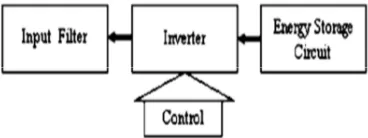
The general structure of the active filter consists of several blocks as shown in figure 3 which consists of input filter, inverter,
energy source circuit and controller.
[image:3.595.290.520.74.243.2]Controller generates the gating signals to meet the requirement with accuracy and these signals are fed to inverter. Inverter block with input filter produces the filter current by using energy from storage circuit and gating signals which are generated from controller.
Figure 3: General Structure of Active Filter
The shunt-connected active power filter, with a self-controlled dc bus, has a topology similar to that of a static compensator
(STATCOM) used for reactive power
compensation in power transmission systems. Shunt active power filters compensate load current harmonics by injecting equal-but opposite harmonic compensating current. In this case the shunt active power filter operates as a current source injecting the harmonic components generated by the load but phase-shifted by 180°. Figure 4 shows the connection of a shunt active power filter.
Figure 4: Shunt Active Power Filter
[image:3.595.307.507.372.504.2]Figure 5 shows how the active filter works to compensate the load harmonic currents. Shunt active filter produces filter current (IF), which is equal and opposite to the load current such that source current become sinusoidal. Such that it compensates the harmonics in load current and reactive [power generated at load side. The expected wave forms of filter current, source current and load current are also shown in figure 5.
Figure 5: Generation Of Filter Current IF To
Compensate Load-Current Harmonics
5. MATHEMATICAL MODEL OF ACTIVE
POWER FILTER
The equivalent circuit of the whole power
supply-active filter-diode rectifier is
[image:3.595.100.284.426.495.2]presented in figure 6.
[image:3.595.308.507.587.718.2]According to the equivalent circuit, the active power filter is described by the relation:
(1)
Where, ∗ (2)
γ is a switching state taking the values of either 1 or –1 corresponding to the two inverter levels +E or - E . Equation (2) allows the dimensioning of the filter. Finally, the whole active power filter with 3-phase supply and rectifier can be modeled by the following equations: 0 0 0 0 0 0 (3) 0 0 0 0 0 0 (4)
Equations (3) and (4) represent
mathematical modeling equations of shunt active filter. Figure 6 represents the configuration of active filter with 3-phase supply and rectifier, here E represents external dc and C acts like storage element. esa represents source voltage, RS, LS represents source resistance and inductance, RL, LL represents load side resistance and inductance and ,LF,CF represents filter inductance and filter capacitance. Here shunt active filter connected between source and load. Here If a represents filter current which is generated by inverter (shunt active filter). Inverter gating signals are generated by controller for accuracy results. Filter current is equal and opposite to load current (ILa) and reactive component fundamental current (Ifra). Such that it compensates the harmonics, which are generated at load side. Then source current (ISa ) become sinusoidal. To get results with accuracy controller required. In this paper Hysteresis current controller and fuzzy logic controller are implemented to shunt active filter.
6. HYSTERESIS CONTROLLER TO
SHUNT ACTIVE FILTER
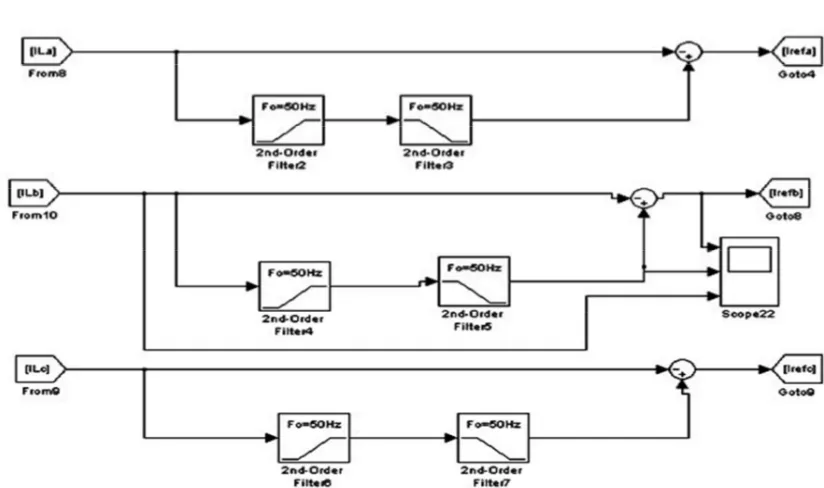
Figure 7 (ANNEXURE 2) shows the simulation circuit for reference current calculation. Load current with harmonics is
passed through two 2nd order filters, in which one acts as low pass filter and another acts as high pass filter. They produce the current without harmonics. The difference between harmonic less current and load current with harmonics will give reference filter current signal.
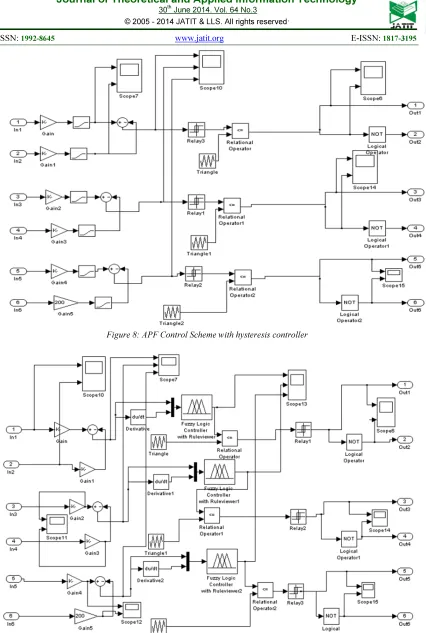
Figure 8 (ANNEXURE 2) shows schematic diagram of hysteresis controller. Reference currents, which are generated by using notch filter method, and filter current are compared. The resultant (error) is fed to hysteresis controller. Hysteresis controller allows the error within specified band width and it controls the error. If the error is in the given band width then controller produces output as 1 otherwise output is 0.
The output of hysteresis controller and triangular carrier wave, with frequency10KHz, are given to PWM controller to generate switching signals to the converter. To increase the current of particular phase, the upper switch of the PWM converter of that particular phase is switched on, while to decrease the current the lower switch of the particular phase is switched on. These switching signals after proper isolation and amplification are given to the switching devices. Due to these switching actions current flows through the filter inductor LC, to compensate the harmonic current and reactive power of the load, so that only active component drawn from the source.
7. FUZZY CONTROLLER TO SHUNT
ACTIVE FILTER
Figure 9 (ANNEXURE 2) shows schematic diagram of fuzzy controller. Reference currents, which are generated by using notch filter method, and filter current are compared. The resultant (error) and change in error (de) are given to fuzzy controller as input. Based on inference mechanism, fuzzy controller produces the gating signals to the converter in order to get filter current, which compensate the load current harmonics and reactive component of load current.
isolation and amplification are given to the switching devices. Due to these switching actions current flows through the filter inductor LC, to compensate the harmonic current and reactive power of the load, so that only active component drawn from the source.
8. SIMULATION AND RESULTS
For simulation studies, the SIMULINK toolbox under MATLAB software is used in order to model and test the system under investigation.
The parameters taken for modeling the system are given in Table 1(APPENDIX A).
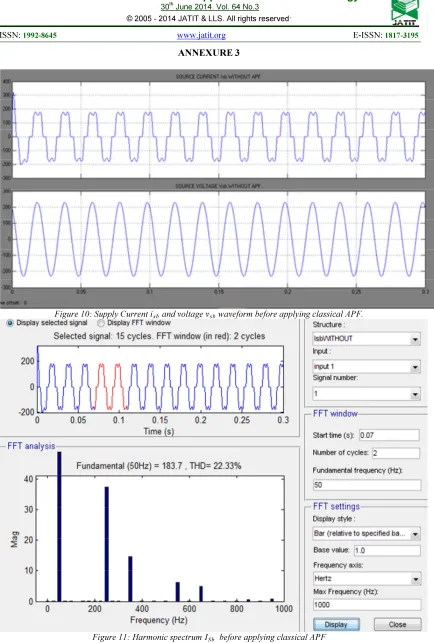
Figures 10 – 16 (ANNEXURE 3) show the simulations results of the proposed shunt active power filter controlled by fuzzy logic and a conventional Hysteresis controller with MATLAB program. The three phase source voltages are assumed to be balanced and sinusoidal. The source voltage waveform of the reference phase only (phase-b, in this case) is shown in figure 10 (ANNEXURE 3).
A load with highly nonlinear characteristics is considered for the load compensation. The THD in the load current is 22.33% shown in figure 11 (ANNEXURE 3) without filter. The phase-b load current is shown in figure 12 (ANNEXURE 3). The source current is equal to the load current when the compensator is not connected.
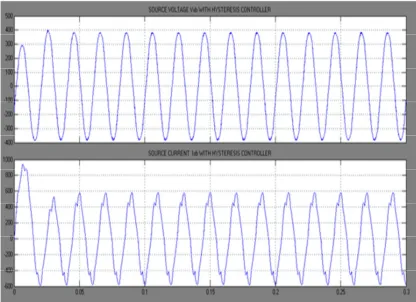
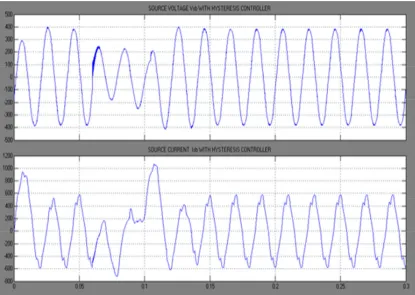
After applying the APF with hysteresis controller THD in source current is reduced to 9.11% it is shown in figure 14 (ANNEXURE 3). The filter reference currents, which are generated by notch filter method, are shown in figure 12 (ANNEXURE 3). Source current and voltage waveforms with hysteresis controller are shown in figure 13 (ANNEXURE 3). At non-linear side current and voltage waveforms are shown in figure 17 (ANNEXURE 3). Current and voltage waves contains less ripple when compare to fuzzy controller. Performance of controller under fault condition and after fault condition is shown in figure 19 (ANNEXURE 3).
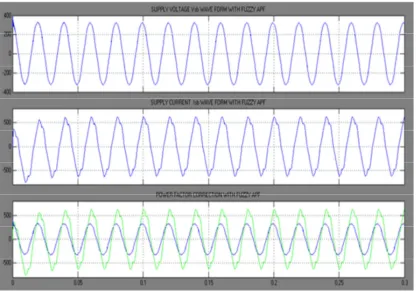
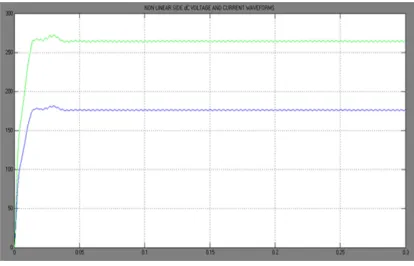
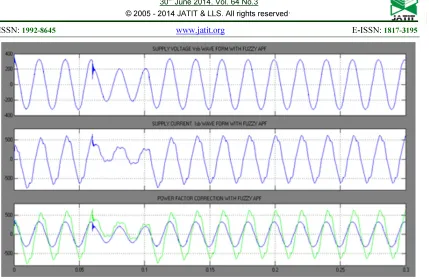
After implementing the fuzzy controller to APF, THD in source current is reduced to 7.01%, the harmonic spectrum is shown in figure 16 (ANNEXURE 3). Source current, voltage and power factor correction waveforms are shown in figure 15 (ANNEXURE 3). Power factor is reached to 0.951. At non linear side current and voltage waveforms are shown in figure 18. Performance of controller under fault condition and
after fault condition is shown in figure 20 (ANNEXURE 3).
Non linear side DC current, voltage with two controllers are shown in figure 17, figure 18 (ANNEXURE 3). From observation of above figures concluded that ripple content in voltage and current is less with hysteresis controller when compare to Fuzzy controller.
In order to evaluate the performance with fault condition Line to Ground fault applied at source side with small duration of 0.06 to 0.1 sec. and observe the variations in source current and source voltage. Figure 19 (ANNEXURE 3), figure 20 (ANNEXURE 3) represents source current and voltage before fault, during fault, after fault conditions with two controllers. During fault condition oscillations are less with Fuzzy controller when compare to hysteresis controller. After completion of fault period it is settling down to normal state.
9. CONCLUSION
This paper has analyzed a shunt active power filter consisting of a voltage source active power filter. The effectiveness of the shunt active power filtering especially with the application of Hysteresis & Fuzzy controllers are shown. In fact, the distortion of the power supply current was diminished to a satisfactory level. I. With Fuzzy controller THD reduced
to 7.01% from 22.33%
II. With Hysteresis controller THD
reduced to 9.11%.
III. Ripple content at dc side Current and voltage are also reduced.
IV. Power factor correction is done; power factor is improved to 0.951.
This Active Power Filter with the Hysteresis and Fuzzy Controllers were able to perform during fault period on the system and restrained to normal state after the fault period occurred on the mains. As a result, the advantages listed above shows that especially for large power applications, Shunt Active power filters are seem to be an appropriate solution. Finally it is concluded that Fuzzy controller performs better than Hysteresis controller.
REFERENCES
[1] Das, J. C. “Passive Filters: Potentialities
and Limitations”. IEEE Trans. Ind.
[2] Peng, F.Z., Akagi, H. and Nabae, A. “A New Approach to Harmonic Compensation in Power Systems: A Combined System of
Shunt Passive and Series Active Filters”.
IEEE Trans. Ind. Applicat., 26, No. 6
(1990), 983-990.
[3] Morán, L.A., Fernandez, L., Dixon, J.W. and Wallace, R. “A Simple and Low-cost Control Strategy for Active Power Filters
Connected in Cascade”. IEEE Trans. Ind.
Electron., 44, No. 5 (1997), 621-629.
[4] Jintakosonwit, P., Akagi, H., Fujita, H. and Ogasawara, S. “Implementation and
Performance of Automatic Gain
Adjustment in a Shunt Active Filter for Harmonic Damping Throughout a Power
Distribution System”. IEEE Trans. Power
Electron, 17, No. 3 (2002), 438-447.
[5] Dixon, J.W., Venegas, G. and Morán, L.A.
“A Series Active Power Filter Based on a
Sinusoidal Current-controlled
Voltage-source Inverter”. IEEE Trans. Ind.
Electron., l44, No. 5 (1997), 612-620.
[6] Detjen, D. and Park, M.H. “A New Hybrid
Filter to Dampen Resonances and
Compensate Harmonic Currents in
Industrial Power Systems with Power
Factor Correction Equipment.” IEEE
Trans. Power Electron, 16, No. 6 (2001),
821-827.
[7] Lin, B.R. and Yang, T. Y. “Analysis and Implementation of a Three-level Active Filter with a Reduced Number of Power
Semiconductors.” IEE Proc. Electric
Power Applicat., 152, No. 5, (2005), 1055-
1064.
[8] Dell'Aquila, A., Delvino, G., Liserre, M. and Zanchetta, P. “A New Fuzzy Logic
Strategy for Active Power Filter .” IEE
Conf. Publ. 8th Intern. Conf. Power
Electron. and Variable Speed Drives, No.
475 (2000), 392-397.
[9] Dell'Aquila, A., Lecci, A. and Monopoli, V.G. “Fuzzy Controlled Active Filter Driven by an Innovative Current Reference
for Cost Reduction.” IEEE Intern.
Symposium Ind. Electron. Proc., No. 3
(2002), 948-952.
[10] Hamadi, A., Al-Haddad, K., Rahmani, S. and Kanaan, H. “Comparison of Fuzzy
Logic and Proportional Integral
Controller of Voltage Source Active Filter Compensating Current Harmonics and
Power Factor.” IEEE Intern. Conf. Ind.
Techn., No. 2 (2004), 645-650.
[11] Seguier, G. Electronique De Puissance:
Les Fonctions De Base et Leurs
Principales Applications. 7th ed., Paris:
Dunod, 1999.
[12] Choe, G.-H. and Park, M.-H. “A New Injection Method for an AC Harmonic
Elimination by Active Power Filter”. IEEE
Trans. Ind. Electron., 35, No. 1 (1988),
141-147.
[13] Round, S.and Ingram, D.M.E. “An
Evaluation of Techniques for Determining Active Filter Compensating Currents in
Unbalanced Systems”. Europe Power
Electron. Conf. Trondheim, (1997),
ANNEXURE1
Table 5.1.System parameters for simulation study
ANNEXURE2
Figure 7: Simulation circuit for reference current calculation
Parameter Value
Supply’s voltage (vs ) & frequency (fs ) 230V (RMS), 50 Hz
Line’s inductance (Ls ) & resistance( Rs ) 0.03 mH, 0.1 Ω
Impedance upstream of the rectifier (LL)and (RL) 0.07 mH, 0.3 Ω
Inductance (LDC), capacitor (CDC), resistance (RDC) 0.3 mH, 470 μF, 1.5 Ω
Active filter input DC supply: capacitor (C), E 5400μF, 700 V
Active filter output impedance (Lf ) and (Cf) 1.25 mH, 21μF
if iref’s calculating, band-pass filter: damping factor ξ 0.707
LPF corrector: gain K, time constant τ 1, 50e-6 s
PWM block
Carrier signal’s peak amplitude & frequency 10, 10 kHz
[image:7.595.119.531.449.693.2]Figure 8: APF Control Scheme with hysteresis controller
ANNEXURE3
[image:9.595.89.523.80.723.2]Figure 10: Supply Current isb and voltage vsb waveform before applying classical APF.
Figure 12: Load Current, Source Current and Filter Reference Current
[image:10.595.90.506.386.688.2]Figure 14: Harmonic spectrum ISb with Hysteresis controller
FIGURE 15:SUPPLY VOLTAGE V
[image:11.595.92.509.402.694.2]CONTROLLER
Figure 16: Harmonic spectrum IS b with Fuzzy controller
[image:12.595.91.505.457.723.2]Figure 18: Non linear side DC current and voltage with Fuzzy controller
[image:13.595.91.506.392.687.2]Figure 20: Supply voltage VSb and current ISb and power factor correction waveform with Fuzzy Controller with