The impact of training and development
towards women’s career in construction:
research methodological perspective
Elvitigalage Dona, NG, Amaratunga, RDG and Haigh, RP
Title
The impact of training and development towards women’s career in
construction: research methodological perspective
Authors
Elvitigalage Dona, NG, Amaratunga, RDG and Haigh, RP
Type
Conference or Workshop Item
URL
This version is available at: http://usir.salford.ac.uk/9852/
Published Date
2007
USIR is a digital collection of the research output of the University of Salford. Where copyright
permits, full text material held in the repository is made freely available online and can be read,
downloaded and copied for noncommercial private study or research purposes. Please check the
manuscript for any further copyright restrictions.
THE IMPACT OF TRAINING AND DEVELOPMENT TOWARDS
WOMEN’S CAREERS IN CONSTRUCTION: RESEARCH
METHODOLOGICAL PERSPECTIVE
G. Elvitigalage, D. Amaratunga and R. Haigh
Research Institute for the Built and Human Environment, University of Salford, Salford, M5 4WT, UK.
E-mail: [email protected]
ABSTRACT: The UK construction industry has a particularly low participation rate of women, both for those employed in the industry and for those engaged in training. The statistical analyses reveal that women are earning greater numbers of professional degrees and entering the labour force; however, these women are not reaching the top corporate management tiers. It has been identified that lack of training has helped to prevent entry of women into the management ranks in many organizations and to keep women at the lower levels within management. In this context, it is vital to consider the impact of proper training and development (T&D) towards the women’s career progression in the construction industry. Accordingly, this paper highlights the aspects which will be addressed when designing a feasible research methodology for the study under consideration. The paper illustrates how the philosophical issues directed the use of case studies as the suitable research approach. It will be concluded with a discussion on the importance of case study design in gaining the maximum outcome from the research.
Keywords - Research Methodology, Training and Development, Women’s Career.
1 INTRODUCTION
Research is often described as an active, diligent and systematic process of inquiry aimed at discovering, interpreting and revising facts (Trochim, 2006). This intellectual investigation produces a greater knowledge of events, behaviours, theories and laws and makes practical applications possible (Trochim, 2006). Alternatively, the main intention of any research is to add value to the accumulated knowledge through means of identifying, investigating and producing solutions to an unsolved problem (Remenyi, 1998). The process of finding solutions to the research problem is “not a clear cut sequence of procedures followed by a neat pattern, but a messy interaction between the conceptual and empirical world” (Bechhofer, 1974, cited in Gill and Johnson, 2002,). Booth et al (2003) also agree with this view, states that “research follows a crooked path, taking unexpected turns, even looping back on itself”. Hence, the research process is uncertain and risky, because an unanswered question or unsolved problem will be identified and studied and the researcher will attempt to produce the suitable answer to the question or a solution to the problem (Amaratunga et al, 2002). Thus, the appropriate research design would minimise the possibilities of any failures by identifying and forecasting any problems and pitfalls that the researcher may come across. Research design looks into the philosophical aspects of the research which in turn helps to identify the overall research strategy (collecting, analysing, interpretation of data and drawing conclusions); evaluate various research methods and identify their limitations; increase the compatibility of research approaches and research techniques (Easterby-Smith et al, 2002). Therefore, a discussion of philosophy is essential before embarking on a research project.
assumptions” (Gill and Johnson, 2002,). Accordingly, this paper discusses how the variables such as philosophical issues, nature of the research problem, resource constraints have led the way to select the appropriate research approach, and techniques. The first section of the paper presents the background to the study after addressing the need of T&D towards women’s career development in the construction industry. Next, the research methodological aspects of this study are discussed with particular reference to establishing the philosophical stand for the study, selection and design of the case study research approach, and data collection and analysis techniques. Finally, the conclusion of the paper is presented.
2 BACKGROUND
The UK construction industry plays a critical role in ensuring Britain’s prosperity. It provides a tenth of the UK’s gross domestic product and is a substantial employer, with over two million people employed (DTI 2003; CITB 2003). The skills gap and labour shortage is a threat to the industry, if it wants to remain competitive and improve its productivity and business performance. The Construction Industry Training Board (CITB) forecasts that around 76,000 new recruits would be required each year for the period 2002-2006 and needs to recruit and retain over 88,000 trained people each year for the next five years (CITB-Construction Skills, 2006). The industry will, therefore, have to recruit from non-traditional groups, with women expected to account for half its growth in the workforce over the next ten years, moving towards gender equality in the industry.
3 NEED FOR TRAINING AND DEVELOPMENT TO AID WOMEN’S CAREER PROGRESSION IN CONSTRUCTION
The progression of women in the construction industry could be seen to be more variable than that of men (Dainty et al, 2000). The notion that women’s careers differ from men’s careers has received varying levels of attention (Osipow and Fitzgerald, 1996). Three critical factors have been identified by Kram (1996), which make a compelling case for treating women’s careers as entities worthy of focused investigation:
1. The differential impact of family responsibilities on careers for men and women; 2. Findings from women’s developmental psychology suggest a distinctive relational
emphasis may pervade their career development; and
3. The relative under-representation of women and subsequent token status at higher organizational levels uniquely constrain their career progress.
Women were found to have progressed an average of one hierarchical level behind their male peers of similar age and experience (Dainty et al, 2000). They also found that women’s career progression was seen to be more variable particularly during years three to twelve of their careers, which accounted for their development after they had left company training programmes through the junior management grades. The transition from junior to middle management appeared particularly problematic for women (Dainty et al, 2000). Moreover, it identified that company training programmes were highly recognised for the career development of women (Dainty et al, 2000). However, an Institute of Management (2002) study highlighted the lack of training and development as a particular barrier to career progression of women. Thus, proper training programmes enhance women’s careers within the male dominated industry. It highlighted women are seeking to get the appropriate training programme throughout their career in order to develop their careers. On the other hand, opening the door for women to access proper T&D programmes, within the male dominated environment, would provide the best solution for the aforementioned leaky pipeline concept. Fielden et al (2001) reported that CITB had run summer school/taster courses for school leavers (16-18 years) over a 10-12 week period. The first course had attracted 11 women, eight of whom completed and three entered the industry. It was suggested that these and other “taster courses” could be used to encourage women to undertake training and/or employment in construction (Fielden et al, 2001). Women were highly impressed by these training programmes as a means of entering the industry. Fielden et al, (2001) in her research put forwarded that the participants in the male dominated group felt strongly about the general lack of training provided by the construction industry, while the ‘women only’ group were more concerned at the limited attempt to attract and train women and singled out the CITB for failing to target women (with women representing less than 1% of trainees).
Several government initiatives have been undertaken to introduce T&D for construction professionals; however, the desired results have yet to be seen in the industry due to leaky pipeline concept. According to above, a recognized T&D plan is needed for women’s career development and executed according to the women’s career ladder. Therefore, it is necessary to identify the different stages of the women’s career ladder in the first instance and subsequently identify T&D programmes for women’s career development, at organizational and regional level.
research aim and objectives pertaining to this study. The research problem has been formulated to address and reflect this need.
3.1 The research problem, aim and objectives
The following research problem is derived from the literature review which reflects the need for proper (after analysing of women’s career ladder) T&D towards women’s career progression in construction industry.
T&D has been identified as one of the main drivers for the progress of women’s careers in the construction industry. In order to attract and retain women into the industry, numerous organizations and government bodies have introduced several T&D programmes specific to the industry; however, whether these programmes are properly meeting the needs of women’s careers is in doubt. Furthermore, whether they were formulated according to women’s career ladder or not also is also uncertain. A lack of empirical evidence indicates the requirement for effective T&D programmes which are designed according to the women’s career ladder in order to attract and retain women in to construction.
The aim of this study is to develop a T&D framework for the progression of women’s careers in the construction industry. The following specific objectives have been formulated to address this aim:
• Identify the importance of women’s career development in the construction industry; • Identify the role and current status of construction T&D, on women’s career
development;
• Identify the barriers faced by women receiving T&D in construction industry; • What lessons can be learned from other sectors in the development of T&D for the
construction industry;
• Develop a framework of “T&D towards women’s career development” to attract and retain women in the industry.
To address this research problem while fulfilling the aims and objectives, a mechanism has to be developed upon which the research can be built. According to Nachmias and Nachmias (1996), a research methodology identifies the explicit rules and procedures which the research can be based upon. Accordingly, the section below discusses the development of appropriate research methodology for this study.
4 RESEARCH METHODOLOGY
Research methodology refers to the overall approach to the design process from the theoretical underpinnings to the collection and analysis of the data (Collis & Hussey, 2003). There are many factors to be considered when choosing an appropriate research methodology; the topic to be researched and the specific research question are the primary drivers in the choice of methodology (Remenyi et al, 1998).
Figure 1: The research “onion” (Saunders M, Lewis P and Thornhill, 2007)
4.1 Research philosophy
Research philosophy contains important assumptions about the way in which view the world (Saunders et al, 2007). Further, they argue these assumptions will underpin the research strategy and the methods chosen as part of that strategy. In part, the philosophy researcher adopt will be influenced by practical considerations. However, the main influence is likely to be researcher’s particular view of the relationship between knowledge and the process by which it is developed (Saunders et al, 2007). Philosophy is primarily concerned with rigorously establishing, regulating and improving the methods of knowledge creation in all fields of intellectual endeavour (Chia, 2002). According to Easterby-Smith et al (2003) there are at least three reasons for the importance of understanding the philosophical issues of a research. First, it can help to clarify research designs. Second, knowledge of philosophy can help the researcher to recognize which design will work and which will not. Third, knowledge of philosophy can help the researcher to identify and even to create designs that may be outside the researchers past experience. In addition to that, research philosophies guide the researcher to consider about research constraints of different subject or knowledge structures (Easterby-Smith et al, 2002).
In this discussion, three major way of thinking about research philosophy are identified: epistemology, ontology, and axiology. (Collins, 1998, and Saunders et al, 2007) which can be further seen in the following sections.
Techniques and procedures (Data collection and data analysis)
Time horizons (cross sectional or longitudinal)
Choices (mono, mixed and multi methods) Approaches (Deductive or inductive)
Strategies (experiment, survey, case study, action research, grounded theory, ethnography andarchival research)
4.1.1 Epistemology
Epistemology concern what constitutes acceptable knowledge in the field of study (Saunders et al, 2007). Saunders et al. (2007) identify three traditions of philosophies: “Positivism,” “Realism” and “Interpretivism”.
Positivism argues that “working with an observable social reality and that the end product of such research can be law-like generalisations similar to those produced by the physical and natural scientists” (Remenyi et al, 1998). Further, the researcher in this tradition assumes the role of an objective analyst, coolly making detached interpretations about those data that have been collected in an apparently value-free manner (Saunders et al, 2007).
Realism is another epistemological position which relates to scientific enquiry. The essence of realism is that what the senses shows us as reality is the truth: that objects have an existence independent of the human mind (Saunders et al, 2007). In this argument, realism opposed to idealism, the theory that only the mind and its contents exist.
Interpretivism emphasises the difference between conducting research among people rather than objects (Saunders et al, 2007), where the social scientist should welcome and appreciate the different views and meanings that people place upon their experiences (Easterby-Smith et al, 2002). Further, they argue that, interpretivism is an epistemology that advocates, it is necessary for the researcher to understand difference between humans in our role as social actors.
The discussion above provides a basis to judge the philosophical base of the study in question. As set out by the aims and objectives, this research involves the study of complex interactions between people in real-life settings. Further, this study requires the researcher to be a part of the environment and interaction is needed within the environment to identify the different views of people and to interpret them. For instance, the views about the importance of women’s role in the construction industry, factors which are needed for the successful attainment or development of women’s careers in construction, suitable T&D models and methods for their career development. It requires appropriate understanding of the context and the process of women’s careers, and to acquire knowledge by the use of reasoning, intuition, or perception. Moreover, this study is largely context specific, demanding to focus on in-depth studies of small samples within uncontrolled environments. This requires the selection of a small number of samples, which is facilitated by the interpretivism stance. According to the above reasons, it can be argued that interpretivism is preferred over positivism and realism stance for this research.
4.1.2 Ontology
Ontological assumption or the assumptions that are made about the reality of the nature is other important aspect within the research philosophy (Saunders et al, 2007). Moreover, this raises questions of the assumptions researchers have about the way the world operates and the commitment held to particular views. The ontological assumption is based on the social entities exist in reality external to social actors concerned with their existence is known as “objectivism” (Saunders et al, 2007). The assumption based on that social phenomena are created from the perceptions and consequent actions of those social actors concerned with their existence is know as “subjectivism” (Saunders et al, 2007).
the research environment is not expected to control and simplify with assumptions as in deductive research methodologies and the free flow of ideas, perceptions will be encouraged and studied. Hence, it can be seen that this research favour subjectivism than objectivism stance.
4.1.3 Axiology
Within the research philosophy, Axiology involves the values, ethics, and belief systems of a philosophy. It is a brand of philosophy that studies judgements about value (Saunders et al, 2007). Axiology concerns assumptions about the value that the researcher attaches to the knowledge. Interpretivism (social constructionism) suggests that the research is value-laden (Healy and Perry, 2000; Silverman, 1998) whereas the positivism suggests the researcher should retain a value free view. Accordingly, in the value free research, the choice of what to study and how to study is determined by objective criteria and in value laden research the choice is determined by human beliefs and experiences (Easterby-Smith et al, 2002).
This research requires respondents to come up with their own views on T&D and women’s career development issues in the industry. Whilst, interviewees engage in different organizations and will have different experiences, fundamentally different answers may appear. Therefore, it may be difficult to arrive at sensible answers. Hence, the researcher may add her own value to those answers, since the researcher is quite familiar with this area of research due to personal experience on career development process and T&D programmes. In this sense, this research stance is the value laden position.
4.2 Research Approach
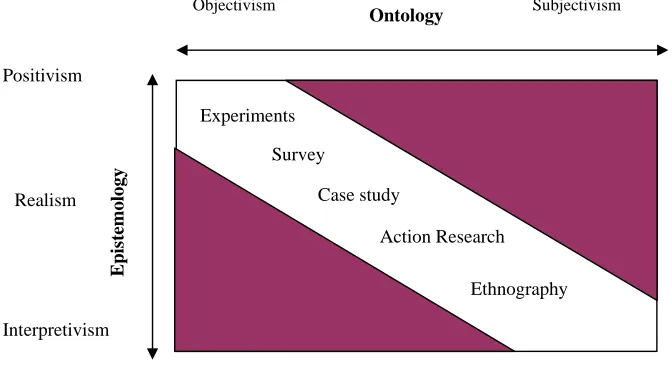
Research approaches are about organising research activity and embodying data collection, in ways that, are most likely to achieve the research aims. They are guided by philosophical underpinning and energies the appropriate methods of research techniques. There are a number of different research approaches ones research can be based upon (Yin, 2003; Gill and Johnson, 2002). Figure 2 shows how the research approaches can be positioned within the epistemological and ontological continuums. It can be seen that how experiments and surveys are governed by positivist and objectivism stances whereas case studies, action research and ethnographic approaches are towards interpretivism and subjectivism stances.
Yin (2003) identifies three conditions which have to be considered when selecting the appropriate research strategies;
• the type of research question posed
• the extent of control an investigator has over the actual behavioural events • the degree of focus on a contemporary event
Figure 2: Research approaches (Sexton, 2003)
Since this research falls under the interpretivism and subjectivism stances, the researcher has to make a choice between ethnography, action research, or case studies. According to Harvey and Myers (1995), ethnography approach provides the researchers insights into the beliefs and values of human, social, and organisational aspects of socio-cultural phenomenon. Further, ethnography research takes a considerable time period (Burns, 2000; Van Maanen, 1982). In action research, the researcher will be a part of the environment under study, tries to solve practical problems (Waser and Johns, 2003), and tries to influence and change the attitudes and behaviours of the participants (Waser and Johns, 2003).
Robson (2002) defines case study as “a strategy for doing research which involves an empirical investigation of a particular contemporary phenomenon within its real life context using multiple sources of evidence”. Yin (2003) also highlighted the importance of contexts, adding that, within a case study, the boundaries between the phenomenon being studied and the context within which it is being studied are not clearly evident. Case studies are carried out in a way that it incorporates the views of the “actors” in the case under observation (Zonabend, 1992). Due to the open ended inquiry used in case studies, it is suitable to built theory and generate hypothesis (Amaratunga et al, 2002). Further, case studies provide the opportunity of dealing with a full variety of evidence such as documents, interviews and observations (Yin, 2003).
Research under consideration does not intend to influence or change the attitudes or procedures of the participants or the environment. Furthermore, it does not intend to study behavioural patterns or physiology of the participants as in the case of ethnographical studies. Hence, the use of case studies is preferred over action research and ethnography. The case study approach is, therefore, suitable for this research to explore the women’s career progression within the context of construction industry and T&D aspects within the case study organisations. The case study approach too provides the opportunity of carrying out an in depth study about the links between women’s career development and T&D.
This research has the characteristics of both the exploratory and explanatory case studies. According to Yin (2003), the nature of the research questions posed has an effect on the research approach. Yin argues that “how” and “why” questions favour the use of case studies and the use of the “what” question is suitable for the exploratory type of researches. Research under consideration has a combination of “how” and “why” questions coupled with “what” questions. The following reasons could be listed as the key points for the selection of case study methodology for this research;
Ontology Subjectivism Objectivism
Ep
is
te
m
o
lo
g
y
Survey
Case study
Action Research
Ethnography Experiments
Positivism
Realism
1. Does not intend to control/manipulate the environment under examination
2. Does not intend to interfere with the attitudes, perceptions or the procedures of the environment (as in the case of action research)
3. Analyses contemporary events
4. Requires to do an in depth study on the selected environment. Thus, it will be an advantage to rely on multiple sources of evidence and the selection of a small sample to allow an in depth study
5. Requires exploring and analysing the “real life” context of women’s career in construction industry and T&D.
The above section describes the selection of the most appropriate research approach. Case studies were identified as the suitable research approach. Accordingly, the following describes the design of the case study.
4.2.1 Case study design
[image:10.612.100.516.401.669.2]
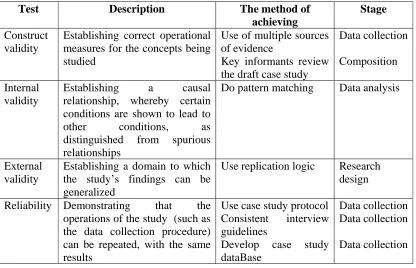
A research design has been identified as the “logic that links the data to be collected (and the conclusions to be drawn) to the initial questions of study” (Yin, 2003). Nachmias and Nachmias (1996) argue that the research design guides the researcher to collect, analyse and interpret the observations he made. There are four conditions where the development of a case study needs to be satisfied. The way the research under consideration satisfies these conditions are presented in Table 1.
Table 1: Validity and reliability of case studies (adopted from Yin, 2003)
Test Description The method of achieving
Stage
Construct validity
Establishing correct operational measures for the concepts being studied
Use of multiple sources of evidence
Key informants review the draft case study
Data collection
Composition
Internal validity
Establishing a causal relationship, whereby certain conditions are shown to lead to other conditions, as distinguished from spurious relationships
Do pattern matching Data analysis
External validity
Establishing a domain to which the study’s findings can be generalized
Use replication logic Research design
Reliability Demonstrating that the operations of the study (such as the data collection procedure) can be repeated, with the same results
Use case study protocol Consistent interview guidelines
Develop case study dataBase
Data collection Data collection
Data collection
and across case studies and finally reaching conclusions. The section above discussed how the case studies will be designed to facilitate the theory verification process and explained the methods that used to ensure reliability and validity of the research. The following section will highlight the research techniques.
4.3 Research Techniques
As discussed in section 4.2 this research takes the interpritivism, subjectivism and value laden stances in terms of the research philosophy. These philosophical stances together with the characteristics of the research under consideration directed the use of case studies research approach which was discussed in section 4.2.1. Having identifying the research philosophy and research approach, the next step is to determine the appropriate research techniques for the study. Accordingly, below section will look into research techniques which suitable for the aforementioned research.
4.3.1 Data collection
Intended data collection techniques describe the ways and means to fulfill the ‘aims and objectives’ of this study by carefully addressing the research questions. Yin (2003) identifies three principles of data collection;
1. use of multiple evidence 2. creating a case study database 3. maintaining a chain of evidence
Yin (2003) further identifies six main sources of evidence which can be used for case study data collection procedure. They are documents, archival records, interviews, direct observations, participant observations, and physical artifacts. Accordingly, for this research semi structured interviews and direct observation will be used to understand the context of women’s careers in the construction industry and the applicability of T&D. When the same results are obtained through different mechanisms, the confidence of the results is high (Stoecker, 1991) as the weaknesses of one method will be compensated by the strengths of another method. Thus, results obtained from this research will be more convincing and accurate, increasing the “construct validity” of the research.
In addition to the use of multiple sources, a case study data base will be created which consists of case study notes (resulted from the interviews and observations), tabular material obtained from the case study or created from the researcher narratives produced by the researcher. The database will be used to store and retrieve the aforementioned sources of evidence in a presentable manner. Further, during the data collection stage, it is expected to use case study protocol which consist of interview procedures, general rules that will be followed during the case studies. Consistent interview guidelines are also expected to be used. The use of a case study database, case study protocol and consistent interview guidelines will increase the “reliability" of the research.
4.3.2 Data analysis
Data analysis consists of examining, categorising, tabulating, testing or otherwise recombining both quantitative and qualitative evidence to address the initial propositions of a study (Yin, 2003). It is important to have a data analysing strategy as it will guide the researcher to select the appropriate data analysing tools, to make sure that the evidence is treated well, to generate sound and convincing analytical conclusions while discarding the alternative interpretations (Yin, 2003). The objectives, research questions, and hypothesis of this study are developed through the identification of theoretical propositions. Accordingly, this study is intended to rely on the theoretical propositions. This will focus the study more by guiding it to identify the relevant data while avoiding the other.
Case and cross-case data analysis is expected to be carried out during the data analysis stage by using Pattern matching; a technique which compares the theories and observed data (Yin, 1994). Accordingly, this research will match the data gathered from semi structured interviews and through observations with the theoretically predicted data. Content analysis will be used to code the textual data gathered from the semi structured interviews. Content analysis is a method that compresses many words into fewer content categories (Krippendorff, 1980). The first stage of analysis identified by Hall and Hall (1996) is data reduction, which is the process of selecting, focusing, and simplifying the interview transcripts. Before starting the data analysis, all the interviews were converted into text; thus, the transcripts of the interviews were made ready for analysis. A transcript is the mere text which is used to identify data consisting of words which have become recorded without the intervention of the researcher through an interview. The data reduction was done by reading through the transcripts and extracting the most relevant data for all of the questions listed in the interview guidelines, and any additional questions that were raised during the interview. To display and identify the relationships of concepts derived from the interviews and observations, cognitive mapping technique will be used. This is a method that enables the recording of qualitative data in a structured manner to enhance the understanding and analysis of data (Ackermann et al, 1992). To facilitate the data analysis process, computer software packages are expected to be used, namely NVivo and Decision Explorer for content analysis and cognitive mapping respectively.
Arriving at conclusions for the study involves interpretation and drawing meanings from the displayed data (Miles and Huberman, 1994). The data from this research will be summarised and conclusions will be drawn which will justify or falsify the research hypothesis of the research.
5 CONCLUSION
philosophy, approach and techniques while the clear definition and design of research strategy would generate unbiased and more convincing research outcomes.
6 REFERENCE
Ackermann, F., Eden, C. and Cropper, S. 1992, Getting started with cognitive mapping, Paper presented at the 7th Young Operational research conference, University of Warwick Amaratunga, D., Baldry, D., Sarshar, M., and Newton, R. 2002, Quantitative and qualitative research in the built environment: application of “mixed” research approach, Work Study, 51.1, pp 17- 31
Booth, W. C., Gregory G. C., and Joseph M. W.2003, The Craft of Research, 2nd edition, Arnold, New York
Brown, A.D. (1995) Organisational Culture, Pitman, London
Burns, R. 2000, Introduction to research methods, SAGE publications, London
Business link, 2005, Manage your research, design and development, (accessed: 12th June 2005), available from: http://www.businesslink.gov.uk/bdotg/action/detail
Chia, R., 2002. The Production of Management Knowledge: Philosophical Underpinnings of Chicago guidance to writing publisher, USA
CITB (2003). Construction Skills Foresight Report, 2003. CITB (2003). Employers’ skill needs survey.
CITB (2006) Construction skills report 2006.
Coles, B.S. (1992) Gender balance in engineering education, in 3rd World Conference on Engineering Education,Vol 2, Duggan,T.V.(ed), University of Portsmouth, pp 459-465
Collins, D. 1998, Organisational change: Sociological perspective, Routledge, London Collis, J. and Hussey, R., 2003. 2nd Ed. Business Research: A practical guide for
undergraduate and postgraduate students. New York: Palgrave Macmillan.
Dainty, A.R.J., Bagilhole, B.M. and Neal, R.H.(2000) A grounded theory of women’s career under-achievement in large UK construction companies, Construction Management and Economics, 18, pp 239-250
DTI (2003). Gender and Innovation: Promoting Science, Engineering and Technology for Women.
Easterby-Smith, M., Thorpe, R. and Lowe, A., 2003. 2nd Ed. Management Research: An Introduction. London: Sage publications.
Easterby-Smith, M., Thorpe, R., and Lowe, A. 2002, Management Research: An Introduction, 2nd, SAGE publications, London
EOC (2006). Sex and power: who runs Britain? 2006, Equal Opportunities Commission. Fielden, S.L., Davidson, M.J., Gale A.W. and Davey, C.L. (2001). “Woman in construction:
the untapped resource”. Construction Management and Economics 18(1): pp 113-121. Gill, J., and Johnson, P. 2002, Research methods for managers, 3rd, SAGE publication,
London
Guba, E., and Lincoln, Y. 1994, Competing paradigms in qualitative research, In: Denzin, N. Gurjao S.I.,(2006), INCLUSIVITY: The changing role of women in the construction
workforce, in Joint CIB W065/W055/W086 Symposium Construction in the XXI century: Local and global challenges, October , Roberto P, Enrico D.A.and Francesco P(ed),Scientific Association for the Promotion of the Relationships between
Architecture and Building Technics, Rome
Harvey, L., and Myers, M. 1995, Scholarship and practice: the contribution of ethnographic research methods to bridging the gap, Information Technology and People, 8.3, pp 13-27
Healy, M., and Perry, C. 2000, Comprehensive criteria to judge validity and reliability of qualitative research within the realism paradigm, Qualitative Market Research: An International Journal, 3.3, pp 18-126
Higher Education in Further Education (HEFCE), (2005), Higher Education in Further Education: Students Survey
Institute of Management (2002), A Woman’s Place? A Survey of Female Managers’ Changing Professional and Personal Roles, IoM, London.
Johnson, P., and Duberly, J. 2000, Understanding Management Research, SAGE publications, London
Johnson, P.A., Leasure, J.D. and Llinas, E.S. (1992) Future resources for engineering, ASCE Journal of Professional Issues in Engineering Education & Practice, 118 (1), pp 30- 7 Kram, K.E. (1996), "A relational approach to career development", in Hall, D.T. and
Associates (Eds), The Career Is Dead, Long Live the Career, Jossey-Bass, San Francisco, CA, pp132-57.
Krippendorff, K. 1980, Content analysis: an introduction to its methodology, SAGE, London Link, A. (2006). “Join the job queue”. Building. January 2006
Miles, M. B., and Huberman, A. M. 1994, An expanded sourcebook-Qualitative data analysis, USA, SAGE publications
O'Neil, D.A., Bilimoria, D., Saatcioglu, A. (2004), "Women's career types: attributions of satisfaction with career success", Career Development International, Vol. 9 No.5, pp 478-500.
ONS (2005). Labour Force Survey Quarterly Supplement. Office for National Statistics. Osipow, S.H., Fitzgerald, L.H. (1996), Theories of Career Development, 4th ed., Allyn &
Bacon, Needham Heights, MA..
Powell,G.N. and Mainierio ,L.A.(1992) Cross- currents in the river of time: conceptualizing the complexities of women’s careers, Journal of Management,18(2), pp 215-237 Remenyi, D., Williams, B., Money, A. and Swartz, E. (1998), Doing Research in Business
and Management, Sage Publications, London
Research Design. In: D. PARTINGTON, ed. Essential Skills for Management Research. London: Sage Publications.
Robson, C. 2002, Real world research, Blackwell Publishing, Oxford
Saunders, M., Lewis P., and Thornhill, A. (2007) Research methods for business students, 4th edition, Person Education Limited, Essex
Sexton, M. 2003, A supple approach to exposing and challenging assumptions and PhD path conference, (accessed June 2005), Lisbon, available from:
http://www.research.scpm.salford.ac.uk/bf2003/sexton_keynote.pdf
Silverman, D. 1998, Qualitative research: meanings or practices?, Information systems journal, 8.3, pp 3-20
Trochim, W.M.K, (2006), The Research Methods Knowledge Base, 2nd edition, Automic Dog Publisher, Ohio Publications, London
Van Maanen, M. 1982, Linking ways of knowing with ways of being practical, Curriculum Inquiry, 6 .3, pp 205-228
Waser, H., and Johns, N. 2003, An evaluation of action research as a vehicle for individual and organisational development in the hotel industry, International Journal of Hospitality Management, 22.4, 373-393
Yin, K. 2003, Case study research: design and methods, 3rd, SAGE publications, London Zairi, M. 1997, Business process management: A boundary-less approach to modern
competitiveness, BusinessPprocess Management, 3.1, pp 64-80