A STUDY ON SIMULATION AND OPTIMIZATION FOR
PERSONNEL AND VEHICLE COORDINATION
EVACUATION IN CASE OF EMERGENCY
1YUNLONG MA, 2FENG ZHANG, 3JIAN WANG
1
Lecturer, CIMS Research Center of Tongji University, Shanghai 201804, China
2
Corresponding Author, CIMS Research Center of Tongji University, Shanghai 201804, China
3 Prof., CIMS Research Center of Tongji University, Shanghai 201804, China
E-mail: [email protected], [email protected], [email protected]
ABSTRACT
A novel approach is proposed in this paper for personnel and vehicle iterative evacuation optimization to tackle crowd evacuation problem in emergency. The paper analyzes the mechanism to coordinate people flow evacuation with traffic stream evacuation, and explores optimization model from a personnel and vehicle coordination evacuation perspective. The evacuation is classified as two categories, namely evacuation with intervention and evacuation without intervention, which depends on whether intervention can be applied to path selection for evacuees. Scheduling scheme of evacuation vehicles is derived from improved ant colony algorithm, and then we integrate personnel evacuation simulation with micro traffic simulation system based on distributed collaborative simulation platform. Finally the optimal scheduling solution of system is searched out through constantly modifying evacuation plan by improved genetic algorithm.
Keywords: Personnel and Vehicle Coordination Evacuation (PVCE), Simulation and Optimization,
Evacuation with Intervention, Evacuation without Intervention
1. INTRODUCTION
With the speedy tone of China’s urbanization, cities have seen its gradually expanding scale as well as its population. If there aren’t timely and effective emergency evacuation measures, worst things will be inevitable when a bad incident happen. Instead of conventional mathematical modeling on evacuees, computer simulation technology has become a main approach to study emergency evacuation problem, because of it seems impossible to stimulate emergency incidents and also difficult to establish mathematical model to represent motion law of evacuees. In general, the process of regional evacuation includes evacuation of building and evacuation outside. And evacuation of building means the process of transferring evacuees from building to exits; the latter is the process of transferring evacuees from exits to relatively safe areas.
The present studies on evacuation mainly focused on inside building. In-depth researches of evacuation outside have been done earlier in America. They majorly studied the personnel evacuation in large area influenced by hurricane, flood, gas leakage, and etc., the main evacuation
way is vehicles, while related literature of evacuation that takes walking as evacuation way is rare. There are only some conceptions about region emergency traffic evacuation in China and is no corresponding literature yet. “9.11” event in America and earthquake happened in Sichuan province of China indicated that it’s quite significant to deal with emergency which taking walking as the major means of transportation during evacuation. At first the human behavior should be analyzed, and then the evacuation process outside building in residential area is simulated. In the process, people walk to the relatively safe areas. Therefore, it’s necessary to study the coordination relationship between personnel evacuation with vehicle evacuation in emergency, in order to search out the optimum evacuation solution and improve the theory of emergency evacuation modeling and simulation. In this way, academic support is provided for evaluation before evacuation, during evacuation and after evacuation.
analyzed, and optimization model was explored from a personnel and vehicle coordination evacuation (PVCE) perspective. Thus the inherent law of coordinating evacuation was revealed. In addition, in order to combine personnel evacuation, vehicle evacuation and other models, we studied the integration method of multiple simulation models based on distributed simulation platform, and developed a prototype system that integrates simulation of PVCE.
The remaining of this paper is organized as follows. Section 2 describes the related works. Section 3 presents the personnel and vehicle coordination evacuation simulation optimization. Section 4 makes an experiment. And section 5 summarizes the paper and draws conclusion.
2. RELATED WORKS
The emergency evacuation is a process in which evacuation routes and traffic volume derived from each connection are determined by analyzing the influences of sudden disasters on road traffic network and its running state, and afterwards the evacuation time of different disaster conditions is estimated. The process is based on analysis of the emergency evacuation behavior and traffic demand. The foreign studies on regional, long distance evacuation problems started earlier, and had formed a complete research system, involving evacuation mechanism, evacuation routes, evacuation scope, evacuation structure, etc.
Yamada T. (1996) [1] obtained the optimal evacuation path from residential areas to each refuge, through searching the shortest path and the minimal cost flow respectively. Vania E.G. Campos, et al. (1999) [2] proposed a K-optimal path algorithm to determine the optimal evacuation path. They took the ratio of path capacity of OD pairs and travel time as measurement indicator. Cova, T.J. and J.P. Johnson (2003) [3] thought that interweaving and conflict of traffic at intersections are major reasons for evacuation delay. A lane-based network flow model to optimize evacuation path is presented, using mixed integer programming to find model solution. G.L. Hamza-Lup (2004) [4] showed how to use ITS to handle and improve organization and management of emergency traffic in conditions such as natural disasters, man-made disasters and terrorist attacks, and developed STEMS (Smart Traffic Evacuation Management System).
With the development of computer technology, simulation techniques have increasingly been used
to the study of emergency traffic evacuation. Through simulation platform and evacuation path selection model, simulating the effect of evacuation and the behavior of evacuation traffic has become the hot spot of emergency traffic evacuation study.
Chen X. and Zhan F.B. (2008) [5] simulated the operating characteristics of individual vehicle and total traffic in dynamic complex road network by a series of rules, using agent-based simulation technique. According to 2008 Beijing Olympic traffic project, the Transportation Research Center of Beijing University of Technology [6]-[7] carried out a deep study and exploration, involving Olympic emergency traffic evacuation, evacuation path selection, evacuation organization and management, evacuation plan and evaluation, evacuation traffic simulation. Guoguang He research group of Tianjin University [8]-[9] mainly studied organization and optimization of emergency traffic evacuation, and evacuation path selection, etc., with intersection characteristics, intersection delay, signal control, traffic capacity and other conditions considered. Yueming Chen and Deyun Xiao [10]-[11] of Tsinghua University modeled emergency evacuation using dynamic traffic assignment, and obtained the optimal solution by Pontryagin minimum value theorem. Chunzhu Wei [12] presented an improved CA algorithm based on Ant-Colony optimization algorithm (ACO) coupling simulation with optimization to serve the disaster crowd evacuation problem. Pengfei Duan [13] proposed a multi-objective optimization model based on heuristic ant colony algorithm for emergency evacuation. Lei, Wenjun [14] simulated the process of pedestrian crowds' evacuation from a huge transit terminal subway station, using an agent-based model. Koo, J [15] studied evacuation strategies for a heterogeneous population in high-rise building environments.
On the whole, present studies didn’t go deep into strategy of optimization and coordination of people flow evacuation and vehicle stream evacuation, thus, the entire evacuation process cannot be modeled and simulated. Further, problems including single destination and multiple destination, and collaborative guidance of people flow and vehicle stream need to be solved in PVCE. It’s necessary to model and simulate the entire evacuation process through a distributed co-simulation environment.
3. PERSONNEL AND VEHICLE
COORDINATION EVACUATION SIMULATION OPTIMIZATION
In general, vehicles can be optimized and scheduled. Therefore depending on whether intervention can be applied to evacuees for path selection, the PVCE problem was classified as two categories: evacuation with intervention and one without intervention. In nonintervention conditions such as fire and tsunami, intervention measures cannot be applied to evacuees for path selection, in this way, people chose their path only according to environment factors and states of mind. On the contrary, in intervention conditions, if somewhat sudden incidents happened, intervention measures can be applied to evacuees for path selection, evacuees were guided to the optimal assembly points at the soonest, thus the overall optimal of evacuation program was realized. Figure 1 showed the framework of system.
3.1 PVCE Optimization Method in Evacuation
without Intervention
In nonintervention conditions, people flow was uncontrollable. But scheduling vehicles must be conditioned on the result of people flow evacuation, so as to figure out the amount of evacuation vehicles that every assembly point needs. Therefore, it should be obtained first that the number of people that converge at each assembly point every moment, namely the function of the number of people at each assembly point that varies with time, which was obtained through modeling and simulation of evacuation environment and disaster conditions. The target of evacuation was to minimize the time that entire evacuees are detained at assembly points. Consequently, in view of the function above, the optimal scheduling scheme of evacuation vehicles
was searched out through improved ant colony algorithm.
3.1.1 Prediction of simulation-based people
flow evacuation
In the research of prediction of people flow evacuation, there were generally two kinds of methods. Empirical formula method adopted by Japan and computer simulation method based on grid model adopted by the West. Since the empirical formula method can only predict the time of evacuation, simulation-based method was used.
At the beginning, the evacuation environment and evacuation needs of people flow were modeled. The natural result of evacuees was predicted by grid model-based computer simulation method. Then, the function of the number of people at assembly points that varies with time was obtained, which provided a basis for dynamic scheduling of evacuation vehicles.
Y
i=
f
(
k
)
(1)Where , denotes the number of assembly points, k denotes a certain moment in evacuation process, represents the number of evacuees that converge at the assembly point.
3.1.2 Ant colony algorithm-based evacuation
vehicle scheduling algorithm
The problem of evacuation vehicle scheduling, is exactly the optimal path selection problem for emergency rescue vehicles. The current solutions mainly involved ant colony algorithm, Dijkstra labeling method, Floyd algorithm, grey theory, genetic algorithm, and etc. Dijkstra labeling method is a widely used method. But it runs very slowly when solving large-scale complex network model. If used to practice directly, the method cannot meet requirements. Ant colony algorithm adopts the greedy rule to optimizing, which reduces greatly the cost of computer operation. Moreover, we can achieve desired effects with the basic ant colony algorithm improved appropriately and then applied to emergency rescue path selection.
Figure 1 Diagram for the framework of system
3.2 PVCE Optimization Method in Evacuation
with Intervention
In intervention conditions, both of path selections of every evacuee and of vehicles needed to be considered, the objective of optimization was to minimize the total time of all evacuees. It’s assumed that various intervention measures can be adopted in path selection of evacuees, namely the destination assembly points of evacuees were assigned in advance.
Because transportation system and crowd evacuation process are all random, time-varying and dynamic, it’s difficult to fully consider various factors for conventional mathematical analysis
method. The obtained solutions cannot guarantee good practical effects in coordination control. In view of the rise of simulation and optimization method in recent years, simulation and optimization method for personnel and vehicle coordination evacuation was introduced in order to solve problems above.
and vehicle stream based on distributed collaborative simulation platform. Besides, the minimum evacuation time was obtained by simulation. Finally, the evacuation solution was corrected constantly by improved genetic algorithm. Accordingly, the optimization scheduling solution of system was obtained. As the evacuation scale expanded, the complexity of simulation and optimization increased sharply. In order to reduce the model complexity, the method to simplify optimization model and the strategy of intervention was studied.
3.2.1 PVCE simulation and optimization
method
1) Improved genetic algorithm-based simulation and optimization algorithm
Common simulation optimization methods include the following categories: gradient-based method, stochastic optimization method, response surface method, statistical method and heuristic method, etc. When dealt with optimization problem of personnel and vehicle coordination evacuation, non-heuristic methods generally require a lot of theoretical assumptions, and they are complicated to compute and have poor stability. Furthermore, the performances of the algorithms decline rapidly as the size of solving problem increases. However, heuristic methods can avoid the above drawbacks,
and also can realize global optimization, as well as solve the discrete qualitative decision variable problem. As a member of heuristic methods, improved genetic algorithm (IGA) holds diversity during population selecting; meanwhile, it has a faster convergence speed. Therefore, IGA ws applied to solve the optimization problem of personnel and vehicle coordination evacuation.
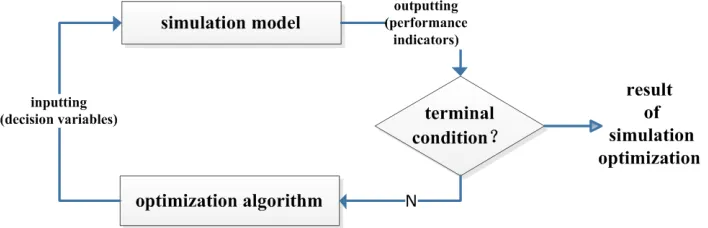
As shown in Figure 2, PVCE based on simulation and optimization mainly includes 3 parts, they are respectively simulation optimization control, optimization algorithm, and simulation model.
As the center of the entire method, simulation optimization control was responsible for initializing decision variable of problem description domain, and coordinating the operation of simulation model and heuristic optimization algorithm so as to complete data exchange and computation between them as well as determine the terminal condition. Finally, the simulation result was analyzed.
[image:5.612.131.485.429.543.2]Optimization algorithm was the kernel module of the entire method, it calculated indicators trend of the simulation result, adjusted the search direction and step length, and then gradually searched for the value of phase displacement.
Figure 2 Diagram Of Simulation Optimization Method Principle
2) Personnel and vehicle coordination evacuation simulation method
Personnel and vehicle coordination evacuation simulation was an important part of simulation optimization. We studied the various information interactions of people flow, vehicle stream and etc. In addition, we did some researches of communication language, collaboration and coordination, simulation step and other problems among models of distributed simulation platform.
3.2.2 Simplification of simulation
optimization model
The complexity degree of simulation optimization increases rapidly with the expansion
of evacuation scale. Accordingly, the method to simplify optimization model was considered in research in order to reduce the model complexity.
4. VALIDATION
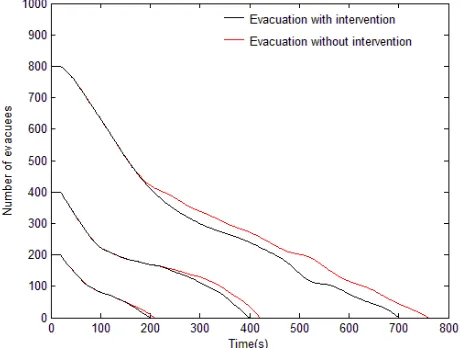
To validate the performances of evacuation which applied intervention measures, we performed an experiment by MATLAB 7.0 with an office building taken as object, and then initialized the total number of evacuees to three situations, they
[image:6.612.186.416.187.361.2]are respectively 200, 400 and 800. Figure 3 displayed the relationship that the remaining number of people varies with time. The black line denotes evacuation with intervention measures applied, while the red line denotes evacuation without intervention. We can see from Figure 3 that:
Figure 3 Comparison Between Evacuation With Intervention And Evacuation Without Intervention
(1) The curvature change of curve corresponded to the fluctuation of evacuation efficiency. Early during evacuation, both the channel utilization and the evacuation efficiency showed a significant upward trend, forming an "outer convex" curve. When the crowd density exceeded the channel capacity, and blockage gradually emerged, the evacuation efficiency stopped rising and even started to decline, forming an “inner concave” curve. Then the efficiency gradually stabilized, and the corresponding curve showed plummeting.
(2) Simulation results were relatively similar when people density was low. Compared to evacuation without intervention, evacuation in intervention conditions had a higher efficiency, which was obvious when the initial number of evacuees is big.
(3) The initial segment of each curve was parallel to the timeline, and the length of the parallel segment corresponded to the time that the first one evacuated from building required.
5. CONCLUSION
The need to solve the problem of coordination evacuation for personnel and vehicle is increasingly significant with increasing urban development. In this paper we studied the mechanism which coordinates people flow evacuation with vehicle
stream evacuation in emergency. In addition, optimization model was established from the angel of personnel and vehicle coordination evacuation. We classified the evacuation as two categories, evacuation with intervention and evacuation without intervention. Statistical analysis indicated that the former yielded better performances when compared to the latter for cases that possessed a higher efficiency of evacuation. The research is useful for the study of emergency evacuation modeling and simulation in case of emergency. We improved ant colony algorithm to get scheduling scheme of evacuation vehicles. Therefore, future work will investigate the implementation of the ACO (ant colony optimization) in a parallel computing environment and the communication mechanism of multiple ant colonies.
REFRENCES:
[1] Yamada, T., “A network of approach to a city emergency evacuation planning”, International
Journal of Systems Science, Vol. 27, No. 10,
1996, pp. 931-936.
[2] Vania E.G. Campos, Paulo A.L. da Silva and Paulo O.B. Netto, “Evacuation transportation planning; a method of identifying optimal independent routes”, Urban Transport and the Environment for the 21st Century,
[3] Cova, T.J. and J.P. Johnson, “A network flow model for lane-based evacuation routing”, Transportation Research Part a-Policy and
Practice, Vol. 7, No. 7, 2003, pp. 579-604.
[4] G.L. Hamza-Lup, K.A. Hua, M. Le, and R. Peng, “Enhancing Intelligent Transportation Systems to Improve and Support Homeland Security,” Proceedings of The 7th International IEEE Conference on Intelligent Transportation
Systems, October 2004, pp. 250-255.
[5] Chen X. and Zhan F.B., “Agent-Based Modeling and Simulation of Urban Evacuation: Relative Effectiveness of Simultaneous and Staged Evacuation Strategies”, Journal of the
Operational Research Society, Vol. 59, 2008,
pp. 25-53.
[6] Xu Yan and Yang Xiaokuan, “Plan of the 29th Olympic Games transport emergency management system”, Journal of Beijing
University of Technology, Vol. 31, No. 5, 2005,
pp. 481-485. (in Chinese)
[7] Xu Yan and Rong Jian, “Beijing transportation demand forecast of the 29th Olympic Games”,
Journal of Beijing University of Technology,
Vol. 29, No. 3, 2003, pp. 315-319. (in Chinese) [8] Guoguang He, Noth G., “Urban traffic control
system-a general analysis from the point of view of control theory”, Proceedings volume
from the 8th IFAC/IFIP/IFORS Symposium,
vol. 2, 1997, pp. 503-506.
[9] Shoufeng Ma, Guoguang He and Shitong Wang, “A hierarchical coordination model for control-guidance integrated systems in ITS”, IEEE 5th International Conference on
Intelligent Transportation Systems, 2002, pp.
522-527.
[10] Yueming Chen and Deyun Xiao, “Study on evacuation model and algorithm for emergency evacuation”, 7th World Congress on Intelligent
Control and Automation, 2008, pp. 3732-3736.
[11] Yueming Chen and Deyun Xiao, “Real-time traffic management under emergency evacuation based on dynamic traffic assignment”, IEEE International Conference
on Automation and Logistics, September 1-3,
2008, pp. 1376-1380.
[12] Chunzhu We and Qinyan Meng, “A research on human emergency evacuation based on revised ACO-CA”, 20th International Conference on Geoinformatics
(GEOINFORMATICS), 2012, pp. 1-7.
[13] Pengfei Duan, Shengwu Xiong and Hongxin Jiang, “Multi-objective Optimization Model Based on Heuristic Ant Colony Algorithm for Emergency Evacuation”, 15th International IEEE Conference on Intelligent Transportation
Systems Anchorage, September 16-19, 2012,
pp. 1258-1262.
[14] Lei WJ, Li AG, Gao R, Hao XP and Deng BS, “Simulation of pedestrian crowds' evacuation in a huge transit terminal subway station”, Physica A-Statistical Mechanics and ITS
Application, Vol. 391, No. 22, 2012, pp.
5355-5365.