SUPPLIER RELATIONSHIP MANAGEMENT MODEL
FOR SME’S E-COMMERCE TRANSACTION BROKER
CASE STUDY: HOTEL ROOMS PROVIDER
1NIKO IBRAHIM, 2VERONICA S. MOERTINI, 3VERLIYANTINA
1Information System Department, Maranatha Christian University 2Informatics Department, Parahyangan Catholic University
3R&D Department, KlikHotel.com
Bandung, Indonesia
E-mail:[email protected], [email protected], [email protected]
ABSTRACT
As market intermediaries, e-commerce transaction broker firms need to strongly collaborate with suppliers in order to develop brands seek by customers. Developing suitable electronic Supplier Relationship Management (e-SRM) system is the solution to this need. In this paper, we propose our concept of e-SRM for transaction brokers owned by small medium enterprises (SMEs), which includes the integrated e-SRM and e-CRM architecture, as well as the e-SRM applications and their features. We then discuss the customization and implementation of the proposed e-SRM model in a specific transaction broker selling hotel rooms, which owned by an SME, KlikHotel.com. The implementation of the e-SRM in KlikHotel.com has been successfully boosting the number of suppliers (hotel members) and hotel room sales.
Keywords:e-CRM, e-SRM, SME, Transaction Broker
1. INTRODUCTION
One of the opportunities that can be worked out by Small Medium Enterprises (SMEs), which are recognized as the backbone of economy in many countries, in conducting online business is running transaction broker e-commerce that acts as intermediary between buyers and sellers. Intermediary firms have specific functions in marketing products, which are matching buyers and sellers, facilitating transactions and providing business infrastructure [1]. As intermediaries, transaction brokers should be able to successfully sell supplier’s products to customers. It is known that customers often seek fine brands in fulfilling their needs. Hence, transaction brokers should build brands in order to sell products/services successfully in the market. It is recognized that factors shaping brand include quality, reliability, consistency, trust, affection, loyalty and reputation [2]. As intermediaries, transaction could not develop brands by themselves and should strongly collaborate with suppliers to resolve those factors.
In our research we find that in order to build strong relationships with suppliers, transaction brokers must develop electronic Supplier Relationship Management (e-SRM) system. Unlike customer relationship management (CRM) that has been matured, e-SRM is a relatively new concept
that has not been discussed very much in literatures. The existing concept of e-SRM that we find in literature [3][4] is intended for manufacture firms and become part of supply chain management systems. Other discussion related to SRM that we found are as follows: (1) A report summary of 170 paper published in 2000-2010 and highlight the techniques used in analyzing organizational data to support supplier selection decisions [5]; many approaches are adopted, among them are analytic hierarchy process (AHP), artificial intelligence (cluster analysis, neural network, decision trees, etc.), statistics, fuzzy set, and so on; (2) A method for finding key suppliers from a large database of shipment. The method employs association rule algorithms [6]; (3) A technique used to identify potential suppliers by employing association rules algorithm, which analyzes shipment transaction data [7]; (4) A real time business intelligent (BI) model that pulls together large quantities of real time information from disparate heterogeneous systems and distills them into focused views of the business [8]. The real-time BI has the capabilities of enabling companies to work directly with customers.
for transaction brokers, specifically run by SMEs with their specific organization constraints. Hence, we intend to contribute in proposing this model.
In this paper, we propose the integrated e-SRM and e-CRM architecture, the e-SRM applications and functions that resolve brand factors. We also discuss the customization, implementation of proposed e-SRM model in an SME transaction brokers selling hotel rooms and show that the e-SRM has been successfully promote brands in our transaction broker case study. Finally, we discuss the conclusion and further research needed.
2. LITERATURE STUDY
2.1. The Market Intermediaries and
Transaction Broker Roles
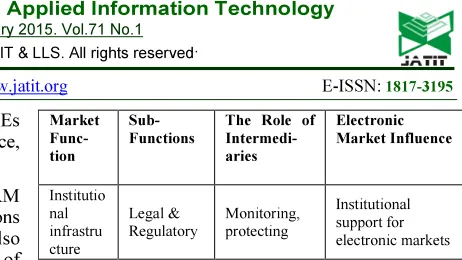
[image:2.595.281.512.72.202.2]Markets (electronic or otherwise) serve three main functions, which are matching buyers and sellers, facilitation of transactions and institutional infrastructure. The role of intermediaries for every function and its sub-functions, and the electronic market influence that must be considered by intermediaries is depicted in Table 1 [1]. Hence, electronic intermediaries should manage and provide services such that those influences can be optimized in their e-commerce websites.
Table 1: The Electronic Market Influence of Intermediaries.
Market Func-tion
Sub-Functions
The Role of Intermedi-aries
Electronic Market Influence
Matchin g buyers and sellers
Determinati on of product offerings
Monitoring, alerting
Personalization of products, aggregation, disaggregation
Searching Reducing
search costs
Lower search costs, more complex search requirements, lower barriers to entry
Price discovery
Facilitating (but increasing price)
Redistribution of mechanisms, new markets
Facilitati on of transacti ons
Logistics
Shipping, distribution, warehousing
Lower logistical costs, economies of scale
Settlement Facilitating,
monitoring
New cost structures, new payment mechanisms
Trust Rating,
guaranteeing
Increased protection requirements
Market Func-tion
Sub-Functions
The Role of Intermedi-aries
Electronic Market Influence
Institutio nal infrastru cture
Legal & Regulatory
Monitoring, protecting
Institutional support for electronic markets
In general, intermediaries can be categorized into four groups, which are consultant, broker, mediator and resource provider. The brokers possess the following characteristics [1]:
1. They act as creators and/or acquirers of sought after knowledge and/or technology. Brokers can also perform an integration role bringing multiple parties together into a collaboration ‘deal’. Roles may involve assistance in negotiating contracts, purchases, or sales.
2. They perform as agencies, parties acting for either buyers or sellers of knowledge (rarely both) on the basis of their capacity to meet needs through their networks and ability to initiate and negotiate deals. An example would be a technology broker, acting on behalf of a client, who identifies/seeks out a technology and works towards creating a deal. Brokers are typically paid a commission on the value of a transaction or a success fee.
The B2C (business to consumers) e-commerce business model that acts as market intermediary is known as transaction broker. Industries that widely using this model include financial services, travel services and job placement services [2]. These e-commerce systems should or usually provide functions and sub-functions depicted in Table 1.
2.2. Supplier Relationship Management (SRM)
SRM is a relatively new concept that is enhanced from Customer Relationship Management (CRM) concept [9]. Similar to the CRM, SRM objectives are: Attract and acquire suppliers, develop suppliers and maintain/promote their loyalties. SRM should focus on helping key suppliers improve quality, cost, and performance as well as integrating key suppliers into the organization [3].
Lengthen and strengthen critical supplier relationships; (e) Increase satisfaction of goods and services purchased.
There are few techniques in developing relationships with suppliers [4], which are: (a) Segment the entire suppliers into several strata based on needed criteria; (b) Develop programs that are appropriate to each of those segments; (c) Apply tools which recognize the most strategic set of suppliers.
In developing SRM system, it is suggested that [3] [4]: (a) It should combine both qualitative feedback and quantitative data and offer various means to analyze and report on that information; the system should produce an accurate overall score for each supplier which can be compared with other suppliers and tracked over time; (b) Clients and suppliers must share information and jointly collaborate on effective result oriented strategies, which need the support of technological horsepower; (c) By closing any delay between data capture and reporting, suppliers can be engaged more quickly to improve the working.
2.3. E-CRM Applications in e-Commerce
Systems
Whereas SRM has not been discussed very much in literatures, CRM has been widely known and implemented. Specifically for with e-commerce systems, the electronic CRM applications that are integrated with e-commerce systems are [11]:
1. Customer-facing applications (CFA): Include features where customers interact with the company such as call centers, sales automation and field service automation;
2. Customer-touching applications (CTA): Include features where customers interact directly with the applications such as personalized web pages, self-service activities, FAQs, campaign management and general-purpose e-commerce applications;
3. Customer-centric intelligence applications (CCIA): Include features where intelligent systems (using data warehouse, data mining and so on) are used to provide personal services or recommendations.
4. Online networking applications (ONA): Online networking refers to methods that provide the opportunity to build personal relationships with a wide range of people. These include chat rooms, blogs, wikis, and discussion lists.
2.4. Brand Development
Marketing seeks to create unique, highly differentiated products or services that are produced or supplied by one trusted firm [2]. In developing differentiated products, firms should not only sell core and actual products, but augmented products that include additional benefits such as after-sales support and other services. This is the basis for building the product’s brand. Brand can be viewed as expectations consumers have when consuming, or thinking about consuming a specific product. The most important expectations include: (a) quality, (b) reliability, (c) consistency, (d) trust, (e) affection, (f) loyalty and (g) reputation.
3. PROPOSED E-SRM MODEL
3.1. Transaction Broker Integrated SRM and
CRM Architecture
As intermediary firms, transaction brokers conduct business with suppliers and buyers. The buyers as well as the supplier could be organizations or individuals. In order to build products’ brand (see Section 2.4) that will be marketed successfully, they should build strong relationships with suppliers through SRM (see Section 2.2) to help suppliers in developing brands that satisfy customers and develop relationship with customers through CRM. Therefore, integrated SRM and CRM are needed.
We propose an arctitecture of integrated SRM and CRM by adopting the CRM systems for e-commerce (depicted in Section 2.3) as shown in Figure 1 with the following descriptions:
1. For supplier convenient and speedy services, they must have access to Supplier-Touching Applications (STA) having modules of self service supports, e-commerce features (needed to manage products, company profiles, and so on) and campaign management application needed to manage their product promotions. They should also be able to contact specialized staff, having the skills and knowledge of suppliers’ business, where the staffs use Supplier-Facing Applications (SFA).
2. The CRM side is adopted from the work of Turban and King with no modification [11].
functions for analyzing business data stored in databases as well as data warehouse using traditional techniques (statistical computations) and data mining technologies.
Based on the survey, we found that SMEs running e-commerce businesses could not afford powerful IT infrastructures needed to run CSCI in Business Intelligence (BI) system (that includes data warehouse, OLAP server and data mining technologies). Hence, in the first years, SMEs can focus with functions that analyze data stored in databases. SMEs can then also subscribe cloud services from BI providers and obtain on-demand services for conducting more intelligent analysis.
[image:4.595.90.516.202.757.2]As intermediaries having the market functions and roles as depicted in Section 2.1, transaction broker SMEs must build strong relationships with suppliers before they can sell fine brands. Thus, in the first years SMEs should prioritize the development of suitable SRM systems while gradually also develop CRM for customers.
Figure 1: The Transaction Broker E-SRM and E-CRM Applications Architecture
3.2. Transaction Broker e-SRM
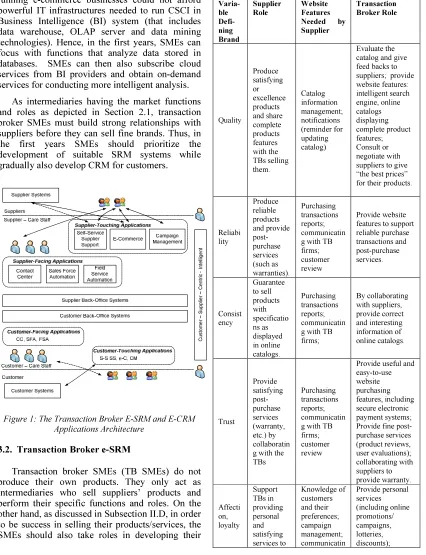
Transaction broker SMEs (TB SMEs) do not produce their own products. They only act as intermediaries who sell suppliers’ products and perform their specific functions and roles. On the other hand, as discussed in Subsection II.D, in order to be success in selling their products/services, the SMEs should also take roles in developing their
brand. Here, we present our analysis results of how TB SMEs can develop their brands by collaborating with suppliers as depicted in Table 2.
Table 2: The Role of Suppliers and Transaction Broker Firms in Building Brand
Varia-ble Defi-ning Brand Supplier Role Website Features
Needed by
Supplier Transaction Broker Role Quality Produce satisfying or excellence products and share complete products features with the TBs selling them. Catalog information management; notifications (reminder for updating catalog) Evaluate the catalog and give feed backs to suppliers; provide website features: intelligent search engine, online catalogs displaying complete product features; Consult or negotiate with suppliers to give “the best prices” for their products.
Reliabi lity Produce reliable products and provide post-purchase services (such as warranties). Purchasing transactions reports; communicatin g with TB firms; customer review
Provide website features to support reliable purchase transactions and post-purchase services. Consist ency Guarantee to sell products with specificatio ns as displayed in online catalogs. Purchasing transactions reports; communicatin g with TB firms; By collaborating with suppliers, provide correct and interesting information of online catalogs. Trust Provide satisfying post-purchase services (warranty, etc.) by collaboratin g with the TBs
Purchasing transactions reports; communicatin g with TB firms; customer review
Varia-ble Defi-ning Brand
Supplier Role
Website Features
Needed by
Supplier
Transaction Broker Role
customers. g with TB
firms;
collaborating with suppliers to provide post-purchase (newsletters, customer email, online updates, targeted email with personal promotions).
Reputa tion
Produce satisfying or excellence products and collaboratin g with the TBs to provide post-purchase services (warranty, etc.).
Purchasing transactions reports; customer review
By collaborating with suppliers, provide post-purchase services, such as warranty and gather customers feedback (product reviews, user evaluations); inform customers feedback to suppliers; Provide suggestion or recommendation to improve and design new products.
As can be seen in Table 2, transaction broker firms should highly communicate and collaborate with suppliers in order to create product brands. Hence, SRM should also be intended to promote brands sold by TB firms. Other than those, as in CRM, the SRM of TB SMEs should also have the objectives of: (1) Promoting suppliers loyalty; (2) Promoting suppliers value, such as by designing specific promotions (event promotions) where suppliers can join the promo event to sell more products; (3) Preventing valuable suppliers from churning.
Based on the SRM objectives, the concept of SRM depicted in Section 2.2, role of suppliers and TB firms in building brand (Table 2), the application features of e-SRM can be defined as the following.
1) Supplier Facing Applications (SFA)
As SFA users are supplier-care staff, the SFA should provide features to support the staff in managing and developing relationships with suppliers through “traditional” techniques (by phone, fax, in person). Therefore SFA should provide features as follows:
• SFA-1. Contact center: phone, messaging, email, and so on;
• SFA-2. Sales force and field service automation: products and inventory management, promotions/campaign management, reminder/notifications for updating products information (catalog), campaign, product stocks, transaction payments;
• SFA-3. Field Service Automation: Reports of inventory, purchasing transactions, campaigns, and so on;
• SFA-4. Knowledge obtained from data: supplier segmentations, monitoring and predicting suppliers who tend to churn, knowledge of customers review, knowledge of customer behavior in purchasing products and using websites.
2) Supplier Touching Applications (STA)
As STA is used by the suppliers, it should provide features to help suppliers in performing their roles defined in Table 2, which are:
• STA-1. Self-service supplier support and e-commerce features: products and inventory management, promotions/campaign management (create, update, change status, etc.), transaction payments management;
• STA-2. E-commerce: Personalized reports and dash boards of inventory, transactions, sales, campaigns, customers review and competitors information (such as prices);
• STA-3. Campaign management: Presenting knowledge obtained from each supplier data: segments of customers and products purchased by each segment, products purchased together, valuable information analyzed from customer’s review/comments, reasons why customers churn, and so on.
employ the traditional techniques, which are statistical computations, whereas buy on-demand BI functions from cloud services providers.
4. CASE STUDY: SRM OF HOTEL ROOMS
PROVIDER
4.1. Markets of Travel Services in Indonesia
One of the business opportunities that can be “caught” by SMEs in Indonesia is running an e-commerce transaction broker selling hotel rooms. The opportunity is backed up by the following facts.
In 2013, there is 72.7 million of Internet users (29% of total population) in Indonesian. However, at this time only 8% (5.6 million) of users are involved in internet transaction [12]. Hence, there is still ample of opportunities for growing. The demographic profiles of the largest users are [13]: age between 15 to 54 (87%), living in cities (53%), having high school education or more (72%). Indonesian middle class is expected to grow from 74 million in 2012 to roughly 141 million people by 2020 [14]. Among them, spending continues to rise with increase of wealth in travel and restaurant dining and online spending for tickets for trips or shows is the third largest compared to other goods. No wonder that the largest market segment of hotel rooms in Indonesia is budget accommodations, such as 3 and 4 star of hotels, that grow fast to meet this demand [15]. Concerning their behavior of online shopping, this middle class have specific characteristics [16], which are more than 60% enjoy searching for discounts/promotions and 88% of them want to experiment with brands. It is also reported that 69% of customers like branded websites.
4.2. Implementation of the e-SRM Model in a
Case-Study SME
In implementing the model, which is applicable to various types of business area, an SME should design a system having features in line with its vision-mission, which is also resolving specific issues and problems related to its business area. The SME should also define priorities, which applications features should be implemented first by considering their capability, resources and the most important issues to be addressed.
In responding to travel services market survey results depicted in Section 4.1, here, we propose the implementation of the e-SRM model for a transaction broker SME of our case study that sells hotel rooms.
4.2.1. The SME of transaction broker case
study
The case study SME is a transaction broker selling hotel rooms, KlikHotel.com, which was founded in 2010. It sells hotel rooms both to individual customers (via B2C e-commerce model), travel agent and tour operators (via B2B e-commerce model) by collaborating with hotels as suppliers (as of April 2014, the SME manages more than 1600 suppliers). Based on market survey as depicted in Section 4.1, the SME targets the middle class Indonesians and focus on budget hotels. The SME generates revenue from room transaction fees.
In order to build brand (having excellent reputation, affection, trust, consistency and quality) recognized by customers, KlikHotel.com prioritize in strengthening relationships with suppliers such that it can provide precise information for each of the hotel rooms, handle booking transactions easily and correctly and innovate attractive campaign/promotions for the middle class.
4.2.2. KlikHotel.com issues and objective in
managing suppliers
In managing and maintaining suppliers, the main issues faced are:
1. Acquiring new suppliers is costly as the marketing staff must meet and negotiate with the right person in hotel’s management. The average cost of acquiring a supplier is more than IDR 200.000.
2. While room availability must be precise at any time and rates must be maintained competitively, up to date and correctly, many hotels reluctant to maintain the information by themselves (especially if they find that their rooms have not been sold well by the website).
3. Although lots of small hotels eager to join as room suppliers, they lack of skilled human resources for maintaining hotel rooms information in the website.
4. Despite the fact that middle class in Indonesia like to search bargains, lots of hotels lack the capability of designing
innovative and creative
campaigns/promotions/deals for customers.
5. In attempt to gain more profit, several days before every peak season (week end or holiday), hotels want to sell their rooms by themselves (hence, do not provide rooms to be sold by KlikHotel.com)
Hence, in the first 5 years KlikHotel.com prioritizes and emphasizes the following e-SRM objectives:
1. Obj-1. Highly providing helps needed by hotels (specifically the small ones) in maintaining their room information and process the booking transactions such that the hotels staff just need to proceed with check in procedures.
2. Obj-2. Maintaining rooms availability and the attractive yet correct room rates at any time by applying specific strategies (such as by negotiating with hotels to sell rooms with competitive tariff to customers long before the peak season come);
3. Obj-3. Increasing room sales by designing creative campaigns/deals suitable middle class segment and ask hotels to join the campaigns/deals;
4. Obj-4. Evaluating the hotels performance (high selling, maintaining up to date hotel information, creating campaigns, etc.) and rewarding those having high performance with special bonuses
4.2.3. e-SRM application features
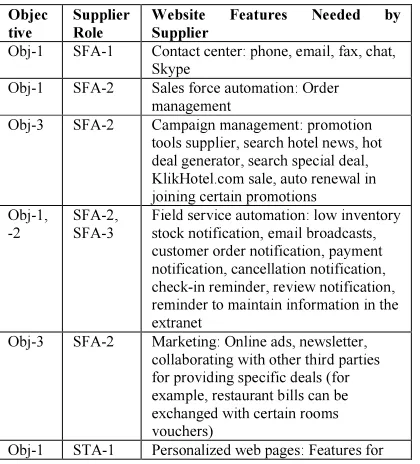
[image:7.595.87.297.515.747.2]Based on the objectives and priorities of KlikHotel.com, we have designed, customized and implemented the proposed features of SFA, STA and SCIA for the SME of case study. It is depicted in Table 3.
Table 3: The Features of SFA, STA and SCIA Resolving The Issues
Objec tive
Supplier Role
Website Features Needed by
Supplier
Obj-1 SFA-1 Contact center: phone, email, fax, chat,
Skype
Obj-1 SFA-2 Sales force automation: Order
management
Obj-3 SFA-2 Campaign management: promotion
tools supplier, search hotel news, hot deal generator, search special deal, KlikHotel.com sale, auto renewal in joining certain promotions Obj-1,
-2
SFA-2, SFA-3
Field service automation: low inventory stock notification, email broadcasts, customer order notification, payment notification, cancellation notification, check-in reminder, review notification, reminder to maintain information in the extranet
Obj-3 SFA-2 Marketing: Online ads, newsletter,
collaborating with other third parties for providing specific deals (for example, restaurant bills can be exchanged with certain rooms vouchers)
Obj-1 STA-1 Personalized web pages: Features for
Objec tive
Supplier Role
Website Features Needed by
Supplier
chained hotel differ to non-chained hotel (i.e. for chain hotel, a user account can be used to manage all of hotels in the chain)
Obj-1, -2
STA-1 Self service activities: room allotment
update, hotel profile update, photo gallery update, user management setting
Obj-1, -2
STA-1, STA-2
Inventory automation: auto renewal promo, low inventory notification Obj-1,
-2
STA-1, STA-2
Field service automation: order notifications, payment notifications, cancellation notifications, check-in reminders, review notifications, reminder of maintaining rooms information (extranet)
Obj-3 STA-1,
STA-2
Campaign management: Managing promotions (such as special price, early bird or long stay promotion), last minute sales, special deal and mystery deal (opaque selling)
Obj-1 STA-1 FAQ: Manual guide, newsletter
Obj-4 SFA-4 Searching/filtering hotels based on their
performance (measured by certain criteria )
Obj-4 SFA-4 Segmenting and ranking hotels based
on specific variables and computation
Obj-4 SFA-4 General statistical reports needed to
evaluate hotels
4.2.4. Examples of SFA and STA features
As features for managing creative campaigns/promotions is very important (to respond to the need of middle-class customers who are “bargain-hunters”), here, we mainly discuss the campaign management features in SFA and STA.
1) SFA-2 Sales Force Automation
We have designed and implemented functions for:
1. Creating and managing innovative-attractive campaigns (via hot deal campaign), such as the ones called mystery deal. It offers very low room-rate without explicitly inform the hotel name (it gives some hints only). Customer should “buy/take” the deal in order to find out the real hotel rooms.
2. Creating and managing discount campaigns, called cash-back promotions. Cash-back promotion is choosen manually by klikhotel.com’s promotion team to any hotels to increase competitiveness, compared to other online travel agents.
campaigned created/offered by KlikHotel.com.
[image:8.595.88.295.179.314.2]Figure 2 depicts the user interface of this campaign features.
Figure 2: The Menu of Campaign Management in SFA Used by The Supplier-Care Staff
2) STA Campaign management feature
We have designed, customized and implemented functions for facilitating each hotel to create and manage its own campaign. The options are special price, early bird booking, and last minute deals/promotions that can be applied for specific rooms for certain period of time. Figure 3 depicts user interface of the features.
3) SFA-2 and STA-2 Room availability
search feature
One of the most important information needed by customers is room availability. We designed a feature for quickly searching room availability based on certain price, room type, hotel name, hotel group, region and period. The users can then inform the search results to customers.
4) STA-1 Self-service hotel information
management feature
Features are provided for hotels to manage their information (such as to update rooms information facilities, price, ant their amenities).
Figure 3: Promotion/Campaign Management Tools Used by Hotels
As KlikHotel.com could not afford yet to provide BI systems, we designed and implemented analytical functions using statistical computations for processing data stored in database. These functions are for measuring and reporting hotels performance, and sorting hotels based on specific computed measure.
5) SFA Measuring and reporting hotels
performance features
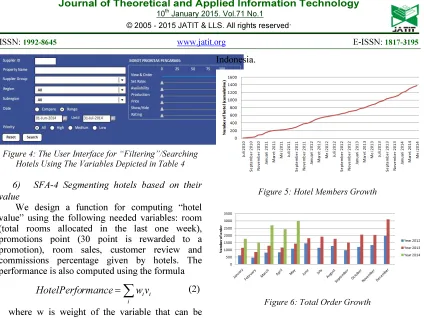
The important variables used to measure hotels performance is depicted in Table 4. The hotel performance is computed using the formula of
∑
=i i iv
w rmance
HotelPerfo (1)
where w is the weight of the variable (value: 0-100%) and v is the variable.
The total of all weights must be equal to 100%. If a weight of a variable is set to 0%, the corresponding variable is not included in computing the performance. We design a user interface that accommodates flexibility in selecting weights and variables for computing performance (see Figure 4). This function provides the capability to detect hotels that “need special attention” such as hotels having high discrepancy between number of visits with total bookings, which indicates problems (customers may like the rooms but price may be too expensive). If total of paid transactions is low, the hotels should also be checked. If the discrepancy between week day and week-end rates is high, the hotels should also be consulted.
Table 4: The Variables Used in Analyzing Hotels.
No Criteria Descriptions
1 View and
order
Number of users visiting hotel’s page and total of customers who make booking
2 Set rates The update status of room rates (value: Yes/No)
3 Availabil
ity
Stocks (allotment) of rooms (specifically during certain weekends)
4 Production Total of paid customer booking order transactions
5 Price The discrepancy between weekday and
weekend rates
6 Show The status of room information visibility to
users (value: Show/No show)
7 Rating
Figure 4: The User Interface for “Filtering”/Searching Hotels Using The Variables Depicted in Table 4
6) SFA-4 Segmenting hotels based on their
value
We design a function for computing “hotel value” using the following needed variables: room (total rooms allocated in the last one week), promotions point (30 point is rewarded to a promotion), room sales, customer review and commissions percentage given by hotels. The performance is also computed using the formula
∑
=
i i iv
w rmance
HotelPerfo (2)
where w is weight of the variable that can be adjusted and v is variable.
Hotels can then be sorted based on their value and KlikHotel.com can take appropriate business actions in managing hotels, such as giving bonus to high value hotels and penalties to hotels provided bad services to customers.
7) SFA General statistical report
General business reports are also generated, such as: (a) Reports of hotel distributions in a region/province; (b) Reports of top ten hotels (based on their sales) in top five cities; (c) Reports of daily, monthly, yearly of booking transactions, which can be used to compute room sales growth; (d) Analytical reports of “last production” per hotel, per hotel-group, per region for certain period of time.
5. EVALUATION/RESULTS
So far we have adopted and implemented the proposed e-SRM model only in our case study SME, KlikHotel.com. Hence, we can discuss the implementation results based on it. The e-SRM implemented in KlikHotel.com e-commerce system have successfully increase the number of hotels (suppliers) joined in the system in the last more than three years (see Figure 5). By having more hotels offered and strong relationships with the hotel members, KlikHotel.com’s brand has been also promoted as can be proven by the all time increased total order (see Figure 6). KlikHotel.com is now one of the most popular websites offering hotel rooms in
Indonesia.
[image:9.595.89.513.73.391.2]Figure 5: Hotel Members Growth
Figure 6: Total Order Growth
6.CONCLUSION AND FUTURE WORKS
By developing e-SRM, brands of e-commerce transaction brokers can be promoted that leads to sales increase. By adopting e-SRM, strong relationship and collaboration between transaction broker firms and suppliers can also be achieved, which is beneficial to both parties as they can conduct business activities more efficiently. In adopting the model for certain transaction broker with specific business area, local issues must be identified and then resolved by designing functions accordingly.
So far we have customized and implemented the proposed e-SRM in a SME case study providing hotel rooms only. More research is needed to customize it for other transaction brokers with different business area. The e-SRM with its functions that we propose is specifically suitable for transaction brokers. Hence, e-SRM models for other types of e-commerce system need to be developed.
ACKNOWLEDGMENT
REFERENCES:
[1] “Study of the Role of Intermediaries in Support of Innovation”, Department of Industry, Tourism and Resources, Howard Partners, April 2007.
[2] K.C. Laudon and C.G. Traver, “E-commerce Business Technology Society”, 6th ed., Pearson Education, Inc., England, 2010. [3] M. E. Chenoweth, N. Y. Moore, A. G. Cox, J.
D. Mele, and J. M. Sollinger, “Best Practices in Supplier Relationship Management and Their Early Implementation in the Air Force Materiel Command”, Prepared for the United States Air Force, PROJECT AIR FORCE, RAND Corporation, 2012.
[4] “How to Build More Successful Strategic Supplier Relationships, Incorporating “Performance & Value” metrics in supplier
scorecards”, Decideware,
www.decideware.com, (accessed 3 April 2014) [5] M. Setak, Samaneh S. and A. Alimohammadian, “Supplier Selection and Order Allocation Models in Supply Chain Management: A Review”, World Applied Sciences Journal 18 (1): 55-72, 2012.
[6] R.H. Lin, C.L. Chuang,, J.J.H. Liou c, G.D. Wua, “An integrated method for finding key suppliers in SCM”, Expert Systems with Applications 36, 6461–6465, 2009.
[7] Malik, A. Gupta, S. Rai, “An Approach of Data Mining Algorithm to Identify Potential Suppliers of an Organization using Vertical Data Format”, MIT International Journal of Computer Science & Information Technologi, Vol. 1, No. 2, pp. 89-94, Aug 2011.
[8] B.S. Sahay and J. Ranjan, “Real time business intelligence in supply chain analytics”, Information Management & Computer Security, Vol. 16 No. 1, pp. 28-48, 2008. [9] A. Lang, D. Paravicini, Y.Pigneur, and E.
Revaz, “From Customer Relationship Management (CRM) to Supplier Relationship Management (SRM)”, HEC Lausanne, 2002. [10] C. C. Poirier, “Supplier Relationship
Management, An Advanced Supply Chain Management Technique”, Computer Sciences Corporation (CSC), 2003.
[11] E. Turban and D. King, “E-commerce 2012: Managerial and Social Networks Perspective”, 7th ed., Prentice Hall, USA, 2012.
[12] “a New Digital Class Emerges”, eMarketer,
March 2013,
http://www.emarketer.com/Article/Indonesia-New-Digital-Class-Emerges/1009723 (accessed: 28 May 2014)
[13] Broadcasting Board of Governors (BBG) and Gallup, “Media Use in Indonesia 2012”,
October 2012,
http://www.bbg.gov/blog/2012/10/02/new-bbg- research-series-media-use-in-indonesia-2012-oct-15/ (accessed: 28 May 2014)
[14] The Boston Consulting Group (BCG), Asia’s Next Big Opportunity: Indonesia’s Rising Middle-Class and Affluent Customers, March 2013.
[15] “Indonesia hoteliers eye emerging middle
class”, HotelNewsNow
http://www.hotelnewsnow.com/Article/8505/In donesia-hoteliers-eye-emerging-middle-class#sthash.Xrkvivit.dpuf (Accessed: 28 May 2014)
[16] “Under the Influence: Customer Trust in Advertising”, The Nielsen Company,
Newswire, September 2013,