http://dx.doi.org/10.4236/health.2013.512A013
Utility of “loco-check,” self-checklist for “locomotive
syndrome” as a tool for estimating the physical
dysfunction of elderly people
*
Yasumoto Matsui1#, Marie Takemura1, Atsushi Harada1, Fujiko Ando2,3, Hiroshi Shimokata3
1Department of Orthopedic Surgery, National Center for Geriatrics and Gerontology, Obu, Japan; #Corresponding Author: [email protected], [email protected], [email protected]
2Department of Health and Medical Sciences, Aichi Shukutoku University, Nagakute, Japan; [email protected]
3Department for Development of Preventive Medicine Center for Development of Advanced Medicine for Dementia, National Center
for Geriatrics and Gerontology, Obu, Japan; [email protected]
Received 22 October 2013; revised 26 November 2013; accepted 2 December 2013
Copyright © 2013 Yasumoto Matsui et al. This is an open access article distributed under the Creative Commons Attribution License, which permits unrestricted use, distribution, and reproduction in any medium, provided the original work is properly cited.
ABSTRACT
Aim: A new concept of locomotive syndrome has been proposed by the Japanese Orthopae- dic Association. The aim of this study is to clari- fy the utility of its self-checklist, “loco-check,” as a tool for estimating the physical dysfunction of elderly people. Methods: Subjects were 1124 community-dwelling Japanese people, 557 men and 567 women, aged 40 - 89 years. Information about the seven “loco-check” items was obtained from present inquiry sheets. Physical functions were examined by grip strength, knee extension strength, walking speed and one-leg standing time with open eyes. The averages of these test values, controlled for age and BMI, were com- pared between the “loco-check” (+) group and the “loco-check” (−) group. Also we examined about the trend of decline of physical function, together with SF36 physical function subscale score, as the number of the items chosen in- creased. Results: Adjusted average values of all four physical function examinations in the “loco- check” (+) group were significantly lower than those of the “loco-check” (−) group (all, p < 0.001). Also the adjusted average values of the majority of four tests were significantly lower in those who checked each of the “lococheck” items than those who did not, for most of the items. It was also revealed that the more items subjects checked, the lower the adjusted aver- age values were, except for one-leg standing
time. It was also the case with SF36 physical function subscale score. Conclusion: We showed the utility of “loco-check” as a simple tool not only for noticing the physical dysfunction of elderly people, but also for estimating the extent of it, except for balancing ability, particularly by counting the number of checked items.
Keywords: Locomotive Syndrome; Loco-Check; Physical Dysfunction; Estimation; Elderly People
1. INTRODUCTION
Recently, the population of elderly people has been growing larger and larger in developed countries. Among those countries, Japan has gained the top status as a super-aging society [1] and the population needing nurs- ing care has naturally become larger. In order to cope with this situation, the Japanese Orthopaedic Association (JOA) proposed the new concept “Locomotive Syn- drome” [2-4] in 2007. The JOA then used the short term “Locomo” for easy recall by Japanese people in general and to alert them about the importance of the locomotive organs in maintaining their independence all through their lives, because orthopedic problems have become one of the main reasons for the nursing care [2]. This syndrome refers to those elderly who are in need of nursing care services due to problems with their loco- motive organs, or those who have risked conditions which may lead them to use such services in the future. For the greater self-awareness of the possibility of such a risk condition, the JOA prepared a self-checklist com- posed of seven items with which individuals can test themselves during their activities of daily living in and
*Disclosure statement: No potential conflicts of interest were
outside of the house (described in the Materials and methods section) [4]. These 7 items, called “loco-check,” are very well-considered and cautiously chosen by the experts in this field, but their usefulness for estimating the physical dysfunction (particularly its extent) has not been revealed yet. Hence, the purpose of this study is to verify its usefulness in the originally targeted self-awareness of a person’s physical disability, and also to investigate if it is available to surmise its extent by counting the number of checked items. We examined the relationship of the “loco- check” and the physical functional status evaluated by grip strength, leg extension strength, walking speed, one-leg standing time with eyes open, and compared with the SF36 (physical function subscale), most of which are popularly used to represent physical status. The verifi- cation of the utility of “loco-check” will help acquaint not only Japanese but people worldwide with the enlightened new notion of “Locomotive Syndrome”.
2. MATERIALS AND METHODS
2.1. SubjectsThe subjects were selected among people who partici- pated in the 7th wave of the National Institute for Lon- gevity Sciences Longitudinal Study of Aging (NILS- LSA). Details of the NILS-LSA are described elsewhere [5].It is a biannual examination checking the physical and mental condition of ordinary Japanese people, so as to clarify the effect of aging. It is conducted by the Na- tional Center for Geriatrics and Gerontology (NCGG) in Japan. The National Institute for Longevity Sciences (NILS) is a research section of NCGG. The participants were chosen randomly from residents of Obu City and Higashiura-cho, in Aichi Prefecture, Japan. For this study, data from 1,124 persons were analyzed (61.5 ± 13.3, mean ± SD). Participants were 557 men and 567 women, whose ages ranged from 40 to 89, and the period of par-ticipation ranged from July 2010 to June 2011.
2.2. Information on Seven “Loco-Check” Items
The pre-mailed inquiry sheets completed by partici- pants were utilized to determine whether they thought themselves to be fit in the seven “loco-check” items [4]: 1) You cannot put on a pair of socks while standing on one leg; 2) You stumble or slip in your house; 3) You need to use a handrail when going upstairs; 4) You cannot get across the road at a crossing before the traffic light changes; 5) You have difficulty walking conti- nuously for 15 min; 6) You find it difficult to walk home carrying a shopping bag weighing about 2 kg; and 7) You find it difficult to do housework requiring physical strength. The “loco-check” (+) group was defined as those who checked at least one of the seven items, and the “loco-check” (−) group as those who checked none.
2.3. Evaluation of Physical Functions
Physical functions of participants were evaluated by the internationally commonly utilized four fundamental physical function tests; grip strength (kg), leg extension strength (kg), walking speed (m/sec), and one leg stand- ing time with open eyes (seconds; maximum 30 seconds). Also, for comparison with the similar questionnaires about physical function, the subscale from SF36 [6,7] (SF36 PF in the following context) was used. It is composed of 10 questions and the maximum score was set as 100 points; for each item 0, 5 or 10 points were allocated; namely, very difficult—0 points, slightly difficult—5 points, and not at all difficult—10 points.
2.4. Comparison of Physical Function of Those Who Selected “Loco-Check” Items and Those Who Did Not
Average values of five tests: grip strength, leg exten- sion strength, walking speed, and one leg standing time with open eyes, controlled for age and BMI, were com- pared between the “loco-check” (+) group of those who checked at least one of seven “loco-check” items, and the “loco-check” (−) group who checked none. Also, adjusted average values of five tests were compared between the group of those who checked each of the seven loco- check items, and the group of those who did not. Further- more, the values of four tests, together with the total score of SF36 PF, were compared among groups who checked none, 1, 2, 3, 4 and 5 items and examined if there was a decreasing trend as the checked number increased. This served to find out whether the numbers of checked items have significance in judging individual levels of physical disability.
The study protocol was approved by the Committee on Ethics of Human Research of the National Institute for Longevity Sciences. Written informed consent was ob- tained from each subject.
Statistical analyses were conducted with a general lin-ear model, controlled for age and BMI as mentioned above, using SAS (Ver. 9.1.3). Comparison between those who checked or did not was conducted by Student
t-test, and investigation about the significance of the
numbers checked was done by trend analysis.
3. RESULTS
Characteristics of the subjects are shown in Table 1. The adjusted average values of four tests (grip strength, leg extension strength, walking speed, and one leg stand- ing time with open eyes of the “loco-check” (+) group) were significantly lower than those of the “loco-check” (−) group in all of the tests (all p < 0.001) as described in Table 2.
Table 1. Subject characteristics.
“loco-check” (+) “loco-check” (−) group p N (male/female) 310 (143/167) 814 (414/400) 0.156
Height (cm) 156.7 ± 9.5 160.6 ± 9.3 <0.0001 Weight (kg) 57.8 ± 11.6 58.1 ± 10.9 0.607
[image:3.595.56.288.100.166.2]BMI 23.5 ± 3.8 22.4 ± 3.0 <0.0001
Table 2. Adjusted average values of four tests.
“loco-check” (+) group
“loco-check” (−) group p Grip strength (kg) 28.8 ± 0.3 30.6 ± 0.2 <0.0001 Leg extension strength (kg) 36.6 ± 0.6 39.1 ± 0.3 0.0008
Walking speed (m/min) 77.8 ± 0.6 81.9 ± 0.4 <0.0001 One leg standing time
with eyes open 50.7 ± 4.4 77.0 ± 3.6 <0.0001
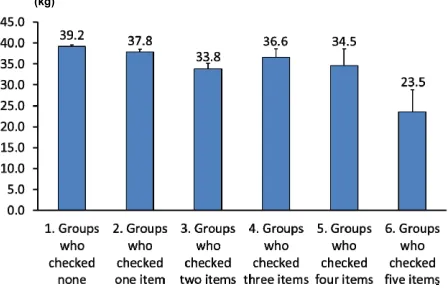
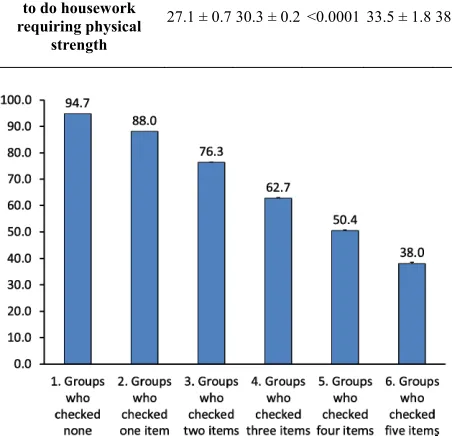
who checked or did not) the adjusted average values of four examinations concerning each question on the seven items, the values of those who checked the items 1), 2), and 3) were significantly lower in all four tests (Table 3). Furthermore, those who checked; 4) showed lower values in the grip strength than those who did not check; those who checked; 5) showed lower values in the grip strength and walking speed than those who did not check; and those who checked; 6) and 7) showed lower values in 3 of the tests other than the one leg standing time (Table 3). As for the investigation of the trends in the values of the four tests, together with the SF36 PF score, with a decrease as the number of checked items increased until five, most of the tests, other than one leg standing time, showed a significant declining trend in physical function (as for the knee extension strength, p = 0.0043, and other 3 items p < 0.0001) (Figures 1-4).
4. DISCUSSION
The locomotive syndrome, or so-called “Locomo,” is a new concept that was proposed by the Japanese Ortho- paedic Association (JOA) in 2007. This concept is inten- ded to help prevent elderly people from coming to need nursing care services due to problems with their locomo- tive organs. Seven items, called a “loco-check,” have been prepared so that elderly people can perform a self- check of locomotive problems [4]. These items, rather than being selected after a close examination of their validity, were selected with priority for ease of communi- cation among the general population. Thus, items that people can easily understand were selected. This study is intended to reveal the utility of the full “loco-check” list not only as a means to help people themselves become aware of their gradual decline in various motor functions but also to estimate the extent of their physical dysfunc- tion in the general population, by comparing the “loco- check” with very popularly used indices such as grip
(kg)
Figure 1. As the number of checked items increased, average grip strength declined significantly (p trend <0.0001).
[image:3.595.56.286.194.277.2](m/min)
Figure 2. As the number of checked items increased, average leg extension strength declined significantly (ptrend = 0.0043).
(kg)
Figure 3. As the numbers of checked items increased, average walking speed declined significantly (p trend < 0.0001).
[image:3.595.310.534.286.429.2] [image:3.595.311.535.471.615.2]Table 3. Comparison between two groups (those who checked or did not) and the adjusted average values from five exams concern-ing each question on seven items.
Grip strength (kg) p Leg extension strength (kg) p Walking speed (m/min) p
One leg standing time with eyes open
(sec)
“Loco-check” (+) (−) (+) (−) (+) (−) (+) (−)
1) You cannot put on a pair of socks while standing
on one leg
28.6 ± 0.4 30.5 ± 0.2 <0.0001 36.6 ± 0.8 38.9 ± 0.3 0.01 77.3 ± 0.8 81.6 ± 0.3 <0.0001 49.8 ± 5.2 72.6 ± 3.2 0.0003
2) You stumble or
slip in your house 28.3 ± 0.5 30.3 ± 0.2 0.0005 36.4 ± 1.0 38.8 ± 0.3 0.031 78.5 ± 1.1 81.1 ± 0.3 0.0225 49.5 ± 8.2 68.5 ± 3.0 0.0312
3) You need to use a handrail when
going upstairs
27.7 ± 0.5 30.4 ± 0.2 <0.0001 34.6 ± 1.2 38.9 ± 0.3 0.0006 71.7 ± 1.1 81.8 ± 0.3 <0.0001 50.2 ± 6.6 70.0 ± 3.1 0.0079
4) You cannot cross the road at a crossing
before the traffic light changes
25.6 ± 1.7 30.2 ± 0.2 0.0063 30.4 ± 5.4 38.6 ± 0.3 n.s. 86.5 ± 7.3 80.9 ± 0.3 n.s. 68.1 ± 34.2 66.2 ± 2.8 n.s.
5) You have difficulty walking continuously
for 15 min
27.4 ± 1.1 30.2 ± 0.2 0.0085 39.7 ± 3.1 38.6 ± 0.3 n.s. 69.9 ± 2.8 81.0 ± 0.3 <0.0001 43.8 ± 15.4 66.9 ± 2.8 n.s.
6) You find it difficult to walk home carrying
a shopping bag weighing about 2 kg
27.0 ± 0.9 30.3 ± 0.2 0.0002 33.4 ± 2.5 38.6 ± 0.3 0.0395 72.5 ± 2.2 81.1 ± 0.3 0.0001 52.0 ± 12.8 66.9 ± 2.9 n.s.
7) You find it difficult to do housework requiring physical
strength
27.1 ± 0.7 30.3 ± 0.2 <0.0001 33.5 ± 1.8 38.7 ± 0.3 0.0037 72.0 ± 1.6 81.2 ± 0.3 <0.0001 58.5 ± 10.6 66.8 ± 2.9 n.s.
Figure 4. As the numbers of checked items increased, average SF36 PF scores declined significantly (ptrend < 0.0001).
larly useful to know the decline of your physical function in strength, walking ability, as well as balancing ability. We have also shown that the number of items checked is important to understand the severity of the decline; that
is, the more items are checked, the greater the physical dysfunction is, except for balancing ability.
In recent years, a new scale consisting of 25 question items, the Geriatric Locomotive Function Scale, now called “Locomo 25,” was developed by Seichi et al. [8]
[image:4.595.60.286.431.654.2][13].
The basic idea behind “Locomotive Syndrome” is to have a simple and accessible method to help people in general to become aware of their own risk of declining motor function so that they will seek help at a special orthopedic clinic at an early stage. In fact, the prevalence of orthopedic diseases has been shown to be higher than expected [14,15]. The early consultation with a specialist will lead to increased opportunities for the proper treatment at an earlier stage of disease.
The loco-check is also introduced with cartoon drawings for easier understanding by everyone [16,17]. To make this new idea of the loco-check more widely known among the general Japanese population, and even among people worldwide in the future, the greater use of these kinds of accessible question items is beneficial. The present study shows their usefulness through com- parison with four fundamental physical function tests, together with the internationally-used questionnaires about physical function from SF36. In fact, some reports have shown that the loco-check (whether there are any of the applied items) is related to physical functions like muscle strength or walking speed [18,19]. Also, Sasaki et al. [20] recently reported that a non-loco-check group
showed significantly better performances in the func- tional reach and reach tests than the loco-check group in males and females, as well as better grasping power and one-leg standing with the eyes open in females, by age adjusted comparison. These findings partly coincide with our own results. Increased self-awareness of a decline in physical function may also induce people to perform “loco-training” exercises [16], such as standing on one leg or half squats, which previously have been reported to be effective [18,21-23].
A limitation of our study is that the subjects accounted for only about half of all participants in the 7th wave of the NILS-SA. It is possible that the results do not accurately reflect the results of all participants. However, the number of subjects should still be large enough to discuss the trends in all participants and to show the value of the loco-check.
The strength of the study is that the subject sample was selected randomly from the local community with very little bias in the process.
In summary, we investigated the relationship between the loco-check and physical function status as evaluated by grip strength, knee extension strength, walking speed, one-leg standing time and the SF36 (physical function subscale). We thereby demonstrated the utility of the loco-check not only as a means of screening to promote self-awareness of locomotive organ impairments, but also as a simple way to surmise the severity of the im- pairment by counting the number of items checked, excluding balancing ability.
5. ACKNOWLEDGEMENTS
This study was funded by The Research Fund for Longevity Sci- ences (20shi-2) from the National Center for Geriatrics and Gerontol-ogy (NCGG), Japan.
REFERENCES
[1] Muramatsu, N. and Akiyama, H.(2011)Japan: Super- aging society preparing for the future. Gerontologist, 51,
425-432. http://dx.doi.org/10.1093/geront/gnr067
[2] Nakamuran, K. (2008) A “Super-aged” society and the “locomotive syndrome.” Journal of Orthopedic Science,
13, 1-2. http://dx.doi.org/10.1007/s00776-007-1202-6
[3] Nakamura, K. (2009) Locomotive syndrome: Disability- free life expectancy and locomotive organ health in a “super-aged” society. Journal of Orthopedic Science,14,
1-2. http://dx.doi.org/10.1007/s00776-008-1302-y
[4] Nakamura K. (2011) The concept and treatment of lo- comotive syndrome: Its acceptance and spread in Japan.
Journal of Orthopedic Science, 16, 489-491.
http://dx.doi.org/10.1007/s00776-011-0108-5
[5] Shimokata, H., Ando, F. and Niino, N. (2000) A new comprehensive study on aging—The National Institute of Longevity Science, longitudinal study of aging (NILS- LSA). Journal of Epidemiology, 10, S1-S9.
http://dx.doi.org/10.2188/jea.10.1sup_1
[6] Ware, Jr., J.E. and Sherbourne, C.D. (1992) The MOS 36-item short-form health survey (SF-36). I. Conceptual framework and item selection. Medical Care, 30, 473-483.
http://dx.doi.org/10.1097/00005650-199206000-00002
[7] Ware, Jr., J.E. and Gandek, B. (1998) Overview of the SF-36 health survey and the international quality of life assessment (IQOLA) project. Journal of Clinical Epide- miology, 51, 903-912.
http://dx.doi.org/10.1016/S0895-4356(98)00081-X
[8] Seichi, A., Hoshino, Y., Doi, T., Akai, M., Tobimatsu, Y. and Iwaya, T. (2012) Development of a screening tool for risk of locomotive syndrome in the elderly: The 25-ques- tion Geriatric Locomotive Function Scale. Journal of Or- thopedic Science, 7, 163-172.
http://dx.doi.org/10.1007/s00776-011-0193-5
[9] Brooks, R. (1996) EuroQol: The current tate of play.
Health Policy,37, 53-72.
http://dx.doi.org/10.1016/0168-8510(96)00822-6
[10] Hirano, K., Imagama, S., Hasegawa, Y., Ito, Z., Mu- ramoto, A. and Ishiguro, N. (2013) The influence of lo- comotive syndrome on health-related quality of life in a community-living population. Modern Rheumatology, 23,
939-944. http://dx.doi.org/10.1007/s10165-012-0770-2
[11] Muramoto, A., Imagama, S., Ito, Z., Hirano, K., Ishiguro, N, and Hasegawa ,Y. (2012) Physical performance tests are useful for evaluating the severity of locomotive syn- drome. Journal of Orthopedic Science, 17, 782-788.
http://dx.doi.org/10.1007/s00776-012-0283-z
performance test for locomotive syndrome. Journal of Orthopedic Science, 18, 618-626.
http://dx.doi.org/10.1007/s00776-013-0382-5
[13] Yoshimura, N., Muraki, S., Oka, H., Kawaguchi, H., Na-kamura, K. and Akune, T. (2012) Usefulness of “Loco- check” scores in predicting the occurrence of disabilities: The road study. Journal of Japanese Orthopedic Associa- tion, 86, S87 (in Japanese).
[14] Yoshimura, N., Muraki, S., Oka, H., Mabuchi, A., En-Yo, Y., Yoshida, M., et al. (2009) Prevalence of knee oste-
oarthritis, lumbar spondylosis, and osteoporosis in Japa- nese men and women: The research on osteoarthritis/os- teoporosis against disability study. Journal of Bone and Mineral Metabolism, 27, 620-628.
http://dx.doi.org/10.1007/s00774-009-0080-8
[15] Kadono, Y., Yasunaga, H., Horiguchi, H., Hashimoto, H., Matsuda, S., Tanaka, S., et al. (2010) Statistics for ortho- pedic surgery 2006-2007: Data from the Japanese diag- nosis procedure combination database. Journal of Ortho- pedic Science, 15, 162-170.
http://dx.doi.org/10.1007/s00776-009-1448-2
[16] Japanese Orthopaedic Association (2012) Pamphlet of locomotive.
http--www.joa.or.jp-jp-public-locomo-locomo_pamphlet_ 2012.pdf
[17] Locomo Challenge (2013)
https://locomo-joa.jp/check/lococheck/
[18] Ishibashi, H. (2011). Benefits of locomotion check and effectiveness of locomotion training on physical functions in the elderly. IGAKU NO AYUMI (Journal of Clinical and Experimental Medicine, 236, 353-359 (in Japanese)
[19] Hirano, K., Imagama, S., Hasegawa, Y., Wakao, N., Mu- ramoto, A. and Ishiguro, N. (2012) Impact of spinal im- balance and back muscle strength on locomotive syn- drome in community-living elderly people. Journal of Orthopedic Science, 17, 532-537.
http://dx.doi.org/10.1007/s00776-012-0266-0
[20] Sasaki, E., Ishibashi, Y., Tsuda, E., Ono, A., Yamamoto, Y., Inoue, R., et al. (2013) Evaluation of locomotive dis-
ability using loco-check: A cross-sectional study in the Japanese general population. Journal of Orthopedic Sci- ence, 18, 121-129.
http://dx.doi.org/10.1007/s00776-012-0329-2
[21] Sakamoto, K., Nakamura, T., Hagino, H., Endo, N., Mori, S., Muto, Y., et al., Committee on Osteoporosis of the Ja- panese Orthopaedic Association (2006) Effects of uni- pedal standing balance exercise on the prevention of falls and hip fracture among clinically defined high-risk eld- erly individuals: A randomized controlled trial. Journal of Orthopedic Science, 11, 467-472.
http://dx.doi.org/10.1007/s00776-006-1057-2
[22] Kita, K., Hujino, K., Nasu, T., Kawahara, K. and Sunami, Y., Japanese Clinical Orthopaedic Association, Commit- tee on Musculoskeletal Rehabilitation (2007) A simple protocol for preventing falls and fractures in elderly indi- viduals with musculoskeletal disease. Osteoporosis In- ternational, 18, 611-619.
http://dx.doi.org/10.1007/s00198-006-0288-6
[23] Michikawa, T., Nishiwaki, Y., Takebayashi, T. and To- yama, Y. (2009) One-leg standing test for elderly popula- tions. Journal of Orthopedic Science, 14, 675-685.