Technology (IJRASET)
Region Based Image Retrieval Approach Using
SVM with Shape and Texture Based Feature
Bharath. P1, Prasad. C2
1
Department of ECE, Shree Institute of Technical Education, Tirupathi, India
2
Assistant Professor, Department of ECE, Shree Institute of Technical Education, Tirupathi, India
Abstract: The content based image retrieval is important research in medical and internet applications. This aim is searching the images from database based on query image. Region based image retrieval approach using edge following technique with shape and texture based feature are present in this paper. The Gradient based cluster algorithm is used to find the boundaries of noisy medical images. The performance and robustness of edge following technique is tested to detect the objects in different medical images. To accomplish this, local binary pattern (LBP) as texture feature and Hu moments (Hu), Tchybysheve Moments, invariant moment as shape based features are taken in this paper. These shape and texture features are calculated from segmented images and combine as feature vectors. The advantage of feature vector is to reduce the image dimensionality and less computation time. After feature vector is calculated, comparing the feature vector of query image and feature vectors of given database images and then sorted the images based on distance. The proposed method has better to improve the retrievals accuracy, high speed and less computation time. Our obtained results show the proposed method is robust in different medical image alterations. The proposed method obtains 99% retrieval accuracy, which is satisfactory. The region based image retrieval performance of proposed method is tested of 4000 images with 40 different classes.
Keywords: content-based image retrieval, shape, texture and Euclidian distance
I. INTRODUCTION
In present days, digital and internet technologies produce the large amount of digital images and therefore digital image databases are becoming a more larger and wider. The CBIR systems divide in two categories. They are image based searching and segment based search (also called region based search). In CBIR systems, a query an image to search the images in database and to be matched. In CBIR contain several well-known methods to retrieve the digital images from database. One of the techniques is IBM QBIC to retrieve the similarity images based on color and texture percentage in the images [1]. Virage [5] is used for video content based Retrieval H. Eidenberger [6] uses interactive learning agent for image retrieval [6]. The color regions arrangement used by Visual Seek system [2]. T. Huang [4] introduced the relevance feedback with MARS in image retrieval. Region based image retrieval with Expectation-Maximization-like (EM) segmentation introduced in [3].
CBIR systems use low-level features vectors such as color, Shape, texture and spatial information [7, 8]. These combination features used to retrieve the similarity images [9]. Color and texture are important features [10] in CBIR systems. The color and texture feature combination has less retrieval accuracy and less speed.
Texture and shape features are less develop compare to color features. Various texture and shape feature are investigated in computer vision and pattern recognition. Yet, medical retrieval by texture and shape are the effective search technique in medical and other application fields [11].
Technology (IJRASET)
and takes the more storage of image retrieval.
II. SHAPE FEATURE
Shape feature is important feature in content-based image retrieval systems. It is a high level feature technique that can be determining the images similarity from database. This similarity measures used Euclidian distance of corresponding feature vectors. Particularly, the shape features are used in medical images in content based image retrieval. In shape feature, there are different methods are used to representation with feature vector.
A. Invariant moments
Invariant moment is also defined as moment invariant. It is used as shape feature in CBIR systems and classification systems. The object characteristics of invariant Moments can provides the uniquely shape representation. It is also well performed in the multidimensional feature space in retrieval and classification systems. The values of invariant moments are invariant in terms of the scale, rotation and translation of the shape. Invariant moment is determine the centre moments (origin of object). So, it reduces the dimension of object and independent rotation in second and third order values of central moments. Presently , invariant moment are dermine based on boundary shape and interior . The regular invariant moment function f(x, y) in analog form is given by:
Where Mpq is the moment of two-dimensional image of the function f(x,y). P is row representation and q is the column representation in image. The regular invariant moment function f(x, y) in digital form is given by:
The centre gravity of coordinates x, y in analog form is given by X=M10/M00
Y=M01/M00
The centre gravity of coordinates x, y in digital form is given by
Where µpq is centre gravity of object.
III. TEXTURE FEATURE
Texture is an important feature in nature image. It is high level feature texture. It is formed a repeating values in spatial positions. Basically, the repetition values involves orientation, elements of optical features and scale variations. Texture feature contain different techniques are used in CBIR system.
A. Local binary pattern
Technology (IJRASET)
get binary results. The local binary pattern of 2D image is given by LBP=Gp-P
Where Gp is the pixel gray value and P is the local neighborhood pixel The procedure of local binary pattern in CBIR system as follows in stepwise Step1: divide the image object into blocks (each block 16×16 pixels)
Step2: compare the each pixel to its 4 neighbors in circle manner or clock wise direction. Step3: if pixel value is larger the neighbor value then assign 1elsewhere 0
Step4: calculate the histogram and then normalization Step5: take the histogram values of each cell as a feature.
IV. GRADIENT BASED CLUSTER ALGORITHM (GCA)
Image segmentation is the key role in image retrieval. The images are segmented into dominant image objects or regions. The paper uses segmentation approaching, such as GCA method, the advantage is computing effectively and satisfying the requirement of real-time GCA. Clustering is the process of partitioning a group of data points into a small number of clusters. THE goal is to assign a cluster to each data point. Gradient is a clustering method that aims to find the positions μi=1...k of the clusters that minimize the distance from the data points to the cluster. Gradient based clustering solves
Where si is the set of points that belong to cluster i. The gradient clustering uses the square of the Euclidean distance d(x,μi)=∥x−μi∥2
.
Where μi is the mean of points in Si.
V. DISTANCE SIMILARITY
Distance similarity calculation between two images of feature vectors. The distance measures can collect from different areas of published papers.
A. Euclidian distance
In this paper, we consider a Euclidian distance as a similarity measurement in CBIR system. Suppose X= {X1, X2, X3… Xi} is the
feature vector of medical query image and Y= {Y1, Y2, Y3… Yi} is the feature vector in database images then calculate the
Euclidian distance between X, Y is given by
2 2 2
(y1 x1)
(y2 x2)
... (y
x )
Deludian
n
n
2 1
(y
)
n i iDeludian
xi
In this paper, we obtain the distance b/w the mutli feature of query image and multi feature of candidate images i.e database. After that, apply the threshold then retrieve the similarity images of query .
VI. RETRIEVAL ACCURACY
Technology (IJRASET)
It defined as the ratio of same class images retrieve and total medical image in database. The range of precision value between 0 to 1. If precision value is low, the retrieval accuracy has less in CBIR systems. Using medical image database, retrieval images are made based on query images. In this paper, randomly 500 query images are taken. After retrieve the images, counting the correct retrieve images from database and then calculate the precision. The average precision of proposed method is 0.658 for 50 images retrieve.
[image:5.612.45.569.219.275.2]Table 1 shows the average precision with different features using proposed method.
Table.1. average precision with multiple features using proposed method Image category Shape feature Texture feature Combined features
Rational chebyshev LBP Invariant moments Rational chebyshev+ invariant moments + LBP KNEE 0.3568 0.2635 0.1565 0.5992
chest 0.3578 0.2530 0.1892 0.5832 Another approach used in retrieval accuracy is recall. The formula of recall is defined as
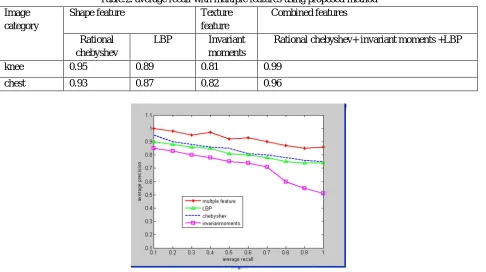
[image:5.612.68.554.398.670.2]It defined as the ratio of same class images retrieve and total medical image in same class. The range of recall value between 0 to 1. If recall value is zero, the average retrieval accuracy is 0%. If recall value is one, the average retrieval accuracy is 100%. Table 2 shows the average recall with different features using proposed.
Table.2. average recall with multiple features using proposed method Image
category
Shape feature Texture feature
Combined features
Rational chebyshev
LBP Invariant moments
Rational chebyshev+ invariant moments +LBP
knee 0.95 0.89 0.81 0.99 chest 0.93 0.87 0.82 0.96
Fig.3. shows that average precision vs. average recall of different feature descriptor
Technology (IJRASET)
from selected database. In CBIR systems, Multiple features is most suitable compare to single features corresponding as shown in fig.3.
VII. EXPERIMENTAL RESULTS
In proposed method, we use the public medical image database. In this database we take 1,000 medical images and divide the images in to 20 classes of 50 images each. These medical images contain human body like knee, tumor, and lung and so on. These images are gray scale level and convert all images in JPG format. Twenty images from database are various regions and choose a query image in CBIR system. After that measuring the precision and recall in table 1.2.
Medical image retrieval of edge following based CBIR systems as shown in fig.5
Fig.4 Image retrieval using edge following based CBIR systems.
In fig.4 show first row of first image can be taken as query image. In the edge following based CBIR system, the images are retrieving based on combined features such as chybheshev, local binary pattern and invariant moments. If combine multiple feature, to get the better performance than the single feature in medical images. The feature such a shape and texture are important role in the proposed technique.
REFERENCES
[1] C. Faloutsos, R. Barber, M. Flickner, J. Hafner, W. Niblack, D. Petkovic, and W. Equitz, “Efficient and Effective Querying by Image Content”, Journal of Intelligent Information Systems, Vol. 3, No. 3/4, pp. 231–262, 1994.
[2] J. R. Smith, and S. F. Chang, “VisualSEEk: a Fully Automated Content-Based Image Query System”, in ACM Multimedia, Boston, MA, 1996.
[3] C. Carson, S. Belongie, H. Greenspan, and J. Malik, “Blobworld: Image Segmentation Using Expectation Maximization and its Application to Image Querying”, IEEE Transactions on Pattern Analysis and Machine Intelligence, Vol. 24, No. 8, pp. 1026–1038, 2002.
[4] T. Huang, S. Mehrotra, and K. Ramchandran, “Multimedia Analysis and Retrieval System (MARS) project”, Proc of 33rd Annual Clinic on Library Application of Data Processing-Digital Image Access and Retrieval, 1996.
[5] J. Bach, C. Fuller, A. Gupta, A. Hampapur, B. Gorowitz, R. Humphrey, R. Jain, and C. Shu, “Virage image search engine: an open framework for image management”, in Proceedings of the SPIE, Storage and Retrieval for Image and Video Databases IV, San Jose, CA, pp. 76-87, 1996.
[6] H. Eidenberger, “Distance measures for MPEG-7-based retrieval”, Proceedings of the 5th ACM SIGMM international workshop on Multimedia information retrieval, pp. 130-137, Berkeley, California, 2003.
[7] Liu, Y., Zhang, D., Lu, G., Ma, W.: A survey of content-based image retrieval with high level semantics. Elsevier Pattern Rec. 40, 262–282 (2007)
[8] Oussalah, M.: Content-Based Image Retrieval: Review of State of Art and Future Directions. In: IEEE Image Processing Theory, Tools & Application, pp. 1– 10. IEEE Press, Sousse (2008)
[9] Chen, Z.: Semantic Research on Content-Based Image Retrieval. In: IEEE International Conference on Multimedia Technology, pp. 1–4. IEEE Press, Ningbo (2010)
[10] Manjunath, B.S., Ohm, J.R., Vasudevan, V.V., Yamada, A.: Color and texture descriptors. IEEE Trans. Circuits Syst. Video Technol. 11(6), 703–715 (2001) [11] Burt, P.J., Adelson, E.H.: The Laplacian pyramid as a compact image code. IEEE Trans. Commun. 31(4), 532–540 (1983).
[12] Mukandan, Ong, Lee. Image analysis by Tchebichef Moments IEEE transactions on Image processing, 10(9):1357-1364,2001. [13] Turner, M.: Texture discrimination by Gabor functions. Biological Cybernetics 55 (1986) 71–82