A Survey on Enhancing Network Lifetime of
Nodes in Wireless Sensor Networks
Tavleen Kaur, Jaspreet Kaur
Department of Computer Science & Engineering
SUSCET, Tangori Mohali, Punjab, India
Abstract—Wireless sensor networks have become an important research area in the field of computers and electronics in the last decade. The original motivation for the development of wireless sensor networks was military applications such as battlefield surveillance. However there are number of other applications of wireless sensor networks such as healthcare monitoring, forest fire detection, environment monitoring, home automation. This paper gives a brief overview of what a wireless sensor network is, its applications, challenges in wireless sensor networks, network lifetime and the techniques for maximizing the network lifetime.
Keywords—Sensor Networks, WSN, Network Lifetime, Aggregation, Mobile Relays, TDMA, LEACH
I. INTRODUCTION
[image:2.612.334.562.362.506.2]A wireless sensor network (WSN) consists of a large number of spatially distributed sensor nodes which are cheap, low power, limited in memory, energy constrained due to their small size and work cooperatively to monitor physical or environmental conditions such as temperature, sound, vibration, pressure, motion or pollutants, at different locations. A sensor node performs three basic functions-sensing, processing and communication. Until wireless sensor networks became popular, the wired sensor networks were being used for the same purpose but due to high cost of installation, termination, maintenance, upgradation and infeasibility of wired sensor networks in hostile and remote locations, wireless sensor networks became a good alternative [1]. Since the sensor nodes in a wireless sensor network are randomly deployed so the positions of the sensor nodes need not to be predetermined. Figure 1. shows a typical wireless sensor network.
Fig. 1. A wireless sensor network [3]
Sensor nodes consist of one or more sensors, a processor, memory, a power supply, a radio, and an actuator [5]. The components of a sensor node are shown in Figure 2. Due to deployment of the sensor nodes in difficult-to-access locations, a radio is implemented for wireless communication to transfer the data to a base station (e.g. a PC, mobile phone, laptop). Battery is the main power source in a sensor node.
Sink
Remote Controller
Sensor Node User
Fig. 2. Components of a wireless sensor node [4]
There are two types of WSNs: structured and unstructured. In a structured WSN, all or some of the sensor nodes are deployed in a planned manner. A pre-planned deployment means that the nodes are placed at predetermined locations. The advantage of a structured network is lower network maintenance and management cost. In an unstructured WSN, the sensor nodes are deployed in an ad hoc manner into the field. An ad hoc deployment means that the nodes are placed at random locations. After the placement of the nodes in an unstructured WSN, the network is left unattended to perform monitoring and reporting functions. The disadvantages of an unstructured WSN are higher network maintenance and difficult failure detection since there are so many nodes.
Both wireless ad hoc networks and wireless sensor networks consist of wireless nodes but WSNs are different in following ways [2]:
Number of nodes can be large in quantity. Sensor nodes are densely deployed. Sensor nodes are prone to failure. Frequent topology changes.
Broadcast communication paradigm.
Limited power, processing and power capabilities. Absence of unique global identification per node.
II. APPLICATIONS OF WIRELESS SENSOR NETWORKS
Sensor networks can be used for detecting and preventing terrorist attacks. These are used for detecting enemy movements, equipments, ammunition and explosions etc. [1].
B. Environmental Applications
WSNs can be used to detect and monitor environmental changes in plains, forests, oceans, flood-levels, agriculture etc. Some of the major areas are listed below.
1) Air Quality Monitoring
WSNs are used for measuring the degree of pollution in the air frequently in order to safeguard people and the environment from any kind of damages due to air pollution [7].
2) Air Pollution Monitoring
Wireless sensor networks have been deployed in several cities (Stockholm, London or Brisbane) to monitor the concentration of dangerous gases for citizens [7].
3) Landslide Detection
A landslide detection system uses a wireless sensor network for detecting the slight movements of soil and changes in various parameters that may occur before or during a landslide. Through the data gathered it may be possible to know the occurrence of landslides long before it actually happens [7].
4) Forest Fire Detection
Wireless sensor networks can also be deployed in forests to detect when a fire has started. This will help the fire brigade to know when a fire has started and how it is spreading [7].
C. Health Applications
WSNs can be used for tracking and monitoring patients and doctors inside a hospital. Sensors are implanted in the human body to monitor medical problems like cancer and help patients maintain their health [2].
Power Source
Memory GPS
Sensors
Processor
Smart sensor nodes and actuators can be buried in appliances, such as vacuum cleaners, micro-wave ovens, refrigerators etc. because these sensor nodes inside the domestic devices can interact with each other and with the external network via the internet or satellite [2]. They allow end users to manage home devices locally and remotely more easily.
E. Water/Waste Water Monitoring
Monitoring the quality and level of water includes many activities such as checking the quality of underground or surface water and ensuring a country’s water infrastructure for the benefit of both human and animal [7].
F. Natural Disaster Prevention
Wireless sensor networks can effectively act to prevent the consequences of natural disasters, like floods. Wireless nodes have successfully been deployed in rivers where changes of the water levels have to be monitored in real time [7].
III. CHALLENGES IN WIRELESS SENSOR NETWORKS
The main challenges of wireless sensor networks are:
A. Power Management
A wireless sensor network is composed of a number of sensor nodes that are randomly deployed in hostile environments or remote locations. The major limitation of WSNs is the low energy capacities of the sensors. Since the sensors are usually deployed in hostile environments in large quantities, it is difficult or impossible to replace or recharge the batteries. So WSNs are limited in power.
B. Localization
Determining the location of sensors is a challenge. Since the sensors are randomly deployed and in large quantities so it is difficult to determine their location. A feasible solution to this problem is to allow some nodes to have location information at all times and allow other nodes to infer their location by exchanging information with them [10].
C. Routing
Routing techniques are required for sending data between sensor nodes and the base stations for communication. Different routing protocols are proposed for wireless sensor network. These protocols are classified according to different parameters.
D. Deployment Techniques
Node deployment techniques in wireless sensor networks affect the complexity of problem and also the lifetime of network. During the operation of WSN new nodes may be added or existing nodes may be replaced from the network which changes the node location and overall topology. Node deployments are done according to the following metrics: coverage, energy computation and message transfer delay [10].
E. Security
Since wireless networks are deployed in extreme environmental conditions and may be prone to enemy attacks. So securing WSNs is an important challenge [5].
F. Self-Organization
Due to the random deployment of sensor nodes in human inaccessible areas such as battlefield surveillance, sensor networks must be self-organizing. Furthermore, nodes may fail due to limitation of energy, physical destruction etc. and new nodes may need to join the network so the WSNs must undergo continuous reconfiguration in order to function properly.
G. Scalability
The senor networks should be capable of scaling to a large number of sensor nodes.
H. Fault Tolerance
the Poisson distribution to capture the probability of not having a failure within the time interval (0,t):
)
(
)
(
t
t
R
k
k (1)Where
kand t are the failure rate of sensor node k and the time period, respectively.I. Density and Network Size
The effective range of the sensors defines the coverage area of a sensor node. The density of the nodes indicates the degree of coverage of an area of interest by sensor nodes. The network size affects reliability, accuracy, and data processing algorithms. The density can range from a few sensor nodes to a hundred in a region, which can be less than 10m in diameter. The density μ is calculated as in [12]:
A
R
N
R
)
(
)
/
(
2
(2)
Where N is the scattered sensor nodes in region A, and R is the radio transmission range. μ(R) gives the number of nodes within the transmission radius of each node in region A.
IV. NETWORK LIFETIME
The network lifetime may be defined as the time until the first sensor in the WSN dies [9] .Sensor lifetime [8] is the amount of time until the sensor runs out of energy. This is given by
k k
E
E
time
unit
per
n
consumptio
Energy
energy
Initial
T
0(3)
The network lifetime is given by
k
T
T
min
(4)
The Parameters [13] to be considered for maximizing network lifetime are:
Area to be monitored by wireless sensor network Aggregated data rate
Sensing range Transmission range
Mobility of cluster nodes rate allocation Topology control
Power consumed by various components of the sensor in a variety of operating modes, i.e. sleep mode, standby mode, active sensing mode, transmitting and receiving.
Required time of operation of network Lifetime improvement
V. TECHNIQUES FOR MAXIMIZING THE NETWORK LIFETIME
The main challenge in a WSN is to maximize the network lifetime. Some of the techniques for maximizing the network lifetime are:
A. Aggregation
In a WSN the nodes monitor the environment by collecting information from their surroundings, and work cooperatively to send the data to a base station. It is possible that the nodes might carry redundant data due to their physical closeness which ultimately leads to increased energy consumption of the nodes. So to remove the redundant data and reduce the traffic, it is necessary to aggregate the data at the intermediate nodes. Data aggregation [17] is a process of aggregating the sensor data using aggregation approaches. The main goal of data aggregation algorithms is to gather and aggregate data in an energy efficient manner so that the network lifetime is enhanced. Some of the data aggregation algorithms used are centralized approach, LEACH (low energy adaptive clustering hierarchy), TAG (Tiny Aggregation) etc. The general architecture of a data aggregation algorithm is shown in Figure 3.
Sensor data collected from sensor node
Fig. 3. General architecture of a data aggregation algorithm [17]
B. Clustering
Clustering is another technique for the efficient utilization of the limited energy resources of the sensor nodes and extending the lifetime of the sensor network. Since physically-close nodes have redundant data so the overall description of the events in a certain region is sufficient than the individual node data. These physically-close nodes can be grouped into a cluster. In every cluster a sensor node is elected to be the leader node (called cluster-head) of that cluster. All the sensor nodes (called regular nodes) present in the same cluster send their sensed data to their respective cluster-heads using single-hop or multi-hop communication. After that it is the responsibility of the cluster-head to transmit data to the base station. A common example of such a clustering algorithm is LEACH (low energy adaptive clustering hierarchy). In LEACH, [14] the entire network is divided into clusters, with each cluster having a Cluster Head (CH) and non-Cluster Head (non-CH) nodes. Non-CH nodes join the clusters of CHs closest to themselves. After receiving all the joining requests, the CH determines a TDMA (Time Division Multiple Access) schedule and sends it to its nodes. Each non-CH sends its data to the CH in its allotted time slot by means of a DSSS code which is unique to the cluster. The CH then aggregates the data from the nodes in its cluster and sends it to the end user or base station. When not transmitting, the cluster nodes are in sleep state, thereby reducing the energy consumption from idle listening The LEACH operation is divided into rounds, with a round consisting of a number of frames. Each CH transmits to the BS once per frame, and thereby each node transmits to its CH once per frame in its allotted time slot. In each round, a new set of CHs are chosen, thereby keeping the average energy consumption in the network constant.
C. Topology Control
The topology of a sensor network is dynamic, decentralized, ever changing and the sensor nodes may move around arbitrarily. Topology control [6] is the reorganization and management of node parameters and modes of operation from time to time to modify the topology of the network with the goal of extending its
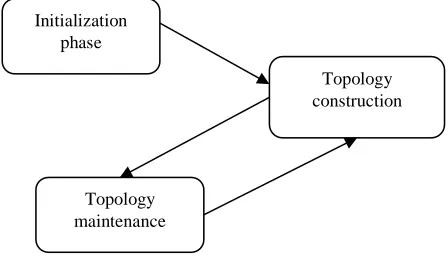
[image:6.612.330.554.193.326.2]lifetime while preserving important characteristics, such as network and sensing connectivity and coverage. The main aim of topology control in this domain is to save energy, reduce interference between nodes and extend lifetime of the network. Topology control is an iterative process as shown in Figure 4.
Fig. 4. Topology control process
First, there is an initialization phase. In this phase, nodes discover themselves and use their maximum transmission power to build the initial topology. After this initialization phase, the second phase builds a new (reduced) topology. This phase is called topology construction. There are many ways to perform topology construction:
Change the transmission range of the nodes. Turn off nodes from the network.
Create a communication backbone. Clustering
Adding new nodes to the network to preserve connectivity.
There are four states of a sensor node’s radio: transmit, receive, idle, or sleep. In the idle state, the transceiver neither transmits nor receives, and in the sleep mode, the radio is turned off. In order to save energy, the nodes are set to the sleep mode if they are not needed because nodes consume less energy in sleep mode and are woken up when required. This is called scheduling. Scheduling [10] is when to activate a sensor node and when to keep it idle. One approach of scheduling is to divide all sensors into disjoint sensor cover, each sensor cover need to satisfy the coverage constraints. Only one sensor cover is active at a time to provide the functionality and the remaining sensors are in the sleeping mode. Once the active sensor cover runs out of energy then another sensor cover is selected to enter the active mode and provide the functionality and remaining sensor nodes are in the sleeping mode. The network activity can be divided in rounds, and at the beginning of each round active sensor nodes are decided.
E. Routing
A sensor network monitors the information from surroundings and transmits the data to the base station. Since transmissions consume the majority of the energy available to a sensor node it becomes important to limit their usage while maintaining reliable communication with the sink node. Routing in WSNs is very challenging due to the following reasons [15]: first, it is not possible to build global addressing and routing algorithms exactly as in typical communication networks. Second, the data flows from multiple sources to the sink. Third, the generated data may be redundant due to the physical closeness of the neighboring sensor nodes. Last, the sensor nodes are tightly constrained in terms of transmission power, on-board energy, processing capacity and storage. Routing protocols for wireless sensor networks must take into consideration metrics such as reliability, throughput, latency, storage requirement, and overhead and network lifetime.
F. Mobile Relays
Wireless sensor networks are composed of a few resource rich (in terms of processing, memory and energy) mobile nodes and a large number of simple static nodes. These mobile nodes act as mobile relays which transmit the data for all the static nodes in the network. Suppose that the
the lifetime of these two nodes is T, while other sensors have lifetime much longer than T. So, mobile nodes can be used for relaying the data of such bottleneck nodes in the network to the sink. Introducing one mobile relay could increase the lifetime of the sensor networks by a factor of four [16].
VI. CONCLUSION
Wireless sensor networks have emerged as an attractive research field. Unlike other networks, WSNs are designed for specific applications some of them are discussed in this paper. In this paper we surveyed about wireless sensor network, its applications, challenges in WSNs, network lifetime and some techniques for maximizing the network lifetime. Other potential research areas in the wireless sensor networks which can be taken up are self-configuration, fault-tolerance, adaptation, flexibility, energy efficiency, efficient protocol design and operation, scalability and heterogeneity, security, architectural issues etc.
REFERENCES
[1] Eiko Yoneki and Jean Bacon, ’’A survey of Wireless Sensor Network technologies: research trends and middleware’s role”, Univ. of Cambridge Computer Laboratory, Cambridge CB3 0FD, United Kingdom, Tech. Rep., Sept. 2005.
[2] I.F. Akyildiz, W. Su*, Y. Sankarasubramaniam, E. Cayirci, ”Wireless sensor networks: a survey”,
Computer Networks, vol. 38, no.4, pp. 393-422, March 2002, Elsevier.
[3] Giuseppe Anastasi, Marco Conti, Mario Di Francesco, Andrea Passarella”, Energy conservation in wireless sensor networks: A survey”,Ad Hoc Networks,vol. 7, no. 3, pp. 537-568, May 2009, Elsevier.
[4] [Online]. Available: https://www.google.co.in/
[5] Jennifer Yick, Biswanth Mukherjee, Dipak Ghosal, “Wireless sensor network survey”, Computer Networks, vol. 52, no. 12, pp. 2292–2330, 2008, Elsevier.
[6] Regis Anne. W, ”A Survey On The Approaches to Maximize Network Lifetime Of Wireless Sensor Networks”, Karunya University, Coimbatore.
[9] Y. Yun and Y. Xia, “Maximizing the Lifetime of Wireless Sensor Networks with Mobile Sink in Delay-Tolerant Applications”, IEEE Transactions on Mobile Computing, vol. 9, pp. 1308-1318, 2010.
[10] Deepika Thakral, ”Maximizing Network Lifetime of Wireless Sensor Network-A Review”,IJRASET , vol. 1, no. IV, pp. 81-84, Nov. 2013.
[11]G. Hoblos, M. Staroswiecki, A. Aitouche, “Optimal design of fault tolerant sensor networks”, IEEE International Conference on Control Applications, Anchorage, AK,pp. 467–472, Sept. 2000.
[12] Bulusu, N. et al. Self-Configuration Localization Systems. PhD Dissertation, UCLA, 2002.
[13]J. Wu and S. Yang, “Coverage and Connectivity in Sensor Networks with Adjustable Ranges”,
International Workshop on Mobile and Wireless Networking (MWN), Aug. 2004.
[14]Deepa Padmanabhan, Fabrice Labeau,” Effect of Location on the Latency in Cluster-Based WSNs”, in Sensors, Nov.2013, doi: 10.1109/ICSENS.2013.6688558.978-1-4673-4642-9/13,IEEE 2013.
[15]José Cecílio, Eudisley Anjos, João Costa, Pedro Furtado,” Survey on Data Routing in WSN”, University of Coimbra, DEI/CISUC.
[16] W. Wang, V. Srinivasan, and K.-C. Chua, “Using mobile relays to prolong the lifetime of wireless sensor networks”,in MobiCom ’05, pp. 270–283, 2005. [17]Nandini. S. Patil, Prof. P. R. Patil,” Data Aggregation
![Fig. 1. A wireless sensor network [3]](https://thumb-us.123doks.com/thumbv2/123dok_us/8588318.863086/2.612.334.562.362.506/fig-a-wireless-sensor-network.webp)
![Fig. 2. Components of a wireless sensor node [4]](https://thumb-us.123doks.com/thumbv2/123dok_us/8588318.863086/3.612.45.288.101.292/fig-components-wireless-sensor-node.webp)