Distributed Operating System: An Overview
Deepika Choudhary
#1, Anjali Lather
*2, Sandeep Yadav
#3 1,2,3Computer Science and Engineering, Dronacharya College of Engineering, Gurgaon
Abstract—Distributed operating systems have many aspects in common with centralized ones, but they also differ in certain ways. As distributed computing becomes more widespread, both in high-energy physics and in other applications, centralized operating systems will gradually give way to the distributed ones. This paper is intended as an introduction to distributed operating systems.
Keywords—Transparency, reliability, scalability, flexibility, security
I. INTRODUCTION
As distributed computing becomes more widespread, both in high-energy physics and in other applications, centralized operating systems will gradually give way to the distributed ones. Distributed operating systems have many points in common with centralized ones, but they also have many distinctive features of their own. Distributed Operating System is a model where distributed applications are running on multiple computers linked by communications. A distributed operating system is an extension of the network operating system that supports higher levels of communication and integration of the machines on the network. This system looks to its users like an ordinary centralized operating system but runs on multiple, independent central processing units (CPUs). The key concept here is transparency. Another way of expressing the same idea is to say that the user views the system as a “virtual uniprocessor” not as a collection of distinct machines.
II. HISTORY
Research and experimentation efforts began in earnest in the 1970s and continued through 1990s, with focused interest peaking in the late 1980s. A number of distributed operating systems were introduced during this period, however, very few of these implementations achieved even modest commercial success.
A. 1975-1995
B. 1995 - Today
During this period cluster or grid architecture was increasingly dominant. The Special node machines eschewed in favour of COTS technologies. Google took this to the extreme i.e. thousands of nodes and cluster. The SETI@Home started in May 1999. It analysed the radio signals that were being collected by the Arecibo Radio Telescope in Puerto Rico.
III. DESIGN ISSUES
The distributed systems have to be designed carefully, since there are many pitfalls for the unwary. A key issue is transparency i.e. hiding all the distribution from the users and from the application programs. Another issue is flexibility. Other important issues are reliability, performance, scalability, security and failure handling.
A. Transparency
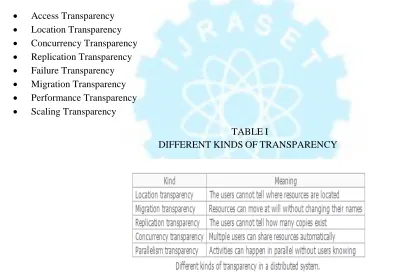
The implementation of the distributed system is very complex, as a number of issues have to be considered to achieve its final objective. The complexities should not worry the user of the distributed system from using it i.e., the complexities should be hidden from the user who uses the distributed system. This property of the distributed system is called its transparency. There are different kinds of transparencies that the distributed system has to incorporate. The following are the different transparencies encountered in the distributed systems:
Access Transparency
Location Transparency
Concurrency Transparency
Replication Transparency
Failure Transparency
Migration Transparency
Performance Transparency
[image:3.612.58.467.319.599.2] Scaling Transparency
TABLE I
DIFFERENT KINDS OF TRANSPARENCY
B. Flexibility
Flexibility in a distributed operating system is enhanced through the modular and characteristics of the distributed OS, and by providing a richer set of higher-level services. As the system is very flexible, it is very easy to install, implement and debug new services. Each service is equally accessible to every client remote or local.
C. Reliability
occurrence of faults. These proactive measures can be in the form of transactions, replication and backups. Fault tolerance is the ability of a system to continue operation in the presence of a fault.
D. Security
Security for information resources in distributed system have 3 components:
a) Confidentiality: protection against disclosure to unauthorized individuals.
b) Integrity: protection against alteration/corruption
c) Availability: protection against interference with the means to access the resources.
The challenge is to send sensitive information over Internet in a secure manner and to identify a remote user or other agent correctly.
E. Scalability
The concept of scalability refers to the ability of a system to continuously evolve in order to support a growing amount of tasks. A system is described as scalable if it remains effective when there is a significant increase in the number of resources and the number of users.
F. Failure Handling
Failures in a distributed system are partial i.e. some components fail while others can function. That is the reason why handling the failures are difficult. Failure handling includes:
a) Detecting failures:to manage the presence of failures cannot be detected but may be suspected. b) Masking failures:hiding failure not guaranteed in the worst case.
c) Concurrency:Where applications/services process concurrency, it will effect a conflict in operations with one another and produce inconsistence results. Each resource must be designed to be safe in a concurrent environment.
IV. ADVANTAGES
Various advantages of the distributed operating system are as follows:
a) Cost: Better price / performance as long as everyday hardware is used for the component computers –Better use of existing hardware
b) Performance:By using the combined processing and storage capacity of many nodes, performance levels can be reached that are out of the scope of centralised machines
c) Scalability: Resources such as processing and storage capacity can be increased incrementally
d) Reliability:The important advantage of distributed computing system is reliability. It is more reliable than a single system. If one machine from system crashes, the rest of the computers remain unaffected and the system can survive as a whole.
e) Incremental Growth:The second advantage is that if there is a need of 10 per cent more computing power, one should just add 10 per cent more processors. System architecture is crucial to the type of system growth, however, since it is hard to give each user of a personal computer another 10 per cent
TABLE II
ADVANTAGES OF DISTRIBUTED SYSTEM
V. DISADVANTAGES
The various disadvantages of the distributed operating system are as follows:
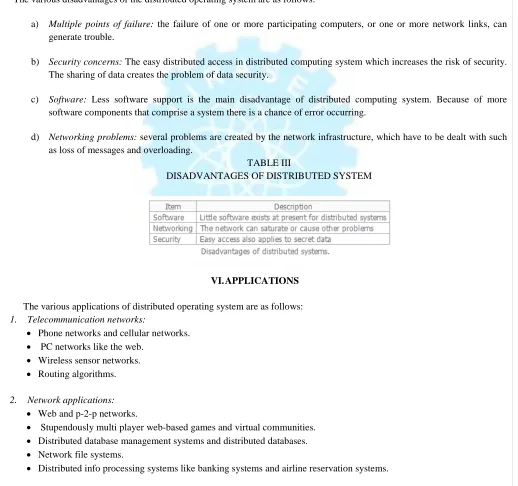
a) Multiple points of failure:the failure of one or more participating computers, or one or more network links, can generate trouble.
b) Security concerns:The easy distributed access in distributed computing system which increases the risk of security. The sharing of data creates the problem of data security.
c) Software: Less software support is the main disadvantage of distributed computing system. Because of more software components that comprise a system there is a chance of error occurring.
d) Networking problems:several problems are created by the network infrastructure, which have to be dealt with such as loss of messages and overloading.
TABLE III
DISADVANTAGES OF DISTRIBUTED SYSTEM
VI.APPLICATIONS
The various applications of distributed operating system are as follows:
1. Telecommunication networks:
Phone networks and cellular networks.
PC networks like the web.
Wireless sensor networks.
Routing algorithms.
2. Network applications:
Web and p-2-p networks.
Stupendously multi player web-based games and virtual communities.
Distributed database management systems and distributed databases.
Network file systems.
3. Real time process control :
Aircraft control systems.
Business control systems.
4. Parallel computation:
Systematic computing, including cluster computing and grid computing and varied volunteer computing projects; see the list of distributed computing projects
.Distributed rendering in PC graphics.
VII. CONCLUSIONS
The concept of distributed computing is the most efficient way to achieve the optimization. A distributed system consists of multiple computers that communicate through a computer network. It deals with hardware and software systems that contain more than one processing / storage and run in concurrently. Thus distributed computing has the chance to lead into new age in terms of computer paradigm, resources sharing pattern and online collaboration. Grid computing and cloud computing are form of distributed computing.
REFERENCES
[1] http://en.wikipedia.org/wiki/Distributed_operating_system [2] Distributed Operating Systems By Andrew S. Tanenbaum [3] Distributed Systems: Concepts and Design, 4/e By Coulouris
[4] http://repo.hackerzvoice.net/depot_madchat/ebooks/Distribute_OS-Tanenbaum.pdf [5] http://dare.ubvu.vu.nl/bitstream/handle/1871/2601/11027.pdf?sequence=1 [6] http://student.fiit.stuba.sk/dos/lecture1.pdf
[7] https://www.google.co.in/url?sa=t&rct=j&q=&esrc=s&source=web&cd=3&cad=rja&uact=8&ved=0CCwQFjAC&url=http%3A%2F%2Fwww.researchg ate.net%2Fpublication%2F2944262_Research_Issues_In_Distributed_Operating_Systems%2Ffile%2Fd912f50acf6942ad32.pdf&ei=nv0vVIfHBI3guQT CsIHYDg&usg=AFQjCNF0bhCKVfb3HL81UN87uozEG8LUdA&sig2=lmlocExQWdMXQrIU6-9sQQ
[8] http://www.slideshare.net/alokeparnachoudhury/distributed-computing-35982508
[9] http://www.e-reading.me/chapter.php/143358/3/Tanenbaum_-_Distributed_operating_systems.html [10] http://staff.um.edu.mt/csta1/courses/lectures/csm202/os17.html