Technology (IJRASET)
Image mosaic based on 3D environment using
phase correlation and Harris operator
Akshay Wagaji Gawande1, Archana H.charakhawala2
1
Student. Electronic and Telecommunication (M.Tech), Faculty. Electronic and Telecommunication
2
Priyadarshni College of Engineering, Nagpur, Maharashtra
Abstract- presently the image mosaicking technique has become the favored lighting tricks analysis. Conjointly image mosaic has been expeditiously and exactly applied to areas like trade, military, and health care. Technique of image mosaic for restoring pictures with larger visual angle and a lot of reality plays an important role in detective work a lot of data from the image. In fact, to the limit of objective conditions, i.e. equipment's or weather, pictures are sometimes unable to mirror the total scene that makes it tougher for the any process of these pictures. The overall task of image mosaic is to make the pictures in means of their positioning series that overlaps in area. Compared with single pictures, scene pictures inbuilt this fashion are sometimes of upper resolution and bigger vision. Image mosaic aims to mix a collection of pictures, unremarkably overlapped, to make one image. Section correlation are used for image mosaicking and Harris operator are used for corner detection.
Keywords— Mosaic; Harris operator; section correlation; corner;
I. INTRODUCTION
Algorithms for process pictures and mosaic them into seamless photo-mosaics are among the oldest and most generally employed in pc vision. Frame-rate image alignment is employed in each TV camera that has AN “image stabilization” feature. Image sewing algorithms produce higher resolution photo-mosaics accustomed manufacture today’s digital maps and satellite photos. They conjointly return bundled with most digital cameras presently being sold, and may be accustomed produce stunning ultra-wide-angle panoramas. In day to day life and work generally there's a desire for wide angle and high resolution bird's-eye pictures that the normal camera instrumentality cannot reach. However, it's not possible as so much because the problems like whole scene, skilled equipment, high value of maintenance convenient for operation, lack of technical personnel and ineptness of general uses are involved, and therefore the employment of image mosaicking techniques has been imply In this work we've used technique} which mixes each specifically the feature-based technique and frequency-domain method for image mosaicking. We’ve used Harris corner detection technique as a feature based mostly} technique and Fourier rework based cross correlation or section correlation technique because the frequency domain technique. Image mosaic may be a technique accustomed sew variety of pictures taken consecutive once image capturing devices isn't capable to accommodate among one frame. The image taken by traditional camera may be accustomed produce a bigger field of read victimization a picture mosaicking program.
We can use the varied step for image mosaicking they're fallow.
A. Take a sequence of pictures from a similar position Rotate the Camera concerning its optical center
B. Reckon transformation between second image and initial victimization Harris operator and section correlation rework. C. The second image to overlap with the primary mix the 2 along to form a mosaic.
D. If there are a lot of pictures, repeat
II. REVIEWONLITERATURE
The original image alignment algorithmic program was the Lucas-Kanade algorithmic program. The goal of Lucas- Kanade is to align a templet image to associate degree input image, wherever could be a column vector containing the peel coordinates. If the Lucas-Kanade algorithmic program is being employed to calculate optical flow or to trace a picture patch from time to time, the templet is associate degree extracted sub-region (a window, maybe) of the image [1].
Technology (IJRASET)
An early example of a wide used image registration algorithmic program is that the patch-based translational alignment (optical flow) technique developed by screenwriter and Kanade [1]. Variants of this algorithmic program square measure utilized in most motion-compensated video compression schemes like MPEG [2]. Similar constant quantity motion estimation algorithms have found a large kind of applications, as well as video report [3][4], video stabilization [5], and video compression [6][7]. Additional subtle image registration algorithms have additionally been developed for medical imaging and remote sensing. Within the photogrammetric community, additional manually intensive ways supported surveyed communication system points or manually registered tie points have long been accustomed register aerial photos into large-scale photo-mosaics [8]. One amongst the key advances during this community was the event of bundle adjustment algorithms that would at the same time solve for the locations of all of the camera positions, so yielding globally consistent solutions [9]. One amongst the continual issues in making photo-mosaics is that the elimination of visible seams, that a spread of techniques are developed over the years [10]-[11].
In film photography, special cameras were developed at the flip of the century to require ultra-wide-angle panoramas, usually by exposing the film through a vertical slit because the camera turned on its axis [12]. Within the mid-1990s, image alignment techniques. Were started being applied to the development of camera lens seamless panoramas from regular hand-held cameras [13]-[14]. newer add this space has addressed the requirement to calculate globally consistent alignments [15]-[16], the removal of “ghosts” thanks to optical phenomenon and object movement [17][18], and coping with varied exposures [19]. (An assortment of a number of these papers is found in [20].) These techniques have spawned an outsized variety of business sewing product [21][22], that reviews and comparison is found on the net.
While most of the higher than techniques work by directly minimizing pixel-to-pixel dissimilarities, a unique category of algorithms works by extracting a thin set of options then matching these to every different [23]. Feature-based approaches have the advantage of being additional strong against scene movement and square measure doubtless quicker, if enforced the proper manner. Their biggest advantage, however, is that the ability to “recognize panoramas,” i.e., to mechanically discover the nearness (overlap) relationships among associate degree unordered set of pictures, that makes them ideally fitted to absolutely machine-driven sewing of panoramas taken by casual users [24].
Program for image registration. SIFT algorithmic program is obtained by judgment the feature points of native extreme, combined with neighborhood info to explain the feature points to make a feature vector, so as to create the matching relationship between the feature points.
According to the comparison and analysis higher than, aiming at the mosaic between pictures that have larger scale distinction, we have a tendency to try and synthesize the benefits each in frequency dispose and registration with options, a brand new strong methodology combined the phase-correlation and Harris corner is planned. We will get the issue of translation and zoom by cross-power spectrum so as to optimize the detection of Harris. The feature detection then is restricted within the overlapped space to avoid the waste of resource in immaterial space after we do the search work. Additional significantly, this methodology will eliminate the non-adaptive weakness thanks to scale modification. It’s superior to SIFT and original Harris algorithmic program in terms of the calculation speed and pertinence.
III. PROBLEMDEFINITION
By keeping following things in mind as an objective, we are expecting best results from this approach of mosaicking.
A. To propose a better mosaicking method, which can stitch scattered images together of the same scene (or target), so as to restore an image (or target) without losing a prior information in it.
B. To increase accuracy and reduce the time to mosaic the images which will shows better efficiency as compared to other mosaicking techniques
IV. METHODOLOGY
Technology (IJRASET)
dimensions distinction between the pictures may enlarge from one.8 to 4.7 and may eventually acquire a transparent and stable mosaic result.
The interpretation, scale and rotation within the accessible set of pictures are handled within the following means. At the start part correlation algorithmic rule is employed to calculate the cross-power spectrum for registration of pictures and is employed to induce the interpretation issue. For pictures that have relative relationships in location and scale, we will conjointly get the zoom issue and rotation angle through a series of coordination remodel.
A. Corners as Interest Points
Several applications need relating 2 or a lot of pictures so as to extract info from them. As an example, if 2 consecutive frames during a video sequence taken from a moving camera may be connected, it's potential to extract info concerning the depth of objects within the atmosphere and also the speed of the camera. The brute force methodology of comparison each element within the 2 pictures is computationally prohibitory for the bulk of applications. Intuitively, one will image relating 2 pictures by matching solely locations within the image that are in how fascinating. Such purposes are remarked as interest points associate degreed are situated mistreatment an interest point detector. Finding a relationship between pictures is then performed mistreatment solely these points. This drastically reduces the specified computation time. Many alternative interest purpose detectors are planned with a large vary of definitions for what points in a picture are fascinating. Some detectors notice points of high native symmetry; others notice areas of extremely variable texture, whereas others find corner points. Corner points are fascinating as they're fashioned from 2 or a lot of edges and edges typically outline the boundary between 2 completely different objects or elements of an equivalent object. Several corner detectors are developed and this web site investigates a number of them. A lot of necessary ones.
B. Requirements of a Corner Detector
It is fascinating for a corner detector to satisfvariety of criteria:
1) All "true corners" ought to be detected. 2) No "false corners" ought to be detected. 3) Corner points ought to be localized.
4) Detector ought to have a high repeatability rate (good stability). 5) Detector ought to be sturdy with relevance noise.
6) Detector ought to be computationally economical.
The detection of all true corners with no false corners is application (interpretation) dependent since there's no well outlined definition of a grayscale corner. However, in several pictures the corners area unit intuitively clear and such pictures may be wont to assess the performance of various corner detector.
C. Corner Detection Algorithm
There are many corner detection algorithms that are quite well-liked as they're traditionally important, wide used, and a lot of appropriate for a specific application (i.e. real-time). additionally, of these detectors mentioned here are often thought of interest purpose within the component i.e. corner detectors as they assign a live of cornerness to any or all pixels in a picture. The principally and usually corner detectors are make up this interest purpose class, though however they calculate the cornerness live varies considerably. This is often in distinction to corner detectors that realize corners by tracing the contours of objects and determined the native maxima of absolute curvature or approaches mistreatment morphological operators.
The following corner detection algorithms ar thought of here: 1) Moravec (1977)
2) Harris/Plessey (1988)
3) Trajkovic and. Hedley (4-Neighbours) (1998) 4) Trajkovic and Hedley (8-Neighbours) (1998)
Technology (IJRASET)
could be a cornerness map. Since for every component within the input image the corner operator is applied for to get a cornerness live, the cornerness map has identical dimensions because the input image and may be thought of as a processed version of the input image.
The Harris corner detector uses each x and y gradients so as to see whether or not a component could be a corner or not. To be a corner, then there has got to be important amendment in each directions. However, the Harris corner formula calculates the probability. That a component could be a corner from summing all the encircling gradients Gx and Gy around of the component and performing arts some calculations to see its probability of being a corner.
In order to extract the corners, the Harris corner detector wants a five x five window so as to calculate a score for the component at location (2, 2). The window size demand comes from the very fact that we want to calculate the encircling gradients, and to calculate those gradients we want the pixels around those.
V. HARRIS CORNER ALGORITHMS
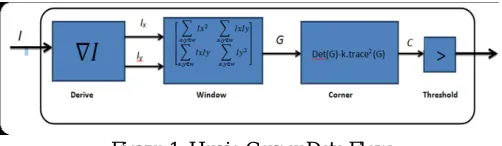
The Harris corner algorithm use to detect the both x and y gradients in order to determine whether a pixel is a corner or not. To be a corner, then there has to be significant change in both directions. However, the Harris corner algorithm calculated the similarly that a pixel is a corner from summing all the surrounding gradients around a pixel and some calculations to
[image:5.612.181.432.327.400.2]Determine its likelihood of being a corner. In order to extract the corners, the Harris corner detector needs a 5 x 5 window in order to compute a score for the pixel at location (2, 2). The window size requirement comes from the fact that we need to calculate the surrounding gradients, and to calculate those gradients we need the pixels around those.
Figure 1. Harris-Corner Data Flow The following four steps are required to process the image:
Convolve image with vertical and horizontal differential operator to obtain gradients Gx and Gy of the image. Generate the three summations necessary from Ix and Iy to from the Harris 2x2 Window (see diagram).
To compute the trace and determinant to come up with a value for the already occurs that the current pixel is a corner. Compare with a threshold value to determine. Its corner or not. If it is corner, then output a “1” attached at the end of the 8-bit pixel value written to memory, so then an overlay can read this 8-bit and mark that pixel as a corner.
A. Feature Extraction Method
Technology (IJRASET)
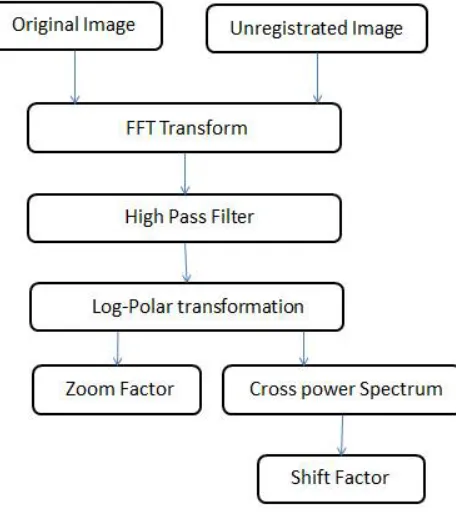
Figure 2. Flowchart to compute the factors Step 1: Get the shift and zoom factors with the help of phase correlation calculation.
Step 2: Modulate the unregistered image according to the zoom factor obtained from step 1 to get a couple of images with the same size
Step 3: Ascertain the ROI (Region of Interest) between the images.
Step 4: before the Preprocess image. The edge detection also can reduce the search area and can greatly cut the matching-time down. Using the Template
Step 3: the ROI (Region of Interest) between the images.
Step 4: Preprocess image before other works. The edge detection also can reduce the search area and can greatly cut the matching-time down
VI. IMPLEMENTATION
A. Phase correlation algorithm
This algorithm is uses to finding the cross-power spectrum to register images and it’s also used to get the translation factor initially. Suppose we consider two images I1 and I2, and the translation between those two is given following
The Fourier transformation
F1 and F2 are the Fourier transformation of I1 and I2. The cross-power spectrum is:
B. Feature Extraction of Harris corner
Technology (IJRASET)
VII.EXPERIMENTAL RESULT
A. Experimental Result
Usually only four corresponding points in any two images are required to estimate the homographic relating the two points. In practice, a large number of points are detected on the two images and correspondences are solved. In this project, Harris corner detector is used to detect the corners. For each corner detected in one image, its corresponding neighborhood is searched in the other image. Those corners in second image are labeled as candidate matches whose neighborhood is similar to the corner detected in the first image. Hence, corresponding to each corner in the first image there could be multiple candidate matches. The correlation coefficient between the neighborhood of corners in the first image and second image is taken to the measure of similarity. In the project, we load three distinct images one by one. The image files are place in the Images folder.
The following four steps are required to process the image:
1) Get the images for mosaic. Convolve image with horizontal and vertical differential operator to obtain gradients Gx and Gy.
2) Generate the three summations necessary from Ix and Iy to from the Harris 2x2 Window (see diagram). 3) Compute the determinant and trace to come up with a value for the likelihood that the current pixel is a corner.
4) Compare with a threshold to determine if it is a corner. If it is, output a “1” attached at the end of the 8-bit pixel value written to memory, so then an overlay can read this bit and mark that pixel as a corner.
The scaling and translation relationship is performed according to the correlation method known as phase-correlation. Then the image has to be adjusted and the ROI scope of for calculating the similarity is kept limited as per the derived factors. At last the feature points are used to detect and match in the region of interest, based on the Harris corner. We load three distinct images one by one. The image files are place in the Images folder
VII.I. Window for loading images Step1.
Technology (IJRASET)
Step2.
Loading second image
Step3. Loading third image
Set of tentative correspondences (pairs of matched points between two images) are shown below.
Technology (IJRASET)
Matching points between two images 2 and 3 Step4. Output after mosaicking process Mosaic image.
VIII. CONCLUSION
An approach for image mosaic based on phase-correlation and Harris operator is obtained through this project. First the scaling and translation relationship is gained according Io the correlation method known as phase-correlation. Then the unregistrated image is adjusted and the ROI scope of matching is kept limited all according to the factors derived.
We comprehensively apply the advantages of spatial and frequency domain to conquer Harris's maximum inadequacies for not possessing the scale-invariant quality, and also we have enhanced robustness. As a result, the setting of ROI and adoption of preprocessing avoid the useless extraction and registration which leads to additional speed-ups and improvement of the precision
REFERENCES
[1] Lucas, B. D. And Kanade, T. (1981). “An iterative image registration technique with an application in stereo vision”. In Seventh International Joint Conference on Artificial Intelligence (IJCAI-81), pages 674–679.
[2] D. Le Gall, “MPEG: A video compression standard for multimedia applications,” Communications of the ACM, vol. 34, no. 4, pp. 44–58, April 1991. [3] J. R. Bergen, P. Anandan, K. J. Hanna, and R. Hingorani, “Hierarchical model-based motion estimation,” in Second European Conference on Computer Vision
(ECCV’92), (Santa Margherita Liguere, Italy), pp. 237–252, Springer-Verlag, May 1992.
[4] M. Irani and P. Anandan, “Video indexing based on mosaic representations”, Proceedings of the IEEE, vol. 86, no. 5, pp. 905–921, May 1998.
[5] M. Hansen, P. Anandan, K. Dana, G. van der Wal, and P. Burt, “Real-time scene stabilization and mosaic construction,” in IEEE Workshop on Applications of Computer Vision (WACV’94), (Sarasota), pp. 54–62, December 1994. IEEE Computer Society.
[6] M. Irani, S. Hsu, and P. Anandan, “Video compression using mosaic representations” Signal Processing: Image Communication, vol. 7, pp. 529–552, 1995. [7] M.-C. Lee et al., “A layered video object coding system using sprite and affine motion model,” IEEE Transactions on Circuits and Systems for Video
Technology, vol. 7, no. 1, pp. 130–145, February 1997.
[8] C. C. Slama, ed., Manual of Photogrammetry. Fourth Edition, Falls Church, Virginia, 1980. American Society of Photogrammetry.
[9] B. Triggs et al., “International Workshop on Vision Algorithms,” in Bundle adjustment – a modern synthesis, (Kerkyra, Greece), pp. 298–372, Springer, September 1999.
[10] A. Agarwala et al., “Interactive digigtal photomontage,” ACM Transactions on Graphics, vol. 23, no. 3, pp. 292–300, August 2004. [11] S. Peleg, “Elimination of seams from photomosaics,” Computer Vision, Graphics, and Image Processing, vol. 16, pp. 1206–1210, 1981.
[12] J. Meehan, Panoramic Photography. Watson-Guptill, 1990.
Technology (IJRASET)
[14] R. Szeliski, “Video mosaics for virtual environments,” IEEE Computer Graphics and Applications, vol. 16, no. 2, pp. 22–30, March 1996.
[15] H. S. Sawhney and R. Kumar, “True multi-image alignment and its application to mosaicing and lens distortion correction,” IEEE Transactions on Pattern Analysis and Machine Intelligence, vol. 21, no. 3, pp. 235–243, March 1999.
[16] R. Szeliski and H.-Y. Shum, “Creating full view panoramic image mosaics and texture-mapped models,” in Computer Graphics (SIGGRAPH’97 Proceedings), pp. 251–258, August 1997.
[17] J. Davis, “Mosaics of scenes with moving objects,” in IEEE Computer Society Conference on Computer Vision and Pattern Recognition (CVPR’98), (Santa Barbara), pp. 354–360, June 1998.
[18] M. Uyttendaele, A. Eden, and R. Szeliski, “Eliminating ghosting and exposure artifacts in image mosaics,” in IEEE Computer Society Conference on Computer Vision and Pattern Recognition (CVPR’2001), (Kauai, Hawaii), vol. II, pp. 509–516, December 2001.
[19] A. Levin, A. Zomet, S. Peleg, and Y. Weiss, “Seamless image stitching in the gradient domain,” in Eighth European Conference on Computer Vision (ECCV 2004), (Prague), vol. IV, pp. 377–389, Springer-Verlag, May 2004.
[20] R. Benosman and S. B. Kang, eds., Panoramic Vision: Sensors, Theory, and Applications. New York: Springer, 2001.
[21] S. E. Chen, “QuickTime VR – an image-based approach to virtual environment navigation,” Computer Graphics (SIGGRAPH’95), pp. 29–38, August 1995. [22] H. S. Sawhney et al., “Videobrush: Experiences with consumer video mosaicing,” in IEEE Workshop on Applications of Computer Vision (WACV’98),
(Princeton), pp. 56–62, IEEE Computer Society, October 1998.
[23] F. Badra, A. Qumsieh, and G. Dudek, “Rotation and zooming in image mosaicing,” in IEEE Workshop on Applications of Computer Vision (WACV’98), (Princeton), pp. 50–55, October 1998. IEEE Computer Society.