Selection of coding vectors for Random
Linear Network Coding
Mane Pallavi Ramesh
Electronics and Communication Engineering Department, Manipal Institute of Technology, Manipal, India
Abstract—This paper aims to explore Random Linear Network Coding and bring out insights on generation of coding vectors used for encoding. RLNC improve the performance of the network using inherent broadcast characteristic of wireless networks. The challenge of the technique is the generation of coding vectors over a finite field GF (2m) used to combine the packets. The results in this paper highlight the probability of selecting coding vectors with respect to the number of coded packets generated over a finite field GF (2m). Keywords
—
Random Linear Network Coding, Finite field, Rank, Wireless Networks, Valid coding vector, Innovative coded packetI. INTRODUCTION
Random Linear Network coding (RLNC) has received considerable attention from the research community as a distributed technique that does not require the centralized knowledge of network [1], [2]. RLNC can be easily used for multicast and broadcast applications [3], [4]. It is suitable in scenarios where network topology keeps changing, where nodes get added or deleted from the network. RLNC is the first of its kind to implement network coding in a decentralized manner with an advantage of not requiring the nodes to gather knowledge about network topology. With its added advantage of being decentralized, RLNC is also easily applicable in ad hoc networks and wireless sensor networks, internet, distributed storage, WiMAX [5]-[7].
RLNC can be implemented at either a source or intermediate nodes in the network in general [8], [2]. The basic idea of RLNC is the linear combination of packets over GF (2m). If RLNC is implemented at source it linearly combines original packets using coding coefficients from the coding vector [8]. And if RLNC is implemented at the intermediate node it combined received packets that could be original or coded packets [2]. For decoding of coded packets it is necessary to augment the coding vectors along with the resulting combined packet which is termed as coded packet. The length/size of coding vector depends on the number of packets used to combine. The augmentation of coding vector adds to the overhead and may reduce the performance of the network. Another variation to RLNC is RLNCV studied in [9], [10], where only one symbol is sent there by reducing the network coding overhead to just one symbol over GF (2m). In our earlier paper [10], we have shown with reduction in overhead RLNCV has better network utilization. RLNCV uses the structure of Vandermonde matrix to generate coding vectors from one distinct symbol over finite field. From its properties it limits the choice of the symbol used to generate the coding vector that it must be distinct each time the coded packet is generated. This limits the number of coding vectors feasible to that can be used by the size of finite field and is studied in [9]. Similar to the limitation on number coding vectors in RLNCV, there must be limited number of coding vectors in RLNC as well which is not explored. This paper analyses RLNC technique and investigates the availability of coding vectors for RLNC over finite field. More specifically this paper presents by simulation the number of coding vectors that can be used for subsequent iterations based on the rank criteria of decoding matrix.
II. SYSTEMMODEL
In our model network coding is implemented at source. Packets are assumed to be of fixed size. A node that implements RLNC has to randomly select coding coefficients from a finite field GF (2m) and then perform linear combination of packets using these coefficients. For instance if M packets are to be coded at jth instant of time, then a node has to select M coding coefficients
M i
ji, 1,2,...
and compute the linear combination Cj, as given in equation (1).
i P M
i ji
j
C
1
(1)
Here ji are selected randomly from a Galois Field (GF) of appropriate size, and Pi is the i
th
packet. The coding coefficients
[βj1 βj2 βj3 …. βjM], termed as a coding vector at jth time slot are augmented with the linear combinationCj.
III. ANALYSISOFRLNC
packets for broadcasting. The challenge in implementation of random linear network coding is, a node has to compute coding coefficients randomly during every time slot such that it should enhance the rank of decoding matrix at the receiver. These coding vectors are termed as valid coding vectors.
At every receiver the individual packets could be decoded from M successfully received error free coded packets provided the coding vectors stacked to form an M x M decoding matrix is invertible. That is equivalently the decoding matrix has a full rank. In an ideal situation where there is no packet loss it is sufficient that there exist M coding vectors such that they are linearly independent or have full rank. Wireless communication links encounters loss of packets due to channel fading and channel errors or erasures [11], [12]. Network coding can be used to reliably communicate even in presence of channel impairments. Network coding reduces the expected number of transmission (ETX) as compared to the traditional store and forward technique [13]. It improves the performance of the network particularly when the packet losses are not correlated at the receivers. Coding for reliable communication using network coding is studied in [14], [15]. To broadcast or multicast M packets to multiple receivers using RLNC in presence of packet loss, a node that implements RLNC has to generally transmit more than M
innovative coded packet*, until every receiver can decode all M packets that were combined.
The challenge of implementing RLNC is selection of coding vectors over chosen field that can generate innovative coded packets [16]. Listed below is the criterion for selection of coding vectors to generate innovative coded packet.
A. Criteria for Selection of Valid coding vectors for RLNC
The coding vectors selected for combining M packets must of length M symbols over a finite field GF (2m) and must satisfy following rules:
1) To start with the first time slot, any non-zero vector of M symbols over GF (2m) is valid coding vector.
2) For next subsequent M time slot any non-zero vector of M symbols over GF (2m) when it is stacked in rows of matrix along with previously selected coding vectors enhances the rank is considered to be valid.
3) For subsequent time slot greater than M, any non-zero vector of M symbols over GF (2m) when it is stacked in rows of matrix along with every set of (M-1) previously selected coding vectors it is enhances the rank is considered to be valid.
IV. RESULTS
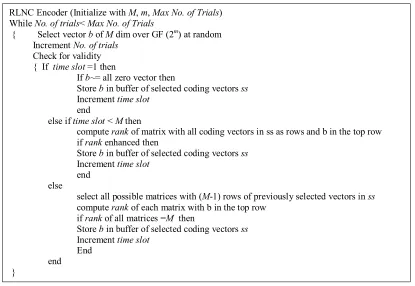
RLNC encoder was implemented using MATLAB. All computations were carried in finite field of size GF (2m). The pseudo code of algorithm to select valid coding vectors based on rank criteria discussed in section III is as shown in Fig. 1. The
RLNC Encoder (Initialize with M, m, Max No. of Trials) While No. of trials< Max No. of Trials
{ Select vector b of M dim over GF (2m) at random Increment No. of trials
Check for validity { If time slot =1 then
If b~= all zero vector then
Store b in buffer of selected coding vectors ss Increment time slot
end
else if time slot < M then
compute rank of matrix with all coding vectors in ss as rows and b in the top row if rank enhanced then
Store b in buffer of selected coding vectors ss Increment time slot
end else
select all possible matrices with (M-1) rows of previously selected vectors in ss compute rank of each matrix with b in the top row
if rank of all matrices =M then
Store b in buffer of selected coding vectors ss Increment time slot
[image:3.612.103.518.111.397.2]End end }
probability of selecting valid coding vectors in each time slot is also computed. We present the results obtained for two field size with GF (24) and GF (28). Our results also highlight on the number of valid coding vectors available.
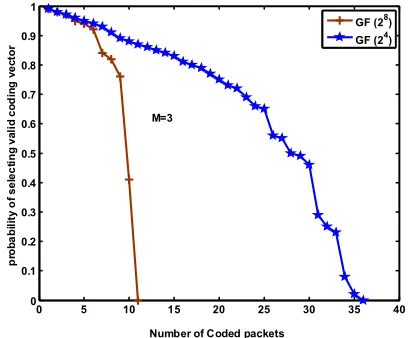
Fig. 2 shows the probability of selecting valid coding vectors that are used to combine M=3 packets over field size GF (24) and GF (28) to form coded packets to be sent in subsequent time slot. Maximum number of trials set to 100 for each field size. From figure it is clear that the probability of selecting valid coding vectors reduces and approaches to zero. The number of coding vectors used to form innovative coded packetsis limited by the field size. Thus from figure it is clearly seen that number of innovative coded packets that can be generated at the source (RLNC encoder) is limited to 10 with GF (24) and limited to 33 with GF (28) as the probability reduces to zero.
Fig. 3 shows the number of trials required to select the valid coding vectors that can generate innovative coded packets for both chosen field size. It is seen that for initial time slots in every trial valid coding vector can be selected. But at higher time slots it requires more number of trials to select valid coding vectors as the choice becomes more restrictive as listed in section III. The selection of coding vector also reflects on the computational time required to verify for the rank. Fig 4 highlights the computational time required to select valid coding vector as a function of number of innovative coded packets generated. It is seen that RLNC needs computational time to select coding vector and it is more obvious for large field size.
Fig.5 shows the probability of selecting coding vector for M=4 for field size GF (24) and GF (28).The probability decreases as
0 5 10 15 20 25 30 35 40
0 0.1 0.2 0.3 0.4 0.5 0.6 0.7 0.8 0.9 1
Number of Coded packets
p rob a bi li ty o f s e le c ti ng v a li d c o d in g v e c tor
GF (28) GF (24)
M=3
Fig. 2 Probability of selecting valid coding vectors used to combine
M=3 packets at the source as a function of number of coded packets generated over GF (24
) and GF (28
) respectively in maximum number of trials set to 100
0 5 10 15 20 25 30 35 40
0 10 20 30 40 50 60 70 80 90 100
Number of coded packets
N u m b e r o f tr ia ls
GF (24) GF (28)
Fig. 3 Number of trials to select valid coding vectors used to combine
M=3 packets at the source as a function of number of coded packets generated over GF (24
) and GF (28
) respectively in maximum number of trials set to 100.
0 5 10 15 20 25 30 35
0 10 20 30 40 50 60 70 80
Number of coded packets
T im e i n s e c
GF (28) GF (24)
Fig. 4 Computation time in seconds required in to select valid coding vectors for M=3 as a function of number of coded packets generated over GF (24) and GF (28) respectively in maximum number of trials set to 100.
0 2 4 6 8 10 12 14 16 18
0 0.1 0.2 0.3 0.4 0.5 0.6 0.7 0.8 0.9 1 coded packets p ro b a b il it y o f s e le c ti n g v a li d c o d in g v e c to r
GF (28) GF (24)
M = 4
Fig. 2 Probability of selecting valid coding vectors used to combine
M=4 packets at the source as a function of number of coded packets generated over GF (24
) and GF (28
[image:4.612.89.293.123.292.2] [image:4.612.319.528.124.286.2] [image:4.612.90.300.349.513.2] [image:4.612.328.542.350.516.2]the number of coded packets generated increases. But another interesting behaviour observed is the number of valid coding vectors or equivalently coded packets obtained is reduced to 16 in max number of trials set to 100 for field size GF (28) as compared to 35 in Fig. 2 for M=3.
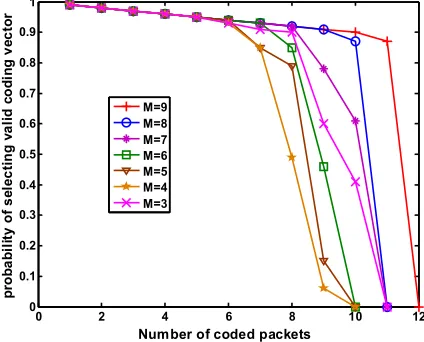
The simulation is repeated for field size GF (24) byvarying various values of M from 3 to 9. The smaller field size is chosen as the computation of rank for large field size is more. However the behaviour for large field size will be same except the values. Fig. 6 shows the probability of selecting valid coding vectors consisting of M symbols over field GF (24) as a function of number of coded packets generated setting values for M from 3 to 9. The number of vectors of length M symbols
over field GF (24) available will be M
24 . Even through this number will be large for high values of M, the available valid
coding vectors is still limited to a very small value. Also it can be observed that initially the probability of selecting valid
coding vectors is near to one but fall drastically when the required of innovative coding vectors increases.
V. CONCLUSIONS
We have presented the practical insight on selection of coding vectors that are used to generate innovative coded packets in RLNC, a decentralized network coding technique. The success of RLNC lies in the generation of valid coding vectors. The number of valid coding vectors that are available for the first few transmission time slots is fascinatingly large. However, with the increase requirement of innovative coded packets, the selection of valid coding vector becomes difficult. RLNC also consumes computational time and memory to keep track of rank of valid coding vectors. Generalized comparison in terms of time and memory requirements of RLNC and RLNCV over finite field is the future work.
REFERENCES
[1] Ralf Koetter and Muriel Medard, “An Algebraic approach to network coding”, IEEE/ACM Trans. on Networking, Vol. 11, No. 5, pp. 782-795, October 2003.
[2] Philip A. Chou, Yunnan Wu, and Kamal Jain, “Practical Network Coding,” in Proc. 41st Allerton Conf. on Comm. Control and Computing, Monticell, IL, USA, Vol. 1, pp. 1-10, October 2003.
[3] Tracey Ho, Ralf Koetter, Muriel Medard, David R. Karger and Michelle Effros, “The Benefits of Coding over Routing in an Randomized Setting”, ISlT
2003, Japan, June 29-July 4, 2003.
[4] Tracey Ho, Muriel Medard, Ralf Koetter, David R. Karger, Michelle Effros, Jun Shi, and Ben Leong, “A Random Linear Network Coding Approach to Multicast”, IEEE Tran. on Information Technology, Vol. 52, No. 10, pp. 4413-4430, October 2006.
[5] Philip A. Chou and Yunnan Wu., “Network Coding for the Internet and Wireless Networks”, IEEESignal Processing Magazine, Vol. 24, No. 5, pp. 77– 85, September 2007.
[6] S. Acedanski, S. Deb, M. Medard, and R. Koetter, “How Good Is Random Linear Coding Based Distributed Networked Storage,” Proc. Workshop Network Coding, Theory and Applications, April 2005.
[7] Jin Jin, Baochun Li and Taegon Kong, “Is Random Network Coding Helpful in WiMAX?”, IEEE INFOCOM ’08, Conf. on Computer Communications,
pp. 13-18, April 2008.
[8] Daniel E. Lucani, Milica Stojanovic, Muriel Medard, “Random linear network coding for time division duplexing: When to stop talking and start listening,” in Proc. of IEEE INFOCOM 2009, Brazil, April 2009.
0 2 4 6 8 10 12
0 0.1 0.2 0.3 0.4 0.5 0.6 0.7 0.8 0.9 1
Number of coded packets
[image:5.612.187.399.216.387.2]p ro b a b il it y o f s e le c ti n g v a li d c o d in g v e c to r M=9 M=8 M=7 M=6 M=5 M=4 M=3
[9] Nikolaos Thomos and Pascal Frossard, “Toward One Symbol Network Coding Vectors”, in IEEE Communications Letters, pp 1860-1863, November 2012,
[10] Pallavi R. Mane, Sudhakara G., M. Sathish Kumar, “ Performance Evaluation of Random Linear Network Coding using Vandermonde Matrix”,
ScienceDirect Physical Communication, ELSEVIER, Vol. 10, No. 4, pp 23-30, March 2014.
[11] Bernard Sklar, “Digital Communications: Fundamentals and Applications”, 2nd Edition, Prentice-Hall January 2001. [12] Andrea Goldsmith, “Wireless Communication”, Cambridge University Press, 1st
South Asian Edition 2009.
[13] Dong Nguyen, Taun Tran, Thinh Nguyen, and Bella Bose, “Wireless Broadcast Using Network Coding”, IEEE Tran. On Vehicular Technology, Vol. 58, No.2, pp. 914-925, Feb 2009.
[14] Desmond S. Lun, Muriel Medard, Ralf Koetter, and Michelle Effros, “On Coding for reliable communication over packet networks”, ScienceDirect Physical Communication, ELSEVIER, Vol. 1, pp. 3-20, 2008.
[15] Ralf Koetter and Frank R. Kschischang, “Coding for Errors and Erasures in Random Network Coding”, IEEE Tran. on Information Theory, Vol. 54, No. 8, pp. 3579-3591 August 2008.