© 2016, IRJET | Impact Factor value: 4.45 | ISO 9001:2008 Certified Journal | Page 1471
Interactive Content Based Image Retrieval System: Survey and
Overview
Deepa Dubey Vivek Suryawanshi G.S. Prajapati
[email protected] Assistant Prof. VNS College HOD VNS College VNS College Bhopal [email protected] [email protected] Bhopal India Bhopal,India Bhopal lndia
---******--- Abstract—With a specific end goal to successfully and accurately recover the coveted pictures from a vast picture database, the improvement of a substance based picture recovery (CBIR) framework has turned into an imperative exploration issue. Albeit far reaching thinks about, directed and picture finding is sought from interactive media databases and it is exceptionally troublesome and open issue. This paper gives the review of late specialized accomplishments in the exploration zone of substance based picture recovery, for example, the pertinence criticism (RF), intelligent hereditary calculation and neural system. Importance criticism upgrades the capacity of CBIR viably by dropping the semantic hole between low-level elements and abnormal state highlights. Intelligent hereditary calculation is a branch of transformative calculation which makes the recovery procedure more intuitive so client can get propelled results from database coordinating to Query Image with his assessment. Neuro-fluffy rationale based understood input gets enhanced results when contrasted with customary certain criticism. The paper covers the present accomplishments in importance criticism, intuitive hereditary calculation, neural system in CBIR, different significance input strategies and uses of CBIR.
Index Terms—CBIR,RF,Interactive Genetic Algorithm ,Nural Network
I.INTRODUCTION
Vast picture databases are hard to skim with customary content pursuits on the grounds that the assignment of client based explanation turn out to be extremely tedious, as the content regularly neglects to pass on the rich structure of pictures. A substance based recovery framework tackles this issue where recovery depends on the computerizing coordinating of highlight of question picture with that of picture database through some picture similitude assessment [1]. Content-based picture recovery is a strategy where pertinent pictures from expansive scale picture databases are looked by interests' .it has turned into a dynamic and quick propelling examination region since most recent two decade. Amid the previous decade,
wonderful advancement has been made in both hypothetical exploration and framework improvement. In any case, there stay numerous testing research issues that keep on attracting analysts from various controls [2]. Early
procedures to picture recovery were not essentially taking into account visual components but rather in light of the printed explanation of pictures. It implies that pictures
were initially commented on with content and afterward sought utilizing a content based methodology from conventional database administration frameworks [2]. Be that as it may, the execution of conventional way to deal with picture recovery is exceptionally touchy to the catchphrases utilized by the client and the framework. Accordingly, content-based picture recovery (CBIR) has gotten much consideration in mixed media recovery group. It manages the picture content itself, for example, shading, surface, and shape and picture structure rather than explained content [3].
Fundamental thoughts behinds CBIR is to break down picture data by low level components of a picture, for example, shading, composition, shape and shading design and so forth., and to make highlight vectors of a picture as its list. The components are put away in a picture highlight database for future use [3]. At the point when an inquiry picture is given, the elements of the question picture are separated to coordinate the elements in the element database by a pre-built up calculation, so that a gathering of comparable pictures to the question picture can be returned as the recovery pictures [4-6]. There are three major bases for substance based picture recovery, i.e. visual component extraction, multidimensional indexing, and recovery framework plan.
a. Highlight extraction and indexing of picture database as per the picked visual elements, which from the perceptual component space, for instance shading, shape, composition or any blend of above.
b. Highlight extraction of question picture.
c. Coordinating the question picture to the most comparative pictures in the database as indicated by some picture similitude measure. This structures the hunt a portion of CBIR frameworks.
© 2016, IRJET | Impact Factor value: 4.45 | ISO 9001:2008 Certified Journal | Page 1472 picture databases. The elements further can be delegated low-level and abnormal state highlights. The center is to construct an all inclusive CBIR framework utilizing low level components. Clients can inquiry illustration pictures in view of these elements. By likeness correlation the objective picture from the picture storehouse is recovered. In the mean time, the following essential stage today is centered around bunching procedures. Grouping calculations can offer unrivaled association of multidimensional information for powerful recovery. Bunching calculations permit a closest neighbor hunt to be proficiently performed [7].
II.STANDARD CBIRSYSTEM
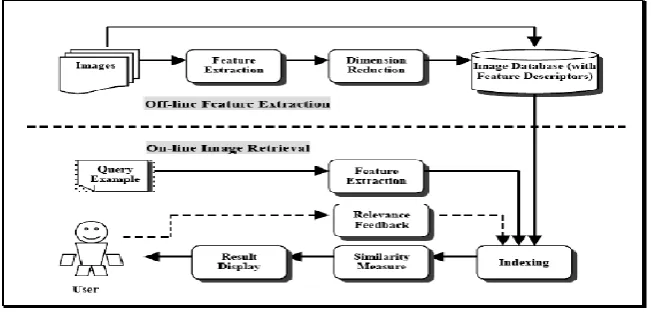
[image:2.595.135.461.331.487.2]Content-based recovery utilizes the substance of pictures to speak to and get to the pictures. A normal substance based recovery framework is separated into disconnected from the net component extraction and online picture recovery. A calculated system for substance based picture recovery is represented in Figure 1 [8]. In disconnected from the net stage, the framework naturally extricates visual traits (shading, shape, composition, and spatial data) of every picture in the database in light of its pixel values and stores them in an alternate database inside the framework called a component database. The element information (otherwise called picture signature) for each of the visual traits of every picture is especially littler in size contrasted with the picture information, hence the component database contains a reflection (minimized structure) of the pictures in the picture database. One point of preference of a mark over the first pixel qualities is the huge pressure of picture representation. Be that as it may, a more imperative explanation behind utilizing the mark is to pick up an enhanced relationship between's picture representation and visual semantics [8].
Fig. 1. A Conceptual Framework for Content-Based Image Retrieval.
In on-line picture recovery, the client can present an inquiry case to the recovery framework looking for wanted pictures. The framework speaks to this case with a component vector. The separations (i.e., similitudes) between the element vectors of the question illustration and those of the media in the component database are then processed and positioned. Recovery is directed by applying an indexing plan to give an effective method for seeking the picture database. At long last, the framework positions the indexed lists and afterward gives back the outcomes that are most like the question cases. In the event that the client is not fulfilled by the list items, he can give pertinence input to the recovery framework, which contains an instrument to take in the client's data needs.
III.APPLICATION
a.
The upsides of such frameworks range from basic clients seeking a specific picture on the web.b. Different sorts of experts like police power for picture acknowledgment in wrongdoing counteractive action. c. Medicine diagnosis
d. Architectural and engineering design e. Fashion and publishing
f. Geographical information and remote sensing systems
g.
Home entertainmentIV.IMAGE RETRIEVAL USING RELEVANCE FEEDBACK
© 2016, IRJET | Impact Factor value: 4.45 | ISO 9001:2008 Certified Journal | Page 1473 are typically included. Significance criticism is an intelligent procedure which incorporates "clients" assessment of the recovery results [9]. Design of RF framework show in figure 2 commonly, the pertinence input procedure incorporates an intuitive scoring framework to assess the past recovery results to enhance the consequent substance recovery .
Fig. 2. Architecture of Relevance Feedback System
V.IMAGE RETRIEVAL USING GENETIC/INTERACTIVE GENETICALGORITHM
Hereditary calculation (GA) is a counterfeit consciousness technique taking into account the hypothesis of regular determination and development [10]. It is a proficiently worldwide seeking calculation taking into account the guideline of "survival of the fittest" and utilized for enhancement and looking issues. As specified some time recently, usage of substance based picture indexing and recovery (CBIR) utilizing one substance highlight does not give adequate recovery exactness. To conquer this issue, any novel model for the substance based picture recovery framework must join different components for the picture like shading, composition, and shape. Tragically, relegating square with weights for every component can't accomplish great result. These weights must be enhanced utilizing any inquiry advancement system like hereditary calculation (GA) for expanding normal exactness and normal review of picture recovery.
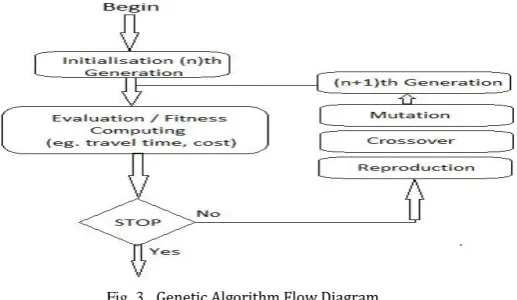
General flowchart for hereditary calculation show in figure.3. Terminals are typically program inputs, despite the fact that they may likewise be constants. Capacities take inputs and create yields. Capacity information can be either a terminal or the yield of another capacity. The wellness of an individual is controlled by its viability in delivering the right yields for all cases in a preparing set. The preparation set is a set containing inputs and their reporter already known yields. To develop the populace, and improve the sought goals, it is important to pick the right people to be liable to hereditary administrators. In this way, choice administrators are utilized to choose the people, normally, taking into account their wellness. Case of choice technique are roulette wheel, competition and rank-based choices. Hereditary administrators present variability in the people and make development conceivable, which may create better people in back eras. The hybrid administrator trades sub-trees from a couple of people, producing two others. Transformation administrator replaces an arbitrarily picked sub-tree from a person by a sub-tree haphazardly created. The proliferation administrator basically duplicates people and embeds them in the people to come.
Fig. 3. Genetic Algorithm Flow Diagram
[image:3.595.176.435.558.708.2]© 2016, IRJET | Impact Factor value: 4.45 | ISO 9001:2008 Certified Journal | Page 1474 IGA empowers remarkable substance to develop that suits the client's inclinations. Taking into account this reason, IGA can be utilized to take care of issues that are troublesome or difficult to figure a computational wellness capacity, for instance, advancing pictures, music, different creative plans, and structures to fit a client's tasteful inclinations
VI.IMAGE RETRIEVAL USING FUZZY LOGIC/NEURO FUZZY LOGIC
The recovery of maritime structures comprises of finding comparative areas in the picture DB to the predetermined question. For our situation, the recovery is completed by method for the execution of fluffy inquiries on the framework DB. For the recovery of maritime structures, the formation of a classifier made out of descriptors is required. At the point when the classifier is made, fluffy data is put away into the fluffy DB. For our specific issue, the arrangement of reasonable descriptors for tackling the issue has been proposed by oceanography specialists. Programmed picture recovery utilizing fluffy rationale can be depicted in the accompanying strides [12]. The client needs to choose a particular maritime district for recovering. Note that from the fluffy information data of a locale, a fluffy question can be executed to recover comparative districts to one given, which is the idea of CBIR. Also, basic alterations in the CBIR would permit us to execute inquiries by idea and substance. The framework seeks among every current locale in the fluffy DB and chooses with a level of closeness (equivalent or higher) every single comparative district. Note that recovered districts by the framework will rely on upon both the chose descriptors and the arrangement parameters of the MFs identified with every descriptor. For our specific issue, the arrangement of appropriate descriptors for taking care of the issue has been proposed by oceanography specialists.
Neuro-fluffy surmising framework actualizes fluffy derivation framework in the structure of Adaptive systems. NFIS is a food forward neural system, in which the parameters of the square hubs need learning. The learning of fluffy surmising framework is the alteration about the forerunner parameters and ensuing parameters [12].
VII.IMAGE RETRIEVAL USING SUPPORT VECTOR MACHINE (SVM)
Bolster Vector Machines (SVMs) are regulated learning techniques [13] utilized for picture grouping. It sees the given picture database as two arrangements of vectors in a " n " dimensional space and develops an isolating hyper plane that amplifies the edge between the pictures significant to inquiry and the pictures not pertinent to the question. SVM is a portion technique and the bit capacity utilized as a part of SVM is extremely critical in deciding the execution.
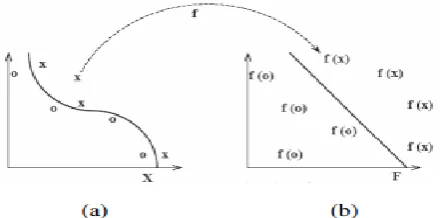
The essential standard of SVMs is a greatest edge classifier. Utilizing the piece techniques, the information can be first verifiably mapped to a high dimensional portion space. The greatest edge classifier is resolved in the piece space and the comparing choice capacity in the first space can be non-direct [13]. The non-direct information in the component space is grouped into straight information in bit space by the SVMs. This is represented in Figure 4 as takes after.
[image:4.595.200.421.502.611.2]The point of SVM arrangement strategy is to locate an ideal hyper plane isolating applicable and unimportant vectors by boosting the span of the edge (between both classes).
Fig. 4. The function ‘f’ embeds the data in the original space (a) kernel space (b) where the nonlinear pattern now becomes linear.
Picture arrangement or order is a machine learning approach and can be dealt with as a stage for accelerating picture recovery in substantial databases and to enhance recovery precision. Essentially, without marked information, unsupervised grouping is additionally discovered helpful for expanding the recovery speed and in addition to enhance recovery exactness. Picture bunching intrinsically relies on upon a closeness measure, while picture arrangement has been performed by various strategies that neither require nor make utilization of comparability measures [13].
VIII. RELATED WORKS
© 2016, IRJET | Impact Factor value: 4.45 | ISO 9001:2008 Certified Journal | Page 1475 picture size and introduction [4-5]. Shading histogram is invariant to introduction and scale and this makes it effective in picture grouping. Henceforth, shading histogram-based shading descriptor has been widely concentrated on furthermore, broadly utilized as a part of CBIR frameworks for its straightforwardness and viability [6].
Prior to a shading descriptor can be chosen, the fundamental shading space must be determined. For CBIR, the RGB space was utilized by numerous analysts to extricate the shading highlights in it. Sadly, the RGB is not appropriate for portraying hues in wording that are functional for human elucidation. The HSV (tint, immersion, esteem) model is a perfect apparatus for creating picture preparing calculations in light of shading portrayals that are regular and natural to people [6].
Composition is likewise a standout amongst the most utilized low level visual components that alludes to natural surface properties of an item and their relationship to the encompassing environment. Customary surface components utilized for CBIR are measurement composition highlights utilizing dark level co-event framework (GLCM) [14], edge histogram descriptor (EHD), which is one of the MPEG-7 surface descriptors [15], and wavelet minutes [16]. As of late, BDIP (square contrast of converse probabilities) and BVLC (piece variety of neighborhood relationship coefficients) highlights have been proposed which adequately quantify nearby shine varieties and nearby composition smoothness, separately [17]. The brilliant execution of BDIP and BVLC originates from that them two are limited and very much standardized to lessen the impact of enlightenment [17]. These components are appeared to yield better recovery precision over the analyzed customary elements. They are separated from 2*2 squares into which an inquiry picture is parceled to quantify neighborhood picture attributes in incredible point of interest.
For picture recovery, Object shape components can likewise be utilized to give effective data, since people can perceive questions exclusively from their shapes. Fundamentally, the shape contains semantic data of item, and it is not quite the same as other basic visual elements, for example, shading or composition highlights [4]. As a rule, Shape components can be extricated from a picture by utilizing two sorts of techniques: form and locales. Form based techniques are typically used to remove the limit components of an item shape. Such strategies totally disregard the vital components inside the limits Region-based picture recovery techniques firstly apply division to separate a picture into various districts/sections, by setting edge values as indicated by the attractive results. though the limit of a picture can be gotten by applying any edge location strategy to a picture [5-6].
Over the previous decades, numerous scientists have concentrated on the investigations of CBIR by utilizing just a solitary element. Be that as it may, it is difficult to increase acceptable recovery results utilizing a solitary element in light of the fact that a picture for the most part contains different visual qualities with some development technology[6]. Along these lines, it is important to remove and select proficient components that are correlative to each other in order to accomplish an attractive recovery execution button.
Chin Lai et.al.[18] have proposed an intelligent hereditary calculation (IGA) to diminish the crevice between the recovery results and the clients' desire .They have utilized Color traits like the mean quality, standard deviation, and picture bitmap .They have additionally utilized composition highlights like the entropy in light of the dim level co-event grid and the edge histogram .
N.Srikrishna, K.Vindhya and P.Satyanarayana [12] propose a neuro-fluffy method for CBIR. The CBIR system depends on fluffy translation of regular dialects neural system learning and looking calculations. At first, fluffy rationale is created to decipher characteristic expression like most, numerous and few. In other hand, a neural system is figured to take in the significance of most ruddy, numerous ruddy and couple of rosy. The neural system is self deciding to the database utilized, which abstains from retraining of the neural system. Finally, a parallel hunt calculation is utilized to rivalry and presentation neural system's yield and pictures from database. The future strategies are extremely excellent and the modernization of this exploration depends on half and half way to deal with CBIR as well as on the crisp thought of preparing neural system on inquiries. One of the extraordinary part of that examination is the neural system is outline to learn question and not databases. The strategy can be utilized for any genuine online database.
A one of a kind methodology for substance based absolutely shading picture arrangement by utilizing Support Vector Machine (SVM). Antiquated grouping approaches bargain inadequately on substance essentially based picture arrangement undertakings being one in each of the reasons of high property of the component choice. In this paper, shading picture characterization is finished on components extricated from histograms of shading components. The advantage of utilizing shading picture histograms unit higher Efficiency, and powerlessness to little changes in camera view-point i.e. interpretation and turn. As contextual investigation for approval reason, test trials were done on an information of with respect to 5 hundred footage partitioned into four out and out very surprising classes has been reportable and thought about on bar diagram highlights for various RGB, CMYK, Lab, YUV, YCBCR, HSV, HVC and YIQ shading zones. Results upheld the anticipated methodology are discovered empowering as far as shading picture arrangement precision [19].
© 2016, IRJET | Impact Factor value: 4.45 | ISO 9001:2008 Certified Journal | Page 1476 execution of picture recovery. In classifier preparing, an example expanding plan is embraced to adjust the extent of positive specimens and negative specimens. And afterward, a combination subject for various classifiers in view of versatile weighting is proposed to vote the last inquiry results .
Ritendra Datta, Jia Li James and Z. Wang [21] have proposed the most recent decade has seen immense enthusiasm for exploration on CBIR. This has secured the strategy for an expansive number of new methods, and a mounting enthusiasm for related fields to backing such frameworks. Correspondingly, computerized symbolism has extended its prospect in numerous bearings, resultant in an explosion in the volume of picture information important to be sort out. They examine a portion of the principle commitments in the present decade identified with picture recovery (IR) and mechanized picture comment. They are likewise examine few of the key difficulties required in the adjustment of existing picture recovery procedures to fabricate helpful frameworks that can deal with certifiable information.
IX.RESEARCH ISSUES
Noteworthy perceptions in the survey of related works are as per the following:
• There still have not been flawless depictions for semantic components. This is because of the differing qualities of visual elements, which broadly exists in genuine utilizations of picture recovery.
• Implementation of substance based picture indexing and recovery (CBIR) utilizing one substance highlight doesn't give adequate recovery exactness.
• For joining of various sorts of components, there is a need to prepare these elements with various weights to accomplish great results. Doling out equivalent weights for every element can‟t accomplish great result.
• It is more reasonable and it has an awesome advantage to order the pictures into bunches in order to have the capacity to lessen the inquiry space in such web crawlers. Information Clustering is regularly stepped for accelerating picture recovery and enhancing exactness particularly in expansive databases.
• The existing CBIR frameworks utilize either worldwide elements, or district based components to speak to the substance of a picture. Despite the fact that RBIR frameworks can build the recovery precision, they require high complex calculations to ascertain comparability; since these frameworks need to consider every district in the database pictures particularly and shading pictures have expansive measurements and the calculations are entirely tedious, RBIR frameworks require a high recovery reaction time.
• All current CBIR frameworks experience the ill effects of deficient speculation execution and precision. One exceptionally issue when planning CBIR framework is to make a framework broadly useful. When we consolidate a few procedures like substance based, multi-highlights extraction, bunching and counterfeit consciousness to assemble the CBIR framework, we can get nearer to speculation to an ever increasing extent.
X.CONCLUSION
With the guide of hereditary calculation based likeness measure and utilization of criticism procedures, pictures that are like the inquiry picture are recovering viably and productive. Utilization of hereditary calculation in CBIR framework lessen the calculation time. This new approach lessen "semantic hole" between the human recognition and visual substance and expansion execution of framework. Here we have made two level engineering of understood and unequivocal input as mix of certain and express criticism in CBIR framework gives preferable result over just express input.
In this paper, when we assessed the wellness of an individual, we considered just the event frequencies of a picture in recovery come about, and not the area of a picture in recovery result. Be that as it may, the area of a picture in recovery result reflects straightforwardly the comparability of it and question picture. Thus, this element ought to be considered while assessing the wellness of an individual substance, which is likewise our future work.
ACKNOWLEDGMENT
© 2016, IRJET | Impact Factor value: 4.45 | ISO 9001:2008 Certified Journal | Page 1477
REFERENCES
[1] J. R. Smith and S. F. Chang,“ Single Color Extraction and Image Query,” in Proc. IEEE International Conference on Image Processing,
vol. 3, pp. 23-41, 1997.
[2] Dr. Fuhui Long, Dr. Hongjiang Zhang and Prof. David Dagan Feng, “FUNDAMENTALS OF CONTENT-BASED IMAGE RETRIEVAL
[3] Jiayin Kang1, Wenjuan Zhang2 “A Framework for Image Retrieval with Hybrid Features”
[4] R. Min, H. D. Cheng, Effective image retrieval using dominant color descriptor and fuzzy support vector machine, Pattern
Recognition, Vol. 42, pp. 147–157, 2009.
[5] J. Yue, Z. B. Li, L. Liu, et al, Content-based image retrieval using color and texture fused features, Mathematical and Computer
Modelling, Vol. 54, pp. 1121–1127, 2011.
[6] X. Y. Wang, Y. J. Yu, H. Y. Yang, An effective image retrieval scheme using color, texture and shape features, Computer Standards &
Interfaces, Vol. 33, pp. 59–68, 2011.
[7] Mrs Monika Jain, Dr.S.K.Singh” A Survey On: Content Based Image Retrieval Systems Using Clustering Techniques For Large Data
sets”, International Journal of Managing information technology (IJMIT) Vol.3, No.4, November 2011
[8] F. Long, H. Zhang, H. Dagan, and D. Feng, “Fundamentals of content based image retrieval,” in D. Feng, W. Siu, H. Zhang (Eds.):
“Multimedia Information Retrieval and Management. Technological Fundamentals and Applications,” Multimedia Signal Processing Book, Chapter 1, Springer-Verlag, Berlin Heidelberg New York, 2003, pp.1-26.
[9] X. S. Zhou and T. S. Huang, "Relevance feedback in content-based image retrieval: Some recent advances," Inf. Sci., vol. 148, no. 1-4,
pp. 129-137, Dec. 2002.
[10]H. Shao, J. Zhang, W. Cui, and H. ZHAO, “Automatic Feature Weight Assignment Based on Genetic Algorithm for Image Retrieval,”
Proceedings of the 2003 IEEE International Conference on Robotics, Intelligent Systems and Signal Processing, China, 2003.
[11]Chih-Chin Lai, "A User-Oriented Image Retrieval System Based on Interactive Genetic Algorithm,"IEEE TRANSACTIONS ON
INSTRUMENTATION AND MEASUREMENT/0018-9456/2011.
[12]N.Srikrishna, K.Vindhya and P. Satyanarayana,” A neuro fuzzy approach to CBIR,” 7th Conference on Global spatial data
infrastructure, Aug. 2004.
[13]Agrawal, Saurabh, et al. "Content based color image classification using SVM."Information Technology: New Generations (ITNG),
2011 Eighth International Conference on. IEEE, 2011.
[14]R. M. Haralick, K. Shanmugam, and I. Dinstein, “Texture features for image classification,” IEEE Trans. Syst. Man Cybern, vol. SMC-8,
pp. 610–621, Nov. 1973.
[15][10] ISO/IEC 15938-3/FDIS Information Technology—Multimedia Content Description Interface—Part 3 Visual Jul. 2001,
ISO/IEC/JTC1/SC29/WG11 Doc. N4358.
[16][11] J. R. Smith and S.-F. Chang, “Transform features for texture classification and discrimination in large image databases,” in Proc.
IEEE Int. Conf. Image Processing, Austin, TX, Nov. 1994, vol. 3, pp. 407–411.
[17]Y. D. Chun, S. Y. Seo, and N. C. Kim, “Image retrieval using BDIP and BVLC moments,” IEEE Trans. Circuits Syst. Video Technol., vol.
13, pp. 951–957, Sep. 2003.
[18]Chih-Chin Lai, "A User-Oriented Image Retrieval System Based on Interactive Genetic Algorithm, "IEEE TRANSACTIONS ON
INSTRUMENTATION AND MEASUREMENT/0018-9456/2011.
[19]Yu-guang, Ye. 2007. “Research of image Retrieval based on fusing with multi-character”, Hua Qiao University, pp. 14-16.
[20]Mianchu Chen, Ping Fu-Yuan sun, Hui-zhang "Image Retrieval Based on Multi-feature similarity score fusion using Genetic
Algorithm" The 2nd International Conference on Computer and Automation Engineering (ICCAE), vol. 6, pp no. 751-759, Feb. 2010.
[21]Ritendra Datta, Jia Li James and Z - Wang, “CBIR- Approaches and Trends of the New Age” 4th International Conference the Next