Volume 2010, Article ID 745162,12pages doi:10.1155/2010/745162
Research Article
Hybrid Method for a Class of Stochastic Bi-Criteria
Optimization Problems
Zhong Wan, AiYun Hao, FuZheng Meng, and Chaoming Hu
School of Mathematical Sciences and Computing Technology, Central South University, Changsha, Hunan, China
Correspondence should be addressed to Zhong Wan,[email protected]
Received 24 June 2010; Accepted 20 October 2010
Academic Editor: Kok Teo
Copyrightq2010 Zhong Wan et al. This is an open access article distributed under the Creative Commons Attribution License, which permits unrestricted use, distribution, and reproduction in any medium, provided the original work is properly cited.
We study a class of stochastic bi-criteria optimization problems with one quadratic and one linear objective functions and some linear inequality constraints. A hybrid method of chance-constrained programmingCCPcombined with variance expectationVEis proposed to find the optimal solution of the original problem. By introducing the expectation level, the bi-criteria problem is converted into a single-objective problem. By introducing the confidence level and the preference level of decision maker, we obtain a relaxed robust deterministic formulation of the stochastic problem. Then, an interactive algorithm is developed to solve the obtained deterministic model with three parameters, reflecting the preferences of decision maker. Numerical experiments show that the proposed method is superior to the existing methods. The optimal solution obtained by our method has less violation of the constraints and reflects the satisfaction degree of decision-maker.
1. Introduction
In many fields of industrial engineering and management sciences, there often exist some uncertainties, such as the return rate of security and the amounts of demand and supply. Recently, many attentions have been paid to construct optimization models with uncertain parameters for the decision problems in the field of management science and to design some efficient solution methods for these optimization models. For this connection, one can see
1–9and the references therein.
Arising from the optimal network design problem and the fields of economic and management sciences, the following model often needs to be studiedsee, e.g.,7:
min fx 1
2x
TDwx,
s.t. Awx≥bw,
x≥0,
1.1
where f : Rn → R is continuously differentiable,w is at-dimensional stochastic vector,
Cw c1w, c2w, . . . , cnwT andbw b1w, b2w, . . . , bmwT are given vectors,
Dw dijwn×nandAw aijwm×nare given stochastic matrices. So, Problem1.1 is a stochastic bi-criteria optimization problem. The main difficulties to solve this kind of problems lie in two aspects. The first one is that optimal decisions are required to be prior to the observation of the stochastic parameters. In this situation, one can hardly find any decision that has no constraints violation caused by unexpected random effects. The second one is that no decision can optimize the two objective functions simultaneously.
By expectation method, the authors in 9 transformed Problem 1.1 into the following deterministic model:
min Efx 1 2x
TEDwx,
max EgxECwx
s.t. EAwx≥Ebw,
x≥0
1.2
and developed an algorithm to obtain an approximate solution of the original problem. Though the expectation method is a convenient way of dealing with stochastic programs 9, 10, it may not ensure that the optimal solution is robust as well as having optimal values of objective functions in general. For this, we are going to propose a hybrid method for the solution of Problem1.1. The basic idea is as follows.
For the bi-criteria problem, we introduce a parameter of expectation level for the second objective, and transform the original problem into a problem with single-objective function. For the stochastic parameters, we introduce an appropriate combination of the mean and variance of the cost, which is to be minimized subject to some chance constraints. The variance appeared in the cost function can be interpreted as a risk measure, which can make the solution more robust. For the chance constraint, it ensures that the probability for the constraints to be satisfied is greater than or equal to some value. The larger this value is taken, the higher probability the constraints are satisfied. In other words, the chance constraints approach can guarantee that the obtained solution has less degree of constraint violation see4,11. Based on such a reformulation for the original problem, an interactive algorithm will also be developed to find its solution with some satisfaction degree.
parameters, reflecting the preferences of decision maker. Numerical experiments are carried out inSection 4to show the advantage of the proposed method. Final remarks are given in the last section.
2. Reformulation of Stochastic Bi-Criteria Model by Hybrid Approach
In this section, we are going to reformulate the original stochastic bi-criteria problem into a deterministic problem.
Note that there are various ways to deal with multiple-objective problems. For details, see, for example,6,10,12. In this paper, Problem1.1is converted into a single-objective model by introducing a parameter, called theexpectation level of decision maker.
Let ρdenote the expectation level of decision maker to the second objective. Then,
1.1is relaxed into the following model:
min fx 1
2x
TDwx
s.t. Cwx≥ρ,
Awx≥bw,
x≥0.
2.1
Notice that the solution of the above problem is a compromising solution of Problem1.1 by a suitableρ. Actually,ρ ≤ρ∗, whereρ∗is the maximum of the second objective function. Whenρρ∗, the solution of2.1ensures that the second objective achieve its maximal value. Next, taking into account that the expectation value represents the average level and the variance indicates the deviation of the stochastic variable, the stochastic objective function in2.1is transformed into
μE
1 2x
TDwx
1−μσ
1 2x
TDwx
, 2.2
whereE·andσ·denote, respectively, the expectation and the variance of stochastic matrix, andμ∈0,1is introduced to describe the preference of decision maker to the average level and the robustness of objective value, and is called thepreference levelof decision maker. The variance appeared in the cost function can be interpreted as the risk measure, which can make the obtained solution more robust.
general stochastic constraintsAwx≥ bw, we obtain their deterministic formulations by expectation method as done in9.
Specifically, Problem2.1is reformulated as
min μE
1 2x
TDwx
1−μσ
1 2x
TDwx
s.t. P
n
i1
ciwxi≥ρ
≥η,
EAwx≥Ebw,
x≥0,
0≤μ≤1,
2.3
whereηis theprobability (or confidence) levelfor the first stochastic constraint to be satisfied. DenoteQandR, respectively, the expectation and the variance of the stochastic matrix Dw dijwn×n, that is,
QEDw Edijw
n×n, RσDw
σdijw
n×n. 2.4
If all components of the stochastic matrixDware statistically independent, then,2.3reads
min 1
2μx
TQx 1
4
1−μ x2TRx2
s.t. P
n
i1
ciwxi≥ρ
≥η,
EAwx≥Ebw,
x≥0,
0≤μ≤1,
2.5
wherex2 x2
Furthermore, suppose that the probability density functions of all components of the stochastic vectorCware normally distributed, and are statistically independent, then, the model2.5can be equivalently written as:
min 1
2μx
TQx 1
4
1−μ x2TRx2
s.t. P
n
i1ciwxi−M
N <
ρ−M N
≤1−η,
n
j1
Eaijwxj≥Ebiw, i1,2, . . . , m,
x≥0,
0≤μ≤1,
2.6
where M ni1Eciwxi, N
n
i1σciwx2i. So, Model 2.6 has the following
deterministic form:
min 1
2μx
TQx 1
4
1−μ x2TRx2
s.t. M Φ−11−ηN≥ρ,
n
j1
Eaijwxj≥Ebiw, i1,2, . . . , m,
x≥0,
0≤μ≤1.
2.7
Denote
μijE
aij
, μi0Ebiw. 2.8
Then,2.7yields
min 1
2μx
TQx 1
4
1−μ x2TRx2
s.t. M Φ−11−ηN≥ρ,
n
j1
μijxj≥μi0, i1,2, . . . , m,
x≥0,
0≤μ≤1,
where Φ−1 is the inverse of the probability density function with standard normal distribution.
From the above deduction, we obtain a new relaxed deterministic formulation2.6of the original problem1.1. Based on this model, an efficient solution method is developed in the next section.
3. Interactive Algorithm
In this section, from Model 2.9, we are going to develop an interactive algorithm to obtain an optimal solution of the original problem 1.1 such that there is less violation of constraints. It is more robust in the sense of less degree of constraint violation taking account of the satisfaction degree of decision maker. The basic idea of this algorithm is to adjust the three-level parameters of decision maker until a satisfactory solution is obtained.
It is noted that, for givenμ, ρ, and η, we solve a subproblem that turns out to be a minimization problem of quartic polynomial with one quadratical constraint and several linear constraints7. Then, by comparing the features of the solutions corresponding to a series of subproblems, we decide whether or not the algorithm is to be terminated. The overall algorithm is as follows.
Algorithm 3.1Interactive Algorithm for Stochastic Bi-criteria Problems.
Step 1. Chooseμ,ρ, andη, where 0 ≤μ≤1,ρmin ≤ρ≤ρmax,ηmin ≤η≤ηmax. Here,ρminand
ρmax,ηminandηmaxdenote, respectively, the minimum and the maximum ofρandηgiven by the decision maker.
Letδ1,δ2, andδ3be three positive constant scalars, for example, fixδ10.01,δ20.5, andδ30.05. Takeμ0 0,ρ0 ρmin, andη0ηmin. Seth0,t0,w0,Δμt Δηh Δρw 0.
Step 2. Compute a solution of the following subproblem:
min 1
2
μ0 Δμt
xTQx 1 4
1−μ0−Δμt x2 T
Rx2
s.t. M Φ−1 1−η0−Δηh
N≥ρ0 Δρw,
n
j1
μijxj≥μi0, i1,2, . . . , m,
x≥0,
0≤μ≤1.
3.1
Step 3. Ifη0 Δηh> ηmax, then go toStep 5. Otherwise, go toStep 4.
Step 4. Ask the decision maker whetherxμρηandFμρηare satisfactory. If they are, then go to Step 9; Otherwise, ask the decision maker whetherΔηhneeds to be changed. If it does not,
then go toStep 2. Otherwise, ask the decision maker to updateΔηhbyΔηh, and go toStep 2.
Step 5. LetΔρw Δρw δ
2,w w 1, andΔηh 0. Ifρ0 Δρw > ρmax, then go toStep 7. Otherwise, go toStep 6.
Step 6. Ask the decision maker whetherΔρwneeds to be changed. If it does not, then go to Step 2. Otherwise, updateΔρwbyΔρw, and go toStep 2.
Step 7. LetΔμt Δμt δ
3,tt 1,Δηh0, andΔρw0. Ifμ0 Δμt>1, the algorithm stops,
xμρηandFμρηare the desired results. Otherwise, go toStep 8.
Step 8. Ask the decision maker whetherΔμtneeds to be changed. If it does not, then go to Step 2. Otherwise, updateΔμtbyΔμt, and go toStep 2.
Step 9. xμρηandFμρηare the desired results. The algorithm terminates.
4. Numerical Experiments
In this section, we will study the numerical performances ofAlgorithm 3.1. For this, suppose that the probability density functions of all components of the stochastic vectorsCwand bw, of the matricesDwandAware normally distributed. These stochastic elements are statistically independent, that is,
dijw∼N μij, σ2ij, i, j1,2, . . . , n,
aijw∼N μij, σij2
, i1,2, . . . , m, j1,2, . . . , n,
biw∼Nμi0, σi20
, i1,2, . . . , m, ciw∼Nμi, σi2
, i1,2, . . . , n,
4.1
whereNμ, σ2denotes the normally distributed probability density function with meanμ and varianceσ2.
Firstly, we implementAlgorithm 3.1 in Lingo 9.0 to investigate how the parameters μ,ρand η affect the optimal solution. Here, we take Aw aijw ∈ R3×4,bw ∈ R3,
Cw∈R4andDw d
ijw∈R4×4. For example, we take
a11w∼N 40,942
, a12w∼N 25,752
,
a13w∼N 31,822
, a14w∼N 8,212
,
a21w∼N 22,612
, a22w∼N 38,872
,
a23w∼N 21,602
, a24w∼N 17,482
a31w∼N 38,862
, a32w∼N 28,802
,
a33w∼N 17,502
, a34w∼N 26,742
,
b1w∼N 51,1202
, b2w∼N 32,722
,
b3w∼N 43,982
, c1w∼N 23,642
,
c2w∼N 25,742
, c3w∼N 19,512
,
c4w∼N 27,782
, d11w∼N 12,312
,
d12w∼N 15,412
, d13w∼N 10,272
,
d14w∼N 17,512
, d21w∼N 14,432
,
d22w∼N 16,432
, d23w∼N 13,332
,
d24w∼N 15,422
, d31w∼N 21,592
,
d32w∼N 8,192
, d33w∼N 11,282
,
d34w∼N 20,552
, d41w∼N 18,552
,
d42w∼N 31,842
, d43w∼N 32,702
, d44w∼N 25,832
,
μ0.6, ρ60, η0.95. 4.2
Then, the subproblem inAlgorithm 3.1to be solved is as follows:
min 0.3xTQx 0.1 x2TRx2
s.t. 10622x21 14283x22 6720x23 15835x42−1150x1x2−874x1x3
−1242x1x4−950x2x3−1350x2x4−1026x3x4 2760x1 3000x2
2280x3 3240x4 ≥3600,
40x1 25x2 31x3 8x4≥51,
22x1 38x2 21x3 17x4≥32,
38x1 28x2 17x3 26x4≥43,
x≥0,
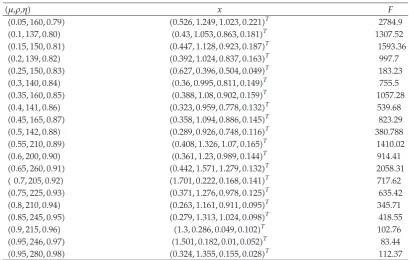
Table 1:Effects of the three-level parameters on solutions.
μ,ρ,η x F
0.05,160,0.79 0.526,1.249,1.023,0.221T 2784.9 0.1,137,0.80 0.43,1.053,0.863,0.181T 1307.52 0.15,150,0.81 0.447,1.128,0.923,0.187T 1593.36 0.2,139,0.82 0.392,1.024,0.837,0.163T 997.7 0.25,150,0.83 0.627,0.396,0.504,0.049T 183.23 0.3,140,0.84 0.36,0.995,0.811,0.149T 755.5 0.35,160,0.85 0.388,1.08,0.902,0.159T 1057.28
0.4,141,0.86 0.323,0.959,0.778,0.132T 539.68 0.45,165,0.87 0.358,1.094,0.886,0.145T 823.29 0.5,142,0.88 0.289,0.926,0.748,0.116T 380.788
0.55,210,0.89 0.408,1.326,1.07,0.165T 1410.02 0.6,200,0.90 0.361,1.23,0.989,0.144T 914.41 0.65,260,0.91 0.442,1.571,1.279,0.132T 2058.31
0.7,205,0.92 1.701,0.222,0.168,0.141T 717.62 0.75,225,0.93 0.371,1.276,0.978,0.125T 635.42 0.8,210,0.94 0.263,1.161,0.911,0.095T 345.71 0.85,245,0.95 0.279,1.313,1.024,0.098T 418.55 0.9,215,0.96 1.3,0.286,0.049,0.102T 102.76 0.95,246,0.97 1.501,0.182,0.01,0.052T 83.44 0.95,280,0.98 0.324,1.355,0.155,0.028T 112.37
where
Q
⎛ ⎜ ⎜ ⎜ ⎜ ⎜ ⎝
12 15 10 17
14 16 13 15
21 8 11 20
18 31 32 25 ⎞ ⎟ ⎟ ⎟ ⎟ ⎟
⎠, R
⎛ ⎜ ⎜ ⎜ ⎜ ⎜ ⎝
961 1681 729 2601
1849 1849 1089 1764
3481 361 784 3025
3025 7056 4900 6889 ⎞ ⎟ ⎟ ⎟ ⎟ ⎟
⎠. 4.4
In Lingo 9.0, we obtain the optimal solution of Model4.3:x1 0.6398,x2 0.3884,
x30.4965,x40.0381 and the value of the objective function is 105.682. In the same setting, from Model1.2in9, we obtained an optimal solutionx01 2.52,x02x03 x04 0, and
f0x 36.36,g0x 44.31.
With different choices of the level parametersμ, ρ andη, it can be seen how these parameters affect the optimal solution. The numerical results are reported inTable 1.
FromTable 1, it can be seen that the adjustment ofμ,ρ, andηis helpful for the decision maker to choose a favorite solution.
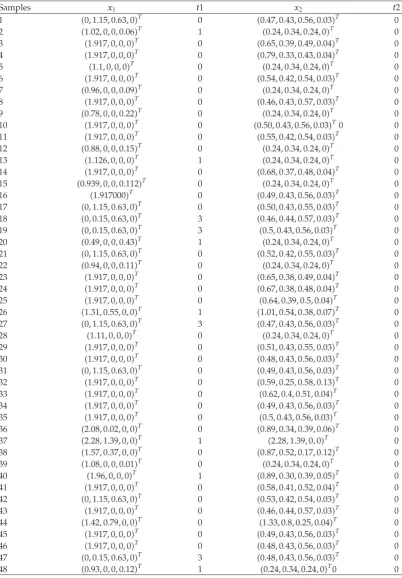
In the end of this section, we are going to investigate the degree of constraint violation for the proposed method. By simulation, in MATLAB 6.5, 48 samples of all stochastic parameters are generated. Thus, we get 48 optimization problems. Next, we are going to investigate the degree of constraint violation for the proposed method in this paper and the expectation method presented in9.
Table 2:Comparison between expectation method and hybrid method.
Samples x1 t1 x2 t2
1 0,1.15,0.63,0T 0 0.47,0.43,0.56,0.03T 0 2 1.02,0,0,0.06T 1 0.24,0.34,0.24,0T 0 3 1.917,0,0,0T 0 0.65,0.39,0.49,0.04T 0 4 1.917,0,0,0T 0 0.79,0.33,0.43,0.04T 0
5 1.1,0,0,0T 0 0.24,0.34,0.24,0T 0
6 1.917,0,0,0T 0 0.54,0.42,0.54,0.03T 0
7 0.96,0,0,0.09T 0 0.24,0.34,0.24,0T 0 8 1.917,0,0,0T 0 0.46,0.43,0.57,0.03T 0 9 0.78,0,0,0.22T 0 0.24,0.34,0.24,0T 0 10 1.917,0,0,0T 0 0.50,0.43,0.56,0.03T0 0 11 1.917,0,0,0T 0 0.55,0.42,0.54,0.03T 0 12 0.88,0,0,0.15T 0 0.24,0.34,0.24,0T 0 13 1.126,0,0,0T 1 0.24,0.34,0.24,0T 0
14 1.917,0,0,0T 0 0.68,0.37,0.48,0.04T 0 15 0.939,0,0,0.112T 0 0.24,0.34,0.24,0T 0
16 1.917000T 0 0.49,0.43,0.56,0.03T 0
17 0,1.15,0.63,0T 0 0.50,0.43,0.55,0.03T 0 18 0,0.15,0.63,0T 3 0.46,0.44,0.57,0.03T 0 19 0,0.15,0.63,0T 3 0.5,0.43,0.56,0.03T 0 20 0.49,0,0,0.43T 1 0.24,0.34,0.24,0T 0
21 0,1.15,0.63,0T 0 0.52,0.42,0.55,0.03T 0 22 0.94,0,0,0.11T 0 0.24,0.34,0.24,0T 0
23 1.917,0,0,0T 0 0.65,0.38,0.49,0.04T 0 24 1.917,0,0,0T 0 0.67,0.38,0.48,0.04T 0 25 1.917,0,0,0T 0 0.64,0.39,0.5,0.04T 0 26 1.31,0.55,0,0T 1 1.01,0.54,0.38,0.07T 0 27 0,1.15,0.63,0T 3 0.47,0.43,0.56,0.03T 0
28 1.11,0,0,0T 0 0.24,0.34,0.24,0T 0
29 1.917,0,0,0T 0 0.51,0.43,0.55,0.03T 0
30 1.917,0,0,0T 0 0.48,0.43,0.56,0.03T 0 31 0,1.15,0.63,0T 0 0.49,0.43,0.56,0.03T 0
32 1.917,0,0,0T 0 0.59,0.25,0.58,0.13T 0 33 1.917,0,0,0T 0 0.62,0.4,0.51,0.04T 0 34 1.917,0,0,0T 0 0.49,0.43,0.56,0.03T 0 35 1.917,0,0,0T 0 0.5,0.43,0.56,0.03T 0 36 2.08,0.02,0,0T 0 0.89,0.34,0.39,0.06T 0
37 2.28,1.39,0,0T 1 2.28,1.39,0,0T 0
38 1.57,0.37,0,0T 0 0.87,0.52,0.17,0.12T 0
39 1.08,0,0,0.01T 0 0.24,0.34,0.24,0T 0 40 1.96,0,0,0T 1 0.89,0.30,0.39,0.05T 0
41 1.917,0,0,0T 0 0.58,0.41,0.52,0.04T 0 42 0,1.15,0.63,0T 0 0.53,0.42,0.54,0.03T 0 43 1.917,0,0,0T 0 0.46,0.44,0.57,0.03T 0 44 1.42,0.79,0,0T 0 1.33,0.8,0.25,0.04T 0 45 1.917,0,0,0T 0 0.49,0.43,0.56,0.03T 0 46 1.917,0,0,0T 0 0.48,0.43,0.56,0.03T 0 47 0,0.15,0.63,0T 3 0.48,0.43,0.56,0.03T 0
against all constraints of the expectation model and the hybrid model, respectively. Takeμ 0.6,ρ60, andη0.95.Table 2reports the numerical results.
From Table 2, it is shown that the optimal solution by the hybrid method has no violation of the constraints for all the 48 samples with 0.95 probability level, while there are 19 times of violating constraints for the expectation method.
5. Final Remarks
In this paper, a class of stochastic bi-criteria optimization problems was studied by a new hybrid method where the chance-constrained programming CCP is combined with the variance-expectationVEmethod. Then an interactive algorithm was developed to find an optimal solution of the original problem, reflecting the satisfaction degree of the decision maker.
Following the proposed hybrid method, if we deal with all the stochastic inequalities by the chance constraint method, then the optimal solution would have less constraints violation degree than that obtained by the method proposed in this paper. But in this situation, a joint chance constraint is generated as follows:
P
n
i1
ciwxi≥ρ, Awx≥bw
≥η. 5.1
Even if some strong assumptions are imposed, it is difficult to obtain explicit expressions of deterministic inequalities constraints that are involved only with the decision variablex ∈ Rn for the stochastic constraints. Thus, it calls for the investigation of other more efficient
approaches.
Acknowledgments
The authors would like to express their thanks to the two anonymous referees for their comments on the paper, which have improved its presentation. The work of these authors was supported by the National Natural Science Foundation of ChinaGrant no. 71071162, and 70921001and the Project for Excellent Talent of New Century, Ministry of Education, ChinaGrant no. NCET-07-0864.
References
1 D. Kofjaˇc, M. Kljaji´c, and V. Rejec, “The anticipative concept in warehouse optimization using simulation in an uncertain environment,”European Journal of Operational Research, vol. 193, no. 3, pp. 660–669, 2009.
2 P. B. Hermanns and N. V. Thoai, “Global optimization algorithm for solving bilevel programming problems with quadratic lower levels,”Journal of Industrial and Management Optimization, vol. 6, no. 1, pp. 177–196, 2010.
3 C. Jiang, X. Han, G. R. Liu, and G. P. Liu, “A nonlinear interval number programming method for uncertain optimization problems,”European Journal of Operational Research, vol. 188, no. 1, pp. 1–13, 2008.
5 M. J. Pardo and D. de la Fuente, “Design of a fuzzy finite capacity queuing model based on the degree of customer satisfaction: analysis and fuzzy optimization,”Fuzzy Sets and Systems, vol. 159, no. 24, pp. 3313–3332, 2008.
6 D. Panda, S. Kar, and M. Maiti, “Multi-item EOQ model with hybrid cost parameters under fuzzy/fuzzy-stochastic resource constraints: a geometric programming approach,” Computers & Mathematics with Applications, vol. 56, no. 11, pp. 2970–2985, 2008.
7 Z. Wan, A.-Y. Hao, F.-Z. Meng, and Y.-L. Wang, “Interactive algorithms for optimization to multiple-objectives design problems with stochastic environment,”Journal of Hunan University Natural Sciences, vol. 37, no. 8, pp. 83–86, 2010.
8 Z. Wan, S. Zhang, and Y. Wang, “Penalty algorithm based on conjugate gradient method for solving portfolio management problem,”Journal of Inequalities and Applications, vol. 2009, Article ID 970723, 16 pages, 2009.
9 J. Xu and J. Li, “A class of stochastic optimization problems with one quadratic and several linear objective functions and extended portfolio selection model,”Journal of Computational and Applied Mathematics, vol. 146, no. 1, pp. 99–113, 2002.
10 K. Maity and M. Maiti, “A numerical approach to a multi-objective optimal inventory control problem for deteriorating multi-items under fuzzy inflation and discounting,”Computers & Mathematics with Applications, vol. 55, no. 8, pp. 1794–1807, 2008.
11 P. Kall and S. W. Wallace, Stochastic Programming, Wiley-Interscience Series in Systems and Optimization, John Wiley & Sons, Chichester, UK, 1994.