2016 Joint International Conference on Artificial Intelligence and Computer Engineering (AICE 2016) and International Conference on Network and Communication Security (NCS 2016)
ISBN: 978-1-60595-362-5
Short-term Wind Energy Prediction Algorithm Based on SAGA-DBNs
Fei WANG
a, Zhong-Dong WU
b,*, Qiang LI
cSchool of Electronic and Information Engineering, Lanzhou Jiaotong University, Lanzhou, Gansu, China
a[email protected], b[email protected], c[email protected]
*Corresponding author
Keywords: Wind Energy Prediction, Simulated Annealing Genetic Algorithm, BP Neural Network, Deep Belief Networks.
Abstract. In order to overcome initial weights direction in the deep conviction network and improve the prediction accuracy of wind energy further, this paper proposes a new algorithm which combined the simulated annealing genetic algorithm and the deep belief network. Firstly, the main influencing factors of wind energy are selected. Then the superior global searching capability of the simulated annealing genetic algorithm is used to train the deep belief network and optimize the weights layer by layer. Finally, the deep belief networks weights were tuned by a BP neural network to make sure the networks are the best wind energy prediction system. The algorithm is verified by the experimental data from a wind farm in western China. The results show that the algorithm not only can overcome initial weights direction in the deep belief networks, but also further improve the prediction accuracy.
Introduction
Wind energy is the renewable energy with the most large-scale exploiting value and great developing prospects. However, due to the fluctuations and intermittent of wind energy, the power balance of the grid will be impacted greatly and even cause transmission accidents. Therefore, developing the accurate short-term wind energy prediction method is crucial to ensuring the power balance and helping the operators to prearrange schedule.
Currently, there are three main ways for short-term wind energy prediction [1]: physical prediction method, statistical prediction method and intelligent prediction method. Physical prediction need to establish a physical model for the wind turbines, which requiring extensive knowledge of meteorology and topography, turbulence and other physical information. So, the model is complicated and poor in applicability [2]. Statistical prediction generally has features like fast, simple prediction model, but because it cannot accurately describe the complicated nonlinear dynamics of wind energy systems, it leads to instability of prediction results [3]. Intelligent prediction uses the powerful nonlinear mapping ability of artificial intelligence algorithm, taking a large amount of historical data to train the network, completely extracting the feature information of historical data to making it be a best prediction system. So, with great advantage, it is currently the most widely used prediction method [4].
This paper combines the advantages of the simulated annealing genetic algorithm and deep belief networks for short-term wind energy prediction, through comparing computed data from this paper and the actual production data from a wind farm in western China, it shows that the algorithm has a higher prediction accuracy than other classical wind energy prediction algorithm.
Analysis of Wind Farm Output Energy Influence Factors Analysis
3/ 2 p
p C A v . (1)
Where, p is the output energy of a wind turbine; Cp is the power coefficient of wind turbine; ρ is the air density; A is the rotor swept area; v is the wind speed perpendicular to wind turbine.
Eq. 1 shows that wind energy is proportional to wind speed cubed and air density, because the wind speed and air density are the key factors for wind energy. Since the air density is mainly determined by humidity, temperature and pressure, so temperature, humidity and pressure are used to replace the air density for wind energy prediction. During the wind energy transformed into electrical energy, wind direction has a great impact on the wind energy farms efficiency factor. Therefore, wind direction is also a key factor in wind energy. In order to enable them input conveniently, it is taking the sine and cosine of wind as a representative of a wind direction. According to the literature [5], the history of the wind energy also has an important impact on the wind energy prediction. Therefore, the main factors in the wind farms output power identified in this paper are: wind speed, the sine of wind direction, the cosine of wind direction, air temperature, pressure, humidity and wind energy history.
Data Processing
This paper selects experimental data according to the main factors of wind energy. Since the experimental data has different dimensions and the different data will influence the prediction accuracy, normalization is needed for data processing.
For wind speed, for example, the experimental data is normalized for the network’s input, which is defined as follows:
min
max min g
v v v
v v
. (2)
Where, vg is normalized wind speed value; v is experimental wind speed data; vmax is experimental maximum wind speed data; vmin is experimental minimum wind speed data.
Using the same method to normalize the wind direction, air temperature, barometric pressure, humidity and wind energy history, those processing results are taken as the network input.
Model Establishment Based on SAGA-DBNs Deep Relief Networks Model
Deep learning model is a machine learning model having a few of hidden layers, by characteristics transformation layer by layer, sample characteristics transform from the original space to another space, making it easier to extract features with high prediction accuracy [6]. Deep belief networks proposed in 2006 is a typical representative of the deep learning. It can be considered as a generalization of traditional neural networks, which is superimposed by a few of RBM (restricted Boltzmann Machine) [7]. RBM is a kind of non-linear symmetry neural network consisting of visible layer and hidden layers, neurons in the same layers in the network are disconnected, while neurons in different layers are connected.
Training for DBNs step by step is the training for each RBM, cognitive process: learning and reasoning processes can be respectively expressed as follows [8]:
1 ( 1)
1 j ii ij
j b v w
p h
e
. (3)
1 ( 1)
1 i j j ji
i c h w
p v
e
Where, vj and hj are the i th neuron in the visible layer and the j th neuron in the hidden layer; b
and c are the offset values in the visible layer and hidden layer; wij is the weight value in neuron i in
the visible layer and neuron j in hidden layer.
When parameters set Φ=(w, b, c), the results from the RBM cognitive process are discrete to binary system process and adding noise variable to attain continuity, namely:
( (0,1))
j j ij i j
i
s
w s N . (5)( (0,1))
i i ij j i
j
s
w s N . (6)1
( ) ( )
1 jj
j xj L H L x
e
. (7)
1
( ) ( )
1 i i
i xi L H L x
e
. (8)
Where, sj and si are hidden layer neurons j and visible layer neurons i; N (0, 1) Gaussian random
variable with the mean for 0 and variance of 1; σ is a constant; υ () is function Sigmoid with asymptotic line θH and θL; α is noise control variable, which represents the function Sigmoid slope
control.
According to the analysis before, weight values and bias parameters can be updated as Eq. 9~Eq. 11.
0 0 1 1
( )
ij w i j i j
w s s s s
. (9)
2 2
0 1
2( )
b
j j
b s s
b
. (10)
2 2
0 1
2( )
c
i i
c s s
c
. (11)
Where, ηw, ηb, ηc are learning rate; <·> is the mean of state sampling; wij, b, c are random values
during the initialization phase.
Pre-training on Simulated Annealing Genetic Algorithm
Genetic algorithm has the strong global optimization ability, but it is easy to converge into a local optimum in solving practical problems. Simulated annealing algorithm has the ability to get rid of the local optimum and can suppress premature in genetic algorithms. Therefore, these two kinds of algorithms’ advantages are combined to constitute the SAGA (simulated annealing genetic algorithm) [9], which can effectively alleviate the pressure of selection on genetic algorithm, a better solution to the optimization problem in the practical application.
During training DBNs, randomly assigned initial weights make the weights has directivity [10]. With network training by layers, directivity diffusion makes the network characteristics extracting losing comprehensiveness, which ultimately affect the prediction accuracy. Since the simulated annealing genetic algorithm not only has a strong global searching capability and will not generate premature convergence, but also suppress weights directivity by DBNs training.
Start
Initialization parameters setting
Fitness function built
Computational fitness function
the termination condition is satisfied?
Selection
Mutation Crossover
Use equation (9) ~ (11) to modify the weight of RBM
End
Modified annealing temperature and Generate new groups
Y
[image:4.612.205.405.63.252.2]N
Figure 1. Pre-training of DBNs.
Finely Tuned of Networks Using BP Algorithm
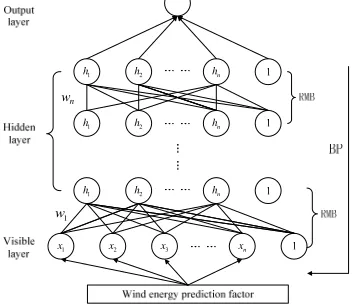
After the deep belief network training is completed layer by layer, the network needs to be finely tuned to optimize network weights, making it be the best network. BP neural network is multi-layer forward feeding network based on error back propagation, with strong optimization capabilities and fault tolerance, it corrects weight by the steepest descent method, which is very suitable for finely tuned DBNs network.
Its trimming process is: after the input of first layer through a few of RBM layers, the output of the last layer is obtained, comparing the output with the expected output, the error term is generated and the error is transferred in a direction opposite to the network training layer by layer, corresponding network weights are updated, process is repeated until the error is within the allowable range, the structure shown in Fig.2.
1 h
1 h
2 h
2 h
n
h
1
h h2 hn
1
x x2 x3
n
h
n
x n
w
1
w
Figure 2. Finely tuned DBNs.
Results and Analysis
This paper takes wind energy turbine from a wind farm in western China as experimental subjects, selecting 28-day numerical weather prediction data and history of wind energy data as the experimental data, taking the data of first the 27 days as the training set and the data of the 28th day as a test set. According to the literatures [9, 10], set the relevant parameters.
[image:4.612.215.392.445.597.2]order to avoid accidental experiment. The experimental result is the average of 10 times prediction. Prediction using multi-step prediction method, i.e. taking the predicted value of the previous time as the true value and together with processed other factors are added to the input of the network, while removing the farthest historical data from the current forecasting point, updating the network and the wind energy at next time is predicted.
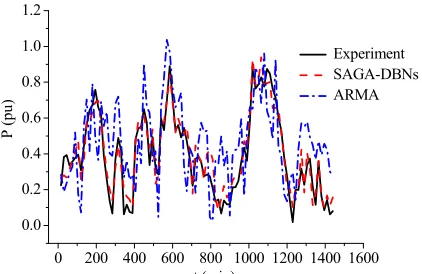
The wind power turbine is conducted to experiment by using this paper’s algorithm, radial basis function and autoregressive moving average models. The result is shown as following figure.
0 200 400 600 800 1000 1200 1400 1600 0.0
0.2 0.4 0.6 0.8 1.0 1.2
P (pu
)
t (min)
Experiment SAGA-DBNs RBF
Figure 3. Prediction results comparison between SAGA-DBNs and RBF.
0 200 400 600 800 1000 1200 1400 1600 0.0
0.2 0.4 0.6 0.8 1.0 1.2
P (pu
)
t (min)
Experiment SAGA-DBNs ARMA
[image:5.612.202.413.334.471.2]Figure 4. Prediction results comparison between SAGA-DBNs and ARMA.
Table 1. Errors between prediction results and experimental results.
Index SAGA-DBNs RBF ARMA MAE (%) 9.21 13.92 21.34
RMSE (%) 10.96 16.10 22.77
Summary
This paper established a short-term wind energy prediction model combining simulated annealing algorithm and deep belief networks. The predicted results of this paper are compared with experimental data. The comparison results show that this model has a powerful nonlinear mapping ability and higher prediction accuracy and speed than those of traditional prediction methods.
Acknowledgement
This research was supported by Gansu Natural Science Foundation (No.148RJZA033) and Gansu University Basic Research Fund Project (No.213056).
References
[1] H. Peng, F. Liu, X. Yang, A hybrid strategy of short term wind power prediction, J. Renew. Energy. 50(2013)590-595.
[2] I. Sanchez, Short-term prediction of wind energy production, J. Int. J. Forecast. 22(2006)43-56. [3] G.H. Riahy, M. Abedi, Short term wind speed forecasting for wind turbine applications using linear prediction method, J. Renew. Energy, 3(2008)35-41.
[4] G. Fan, W. Wang, C. Liu, et al, Wind energy prediction based on artificial neural network, J. Proceedings of the CSEE, 28(2008)118-123. (in Chinese).
[5] A. Tascikaraoglu, M. Uzunoglu, A review of combined approaches for prediction of short-term wind speed and power, J. Renew. Sust. Energ. Rev. 34(2014)243-254.
[6] J. Schmidhuber, Deep learning in neural networks: An overview, J. Neural. Networks, 61(2015)85-117.
[7] L.N. Roux, Y. Bengio, Representational power of restricted Boltzmann machines and deep belief networks, J. Neural Comput. 20(2008)1631-1649.
[8] J. Qiao, G. Pan, H. Han, Design and application of continuous deep belief network, J. ACTA Automatic Sinica, 41(2015)2138-2146.
[9] J. Xie, X. Xu, B. Chen, et al, Optimized scheduling of electrical vehicle network based on genetic simulated annealing algorithm, J. China Mechanical Engineering, 18(2007)1697-1700. ( In Chinese).