Union learning representatives: Micro, meso and macro level
workplace learning opportunities
ELISABET WEEDON
University of Edinburgh, United Kingdom
LYN TETT
University of Huddersfield, United Kingdom
Abstract
This paper explores the role of union learning representatives (ULRs) in providing learning in the work place for migrant workers in a large British private sector company. It focuses specifically on the role of ULRs in supporting the English language learning of Polish immigrants working as bus drivers in Scotland and their learning experiences. It considers: the role played by the ULR in brokering and managing workplace learning and how the union – employer partnership was developed; the benefits of workplace learning for the ESOL learners and the role played by the ULRs in supporting learning. In addition, it examines how far this model of workplace learning is transferable to other workplaces. It concludes that this example of ULR-mediated learning has been effective in promoting learning at the micro and meso levels but questions whether this beneficial impact can lead to the mainstreaming of ULR-led learning at the macro level across all workplaces.
Keywords: Union learning representatives (ULRs), workplace learning, migrant workers, English for Speakers of Other Languages (ESOL)
Introduction
female manual employees (Unionlearn, 2008).
One of the UK’s biggest problems with regard to training provision is the so-called “training apartheid” phenomenon in which those with lower-level academic qualifications are less likely to receive training than are their better-qualified more senior colleagues (Ashton, 2004; Westwood, 2004). According to the most recent Eurostat data, only 9.6% of those aged 18-64 in the UK with ISCED level 0 – 2 (Note 1) qualifications participated in education and training, compared to 28.5% in Sweden (the average for EU 27 was 11%). In contrast 25.5% of those with ISCED level 5 – 6 qualifications in the UK received further training. In Sweden the equivalent figure was 35.9% and for the EU27 15% (Eurostat, 2013). These figures indicate a divide in access to training between those with low and those with high qualifications in the UK that is greater than in many other European countries. Within workplaces with ULRs, however, Hoque and Bacon found that there was “some evidence of greater equality in the distribution of training, particularly where older workers, workers with intermediate-level qualifications and part-time workers (in relation to training incidence) are concerned” (Hoque & Bacon, 2008, p. 723). This was influenced by the role of the ULRs as “volunteer learning advocates [who build on the characteristics that] they share with their colleagues” (Ball, 2011, p. 57) because they often have a shared history of previous non-participation in learning. TUC policy sees the development of learning and skills opportunities for members as a “core activity” (Unionlearn, 2008, p. 2). Individual unions are also reported to have enthusiastically promoted learning opportunities, in part to demonstrate the on-going importance of unions to existing and potential members (Findlay, Findlay, & Warhurst, 2007).
URLs then play an interesting role in promoting learning in workplaces and this paper draws on documentary evidence and qualitative data gathered as part of a larger ESF funded evaluation entitled Skills for Scotland: learning for and in businesses (see Weedon, Riddell, Tett, & McGovern, 2011). It focuses on two ULRs in a large private sector company and examines their involvement in providing learning of different kinds for Polish immigrants in a large Scottish city. It considers issues in relation to ULR-mediated learning and the benefits and barriers to workplace learning. The key questions addressed are:
1. What is the role played by the ULR in brokering and managing workplace learning and how has the union – employer partnership developed?
2. What are the benefits of workplace learning for the ESOL learners, what are the barriers and what role is played by the ULRs in supporting learning?
3. To what extent is this model of workplace learning transferable to other workplaces?
Methodology
Table 1: Overview of participants
No of interviews Bus drivers/Learners 11 Union Learning Representatives (ULRs) 2 Bus company training manager 1
Course tutors 2
Union staff 2
Total number of interviews 18
The interviews with the learners, the two ULRs and the training manager took place in one of the two bus depots – Lakeside and Eastfield. Interviews with drivers either coincided with a driver’s break-time or end of shift and they were conducted in English. We considered using a Polish speaker; however, as the drivers were learning English they wanted to practise speaking the language. Although the drivers were willing and keen to participate, it was extremely difficult to arrange the interviews as the time they had available was short. In addition, the drivers were subject to last minute changes to their rota which meant that they often did not turn up as arranged and a new time had to be set for the interview. The interviews with union staff took place at the university, one course tutor was interviewed at a meeting place in the city and one was interviewed by phone. The interviews lasted around 45 minutes to one hour. The interviews took place during the period October 2009 to June 2010. The interview data were analysed thematically and used to write up a case study of the workplace. The case study incorporated the different perspectives of ULRs, union representatives, the learners (drivers), the tutors and the company training manager. In order to ensure confidentiality, the names of the interviewees and the two bus depots are fictitious.
Findings from the project
This section starts with an overview of the company and the learning centres followed by a description of the characteristics of the drivers/learners. The data are then examined with a particular focus on:
• the union, the Union Learning Representatives (ULRs) and the development of workplace ESOL learning, and
• promoting and supporting learning.
The company and the learning centres
The bus company had grown from being a small Scottish company to a large international company. It had separate operating companies in several cities; each of these had its own Board of Directors and set its own targets but were accountable to the parent company.
chairs, lots of posters on the wall and a range of information leaflets. It was a hub of activity and clearly a very welcoming place. The ULR was based here for most of the day as were a number of tutors. There was a steady stream of employees, mainly drivers coming into the centre; some to attend classes, others to use the computers or as a place to go for their break. One of the Polish drivers explained that the canteen, which was old and leaky, was not a welcoming place. Seating in the canteen was based on seniority; new and foreign drivers ended up in the bit that was often wet. This suggested a contrast with the learning centre where relationships seemed informal with a lot of banter.
The learning centre at Eastfield was similar but smaller than the one at Lakeside. It had computers but not much space for socialising; however, it was close to the locker/changing room which afforded more space. That depot also had a TV room, snooker table and a gym; staff had to pay to use the gym.
The learners
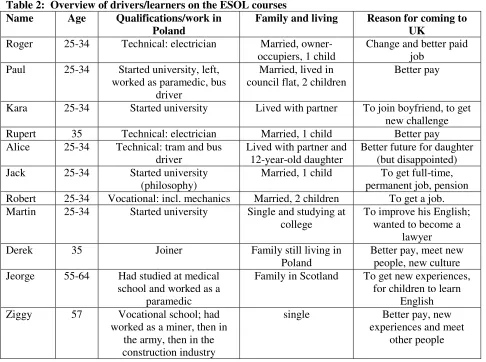
[image:4.595.65.551.386.748.2]As can be seen from Table 2, the majority of the drivers were young and they had come to the UK to improve their living conditions. A relatively large number had started university but dropped out, often for financial reasons. Most had their families living with them or were about to join them. Many were ambitious and keen to use any opportunity for learning to improve their living conditions and as an access to a better job. All the drivers had to pass a basic test in English before being offered employment.
Table 2: Overview of drivers/learners on the ESOL courses Name Age Qualifications/work in
Poland
Family and living Reason for coming to UK
Roger 25-34 Technical: electrician Married, owner-occupiers, 1 child
Change and better paid job
Paul 25-34 Started university, left, worked as paramedic, bus
driver
Married, lived in council flat, 2 children
Better pay
Kara 25-34 Started university Lived with partner To join boyfriend, to get new challenge Rupert 35 Technical: electrician Married, 1 child Better pay Alice 25-34 Technical: tram and bus
driver
Lived with partner and 12-year-old daughter
Better future for daughter (but disappointed) Jack 25-34 Started university
(philosophy)
Married, 1 child To get full-time, permanent job, pension Robert 25-34 Vocational: incl. mechanics Married, 2 children To get a job. Martin 25-34 Started university Single and studying at
college
To improve his English; wanted to become a
lawyer Derek 35 Joiner Family still living in
Poland
Better pay, meet new people, new culture Jeorge 55-64 Had studied at medical
school and worked as a paramedic
Family in Scotland To get new experiences, for children to learn
English Ziggy 57 Vocational school; had
worked as a miner, then in the army, then in the construction industry
single Better pay, new experiences and meet
The union, the Union Learning Representatives (ULRs) and the development of workplace ESOL learning
The union was recently formed by a merger of two other unions. Its Scottish branch had an Education Development Officer and funding from the Scottish Union Learning Fund (SULF) was mainly used to employ three Union Learning Organisers. These were staff working at the union headquarters supporting ULRs across different workplaces. ULRs had an entitlement to time off to undertake their duties (Unionlearn, 2012). One of the main aims of the union learning fund was to encourage partnerships between unions and employers to promote learning in the workplace. The Union Education Development Officer explained that they had obtained funding to develop such provision for a three-year period – 2008-2011 – with the aim of fostering workplace learning:
… that’s what the Scottish Union Learning fund does, it brings workplace learning in to the workplace, and you’ve [some] really good employers … who see the value of it. … What we try and do is we get union learning reps trained, so we ask the company to release them and once we get them trained, we give them the skills to identify learning needs among the workers and then you start talking to workers about forming a learning partnership (John, Union Education Development Officer)
In this workplace, the union convenor and the full-time union learner organiser were mainly responsible for setting up the learning partnerships and making arrangements for ULRs. This was explained by Drew, the Eastfield ULR:
the main Union Convener … negotiated for us to get the paid release, the learning reps thing, and get the facility and he talked the company round to supplying us with all the computers, getting them on the Internet and this was really the only sort of office we had available (Drew, ULR, Eastfield).
Pete, the full-time Union Learning Organiser elaborated further on this process:
… the new route that we take is that we sell this as learning organisers, where the learning reps are identified, what we tend to do is … meet the company, try and get a learning agreement and set up a learning contract which again varies from workplace to workplace. … It’s normally just a loose agreement and what we tend to do is set up a learning committee (Pete, Union Learning Organiser).
He further explained that there was quite a lot of variation between companies in the way they responded to the union, and the union encouraged those on the ground to use learning hours as a bargaining point:
…the best two [companies] that we’ve got … have in their contract now every worker will be guaranteed at least 50 hours learning a year. In a lot of companies it’s hard to pin that down, we’re trying to tell our officers in the economic climate that ‘look you ain’t going to be going in and coming out with 10% pay rises, maybe this is a great opportunity to look at [whether we] can get learning hours, things that companies might be more prepared to [offer]’, so it’s using experience and acumen to get things there as well (Pete, Union Learning Organiser).
English could lead to Health and Safety breaches:
…from a trade union point of view there were issues because people … might have had basic English but when it came to workplace safety actually in the workshops or else driving a bus and checking a bus then there were issues there and we flagged them up. But to be honest that was how we really got the partnership up and running because there was a trade-off there. We threatened with the health and safety as you do! (Pete, Union Learning Organiser).
Whilst there was this element of threat from the union, Pete pointed out that the company had benefited from higher staff retention. The training manager was of the view that the relationship between the union and the employer was beneficial to both parties and generally amicable:
Well my impressions are that [the company] and [the union] have a good close working relationship, you know, they still stand up for what they each believe in, they stand up for their members but I think they do strive for the benefit of the employee at the end of the day (Simon, Company Training Manager).
According to Stuart, the ULR at Lakeside, the company was extremely supportive of his role and it seemed that the partnership worked well in this particular setting:
There is no hindrance with them [the company] and never had any problems, they are always willing to help, you know, especially together with the union, you know (Stuart, ULR, Lakeside).
However, Drew, the ULR from the Eastfield depot, felt that the immediate management at his depot were not totally committed. In contrast, senior management at the Head Office were more committed as evidenced through their involvement in setting up awards for learners and supporting the publication of their short stories.
Pete also elaborated on the way that learning committees were organised and stressed the need for senior management involvement for it to work:
The learning committees … we always insist that there’s a senior management person there, more so in local authorities … because they tend to put in a layer of middle management who aren’t decision-makers so that the committee then becomes irrelevant, you need senior management …so that if they agree something decisions will be acted on, so that’s something that we always insist on in the learning contract (Pete, Union Learning Organiser).
In addition to developing union – employer partnerships, the union also elaborated on the importance of the partnerships that they had entered into with colleges and local authorities to deliver learning. They had had a long-term partnership with one particular college to deliver accredited training to the union representatives and this had extended into collaboration in offering ESOL in the workplace at the bus company. Funding came from an ESF-funded three-year project aimed at upskilling the workforce. Literacy tuition had been provided through a partnership with a local council.
both worked a three hour shift in the morning but the remainder of the day was spent as a ULR.
The company had started to recruit drivers from Eastern Europe in 2005, after several Eastern European states had joined the EU in 2004, due to a shortage of local labour as explained by the training manager:
At the end of it all we had something like 300 Eastern European workers, about 200 of which were drivers. So it was about 10% of the driving force in here, you know, quite significant numbers and it helped at a time when it was difficult to recruit and we were faced with a driver shortage … I don’t know what we would have done without that intake of Eastern Europeans, certainly we were short of drivers and it wasn’t a question of… not giving them to the people that live locally. First of all we advertised [locally] for years, the press, the busses, there just wasn’t the uptake (Simon, Company Training Manager).
The ESOL courses were initially funded by the company; however, through the partnership with the union they were able to participate in the ESF-funded project reported on here. The ULR at Lakeside estimated that around 80 to 90 drivers had completed the ESOL courses at various levels. That would suggest that around 40% of the eastern European drivers had engaged in ESOL learning.
The union, or at least those involved with education and training, had clearly embraced the new roles and opportunities provided by the union learning fund. The bus company focused on in this case study seemed to be operating in a successful partnership with the unions and had contributed to the learning agenda through the provision of learning centres and computers with internet access. They had also gained through having a better qualified workforce and, perhaps more important for them, their staff retention rate had improved. This suggests a beneficial impact of the creation of the union learning fund and the development of the ULR role.
The next section explores the development of the learning opportunities, the nature of the relationship between the ULR and the learners as well as challenges in providing learning in the workplace.
Promoting and supporting learning
The interviews with the ULRs as well as with the learners identified what was considered the key aspects of workplace learning. This included a strong focus on individual learner needs as well as flexibility in the delivery.
The needs of the learner
It was clear from the interviews that there was a strong emphasis on the individual which focused on the needs of the learner rather than only on the demands of the workplace and that learning was adapted and tailored to the individual learner’s needs. Lakeside was the main/hub learning centre which supported the other centres. Stuart therefore had a role which extended to supporting the other learning centres as well as organising the learning in his own depot. According to him, it was essential to take the learner’s needs into account when trying to foster a positive attitude to learning:
them in, likes of Jim over there, he is retired, he was a retired cleaner, and he never switched a computer on in his life, he didn’t know how to do anything like that with computers. But we have managed to get him involved and now he is retired he is writing his life story, he comes in every Tuesday (Stuart, ULR, Lakeside).
He also recognised that flexibility was crucial in a setting where shift work was the norm and where people’s shifts changed regularly and unpredictably:
… it’s a lot to do with the job, you know, because bus driving can be… one week you can be up at four in the morning, next week start at four in the afternoon, and they could be on a spread over starting at seven and finishing at seven, so you have got to kind of fit in, you know (Stuart, ULR, Lakeside).
Flexibility was also needed in terms of the range of provision and mode of learning and this was reflected in the range of learning opportunities offered through the learning centres such as ESOL, literacy, ICT and conversational Spanish. Although our main focus was on the ESOL learning it was evident that the other opportunities on offer enabled access to English language learning in a range of different ways:
We have looked at all the different avenues that we can go down to sort of keep this going. So that’s how we come in with Tribal Gold [online learning], we got Graeme [ESOL tutor] down from [the union offices], we have got the adult literacy and they have been very good [in helping to teach the ESOL learners] as well, because at first they were sort of ‘hang on we don’t teach ESOL’ (Stuart, ULR, Lakeside).
This flexibility and accessibility was valued by the learners. Classes were arranged two days a week with classes in the morning as well as in the afternoon. This allowed drivers to fit the class in with their shifts. The tutor stayed in between classes which meant that learners could speak to the tutor if they had missed classes because of their shifts or if they were stuck on something specific:
If he [tutor] was in here and he was waiting between that lesson and he had time off you could come to him and just learn a wee bit, or he helped to understand some letter, or just speak to him (Kara, driver).
And
Because of our work, we work shifts, Graeme [tutor] stayed here for a whole day because lessons were from 10 until 12 and then from 5 until 7 so Graeme stayed here all day long so we came here and ask or speak to Graeme whatever, any time. He had a break but basically he stayed here, two days each week (Rupert, driver).
In addition, when learners wanted to go beyond the learning in the workplace, Stuart acted as broker by helping them identify college courses and funding for these courses. This was important for a number of the foreign drivers as they were unfamiliar with the educational system:
I have had a few drivers that have come here and they have asked me they want to do this and want to do that. What I do is I contact the colleges and find out and also try to get them funded you know, from different places (Stuart, ULR, Lakeside).
workplace at level 4 and level 5 was being developed. However, it was possible to attend classes without doing the assessments and, in addition, literacy provision, which was mainly intended for native speakers, was also made available to those foreign drivers who wanted to participate. There were differences between learners in the extent to which they felt a formal qualification was of importance and there were a few who had moved from the onsite learning into college courses.
In summary, there were opportunities to access learning in a number of different ways and the teaching and learning focused strongly on individual learner need. There was a strong emphasis on providing learning for those who had previously missed out, such as the retired cleaner who featured in the quote above. In addition, the ULR provided support akin to a mentor or counsellor. This is explored in the following section.
Developing relationships
The relationships the ULRs developed with the learners were an important aspect of the overall culture in the learning centres. This included helping the learners with day-to-day issues as well as encouraging them to adopt habits that helped develop their English:
… I used to go to their homes and help them with different things, and some of the problems … you walk into the house, they shut the door, right, you could be in Poland, because he is speaking Polish, his wife is speaking Polish, his children are speaking Polish, and they got the Polstart (Polish TV channel). I says to him ‘look, you are never going to learn if everything is Polish, the best thing to do is get rid of this Polstart TV, try and watch TV but watch Scottish television, something English’. So a few of them started doing that, you know, and that worked (Stuart, ULR, Lakeside).
The learners explained that this support had been vital, especially when they first arrived:
Yeah especially when I came here he helped us with many things, driving license … the bills for electricity or gas supply, if you have to speak to them you have to wait, you have to use call centres, they sometimes speak very difficult, so he helped to translate. At the beginning was many problem, I had many problems, all of we had many problems and Stuart helped us with this. Very good idea to have him there – especially for us (Paul, driver).
And
Yes he helped with me with my application in here, he helped me to translate words for the test, on beginning when I start to drive the buses he helped me to learn that [local dialect] saying about tickets … and everything, sometimes when I need to call and I don’t know what to say he helped me. We are still in contact with Stuart so when he needs my help or he’s saying listen you should come and learn something right now, he’s come to me (Kara, driver).
Pastoral support and a range of learning opportunities were clearly important ingredients in promoting workplace learning. However, there were also some challenges in participating in learning in the workplace as can be seen below.
Barriers to learning
because of other commitments such as the stress of shift working or family demands:
I could …[come] only in the morning … but if Dave [tutor] got the lessons in the evening, I did not come because actually I start work 4 o'clock in the morning so I wake up, half past 2, I finish work about 3 and then I have to buy something to eat and cooking and when I go into house there is about 5 o'clock and the lessons start 5, so when I come here to lesson and learn English, finish 7 o'clock and I will be back to home that would be 8 o'clock so I will be sleep about 4 hours, that is not enough for me, that is all day, that is why I was coming only to morning [classes] (Alice, driver).
Alice also had a 12-year old daughter who she did not want to leave alone for too long. Dave, the tutor who took over from Graeme, identified some further challenges with teaching in the workplace. One was that the main focus for the drivers/learners was their job and that they had to make compromises in order to attend the classes. This at times led to disruption because students had to leave in the middle of a class to start their shift. For him as a tutor there were also some practical difficulties such as the lack of dedicated teaching space with good equipment. This impacted on aspects of the teaching such as the listening exercises.
It is evident from the account above that there were real benefits to union-mediated learning in the workplace for the learners as well as for the company. These benefits include the access to a range of learning opportunities in the workplace as well as elsewhere, a learner-centred approach to learning, flexibility in terms of delivery and a supportive environment. There were also challenges which related to working practices of the company, personal circumstances of the learners as well as lack of equipment in the learning centre.
Discussion and conclusion
Any analysis of workplace learning needs to take into account the ‘milieu of asymmetrical power relationships and the social structures in which people are embedded’ (Bratton, Helms Mills, Pyrch, & Sawchuk, 2004, p. 2) and trade unions face an educational and employment terrain that is largely defined by the employer. Stroud & Fairbrother (2008a), drawing on research in the steel industry, have argued that union involvement in workplace learning can be marginal and consolidate ‘outdated and historically entrenched (regressive) practices’ (p. 15). However, the ULRs in our study evidently played a central role in brokering and managing workplace learning. In this workplace their role was extended to include informal assistance with the local dialect as well as support in a range of other matters. It could therefore be argued that the partnership developed between the union and the company had brought benefits to those employees who chose to engage with the learning. The drivers/learners included in this case study felt that the learning centre offered flexible and accessible learning opportunities of both a formal and informal nature. Some of the drivers focused more on the informal aspect whilst others wished to progress and gain certificates, but they were all positive and pointed out the benefits they had gained from their learning.
dedicated teaching space and particular types of equipment also limited some of the provision.
It was clear that the union had developed a partnership with the employer that was beneficial for employees who chose to engage in learning. A learning agreement was in place between union and employer, and ULRs were given time off to perform their duties. The ULR at Lakeside, the lead learning centre, was proactive in identifying learning opportunities for the employees, either through sourcing learning that was then delivered in the learning centres or in finding places, for example, at a local college, for learners wishing to do classes that were not available at the learning centre. The learning centre provided excellent opportunities for informal learning and the ULR provided support to the migrant workers beyond his learning remit. In addition, the employer benefited from a more content and competent workforce as indicated by their increased staff retention. The employer could also use the learning centre for some aspects of their training. From the union’s perspective, the learning agreement and the ULR provided an opportunity for recruitment as the learning was open to all irrespective of union membership. However, it was difficult to assess this aspect as all the drivers we spoke to had joined the union on their arrival.
The employer and the union could be seen to be responding to the demands of the Scottish Government’s Skill Strategy (Scottish Government, 2007). The employer was facilitating access to learning, working with learning providers, and they were aware of the benefits to their performance of training. The unions were supporting the development of ULRs and working in partnership with the employer. Individual employees who took part in the ESOL classes were taking an active role in their own learning and working with their ULR to identify learning needs.
Our research therefore seems to offer evidence for a partnership that was working well particularly because the ULRs were supported by the employer. It could be seen to provide further evidence to supporters of the development of union-employer partnerships such as Munro and Rainbird who argued that learning partnerships provide new opportunities for unions to influence workplace practices and to provide learning to those who have limited opportunities (Munro & Rainbird, 2004). A further benefit noted by Wallis, Stuart, and Greenwood (2005) was that the union was effective in widening participation and, although not discussed in depth in this paper, our observations of the learning centre demonstrated access to those least well qualified. The beneficial aspects of union membership was in evidence beyond the access to learning as one driver had required legal support after an accident and another driver who failed to develop sufficient language skills had been retained for an alternative position. In both cases it was union action that ensured that the drivers were supported. However, as noted in the literature (e.g. Hoque & Bacon, 2008) positive aspects of union-employer partnerships were not necessarily replicated more widely across other workplaces. The interviews with the full-time union officials supported this view and pointed towards a considerable unevenness in the extent to which employers were willing to enter into such partnerships.
training provision and trade union involvement in determining provision. McIlroy (2008) stresses the precarious nature of the government-union relationship and this is particularly pertinent with the change to a UK Conservative-led Coalition Government that is traditionally anti-union. In Scotland there is an agreement between the STUC and the Scottish Government for union learning funding to be extended to the end of 2013; however, any change of government in a time of recession is likely to impact detrimentally on future funding.
This leads to concern about the stability of present employer – union partnerships. In this particular study, the employer provided a learning centre, computers and initially some funding for learning but the expectation seemed to be that the ULR and the union would take the main responsibility for sourcing externally funded learning. During a recession this may become more problematic and support from the employer may decrease if budget cuts impact on the company’s profitability. It is clear that ULR-led learning initiatives are still on the fringes of employer training initiatives. Stoney stressed this when reflecting on learning partnerships. He noted the fragility of such partnerships and that it may be some time before workplace learning becomes central to work rather than being seen as “a negotiable and expendable extra” (Stoney, 2002, p. 67). Perhaps the question that needs to be raised is whether they will ever become part of mainstream provision implemented at the macro level or remain successful only at the micro and meso levels.
Notes
1. ISCED level 0-2 refers to education up to lower secondary; ISCED level 5-6 refers to degree level qualifications. ISCED stands for International Standard Classification of Education.
2. SQA stands for the Scottish Qualifications Authority; SQA qualifications are recognised nationally.
References
Ashton, D. (2004). The impact of organisational structure and practices on learning in the workplace. International journal of training and development, 8(1), 43-53.
Ball, M. (2011). Learning, labour and union learning representatives: Promoting workplace learning. Studies in the Education of Adults, 43(1), 50-59.
Bratton, J., Helms Mills, J., Pyrch, T., & Sawchuk, P. (2004). Workplace learning: A critical introduction. Toronto, ON: Garamond Press.
Eurostat. (2013). Participation in education and training by sex, age groups and educational attainment (trng_lfs_02). Retrieved from Eurostat database http://edin.ac/15fiEbm
Findlay, J., Findlay, P., & Warhurst, C. (2007). Estimating the demand for union-led learning in Scotland. London, UK: Unionlearn. Retrieved from http://edin.ac/ZKLvTJ
Hoque, K., & Bacon, N. (2008). Trade unions, union learning representatives and employer-provided training in Britain. Journal of Industrial Relations, 46(4), 702-731.
McIlroy, J. (2008). Ten years of New Labour: Workplace learning, social partnership and union revitalization in Britain. British Journal of Industrial Relations, 46(2), 283-313.
assessment of UNISON/employer partnerships on learning in the UK public sector. Industrial Relations Journal, 35(5), 419-433.
Scottish Government. (2007). Skills for Scotland: A lifelong skills strategy. Edinburgh, UK: Scottish Government.
Stoney, C. (2002). Partnership and workplace learning in the UK: Pioneering work at British Telecommunications plc. Journal of Workplace Learning, 4(2), 58-67.
Stroud, D., & Fairbrother, P. (2008a). Workplace learning: A trade union failure to service needs. Journal of Workplace Learning,20(1), 6-20.
Stroud, D., & Fairbrother, P. (2008b). The importance of workplace learning for trade
unions: A study of the steel industry. Studies in Continuing Education, 30(3), 231-245.
TUC. (2004). Winning for learners: A TUC handbook for ULRs. London, UK: TUC.
Unionlearn. (2008). Opening doors to learning: Union learning representatives survey report 2008. London: Unionlearn with the TUC.
Unionlearn. (2012). Annual Report 11/12, London, UK: Unionlearn with the TUC. Retrieved from http://www.unionlearn.org.uk/publications/unionlearn-annual-report-2012
Wallis, E., Stuart, M., & Greenwood, I. (2005). ‘Learners of the workplace unite!’: An empirical examination of the UK trade union learning representative initiative. Work, Employment and Society, 19(2), 283-304.
Warhurst, C., Findlay, P., & Thompson, P. (2007). Organising to learn and learning to organise: Three case studies on the effects of union-led workplace learning (Research paper 2). London, UK: Scottish Centre for Employment Research/unionlearn with the TUC. Retrieved from http://www.unionlearn.org.uk/sites/default/files/2.pdf
Weedon, E., Riddell, S., Tett, L., & McGovern, M. (2011). Skills for Scotland: Learning in and for businesses. Edinburgh: CREID. Retrieved from http://edin.ac/138emhl
Westwood, A. (2004). The skills that matter and the shortages that don’t. In C. Warhurst, I. Grugulis, & E. Keep (Eds.), The skills that matter (pp. 38–54). Basingstoke, UK: Palgrave Macmillan.
Authors’ profiles
Dr Elisabet Weedon is Deputy Director of the Centre for Research in Education Inclusion and Diversity and a Senior Research Fellow at the Moray House School of Education, University of Edinburgh. Her main research interests are in the area of workplace learning, higher education, social justice and equality in education. She is currently involved in projects on higher education and educational experiences and outcomes for Muslim pupils in England and Scotland.