2017 2nd International Conference on Advances in Management Engineering and Information Technology (AMEIT 2017) ISBN: 978-1-60595-457-8
An Improved Fuzzy C-Means Clustering Algorithm
Based on Potential Field
Yuan-hang HAO, Zhu-chao YU
*, Xin GAO and Si-di WANG
School of Business Administration, Northeastern University, Shenyang, China
*Corresponding author
Keywords: Fuzzy C-means, Clustering, Potential field, Electrical rules, Data field.
Abstract. In the area of recommendation system, clustering is an effective way to find similar users and reduce the complexity of recommendation algorithm. A good clustering result has two characteristics: maximizing compactness within cluster and maximizing separation between clusters. Following laws of attraction and repulsion, electric charges in an electric potential field have the same feature as clusters. Based on potential field, an improved Fuzzy C-Means (FCM) clustering algorithm is proposed, which is called EFCM (Electrical FCM). This algorithm combines the basic electrical rules of potential field, Coulomb's law and data field theory to obtain better clustering results. The experiment results show that the improved EFCM algorithm not only obtains good initial cluster centers, but also helps to improve the process of iterative updating.
Introduction
Today, e-commerce is influencing every field of our society, making it possible to book a hotel online. The increasing hotel information expanded the personal choices and freedom of consumers, however, it also led to information overload. As a result, the hotel recommendation algorithm came into being. The foundation of recommending hotels is based on the user ratings. The common approach is to recommend according to the similarity of user's interests. Cluster analysis is an effective method in finding out similar users and reducing complexity of the recommendation algorithm. Maryam etc. [1] proposed a developed collaborative filtering algorithm combining with the clustering algorithm, which prompted the accuracy of recommendation and solved the sparse problem of the data.
The traditional clustering algorithm is a crisp assignment of data to clusters, which means that the sample data can only belong to a certain cluster. The crisp assignment means there is a sharp boundary between two clusters. However, many objects do not have a strict characterizing attribute, and there are no sharp boundaries between clusters in most cases. In order to solve this problem, Zadeh [2] proposed the concept of fuzzy clustering, which offered an efficient tool used for soft assignment of data. In fuzzy clustering algorithm, the data can belong to more than a certain catalogue and the membership grades of each of the data points are on behalf of the degree of that the point belong to each cluster.
In order to solve the fuzzy clustering problems, many scholars proposed heuristic and meta-heuristic algorithms. The fuzzy C-means (FCM) algorithm is one of the most practical methods of fuzzy clustering. The idea of this algorithm is to achieve the goal of data classification through the membership degree of each sample data belonging to a class. The good clustering result has two characteristics: one is to achieve maximum compactness within cluster; the other is to achieve maximum separation between clusters [3]. However, fuzzy C-means (FCM) algorithm, which is very sensitive to the noise points and the initial center points, is unable to find the global optimum. Therefore, the result cannot reach the goal of highest compactness within clusters and highest separation of clusters, which means that it is difficult to find the global optimum.
field through the interaction of attraction and exclusion is similar to objective of the fuzzy clustering. There is a greater repulsive force between different clusters that makes clusters more separate and data in the same cluster more compact, which can reduce the impact of weak noise points. In addition, the theory of data field based on the concept of physical field can help us to get the center of the potential field in the data space. The number and location of the potential centers offer a very important reference for determining the number of clusters and selecting the initial cluster centers. This can improve the defect of traditional FCM algorithm that the initial clustering centers is overly sensitive. Kumar etc. [4]proposed a hybrid approach to solve the problem of random initialization of cluster centers. They used BBO—a population based evolutionary algorithm which motivated by migration mechanism of ecosystems. Aldahdooh and Ashour [5] proposed a selection method for initial cluster centroid in K-means clustering instead of the random selection method. In recent years, under the inspiration of social and natural laws, the researchers have combined fuzzy clustering algorithm with other algorithms such as genetic algorithm, ant colony optimization algorithm and particle swarm algorithm and achieved great success. The EFCM algorithm proposed in this paper improves the selection process of initial clustering centers and iterative updating process of traditional FCM algorithm based on the theory of charge interaction, Coulomb's law and data field theory, which makes the algorithm more realistic. Experiments can be used to prove the advantages of the improved EFCM algorithm compared to the traditional FCM algorithm.
Theoretical Basis
Fuzzy C-means (FCM) Algorithm
The fuzzy C-means clustering (FCM) algorithm was originally proposed by Dunn and later developed and promoted by Bezdek. The algorithm can find out the membership matrix and clustering centers minimizing the objective function by constantly iterating and updating, and finally divides the data into multiple clusters. The form of the objective function is shown in equation (1):
2 2
p
1 1 1 1
min min .
c n c n
m m
ik ik ik k i
i k i k
J u d u X V
= = = =
=
∑∑
=∑∑
− (1)where c is the number of clusters; n is the number of data objects; the parameter m∈[1,+∞] is called the fuzzy weighting factor; Vi represents the cluster center of the i-th cluster; Xk is a vector
representation of the sample data points; Xk−Vi 2 represents the Euclidean distance between k X
and Vi; uik indicates the membership degree that the sample data Xk belongs to the cluster of Vi,
which satisfies
∑
∑
= = = = ≤ < = ≤ ≤ n k ik c i ik
ik u u ni c k n
u 1 1 , 2 , 1 , , , 2 , 1 , 0 , 1 , 1
0 … … .
In this process, the equations (2) and (3) are respectively used to iterate the membership degree and the clustering center.
. 1 , 1 , 1 1 1 1 2 ) ( 2 ) ( ) 1
( i c j n
V X V X u c k m t k j t i j t
ij ≤ ≤ ≤ ≤
− − = − = − +
∑
(2) -1 1 1 ,1 . n n m mi ik k ik
k k
V u X u i c
Coulomb's law is one of the basic laws of electromagnetics. Coulomb's law is described by mathematic formulae as follows:
1 2 2 . kq q F
r
= (4)
where, represents the quantity of charge on object 1 (in Coulomb’s), represents the quantity of charge on object 2 (in Coulomb’s), and r represents the distance of separation between the two objects(in meters). The symbol k is Electrostatic constant, and is also called the Coulomb’s constant.
Data field theory
Data field is an abstract data space where the energy of data are transmitted from the sample space to the whole data space through the data radiation.
There is a data set in the data space, . At any point in the whole data field, the
value of potential function is as follows:
2
( )
1 1
( ) ( ) .
i
x x
n n
i
i i
x x e δ
φ φ
− −
= =
=
∑
=∑
(5)where, is the Euclidean distance between data objects, is the factor of data radiation that is mainly related to the quantity and distribution of the data, which has a great influence on the distribution of potential field.
In the potential field, the center of the equipotential line (surface) is called the potential center. All of the equipotential line in the data field will be gathered to the potential center. If the potential center is regarded as the data center of a data field in the data space, obviously, it can be regarded as the cluster center. This characteristic will help us determine the cluster center and the number of clusters in the EFCM algorithm.
EFCM Algorithm
We proposed an improved FCM clustering algorithm based on potential field, or EFCM for short. It will update the membership matrix and cluster centers. In the end, data sets complete clustering procedures.
In order to determine the initial cluster center, we can calculate the potential value of each point in space according to the formula (5). Next we can find out local maximum value of the potential field, that is a potential center. In fact, the potential center represents the center of gravity of the same cluster, which is the cluster center. However, potential center will not coincide with the data objects in space generally, so we select the nearest data object as the initial cluster center (according to Euclidean distance).
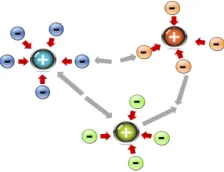
The algorithm in this paper is based on potential field, especially Coulomb's law and there are some basic assumptions as follows:
(1) In data field, the cluster centers represent positive charges and the remaining data represent negative charges;
(2) Clusters are considered as a n-dimensional spatial electric field;
(3) Negative charges (data) in the electric field (cluster) not only interact with the positive charges (cluster centers) in the same electric field, but also interact with the positive charges in other fields.
Figure 1. Clustering algorithm hypothesis diagram.
The objective function of the EFCM algorithm is similar to that of the traditional FCM algorithm, which aims to make the data cluster compact and achieve the maximum separation between clusters. The form of the objective function based on potential field is shown in equation (6):
-1 ,max _
2
1 ,max _
( ) .
( , )
c
i u k k ik
k i k k i u k
q q U
J G
d q q = ∈
× ×
=
∑ ∑
(6)where is the number of clusters, is the center of cluster k, is the data with the highest degree of membership in a cluster k, is the membership function of ith object in kth cluster.
The membership matrix and cluster center are updated iteratively according to the following equation (7) and (8):
-1
1 1
( 1)
2 2
1
.
( , ) ( , )
m m
c
i j i j
t ij
j
i j i j
q q q q
U
D q q D q q
− −
+
=
= ⋅
∑
(7)
-1
1 1
.
n n
m m
k ik i ik
k k
V U q U
= =
= × ⋅
∑
∑
(8)The steps of the EFCM algorithm can be summarized as follows:
Step 1: Calculate the potential center of the data field according to data field theory then determine the number of clusters C and the initial cluster center V.
Step 2: Initialize the membership matrix and the cluster center . Set the threshold of the iteration, and the iteration counter ;
Step 3: Update the membership matrix according to formula (7); Step 4: Update the cluster center according to formula (8);
Step 5: If , stop the process of updating and output membership matrix and cluster center ; otherwise, make and turn to the second step to continue the implementation of the algorithm.
Data Experiment
The purpose of the experiment is to compare the performance of FCM and EFCM clustering algorithms. The experiment chooses two evaluation indicators to estimate the separation of clusters and the compactness within clusters. Furthermore, the process of the experiment is described in more detail below.
The Experimental Data Sets
According to our statistics, the hotels score between 3.7 and 4.9 and the ratings by their users are between 1 and 5. There are some users who scored different hotels. We should pretreat the data and divide the ratings from the same hotel into a data set.
Assessment Index
The algorithm is evaluated by using the separation of clusters and the compactness within clusters. The partition coefficient constructed by Bezdek[3]
2
1 1
1
( ) .
n c
ik k i
PC U U
n = =
=
∑∑
(9)The partition entropy constructed by Bezdek[3]
1 1
1
( ) log( ) .
n c
ik ik
k i
PE U U U
n = =
= −
∑∑
(10)Among them, the larger PC(U), the more compact the cluster, the smaller PE(U), the more isolated the cluster, and the better the clustering algorithm.
Experimentation Process
Step 1: Using the FCM clustering algorithm to cluster the data points. Step 2: Using the EFCM clustering algorithm to cluster the data points.
Step 3: Calculating the values of PC(U) and PE(U) obtained by the clustering results corresponding to the two algorithms.
Step 4: Repeating the above steps to compute the best values, average values and standard deviation of PC(U) and PE(U) for both algorithms.
Conclusions
The electrical fuzzy C-means (EFCM) algorithm has many advantages: (1) Using data field theory to determine the initial clustering centers can not only reduce the time spent in clustering, but also effectively avoid the local optimal solution caused by determining the centers randomly; (2) Changing the data radiation factor can result in a different number of potentials, so that the number of clusters can be adjusted as needed; (3) The improvement of the iterative updating process based on Coulomb's law can better achieve the goal of achieving the maximum separation of clusters and the maximum compactness within clusters. At the same time, through the experimental steps, we can verify whether the clustering algorithm used in this paper makes a beneficial improvement to the traditional C-means fuzzy clustering algorithm.
Acknowledgement
This research is partly supported by the National Science Foundation for Excellent Innovation Research Group of China (Project No. 71171043) and the Humanities and Society Science Research General Project of Ministry of Education of Liaoning (Project Nos. WJ2013046).
References
[1] M.K. Najafabadi, M.N. Mahrin, S. Chuprat, H.M. Sarkan, Improving the accuracy of collaborative filtering recommendations using clustering and association rules mining on implicit data, Computers in Human Behavior, 67(2017) 113-128.
[3] Y.J. Zhang, W.N. Wang, X.N. Zhang, et al, A Cluster Validity Index for Fuzzy Clustering, Information Sciences, 178(2008) 1205-1218.
[4] K. Vijay, C. K. Jitender, K. Dinesh, Initializing Cluster Center for K-Means Using Biogeography Based Optimization, Advances in Computing, Communication and Control, 125(2011) 448-456.