University of South Carolina
Scholar Commons
Theses and Dissertations
12-14-2015
Empirical Connections Between the Construct of
Value, the Quality of Stability, and the Construct of
Regret
William Samuel Morris Jr. University of South Carolina - Columbia
Follow this and additional works at:https://scholarcommons.sc.edu/etd Part of theEducational Psychology Commons
This Open Access Dissertation is brought to you by Scholar Commons. It has been accepted for inclusion in Theses and Dissertations by an authorized administrator of Scholar Commons. For more information, please [email protected].
Recommended Citation
Empirical Connections Between the Construct of Value, the Quality of Stability, and the Construct of Regret
by
William Samuel Morris, Jr.
Bachelor of Arts
University of St. Andrews, 1994
–––––––––––––––––––––––––––––––––––––––––
Submitted in Partial Fulfillment of the Requirements
For the Degree of Doctor of Philosophy in
Educational Psychology and Research
College of Education
University of South Carolina
2015
Accepted by:
Kellah Edens, Major Professor
Michael Grant, Committee Member
Kelly Lynn Mulvey, Committee Member
Kate Niehaus, Committee Member
ii
iii Abstract
The term value is a psychological construct frequently used in the social sciences.
This research addresses the issue of stability of ratings of perceived value of participants
for monetary, tangible, and intangible items that cross contexts. Also elucidated is the
relationship of value to regret. Hypothesis one stated that value would be stable across
time and different rating conditions. Forty-four participants rated the value of 72
stimulus items at two time points and in different contexts. Paired samples t-tests
indicated 28 participants had no statistical difference in scores. Twenty-eight scores out
of 44, when applied to a binomial test, indicates a more than chance proportion of
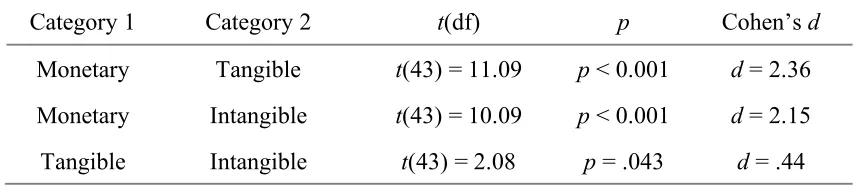
significant scores. The second hypothesis investigated if a difference in stability existed
in monetary, tangible item, and intangible item domains. Paired samples t-tests of
difference scores for all domains of stimulus items grouped by stimulus item category
revealed that all three pair-wise comparisons showed statistical differences. The third
hypothesis stated there was a clear and predictable relationship in the ratings of value and
regret in a blind choice condition. After rating value and regret in a choice condition for
hypothesis three, a statistically significant proportion of the participants fell within the
hypothesized relationship between value and regret. This suggests that the construct of
value has strong, stable, and predictable elements. These results encourage additional
research into the nature of value, and its relationship to regret, to form a more
iv
Table of Contents
Abstract ... iii
Chapter 1. Introduction ...1
Chapter 2. Literature Review ...13
Chapter 3. Methods ...46
Chapter 4. Results ...54
Chapter 5. Discussion ...59
References ...73
Appendix A. Card Numbers and Associated Stimulus Item Descriptions ...87
1
Chapter 1: Introduction
As an underlying principle in many of the social sciences, the psychological
construct of value serves an important purpose. Whether the decision making scenario is
medical and health related, monetary in nature, related to principles of behavior and
relations to others, or a comparative for cultural reference, the idea of value, or a
collection of values, acts as a guide to action.
In economics, value serves as a critical component of research in such areas as
economic preferences and attitude expression (Kahneman, Ritov, & Schkade, 1999).
This research attempts to clarify how individuals view their economic choices and what
factors mediate purchasing options. A strong emphasis in this field is on perception and
the factors that may alter perceptions of value relative to concrete pricing of items in the
marketplace (Deppe, Schwindt, Kugel, Plabmann, & Kenning, 2005; Zeithaml, 1988).
The field of philosophy makes use of the construct of value in many ways. An
important area for value is that of moral cognition where the neural mechanisms and
justification for moral decision making within and across various theories of morality
(Casebeer & Churchland, 2003) are explored. Another philosophical perspective is that
of value systems, or collections of individual value judgments that, when combined
within an individual and society, create a system of behavior and acceptance (Fehr &
2
Motivation research has made use of the psychological construct of value over
many years. Atkinson (1957) recognized the impact of what an individual values on
risk-taking behavior. Sorensen (1976) identified value as a specific type of reinforcement to
encourage specific repeat behaviors in children. From a behaviorist perspective, this
finding had great utility in explaining repeated behaviors. More recently, Expectancy
Value Theory has incorporated value as an integral mediating component for the
selection of one decision path over another and has a large body of experimental data for
review (Bong, 2001; Eccles & Wigfield, 2002; Shah & Higgins, 1997; Wigfield &
Eccles, 2000).
In the areas of cognition and perception, value is a critical component. From a
perception perspective, value has been viewed as an organization principle for incoming
stimuli from the environment (Bruner & Goodman, 1947) as well as a filter for those
perceptions (Hsee & Rottenstreich, 2004). An associated area is that of implicit attitude
formation and those unconscious processes that affect our implicit memory systems and
therefore the interpretation of our perceptions (Betsch, Plessner, Schwieren, & Gutig,
2001; Roskos-Ewoldson & Fazio, 1992). Another common cognition area in which value
is prominent is that of memory. A common question in the area involves emotional
memories, both implicit and explicit, and whether the concept of value hinders or assists
the memory consolidation process (Brod, Werkel-Berger, & Shing, 2013; Gottfried,
O’Doherty, & Dolan, 2003; LaBar & Cabeza, 2006; Mather & Knight, 2005).
The construct of value is also an integral element in the judgment and decision
making literature. From the cognitive moderation of decision making (McClure,
3
the decision process (Camacho, Higgins, & Luger, 2003; Higgins, 2000), value is ever
present. Tied very closely to the fields of cognition and perception, the decision making
research often deals with choice conditions and the impacts of value creation from
previous experience on those decision processes (Coricelli, Dolan, & Sirigu, 2007;
McKinstry, Dale, & Spivey, 2008; Peters, Västfjäll, Gärling & Slovic, 2006; Storbeck &
Clore, 2008)
Though extensive research has been conducted in these fields of study, a common
understanding of value, its properties and relationships, has yet to emerge as many
conceptions of value are used. Examples include perceived value (Stern, Dietz, & Kalof,
1993), intrinsic value (Rabinowicz & Ronnow-Rasmussen, 2005; Beardsley, 2005), task
value (Bong, 2001; Eccles & Wigfield, 2002; Fredricks & Eccles, 2002), instrumental
value (Husman, Derryberry, Crowson, & Lomax, 2004), incentive value (Atkinson, 1957;
Condly, Clark, & Stolovich, 2003), and attainment value (Eccles & Wigfield, 2002; Shah
& Higgins, 1997; Sorenson, 1976). What has clearly emerged is that the concept of
value, whether perceived or intrinsic, estimated or final, is used in areas of economic
research using monetary stimuli (Brandstatter, Gigerenzer, & Hertwig, 2006; Desmeules,
Bechara, & Dube, 2008; Just & Peterson, 2010; Weber & Johnson, 2009), in decision
making with concrete, tangible, objects (Hastie, 2001; Wedell, 1998), and in perception,
judgment, and choice conditions using intangible experiences and expressions (Roese &
Summerville, 2005; Roese, Epstude, & Fessel, 2009; Rokeach, 1973). Different
definitions and approaches to value within and across fields and research projects,
4
One way to provide clarity to the understanding of value is to examine stability of
perceived value across time and situations of application. Stability is the recognition that
affective valuations of stimuli are learned and are often assimilated implicitly (Murray,
Izquierdo, & Malkova, 2009; Phelps & LeDoux, 2005; Scherer & Ellsworth, 2009;
Storbeck & Clore, 2008; Tottenham, Hare, & Casey, 2009). To understand the role affect
may play in the memory of experienced stimuli, and, hence, stability, one must turn to the
biology of the organism. Whether discussing affective style (Davidson, 2004), neural
decision theory (Litt, Eliasmith, & Thagard, 2008), an affect oriented event-coding
account of action (Lavender & Hommel, 2007), appraisal theories of affect and cognition
(Scherer & Ellsworth, 2009) or the primacy of feelings in judgment (Pham, Cohen,
Pracejus, & Hughes, 2001), one element is quite clear: there is a specific neural link
between affective stimuli as registered in the amygdala and a positive impact on memory
retention. The amygdala does not act alone in the enhancement of memory, but is shown
to marshall cortical areas of the prefrontal cortex related to attention to promote
continued focus on the stimuli in question, and to stimulate hippocampal regions for the
actual encoding of the memory for later retrieval (Davidson, 2004; Isen, 2008; Kensinger
& Schacter, 2008; LaBar, 2009; Sander, 2009).
Therefore, the concept of stability with value represents an affective memory
trace for a particular stimulus that will cause an organism, barring cognitive or affective
interference, to remember the felt expression of the stimulus and to regard it similarly
through multiple experiences. This allows for both stability and growth as the memory
trace will be used as a reference for future judgments while the memory trace is also open
5
Regret is a construct directly related to decision making. Value, as stated, has
had a great deal of research conducted in the area of decision making. To consider that
they may have a relation to one another is worthy of investigation. When an individual
makes a decision, he or she may have particular emotions and expectations associated
with the type of decision to be made (Connolly & Zeelenberg, 2002). Regret is directly
tied to the expectations of the decision. More specifically, regret is the cognitively based
negative emotion associated with a decision of poor outcome that an individual believes
might have turned out differently with a different choice made (Gilbert, Morewedge,
Risen, & Wilson, 2004). The cognitive creation of multiple alternatives in a decision
situation and the attempted evaluation of those alternative has been termed counterfactual
thinking – first identified by Kahneman and Tversky in 1982 (Hetts, Boninger, Armor,
Gleicher, & Nathanson, 2000). Counterfactuals contain all the elements necessary to
identify and research the overall decision process, including the motivation to act
according to what an individual most desires or values. Counterfactuals contain
antecedent conditions and multiple alternative outcomes that can give rise to the
cognitive processes necessary to reach each of the alternative goal states and therefore
give rise to the behavioral process that is actually used to reach an identified goal state
(Hetts, Boninger, Armor, Gleicher, & Nathanson, 2000).
The quality of stability as a function of value may prove to be an important
definitional characteristic. The construct of regret, and any relationship to value
observed, may assist to illuminate the psychological construct of value through
6 Statement of the Problem
The psychological construct of value has been the subject of research in many
fields of study. Despite the extensive research base, it is still not a coherent construct.
Some understanding of how the construct of value functions within and across the
domains of monetary, tangible, and intangible items is necessary if value is to become a
cohesive construct. Additionally, to date, research has not yet demonstrated whether
value judgments an individual makes are stable across time. The stability of a construct
directly relates to its reliability in classical research terms. Reliability, in simple terms, is
the ability to receive similar scores from a measure of a construct in different times and
circumstances, assuming nothing has changed to alter the individual or the measure
between measurements (Golafshani, 2003; Kimberlin & Winterstein, 2008; Roberts,
Priest, & Traynor, 2006). Though reliability is required for there to be validity in a
construct, it is not enough on its own to warrant claiming validity (Roberts, Priest, &
Traynor, 2006; Trochim, 2006).
Do those value judgments, or perceived value of items and situation ratings, in
one instance carry over when an individual is faced with a choice condition? As
decision making and value is important in economic (Deppe, Schwindt, Kugel,
Plabmann, & Kenning, 2005; Kahneman, Ritov, & Schkade, 1999; Zeithaml, 1988) as
well as non-economic (McClure, Laibson, Lowenstein, & Cohen, 2004; Weber &
Johnson, 2009) research areas, the idea that a person’s decision processes over time
would be stable relative to the value judgments made in the decision process does much
for the prediction of human behavior should an individual’s value judgments be made
7
Additionally, the construct validity of value can only be enhanced if a solid,
stable, and predictable relationship exists between the construct of value and another
heavily researched construct such as regret (King & Hicks, 1990; Trochim, 2006; Westen
& Rosenthal, 2003).
Purpose of the Research
The purpose of this research is to address the issue of perceived value of an
individual for items from multiple domains of interest: specifically the monetary,
tangible, and intangible domains previously identified. Are perceived values for items
stable across time and contexts, or will those ratings easily change in the presence of
other items of interest from multiple categories? Additionally, this study will elucidate
the relationship of value to regret which is a very thoroughly studied construct with
experimental evidence across multiple fields such as personal relationships (Roese,
Epstude, & Fessel, 2009; Zeelenberg, Nelissen, Bruegelmans, & Pieters, 2008),
economics (Martinez, Zeelenberg, & Rijsman, 2011; Thiene, Boeri, Chorus, 2012), and
general decision making (Connolly & Zeelenberg, 2002; Summerville, 2011).
Research Questions & Hypotheses
Three questions, and three accompanying hypotheses, drive this endeavor.
1. Does the psychological construct of value have stability across time and context
of experience within an individual?
Hypothesis: The first hypothesis is simply that the psychological construct of
value is a relatively stable construct that should resist moderation over short
periods of time and across contexts of use and consideration. This hypothesis
8
stimulus, particularly affective exposure (Cunningham & Zelazo, 2007; Davidson,
2004; Payne, Jackson, Ryan, Hoscheidt, Jacobs, & Nadel, 2006), will enhance the
longevity of the memory and allow for similar physiological responses, otherwise
known as feelings, with continued exposures (Alberini, 2011; Betsch, Plessner,
Schwieren, & Gutig, 2001; Brod, Werkle-Bergner, & Shing, 2013; Mace, 2005).
2. Do the broad domains of value as categorized by monetary, tangible, and
intangible stimuli differ in their levels of stability?
Hypothesis: It is an open question whether the three domains of monetary items,
tangible items and intangible items will differ in how stable they are. A great deal
of experimental work on value has been done using money as a stimulus in
economic preferences (Kahneman, Ritov, & Schkade, 1999), consumer
perceptions (Zeithaml, 1988) and in the categorization of immediate and delayed
reward (McClure, Laibson, Loewenstein, & Cohen, 2004). Additionally, the role
and value of life domains (George & Jones, 1996; Roese, 2005), collections of
values and value systems (Rokeach, 1973; Schwartz & Bardi, 2001) and the effect
of regret and disappointment on item valuations (Martinez, Zeelenberg, &
Rijsman, 2011) has been reviewed. To date, research has not examined the three
domains of tangible items, intangible items and monetary items within the same
investigation. This question, therefore, is highly exploratory in nature and is
designed to delineate possible relationships.
3. Is there an identifiable relationship between the well-studied construct of regret
9
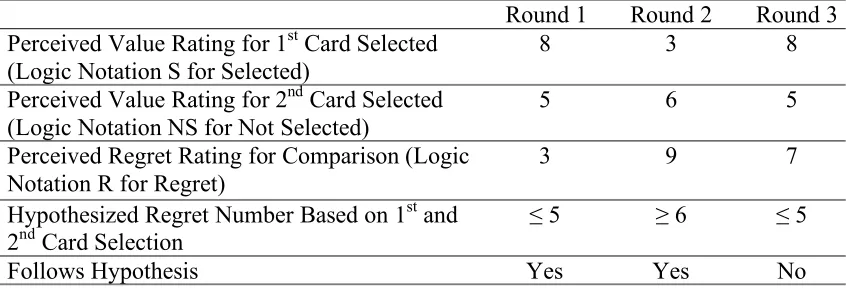
Hypothesis: Hypothesis three states that there is a clear and predictable
relationship between value and regret. More specifically, the hypothesis states
that when an individual is faced with a blind choice condition between two
objects and/or experiences, and the perceived value of one of those items and/or
experiences is higher than the other, then the regret for choosing the more valued
item and/or experience over the less valued item and/or experience will be low.
Similarly, if the individual in the blind choice condition chooses the lesser valued
item and/or experience instead of the more valued item and/or experience, the
perceived regret for that blind choice will be high. This hypothesis is believed to
be accurate because of two conditions: first, the nature of the decision making
process under uncertainty and its relation to the value and regret relationship, and
second, the personal agency exhibited by the decision-maker. Hastie (2001)
describes research in the judgment and decision making arena as, “…how people
(and other organisms and machines) combine desires (utilities, personal values,
goals, ends, etc.) and beliefs (expectations, knowledge, means, etc.) to choose a
course of action” (p. 655). Using the stability component of value from
hypothesis one, and the comment from Hastie (2001), the individual facing a
choice condition will attempt to make a decision that will optimize the outcome to
meet the individual’s desires and beliefs. This decision process, when successful,
will provide a positive affective response that will be remembered and used again
when faced with a similar choice condition in the future. Likewise, should the
individual facing a choice condition make a decision that leads away from his or
10
future, similar, decisions. A key component found to be essential in the
expression of regret is that of personal agency and the sense that the individual
had control over the situation and made a bad choice (Zeelenberg, van Dijk,
Manstead, & van der Pligt, 2000). Regret, therefore, is accompanied by feelings
that the individual has lost an opportunity and desire to correct one’s mistake, by
wanting to completely undo the situation, and a wish that the situation could be
“done over” to produce a more valued outcome (Pieters & Zeelenberg, 2005).
This is one of the most consistently found results in regret research and has been
found in a variety of experimental contexts (Gilbert, Morewedge, Risen, &
Wilson, 2004; Pieters & Zeelenberg, 2005; van Dijk & Zeelenberg, 2002).
Therefore, in a choice condition, the judgment of value between what was
selected, as opposed to what could have been selected, will form a regret variable
that should follow a specific pattern based on the perceived, personal, value of the
stimulus items in the choice condition.
Operational Definitions
To create a more empirically focused definition of value, operational definitions
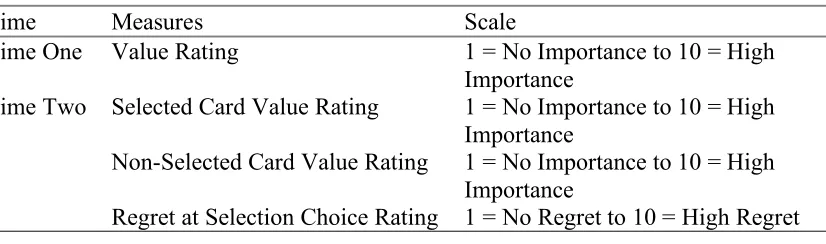
of the three primary constructs of the study are presented. As a construct, value will be
assessed by a participant who will view a stimulus item and rate how important that item
would be for the person to personally and individually have. The rating will be on a scale
of 1 to 10 with 1 being not important and 10 being very important. The stimulus items
will be grouped into the three domains of items and/or experiences previously identified
11
Stability as a construct will be assessed through the value ratings. The participant
will make value ratings for the same stimulus items at two different times and under two
different conditions. Statistical comparisons will then be made to judge the similarity in
ratings between the two times and contexts.
The emotional response of regret can only be present when personal choice and
multiple alternatives are present (Pieters & Zeelenberg, 2007; van Dijk, van der Plight,
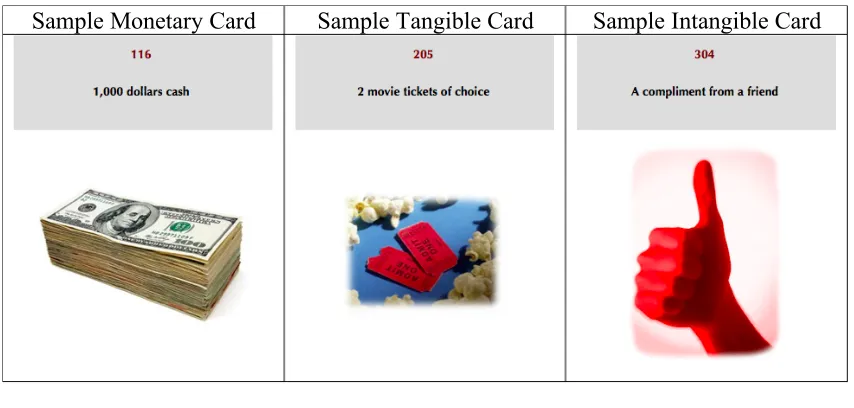
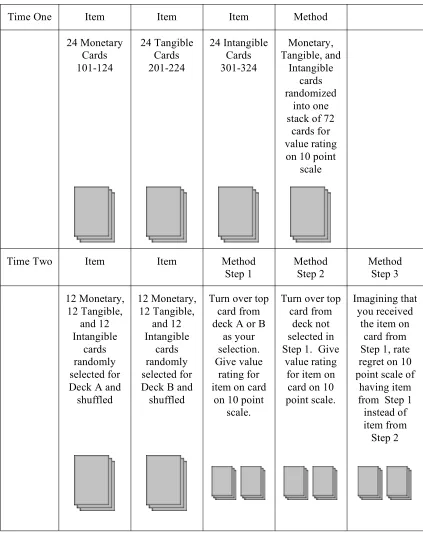
Manstead, van Empelen, & Reinderman, 1998). Therefore, the construct of regret will be
assessed in a choice condition after a participant has blindly selected one stimulus item,
rated it on the value scale, viewed the unselected stimulus item, and rated it on the value
scale. Once the ratings of value have been made the participant will rate the regret of
having selected one stimulus item over another on a 10 point scale with 1 being low
regret and 10 being high regret.
Significance
This research is a first step in exploring a very important construct, value, across
different domains of interest. With additional research outside of any one discipline, but
bridging multiple fields, it may be possible to have the experimental contributions of
value from the field of motivation (Bong, 2001; Shah & Higgins, 1997; Sorenson, 1976)
to be meaningful and assist in experimental efforts in other disciplines using value such
as economics (Depp, Schwindt, Kugel, Plabmann, & Kenning, 2005; van’t Wout, Kahn,
Sanfey, & Aleman, 2006; ) and decision making (Litt, Eliasmith, & Thagard, 2008;
Mellers, Schwartz, & Ritov, 1999; Pennington & Hastie, 1988). It may also be possible
12
experimental results and to an already strongly studied construct, that will bridge multiple
disciplines and aid all fields that adopt its use.
As regret is already a construct with a strong experimental background in multiple
fields such as personal relationships (Roese, Epstude, & Fessel, 2009; Zeelenberg &
Bruegelmans, 2008), economics (Martinez, Zeelenberg, & Rijsman, 2011; Thiene, Boeri,
Chorus, 2012), and general decision making (Connolly & Zeelenberg, 2002;
Summerville, 2011), confirming a specific relationship between value and regret can only
improve the validity of both. Construct validity cannot be established without both
content and convergent validity (Trochim, 2006).
Any explication of the qualities of the construct of value, such as the stability of
value, will enhance content validity (Beckstead, 2009; Cronbach & Meehl, 1955; Rubio,
Berg-Weger, Tebb, Lee, & Rauch, 2003) while investigations into the relationship
between value and a well and widely studied construct such as regret can only serve to
assist development of convergent validity (King & Hicks, 1990; Trochim, 2006; Westen
13
Chapter 2: Literature Review
One underlying concept at the root of any decision process is that of value
(Coricelli, Dolan, & Sirigu, 2007; De Dreu & Boles, 1998; Delgado & Dilmore, 2008;
Deppe, Schwindt, Kugel, Pabmann, & Kenning, 2006; Hsee & Rottenstreich, 2004;
Lerner & Keltner, 2000; Naqvi, Shiv, & Bechara, 2006; Rangel, 2008). The purpose
behind studying decision making, motivation, judgment, emotion, and other
psychological entities of utilitarian perspective is ostensibly to better understand human
behavior; as life can be viewed as an endless string of choices and decisions that can
dramatically affect an individual at the time of their determination as well as in the future
(Gardner, Gabriel, & Lee, 1999; Schwartz, 1996). All of these questions affect more than
the individual making the decision and impact such broad ranging topics as politics,
ethics, and economics (Sanfey, 2007). Therefore, value, as a psychological construct, is a
critical element in understanding human behavior.
By understanding behavior, it may even be possible to predict the course of action
an individual will select under particular conditions. The greatest difficulty in attempting
to predict decision making behavior is to categorize all of the relevant variables that an
individual may use in any choice or decision process. Without identifying the elements
of the decision process, how can any models be created that adequately predict the
14
Though value, as a construct, has been studied in psychology (Higginson,
Mansell, & Wood, 2011; Marken & Mansell, 2013), philosophy (Phinney, Ong, &
Madden, 2000; Rokeach, 1973; Schwartz & Huismans, 1995), and economics
(Rustichini, 2005; Sanfey, Lowenstein, McClure, & Cohen, 2006) and therefore provides
for a wealth of background literature, the same provides for a great deal of uncertainty. A
review of the psychological construct of value is, therefore, required to identify potential
common elements and properties that would prove beneficial to empirical efforts with the
construct.
Although individuals commonly make decisions in uncertain conditions, it is not
surprising that one emotion of particular interest is regret. When an individual makes a
decision, he or she may have particular emotions associated with the type of decision to
be made (getting married, buying a house, selecting a retirement savings plan, etc.) and
form expectations as to the outcome, and the emotions associated with the outcome, of
the decision process (Connolly & Zeelenberg, 2002). Regret is directly tied to the
expectations of an individual’s decision outcome. More specifically, regret is the
cognitively based negative emotion associated with a decision of poor outcome that
might have turned out differently with a different choice made (Gilbert, Morewedge,
Risen, & Wilson, 2004).
As both value and regret are constructs strongly related to the decision making
process, it is natural to question what relationship might exist between the two constructs.
The more information known about how the two may work together in a decision
process, the more solid the empirical data related to the important subject of decision
15 Value
As a construct used in multiple fields of study, value can be complicated to study
and understand as the definitions often change from field to field. To create some sense
of order from the multiple definitions and usages, a review of the construct of value as
used in the fields of philosophy, motivation, cognition, and economics is provided.
Philosophy. In the philosophy literature, value traditionally makes an appearance
in one of four ways: intrinsic value, or the value inherent in an item or belief (Beardsley,
2005; Feldman, 2005; Rabinowicz & Ronnow-Rasmussen, 2005; Rokeach, 1973);
instrumental or final value which places the importance not on the object itself, but as an
end state or relation between itself and another item (Feldman, 2005; Rabinowicz &
Ronnow-Rasmussen, 2005); value as a belief that a person holds which may direct an
individual’s actions (Beardsley, 2005; Rabinowicz & Ronnow-Rasmussen, 2005;
Rokeach, 1973; Schwartz & Bardi, 2001); and value as a collection of individual beliefs
that helps to create a defining characteristic or personality for an individual (Rabinowicz
& Ronnow-Rasmussen, 2005; Rokeach, 1973). Though these different conceptions of
value are all somewhat related, they each have different definitions based on the state of
intangible being, tangible or monetary object, personal preference, or individual being
ascribed the condition of value.
Unfortunately, though Rokeach and others wished to create a foundation upon
which empirical studies could be produced and shared for common understanding, the
conceptions of value proposed largely have no grounding or foundation beyond that of
observation and logic. Does this completely invalidate these conceptions? No, it does
16
idea of how an individual creates these preferences or why an individual would view an
object as having value. The assumption is simply that people do create preferences and
objects do have value in the eye of the beholder. The question of “how” is missing. This
leaves the current conceptions without an empirical foundation. That is not to say,
however, that empirical efforts may not include, and therefore elucidate, Rokeach’s
conceptions of value.
Some empirical efforts in the philosophical arena have been made in regards to
value singularly, and values, or value systems, as collections of intangible individual
values that form guiding principles for motivational goals (Schwartz & Bardi, 2001).
Quite often, the empirical research in this realm involves either individual relationships
(Gardner, Gabriel, and Lee, 1999; Stern, Dietz, & Kalof, 1993; Tsai & Ghoshal, 1998) or
cross cultural comparisons (Phinney, Ong, & Madden, 2000; Schwartz & Bardi, 2001;
Schwartz & Huismans, 1995). Though not always listed as philosophy specifically, the
research listed uses the philosophical resources for the conceptions and definitions that
form the structure of the studies.
Gardner, Gabriel, and Lee (1999) performed three experiments to determine how
culture might affect the values an individual relates as an individual, versus the values an
individual may relate as a member of a specific culture. Individualistic intangible values
consisted of freedom, independence, living an exciting life, choosing one’s course in life,
and others as examples. More collectivist value judgment examples were belongingness,
friendship, family safety, national security, etc. These individualistic and collectivist
values were rated on a scale of 1 to 7 with 1 being not at all important and 7 being of
17
through both stories and word searches, a values inventory rating 56 values as to how
important a particular value might be as a guiding principle for behavior and obligation,
and the Twenty Statements Task (TST) by Kuhn and McPartland (1954), the researchers
determined that culture and priming both impact how an individual perceives his or her
value judgments in relation to goals and behaviors. This implies that value systems are
relatively flexible under priming conditions.
Another individualistic perspective can be found in the research by Stern, Dietz,
and Kalof (1993). This research used a regression model with special weighting for the
belief that an individual will be predisposed to take action when an adverse consequence
is present for something he or she values: more specifically, if adverse consequences to
the environment are likely, and those consequences will affect the individual, the
individual is likely to act if the environment is valued. The researchers measured the
beliefs about consequences for self, specific gender, others, and the environment through
survey questions and intentional statements. These variables, used as weights in the
regression analysis, point to a system of varied value levels for individuals in regards to
the environment and intention to act toward valued goals.
From a group and value systems perspective, Schwartz and Bardi (2001) used 10
previously identified types of values and their importance ratings to identify similarities
in values held between different cultures. The central element of identification for the 10
values was their motivationally expressed goal. The survey asked participants to rate the
importance of various tangible and intangible items such as occupational choice,
consumer purchases, and religiosity. Participants from 56 nations, a teacher contingent
18
Hierarchies of values were then calculated per nation. Means of the ratings and their
ranks then allowed for correlations to be run between samples and nations. Calculated
Pearson correlations between teacher samples and the 56 represented nations indicated a
high degree of similarity and stability. The non-teacher samples across the same 56
represented nations also yielded Pearson correlations that indicated a degree of similarity
and stability.
Motivation. In a similar manner to the field of philosophy, the area of motivation
within the realm of psychology tends to focus on the ideas of incentive value, attainment
value, intrinsic value, and reward. The majority of this work builds off of the early
motivation work of Atkinson (1957) who suggested the importance of value in his
research on risk-taking behavior. For Atkinson (1957), a major question for motivation
was simply how to account for an individual’s selection of one path or action over
another. To answer that question, Atkinson stated that three variables must be defined:
motive, expectancy, and incentive. Expectancy was defined as a cognitive anticipation of
an outcome based upon cues provided by the situation. Motive, however, was not nearly
so easily stated. Essentially, motive, by Atkinson’s perspective, was a relatively stable
internal drive to meet a particular goal or state. Incentive was the third in the triumvirate
and of special interest.
When discussing this particular variable, Atkinson (1957) acknowledged that,
“The incentive [value] variable has been relatively ignored, or at best crudely defined, in
most research.” The definition that he provides for the variable states simply that, “It
represents the relative attractiveness of a specific goal that is offered in a situation, or the
19
(Atkinson, 1957). Working together, the motive provided a drive for a particular goal,
tangible or intangible, specified as incentive value. The expectation was the cognitive
anticipation of the desired, or valued, outcome based on past experiences. This early
work on a theory of expectancy, value, and motive led to expansions upon the idea which
continue to include the construct of value, but often in different, or multiple, conceptions.
Rosenberg (1960) developed an early theory of attitude dynamics that involved a
cognitive and affective component of any valuation of tangible or intangible
circumstance. The evaluative nature of the cognitive and affective component, and the
expected positive or negative outcome of any venture, was expected to be a motivating
factor in behavior (Cohen, Fishbein, & Ahtola, 1972). Rosenberg’s early experiments
included variations of tests of cognitive structures and ratings, or value judgments,
regarding objects and events at intervals of 30 days. His results indicated that when
affective and cognitive components of an attitude are consistent, attitudinal judgments are
stable. Similarly, if the cognitive and affective components are not consistent, the
attitudinal state is unstable. This instability required the individual to go through a
reorganization of cognitive and affective state to again reach equilibrium and stability
(Rosenberg, 1960).
Another extension of this can be found in the expectancy-value components of
attitude as expressed by Fishbein (1963). In this conception, a person’s attitude toward
an intangible event or tangible object may be estimated by multiplying the probability of
an event or goal manifesting and the affective evaluation of the tangible or intangible
stimulus. Predictive validity for this model was shown by Palmgreen and Rayburn
20
attitudes toward news and newsmedia and the goals, rewards, or gratifications for
engaging with the news.
A more modern motivational theory expressing value as a component is
expectancy-value theory (Nagengast, Marsh, & Scalas, 2011; Palmgreen & Rayburn,
1982; Wigfield & Eccles, 2000). Expectancy-value theory is an expansion upon the work
of Atkinson (1957), Rosenberg (1960), and Battle (1965). Expectancy-value theory can
be loosely expressed as the motivational elements involved in both the cognitive
evaluation an individual makes regarding personal ability to perform a task and how
much the task is valued (Wigfield, 1994). Ultimately, an achievement motivation
perspective such as expectancy-value theory attempts to, “…explain people’s choice of
achievement tasks, persistence on those tasks, vigor in carrying them out, and
performance on them.” (Wigfield & Eccles, 2000). This was accurately portrayed in
Feather and O’Brien’s (1987) work with unemployed individuals. Feather and O’Brien
found strong correlation between an individual’s expectation of finding employment and
the extent to which employment itself was viewed as valuable. Additionally, Wiklund,
Davidsson, and Delmar (2003) identified that small business managers’ expectations of
different hypothetical outcomes regarding business growth were highly correlated to the
value previous surveys had established for said outcomes. This analysis was confirmed
through replicated linear regression analysis (Wiklund, Davidsson, & Delmar, 2003).
The expectancy component requires two elements. The first is a self-efficacy
ability belief judgment related to the task, goal, desire, or value that is presented (Bong,
2001). Based on past experience with a similar task, goal, or value, the individual
21
evaluation is completed, an expectation of success or failure is formed (Wigfield &
Eccles, 2000). The interaction of the personally variable expectancy component and the
personally variable value component create the directionality of the effort and persistence
of the individual to the end state in a particular domain or situation (Eccles & Wigfield,
2002). This interaction was tested in a large scale study by Nagengast, et. al. (2011)
through path analysis and structural equation modeling self-concept, enjoyment of
science, and science career aspirations and extracurricular activities. For the 398,750
student participants from 57 countries, the model had a high comparative fit index (.975)
and accurately predicted career aspirations and extracurricular activities from
expectancies and values derived for science. The previous simplistic explanation of the
complex interaction of cognitive expectancies and affective value can more easily be
explained and traced through figure 2.1 below.
Of particular interest for this research is the value component of the
expectancy-value model. The overarching expectancy-value term used in the model is task expectancy-value and focuses on
an individual’s incentives, motivations, and reasons for engaging in activities (Mahama,
Silbereisen, & Eccles, 2013). The attractiveness of task value stems not from some new
and unique view of value, but from the fact that task value incorporates a number of
elements from the Atkinson (1957) model as well as elements that have been derived
from said model (Bong, 2001; Eccles & Wigfield, 2002; Fredricks & Eccles, 2002;
Wigfield & Eccles, 2000). Task value is defined as a combination of attainment value,
intrinsic value, utility value, and cost (Eccles et al., 1983). It has been studied
22
of task value, self-efficacy, and mastery and performance goal orientations (Bong, 2001).
Combined with the previous list of value types derived from the Atkinson (1957) model,
an ultimate list of potential value types was established for the expectancy-value model:
Incentive Value, Attainment Value, Intrinsic Value, Reward, and Cost (Atkinson, 1957;
Eccles et al., 1983; Wigfield & Eccles, 2000).
Incentive value, as provided by Atkinson (1957) has already been discussed as the
provision of a positive outcome for engaging in a particular activity or the avoidance of a
negative outcome by engaging in a particular activity. The incentive in this respect is
either adding a positive element to a situation through a choice condition, or the
avoidance or elimination of a negative element through a particular choice. This is not
Across
Achievement-Related Choices and Performance
Expectations of Success
Subjective Task Value 1. Interest-enjoyment value 2. Attainment value 3. Utility value 4. Relative cost Child’s Perception of…
1. Socializer’s beliefs, expectations, attitudes, and behaviors 2. Gender roles 3. Activity stereotypes
Child’s Interpretations of
Experience
Child’s Goals and General Self-Schemata
1. Self-schemata – personal and social identities
2. Short-term goals 3. Long-term goals 4. Ideal self
5. Self-concept of one’s abilities
Child’s Affective Reactions and Memories Cultural Milieu
1. Gender role stereotypes 2. Cultural stereotypes
of subject matter and occupational characteristics 3. Family demographics Socializer’s Beliefs and Behaviors Stable Child Characteristics 1. Aptitudes of
child and sibs 2. Child gender 3. Birth order
Previous Achievement-Related Experiences
23
dissimilar to the concept of positive and negative reinforcement from a classical
conditioning perspective (Gredler, 1997). However, the motivational perspective looks at
the incentive as a pre-action potential and classical conditioning looks to reinforcement as
a post action response.
Following that line of thought, Heckhausen (1991) views the idea of incentive
value as less a motivational attribute, and more a reinforcement. From his perspective,
actions themselves have no incentive value as the incentive comes from the consequence
of the action. As a consequence is a situation that can only occur after an action,
incentive value was less a motivational construct to perform an initial action and more a
reinforcement to encourage that action in the future to produce a more stable choice
behavior.
As motivational work continued and the idea of incentive value was modified,
and or expanded, into other concepts, certain overlaps occurred. This is particularly the
case with attainment value as indicated by Folger and Doherty (1993). Their work
revolved primarily around the idea of perceived value of monetary sums in the attainment
of specific goals. This would initially place their work in the following section related to
attainment value, however, the energization model presented in their work relies
significantly upon, “… the perceived value of incentives given for successful task
completion” (p. 422). Clearly, the idea of the value of incentives in the motivation to
complete, or attain, a particular goal or state of being, was a major transitional step from
the early work of Atkinson (1957).
A more clearly defined attainment value was presented by Sorenson (1976). This
24
stipulated in the over-arching construct of task value (Bong, 2001; Eccles & Wigfield,
2002). Sorenson (1976) provides two definitions: one for relative attainment value and
one for absolute attainment value. Relative attainment value is viewed as the importance
of doing well in a particular area of endeavor compared to other areas while absolute
attainment value is viewed as the competence one has in a particular area regardless of
the competence in other areas. Although these constructs share similar roots, Eccles &
Wigfield (2002) demonstrated that these constructs are separate. Researchers asked sixth
grade children to first rate how important it was to perform a particular task in English,
mathematics, and sports. After completing the first set of questions, students had to
complete a second set that asked how competent they felt in those areas on the same
scale. Analysis of findings indicated that relative attainment value is a perceived value of
self or group whereas absolute attainment value deals with physical capability and
competence regardless of perceived value by self or others (Eccles & Wigfield, 2002).
Shah and Higgins (1997) further explore the idea of attainment value as,
“…determined by underlying needs to attain desired end-states” (p. 448). The example
given to clarify the construct is that, “the value in attaining food is based on both
cognitive conceptions of the value of food and one’s underlying hunger” (p. 448).
Therefore, attainment value, at least in this example, may be viewed as a combination of
cognitive and affective elements in regards to a particular stimulus. An individual’s
reactions to a tangible object or intangible situation will clearly be predicated on the
cognitive and affective experiences with said object or situation. Through four different
experiments utilizing linear regression analysis, Shah and Higgins (1997) found
25
essence, the directions of the interactions indicate a positive influence on goal attainment
when the goal is considered an attainment as opposed to an obligation.
Still another view of attainment value comes from the expectancy-value models
of Wigfield and Eccles (2000). In this model, attainment value takes a somewhat
different perspective. Building on the previous work of Battle (1966), Wigfield and
Eccles (2000) perceive attainment value as the importance of doing well on a particular
task. To further this perspective, attainment value is doing well on a task as an element
of an individual’s self assessment of worth and competence in one’s self-schema (Eccles
& Wigfield, 2002).
The next element of task value is that of intrinsic value. The basic idea within
intrinsic value is that of personal interest and enjoyment of an activity as the rationale for
engaging in said activity (Fredricks & Eccles, 2002). An elaboration on this basic theme
comes from Eccles and Wigfield (2002) that includes the subjective interest that an
individual has for a proposed activity. Further, there is a belief that an individual who
engages in an activity for intrinsic purposes will meet, and or satisfy, certain positive
psychological goals (Wigfield & Eccles, 2000).
Utility value is another of the task value subsets. Wigfield and Eccles (2000) list
utility value as the usefulness of an activity to reaching a greater goal. The importance of
this conception is the fact that an individual may have no interest in a particular activity,
but will continue to engage in said activity simply because it serves as a means to an end.
Husman et al. (2004) give a good review of the various conceptions of utility value from
Raynor’s (1969) view of there being two temporal qualities to the construct, both present
26
Salience is another term that has been used to describe utility value and has been shown
to correlate positively with cognitive strategies used to study effectively in academic
subjects (Pintrich, 1999).
Clearly there are different definitions for the various constructs mentioned within
the realm of motivation. However, one element is designed to hold them together: one
element to create a family of constructs. That one binding element is value. Hence, from
the motivation literature, a clear definition of value is not only desirable, but essential in
understanding the currently proposed constructs.
Cognition. It is also proposed that the psychological construct of value may
affect how one perceives the world (Bruner & Goodman, 1947; Hsee & Rottenstreich,
2004). Bruner and Goodman (1947) proposed a number of hypotheses though only two
provide an insight into the idea of value and perception. The first hypothesis suggested
that the greater the social value of an object, the greater the impact it would have on
perception before cognitive appraisal. The idea behind the hypothesis is that certain
objects or stimuli become accentuated to our senses based on their proposed and
individualized value. This proposal would suggest that the greater the social value, as
recognized by culture, personal interest, and experience, the more attuned we are to the
perception of said object or stimuli. A more modern approach to this issue was taken by
Pessoa (2008) in discussing valued affective stimuli in the environment and the temporal
qualities of the perception of affect. The automatic quality of perception was confirmed
by Pessoa (2008) and elaborated upon through the biological processes of the medial
temporal region of the brain, often associated with affect (Betsch, Plessner, Schwieren, &
27
perception through any sensory organ are mediated by medial temporal region structures
that evaluate the relative importance of the stimuli before sending the information to
more conscious cognitive areas for additional processing. This unconscious processing
of perceived elements of the environment supports the first hypothesis of Bruner and
Goodman (1947) as well as the second: “the greater the individual need for a socially
valued object, the more marked will be the operation of behavioral determinants” (p. 37).
Both hypotheses presume that the greater the value of a tangible object or intangible
stimuli, whether from a personal or social perspective, the greater impact said object or
stimuli will have on our perception.
Bruner and Goodman (1947) never give a definition for the construct. They do
discuss the various ways in which particular stimuli may become fixated, i.e., the senses
are conditioned - to have a primacy effect on our processing. In one example, children
were asked to estimate the size, from memory, of different denominations of coins.
Then, the children were asked to estimate the sizes of grey cardboard squares introduced
earlier. Even though the grey cardboard circles were the same size as coins, the coins
were always estimated as larger. Additional analysis indicated that children from higher
socio-economic backgrounds had faster and more accurate estimates of coins than
children from lower socio-economic backgrounds even though their grey cardboard disk
estimates were similar. Based on the hypotheses presented, the logical course would
suggest that the items most likely to become fixated are items more likely to be valued.
Such items include food, water, love, fame, and money and are considered rewards; a
28
regarding what is valued and what is not, but it is far from a definition and presents,
therefore, a weak theoretical front.
Closely following the idea of value as perceptual moderator is the work of Hsee
and Rottenstreich (2004). Their work focuses on two types of value, valuation by
calculation and valuation by feeling, both of which may act in a conscious or unconscious
manner and can affect behavior. Though both types of processes of valuation affect
behavior, neither is clearly defined from the perspective of actual value. The closest to a
definition one gets from a highly detailed analysis of preference decision-making is the
idea that value is equated with satisfaction (Hsee & Rottenstreich, 2004, p. 23).
The work of Bruner and Goodman (1947), Pessoa (2008), Dolan (2002), and Hsee
and Rottenstreich (2004) in the area of value as perceptual modifier, in turn, could have
an impact on how an individual might organize in memory, either consciously or not,
information important to his or her life (Betsch et al., 2001; LaBar & Cabeza, 2006).
The entire idea of value affecting, not just how one perceives the world, but also
how one stores memories of perceptions and builds knowledge structures from
experiences, has a tremendous impact on how one might view the nature of human
existence beyond simply human behavior. And yet, for all of its importance, the field of
cognition and psychology has both an unstructured and diverse set of possible definitions
for the psychological construct of value.
Economics. The construct of value has a long and solid history in the field of
economics and economic decision making, or decision making under risk, usually framed
from the perspective of both normative and descriptive decision making (Gurevich,
29
perspective is a more logical expectation of economic behavior that can be
algorithmically expressed as an axiom: a should be statement of behavior (Harrison,
2008). Descriptive economic decision making recognizes that an individual perhaps
should follow some rule of behavior, but often does not for some individual or
personalized reason or rationale. The heuristic models are most used to represent this
variability (Gigerenzer & Gaissmaier, 2011). Two specific decision making theories and
one area of decision making research will be investigated to clarify the role of value in
economic, and risky, decision making.
The more descriptive perspective was largely pioneered by Kahneman and
Tversky with prospect theory (1973, 1983). Daniel Kahneman and Amos Tversky
studied human decision making under uncertainty during the early 1970’s in response to
variations in responses in expected utility experiments (Kahneman & Tversky, 1973).
The various studies that they conducted led to an interesting discovery: humans do not
make decisions, economic or otherwise, regarding future events in a logical manner as
postulated by, “the calculus of chance or the statistical theory of prediction” as found in
expected utility theory (Kahneman, 1973). From these studies, the two researchers
determined that, instead of following these mathematical laws, humans rely on certain
heuristics in order to draw conclusions. Heuristics are strategies that are highly
economical in nature and simplify complex tasks to operations more easily dealt with
(Cosmides, 1996). This collection of heuristics is called prospect theory (Kahneman &
Tversky, 1983). This theory contains two stages: an editing stage where an individual
evaluates and simplifies the data involved in the decision, and a valuation stage where an
30
decision and whether that change in value would prove beneficial based on one’s current
status.
More specifically, the editing stage involves the coding of information into gains
and losses compared to an individual’s current status, the simplification of multiple
probabilities that are similar through combination, the segregation of risky elements of
the decision from riskless elements that do not require evaluation, and the cancellation of
shared components in a decision that do not require consideration (Kahneman & Tversky,
1983). Additionally, the editing stage contains the simplification process where more
complex probabilities are rounded to more easily evaluated statements and the scanning
of information to detect dominated alternatives that can be immediately eliminated from
the decision process (Khaneman & Tversky, 1992). All of these processes work to
reduce the cognitive activity required of an individual during the deliberation process.
The valuation stage is dependent upon three elements: the current status of the
individual, the change in value of the decision in relation to the status of the individual,
and how the individual will weigh that value in comparison to other potential outcomes.
The belief is that the change in value in a decision is only relevant in regard to the
amount of that change in relation to a person’s current status. If the change has
significant meaning to the individual, the prospect is considered in terms of that change,
and not necessarily the probabilities inherent in that change. The potential outcomes
from this valuation are then given different weights based on the desirability of the
outcome compared to another (Tversky & Kahneman, 1992).
More recently, value as a construct in economics has been theorized and studied
31
neuroeconomics, attempts to use standard neuroscience techniques such as brain imaging,
patients with brain damage behavior, animal behavior, and other neural recording efforts
to understand how economic preference and decision making is manifest in the brain
(Camerer, Lowenstein, & Prelec, 2004). Proponents of neuroeconomics point to the
normative models of behavior that could not adequately predict the various ways in
which humans would break the logical rules proposed, and the descriptive models that
attempted to list the various heuristics for human behavior, but were unable to account
for their origins and variability. To account for both perspectives, neuroeconomics uses
the neuroscientific methods to account for the known issues of the past, and hopefully
propose more accurate theories for the future (Hakimzada, Gutnik, Yoskowitz, & Patel,
2005; Rustichini, 2005).
The construct of value manifests in neuroeconomics often through preferences
and emotions. As stated by Litt, Eliasmith, and Thagard (2008), “Economists commonly
take preferences as given, but from a psychological point of view it should be possible to
explain how preferences arise from cognitive and affective processes” (p. 252). Previous
research on preference required the inference of preference through questionnaires and
purchasing behavior, as it could not be accurately represented. Now, however,
preferences can be traced through various cortical and subcortical currents of activation
during purchasing decision tasks through the use of neuroimaging techniques (Kenning &
Plassmann, 2005). Deppe, Schwindt, Kugel, Plassman, and Kenning (2005) were able to
determine through functional magnetic resonance imaging (fMRI) when an individual
was making a purchase involving a favorite, or more valued, tangible consumer good.
32
neural pathways were very distinct in origin. In addition, the preferred consumer good
was found to increase activation in areas related strongly to affect and emotion leading
the team to suggest that emotional ties to consumer products and purchases create
stronger preferences that drive repeat behaviors (Deppe, Schwindt, Kugel, Plassman, &
Kenning, 2005; Sharot, Mauricio, Phelps, & Elizabeth, 2004). Additional studies using
positron emission tomography (PET) have indicated that emotional responses from the
amygdala in the medial temporal lobe correlates with individual subjective ratings of
consumer items which, in turn, correlates to incentive value and activation of the lateral
orbitofrontal regions of the brain (Braeutigam, 2005). These networks tie together the
processes of affect and preferences, and incentives and decision making, creating the
justification for affective inclusion in the decision making process and the decision
process creating its own affective response that will affect future decision making
actions.
Another strong case for emotion as relevant to value can be found in the work of
Desmeules, Bechara, and Dube (2008) in approach and avoidance systems of motivation
and decision choice. In multiple studies, the researchers have found that approach and
avoidance regulating systems, identified primarily as affective systems that selectively
recruit cognitive resources, create systematic preferences that lead to stable and repeated
behaviors.
Sanfey, Loewenstein, McClure, and Cohen (2006) advocate a strong relationship
between the affective creation of preference and value and the biological influence of
reward. In animal models, electrical chemical recordings along specific neural pathways
33
magnitude. This has been repeated in brain imaging studies with humans in which choice
items that have a greater affective value to the participant create greater brain activation
in the reward circuits whether the choice items are monetary (Knutson, Adams, Fong, &
Hommer, 2001), appetitive food items (McClure, Li, Tomlin, Cypert, & Montegue,
2004), or intangible social situations (Rilling, Sanfey, Aronson, Nystom, & Cohen,
2004).
A review of the value literature allows for an expansion of the operationalized
definition of value. Though many researchers have used the term importance in
empirical efforts as synonymous with value (Hsee & Rottenstreich, 2004; Sorensen,
1976; Tversky & Kahneman, 1992) there clearly exist other constructs and ideas which,
bound together, create a structure for the construct of value. These other elements allow
the psychological construct of value to be conceptualized as a multi-dimensional
affective construct with motivational properties. Both the affective and motivational
dimensions of affect play a role in yet another component of value: stability.
Stability
In line with the reasoning of value as containing both an incentive and attainment
component (Eccles & Wigfield, 2002), another element of the definition of stability is
considered. If value can serve to motivate behavior toward a particularly valued goal or
state as considered by Atkinson (1957), Rosenberg (1960), and Shah and Higgins (1997),
and value can also reinforce a behavior after reaching or attaining that goal as determined
by Heckhausen (1991), Eccles and Wigfield (2000), and Nagengast, Marsh, and Scalas
(2011), then the expectation should be that the behavior and value stimulus should
34
Gottfied, O’Doherty, and Dolan (2003) touch directly on the issue of reinforcement and
predictive value of behavior as represented in specific brain structures and networks.
This belief is further supported by the work of Rushworth, Noonan, Boorman, Walton,
and Behrens (2011) in their recent review of reward guided learning and reinforcement in
decision making. The idea of learning and reinforcement from value is also a component
of the cognitive processing literature as exemplified by Bruner and Goodman’s (1947)
research on unconscious processing and the more recent biological elements of
perceptual processing of value as given by Dolan (2002) and LeBar & Cabeza (2006).
This ultimately presents the possibility that a previously unstated component may exist in
the definition of value: stability.
Stability is the recognition that affective valuations of stimuli are learned and are
often assimilated implicitly (Murray, Izquierdo, & Malkova, 2009; Phelps & LeDoux,
2005; Scherer & Ellsworth, 2009; Storbeck & Clore, 2008; Tottenham, Hare, & Casey,
2009). Stability represents a very specific dimension of cognitive interaction:
specifically, affective memory. To understand the role affect may play in the memory of
experienced stimuli, and the effect this would have on the concept of stability, one must
turn to the amygdala, a small, bilateral structure in the medial temporal lobe just forward
of the anterior portion of the hippocampus (Freese & Amaral, 2009). Numerous studies
indicate that the amygdala is involved in the determination of valence and arousal for
experienced and novel stimuli, or at least, is involved in determining the salience of the
stimuli to the organism with which it is interacting (Cunningham, Bavel, & Johnsen,
2008; Dalgleish, 2004; Freese & Amaral, 2009; LaBar & Cabezza, 2006; LeDoux &
35
theory (Litt, Eliasmith, & Thagard, 2008), an affect oriented event-coding account of
action (Lavender & Hommel, 2007), appraisal theories of affect and cognition (Scherer &
Ellsworth, 2009) or the primacy of feelings in judgment (Pham, Cohen, Pracejus, &
Hughes, 2001), one element is quite clear: there is a specific neural link between
affective stimuli as registered in the amygdala and a positive impact on implicit memory
retention. The amygdala does not act alone in the enhancement of memory, but is shown
to marshall cortical areas of the prefrontal cortex related to attention to promote
continued focus on the stimuli in question, and to stimulate hippocampal regions for the
actual encoding of the memory for later retrieval (Davidson, 2004; Isen, 2001; Kensinger
& Schacter, 2008; LaBar & Warren, 2009; Sander, 2009).
This is not to suggest that once an individual has experienced a particular stimulus
and affective response pairing numerous times that the pairing would stay inviolate for
the lifespan of the organism. Plasticity, or the ability of neural connections to alter and
change based on past and current experience, is an important condition to any category of
memory (Posner, Russell, & Peterson, 2005; Whalen, Davis, Oler, Kim, Kim, & Neta,
2009). The ability to change and alter the neural connections that represent a particular
stimulus is critical to the adaptive process, both affectively and cognitively (Allen &
Monyer, 2013; Cunningham, Bavel, Johnsen, 2008; Gaesser, Sorengm NcKekkabdm
Addusm & Sschacter, 2013; Hamann, 2009; Storbeck & Clore, 2008).
Therefore, the concept of stability in the definition of value represents an affective
memory trace for a particular stimulus that will cause an organism, barring cognitive or
affective interference, to remember the felt expression of the stimuli and to regard it
36
new experiences, and experiences with novel stimuli, may change the relative affective
expression for a previous stimulus. The not always consciously remembered state and
felt expression is then believed to influence individual action (Cunningham & Zelazo,
2007).
Regret
One construct with a strong theoretical base and significant experimental support
data is regret. Since regret is an affective construct related to decision and choice
processes, it should prove to be a reasonable companion construct for the validity
process. Previous research (Abraham & Sheeran, 2003; Kahneman & Tversky, 1982;
Hetts, Boninger, Armor, Gleicher, & Nathanson, 2000; Zeelenberg, van Dijk, Manstead,
& van der Pligt, 2000; Roese & Summerville, 2005) has identified particular
characteristics of the construct of regret and are elucidated below. Described in the
following sections are counterfactuals, the idea of anticipatory regret, issues of personal
agency, opportunity for action, and a differentiation between disappointment and regret.
Additionally, the issue of regret having the ability to inform or alter behavior will be
briefly discussed as an important element within each of the above mentioned
characteristics of regret (Pieters & Zeelenberg, 2005).
Counterfactuals. As uncertainty is one of the most common conditions under
which an individual makes a decision, it is not surprising that one emotion of particular
interest is regret. When an individual makes a decision, he or she may have particular
emotions associated with the type of decision to be made (getting married, buying a
house, selecting a retirement savings plan, etc.) and form expectations as to the outcome,