Abstract
27
Objectives: The A1470T polymorphism (rs1049434) in the monocarboxylate (lactate/pyruvate) transporter 1
28
gene (MCT1) has been suggested to influence athletic performance in the general population. We compared
29
genotype distributions and allele frequencies of the MCT1 gene A1470T polymorphism between endurance
30
athletes, sprint/power athletes and matched controls. We also examined the association between the MCT1
31
A1470T and the athletes’ competition level (‘elite’ and ‘national’ level).
32
Design: The study involved endurance athletes (n=112), sprint/power athletes (n=100), and unrelated
33
sedentary controls (n=621), all Caucasians.
34
Method: Genomic DNA was extracted from buccal epithelium using a standard protocol. We conducted
35
Fisher’s exact tests and multinomial logistic regression analyses to assess the association between MCT1
36
genotype and athletic status/competition level.
37
Results: Sprint/power athletes were more likely than controls to possess the minor T allele (TT genotype
38
compared to the AA [p < 0.001]; TT or AT compared to the AA [p = 0.007]; TT compared to both AA or AT
39
genotypes [p < 0.001]). Likewise, sprint/power athletes were more likely than endurance athletes to have the
40
TT genotype compared to the AA (p = 0.029) and the TT compared to both AA or AT genotypes (p = 0.027).
41
Furthermore, elite sprint/power athletes were more likely than national-level athletes to have the TT genotype
42
compared to the AA (p=0.044), and more likely to have the TT genotype compared to both AA or AT
43
genotypes (recessive model) (p=0.045).
44
Conclusions: the MCT1 TT genotype is associated with elite sprint/power athletic status. Future studies are
45
encouraged to replicate these findings in other elite athlete cohorts.
46
47
Key words: Athletic performance, genes, power athletes, running, endurance athletes, monocarboxylate
48
transport protein 1
49
i. Introduction
52
Along with environmental factors, elite athletic performance is also influenced by genetic factors.1
53
Family and twin studies have demonstrated that genetics play a significant role in athletic performance. A
54
genome-wide linkage scan for athletic status reported a heritability of ~ 66% for athletic status in 700 British
55
female dizygotic twin pairs.2 In the HEalth, RIsk factors, exercise Training And Genetics (HERITAGE)
56
family study, the reported heritability of changes in maximal oxygen uptake (VO2 max) with exercise training
57
was ~47% in sedentary subjects.3 In another study, the heritability of explosive strength, which is an
58
important predictor of sprint performance, was assessed at 74-84%.4 To date, more than 20 Single Nucleotide
59
Polymorphisms (SNPs) have been reported to be associated with elite athletic performance.1, 5 Thus far, only
60
the ACTN3 R577X polymorphism6-8 has shown consistent association with elite athletic performance across
61
multiple cohorts,9-11 while the ACE I/D is another highly studied SNP with respect to elite athletic
62
performance providing less consistent results.12, 13 However, the monocarboxylate (lactate/pyruvate)
63
transporter (MCT) family has not previously been researched in relation to elite athletic performance and thus
64
presents interesting and novel candidate genes for investigation.
65
During high-intensity exercise, lactate and protons accumulate in the contracting muscles as a result of
66
glycolysis. In order to maintain glycolysis, lactate is transported out of the cell at high rates by
67
monocarboxylate transporters (MCTs).14-16 The MCT family currently comprises 14 members. In skeletal
68
muscle, the most important and well-described isoforms are MCT1 and MCT4.16 These two MCTs mediate
69
the 1:1 transmembrane cotransport of lactate and protons, relative to the lactate concentration and proton
70
gradient, either into or out of skeletal muscle. Without the MCTs, lactate could not be as rapidly exchanged
71
between tissue compartments. MCT4 has not been correlated with fibre type, while MCT1 is more
72
prevalence in Type I oxidative muscle fibres.17 It has been suggested that a key physiological role of MCT1
73
is to take up lactate from the circulation, while MCT4 seems better suited to assist the extrusion of lactate
74
from glycolytic fibres.15 The MCT1 gene (official symbol SLC16A1; location: 1p12) may be therefore
75
MCT1 has been found predominantly in type I, oxidative muscle fibres, and only in small amounts in type
77
IIX, glycolytic muscle fibres.16, 18 Chronic muscle inactivity has been shown to reduce MCT1 gene
78
expression19, whereas chronic electrical muscle stimulations (which mimics exercise) increase MCT1 gene
79
expression in rats.20 Furthermore, in human skeletal muscle MCT1 protein expression level remains elevated
80
following both continuous-single intensity21 and high-intensity interval endurance training18, 21, leading to
81
increased membrane transporter density.22
82
A common A1470T (Glu490Asp) polymorphism (rs1049434) that leads to the replacement of glutamic
83
acid with aspartic acid has been identified in the MCT1 gene.23 Carriers of the minor T allele have 60-65%
84
reduced lactate transport rates23 and experience higher blood lactate accumulations during high intensity
85
circuit weight training, compared to carriers of the A allele.24 These findings suggest that the MCT1 T allele
86
may impede endurance performance and contribute to individual differences in response to exercise training.
87
Genetic research in sport is still in its infancy and this study is designed to further explore the importance
88
of genes in various athlete phenotypes and competition levels. The aim of this study was to compare
89
genotype distributions and allele frequencies of the MCT1 gene A1470T polymorphism between elite
90
endurance athletes, elite sprint/power athletes and matched controls. In light of the relationship observed
91
between blood lactate accumulation and MCT1 T allele, we hypothesised that MCT1 A1470T polymorphism
92
would be associated with elite athletic status. To our knowledge, this is the first study to investigate the
93
MCT1 gene and elite athletic performance; thus, codominant, dominant and recessive genetic models were
94
assessed to determine differences amongst athlete phenotype (endurance, sprint/power, control). We also
95
examined the association between the MCT1 A1470T polymorphism and the athletes’ competition level
96
(‘elite’ and ‘national’ level) for both athlete groups.
97
98
ii. Methods
99
The study was approved by the Pomeranian Medical University Ethics Committee, Poland, and written
100
48 females; mean age ± SD, 27.8 ± 7.1 yr; range = 16- 41) and 621 unrelated sedentary volunteers (students
102
of University of Szczecin, 453 males and 168 females; mean age ± SD, 20.7 ± 0.9 yr; range = 19-23 yrs). The
103
athletes and controls were all European Caucasians.
104
The athletes were categorized as either endurance athletes or sprint/power athletes as determined by the
105
distance, duration and energy requirements of their event/ sport. All athletes were ranked in the top 10
106
nationally in their sport discipline and grouped as being either ‘elite-level’ or ‘national-level’ based on their
107
best personal performance. Those in the elite group had participated in international competitions such as
108
World and European Championships, and/or Olympic Games, whereas those in the national-level group had
109
participated in national competitions only.
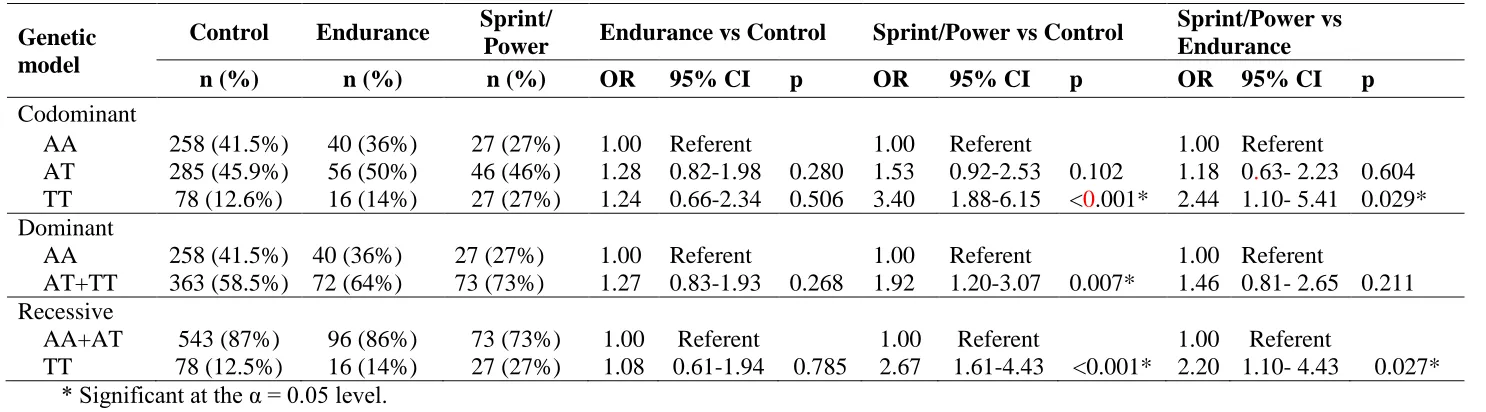
110
The endurance athlete group (n=112, 84% males) included athletes competing in long distance/ duration
111
events demanding predominantly aerobic energy production. This group included 15-50 km cross-country
112
skiers (n= 2), race walkers (n= 6), road cyclists (n= 14), triathletes (n= 4), 5-10 km runners (n = 17),
400-113
1500 m swimmers (n= 11), rowers (n= 42), 1500 m runners (n= 7) and kayakers (n= 9). In this group, 66
114
(59%) were elite athletes.
115
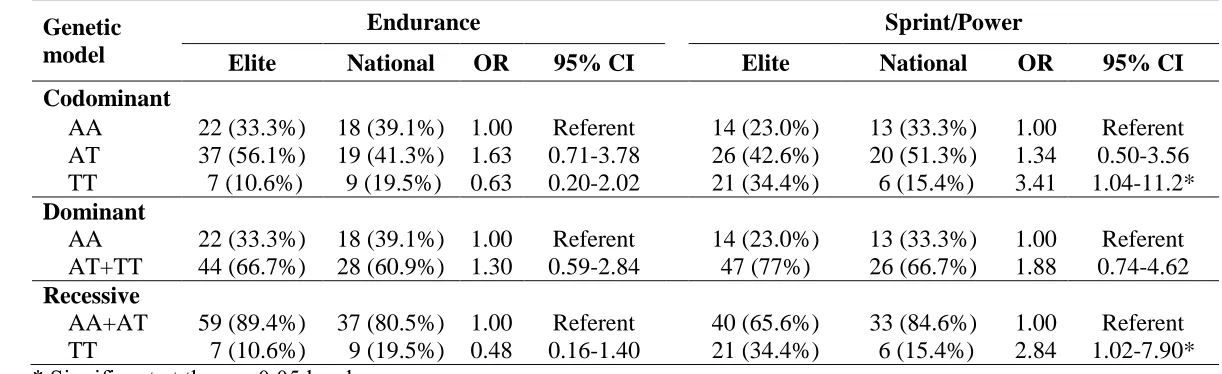
The sprint/ power group (n=100, 70% males) included sprint and power athletes whose events demand
116
predominantly anaerobic energy production. Athletes in this group included: 100-400 m runners (n = 29),
117
jumpers (n= 15), power lifters (n= 22), throwers (n= 14) and weightlifters (n= 20). In this group, 61 (61%)
118
were elite athletes.
119
Detailed methods of sample collection, genotyping, and data analysis are outlined below, according to
120
recent recommendations for reporting of genotype-phenotype association studies.25 Samples were collected
121
during the years 2008-2012. Various methods were used to obtain the samples, including: targeting national
122
teams and providing information to national coaching staff and athletes attending training camps.
123
The buccal cells donated by the subjects were collected in Resuspension Solution (Sigma-Aldrich, USA)
124
with use of Sterile Foam Tipped Applicators (Puritan, USA). DNA was extracted from the buccal cells using
125
protocol. All DNA samples were then stored in the same conditions at -25oC until subsequent processes were
127
performed.
128
The 187 bp fragment of MCT1 gene was amplified by polymerase chain reaction (PCR) using
129
Mastercycler (Eppendorf, Germany). The PCR reactions were performed in 10 μl volumes with 1× PCR
130
buffer, 1.75 mM MgCl2, 1 μM of each deoxynucleotide triphosphate (dNTP, Novazyme, Poland), 4
131
picomoles of each forward primer AGCAAACGAGCAGAAAAAGG-3' and reverse primer
5'-132
CTGGGTCATGAACTGCTCAA-3' (Genomed, Poland), as well as 0.5 U Taq Polymerase (Novazyme,
133
Poland) and 30-50 ng of template DNA. The primers used in the study were previously described and
134
validated by Fedotovskaya et al.19 PCR was performed as follows: 60 seconds of initial denaturation at 94oC,
135
followed by 35 cycles (each cycle consisted of 20 second of denaturation at 94oC, 20 second of annealing at
136
65oC, and 30 second of extension at 72oC) and 90 second of final elongation at 72oC.
137
The amplified PCR fragments were subsequently digested with BccI restriction endonuclease (New England
138
Biolabs, USA). This method yields 83 bp and 104 bp fragments in the presence of the T allele and an
139
undigested 187 bp fragment in the presence of the A allele. Digested products were then electrophoretically
140
separated in ethidium bromide-stained 5% high resolution agarose (Sigma-Aldrich, USA) gels and viewed by
141
UV trans illumination. We performed genotyping exclusively at the Molecular Laboratory at Gdansk
142
University of Physical Education and Sport, Poland, with all samples genotyped in duplicate.
143
Chi squared tests were used to test for the presence of Hardy-Weinberg equilibrium (HWE). Genotype
144
frequencies were compared according to athletic status (i.e. controls, endurance, or sprint/power athlete)
145
using Fisher’s exact test. Multinomial logistic regression analyses were conducted to assess the association
146
between genotype and athletic status/competition level. Sex was adjusted for in the first stage of analysis as
147
there were sex distribution differences in each athletic status groups and the control group. As the T allele
148
was considered to be the risk allele, analyses were made comparing AA (reference group) vs. AT vs. TT
149
(codominant model); AA (reference group) vs. TT and TA combined (dominant model); AA and TA
150
accepted when p ≤ 0.05. Odds ratios with 95% confidence intervals were also calculated for estimation of the
152
risk effect.
153
154
iii. Results
155
Genotypes were determined for 212 DNA samples of athletes and 621 DNA samples of controls – 98%
156
of genotypes could be called.
157
Genotype and allele frequency distributions amongst all participants are presented in Table 1. Genotype
158
distributions of all groups met HWE (all p > 0.10). Table 1 outlines the associations between genotypes and
159
athletic status. All analyses included an adjustment for sex, however, sex was not a significant variable for
160
any association. After adjusting for sex, sprint/power athletes were more likely than controls to possess the
161
minor T allele (TT genotype compared to the AA [OR = 3.40; CI = 1.88 – 6.15; p < 0.001]; TT or AT
162
compared to the AA [OR = 1.92; CI = 1.2 – 3.07; p = 0.007]; TT compared to both AA or AT genotypes [OR
163
= 2.67; CI = 1.61 – 4.40; p < 0.001]). Sprint/power athletes were also more likely than endurance athletes to
164
possess the minor T allele, with a greater likelihood of having the TT genotype compared to the AA (OR =
165
2.44; CI = 1.10-5.41; p = 0.029) and the TT compared to AA+AT genotypes (OR = 2.20; CI = 1.10-4.43; p =
166
0.027). These results indicate that the T allele may be beneficial for sprint/ power athletes compared to
167
endurance, although the risk appears to be only present in the homozygous form indicating a recessive effect.
168
Sprint/power athletes also indicated differences between competition levels (Table 2). Elite athletes were
169
more likely than national-level athletes to have the TT genotype compared to the AA (OR = 3.41; CI = 1.04 –
170
11.2; p=0.044), and also, the TT genotype compared to the AA +AT genotypes combined (OR = 2.84; CI =
171
1.02 – 7.91; p = 0.045) suggesting a recessive effect here as well. The significant increase in likelihood of
172
elite status observed in the sprint/power athletes was, however, not observed in endurance athletes (all
173
comparisons p > 0.05). The effect of the T allele on elite status thus appears to be specific to sprint/power
174
athletes alone. Thus, at both elite and national levels the recessive T allele appears to be associated with
175
iv. Discussion
177
Sprint/power performance is influenced by genetics1, 26 and several genetic variants have been associated
178
with elite sprint/power performance, including the ACE I/D, ACTN3 R577X, AGT Met235Thr, NOS3 -786
179
T/C, IL6 -174 G/C, and GDF-8 K153R.27 However, some of these variants provide no consistent association
180
with sprint/power performance (i.e. ACE I/D) or require additional testing in multiple cohorts (e.g. IL6,
181
AMPD1, NOS3). Furthermore, none of the abovementioned variants are related to lactate transport, an
182
important factor in athletic performance. According to our hypothesis, we found, for the first time, that the
183
MCT1 T allele is associated with sprint/ power performance in a recessive genetic model and the TT
184
genotype was more prevalent in sprint/power athletes compared to both controls (OR = 2.67; CI = 1.61 –
185
4.40; p < 0.001) and endurance athletes (OR = 2.20; CI = 1.10-4.43; p = 0.027). This finding reinforces the
186
hypothesis that MCT1 A1470T might be one, of what appears to be many, polymorphisms that influence
187
athletic performance.
188
There is also biochemical evidence to suggest that MCT1 A1470T polymorphism is associated with
189
exercise performance in humans. A 2010 pilot study in high intensity circuit training by Cuperio et al.24
190
investigated the influence of MCT1 A1470T polymorphism on lactate accumulation after high intensity
191
circuit training. In this study the carriers of the MCT1 AT or TT genotype seem to exhibit a decreased lactate
192
transport capability into the less active muscle cells for oxidation. The Cuperio et al. study24, however, did
193
not provide any insight into the mechanism behind the association between MCT1 and athletic performance.
194
We suggest that this association may be directly related to the increased accumulation of lactate within the
195
blood, triggering muscle fatigue and limited aerobic performance, explaining why the MCT1 T allele was
196
significantly more prevalent in anaerobic (sprint/power) athletes in our findings. We suggest that this
197
association may be directly related to the increased accumulation of lactate within the blood triggering
198
muscle fatigue and limiting aerobic performance. Alternatively, high lactate levels may induce the expression
199
of muscle hypertrophy associated genes (i.e. those encoding mTOR, IGF-1, growth hormone etc.), as
200
hypertrophy.21 Consequently, high levels of lactate in skeletal muscles may assist elite athletes to increase
202
muscle mass and strength enhancing their sprint/power performance. We believe that a functional aproach to
203
uncover the direct influence of MCT1 A1470T polymorphism on athletic performance should be embraced in
204
future studies.
205
An additional novel finding in the present study is that the likelihood of having the MCT1 TT genotype is
206
2.8 times higher for an elite-level sprint/power athlete compared with national-level counterparts. To date,
207
only the ACTN3 R577X has been associated with either sprint8, 28 or endurance8 performance with respect to
208
the level of athletic performance. This observation indicates that while the MCT1 recessive model might be
209
important in the development of sprint/power ability, it is even more important in the development of ‘elite’
210
sprint/power performance. This information may assist coaches and exercise physiologist to further optimise
211
training loads, not only based on environmental factors, but also based on their genomic factors. It is worthy
212
to note that this genotype was not related to the performance amongst endurance athletes, and further research
213
is needed to clearly identify genotypes that are associated with elite the level of endurance performances.
214
In order to confirm the results observed in this report, functional studies related to the the effect of MCT1
215
alleles on skeletal muscle hypertrophy and alterations in sprint/power performance are needed. Future
216
research may also benefit from featuring the competition level of athletes (elite/national level) as a more
217
prominent variable in analesys and that athletes have peaked in their career to ensure the cross-section of
218
results is representative of the athletes’ highest performance ability.
219
Despite advances in our understanding of the genetic basis of power and sprint performance, there are
220
limitations that have hampered the progression of genetic based athletic research which need to be addressed.
221
The primary limiting factor in genetic association studies is the need to recruit large groups of elite athletes to
222
overcome the obvious barrier of large sample size for detecting genetic associations. Recently, it was
223
estimated that, testing a single polymorphism using a case-control design (athletes vs. non-athletes) would
224
require ~250 cases to obtain a statistical power of 80%.28. To address this, large multi-site collaborations, and
225
Additionally, we recognise that the current paper focuses on one genetic variant whereas elite athletic
227
performance is highly polygenic trait, 29, 30 and it is therefore very likely that more novel variants will be
228
discovered that influence sprint/power performance. That said, the identification of MCT1 A1470T as a
229
genetic variant associated with sprint/power performance presents a novel and intriguing candidate gene for
230
further analysis in relation to athletic sprint /power phenotypes.
231
v. Conclusion
232
In conclusion, we provide evidence for an association between MCT1 A1470T polymorphism and elite
233
sprint/ power status in a group of elite European athletes. The findings indicated that the MCT1 TT genotype
234
was overrepresented in sprint/power athletes compared to both endurance athletes and non-athlete controls,
235
which were not significantly different to each other. Furthermore, within the sprint/power athletes, the TT
236
genotype was overrepresented in elite level athletes compared to national level athletes. These findings
237
provide support for the potential influential role of the MCT1 A1470T polymorphism in determining elite
238
athletic status. Future studies are encouraged to replicate these findings by recruiting large enough samples of
239
elite athletes. More research is also required to understand the mechanisms involved in this observed
240
relationship between the MCT1 A1470T polymorphism and athlete phenotype.
241
242
vi. Practical implications
243
• MCT1 A1470T polymorphism should be considered as one of the polymorphisms that may influence
244
sprint/power performance.
245
• The MCT1 A1470T polymorphism is over-represented in elite sprint/power athletes compared to
246
national level athletes.
247
• Discovering the complex relationship between gene variants and sprint/power performance may
248
assist coaches to optimize training.
249
vii. Acknowledgements
252
This work was supported by grant the Polish Ministry of Science and Higher Education (#404 166334).
253
References
254
1.
Eynon N, Ruiz JR, Oliveira J et al. Genes and elite athletes: a roadmap for future
255
research
.
J Physiol
2011; 589(Pt 13):3063-3070.
256
2.
De Moor MH, Spector TD, Cherkas LF et al. Genome-wide linkage scan for athlete
257
status in 700 British female DZ twin pairs
.
Twin Res Hum Genet
2007; 10(6):812-820.
258
3.
Bouchard C, Sarzynski MA, Rice TK et al. Genomic predictors of the maximal O(2)
259
uptake response to standardized exercise training programs
.
J Appl Physiol
2011;
260
110(5):1160-1170.
261
4.
Calvo M, Rodas G, Vallejo M et al. Heritability of explosive power and anaerobic
262
capacity in humans
.
Eur J Appl Physiol
2002; 86(3):218-225.
263
5.
Williams AG, Folland JP. Similarity of polygenic profiles limits the potential for elite
264
human physical performance
.
J Physiol
2008; 586(1):113-121.
265
6.
Eynon N, Alves AJ, Meckel Y et al. Is the interaction between HIF1A P582S and
266
ACTN3 R577X determinant for power/sprint performance?
Metabolism
2010;
59(6):861-267
865.
268
7.
Mikami E, Fuku N, Murakami H et al. ACTN3 R577X Genotype is Associated with
269
Sprinting in Elite Japanese Athletes
.
Int J Sports Med
2013; Epub ahead of print.
270
8.
Eynon N, Duarte JA, Oliveira J et al. ACTN3 R577X polymorphism and Israeli top-level
271
athletes
.
Int J Sports Med
2009; 30(9):695-698.
272
9.
Alfred T, Ben-Shlomo Y, Cooper R et al. ACTN3 genotype, athletic status, and life
273
course physical capability: meta-analysis of the published literature and findings from
274
nine studies
.
Hum Mutat
2011; 32(9):1008-1018.
275
10.
Eynon N, Ruiz JR, Femia P et al. The ACTN3 R577X polymorphism across three groups
276
of elite male European athletes
.
PLoS One
2012; 7(8):e43132.
277
11.
Yang N, MacArthur DG, Gulbin JP et al. ACTN3 genotype is associated with human
278
elite athletic performance
.
Am J Hum Genet
2003; 73(3):627-631.
279
12.
Amir O, Amir R, Yamin C et al. The ACE deletion allele is associated with Israeli elite
280
endurance athletes
.
Exp Physiol
2007; 92(5):881-886.
281
13.
Di Cagno A, Sapere N, Piazza M et al. ACE and AGTR1 polymorphisms in elite
282
rhythmic gymnastics
.
Genet Test Mol Biomarkers
2013; 17(2):99-103.
283
14.
Bishop D, Edge J, Thomas C et al. High-intensity exercise acutely decreases the
284
membrane content of MCT1 and MCT4 and buffer capacity in human skeletal muscle
.
J
285
Appl Physiol
2007; 102(2):616-621.
286
15.
Bonen A. The expression of lactate transporters (MCT1 and MCT4) in heart and muscle
.
287
Eur J Appl Physiol
2001; 86(1):6-11.
288
16.
Thomas C, Bishop DJ, Lambert K et al. Effects of acute and chronic exercise on
289
sarcolemmal MCT1 and MCT4 contents in human skeletal muscles: current status
.
Am J
290
Physiol Regul Integr Comp Physiol
2012; 302(1):R1-14.
291
17.
Dubouchaud H, Butterfield GE, Wolfel EE et al. Endurance training, expression, and
292
physiology of LDH, MCT1, and MCT4 in human skeletal muscle
.
Am J Physiol
293
18.
Pilegaard H, Domino K, Noland T et al. Effect of high-intensity exercise training on
295
lactate/H+ transport capacity in human skeletal muscle
.
Am J Physiol
1999; 276(2 Pt
296
1):E255-E261.
297
19.
Wilson MC, Jackson VN, Heddle C et al. Lactic acid efflux from white skeletal muscle is
298
catalyzed by the monocarboxylate transporter isoform MCT3
.
J Biol Chem
1998;
299
273(26):15920-15926.
300
20.
McCullagh KJ, Poole RC, Halestrap AP et al. Chronic electrical stimulation increases
301
MCT1 and lactate uptake in red and white skeletal muscle
.
Am J Physiol
1997; 273(2 Pt
302
1):E239-E246.
303
21.
Bonen A, McCullagh KJ, Putman CT et al. Short-term training increases human muscle
304
MCT1 and femoral venous lactate in relation to muscle lactate
.
Am J Physiol
1998; 274(1
305
Pt 1):E102-E107.
306
22.
Juel C. Lactate-proton cotransport in skeletal muscle
.
Physiol Rev
1997; 77(2):321-358.
307
23.
Merezhinskaya N, Fishbein WN, Davis JI et al. Mutations in MCT1 cDNA in patients
308
with symptomatic deficiency in lactate transport
.
Muscle Nerve
2000; 23(1):90-97.
309
24.
Cupeiro R, Benito PJ, Maffulli N et al. MCT1 genetic polymorphism influence in high
310
intensity circuit training: a pilot study
.
J Sci Med Sport
2010; 13(5):526-530.
311
25.
Little J, Higgins JP, Ioannidis JP et al. Strengthening the reporting of genetic association
312
studies (STREGA): an extension of the STROBE Statement
.
Hum Genet
2009;
313
125(2):131-151.
314
26.
Eynon N, Hanson ED, Lucia A et al. Genes for elite power and sprint performance:
315
ACTN3 leads the way
.
Sports Med
2013; 43(9):803-817.
316
27.
Ruiz JR, Arteta D, Buxens A et al. Can we identify a power-oriented polygenic profile?
J
317
Appl Physiol
2010; 108(3):561-566.
318
28.
Yang N, MacArthur DG, Gulbin JP et al. ACTN3 genotype is associated with human
319
elite athletic performance
.
Am J Hum Genet
2003; 73(3):627-631.
320
29.
Eynon N, Ruiz JR, Meckel Y et al. Mitochondrial biogenesis related endurance genotype
321
score and sports performance in athletes
.
Mitochondrion
2011; 11(1):64-69.
322
30.
Maciejewska-Karlowska A, Hanson E, Sawczuk M et al. Genomic haplotype within the
323
Peroxisome Proliferator-Activated Receptor Delta (PPARD) gene is associated with elite
324
athletic status
.
Scand J Med Sci Sports
2013; Epub ahead of print.
325
viii. Tables