Private Database Access With HE-over-ORAM Architecture
Craig Gentry IBM Research
Shai Halevi IBM Research
Charanjit Jutla IBM Research
Mariana Raykova SRI International
May 16, 2014
Abstract
Enabling private database queries is an important and challenging research problem with many real-world applications. The goal is for the client to obtain the results of its queries without learning anything else about the database, while the outsourced server learns nothing about the queries or data, including access patterns. The secure-computation-over-ORAM architecture offers a promising approach to this problem, permitting sub-linear time processing of the queries (after pre-processing) without compromising security.
In this work we examine the feasibility of this approach, focusing specifically on secure-computation protocols based on somewhat-homomorphic encryption (SWHE). We devised and implemented secure two-party protocols in the semi-honest model for the path-ORAM protocol of Stefanov et al. This provides access by index or keyword, which we extend (via pre-processing) to limited conjunction queries and range queries. Some of our sub-protocols may be interesting in their own right, such as our new protocols for encrypted comparisons and blinded permutations. We implemented our protocols on top of the HElib homomorphic encryption library. Our basic single-threaded implementation takes about 30 minutes to process a query on a database with 222 records and 120-bit long keywords, providing a cause for optimism about the viability
of this direction, and we expect a better optimized implementation to be much faster.
Keywords. Comparison Protocols, Homomorphic Encryption, ORAM, PIR, Private Queries, Secure Computation
Supported by the Intelligence Advanced Research Projects Activity (IARPA) via Department of Interior National Business Center (DoI/NBC) contract number D11PC20202. The U.S. Government is authorized to reproduce and distribute reprints for Governmental purposes notwithstanding any copyright annotation thereon. Disclaimer: The views and conclusions contained herein are those of the authors and should not be interpreted as necessarily representing the official policies or endorse-ments, either expressed or implied, of IARPA, DoI/NBC, or the U.S. Government.
1
Introduction
The recent explosive growth of data outsourcing raises the issue of privacy guarantees for the out-sourced data. While encryption can protect thecontent of the outsourced data, it remains a challeng-ing problem toaccess the data privately. Since it is often possible to deduce important information from the access pattern alone (see e.g., [16] for some examples), it is important to hide also the access pattern from the server.
functionality, new threat models, and more. Roughly speaking, solutions can be categorized as either PIR-like protocols that inherently work in linear time in the size of the database, or ORAM-based solutions that have linear-time pre-processing but sub-linear access time (at the price of keeping some secret storage at the client). The current work is of the latter type.
The problem of private queries becomes even harder in situations where we need to ensure that the client also does not learn too much. Below we sometimes refer to this setting assymmetricprivate queries (borrowing the terminology from symmetric-PIR). For example, consider an organization that wants to maintain its internal access-control policy for the data, even when this data it outsourced to the cloud. In this case it is not enough to require that the cloud provider does not learn anything about the data. We must also ensure that an individual client from the organization who queries the database only gets the data that it asked for (and was authorized to obtain1), and the access protocol does not inadvertently leak anything else about the data. Similar concerns arise for a government organization setting up a server with need-based access for its clients.
1.1 Previous and Concurrent Work
A promising direction for addressing (symmetric) private-query is the secure-computation-over-ORAM architecture of Ostrovsky and Shoup [21] and Gordon et al. [13]. Here the client and server use secure two-party protocols to simulate the actions of an underlying ORAM protocol. This way we can keep the sub-linear access time of the underlying ORAM, while ensuring that the parties do not learn anything beyond the output of the original protocol, i.e., the server learns nothing and the client only learns the answer to its query.
In [21, 13], this architecture was proposed as a solution for generic multi-party computation in RAM complexity, i.e., without having to transform the original insecure RAM computation into a binary circuit. The first implementation of a system along this line was due to Gordon et al. [13], using Yao-circuit-type two party protocols over the tree-ORAM of Shi et al. [24]. Gentry et al. later proposed a few optimizations for the underlying ORAM scheme [9], and also suggested to utilize low-degree homomorphic encryption for the two-party protocols over this ORAM, but did not implement any of these protocols. Recently Stefanov et al. [25] proposed the Path-ORAM protocol, which is a variant of tree-ORAM with better asymptotic efficiency.
Very recently, Liu et al. [20] developed an automated compiler for secure two-party computation, using the Gordon et al. architecture of Yao-based protocols over tree-ORAM (with many optimiza-tions). Also, Keller and Scholl [18] extended the secure-computation-over-ORAM architecture to handle any number n≥ 2 of parties. They use the SPDZ framework [8] (with protocols based on algebraic-black-box approach with preprocessing) and use both tree-ORAM and path-ORAM as the underlying ORAM schemes. (The work of Keller and Scholl is concurrent to ours.)
Along a different direction, many recent works aimed at achieving extremely high speed by somewhat compromising privacy, leaking a small amount of information about the access pattern. Some notable examples of work along this direction is the CryptDB system of Popa et al. [23], and recent works on searchable symmetric encryption due to Pappas et al. [22] Cash et al. [4], and Jarecki et al. [17].
1.2 This Work
In this work we designed and implemented a system for symmetric private queries in the semi-honest adversary model, supporting private database access by either index or keyword. We focus on exploring the feasibility of the direction advocated by Gentry et al. [9], of using secure-computation
1
protocols based on low-degree homomorphic encryption over the tree-ORAM scheme. Specifically, we used for the underlying ORAM a slight modification of the Path-ORAM protocol of Stefanov et al. [25], and implemented our two-party computation protocols based on the HElib homomorphic-encryption library [15].
Our results show cause for optimism regarding the feasibility of this direction: Our single-threaded implementation can query a moderate-size database with 222 records on a 120-bit keyword in just over 30 minutes. This indicates that SWHE-based protocols are not as slow as commonly believed. Moreover there is a wide range of further optimizations that can be applied (both algorithmic and implementation-level), and we expect a better optimized system to be one to three orders of magni-tude faster (see discussion in Section 5). In this report we describe all the sub-protocols that went into our implementation, and also describe some extensions of the basic system to support range queries, authorization, and even provide limited support for conjunctions via pre-processing.
Our work is similar in many ways to the concurrent work of Keller and Scholl [18]. In particu-lar they also developed secure-computation-over-ORAM protocols for arrays (access-by-index) and dictionaries (access-by-keyword). Some important differences between our work and [18] include the following:
• Keller and Scholl target generic multiparty secure computation rather than data outsourcing. In particular in their system all the parties need to keep state as large as all of the data (since they use secret-sharing to share the entire state). Also the current work includes extensions that are more specific for data outsourcing such as range queries, conjunctive queries, and authorization.
• The protocols in [18] are all in the “algebraic black-box model” (using the SPDZ framework) while ours use SWHE as the basic tool. As we discuss below, introducing new SWHE-based secure protocols is one of the contributions of the current work.
We also note that our performance numbers cannot be directly compared to those from [18], since they only report the online numbers and not the “expensive” offline computations that are done by the SPDZ framework.
1.2.1 SWHE-based Secure Computation
Beyond the specific application of private queries, another contribution of the current work is in developing several new SWHE-based secure computation protocols that are interesting on their own.
Encrypted Equal-to-Zero and Comparisons. Comparing encrypted numbers is a common
low-level task in many cryptographic protocols, and significant effort was invested in optimizing it, see e.g., [6, 26, 27, 19]. In our context, we need the result to be encrypted, i.e. we want the end result to be an encryption of the answer bit, zero or one.
In the simplest setting, we would like to transform an encryption of an n-bit value x into an encryption of a bit b such that b = 0 if x = 0 and b = 1 ifx 6= 0. Computing b homomorphically from x without any interaction requires homomorphic degree roughly 2n, or we can use a single communication round to get an encryption of the individual bits of x, and then can use degree-n
homomorphism to compute the answer. But we can actually do much better. In Section 3.1 we describe a protocol thatuses only additive homomorphism, works in log∗n communicating rounds, and requires O(n) homomorphic addition operations. Moreover using batching techniques, this protocol can be implemented with onlyO(logn) additions and shifts. The end result has complexity
˜
Our protocol relies on the flexibility of contemporary lattice-based encryption schemes that enable additive homomorphism relative to arbitrary moduli. The core of our new equal-to-zero protocol is a one-message sub-protocol that transforms the encryption of the n-bit x into an encryption of a logn-bit y such thaty = 0 if and only ifx= 0. This size-reduction protocol uses the fact that ann -bit value is equal to zero if and only if the sum of its -bits is zero, when using homomorphism modulo
m > n. Applying the size-reduction protocol log∗n times reduces the problem to a constant-size instance, which we can solve using any of the existing techniques.
We also describe in Section 3.2 a protocol for comparing encrypted numbers, where on inputsx, y
we obtain an encryption of a bitb such that b= 1 if y > x and b= 0 otherwise. This protocol uses
n parallel executions of the equal-to-zero protocol on logn-bit values, and some local computation using additive homomorphism. Hence, it too takes log∗nrounds, and using ciphertext-packing can be made to run in complexity quasi-linear inn+k(with kthe security parameter).
The basic comparison protocol from Section 3.2 requires that we have encryptions of the separate bits of the numbers that we compare, but in our application one of these numbers comes from long-term storage and storing its encrypted bits would entail a somewhat large plaintext-to-ciphertext expansion ratio. Hence, we also describe in Section 3.2 another optimization that allows us to encrypt this number as a single integer (or a sequence of integer digits), so long as the integer(s) are stored inreverse bit order.
Blinded Permutation. This protocol, described in Section 3.3, allows two parties to shuffle obliv-iously an array. The input to this protocol is an encrypted arrayaand an encrypted permutation p, and the output is the encryption of the permuted array, namelya0 such thata0[p[i]] =a[i]. The main idea of this protocol is that the server can “blind” the permutationpby permuting it randomly with another random permutationq that it knows, then send it to the client for decryption. The client decrypts and getsq◦p, uses it to permute the array a and returns it to server, who now permutes byq−1 to get the final result. (Of course, more blinding is needed also to hide afrom the client.) Security. The security property of all these protocols (in the semi-honest model) asserts that neither party learns anything during the execution of these protocols. That is, the view of each party consists only of ciphertexts under the other party’s key and of random plaintext elements that are encrypted under it own key. (Hence the entire view can be simulated without knowledge of the encrypted values.)
Different flavor of protocols. Our equal-to-zero and comparison protocols are in some ways quite different than existing protocols in the literature: almost all HE-based protocols in the literature can be described in the arithmetic black-box model [7]. In that model there is an algebraic ring which is shared among parties, and sub-protocols for operations in the ring as used as the basis for everything else. (Usually the overriding complexity measure is the number of invocations of the ring operations.)
Our equal-to-zero protocol is different: while only using additive homomorphism, it does not fit in the algebraic black-box model since it relies on an interplay between different algebraic rings to get better efficiency. This approach, coupled with the ability to compute locally low-degree functions (not just linear), makes SWHE a very useful tool for designing efficient protocols.
Building secure-computation protocols based on SWHE is a new research direction, whereas protocols based on Yao circuits or additive-HE schemes have been investigated and optimized for over two decades. This work helps lay the groundwork for SWHE-based protocols, which are sure to find more uses.
1.2.2 Our Implementation
Specifically, our choice of parameters for this implementation can handle a database of up to 224 records, with keywords of up to 120 bits.2
We tested it on the equivalent of a 222-record database with 120-bit keywords, running on a five-year-old IBM BladeCenter HS22/7870, with two Intel X5570 (4-core) processors, running at 2.93GHz. However, one consequence of usingHElib is that our implementation is inherently single-threaded (since HElib is not thread-safe), so we only utilized one of the eight cores available on that machine. Processing a single access-by-keyword request took over 32 minutes, of which just under three minutes were devoted to obtaining the information itself, and the rest for maintenance operations (i.e., updating the ORAM trees and running the eviction protocol). As we said above, we expect that a better-optimized implementation would be able to do much better (even if we don’t count the 8×speedup that one could get from just using all eight cores). We describe some possible optimizations in Section 5.
2
Background
2.1 The Path-ORAM Protocol
In the basic path-ORAM protocol [25], the server keeps anN-element database in a complete binary tree of heighth= logN, where each node in the tree contains a bucket large enough to store a small constant number Z of data elements. In addition there is also a moderate-size stash of S entries to keep elements that do not fit elsewhere (we think of the stash as being kept at the root of the tree). The content of all the buckets is encrypted under the client’s key, in particular the server does not know how many elements are actually stored in each bucket.
Each database element with logical addressv∈[N] is associated with a random leafLv, and the client keeps an N-entry table of the mapping v 7→ Lv. (I.e., entry v in the table contains the leaf numberLv.)
Denote bydv the data corresponding to logical address v. The protocol maintains the invariant that the triple (Lv, v, dv) is stored in one of the buckets on the path from the root to the leaf Lv. Access to logical addressv consists of two subroutines, one for doing the actual access and another one to clean up after the access.
Access. To access the data in logical address v, the client looks up Lv in its table and asks the server for the entire path from the root to leaf Lv. Upon receiving all the buckets in this path, the client decrypts them, finds a triple of the form (Lv, v, dv) in one of the buckets, and this value dv is the requested data.
The client either leaves the data unchanged (if the operation is a read) or overwrites it with a new value (if it is a write). We denote the resulting data by d0v. In either case, it chooses a new random leaf L0v ∈ [N] and updates its table with the new L0v value. The client then removes the triple (Lv, v, dv) from the bucket where it was found, and puts the triple (L0v, v, d0v) in the root bucket. Finally it re-encrypts all the buckets and send them back to the server, who replaces all the buckets on the path to Lv by the new encrypted buckets. Since the new triple is placed at the root, this operation maintains the tree invariant of the scheme.
Eviction. To prevent the root bucket from overflowing, the client and server run a “maintenance” subroutine whose goal is to evict triples from their current buckets and push them lower down the tree: The client and server agree on some “eviction path” (in [25] this is the same as the read path), and each entry in that pathei= (Li, vi, di) is pushed as far down that path as it can go toward its target leafLi. The stash is used to avoid over-filling the buckets (with conflicts resolved greedily).
2
It is easy to see that as long as the stash does not overflow, the view of the server is computation-ally independent of the access pattern (assuming the security of the encryption scheme). Stefanov et al. proved in [24] that when using the read path for eviction and settingS =O(logN), the prob-ability of the stash overflowing is negligible. In our implementation we instead use the deterministic eviction strategy that was proposed by Gentry et al. in [9]. We run experiments and found that this deterministic strategy allows us to use smaller buckets, namely onlyZ = 2 as opposed toZ = 4 which is needed when evicting along the read-path.
2.1.1 Putting it Together
In the complete construction, the ORAM also stores the mappingv 7→ Lv. Specifically, the server keeps ` = dlog(N)e complete binary trees as above, with the level-i tree having 2`−i leaves. In the largest tree (i = 0), each entry corresponds to one logical address v ∈ {0, . . . , N−1}, and it contains the user data for that logical address. For the next tree (i= 1), each entry corresponds to two consecutive logical addresses, and it contains the two leaf-numbers in the largest tree that are currently assigned to those logical addresses. More generally, each entry in the tree at level i+ 1 corresponds to the union of two level-i intervals (which is altogether a size-2i+1 interval of logical addresses), and that entry contains two leaf-numbers of the level-i tree, namely the leaves that are currently assigned to the entries of those two level-iintervals. With each entry in every tree we store also the first logical address of the interval of that entry, as well as the leaf that is currently assigned to that entry (in the current tree). Thus each entry is of the form
level 0 : L∗, v, user-data level>0 : L∗, v, L1, L2
whereL∗is the leaf currently assigned to that entry, [v, v+2i) is its interval, and (L1, L2) are the leafs
in the next tree that are currently assigned to the two sub-intervals [v, v+ 2i−1), [v+ 2i−1, v+ 2i). Of course, all of the buckets in all of the trees are encrypted under a key known to the client.
The “tree at the last level `”, which has a single node, is kept by the client. That tree has just a single entry, corresponding to the interval [0,2`), and containing two leaf-numbers of the tree at level`−1 that are currently assigned to the entries of the sub-intervals [0,2`−1),[2`−1,2`).
ORAM Access Query. To access the logical addressv, the client looks in its level-` “tree” and determines the level-(`−1) sub-interval containing v, namely j such that (j−1)2`−1 ≤v < j2`−1. The client sets v`−1 = (j−1)2`−1 and L(`−1) = L(
`−1)
j , chooses at random a new leaf ˆL(`−1) and replaces L(j`−1) by this new value in the list. Then the client proceeds iteratively for i=`−1 down to 0:
1. Request from the server all the buckets on the path from the root of the level-i tree down to the leafL(i). Decrypt them and find in them an entry of the form (L(i), vi,data).
2. Ifi >0 do the following:
(a) Parse data= (L(1i−1), L2(i−1)), choose a new random leaf in the next tree, ˆL(i−1).
(b) Determine the level-(i−1) sub-interval containingv, namely j = 1 if v < vi+ 2i−1 and
j= 2 otherwise. If j= 1 then set vi−1 =vi+ 2i−1 and otherwise vi−1 =vi, and also set
L(i−1)=L(i−1)
j .
Else (i= 0), if this is a write operation then setdata0 to be the new value. Otherwise (read), setdata0 =data.
3. Remove the entry (L(i), vi,data) from the bucket where it was found, and place in the root bucket the entry ( ˆL(i), vi,data0). Re-encrypt all the buckets and send to the server.
Finally, the client and server run theEviction subroutine for each of the trees i= 0,1, . . . , `−1. If this was a read operation then the return value is thedatavalue from the last level i= 0.
2.1.2 Access by Keyword
Gentry et al. described in [9] how to extend this protocol to access elements by keyword rather than by index, when the database itself is sorted by that keyword: In an entry corresponding to an interval [v, v+ 2i) we keep not only the two leaf valuesL1, L2 for the next tree, but also the keyword valueK
of the database record at the middle of this interval (i.e., at index v+ 2i−1). The access procedure is then modified so that in Step 2b above we choose the sub-interval by comparing the keywordK∗
that we seek to the valueK that is stored with the current entry, settingj= 1 ifK∗ < K and j= 2 otherwise.
Note that even if the keyword K∗ that we search for is not in the ORAM, we will still return some data at the end of the access protocol, Namely the data corresponding to the smallest keyword
K0 ≥ K∗ in the ORAM. Jumping ahead, in our private-query protocol we handle this matter by multiplying the data with the indicator bitχ(K =K∗).
2.2 Somewhat Homomorphic Encryption (SWHE)
Our implementation of the private database search protocol relies on the HElib library for imple-menting homomorphic encryption [15, 14]. One of the features of this library that we utilize is the ability to choose freely the plaintext space. In particular, we often mix homomorphic operations modulo different moduli (e.g., 2,16,128) in the same protocol. We denote homomorphic addition and multiplication by and, respectively.
Another feature of HElib that we rely on is the ability to “pack” many plaintext elements in a single ciphertext and apply to them operations in a SIMD manner. We refer to the different plaintext values in a single ciphertext as the “plaintext slots” of that ciphertext. (For the specific parameters that we chose for our implementation we get 120 plaintext slots per ciphertext.) Our protocols use in particular theHElibprocedures for computing total sums and partial sums of the plaintext slots, and the efficient implementation of permuting the slots as described in [14]. We also use the ability to homomorphically extract the bits in the binary representation of the plaintext elements when the plaintext space is a power of two, as described in [11] and [1, Appendix B].
3
Main Building Blocks
Below we describe the main low-level protocols that we use in our implementation, for things like comparing numbers, permuting arrays, etc. These protocols could be useful in many other settings as well.
In all the protocols below we use encryption schemes that support at least additive homomorphism with function privacy (in the honest-but-curious model). Below we assume for simplicity that they all operate over plaintext spaceR=Zm for some integerm.3 We assume that we can instantiate the
3
cryptosystem relative to an arbitrary plaintext spaceR=Zm, and we use several different instances with different plaintext spaces. As mentioned in Section 2, contemporary lattice-based cryptosystems indeed support additive homomorphism (and more) with a free choice of the plaintext space.
In terms of security, all the sub-protocols below have the property that the view of each player consists only of ciphertexts relative to keys of the other player, and ciphertext under its own keys that encrypt uniformly random plaintext elements (independent of the input and output of the protocol). Although we do not argue here the security of the sub-protocols in isolation, we use that property when proving that the high-level protocol that uses them is secure (in the honest-but-curious model).
3.1 Equal-to-Zero Protocol
The server has an input ciphertextc =HEC(x), encrypting some x∈R under the client key. The goal of the protocol is for the server to obtain an encryption of a single bitb under the client key, such thatb= 0 if x= 0, andb= 1 otherwise. Letnbe the number of bits that it takes to represent an element inR, so |R| ≤2n.
The protocol consists of multiple rounds, where in each round we transform an equal-to-zero instance with plaintext space of some sizeS into another equal-to-zero instance with plaintext space of size O(logS). After log∗n such rounds we arrive at an instance relative to a small constant plaintext-space, and then use standard protocols (e.g., a secure computation of the AND function) to compute the final bit encryption. The plaintext-space reduction protocol consists of only a single message flow (i.e., half a round) and it is described next.
3.1.1 Plaintext-space reduction
We begin by turning the encryption of x into encryption of (roughly) the bits of x. Namely, the server proceeds as follows:
S1. Choose a randoma∈R and use homomorphism to computec0 ←ca=HEC(x+a).
S2. Denote the bit representation ofaby an−1. . . a1a0. Encrypt the bitsai under the server’s key, butrelative to plaintext spaceZn+1, getting ci=HES(ai) for i= 0, . . . , n−1.
The server sends to the client bothc0 and all the ci’s. The client then proceeds as follows:
C3. Decrypt c0 to obtain the value x0 =x+a∈R, and let x0n−1. . . x00 be the bit representation of this value. Note thatx0 =a iffx= 0.
C4. Use the homomorphism to XOR the bit x0i into the ciphertextc0i for all i, by setting c0i =ci if
x0i= 0 and c0i = 1c0i ifx0i = 1.
Letyi =ai⊕xi0 be the value encrypted in the ciphertext c0i, and observe that the yi’s are all zero if and only ifx= 0.
C5. Use homomorphism to sum up all thec0i’s, thus getting a ciphertextc00←ic0i =HES(Piyi).
3.1.2 Equal-to-zero.
Our equal-to-zero protocol repeats the above plaintext-space reduction protocol for log∗n rounds, switching the client and server roles for each round, until we arrive at a plaintext space of constant size (which can be made as small asZ3, but no smaller).
In the last step of the protocol, however, we replace the step C5 by a secure encrypted-AND protocol. (If the cryptosystem supports multiplicative homomorphism then we can use it directly. Otherwise, we can use any standard secure-computation protocol, e.g., based on OT.) In our imple-mentation we stop at plaintext space Z8, and then use multiplicative homomorphism to complete
the protocol.
Once we have an encryption of the target bit relative to some small plaintext space, we can convert it to an encryption relative to the original plaintext spaceR(or any other desirable plaintext space), e.g., by a one-round protocol of blind/encrypt/re-encrypt/unblind.
We note that the original scheme (that determines the input and output to the protocol) need not even support full additive homomorphism: it is enough for it to beblindable, and indeed in our implementation we sometime apply this protocol to AES in counter mode. The intermediate schemes with smaller plaintext space, however, must be (at least) additively homomorphic, and for those we use lattice-based encryption schemes.
We also note that we can use essentially the same protocol to compute an encrypted bitbwhich is zero ifthe lowest`bits ofxare zeroand one otherwise (for any value of`≤nknown to the client). The only difference is that in the first invocation of the plaintext reduction sub-protocol the client only computes the c0i’s for i= 0, . . . `−1 in step C4 (rather than all of them). We use this variant in our sub-protocol for computing the encrypted permutation during eviction, see Section 4.2.
3.2 Comparison Protocol
This protocol builds on the equal-to-zero protocol from above. For our basic protocol, we have the client holding an n-bit number y in the clear, and also holding the bit-wise encryption of another number x under the server’s key. The goal of the protocol is for the client to obtain an encryption of a single bit b under the client key, such that b = 0 if x ≥ y and b = 1 if y > x. Later in this subsection we discuss some optimizations that we use when transforming our actual setting that we have in our implementation to the one needed for this protocol.
Input. The client holds a plaintext elementy∈Z2n and nciphertextsci=HES(xi) under the server
key that encrypt the bits of the integerx=Pn−1
i=0 xi2i, relative to plaintext spaceZn+1.
C1. The client XORs the bits ofy into the ci’s, setting c0i =ci ifyi = 0 andc0i = 1ci ifyi = 1. Denote bybi =yi⊕xi the bits that are encrypted in thec0i’s.
At this point we note that ifx=y then all thebi’s are zero, and ifx6=ythen some of thebi’s are ones. Moreover, the largest indexi∗ for which bi = 1 corresponds to the top bit wherex, y differ.
C2. The client uses additive homomorphism to compute the partial sums, i.e. for all i its sets
c00i ←i0≥ic0
i=HES(si), where si =Pbj=ibi.
Note that ifx=y then all the si’s are zero, and if the top bit in which x, ydisagree has index
i∗ then we have si = 0 for all i > i∗ and si 6= 0 for all i≤i∗ (since each of the lattersi’s is a sum of≤nbits, not all of them zero).
EQ3. The client and server apply the equal-to-zero protocol from Section 3.1 to each of the ciphertexts
C4. Subtracting ˆci+1 from ˆci for alli < nyield ciphertexts ˜ci, all of which encrypt the bit 0 except ˜
ci∗ =HEC(1). (Ifx=y then all the ˜ci’s encrypt zeros.)
C5. The client multipliesc∗i =yi c˜i.
Clearly we still have c∗i = HES(0) for i 6= i∗, but for i = i∗ we now have c∗i∗ = HES(1) if
yi∗ = 1 and c∗
i = EncS(0) if yi∗ = 0. Recalling that i∗ is the top bit where x, y disagree (if
any), we have thaty > xif and only ifyi∗= 1. Hence all thec∗
i’s are encryption of 0’s ifc≥y, and one of them is an encryption of 1 ify > x.
C6. Summing up thec∗i’s yields c∗=HES(b) whereb= 1 if y > xand b= 0 if x≥y, as needed.
Encrypting integers in reverse bit-order. In our implementation, we use the encrypted com-parison protocol to compare the keyword held by the client to the pivots that are stored encrypted on disk as part of the path-ORAM structure. This means that at the beginning of the protocol the server has the valuex(pivot) encrypted under the client key, and the client has the valuey(keyword) in the clear.
If the pivot value x is encrypted bitwise in the ORAM structure then transforming it to the starting state needed for the protocol above would be a straightforward one-flow blind-decrypt-unblind protocol. However, to save on bandwidth in other parts of the protocol we would prefer to encrypt the pivot as either a single integer or a sequence of integer digits, which makes it harder to extract the bits. To handle this issue without resorting to higher-degree homomorphism we encrypt the integerxinreverse bit order, and modify the basic comparison protocol from above very slightly as follows:
Input. The client holds a plaintext element y ∈Z2n, and the server holds an encryption of an n-bit
integer x under the client key in reverse bit order. Namely, a ciphertext c = EncC(˜x) with ˜
x=Pn−1
i=0 2n−i−1xi. We also denote ˜y =Pn−i=012n−i−1yi.
S(i). Server chooses a random a ∈ Z2n and computes c0 ← c a = HEC(˜x+ ˜a), where ˜a =
Pn−1
i=0 2n−i−1ai is the reverse-bit ordering of a.
S(ii). The server encrypts the bits ai under its own key, relative to plaintext space Zn+1, getting ci=HES(ai) for i= 0, . . . , n−1.
The server sends to the client bothc0 and all the ci’s.
C(iii). The client decrypts c and subtract ˜y from the result, thus getting the n-bit plaintext ˜z = ˜
x−y˜+ ˜a, and let zbe the reverse-bit ordering of ˜z.
Observe that ifx=ythen clearly ˜z= ˜aand therefore alsoz=a. If the top bit in whichx, ydiffer is biti∗, then the lowestn−i∗−1 bits of ˜zand ˜aagree (due to the reverse-bit order), and thereforei∗is also the top bit wherez, adisagree. We can therefore apply steps C1 through C4 of the comparison protocol from above to the plaintextz and encryptedai’s, but multiply the bits yi (rather than zi) in step C5. Correctness follows by the exact same argument as above
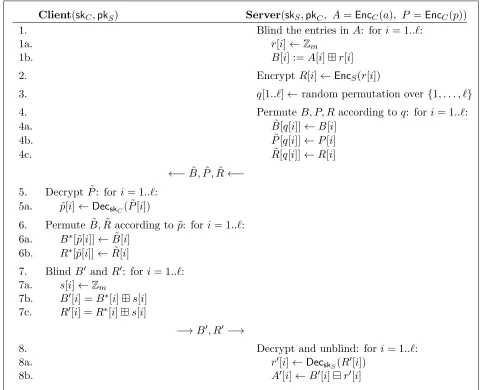
3.3 Blinded Permutations
As input to this protocol, the server has an encryption under the client key of a size-`array a and another size-` array p containing a permutation of the index set {1,2, . . . , `} (over some plaintext space Zm with m ≥ `). The output of the server is an encrypted array a0 which is obtained by permutingAaccording to p. Namely,a0[p[i]] =a[i] for all i.
The protocol is described in Figure 1. We denote the key-pairs of the client and server by (skC,pkC) and (skS,pkS), respectively. Also we denote plaintext values by lowercase letters and ciphertext values by uppercase letters.
Client(skC,pkS) Server(skS,pkC, A=EncC(a), P =EncC(p))
1. Blind the entries inA: for i= 1..`:
1a. r[i]←Zm
1b. B[i] :=A[i]r[i]
2. Encrypt R[i]←EncS(r[i])
3. q[1..`]← random permutation over {1, . . . , `}
4. Permute B, P, R according to q: for i= 1..`:
4a. B˜[q[i]]←B[i]
4b. P˜[q[i]]←P[i]
4c. R˜[q[i]]←R[i]
←−B,˜ P ,˜ R˜←−
5. Decrypt ˜P: for i= 1..`: 5a. p˜[i]←DecskC( ˜P[i])
6. Permute ˜B,R˜ according to ˜p: fori= 1..`: 6a. B∗[˜p[i]]←B˜[i]
6b. R∗[˜p[i]]←R˜[i]
7. Blind B0 andR0: for i= 1..`: 7a. s[i]←Zm
7b. B0[i] =B∗[i]s[i] 7c. R0[i] =R∗[i]s[i]
−→B0, R0 −→
8. Decrypt and unblind: for i= 1..`:
8a. r0[i]←DecskS(R
0[i])
8b. A0[i]←B0[i]r0[i]
Figure 1: Blinded permutation protocol
To see that the protocol from Figure 1 returns the correct output, denote bya0, b0, r0 the plaintext arrays encrypted inA0, B0, R0, respectively. We need to show thata0[p[i]] =a[i]. This holds because (by line 4b) we have p[i] = ˜p[q[i]] for alli, and therefore:
b0p[i] (C=7b) b∗p[i]+sp[i] (S=4b) b∗p˜[q[i]]+sp[i]
(C6a)
= ˜b
q[i]
+s
p[i] (S4a)
= b
i
+s
p[i]
where the numbers above the equalities refer to line numbers in Figure 1. The same argument shows thatr0[p[i]] =r[i] +s[p[i]], hence we have
a0
p[i](S8b)
= b0
p[i]
−r0
p[i]
= b
i
+s
p[i]
− r
i
+s
p[i]
= b[i]−r[i] (S=1b) a[i].
In terms of security, we again note that the view of each party contains ciphertexts under the other party’s key, and ciphertext under the party’s own key that encrypt random elements that are independent of the protocol input and output (or a random permutation in the case of ˜P).
4
Protocols for Private Queries
Below we describe on a high level the main protocols in our implementation. More detailed descrip-tion is available in Appendix C. On a high-level, every database access proceed tree by tree, and processing each tree is done in two phases. First the server reads the root-leaf “read-path” from the tree and the client and server engage in a Read-and-Update protocol. Then the server reads a (potentially different) root-leaf “evict path” from the tree, and the client and server engage in an Eviction protocol.
We logically use additive two-out-of-two secret sharing to share the ORAM state between the client and server, but rely on an optimization that allows the client to hold just a single AES key instead of a long share. Namely, the ORAM trees themselves are stored at the server, encrypted using AES-CTR under the client’s key.
4.1 ORAM Read & Update
The read-phase protocols are used to read a path from one tree in the encrypted ORAM structure, extract from it the information that we need in order to read the next tree, and update the read path. At the beginning of the read phase, the server is holding a single root-leaf path, with each entry encrypted separately using AES-CTR under the client’s key. In addition the server is also holding an AES-CTR encryption of a tagt∗, identifying the entry to extract from this path, and the client is holding in the clear the keyword that it is looking for (which should be compared to the pivot in that entry).
We also maintain the invariant that prior to processing the current tree, the client and server compute two values dc, ds, respectively, whose XOR will be assigned as the new leaf value to the matching entry. This phase consists of four parts:
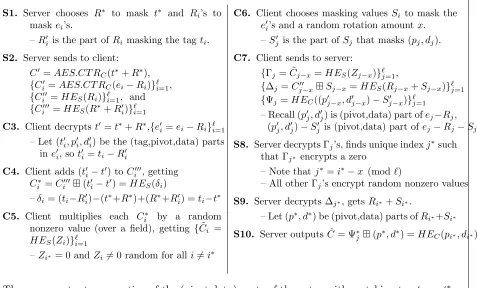
Extract. Extract a single entry from the path containing the information that we seek. More details on this step are given in Figure 2 and Appendix C.1.
Compare. Compare the pivot in the extracted entry against the keyword that we are searching for. Compute a single encrypted bit that contains the result of that comparison. This is done using the comparison protocol from Section 3.2. The low-level details are described in Appendix C.2.
Oblivious-Transfer. Extract one of the two data-items in the entry, depending on the value of the encrypted bit, getting in the clear the path to read in the next tree, and also an encryption of the identifier tag to seek in that path. This is a fairly standard 1-of-2 OT protocol, details are provided in Appendix C.3.
for that entry to a new random leaf. This protocol is fairly standard on a high level, but uses some HE-specific optimizations to speed up low-level operations, see details in Appendix C.4.
When processing the largest tree (that contains the data itself), then in the OT step we also execute an equality protocol to check that the keyword matches the one that we search for, and multiply the returned data by the resulting bit, thus zero-ing it out if the keyword does not exist in the database.
Extraction protocol. Server has encryption of all entriesei on the read path under the client AES-CTR key. Eachei = (ti, pi, di) withti and identifier tag, pi a pivot, anddi some data. The server also holds an encryption of the target tagt∗ under the client AES-CTR key.
S1. Server chooses R∗ to mask t∗ and Ri’s to
maskei’s.
–R0i is the part ofRi masking the tagti.
S2. Server sends to client: C0=AES.CT RC(t∗+R∗), {Ci0 =AES.CT RC(ei−Ri)}`i=1,
{Ci00=HES(Ri)}`i=1, and
{Ci000=HES(R∗+R0i)}`i=1
C3. Client decryptst0=t∗+R∗,{e0i=ei−Ri}`i=1
– Let (t0i, p0i, d0i) be the (tag,pivot,data) parts ine0i, so t0i=ti−R0i
C4. Client adds (t0i−t0) toCi000, getting Ci∗=Ci000(ti0−t0) =HES(δi)
–δi= (ti−R0i)−(t∗+R∗)+(R∗+R0i) =ti−t∗
C5. Client multiplies each Ci∗ by a random nonzero value (over a field), getting {C˜i =
HES(Zi)}`i=1
–Zi∗= 0 andZi 6= 0 random for alli6=i∗
C6. Client chooses masking valuesSi to mask the
e0i’s and a random rotation amount x. –Sj0 is the part of Sj that masks (pj, dj).
C7. Client sends to server:
{Γj = ˜Cj−x=HES(Zj−x)}`j=1,
{∆j =Cj00−xSj−x=HES(Rj−x+Sj−x)}`j=1
{Ψj=HEC((p0j−x, d0j−x)−Sj0−x)}`j=1
– Recall (p0j, d0j) is (pivot,data) part ofej−Rj,
(p0j, d0j)−Sj0 is (pivot,data) part ofej−Rj−Sj
S8. Server decrypts Γj’s, finds unique indexj∗such
that Γj∗ encrypts a zero
– Note thatj∗=i∗−x (mod`)
– All other Γj’s encrypt random nonzero values
S9. Server decrypts ∆j∗, getsRi∗+Si∗.
– Let (p∗, d∗) be (pivot,data) parts ofRi∗+Si∗
S10. Server outputs ˆC= Ψ∗j(p∗, d∗) =HEC(pi∗, di∗)
The server outputs encryption of the (pivot,data) parts of the entry with matching tagti∗=t∗.
Figure 2: The extraction sub-protocol.
4.2 ORAM Eviction
Eviction consists of first computing (an encryption of) the permutation to apply to the entries along the eviction path, and then applying it using the protocol from Section 3.3. At the beginning of the eviction phase, the client and server agree on the eviction path, and the server has the content of all the buckets along that path, which are all encrypted under the client AES key. Each entry of every bucket contains a target-leaf field, we begin the protocol with one round of blind/decrypt/re-encrypt/unblind that converts these AES ciphertexts to HE ciphertexts and also packs them in the slots of a single HE ciphertext.
For a height-h tree with Z-size buckets and S-size stash, we therefore have hZ+S plaintext elements packed in one HE ciphertext, each of them an h-bit string. In our implementation we use
Sub-protocol 1: position bits. Denote the target leaf of the i’th entry in the path by l[i], and denote the leaf at the bottom of the eviction path byl∗. For every levelj= 1. . . h in the tree (with
j = 0 the root and j = h the leaves), we first want to compute ciphertexts Cj[i] under the client key that encrypt one if l[i] and l∗ agree on the first (lowest) j bits, and zero otherwise. This means that entryiwants to get evicted at least as far down as level j. These bits should be encrypted wrt plaintext spaceZm form≥2hZ+S, in our implementation we use m= 128.
To compute the Cj[i]’s, we use additive homomorphism to subtract l∗ from the l[i]’s, getting encryption ofδ[i] = l[i]−l∗, and then apply our equal-to-zero protocol from Section 3.1 h times to each δ[i], each time computing whether the bottom j bits of δ[i] are zero (forj = 0. . . h−1). Note that if theδ[i]’s are all packed in a single ciphertext then we just need to perform h executions of the protocol, one per j, and we get packed ciphertexts Cj[0. . .119]. Also we can perform most of the first plaintext-reduction step in the equal-to-zero sub-protocol only once (rather than for everyj
separately).
Position indexes. Once we have the encrypted bits Cj[i], we can sum them up to get an encryption of the level to which this entry wants to be evicted. Denote this index byv[i]. Although the protocol below does not use the encryption of v[i], it is nonetheless convenient to use the v[i]’s to explain the working of this protocol. Roughly, in this protocol we would want to sort the entries by their position index.
Sub-protocol 2: adding dummy ciphertexts. Next we add encryption of some dummy entries,
to ensure that for any level below the rootj >0 we have at least (h−j+ 1)Z entries with position indexedv[i]≥j. The reason is that we must ensure that once the entries are sorted by their position index, no entry is sent further down the path below the level that that it wants to get to. Hence if we have less than (h−j+ 1)Z entries that want to get to leveljor below, we need to fill these levels with dummy entries so that entries that want to go to higher levels will not get sorted into the lower ones.
We begin by computing encrypted counts Ej of how many entries want to be evicted to levels
j and below, simply by summing Ej = iCj[i]. Similarly the number of entries that want to go exactly to levelj isEj0 =EjEj−1. Letej denote the number encrypted in the ciphertextEj, and
e0j denote the number encrypted in the ciphertext Ej0.
Next we use the Ej’s to compute for each level j how many dummy entries (between 0 and Z) are needed at that level. I.e., for all j = 1. . . h and k = 1. . . Z we compute an encryption of the bitσj,k which is one if we need to add k or more dummies to level j and zero otherwise. It can be verified that the condition we need is
σj,k = 0 iff ∃j0 ≥j s.t. j0
X
t=j
e0j>(j0−j)Z+k. (1)
That is, if there are more than (j0−j)Z+kentries that want to be evicted to levels betweenj andj0
(for somej0), then we need to add less thankdummies to level j.
Unfortunately we cannot use the comparison protocol from Section 3.2 to compute the bits σj,k from theEi0’s, since thee0i’s are sum of bits, so they are integers which are not encoded in reverse bit order. However, thee0i’s are relatively small (at most 2hZ+S = 112) hence even the naive protocol is reasonably efficient. Specifically for eachj0 we subtract (jt=0 jE
0
t)((j0−j)Z+k), over plaintext space Z128, and then use homomorphic bit extraction to get the MSB of the result, which is the
indicator bitχ(P
te0t≤(j0−j)Z+k). Computing the AND of these indicator bits gives us the bit
Once we have the σj,k’s, we prepare encryption of Zh dummy entries, where the position index of the (j, k) entry is set asσj,k·j. This means that we get exactly the right number of dummies with position indexv[i] =j, and the rest of the dummies have position indexv[i] = 0. More specifically, we compute the encrypted bitsCj[i] for these dummies: if we put the (j, k) dummy in some indexi, then for anyj0= 1. . . h, the bit encrypted inCj0[i] is zero ifj0> j, and it is σj,k ifj0≤j.
Sub-protocol 3: sorting by position indexes. All that is left now is to sort by position indexes. Note that because we added the dummies, then an entry that wants to go to leveljwill not be moved to a deeper levelj0> j in the sorted order, because there are at least (h−j)Z entries that want to go to levels below j.
We update the counts Ej and Ej0, counting the Cj[i]’s of the dummies too. Also we compute
Cj0[i] =Cj[i]Cj+1[i] for all i, j, which is 1 if entry iwants to go exactly to levelj. Then for every
entryiwe compute its position in the sorted order as
P[i] =j Cj0[i] i0<iCj0[i0]Ej+1 .
That is, if entry i wants to be at level j, then before it in the order will come all the entries that want to go to j0 > j (there are ej+1 such entries) and all the entries that want to go to level j and
have index smaller thaniin the current array.
Sub-protocol 4: applying the permutation. Now that we have an encryption of the
permuta-tion that we need to apply to the entries, we use our blinded permutapermuta-tion protocol from Secpermuta-tion 3.3 to effect this permutation. This means that we pack all the data of the entries in a HE ciphertext, then apply the protocol from Section 3.3 to this ciphertext, and then convert these ciphertexts back to AES-encrypted ciphertext. In our implementation we need two HE ciphertexts to pack all the data from all the entries in the path so we apply the blinded-permutation protocol twice.
Note that, since we initially put the dummy entries at the end of the packed ciphertext, the last
Zhentries after sorting must be dummies, so we can just ignore them when converting back to AES encryption.
5
Implementation
We implemented our protocols over theHElibimplementation [15] of the BGV scheme [3], which is currently the only publicly available implementation of SWHE that supports most of the functionality that we need.
For our target setting, we used a database with 222records with 120-bit keywords and only a few bytes worth of data. As explained in Appendix A, we can handle large records by using a two-tier system, using a database as above just to get the index of the target record and then use standard ORAM without the secure-computation layer to get the records themselves.
In retrospect, the size of the records and keywords does not have much impact on the performance, indeed over 95% of the time is spent on sub-protocols which are not affected by the record/keyword sizes, and the ones that are affected only have complexity linear in that size. (For example, extrapo-lating from our timing results we could have handled keywords of size over 6000 bits with a moderate change of the implementation and without changing any of the parameters, and it would have added perhaps two minutes to the query time.)
Extract Compare OT Update Total read Evict1 Evict2 Evict3 Evict4 Total evict 38 sec. 92 sec. 41 sec. 70 sec. = 241 sec. 91 sec. 757 sec. 487 sec. 331 sec. = 1663 sec.
Table 1: Running times of different sub-protocols in our implementation.
nodes (the parameterZ). We tested two eviction strategies, the one from [25] that uses the read path also as eviction path, and the one from [9] that deterministically covers all the paths in reverse-bit order. For each of these two strategies we tried several different sizes for the non-root nodes, and for each of those we run the ORAM for 224 accesses and recorded the largest size that the stash at the
root ever grows to.
Our experiments show that for the eviction strategy from [25] we needZ = 4 entries in the non-root nodes before the stash size stabilizes, whereas Z = 2 entries were enough for the deterministic strategy from [9]. Moreover for the latter strategy with Z = 2, the stash never grew beyond S = 5 entries, so we expect that setting S = 24 gives a reasonable security margin. This means that the entire root-to-leaf path in our largest tree needs to holdhZ+S = 22·2 + 24 = 68 entries. However, our sub-protocol 2 from Section 4.2 for computing permutations requires that we addZ more dummy entries per non-root node, thus for that sub-protocol we need to handle 2hZ+S = 112 entries.
At this point, our design choices were dictated by the interfaces that are available (or not) in HElib. HElib is built to provide an effective use of ciphertext-packing techniques [10], and in particular it provides the ability to view the multiple plaintext elements encrypted in a single ciphertext as an array and arbitrarily permute that array. However, it does not (yet) provide an interface to group several ciphertexts into a single larger array and permute that larger array. As a result, we were careful to choose our HE parameters so that all the arrays of plaintext elements that we need fit in a single ciphertext. In particular, this means that we need to fit at least 112 plaintext elements in each ciphertext.
The largest circuit depth that we need to handle in our protocols is dlog 112e = 7 (in Sub-protocol 2 from Section 4.2), and the heuristic estimate provided by HElib indicates that for this depth we have a lower-bound ofφ(m)≥6157 on them-th cyclotomic ring that we need to use (for security parameterλ= 80). Adding the constraint that the number of plaintext slots (which is the order of the quotient group Zm∗/(2)) must be at least 112, we chose to work with m = 6361, for which φ(m) = 6360, we have |Zm∗/(2)| = 120 slots, and each slot can hold an element of the field
GF(253). (Also the fact thatm is a prime number makes the permutation implementation inHElib
slightly faster.)
Finally, a modulo-2 ciphertext space would have let us pack at most 6360 plaintext bits per ciphertext, but to fit all the relevant information of an entire root-to-leaf path in the deepest tree into a single ciphertext, we needed to use plaintext space somewhat larger than that. Hence we chose to encrypt some of the data relative to plaintext space modulo 24 = 16, which lets us pack four times more bits in each ciphertext. We also make use of a modulo-128 plaintext space for some of our sub-protocols.
Performance. With these parameters, a native homomorphic multiplication inHElibtakes roughly 50ms, and permuting the 120-slot arrays takes just under one second. Our implementation of the entire protocol with these parameters runs in about 32 minutes per access (1904 seconds). Table 1 summarizes the breakout of this time into the different sub-protocols from Section 4. In that table, Extract, Compare, OT, and Update are the four sub-protocols of the read phase, and Evict1-4 are the four sub-protocol of the eviction phase.
thee0j’s as in Equation (1) takes 669 seconds (35% of the total). It is conceivable that a sub-protocol with better complexity exists, this is left for future work.
We note that only the first three sub-protocols in the read phase are on the critical path for obtaining the information, all other sub-protocols can be executed “off line” after the information was obtained. Hence our current implementation features a latency of about three minutes per query, but throughput limitation of 32 minutes per query.
In terms of the time to process the separate trees, the read-and-update phase takes roughly 11 seconds per tree, regardless of the height of that tree (since this implementation manipulates a single packed ciphertext for any tree up to height 24). The current implementation of the eviction phase takes about 5h+ 18 seconds to process a height-h tree, so the first tree takes 25 seconds, and the last (height-22) tree takes 130 seconds. Overall, the running time of this implementation on a size-2h database (h≤24) would be
Time(2h)≈2.5h2+ 31.5h seconds,
of which only about 8h seconds are on the critical path. As we mentioned above, the keyword size does not make a big difference in our implementation: shorter keywords will not save us any time, and longer keywords will not cost us much (but would require some change in the implementation). We view these numbers as encouraging; they indicate that SWHE-based protocols are not as slow as commonly believed. Moreover, this is only a first-step implementation and there is much room for improvement. Below we list a few promising avenues:
Parallelism. The HEliblibrary is unfortunately not thread safe, so our implementation is entirely single-threaded. The operations that we do, on the other hand, are easily parallelizable, so an architecture that can exploit this would immediately yield roughly anN×improvement when using
N cores in the computation.
Optimizing for low-degree parallelism. HElib is not specifically optimized for low-degree ho-momorphism. For our sub-protocols that rely only on additive homomorphism (such as our equal-to-zero, comparison, and blinded permutation), it is quite likely that using other lattice-based schemes (e.g., [2]) would yield somewhat better parameters and hence improved efficiency.
Different parameters for different sub-protocols. To simplify the development effort we chose to work with a single parameter setting throughout the protocol. However, this means that we use the largest setting of parameter that can fit everything we need in the protocol. A better-optimized implementation would use different parameters for different sub-protocols and different ORAM trees, resulting in much faster operations for the lower-degree protocols and the smaller trees.
Other optimizations. We expect that there will be many other optimizations that can be applied to our system, both at the algorithmic level at at the level of implementation. For example, one optimization that was used in the Keller-Scholl system [18] and is equally applicable to ours, is to limit the path-ORAM evictions to only pushing elements no more than 5 levels down the tree. They have experimental results showing that the ORAM overflow probability does not increase much by doing this. Using their optimization should have cut the eviction running time for the 222-record
database by a factor of three or four.
Data format. In this implementation we spent a lot of effort on packing as much data as possible in a single HE ciphertext, so that we would only need to manipulate one ciphertext at a time. As a result, much of the implementation time was devoted to translating from one data representation to another. For example, the tag value that we use in the read-and-update phase is sometimes encrypted in bits, and other times relative to a mod-16 plaintext space, so we need to convert it back and forth for every tree that we process. Also, due to our “extreme packing,” the update sub-protocol needs to replace just a few coefficients in the slot corresponding to the extrated entry, so we had to devise some low-level algebraic tricks to move data around inside a single slot (see the Client step in Appendix C.4.2).
References
[1] Jacob Alperin-Sheriff and Chris Peikert. Practical bootstrapping in quasilinear time. In Ran Canetti and Juan A. Garay, editors, CRYPTO (1), volume 8042 ofLecture Notes in Computer Science, pages 1–20. Springer, 2013.
[2] Zvika Brakerski. Fully homomorphic encryption without modulus switching from classical GapSVP. In Reihaneh Safavi-Naini and Ran Canetti, editors,CRYPTO, volume 7417 ofLecture Notes in Computer Science, pages 868–886. Springer, 2012.
[3] Zvika Brakerski, Craig Gentry, and Vinod Vaikuntanathan. (Leveled) fully homomorphic en-cryption without bootstrapping. In ITCS, pages 309–325, 2012.
[4] David Cash, Stanislaw Jarecki, Charanjit S. Jutla, Hugo Krawczyk, Marcel-Catalin Rosu, and Michael Steiner. Highly-scalable searchable symmetric encryption with support for boolean queries. In CRYPTO (1), pages 353–373, 2013.
[5] Benny Chor, Eyal Kushilevitz, Oded Goldreich, and Madhu Sudan. Private information re-trieval. J. ACM, 45(6):965–981, 1998.
[6] Ivan Damg˚ard, Matthias Fitzi, Eike Kiltz, Jesper Buus Nielsen, and Tomas Toft. Uncon-ditionally secure constant-rounds multi-party computation for equality, comparison, bits and exponentiation. In Shai Halevi and Tal Rabin, editors, TCC, volume 3876 of Lecture Notes in Computer Science, pages 285–304. Springer, 2006.
[7] Ivan Damg˚ard and Jesper Buus Nielsen. Universally composable efficient multiparty computa-tion from threshold homomorphic encrypcomputa-tion. InAdvances in Cryptology - CRYPTO’03, volume 2729 of Lecture Notes in Computer Science, pages 247–264. Springer, 2003.
[8] Ivan Damg˚ard, Valerio Pastro, Nigel P. Smart, and Sarah Zakarias. Multiparty computation from somewhat homomorphic encryption. In Advances in Cryptology - CRYPTO’12, volume 7417 of Lecture Notes in Computer Science, pages 643–662. Springer, 2012.
[9] Craig Gentry, Kenny Goldman, Shai Halevi, Charanjit Jutla, Mariana Raykova, and Daniel Wichs. Optimizing ORAM and using it efficiently for secure computation. In PETS, 2013.
[10] Craig Gentry, Shai Halevi, and Nigel Smart. Fully homomorphic encryption with polylog over-head. In ”Advances in Cryptology - EUROCRYPT 2012”, volume 7237 of Lecture Notes in
Computer Science, pages 465–482. Springer, 2012. Full version at http://eprint.iacr.org/
[11] Craig Gentry, Shai Halevi, and Nigel P. Smart. Better bootstrapping in fully homomorphic encryption. InPublic Key Cryptography - PKC 2012, volume 7293 ofLecture Notes in Computer Science, pages 1–16. Springer, 2012.
[12] Oded Goldreich and Rafail Ostrovsky. Software protection and simulation on oblivious RAMs. J. ACM, 43(3):431–473, 1996.
[13] S. Dov Gordon, Jonathan Katz, Vladimir Kolesnikov, Fernando Krell, Tal Malkin, Mariana Raykova, and Yevgeniy Vahlis. Secure two-party computation in sublinear (amortized) time. In CCS, 2012.
[14] Shai Halevi and Victor Shoup. Algorithms in HElib. Cryptology ePrint Archive, Report 2014/106, 2014. http://eprint.iacr.org/.
[15] Shai Halevi and Victor Shoup. HElib - An Implementation of homomorphic encryption. https: //github.com/shaih/HElib/, 2014.
[16] Mohammad Saiful Islam, Mehmet Kuzu, and Murat Kantarcioglu. Access pattern disclosure on searchable encryption: Ramification, attack and mitigation. In 19th Annual Network and Distributed System Security Symposium, NDSS’12. The Internet Society, 2012.
[17] Stanislaw Jarecki, Charanjit S. Jutla, Hugo Krawczyk, Marcel-Catalin Rosu, and Michael Steiner. Outsourced symmetric private information retrieval. In ACM Conference on Com-puter and Communications Security - ACM-CCS’13, pages 875–888. ACM, 2013.
[18] Marcel Keller and Peter Scholl. Efficient, oblivious data structures for MPC. Cryptology ePrint Archive, Report 2014/137, 2014. http://eprint.iacr.org/.
[19] Helger Lipmaa and Tomas Toft. Secure equality and greater-than tests with sublinear online complexity. In ICALP’13 PartII, volume 7966 of Lecture Notes in Computer Science, pages 645–656. Springer, 2013.
[20] Chang Liu, Yan Huang, Elaine Shi, Michael Hicks, and Jonathan Katz. Automating efficient ram-model secure computation. In Proceedings of 35th IEEE Symposium on Security and Pri-vacy, 2014.
[21] Rafail Ostrovsky and Victor Shoup. Private information storage. InSTOC, 1997.
[22] Vasilis Pappas, Mariana Raykova, Binh Vo, Steven M. Bellovin, and Tal Malkin. Private search in the real world. InProceedings of the 27th Annual Computer Security Applications Conference, ACSAC ’11, pages 83–92, 2011.
[23] Raluca A. Popa, Catherine M. S. Redfield, Nickolai Zeldovich, and Hari Balakrishnan. CryptDB: processing queries on an encrypted database. Commun. ACM, 55(9):103–111, 2012.
[24] Elaine Shi, T.-H. Hubert Chan, Emil Stefanov, and Mingfei Li. Oblivious RAM withO((logN)3)
worst-case cost. In ASIACRYPT, pages 197–214, 2011.
[26] Tomas Toft. Sub-linear, secure comparison with two non-colluding parties. In Public Key
Cryptography - PKC’11, volume 6571 of Lecture Notes in Computer Science, pages 174–191.
Springer, 2011.
[27] Ching-Hua Yu. Sign modules in secure arithmetic circuits. Cryptology ePrint Archive, Report 2011/539, 2011. http://eprint.iacr.org/.
A
Extending the Architecture
The protocols so far let us look up a record in the database by its logical address or keyword, but realistic applications often need to handle more complicated queries. In particular we may want to be able to search by different attributes, e.g., by either lastName or birthDate or both. Also we may want to use conjunctive and range queries, for example obtaining all record corresponding to “lastName=‘Smith’ AND birthDate from ‘Jan-1-1970’ to ‘Dec-31-1979’.”
Multiple attributes and conjunctions. A simple method for allowing access by a small number of attributes is to replicate the database with a copy per searchable attribute. For example, to enable searching by eitherlastNameorbirthDate (but not both) we would have two copies of the database, with the first copy sorted by keyword 1.lastNameand the second copy by keyword 2.birthDate. Then rather than looking for lastName=‘Smith’ we would search for keyword=‘1.Smith’, and rather than searching forbirthDate=‘Apr-1-1974’ we would search for keyword=‘2.Apr-1-1974’.
Handling conjunctive queries can be done by pre-processing the database, introducing a new compound attributefor every conjunction. For example, above we would have a new attribute for last-Name.And.BirthDateand then we can query the database for e.g.,lastName.And.BirthDate =‘Smith.Jan-1-1970’. This can be combined with the method above for handling multiple searchable attributes, for example, we could have three copies of the database indexed by 1.lastName, 2.birthDate, and 3.lastName.And.BirthDate. These simple solutions essentially reduce the cases of multiple attributes and conjunctive queries to the case of a single keyword, but they require that we know at pre-processing time all the searchable attributes (including the compound ones), and that there are not too many of them.
In the case where the records themselves are large, we can mitigate the effect of replicating the database per searchable attribute by switching to a two-tier system. Specifically keep the records themselves in adata-ORAM that we do not replicate, and keep the indexes of records at an index-ORAM that we replicate for each searchable attribute. When accessing the database we would first search for the desired keyword in the index-ORAM, getting the index (sequence number) of the actual record, and then access the data-ORAM using that index.
We note that the index value should not be leaked to either the client or the server. However, we could assign to each record in the data ORAM a random identifier and store that identifier in the index ORAM (so revealing it will not leak any additional information), and use the identifier as a keyword to fetch the record from the data-ORAM.
An optimization. When using the two-ORAM solution, we can often use plain ORAM for the data
without the secure-computation layer above it.4 The reason is that for many ORAM protocols (in-cluding path-ORAM), the entire view of the client during the access protocol is uniquely determined by the results of all queries to date, so nothing new is leaked to the client during access to the data ORAM.
4
We note that this “no new leakage” argument does not always hold. For example, in the client-access-control application that we sketched in the introduction we have different client instances running different queries and we want to hide information between different instances. In these cases we cannot just use plain ORAM for the data, but perhaps if we only use access-by-index to this ORAM then we can devise cheaper solutions than our protocol from Section 4.
Range queries. In a range query, the client wishes to obtain all the records in some range and we allow the server to learn the number of records returned. Of course, for such queries to be well defined we need the values of the searchable attribute to have a linear order (or else we can impose such ordering over them).
Given the transformations from above, we can assume a single searchable keyword for the range queries. Also for simplicity of presentation we assume that every value of the searchable attribute occurs at most once in the database (this is really w.l.o.g. since we can transform every database to this form by adding sequence numbers).
To handle range queries we can again use a two-ORAM solution with the index-ORAM containing indexes of records and the data-ORAM containing the records themselves. Recall that for our access-by-keyword protocol we need the database to be sorted by the keyword values, hence if we learn the index of the first record in the range we can fetch all the other records by index. Recall from Section 2.1.2 that the ORAM protocol natively returns the first record with keyword value greater than or equal to the one we are searching for. Our basic approach for range queries is therefore to look up the beginning value of the range in the index ORAM, then look up the records one by one in the data ORAM.
One problem that must be addressed, however, is that we cannot reveal to either client or server the indexes of the relevant records. (For example, learning that the first index in the range query for
birthDate=‘Apr-1-1974’ is 107 leaks the information that 106 of the records belong to people that were born before that date.) This can be solved by using secure-computation over the data ORAM, rather than using plain ORAM.
Another problem to address is that we need to avoid over-shooting the data, i.e., we must be able to ensure that the server does not return records past the end of the range. This is done by running the comparison protocol before returning each record, outputting the result in the clear so that the server can terminate the interaction once a record is retrieved that has too large a keyword value.
Finally, we note that if the records themselves are large then we can optimize this solution further by splitting the data ORAM into two parts (so we have a total of three ORAM structures) with the records stored in a results-ORAM which is accessed by random identifiers (so it can use plain ORAM without the multi-party computation layer) and the middle layer being used to translate the sequential indexes to the random identifiers.
Query authorization. In many applications we need to be able to restrict the queries that the client makes so as to comply with some external policy. For example, in the client-access-control example from the introduction an individual client would need to get some stamp of approval on its query before it can query the server. Or we may have a fixed policy that governs all queries, e.g., the low and high ends of a data range query cannot differ by more than three years.
. . . Bucket:
B entries (B=2, except at the root)
Entry:
Header + 2 data-items
Tag (<=24 bits) Target-leaf (<=24 bits) Pivot (<=120 bits)
Tag (<=24 bits) Target-leaf (<= 24 bits) Header:
Data item:
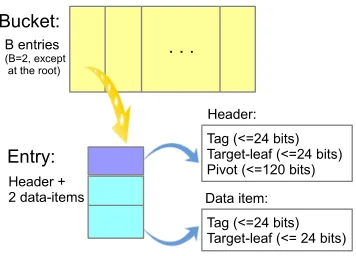
Figure 3: The bucket structure
In many cases the authorizer can be unified with the server itself, and the access control policy can be either encrypted or in the clear. If they are not unified then the authorizer can communicate its decision to the server by signing the (encrypted) query. In some cases we may want to ensure that the server (or even the client) does not learn the result of the authorization process, and that an unauthorized query looks the same as a query with no matching records. In this case the authorization protocol can output an encryption of the decision bit, and this bit can be used as a flag that controls the output of the access protocol, either returning the result from the ORAM or the fixed “no records found” result.
Dynamic databases. All the protocols that we presented in this work assume that the database is static and does not change after the initial pre-processing. Adjusting them to the dynamic-database setting requires that we modify the search-by-keyword mechanism of Gentry et al. [9] to handle insertions and deletions. This can presumably be done using balanced binary search trees, but this is a topic for future work.
B
Data Format in Our Architecture
As in all previous work on secure-computation-over-ORAM, the ORAM state is shared between the client and server and the computation is done on the shared state. In our implementation we logically use additive two-out-of-two sharing, but rely on an optimization that allows the client to hold just a single AES key instead of a long share. Specifically, the ORAM trees themselves are stored at the server, encrypted using AES-CTR under the client’s key, but throughout the protocol we maintain the invariant that the client never sees the actual ciphertext data. Instead, whenever the client needs to access some ciphertext, the server first add to it a random mask, using the malleability of counter mode.
The basic logical data structure that we maintain (in a secret-shared form) is a bucket which is associated with a node in some tree, and holds the ORAM data and metadata. Every bucket other than the root of the trees contains only two entries, each entry containing two data items (that point to two leaves in the next tree). The bucket structure is depicted in Figure 3. In more detail, an entry contains the following fields:
• A 24-bit tag that identifies it,
• A 24-bit leaf value, identifying the leaf that this entry “belongs to” (used for eviction),