signatures based on learning with errors
Shi Bai and Steven D. Galbraith Department of Mathematics,
University of Auckland, New Zealand. [email protected] [email protected]
Abstract. We present a new approach to the compression technique of Lyubashevsky et al. [18, 14] for lattice-based signatures based on learn-ing with errors (LWE). Our ideas seem to be particularly suitable for signature schemes whose security, in the random oracle model, is based on standard worst-case computational assumptions. Our signatures are shorter than any previous proposal for provably-secure signatures based on standard lattice problems: at the 128-bit level we improve signature size from (more than) 16500 bits to around 9000 to 12000 bits.
This is the full version of the paper. The conference version was published at CT-RSA 2014.
Keywords: Lattice-based signatures, learning with errors.
1
Introduction
An important problem is to obtain practical and provably secure public key sig-nature schemes based on lattice assumptions. One approach is to use trapdoor functions and the hash-and-sign methodology (see Gentry, Peikert and Vaikun-tanathan [13], Stehl´e and Steinfeld [23]). However, the most promising avenue for practical signatures (with security in the random oracle model) has long been the use of the Fiat-Shamir paradigm; this is the approach used for all currently de-ployed discrete-logarithm-based digital signature schemes. (For signatures that are proven secure in the standard model, we refer to Boyen [7] and B¨ohl et al. [6].)
A series of works by Lyubashevsky and others [16, 18, 14, 10] have developed schemes based on the Fiat-Shamir paradigm that are secure in the random oracle model. There are several challenges when implementing lattice-based signature schemes, including the size of the public key, the size of the signature and the requirement to sample from discrete Gaussians during the signing process. Our main focus in this paper is to reduce the size of signatures.
The basic idea of Lyubashevsky’s signatures in the case of LWE is to have a public key of the form (A,T = AS+E (modq)) where A is an m×n
small norm and computingv=Ay1+y2 (modq). Then, using the Fiat-Shamir paradigm, the signer computesc=H(v, µ) where µis the message andH is a hash function. Finally, the signer computesz1=y1+Scandz2=y2+Ec. The
signature is (z1,z2,c). The verifier checks thatkz1k andkz2kare small enough and that H(Az1+z2−Tc (mod q), µ) is equal to c. A significant obstacle to short signatures is the need to send the lengthmvectorz2. Recent work [14, 10] has introduced compression techniques that greatly reduce the amount of data to be sent for the vector z2. The main contribution of our paper is to give a variant of the signature scheme with the feature thatz2can be omitted entirely.
1.1 Related work
At Eurocrypt 2012, Lyubashevsky [18] gave a signature scheme whose security (at around the 100-bit security level) relies on SIS and LWE, and for which signatures are 16500 bits. To our knowledge, this is the current record in the literature for signatures whose security is reduced to worst-case assumptions in general lattices. The signing algorithm for that scheme requires sampling from discrete Gaussians. At the 128-bit security level, signatures for this scheme would be around 20000 bits.
G¨uneysu, Lyubashevsky and P¨oppelmann [14] introduced an important com-pression technique and gave a signature scheme that does not require sampling from Gaussians. The security depends on the Ring-SIS and DCK (an NTRU-like variant of Ring-LWE with small parameters) assumptions, however a full secu-rity analysis is not given in their paper. The signatures are around 9000 bits. The compression technique can be modified to shorten the signatures from [18] (of course, it is necessary to change the rejection sampling used in [14] to a Gaussian distribution).
Recently Ducas, Durmus, Lepoint and Lyubashevsky [10] have given a new scheme with several further tricks to reduce the signature size. For security based on SIS (and hence on standard worst-case lattice problems) their scheme has signatures of size more than 20000 bits1. They also give a variant, based on
a non-standard computational assumption related to NTRU, that has signatures of around 5000 bits.
1.2 Our contribution
As mentioned already, our main contribution is to present a variant of the Lyuba-shevsky signature scheme based on LWE that does not require sending any in-formation about the z2 vector. At a high level, Lyubashevsky’s scheme [14, 18]
based on LWE has public key (A,b=As+e (mod q)) and a signature is like a proof of knowledge of the pair (s,e). The key feature of our scheme is to prove
1
knowledge of onlys. The smallness ofebecomes implicit in the verification equa-tion, so we no longer need to send any information aboute. Sinceshas lengthn
andehas length m≈n, not needing to prove knowledge ofehas the potential to provide a significant reduction in signature size.
Briefly, the public key for our scheme is an LWE instance (A,T=AS+E
(mod q)) where all terms are matrices, andS,Ehave small entries. A signature is formed by first choosing a vector y and computing v = Ay (mod q). One then throws away the least significant bits of vand hashes the remaining bits together with the messageµto get a hash valuec. The valuecis used to create a low weight vectorcand the signature is the pair (z=y+Sc, c). As in [10, 14, 18], we use rejection sampling to ensure that the distribution ofzis independent of the secret. To verify the signature one computes w =Az−Tc≡Ay−Ec
(mod q). Assuming thatEcis small enough then the most significant bits ofw
will match those ofvand so the hash value computed using the most significant bits ofw equalsc.
Our work employs several ideas from [10, 14, 18]. We prove the security of our scheme using the proof methodology from [18].
For signatures based on worst-case lattice assumptions we improve signature size from more than 16500 bits to around 9000 bits. The security level (at the 128 bits-level) of our signatures is supported by Regev’s reduction for LWE and also arguments about BKZ 2.0 lattice reduction due to Chen and Nguyen [9]. Hence, we match the signature size of [14], and still with the beneficial feature of using uniform distributions, but with security based on standard assumptions. Relaxing the conditions of Regev’s theorem also allows signatures of size under 10000 bits (see Section B.2). We also give signatures of under 8000 bits with security based on a non-standard matrix-NTRU-like problem (see Section B.3).
2
Preliminaries
2.1 Basic notation and Gaussians
Letq∈Nbe a prime. We writeZq for the integers moduloqand represent this set by integers in the range (−q/2, q/2]. We write (column) vectors in bold face asv= (v1, . . . , vn)T, wherevT denotes the transpose of the vector, and matrices in bold face asA. Then×nidentity matrix is denotedIn. The Euclidean norm is kvk = kvk2 = pPni=1v2i and the infinity norm (or sup norm) is kvk∞ = max1≤i≤n|vi|.
For a ∈ Z and d ∈ N, define [a]2d to be the unique integer in the set (−2d−1,2d−1] such thata≡[a]
2d (mod 2d). For a∈ Z, we definebaed = (a− [a]2d)/2d (dropping thed-least significant bits). Note that it satisfiesb2d−1ed=
b−2d−1+ 1ed= 0 andb2d−1+ 1ed =−b−2d−1ed = 1. We extend this function
to vectors: on input a lengthmvectorv= (v1, . . . , vm)T ∈Zmthe functionbved
is the length mvector with entries bvied. A lattice in Zm is a subgroup of
Zm;
for background see [19, 20].
Let A be a finite set. We write a ← A to denote that a is sampled uni-formly from A. We write A ← Zm×n
q to denote that A is an m×n matrix with entries uniformly and independently sampled fromZq. Letσ∈R>0. Define ρσ(x) = exp(−x2/(2σ2)) andρσ(
Z) = 1 + 2P∞x=1ρσ(x). The discrete Gaussian
distribution on Zwith standard deviation σ is the distribution that associates
to x ∈ Z the probability ρσ(x)/ρσ(Z). We denote this distribution Dσ. Some
authors writes=√2πσand defineρs(x) = exp(−πx2/s2) and denote the
dis-tribution Ds. The tail of a discrete Gaussian variable can be bounded by the following result.
Lemma 1. (Lemma 4.4, full version of [18]) For anyk >0, Prx←Dσ(|x|> kσ)≤2e
−k2/2. (1)
Takingk = 13 gives tail probability approximately 2−121, taking k = 13.5
gives 2−130andk= 14 gives 2−140.
One can also define discrete Gaussian distributions on vectors. We write
y←Dnσ to mean that the vector y= (y1, . . . , yn)T ∈Zn is sampled such that
each entryyi is independently sampled according to the distributionDσ.
2.2 Learning with errors
The learning with errors problem (LWE) was introduced by Regev [24]. It is parameterised by integers n, q ∈ N and distributions χ and φ on Z (typically χ is the uniform distribution on Zq and φ =Dαq for some fixed real number 0< α <1).
Definition 1. Let n, q ∈ N and let χ and φ be distributions on Z. The LWE distribution for a given vector s ∈Zn
– The computational-LWE problem is: For a vector s ← χn and given arbi-trarily many samples from the LWE distribution fors, to compute s.
– The decisional-LWE problem is: Given arbitrarily many samples fromZn+1
q to distinguish whether the samples are distributed uniformly or whether they are distributed as the LWE distribution for some fixed vectors←χn.
We sometimes use notation like (n, q, φ)-LWE to mean the computational LWE problem with these parameters. We also write (n, q, α)-LWE to mean LWE whereφ=Dαq.
If the error distribution is small enough compared with q and if one has enough samples from the LWE-distribution then it can be shown that these computational problems are well-defined. Well-defined for decisional-LWE means that the LWE-distribution, for all vectors likely to be sampled ass←χn, is not statistically close to the uniform distribution. Well-defined for computational-LWE means that there is a unique solution s that is most likely to be the one used to generate the samples from the LWE distribution (in other words, computational-LWE is well-defined as a maximum likelihood problem). There is a reduction (Lemma 4.2 of Regev [25]) from the computational-LWE problem to the decisional-LWE problem. So if one problem is hard then so is the other.
Regev’s main theorem is that the LWE problems are as hard as worst-case assumptions in general lattices whenχis the uniform distribution and whenφis a discrete Gaussian with standard deviationσ=αq for some fixed real number 0< α <1.
Theorem 1. (Regev) Letn, q∈Nand0< α <1be such thatαq≥2
√
n. Then there exists a quantum reduction from worst-case GapSVPO˜(n/α) to (n, q, α
)-LWE.
One can also fix an integermand consider the case ofLWE with a bounded number of samples. We often write the LWE instance in this case as (A,b≡
As+e (mod q)) where Ais an m×nmatrix over Zq,s is a lengthn column vector, ande is a lengthm vector with entries sampled independently fromφ. As long as the bounded samples LWE instance is well-defined then this problem cannot be easier than the general LWE instance. Consider the bounded samples LWE problem whenχis the uniform distribution onZq and whenφis such that error values satisfy |e| ≤E with overwhelming probability (in our application we will haveE= 2d−1 orE= 2d). Then there are at mostqn(2E+ 1)m choices for (s,e) compared with qm choices for b. Hence, as a rule of thumb, we need
qm> qn(2E+ 1)mfor the bounded samples LWE problem to be well-defined. Another well-known fact (see [2]) is that one may reduce LWE to the case where χ=φ. Suppose we have msamples, wherem is significantly larger than
n, and write the LWE instance as (A,b≡As+e (mod q)). With overwhelming probability,Ahas rank nand (swapping rows ofAif necessary) we may write
A=
A1 A2
whereA1 is an invertiblen×nmatrix andA2is an (m−n)×nmatrix. Write b= (b1
b2) ande= ( e1
e2) whereb1ande1have lengthnand we haveb1=A1s+e1
andb2=A2s+e2. It follows that
b2−A2A−11b1= (−A2A−11)e1+e2 (mod q)
which gives an LWE instance where the solution (e1,e2) is sampled from the error distribution. We call this problemLWE with short secrets.
It follows that LWE with short secrets is not easier than the general case. We can also consider the LWE problem with short secrets and with a bounded number of samples. As long as this problem is well defined then it is also not eas-ier than the general case. Furthermore, fewer samples are required for the LWE with short secrets problem to be well-defined: If we again assume the distribu-tion φis such that error values satisfy |e| ≤E with overwhelming probability, then we need, as a rule of thumb, qm > (2E+ 1)n+m for the LWE problem to be well-defined. To get very short signatures one can push this further and have the distributionχhaving smaller support than the error distributionφ(cf. Appendix B.2).
In our work we will consider a matrix variant of LWE. The LWE distribution is on pairs (A,AS+E (modq)) whereSandEare matrices. Each of the columns ofSandEcorresponds to an LWE instance (A,As+e (mod q)), so this is just a collection of individual LWE instances. However, note that the matrix A is shared across all instances; we call themsemi-independent instances of LWE. In any case, it is clear that this matrix variant of LWE cannot be easier than LWE with a single vectorb≡As+e (mod q).
To summarise, we may choose (n, q, α) such thatαq >2√nand setχ=φ=
Dαq. We should choose m such that qm > (28αq)n+m so that the problem is well-defined with overwhelming probability. Consider the computational LWE problem (A,AS+E (modq)) where A is an m×n matrix uniformly chosen fromZm×n
q and whereSandEare chosen to have entries sampled independently fromDαq. Then this problem is not easier than GapSVPO˜(n/α)inn-dimensional
lattices.
2.3 Rejection sampling
For security we will need to ensure that the signatures do not leak the private key. We use a variant of the general rejection sampling lemma of [18] (also see Chapter 2 of Devroye [11]).
Lemma 2. Letf :Zn→Rbe a probability distribution. Given a subsetV ⊆Zn,
let h:V →Rbe a probability distribution defined on V. Let gv: Zn →Rbe a
family of probability distributions indexed by v∈V such that for almost all v’s fromhthere exists a universal upper bound M ∈Rsuch that
Pr[M gv(z)≥f(z); z←f]≥1−negligible.
1. v←h,z←gv, output (z,v)with probabilitymin
f(z) M gv(z),1
, else fail.
2. v←h,z←f, output(z,v)with probability M1.
In the signature (and the security proof), distributionf is a uniform distri-bution over [−B+U, B−U]n where U = 14σSc. Eachv=Sc is a vector with entries in a close-to-Gaussian distribution with standard deviation σSc. With high probability, the coefficients inv are bounded by 14σSc. This accounts for the “almost all” argument in above lemma. In the signaturez=Sc+y, vector
y is generated from a uniform distribution over [−B, B]n (so each entry is set for 2−140error). For success probability of roughly 1/e, we can setB= 14σScn.
3
Our signature scheme
In Appendix A, we recall some standard background on signature schemes. We will focus on our signature scheme (Figure 1) in this section.
The scheme depends on parametersn, m, k, κ, w, q, α, d, B and distributions
DE, DS, Dy and Dz. The distributions DS and DE are the distributions for the secret and error respectively in the LWE assumption. As in [10, 18], the distributionDn
y,Sc(z) is the distribution coming from the shift of the distribution Dn
y by an offset vectorSc. Various constraints on the parameters will be given later, but we typically have m > n = k and q > 2d ≥ B. The main security parameters aren(the security of our scheme will depend on (n, q, α)-LWE) and
κ(which controls the probability of breaking the hash function).
The scheme requires a hash function H to binary strings of fixed lengthκ, and an encoding functionF that maps binary strings of lengthκto elements of the setBk,w of length kvectors of weight w with coefficients in {−1,0,1}. We requireF to be close to an injection in the sense that
Prs1,s2←{0,1}κ(F(s1) =F(s2))≤ c1
2κ (2)
for some constantc1. We also typically choose parameters so that 2κ≈#Bk,w= 2w k
w
. There are several ways to construct a suitable functionF. One method is given in Section 4.4 of [10] and some other approaches are discussed in Appendix C (and the references) of Biswas and Sendrier [5].
The verifier wants to test that signature vectorszhave come from the cor-rect distribution Dzn. This could be done in many ways, depending onDz and how much statistical analysis the verifier wishes to perform. IfDz is a uniform distribution on [−B, B] then the natural test is that kzk∞ ≤B; this could be entirely implicit if the interval is of the form [−2a−1+ 1,2a−1] and entries ofz
are represented byabits. IfDz is a Gaussian or Gaussian-like distribution with mean 0 and standard deviationσz then a cheap test is to have a boundB (e.g.,
B= 2√nσz; see Lemma 4.4 of the full version of [18]) such thatz←Dn
z implies kzk2≤B with high probability. Hence, in Line 4 of Algorithm 3 we write this
The scheme is given by Algorithms 1, 2 and 3 in Figure 1. While reading the protocol the reader may keep in mind the following set of parameters:
(n, m, k, κ, q, d, B) = (512,945,512,132,≈230.84,24,≈220.97).
The distributions DE = DS used here are discrete Gaussians with standard deviation σE =σS ≥2
√
n. We will choose the distributionsDy andDz to be uniform distributions, such as [−B, B]. A minor subtlety is that Dy must cover
Dzwith a little slack on each side, so to keep the notation simple we chooseDy to be the uniform distribution on [−B, B] andDzto be the uniform distribution on [−(B −U), B−U] where U = 14√wσE ≥ 28
√
wn. If one wanted to be pedantic would one could modify line 4 of Algorithm 3 tokzk∞≤B−U.
The message is denoted µ. Recall that, for a ∈ Z, baed = (a−[a]2d)/2d is
essentially the integer awith its dleast significant bits removed. The value M
Algorithm 1Key generation
Input: n, m, k, q, σS, σE
Output: A,T
1: A←Zmq×n
2: S←DSn×k
3: E←DmE×k
4: if |Ei,j|>7σE for any (i, j)then
5: Restart 6: end if
7: T≡AS+E (modq) 8: return A,T
Algorithm 2Signing
Input:
µ,A,T,S, Dy, Dz, d, w, σE, H, F, M
Output: (z, c) 1: y←Dny
2: v≡Ay (modq) 3: c=H(bved, µ)
4: c=F(c) 5: z=y+Sc
6: w≡Az−Tc (modq)
7: if |[wi]2d|>2d−1−7wσE then
8: Restart 9: end if
10: return (z, c) with probability min Dn
z(z)/(M·Dy,nSc(z)),1
Algorithm 3Verifying
Input: µ,z, c,A,T, `, B, d, H, F
Output: Accept or Reject
1: c=F(c)
2: w≡Az−Tc (modq) 3: c0=H(bwed, µ)
4: if c0=candkzk`≤B then
5: return“Accept” 6: else
7: return“Reject” 8: end if
Fig. 1: The LWE Signature Scheme
The test in Line 7 of Algorithm 2 ensures that bved =bv−Eced =bwed, and so the signatures do verify. The bound 7wσE comes from the fact that entries ofEare bounded by 7σE and that the weight ofcisw. Assuming thatw is distributed close to uniformly, then this condition will hold with probability (1−14wσE/2d)mand so we require
2d'7wmσE. (3)
The probability of acceptance is targeted between 1/3 and 1/2 for our parameters (see Table 1 for details).
large and q quite a bit larger than 2d (as a minimum we needbAy (modq)e d to provide more thanκ-bits of entropy into the hash function.
3.1 Possible Attacks
We give a rigorous security proof in the random oracle model in Section 4, but to give some intuition into the design of the scheme and the idea of the proof we informally sketch some potential attacks. Note that the LWE problem appears in different ways in both attacks 1 and 4, and the SIS problem appears in attack 5. These issues are reflected in our security proofs. The modification of Lyubashevsky’s proof from [18] shows how to use a forgery to solve SIS, while our new proof deals with attack 5 by choosing parameters so that the SIS instance has no solutions with overwhelming probability.
1. One can try to determine S from (A,T). This is n semi-independent in-stances of LWE.
2. A general attack on any such 3-move protocol is to guess the hash value
c. Precisely: the attacker chooses z and cand computes c =H(bAz−Tc
(modq)ed, µ) and hopes thatF(c) =c. This attack is prevented by ensuring that the hash function has large enough output set (i.e., κ is sufficiently large) and thatF is close to a bijection.
3. A similar standard attack is to request a signature (z, c) on a messageµand then to try to determine a second messageµ0 such that
H(bAz−TF(c)ed, µ0) =H(bAz−TF(c)ed, µ).
In other words, we have to compute a second-preimage for the hash function. Again this forgery is prevented by takingκlarge enough.
4. Another natural attack is to choose a random vector v and compute c =
F(H(bved, µ)). Then one has to find a short vectorzsuch that
Az−Tc≡v+e (mod q)
wheree is a vector so that bv+eed =bved (in particular, the entries of e
are small). We re-write this equation as
Az−e≡(v+Tc) (mod q)
where the right hand side is known and we want to find (z,e) subject to kzk`≤B andkek∞≤2d−1. This is a variant of LWE.
5. Suppose one can find a short (yet non-zero) vectorxsuch thatbAxed= 0. If (z, c) is a signature on messageµthen, with high probability, so is (z+x, c). This would lead to a successful forgery under our adaptive security definition. Finding such anxis essentially solving SIS: we seek a short vector (x
e) such
6. One can try to perform a statistical analysis of the values (z, c) to learn something aboutSorE. For example, one could try to “average” the zto learn about S, or use the fact that bwed =bw+Eced to learn something aboutE. All such attacks are prevented by ensuring that the distribution of values (z, c) is independent of the secret values.
Note that we are not stating that the output distribution on pairs (z, c) from the signing algorithm is equal to Dzn×Uκ, where Uκ denotes the uniform distribution onκ-bit strings. Indeed, there could be a bias coming from the fact that certain values forcdo not arise for certain values forz(e.g., due to the check in Line 7 of the signing algorithm). What we are claiming is that any bias in the distribution depends only on public information and not on the private key.
4
Security proofs
There are several ways to prove security of our signature scheme in the random oracle model. Each requires different conditions on the parameters. Theorem 2 follows Lyubashevsky’s blueprint and seems to be the most useful for short signatures.
Theorem 2. Let qbe prime. Let parametersn, m, d, κ, B be such that
(2B)nqm−n≥(2d+1)m2κ. (4) and suppose equation (2) holds. LetDy= [−B, B] with the uniform distribution and let S,Ehave entries chosen from discrete Gaussian distributions with stan-dard deviation σS =σE =αq. Let A be a forger against the signature scheme in the random oracle model that makes h hash queries, s sign queries, runs in time t and succeeds with probability δ. Then there is a negligible ε and some 0≤δ0≤δsuch thatAcan be turned into either of the following two algorithms: 1. an algorithm, running in time approximatelytand with advantageδ−δ0−ε,
that solves the(n, m, q, α)-decisional-LWE problem.
2. an algorithm, running in time approximately2tand with success probability
δ0δh0 − 1 2κ
, that solves the unbalanced (m+n, m, q)-search-SIS problem: Given anm×(n+m)matrixA0 to find a lengthnvectory1 and a lengthm
vectory2 such thatky1k∞,ky2k∞≤max(2B,2d−1) + 2E0w andA0(yy1
2)≡0
(modq)where E0 satisfies
(2E0)m+n≥qm2κ. (5)
Theorem 3. Let q be prime. Let the parameters be chosen such that B,2d ≥ 14αq and
deviation σS =σE =αq. LetA be a forger against the signature scheme in the random oracle model that makes h hash queries, s sign queries, runs in timet
and succeeds with probability δ. Then A can be turned into an algorithm that solves (n, m, q, α)-decisional-LWE, running in time approximately 2t, and with success probability at least
min
0<δ0<δmax n
|δ−δ0|,δh0 δh0 − 1 2κ
+Os(s2+κh)+ m+n
2140
o
.
The proof of Theorem 2 is given in Subsection 4.2. We sketch the main idea here. We first replace the signing oracle with a simulation in the random oracle model. We then replace the public key (A,T) with a different value; the decisional-LWE assumption appears at this point. The forking lemma is then used to transform a forger into an algorithm that solves SIS.
Here, we first show that there is enough entropy going into the hash function. In Algorithm 2 the vectory is sampled fromDn
y, and when Dy is the uniform distribution on [−B, B] this means there are (2B+ 1)n choices for y. There are at most (q/2d)m choices for bAyed, and these values are hashed to κ-bit strings, giving at most 2κ possible values for c. It is necessary that the hash outputs are uniformly distributed, which requires that there is sufficient entropy in the distribution of valuesbAyed being hashed. Since (2B+ 1)n will be much greater than 2κ (this condition is required for the computational assumptions to be reasonable), it suffices to ensure that there is a sufficiently large supply of possible values forbAyed. This is the content of Lemma 3.
Lemma 3. Let q >4B >4 and m > n > κ and other notation be as above. Let Dy be the uniform distribution on [−B, B] and suppose the condition in Equation (4) holds. Then the number of values for bAy (mod q)ed is at least 2κ, and the probability that two values y
1,y2 sampled uniformly from [−B, B]n
give the same value is at most 1/2κ.
Proof. LetAbe a randomly chosen matrix. We can assume the rank of Aisn
provided that m≥n(if not then we can re-generateA in the key generation). Hence Adefines an injective linear map fromZn to
Zm.
Lety1∈Dn
y and set u=bAy1 (mod q)ed. Define Su={y2∈D
n
y :bAy2 (modq)ed=u}.
It suffices to bound #Su. Note that if y2 ∈ Su then y = y1−y2 satisfies
kyk∞≤2B and
Ay (mod q)∈[−2d,2d]m.
and the condition q > 4B, implies y = y0. Hence, #Su is upper bounded by 2(d+1)m/qm−n for allu.
There are (2B+ 1)n choices for y
1, so if we choose two of uniformly, the
probability of a collision is bounded by 2(d+1)m/qm−n
(2B+ 1)n ≤ 1
2κ. (7)
4.1 Simulation in the random oracle model
Let Abe a forger for the signature scheme. The forger takes as input a public key for the signature scheme, makeshrandom oracle queries andssign queries, runs in timet, and outputs a valid signature with probabilityδ. Note that sign queries contain implicit hash queries, but we count those separately. So the total number of calls to the random oracle is actuallys+h. We want to useAto solve LWE or SIS.
Game 0 is running the forger A on the real cryptosystem. Game 1 is the same as Game 0, except that the sign queries are replaced by a simulation in the random oracle model (see Algorithm 4 below) and hash queries are handled by answering with random values (as usual we use a list to ensure that the hash function responses are consistent). Our goal in this section is to show that Game 0 and Game 1 are indistinguishable.
Algorithm 4Game 1 sign query handler.
Input: µ,A,T, Dy, Dz, d, w, σE, H, F, M
Output: (z, c)
1: choose uniformly aκ-bit binary stringc
2: c=F(c) 3: z←Dnz
4: w≡Az−Tc (modq)
5: if |[wi]2d|>2d−1−7wσE then
6: Restart 7: end if
8: if H has already been defined on (bwed, µ)then
9: Abort game 10: else
11: ProgramH(bwed, µ) =c
12: end if
13: return(z, c) with probability 1/M
Proof. As with Lemma 5.3 of [18] the indistinguishability can be shown in several steps. We sketch the main ideas.
The first step is to show that, in the random oracle model, one can consider
cas being independent ofy. We decouple cfrom yand show that the changes (Lines 1-2, 8-9) are statistically negligible. First, by Lemma 3 the distribution of values bAy (modq)ed has sufficient entropy thatc is uniformly distributed onκ-bit strings. Hence the real signing algorithm is consistent with line 1 of the simulation.
Lemma 3 can be used to show that the values bwed are well-distributed. Hence, the probability that the game aborts in line 9 of Algorithm 4 is negligible (the danger is that two values of bwed might arise from different choices of c, and this cannot happen in Algorithm 2). This follows by an argument similar to that in [18]. The probability is bounded bys(s+h) max (2d+1/q)m,2−κusing a hybrid argument (this term contributes to theεin the statement of Theorem 2). The next step of the proof is to note that the output distributions have negligible statistical difference, due to the rejection sampling (cf. Lemma 2) in two places in the sign algorithm. Hence, the success of any distinguisher between these two games is negligible.
4.2 Completing the proof of Theorem 2
We want to show that a forger A can be used to solve SIS. We could apply the forking lemma to Game 1, showing that an adversary who can win Game 1 can be used to solve search-SIS. This approach is analogous to Lemma 5.4 of Lyubashevsky [18]. The argument requires there to be more than one private key for the given public key (A,T). Precisely, we need there to exist at least two pairs (S,E),(S0,E0) such thatT≡AS+E≡AS0+E0 (modq) and where both pairs are roughly equally likely with respect to the output distribution of the key generation algorithm. This is achieved in Lemma 5.2 of [18] in the case of SIS by taking mto be sufficiently large. This approach would require taking
nlarge and the signature size is increased.
Instead we employ an alternative proof technique given in Section 6 of Lyuba-shevsky [18]. The idea is to introduce Game 2, which is Game 1 but with the public key replaced by a pair (A,T≡AS0+E0 (mod q)) of matrices overZq, whereS0andE0have larger entries (chosen uniformly in [−E0, E0] whereE0is as in equation (5)) thanSandEdo. The decisional-LWE assumption is that Game 1 and Game 2 are computationally indistinguishable: the only change happens in the public keys which the adversary can not distinguish, according to Lemma 5. Note that we do not claim that (A,T) are uniformly distributed.
Lemma 5. If the decisional (n, m, q, σS, σE)-LWE assumption and decisional (n, m, q, E0)-assumption holds then Game 1 and Game 2 are hard to distinguish. Proof. (Sketch) Let D0 be the distribution of pairs (A,T) output by the key
in Game 2. Namely, T≡AS0+E0 (modq) whereS0 is an n×k matrix with entries in [−E0, E0] andE0 is anm×kmatrix with entries in [−E0, E0]. The in-equality in Equation (5) implies that an LWE instance fromD1 has non-unique
solutions with overwhelming probability. Let U be the uniform distribution on pairs (A,T). The assumptions in the proof are that it is hard to distinguish U
fromD0, and that it is hard to distinguishU fromD1.
If the forgerAbehaves differently between Games 1 and 2, then it acts as a distinguisher betweenD0andD1. So, for simplicity, writeBfor any distinguisher that takes inputs (A,T) fromD0orD1and outputs a bitb. The algorithm wins if the samples were taken fromDb. The advantage ofB is|Pr(B wins)−1
2|. Write bD0 for the expected output of B when run on D0, and bD1 for the expected
output ofB when run onD1. We have|bD0−bD1|=δwhereδis the difference
in the behaviour ofAbetween the two games.
Now, suppose we runB on samples fromU. Then B also outputsb∈ {0,1} with some average behaviourbU. It is then easy to see that either|bU−bD0| ≥δ/2
or|bU−bD1| ≥δ/2. It follows thatB distinguishes eitherD0fromU orD1 from U, which is a contradiction.
We writeδ0 for the success probability of the forger when running Game 2. If the decisional-LWE assumption holds thenδ−δ0 is negligible. Finally, we apply the forking lemma to Game 2; this is the content of Lemma 6. Theorem 2 follows from Lemma 6.
Lemma 6. Suppose the forgerA plays Game 2, makeshhash function queries andssign queries, runs in time t, and succeeds with probabilityδ0. Suppose the parameters satisfy the conditions in Theorem 2. Then there exists an algorithm running in time approx 2t and with success probability δh0δh0 − 1
2k
+O(s22κ + n+m
2140)that solves the unbalanced search-SIS problem defined in Theorem 2.
Proof. LetA0be them×(n+m) matrix giving the input SIS instance. Taking the Hermite normal form we can write A0 = (A|Im), where A is an m×n
matrix. The goal of the proof is to compute short non-zero vectorsy1,y2 such that Ay1+y2≡0 (modq).
As mentioned, we choose a randomn×kmatrixS0 with entries in [−E0, E0] and a random m×k matrix E0 with entries in [−E0, E0]. Set T ≡ AS0 +E0
(mod q). The inequality in Equation (5) implies that the LWE instance has non-unique solutions with overwhelming probability. Game 2 is to run the forger A
on (A,T).
The forger makes hash and sign queries that are simulated in the random oracle model as usual. EventuallyAoutputs a valid signature (z, c) on message
µ. We know that the random oracle has been queried in order for the verification equationc=H(bwed, µ) to hold forw=Az−Tc (modq).
We will now reduce to the case wherecarises from a hash query, rather than a sign query. Suppose not: then there is a sign query on a messageµ0with output equal to (z0, c), and so
Ifµ06=µorbAz−Tc (modq)ed6=bAz0−Tc (modq)ed then we have a colli-sion inH, so this event occurs with probability 1/2κ. Therefore we may assume that µ0 =µand that A(z−z0) (modq) has entries in [−2d,2d]. Ifz6=z0 then we have a non-zero solution toAy1+y2 ≡0 (modq) withky1k∞ ≤2B and ky2k∞ ≤ 2d and we have solved the SIS instance and we are done. Finally, if
z=z0 then (µ0,z0, c) is equal to (µ,z, c) and so it is not a forgery. Hence, for the remainder of the proof we may assume that the forgery (z, c) hascan output of a random oracle query (on some index I) that was not made as part of a sign query.
Now we apply the Bellare-Neven [4] version of the forking lemma. In other words, we re-wind the attack, so thatvis the same but theI-th random oracle output is taken to be a different binary stringc0. One can verify that our signature scheme is a generic signature scheme with security parameterκ. With probability
δ0(δ0 h −
1
2κ) we obtain a valid signature (z0, c0) on the same messageµ. Let c=
F(c) andc0=F(c0). With overwhelming probability we havec6=c0.
Now, we havebAz−Tc (modq)ed =bAz0−Tc0 (mod q)ed and so Az−
Tc+e≡Az0−Tc0 (modq) for some vectoresatisfyingkek∞≤2d−1coming from the rounding. Hence, puttingT≡AS0+E0 (mod q), we see
A(z−z0+S0(c0−c)) +e+E0(c0−c)≡0 (modq). (8) Writingy1=z−z0+S0(c0−c) andy2=e+E0(c0−c) we haveky1k∞≤2B+2E0w andky2k∞≤2d−1+2E0w. Hence, as long as (y1,y2)6= (0,0), we have a solution
to the input SIS instance. Finally, since the matrices (S0,E0) are not uniquely defined with high probability, the adversary does not know which pair (S0,E0) is being used to construct the vectorsy1 andy2. Hence, with probability at least
1
2, we deduce that (y1,y2)6= (0,0).
5
Parameter selection
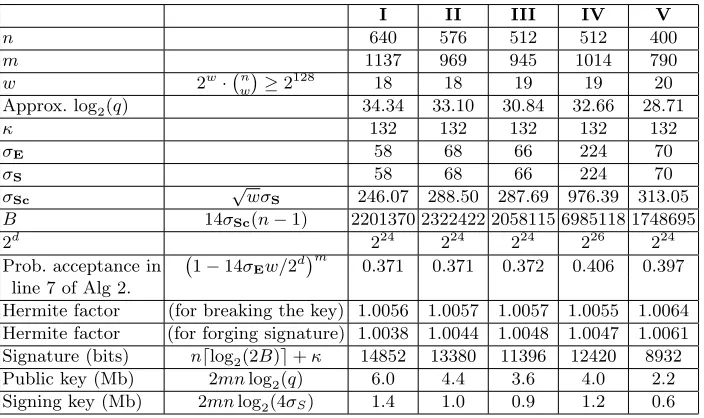
In Table 1, we give some concrete parameters for our signature scheme in Figure 1. The parameters are provably secure (cf.Theorem 2) and reduce to worst-case computational problems in general lattices. In Appendix B.2, we also give some shorter signatures that are based on non-standard LWE assumptions.
We discuss how the signature parameters in Table 1 are chosen. Given the security parameter n, the weight w is chosen such that 1/(2w· wn
) < 2−κ. Standard estimates show thatw≈κ/log(n). The standard deviation of Gaussian entriesSandEare chosen such that the LWE problem for the key is secure. In the signature, one computesz=y+Sc. By the central limit theorem the entries ofScare Gaussian with mean 0 and standard deviationσSc=
√
wσS. We bound
the entries of Sc by 14σSc, which is true with probability 2−140. Let Dz and
Dy be the uniform distribution on [−B+U, B−U] and [−B, B] respectively. The probability of acceptance in line 7 of Algorithm 2 is (1−14σEw/2d)m;
hence we need q > 2d ≥ 14mσEw. We also need the parameters to satisfy the conditions in the statement of Theorem 2. The signature size is given by
be effectively halved by generatingAusing a pseudo-random generator and by publishing only the seed for the generator as part of the public key (cf.[12]).
Table 1: Parameters for LWE Signatures using Uniform Distributions.
I II III IV V
n 640 576 512 512 400
m 1137 969 945 1014 790
w 2w· n
w
≥2128 18 18 19 19 20
Approx. log2(q) 34.34 33.10 30.84 32.66 28.71
κ 132 132 132 132 132
σE 58 68 66 224 70
σS 58 68 66 224 70
σSc
√
wσS 246.07 288.50 287.69 976.39 313.05
B 14σSc(n−1) 2201370 2322422 2058115 6985118 1748695
2d 224 224 224 226 224
Prob. acceptance in 1−14σEw/2d
m
0.371 0.371 0.372 0.406 0.397 line 7 of Alg 2.
Hermite factor (for breaking the key) 1.0056 1.0057 1.0057 1.0055 1.0064 Hermite factor (for forging signature) 1.0038 1.0044 1.0048 1.0047 1.0061 Signature (bits) ndlog2(2B)e+κ 14852 13380 11396 12420 8932 Public key (Mb) 2mnlog2(q) 6.0 4.4 3.6 4.0 2.2 Signing key (Mb) 2mnlog2(4σS) 1.4 1.0 0.9 1.2 0.6
To evaluate the security of our parameters against practical lattice attacks we consider the LWE problem for the secret key and the SIS problem for the forgery. The security can be estimated by computing the (root) Hermite factorγ
of the lattices (based on the BKZ 2.0 estimates of Chen and Nguyen [9]). Tables 2 and 3 of [9] suggest that instances withγ≤1.0065 should require around 2128 operations to solve using BKZ lattice reduction. These security estimations are standard in the field so we only sketch the details.
Solving an LWE instance (A,b≡As+e (mod q)) corresponds to solving the closest vector problem (CVP) with targetbin the image lattice{v∈Zm:v≡ As (modq)} ⊆Zm. It is known that the optimal dimensionm, when using a
lat-tice reduction algorithm with root Hermite factorδ, is aroundpnlog(q)/log(δ). To get closer to the optimal dimension (which is often larger thanm) one can con-sider the inhomogeneous SIS (ISIS) problemb= (A|Im)(sT,eT)T (modq). Let
v0 ∈Zn+mbe any solution (not necessarily small) to the equationb= (A|I m)v0 (mod q). One can solve the ISIS problem by solving the CVP (with target v0) in the kernel lattice{v∈Zn+m:b≡(A|I
m)v (modq)} ⊆Zm.
small, the standard approach is to estimate the lattice gap γ = λ2(L)/λ1(L)
(see [17, 1]). We let λ1(L) be the length of the target vector and λ2(L) be the
Gaussian expected shortest vector of theq-ary lattice. In the ISIS case, the tar-get vector has norm √n+m+ 1σE in the case σS = σE. The root Hermite factorδ(needed for the attack) isγ1/(n+m+1)=qm/(n+m+1)
σE√2πe
1/(n+m+1) . We also want the SIS problem in the forgery to be hard. In the proof of Lemma 6, we choose random matrices S0 and E0 with entries in [−E0, E0] for large enough E0 such the there exists alternative keys. The short vectors in the forgery (cf. Equation (8)) have entries bounded by max(2B,2d−1) + 2E0w. The short vectorsvin the forging problemAv≡0 (modq) have lengthkvk2≤
max(2B,2d−1
+2E0w)√m+n. Following Section 3 and equation (1) of [20], an estimate for the length of the shortest vector that we can find isqm/(n+m)δm+n (whereδ≈1.0065), and for the forgery security we need this to be larger than
D= max(2B,2d−1) + 2E0w√
m+n. In Table 1 we estimate the Hermite fac-tor required to solve the problem byδ= (D/qm/(m+n))1/(n+m).
An asymptotically good set of parameters would be to chooseκandn, then set m = 2n, w≈κ/log(n),σE =σS = 2√n, B = 14nσSc ≈28npκn/log(n), 2d ≈56n√nκ/logn, q ≈ 22d/2B. The public key and signatures for such pa-rameters are polynomially-sized in the security parameter. By Regev’s theorem, the security follows from worst-case computational problems in lattices with polynomial approximation factors.
6
Conclusion
We have described a new method for compressing lattice-based signatures in Lyubashevsky’s framework. The new signature scheme, together with the com-pression method, is based on the standard worst-case hardness of LWE and SIS in general modular lattices. Our signature size for 128-bit security is about 12000 bits, which is shorter than the previous signatures (≥16500 bits) whose security are based on hard problems in general lattices.
Acknowledgements
The authors are grateful to Vadim Lyubashevsky, Chris Peikert and anonymous referees for helpful comments and discussions on drafts of this paper. The au-thors wish to acknowledge NeSI (New Zealand eScience Infrastructure) and the Centre for eResearch at the University of Auckland for providing CPU hours (for searching the parameters in Table 1) and support.
References
2. B. Applebaum, D. Cash, C. Peikert and A. Sahai, Fast Cryptographic Primitives and Circular-Secure Encryption Based on Hard Learning Problems, in S. Halevi (ed.) CRYPTO 2009, Springer LNCS 5677 (2009) 595–618.
3. S. Bai and S. D. Galbraith, Lattice Decoding Attacks on Binary LWE, IACR Cryptology ePrint Archive 2013: 839 (2013).
4. M. Bellare and G. Neven, Multi-Signatures in the Plain Public-Key Model and a General Forking Lemma, in A. Juels, R. N. Wright and S. De Capitani di Vimercati (eds.), ACM CCS 2006, ACM (2006) 390–399.
5. B. Biswas and N. Sendrier, McEliece Cryptosystem Implementation: Theory and Practice, in J. Buchmann and J. Ding (eds.), PQCrypto 2008, Springer LNCS 5299 (2008) 47–62.
6. F. B¨ohl, D. Hofheinz, T. Jager, J. Koch, J. H. Seo and C. Striecks, Practical Signatures From Standard Assumptions, in T. Johansson and P. Q. Nguyen (eds.), EUROCRYPT 2013, Springer LNCS 7881 (2013) 461–485.
7. X. Boyen, Lattice Mixing and Vanishing Trapdoors – A Framework for Fully Secure Short Signatures and More, in P. Q. Nguyen and D. Pointcheval (eds.), PKC 2010, Springer LNCS 6056 (2010) 499–517.
8. Z. Brakerski, A. Langlois, C. Peikert, O. Regev and D. Stehl´e, Classical Hardness of Learning with Errors, in D. Boneh, T. Roughgarden and J. Feigenbaum (eds.), STOC 2013, ACM (2013) 575–584.
9. Y. Chen and P. Q. Nguyen, BKZ 2.0: Better Lattice Security Estimates, in D. H. Lee and X. Wang (eds.), ASIACRYPT 2011, Springer LNCS 7073 (2011) 1–20. 10. L. Ducas, A. Durmus, T. Lepoint and V. Lyubashevsky, Lattice Signatures and
Bimodal Gaussians, in R. Canetti and J. A. Garay (eds.), CRYPTO 2013, Springer LNCS 8042 (2013) 40–56.
11. L. Devroye, Non-Uniform Random Variate Generation, Springer-Verlag, New York, 1986.
12. S. D. Galbraith, Space-efficient variants of cryptosystems based on learning with errors, preprint, 2013.
13. C. Gentry, C. Peikert and V. Vaikuntanathan, Trapdoors for Hard Lattices and New Cryptographic Constructions, in C. Dwork (ed.), STOC 2008, ACM (2008) 197-206.
14. T. G¨uneysu, V. Lyubashevsky and T. P¨oppelmann, Practical Lattice-Based Cryp-tography: A Signature Scheme for Embedded Systems, in E. Prouff and P. Schau-mont (eds.), CHES 2012, Springer LNCS 7428 (2012) 530–547.
15. M. Liu and P. Q. Nguyen, Solving BDD by Enumeration, An Update, in E. Dawson (ed.), CT-RSA 2013, Springer LNCS 7779 (2013) 293–309.
16. V. Lyubashevsky, Fiat-Shamir with Aborts: Applications to Lattice and Factoring-Based Signatures, in M. Matsui (ed.), ASIACRYPT 2009, Springer LNCS 5912 (2009) 598–616.
17. V. Lyubashevsky and D. Micciancio, On Bounded Distance Decoding, Unique Shortest Vectors, and the Minimum Distance Problem, in S. Halevi (ed.), CRYPTO 2009, Springer LNCS 5677 (2009) 577–594.
18. V. Lyubashevsky, Lattice Signatures without Trapdoors, in D. Pointcheval and T. Johansson (eds.), EUROCRYPT 2012, Springer LNCS 7237 (2012) 738–755. 19. D. Micciancio and S. Goldwasser, Complexity of Lattice Problems: A cryptographic
Perspective, Kluwer, 2002.
21. D. Micciancio and C. Peikert, Hardness of SIS and LWE with Small Parameters, in R. Canetti and J. A. Garay (eds.), CRYPTO 2013, Springer LNCS 8042 (2013) 21–39.
22. D. Pointcheval and J. Stern, Security Arguments for Digital Signatures and Blind Signatures, J. Cryptology,13(2000) 361–396.
23. D. Stehl´e and R. Steinfeld, Making NTRUEncrypt and NTRUSign as Secure as Standard Worst-Case Problems over Ideal Lattices, Cryptology ePrint Archive: Report 2013/004.
24. O. Regev, On Lattices, Learning with Errors, Random Linear Codes, and Cryp-tography, in H. N. Gabow and R. Fagin (eds.), STOC 2005, ACM (2005) 84–93. 25. O. Regev, On Lattices, Learning with Errors, Random Linear Codes, and
Cryp-tography, Journal of the ACM 56(6), article 34, 2009.
A
Signatures
A signature scheme comprises three randomized algorithms: KeyGen, Sign, Ver-ify. KeyGen takes as input a security parameter and outputs a public/private key pair (pk, sk). Sign takes as input a messageµand a private keysk, and outputs a signatureΣ. Verify takes as input a messageµ, signatureΣand public keypk, and outputs “valid” or “invalid”. We require that, at least with overwhelming probability, Verify(µ,Sign(µ, sk), pk) = “valid”.
Adaptive security for signatures is defined using a game between a forgery algorithm F and a challenger. The challenger generates a public key pk for the signature scheme at a given security level and runs the forger. The forger takes as input the public key for the signature scheme, makes hrandom oracle queries and ssign queries, runs in time t, and outputs (µ, Σ). The forger wins if Verify(µ, Σ, pk) = “valid”. The success probability (taken over all public keys generated by the challenger, all responses to the hash and sign queries, and over the random choices made byF) is denoted. The signature scheme issecure if there is no polynomial-time (in terms of the security parameter) algorithm F
whose success probability in the above game is non-negligible.
An important tool for analysing signatures in the random oracle model is the Forking Lemma of Pointcheval and Stern [22]. We need the signature scheme to be a generic signature scheme (the scheme in this paper does satisfy that requirement) with security parameter κ and hash output of size 2κ. Note that a sign query involves an implicit hash query, but that this is to a random value that is chosen by the challenger. Hence, when we say that F makes h hash queries we are only counting the actual queries to the random oracle, and not the additionalshash queries implicit in the signing algorithm.
Theorem 13 of [22] considers a forgerF that runs in timet, makeshqueries to the random oracle (including those performed by the sign oracle), s sign queries, and outputs a forgery with probability > 10(s+ 1)(s+h)/2κ. Then the re-winding process produces, with probability one, two valid signatures with the same “y-value” but different hash values in timet0 ≤120686th/.
An alternative formulation was given by Bellare and Neven [4]. The two main differences are a cleaner and more general presentation, and an analysis in the case where the forking lemma just runsF twice (rather than 120686th/times). Bellare and Neven consider a forger F that outputs a valid forgery in time t
with probabilitymakinghrandom oracle queries andssign queries. Then the rewinding algorithm outputs two valid signatures in time approximately 2t and with probability at least (Lemma 1 of [4])
h−
1 2κ
.
In Theorem 3 we use a slight variant of the forking lemma. In our case, we must guess in advance the indexI of the hash query that corresponds to a successful forgery (as we need to program this hash value to be a specific element corresponding to the problem instance). Hence, we need to guess the indexIfrom among thehpossible values. We then answer theI-th hash query with a specific valuec∗ and then, in the re-winding, answer the I-th hash query with another specific valuec†. Both valuesc∗ andc† are chosen uniformly at random. Hence, the probability the rewinding algorithm outputs two valid signatures in time approximately 2tis
h
h−
1 2κ
. (9)
B
Variants
This section discusses some avenues to obtain even shorter signatures. Some of these ideas have already been used by other authors [18, 14, 10]. First we discuss obstructions to very short lattice signatures. The main driver of signature size is that nmust be sufficiently large to ensure the lattice problems are hard. Some further issues are:
– Thez vector has to cover all possible values forSc, so ifSc can be made smaller then signatures will be smaller. Unfortunately, we cannot just reject thosecfor whichScis large, since we are unable to simulate such behaviour.
– Lemma 4 requires the simulation to be statistically very close to the real game, and this requires high-grade rejection sampling in the sign algorithm. If we want to have a constant rejection rate then this leads to a linear factor of n in the bound B for the distribution Dz. In principle, using a Gaussian distribution forDzreduces this to a
√
B.1 General tricks
One can take k very large so thatw is smaller. However, the public key grows in size and the improvement is minor (for example, takingk= 3nso that public keys are 3 times larger only reduceswfrom 18 to 14 whenn= 600).
One can apply a further rejection sampling to ensure that z is small. For example, one can save n bits in the signature by replacing B by B/2 in the distribution Dz. In other words, we require that z ∈ [−B/2, B/2]n. Since z is sampled uniformly it follows that the acceptance probability goes from 1/e
to 1/e2. Similarly, saving 2n bits by reducing Dz to [−B/4, B/4] changes the acceptance probability to 1/e4≈1/55.
B.2 Signatures based on non-standard LWE
We have seen that signature size depends on both n andSc. Hence, there is a temptation to choose the entries of Sto be as small as possible. For instance, we could choose Sto be a binary matrix (entries uniformly chosen from {0,1}) and E from a discrete Gaussian distribution with standard deviation σE. This is the binary secret LWE problem.
Micciancio and Peikert [21] and Brakerski, Langlois, Peikert, Regev and Stenl´e [8] have studied the case of LWE with binary secrets. They give some results that imply that such variants of LWE can be hard. However, their results are not useful for our application as they require a large increase in the param-eter n for the LWE problem. More precisely, Theorem 4.6 of [21] shows that (m, n, q)-binary-LWE can be hard as long as SIVPγ is hard in k = n/log(n) dimensional lattices, where γ = ˜O(√kq). The value n = 512 corresponds to
k= 82, and so such parameters give a weak security guarantee.
Furthermore, there is a lattice decoding attack [3] for LWE with small secrets (where the entries ofSare uniformly chosen from{−d, d}). The algorithm first translates the binary-LWE problem into an inhomogeneous short integer solution problem and then solves the closest vector problem on the re-scaled lattice basis. The results of [3] confirm thatnmust be significantly enlarged if one works with binary vectors for the secret. Section 4.3 of Liu and Nguyen [15] also considers attacking a system with very small uniform errors. They find that the attack works for a much larger range of parameters than the general case, including
n= 350. Hence, using binary secrets for the signatures application seems to not be a good way to get short signatures.
Alternatively, we could chooseSandEfrom Gaussian with deviation σS =
σE≤2 √
n. As a example we choose (n, m, σS, σE, d, w) = (448,886,32,32,23,19) and take q ≈ 227.84. Here B is about 219.74 which gives signatures of size
21n+ 128 = 9540 bits. The Hermite constantγ needed is roughly 1.0060. The acceptance probability is roughly 0.407.
lattices with Gaussian errors (of deviation about 3.3) should require around 2105
time to break. This suggests that, in practice,n= 320 dimensional lattices with Gaussian errors (of larger deviation) should be safe for LWE.
The size ofσS andσE also affects relations in Equation (4). This turns out to be a stricter constraint: it is easier to find suitable parameters whenσS and
σEare large. In general, it seems that using small values forσS andσEmay turn out to provide a relatively minor saving in signature size, so we do not pursue this idea further.
B.3 Bi-modal
We can also consider the bimodal technique of Ducas, Durmus, Lepoint and Lyubashevsky [10] in our setting. The main idea is to work modulo 2q and to choose the matrixT to be such that−T≡T (mod 2q). This can be achieved by ensuring that the entries of the matrixTare all in{0, q}. The matrixTcan be represented usingmnbits rather thanmnlog2(2q) bits.
One particular choice for T isq times ann×n identity matrix (note that this requires m = n, which may result in a further increase in q. In this case the public key is further compressed, since there is no need to publish Tat all. Letk =n and suppose then×nmatrix Swith Gaussian entries is invertible. Construct the public key (A,T) as follows. Choose (S,E) first and set A ≡ (T−E)S−1 (mod 2q). The computational assumption is now related to the NTRU assumption: Given A find matrices (S,E) with small entries such that
A ≡ −ES−1 (modq). In particular, it is necessary (but not sufficient as far as we know) for this matrix-NTRU problem to be hard for our scheme to be secure. Note that the security of the short signature scheme of [10] also relies on an NTRU assumption (also in a ring) of a similar form.
The goal of using the bimodal distribution is that is makes the rejection sampling work better, and so one can use smaller distributions for Dy and Dz (indeed, Gaussian distributions). Using a Gaussian distribution forDywith stan-dard deviation σand the bi-modal trick we should be able to take (as on page 5 of [10])
σ= 12√nσS √
w/√2.
For instance, from parameters (n, σS, w) = (448,32,19) we can obtain σ = 12pwn/2σS ≈25051. Assuming a perfect encoding of Gaussian data that only requires log2(4σ) bits to represent elements from this distribution we might hope
to have signatures of around 448·log2(4σ) + 132≈7575 bits.
The security analysis of this variant requires a different use of the forking lemma, as well as a non-standard assumption. We do not give the details here.
B.4 Signatures based on Ring-LWE/NTRU
Our scheme could be implemented with Ring-LWE. The signature is a single ring element and the hash value. The public key is now a sequenceti=ais+ei (mod q), for 1≤i≤`, with elements inZq[x]/(x2
To sign we computec=H(ba1yed. . .ba`yed, µ) and thenz=y+sc. Ver-ification is that z is short and that H(ba1z−t1ced, . . .ba`z−t`cedµ) equals
c.
The security proof is identical (one can always consider Ring-LWE as a par-ticular case of the matrix problem), but of course the security now depends on the Ring-LWE assumption. Using Ring-LWE will reduce the public key size and improve speed, but it does not seem to lead to any reduction of the signature size, so we do not consider it further in this paper.
C
Completing the proof of Theorem 3
This approach is rather different. When we replace the public key we insert an LWE instance into the key. The forgery therefore can be used to obtain a solution to the LWE instance.
The proof is a little less tight than the proof of Theorem 2 or the proofs in [10, 18], due to our non-standard use of the forking lemma. Our proof applies to many different distributions Dy, but it is simplest to consider Dy to be the uniform distribution [−B, B]. Hence, the full details are given for this case, and so we take`=∞.
The idea of the proof is as follows: We define Game 2 to be the same as Game 1, except that the public key is replaced by a uniformly chosen pair of matrices (A,T). Game 3 is the same as Game 2, except it has a different key generation algorithm (see Algorithm 5 below). Lemma 8 shows that an adversary that can distinguish Game 1 and Game 2 is solving the matrix version of decisional-LWE. Lemma 9 shows that a distinguisher between Game 2 and Game 3 is solving decisional-LWE. Finally, we show that an adversary who can win Game 3 can be used to solve search-LWE.
Lemma 7. Supposeqis prime and that condition (6) holds. Then, with proba-bility1−1/2κ, there is no non-zero vectory∈[−B, B]n withbAy (mod q)ed= 0 and the output ofbAy (modq)ed is uniform and the cardinality of the set
{bAy (mod q)ed:y←Dny} is(2B+ 1)n.
Proof. Letq be a prime such that the equation (6) is satisfied. Fix a non-zero vector yand consider the set Ay={A∈Zqm×n :bAy (mod q)ed = 0}. These are the bad matrices for our vectory. Considering each row ofAwe may choose (n−1) positions arbitrarily, and one remaining entry is constrained to a set of 2d values. Hence #A
y= qn−12d
m .
Consider any set of (2B+ 1)n choices for non-zeroy, then the union of all the bad sets has at most (2B+ 1)n qn−12dm
elements. If a matrix A is not chosen from that union of sets then the functionbAy (modq)ed is non-zero for all thosey. Hence, the probability a matrixAis bad for the set ofyis
(2B+ 1)n qn−12dm
Now, suppose thatbAy1 (modq)ed=bAy2 (mod q)ed. It follows that y=
y1−y2is a vector withAy (mod q) having entries in [−2d,2d]. In other words,
y∈[−2B,2B]nis such thatbAy (modq)e
d+1= 0. Applying the same argument
as above on the enlarged parameters shows that such a vector y occurs with probability at most 1/2κ, and so with overwhelming probability there are no collisions in the functionbAy (mod q)ed.
Note that Lemma 7 prevents the fifth possible attack mentioned in Sec-tion 3.1.
Lemma 8. Let the forger have success probability δ in Game 1 in the random oracle model. If the success probability of the forger in Game 2 isδ0with=|δ0−
δ|then there is an algorithm to distinguish the distribution(A,AS+E (modq)) from the uniform distribution onZmq ×(n+k)that runs in time approximatelytand gives the correct answer with advantage.
Proof. (Sketch) The signing algorithm in Game 2 is the same as Game 1, while the public key of Game 2 is a uniformly chosen pair of matrices (A,T).
LetAbe a forger. We build a distinguisherDthat takes as input a pair (A,T) of matrices, taken either from the uniform distribution or the LWE distribution. The distinguisher runsAon the public key (A,T). The forgerAcan make hash queries and sign queries, and the distinguisher answers these in the random oracle model as we have explained in Algorithm 4. Eventually the forger outputs a candidate signature. If the signature is valid thenDoutputs 1, elseDoutputs 0.
The advantage ofD is defined to be the absolute value of the difference of the probabilities it outputs 1 when the input (A,T) is from each of the two distributions. This isby definition.
Algorithm 5Game 3 key generation (Tw≡b (modq)).
Input: A,b,w6=0 Output: (A,T)
1: For notational convenience we suppose thatw16= 0. 2: Writew= (w1
w0) 3: T0←Zmq×(k−1)
4: Sett≡b−T0w0 (modq) 5: SetT= [w−1
1 t (modq)|T
0
] (This is nowm×k.) 6: return(A,T)
Lemma 9. Let the forger have success probability δ in Game 2 in the ran-dom oracle model. If the success probability of the forger in Game 3 is δ0 with
Proof. (Sketch) Let (A,b) be the decisional-LWE instance and choose any vector
w of low weight. Consider Algorithm 5 on input (A,b,w). If b is sampled uniformly then the output matrixTis uniformly chosen, whereas ifbis sampled from the LWE distribution thenTis constrained. Any difference in the behaviour of the forger for these games therefore distinguishesbfrom random.
Lemma 10. Suppose the forgerAplays Game 3, makeshhash function queries andssign queries, runs in time t, and succeeds with probabilityδ0. Suppose the parameters satisfy the conditions in Theorem 3.
Then there exists an algorithm running in time approx 2t and with success probability δh0δh0 − 1
2k
+O(2sκ2 + n+m
2140)that solves (n, m, q, α)-LWE with short
secrets.
Proof. (Sketch) Let (A,b) be the input (n, m, q, α)-LWE instance. We wish to find vectors y1,y2 such that Ay1+y2 ≡ b (modq) and we know that y1,y2
have been sampled from the discrete Gaussian distributionDαq. It follows that, with probability 2−140,ky
1k∞,ky2k∞≤14αq (see equation (1)). Due to our choice of parameters 2B,2d≥14αq we have that
ky1k∞≤2B and ky2k∞≤2d. (10) Furthermore, equation (6) implies the LWE instance is well-defined in the sense that, with high probability, any pair (y01,y02) of vectors satisfying the bounds of
equation (10) is actually the desired pair (y1,y2) corresponding to the
distribu-tionDαq.
Choose uniformly at random c∗, c† ← {0,1}κ and set w = F(c∗)−F(c†). Then w is a length k vector over Z but we do not need any restriction on its weight (as long as w 6=0, which fails with negligible probability c1/2κ by
equation (2)). Then perform the key generation algorithm in Algorithm 5. The point is that Tw≡b (modq).
We now guess an index 1 ≤ I ≤ h and run the forger A on (A,T). The forger makes hash and sign queries. Hash queries are answered by choosing fresh uniform values that are stored in a list, with the exception that the I-th hash query is answered withc∗. Sign queries are simulated in the random oracle model as usual.
EventuallyA outputs a valid signature (z, c) on message µ. We know that the random oracle has been queried in order for the verification equation c =
H(bved, µ) to hold.
We will now explain thatcarises with overwhelming probability from a hash query, not a sign query. Suppose not: then a sign query on a message µ0 with output equals to (z0, c), and hence we have c = H(bAz−Tc (modq)ed, µ) =
Now we apply the forking lemma. In other words, we re-wind the attack, so that vis the same but theI-th random oracle output is taken to be the binary string c† such thatF(c∗) =F(c†) +w.
One can verify that our signature scheme is a generic signature scheme with security parameter κ. As discussed in Appendix A, we use a variant of the Bellare-Neven [4] formulation given in equation (9). This takes into account that we need a forgery with hash value taken to be the specific value c∗ chosen at the start of the proof, and then replace the same random oracle query with the value c†. Note that both values c∗ and c† are chosen independently and uniformly at random, as required to apply the forking Lemma. It follows that we may obtain a pair of valid signatures (c∗,z∗) and (c†,z†) corresponding to the same hash input (bved, µ) in time approximately 2tand with probability at least
δ0 h
δ0 h −
1 2κ
.
We have
Az∗−TF(c∗)≡v+e∗ (modq) and, similarly,
Az†−TF(c†)≡v+e† (modq).
Subtracting gives
A(z∗−z†) + (e†−e∗)≡T(F(c∗)−F(c†)) =Tw≡b (modq).
Note thatkz∗k∞,kz†k∞≤Band sokz∗−z†k∞≤2B. Similarly,ke∗k∞,ke†k∞≤ 2d−1 and so ke† −e∗k
∞ ≤ 2d. Hence, by uniqueness of the LWE solution, (z∗−z†,e†−e∗) is the desired solution to the LWE instance.