300
Considerations on Models, Algorithms And Security
Challenges In Cloud Computing
Hossein Mohammadi
Department of Computer Engineering, Bukan Branch, Islamic Azad University, Bukan, Iran
Abstract_From the perspective of data security, which has always been an important aspect of quality of service, cloud computing focuses a new challenging security threats. Therefore, a data security model must solve the most challenges of cloud computing security. Cloud Computing is a set of IT Services that are provided to a customer over a network and these services are delivered by third party provider who owns the infrastructure. It is often provided "as a service" over the Internet, typically in the form of infrastructure as a service (IaaS), platform as a service (PaaS), or software as a service (SaaS). If authorized person accesses successfully in his cloud, the data is decrypted in real time for your use. The default gateway platform must contain strong and fast encryption algorithm, file integrity, malware detection, firewall, tokenization and more. This paper describes about the different security algorithms , Data Security Model,security issues and security attacks in cloud computing.
Keywords: Cloud computing, Infrastructure, Service, Security Algorithms. Cloud computing, randomness testing.
1. Introduction
301
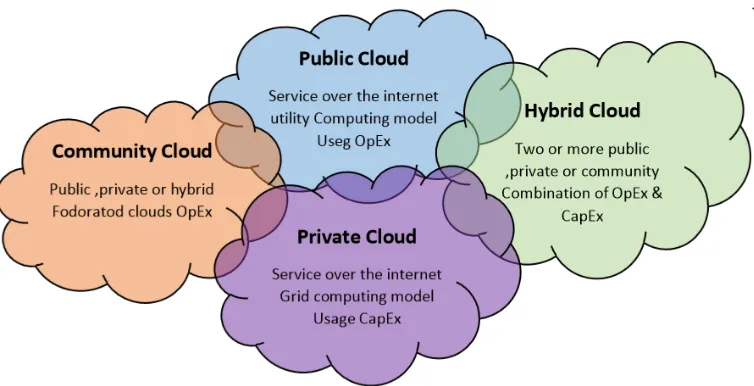
Fig 1: Deployment models operated by Cloud Computing
Private cloud -- The cloud infrastructure is operated solely for an organization. It may be managed by the organization or a third party and may exist on premise or off premise.
Community cloud -- The cloud infrastructure is shared by several organizations and supports a specific community that has shared concerns (e.g., mission, security requirements, policy, and compliance considerations). It may be managed by the organizations or a third party and may exist on premise or off premise.
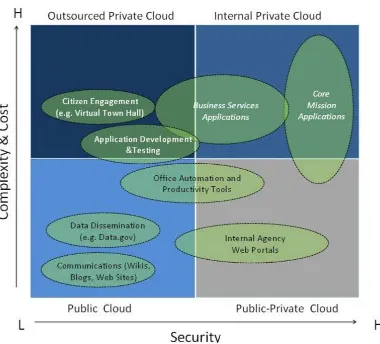
Public cloud -- The cloud infrastructure is made available to the general public or a large industry group and is owned by an organization selling cloud services and the comparison of private and public cloud as shown in fig2.
302
Fig 2 :Comparision of Security and complexity between Private and Public cloud.
The main attributes of cloud computing are illustrated as follows [1]: Multi-tenancy (shared resources): Cloud computing is based on a business model in which resources are shared (i.e., multiple users use the same resource) at the network level, host level and application level; Massive scalability: Cloud computing provides the ability to scale to tens of thousands of systems, as well as the ability to massively scale bandwidth and storage space; Elasticity: Users can rapidly increase and decrease their computing resources as needed; Pay as you used: Users to pay for only the resources they actually use and for only the time they require them; Self-provisioning of resources: Users’ self-provision resources, such as additional systems (processing capability, software, storage) and network resources.
2. Security issues associated with the cloud
303
service (PaaS), or software as a service (SaaS) via the cloud) and security issues faced by their customers[2] .In most cases, the provider must ensure that their infrastructure is secure and that their clients’ data and applications are protected while the customer must ensure that the provider has taken the proper security measures to protect their information[3]. Cloud computing becomes a successful and popular business model due to its charm- ing features. In addition to the benefits at hand, the former features also result in serious cloud-specific security issues. The people whose concern is the cloud security continue to hesitate to transfer their business to cloud. Security issues have been the dominate barrier of the development and widespread use of cloud computing. Understanding the security and privacy risks in cloud computing and developing efficient and effective solutions are critical for its success.
2.1 Security issues faced by cloud providers
2.1.1 Infrastructure as a Service (IaaS)
Infrastructure as a Service is a provision model in which an organization outsources the equipment used to support operations, including storage, hardware, servers and networking components. The service provider owns the equipment and is responsible for housing, running and maintaining it. The client typically pays on a per-use basis. Characteristics and components of IaaS include: Utility computing service and billing model. Automation of administrative tasks. Dynamic scaling. Desktop virtualization. Policy-based services. Internet connectivity.
2.1.2 Platform as a Service (PaaS)
Platform as a Service (PaaS) is a way to rent hardware, operating systems, storage and network capacity over the Internet. The service delivery model allows the customer to rent virtualized servers and associated services for running existing applications or developing and testing new ones. Platform as a Service (PaaS) is an outgrowth of Software as a Service (SaaS), a software distribution model in which hosted software applications are made available to customers over the Internet. PaaS has several advantages for developers. With PaaS, operating system features can be changed and upgraded frequently. Geographically distributed development teams can work together on software development projects. Services can be obtained from diverse sources that cross international boundaries. Initial and ongoing costs can be reduced by the use of infrastructure services from a single vendor rather than maintaining multiple hardware facilities that often perform duplicate functions or suffer from incompatibility problems. Overall expenses can also be minimized by unification of programming development efforts.
2.1.3 Software as a Service (SaaS)
304
Benefits of the SaaS model include:
easier administration
automatic updates and patch management
compatibility: All users will have the same version of software. easier collaboration, for the same reason
global accessibility.
The extensive use of virtualization in implementing cloud infrastructure brings unique security concerns for customers or tenants of a public cloud service[4]. Virtualization alters the relationship between the OS and underlying hardware - be it computing, storage or even networking. This introduces an additional layer - virtualization - that itself must be properly configured, managed and secured[5]. Specific concerns include the potential to compromise the virtualization software, or "hypervisor". While these concerns are largely theoretical, they do exist[6].
Dimensions of cloud security
Correct security controls should be implemented according to asset, threat, and vulnerability risk assessment matrices[7]. While cloud security concerns can be grouped into any number of dimensions (Gartner names seven[8] while the Cloud Security Alliance identifies fourteen areas of concern[9]) these dimensions have been aggregated into three general areas: Security and Privacy, Compliance, and Legal or Contractual Issues[10].
3. Security Concerns
1. Data? The main thing that is where the data is because the data is in cloud so the cloud provider should agree to provide security to the data of our customers.
2. Access? And second thing that who has access to the data that is at cloud. If anyone using the cloud needs to look at who is managing their data and what types of controls are applied
3. Training to Employees? Train the employees because the employees need to know how to access the data maintaining security
. 4. Data Classification? Because there is data of different user so the question is ―Is Data Classified‖
5 service level agreement (SLA) ? The SLA serves as a contracted level of guaranteed service between the cloud provider and the customer that specifies what level of services will be provided.
6. What happens if there is a security breach? If a security incident occurs, what support will you receive from the cloud provider? While many providers promote their services as being unhackable, cloudbased services are an attractive target to hackers.
4. SecurityAlgorithms
305
key can only be decrypted using the private key. user data include encryption prior to storage, user authentication procedures prior to storage or retrieval, and building secure channels for data transmission.
MD5- (Message-Digest algorithm 5), a widely used cryptographic hash function with a 128-bit hash value, processes a variable-length message into a fixed-length output of 128 bits. The input message is broken up into chunks of 512-bit blocks . the message is padded so that its length is divisible by 512. In this sender use the public key of the receiver to encrypt the message and receiver use its private key to decrypt the message.
AES- In cryptography, the Advanced Encryption Standard (AES) is a symmetric-key encryption standard. Each of these ciphers has a 128-bit block size, with key sizes of 128, 192 and 256 bits, respectively [11]. AES algorithm ensures that the hash code is encrypted in a highly secure manner. AES has a fixed block size of 128 bits and uses a key size of 128 in this paper. Its algorithm is as follows:
1. Key Expansion 2. Initial Round 3. Add Round Key 4. Rounds
5. Sub Bytes—a non-linear substitution step where each byte is replaced with another according to a lookup table.
6. Shift Rows—a transposition step where each row of the state is shifted cyclically a certain number of steps.
7. Mix Columns—a mixing operation which operates on the columns of the state, combining the four bytes in each column
8. Add Round Key—each byte of the state is combined with the round key; each round key is derived from the cipher key using a key schedule.
9. Final Round (no Mix Columns) 10. Sub Bytes
11. Shift Rows 12. Add Round Ke
Encryption- converts data to an unintelligible form called cipher text; decrypting the cipher text converts the data back into its original form, called plain text .
Security Attacks cloud computing systems are providing awide variety of services and interfaces to enable vendors to rent out spaces on their physical machines at an hourly rate for a tidy profit. Threats Extortionists : Using DDoS attack to exhaust server resources Competitors : Using known vulnerabilities to interrupt services
306
The DDos Attack Tools Complex: Agobot,Mstream,Trinoo Simple: Extensible Markup Language (XML) based Denial of Service (X-DoS) Hypertext Transfer Protocol (HTTP) based Denial of Service (H-DoS) X-DoS: Coercive Parsing attack Open xml tags Exhaust CPU usage
H-DoS:
Using HTTP Flooder
starts up 1500 threads
send randomized HTTP requests to the victim web server exhaust victim’s communication channels
Cloud TraceBack, CTB
service-oriented traceback architecture
to defend against X-DoS attacks the area of cloud computing.
H-DoS attack
affected Iran
using the attack as an example of bringing down a cloud system train our back propagation neural network called Cloud Protector
Cloud Protector
Back propagation neuralnetwork
5. Conclusion
Cloud computing is revolutionizing how information technology resources and services are used and managed, but the revolution always comes with new problem In the future, we will extend our research by providing implementations and producing results to justify our concepts of security for cloud computing.
References
[1] Priyanka Arora, Arun Singh, Himanshu Tyagi ―Analysis of performance by using security algorithm on cloud network‖ in international conference on Emerging trends in engineering and management (ICETM2012), 23-24 june, 2013.
[2] ―"Swamp Computing" a.k.a. Cloud Computing". Web Security Journal. 2011-12-28. Retrieved 2010-01-25.
[3]""Thunderclouds: Managing SOA-Cloud Risk", Philip Wik". Service Technology Magazine. 2012-10. Retrieved 2011-21- 21.
[4] Winkler, Vic. "Cloud Computing: Virtual Cloud Security Concerns". Technet Magazine, Microsoft. Retrieved 12 February 2014.
307
[6]Winkler, Vic (2011). Securing the Cloud: Cloud Computer Security Techniques and Tactics. Waltham, MA USA: Elsevier. pp. 59. ISBN Securing the Cloud Cloud Computer Security Techniques and Tactics.
[7] "4 Cloud Computing Security Policies You Must Know". CloudComputingSec. 2011. Retrieved 2011-12-13.
[8] "Gartner: Seven cloud-computing security risks". InfoWorld. 2008-07-02. Retrieved 2010-01-25.
[9] "Security Guidance for Critical Areas of Focus in Cloud Computing". Cloud Security Alliance. 2011. Retrieved 2011-05- 04.
[10] "Cloud Security Front and Center". Forrester Research. 2009-11-18. Retrieved 2010-01-25.