Public-Coin Differing-Inputs Obfuscation
and Its Applications
Yuval Ishai Technion
Omkant Pandey UIUC [email protected]
Amit Sahai UCLA [email protected]
Abstract
Differing inputs obfuscation(diO) is a strengthening of indistinguishability obfuscation (iO) that has recently found applications to improving the efficiency and generality of obfuscation, functional encryption, and related primitives. Roughly speaking, a diO scheme ensures that the obfuscations of two efficiently generated programs are indistinguishable not only if the two programs are equivalent, but also if it is hard to find an input on which their outputs differ. The above “indistinguishability” and “hardness” conditions should hold even in the presence of an auxiliary input that is generated together with the programs.
The recent works of Boyle and Pass (ePrint 2013) and Garg et al. (Crypto 2014) cast serious doubt on the plausibility of general-purpose diO with respect to general auxiliary inputs. This leaves open the existence of a variant of diO that is plausible, simple, and useful for applications.
We suggest such a diO variant that we call public-coin diO. A public-coin diO restricts the original definition of diO by requiring the auxiliary input to be a public random string which is given as input to all relevant algorithms. In contrast to standard diO, we argue that it remains very plausible that current candidate constructions of iO for circuits satisfy the public-coin diO requirement.
1
Introduction
General-purpose obfuscation refers to the concept of transforming an arbitrary program so that its functionality is preserved, but otherwise rendering the program “unintelligible.” This concept has intrigued cryptographers for decades, and led to multiple attempts at formalization (most no-tably [BGI+12]). A critical goal in obfuscation research has been to identify the strongest notions of obfuscation that areplausible and have wide applicability. General-purpose obfuscation, however, has proven to be perched precariously between possibility and impossibility.
On the one extreme,virtual black-box obfuscation(VBB) is an ideal form of obfuscation that cap-tures the intuitive notion of obfuscation and often can be directly used in applications. Unfortunately, this notion is impossible in the sense that it provably cannot be realized for certain contrived classes of programs [BGI+12], or for quite large classes of programs under contrived auxiliary inputs [GK05]. On the other extreme, the most liberal notion of general-purpose obfuscation isindistinguishability obfuscation (iO) [BGI+12, GR07]. An iO scheme for a class of “programs” is an efficient randomized algorithm that maps any program P into a functionally equivalent obfuscated program P0 such that if P1 and P2 compute the same function then their obfuscations P10 and P20 are computationally
indistinguishable.
The first plausible construction of a general-purpose iO scheme was given in 2013 by Garg et al. [GGH+13b]. This construction and similar ones from [BR14, BGK+14] render the existence of an iO scheme a plausible assumption, since there are currently no attacks or other evidence suggesting that these constructions fail to meet the iO requirements. In particular, no theoretical impossibility results are known for iO schemes even for contrived classes of programs and auxiliary inputs.
On the downside, the security guarantee of iO appears to be too weak for most natural applica-tions of obfuscation. A recent line of work, originating from [GGH+13b, SW14], has made impressive progress on applying iO towards a wide array of cryptographic applications. However, these appli-cations are still not as broad as one might expect, and the corresponding constructions and their analysis are significantly more complex than those that could be obtained from an ideal obfuscation primitive. Indeed, this may be the case because the definition of iO seems to capture only a quite minimal property of obfuscation.
In search of the “strongest plausible assumption.” The above limitations of iO motivate the search for stronger notions of obfuscation that support more applications and give rise to simpler con-structions and security proofs. Such a stronger notion should be plausible, in the sense that current candidate obfuscation constructions can be conjectured to satisfy the stronger requirements without contradicting other theoretical or empirical evidence. Another important feature is succinct descrip-tion, ruling out contrived notions whose security requirements refer separately to each application. This leads to the following question, which is at the center of our work:
Is there a plausible, useful, and succinctly described notion of obfuscation that captures stronger security requirements than indistinguishability obfuscation?
Differing inputs obfuscation. A seemingly promising positive answer to our question was given by the notion of differing inputs obfuscation(diO). First proposed in [BGI+12] and recently revisited in [ABG+13, BCP14], diO has found a diverse array of applications that do not seem to follow from traditional iO (see below for more details). Roughly speaking, a diO scheme ensures that the obfuscations of two efficiently generated programs P1 and P2 are indistinguishable not only if they
compute the same function, but also if it is hard for an adversary to find an inputx on which the two programs differ, namely xsuch that P1(x)6=P2(x). The above “indistinguishability” and “hardness”
the programs and is given as input both to the adversary trying to find an input x as above and to the distinguisher who tries to distinguish between the two obfuscated programs. Indeed, different applications give rise to different distributions of aux.
However, the recent works of [BP13, GGHW14] cast serious doubts on the plausibility of general-purpose diO with respect to general auxiliary inputs. In particular, [GGHW14] showed that the existence of diO with respect to arbitrary auxiliary inputs contradicts a certain “special-purpose obfuscation” conjecture. At a high level, the impossibility result of [GGHW14] proceeds as follows: Consider a pair of programsP1andP2that produce different one-bit outputs only on inputsx= (m, σ)
that consist of valid message-signature pairs with respect to a fixed unforgeable signature scheme verification key. Now we consider another program D which takes a program P as input, and then hashes P to compute m = h(P) together with a signature σ on m. It then feeds x = (m, σ) as input to P, and outputs the first bit of P(x). Now, the auxiliary input given to the adversary will be a “special-purpose obfuscation” of this program D. The special-purpose obfuscation conjecture of [GGHW14] is that even given this auxiliary input, it is still hard for the adversary to obtain any valid message-signature pair. This assumption seems quite plausible, for instance if D is obfuscated using the obfuscators of [GGH+13b, BR14, BGK+14]. Now, it is evident that the adversary can distinguish between any obfuscations of P1 and P2 using the auxiliary input, and yet by the
special-purpose assumption, the adversary cannot compute any valid message-signature pair, and therefore cannot find a differing input.
What causes impossibility for diO? If we would like to consider general notions of obfuscation that capture security requirements beyond indistinguishability obfuscation, it is imperative that we understand the roots of impossibility for diO. Indeed, it is not difficult to evade the impossibility results of [BP13, GGHW14] by simply assuming that diO only holds with respect tospecific auxiliary input distributions, as has been suggested in [ABG+13, BCP14, BP13]. However, this approach would yield disparate special-purpose variants of the diO assumption for each potential application scenario, with little clarity on why any particular such assumption should be valid. This would defeat our goal of obtaining a general and succinctly described assumption. Therefore, we seek to understand the essential flaw that the works of [BP13, GGHW14], and others like it, can exploit using auxiliary inputs.
Our starting point is the suggestion, made in several previous works [BCP14, BP13, BCCT13, BCPR14], to specifically consider an auxiliary input that is uniformly random, since at least some applications of diO and other suspect primitives seem to work with just uniformly random auxiliary inputs. This certainly seems a great deal safer, and does avoid the specific impossibility results known. However, our starting observation is that even a uniformly random auxiliary input could potentially be problematic in that the auxiliary input could be chosen so that it is the output of a one-way permutation – thus there would still be a secret about the auxiliary input that is hidden from the adversary. Although we don’t currently see a way to exploit this to obtain an impossibility result, could this eventually lead to trouble?
Public-coin differing inputs obfuscation. Building upon the observations above, we introduce the notion of public-coin diO. A public-coin diO restricts the original definition of diO by requiring the auxiliary input aux to be the actual random coins that were given to the program that sampled
P1 and P2. Thus, in public-coin diO, the auxiliary input is not chosen by a sampling algorithm, but
rather the auxiliary input is simply a set of public coins that are made available to all algorithms. In particular, this means that it must be hard to find an input x such that P1(x) 6= P2(x) even given
all information about how P1 and P2 were generated. This rules out the possibility of planting a
trapdoor in the auxiliary input, an option that was critical for proving the negative evidence against diO [BP13, GGHW14].
Indeed, we know of no evidence of impossibility for public-coin diO. The public coin restriction appears to cut a wide path around the impossibility result of [GGHW14]. Intuitively, public-coin diO requires that even “nature” – which is computationally bounded but all-seeing – cannot find any inputs on which the two programs P1 and P2 will differ. This is important because not only [BP13,
GGHW14], but also all previous impossibility results on VBB obfuscation (e.g [BGI+12, GK05]) used
the input/output behavior of the program to plant hidden inputs on which the output of the program is too revealing. But in public-coin diO, the existence of such planted inputs would automatically rule out any security guarantee from diO, since given knowledge of these planted inputs it is easy to find a differing input. Thus, intuitively speaking, this suggests that an impossibility result for public-coin diO would need to find actual weaknesses in the obfuscation mechanism itself – some way to distinguish obfuscations that does not use the input/output behavior of the underlying programs in any way. Existing security proofs in generic1 models [BR14, BGK+14] offer strong evidence that such an impossibility result is unlikely to exist.
We also view our public coin restriction as being a natural limitation to place on diO. Indeed, while our notion is novel in the context of obfuscation, it is reminiscent of (but also quite different from) other scenarios in cryptography where the public-coin restriction was introduced in order to prevent the existence of trapdoor information. For example, in the context of trapdoor permutations, it was observed that allowing the input sampler to use general auxiliary information can lead to problematic constructions technically satisfying the definition of a trapdoor permutation but rendering applications of trapdoor permutations insecure [GR13]. To prevent this, the notion of enhanced trapdoor permutations limits the input samplers to be given only public coins as input. Separately, in the context of collision-resistant hash functions, the distinction between secret-coin and public-coin collision-resistant hash families was studied in [HR04], where it was noted that some applications of collision-resistant hashing require public coins, since secret coins may enable the party picking the key to know impermissible trapdoor information. While these other public-coin primitives are quite different in nature from ours, we view our notion of public-coin diO to be as natural a variant as enhanced trapdoor permutations or public-coin collision resistant hash functions.
Bellare, Stepanovs, and Tessaro [BST14] presented a definitional framework for diO where security of obfuscation is parameterized by a class of samplers (instead of applying for all circuits). This allows one to define and study restricted forms of diO by considering different types of samplers. The central object in this framework is then to identify appropriate types of samplers (which, for example, do not suffer from the negative results of [BP13, GGHW14]).
Our notion of public-coin diO can be cast in the framework of [BST14] by considering samplers that are public-coin. We put forward the case of public-coin samplers as an important notion worthy of further study. Our work demonstrates that the public-coin case is of general interest, evades the implausibility results of [BP13, GGHW14] at a fundamental level, and yields several applications which we discuss shortly.
1
On non-uniformity. Often, because auxiliary input can also capture non-uniformity, the issues of auxiliary input and non-uniformity are treated jointly in definitions. However, since we are introducing nontrivial constraints on auxiliary inputs, we deal with non-uniformity separately. We formulate our definitions to separate out the contributions of auxiliary input (which is a public coin input to the potentially non-uniform sampler), and non-uniform advice. Specifically, we take care to ensure that no secrets can be embedded in the uniform advice provided to the sampler, by allowing the non-uniform advice given to the differing-input finding algorithm to depend arbitrarily on the non-non-uniform advice given to the sampler. Thus, in particular, the non-uniform advice given to the differing-input finding algorithm can contain all secrets present in the non-uniform advice given to the sampler.
Applications of public-coin diO. While the public-coin limitation allows us to give a general definition that avoids all known techniques for proving impossibility, one may wonder whether this limitation also rules out known applications of diO. Indeed, at first glance, the situation may seem quite problematic, since an auxiliary input is typically used to capture the partial progress of a security reduction, which will almost always contain various secrets that must be kept from the adversary. Indeed, existing security proofs for applications of diO [ABG+13, BCP14] proceed along these lines, and therefore do not carry over for public-coin diO.
In order to make use of public-coin diO, we need to ensure that a stronger property is true in the application scenario and throughout the hybrids in the security proof where the diO property is being used: We need to ensure that whenever the diO property is used, the two programs P1 and P2
being considered have the property that it is infeasible to find a differing input between P1 and P2
even given all the randomness used in the entire description of the hybrid experiment (except for the random coins of the obfuscation itself). This is sufficient: When using the diO property across two hybrids, we need that the obfuscations are indistinguishable to an all-knowing adversary that is privy to all randomness in these hybrids (except for the random coins of the obfuscation itself). But if the obfuscations are indistinguishable to an all-knowing adversary, then they are also indistinguishable to a more ignorant adversary. Thus, even if some secrets need to be hidden from the adversary in other hybrid experiments, the proof of security can go through.
Despite the flexibility of the above approach, there are still applications of diO in the literature where we do not know how to use public-coin diO in a similar way, because of the nature of the programs being obfuscated. For example, in [BCP14], diO is used to obtain full security for functional encryption by obfuscating programs that deal explicitly with signatures, where a secret verification key of a signature scheme is hidden within obfuscated programs, and given the signing key it is possible to discover differing inputs. Since trapdoors are crucial in this approach, we do not know how to apply public-coin diO. The fact that public-coin diO does not generically replace diO for all applications illustrates the nontrivial nature of our restriction.
Nevertheless, we can use public-coin diO to obtain several interesting applications, as we now detail. Separate from the applications below, building on our work, public-coin diO has been used to replace the need for diO to achieve constant-round concurrent zero knowledge based on obfuscation [PPS15].
Obfuscating Turing Machines / RAMs with unbounded inputs. Generally, obfuscation has been studied in the context of circuits [BGI+12, GGH+13b]. Of course, given a bound on both (1) the input length and (2) the running time, any Turing Machine or RAM program can be converted to an equivalent circuit. However, if either or both of these variables can be unbounded, then obfuscating Turing Machines presents new feasibility questions beyond obfuscating circuits.
et al. [GKP+13a, GKP+13b] introduced and studied the notion of input-specific run time in the context of several cryptographic primitives such as fully homomorphic encryption [Gen09], functional encryption [SW05, BSW11], and attribute-based encryption [SW05, GPSW06].
Using indistinguishability obfuscation alone, there has recently been exciting progress towards obfuscating Turing Machines directly (i.e., without first transforming it into a circuit). The recent works of Lin and Pass [LP14], Canetti, Holmgren, Jain, and Vaikuntanathan [CHJV14], and Bitansky, Garg, and Telang [BGT14], show how to obfuscate Turing machines or RAM programs directly when both the input-lengthand the overallspaceof the computation is a-priori bounded. More specifically, [LP14, CHJV14, BGT14] first construct garbling schemes for Turing machines (with bounded input-length and space) and use them to obtain obfuscation for Turing machines under same constraints. The size of the obfuscated program in these constructions only depends on the maximum input lengthand space used by the computation (as opposed to worst case running time of the original TM). However, obtaining obfuscation of TMs from garbling schemes introduces its own subtleties due to which current constructions additionally require cryptographic assumptions of sub-exponential hardness.
The recent work of Koppula, Lewko, and Waters [KLW14] presents a novel construction of indistin-guishability obfuscation for Turing Machines withbounded input length (and unbounded space), based only on iO for circuits and standard assumptions. In other words, the size of the obfuscated TM in the [KLW14] construction is polynomial in the maximum input length to be accepted by the obfuscated TM, the description-size of the TM M to be obfuscated, and the security parameter. (Note that, in particular, it is independent of the maximum space of the computation.) While this is a remarkable result, the dependence upon the maximum input length is still a drawback of this work – a drawback that our work does not encounter. In applications of iO for TMs such as non-black-box simulation [PPS15], it is crucial that there is no a-priori polynomial upper bound on the input length of the obfuscated TM. Furthermore, we note that our construction is significantly simpler than the iO-based construction of [KLW14] and relies only onpolynomialhardness assumptions; in contrast [KLW14] (as well as [LP14, CHJV14, BGT14]) require sub-exponential hardness assumptions.
In [BCP14, ABG+13], diO for circuits, together with SNARKs [BCCT12, BCCT13, BCC+14], was shown to imply diO for Turing Machines withunbounded inputs, running time, and space complexity (we will refer to this setting as the setting ofgeneral Turing Machines). However, given the evidence of impossibility for diO, prior to our work, there was no method known to bootstrap from obfuscation for circuits to obfuscation for general Turing Machines based on a plausible and general obfuscation defini-tion. We show that the construction and proofs of [BCP14, ABG+13] can be adapted to the setting of public-coin diO: Specifically, we show that public-coin diO for NC1, together with fully homomorphic encryption with decryption in NC1, and public-coin SNARKs, imply diO for general Turing Machines. We note that our formulation of public-coin SNARK also avoids all known impossibility results for SNARKs and other extractability assumptions [BCPR14].
but nevertheless, subject to the same criticism as the existence of diO.
Functional encryption is strict strengthening of many cryptographic notions including garbling schemes [Yao82, FKN94, BHR12] (also known as randomized encoding of functions [IK00, AIK06]). Thus, our results for functional encryption imply results for garbling schemes (as well as other notions that are implied by functional encryption) under the public-coin diO assumptions of onlypolynomial hardness. In particular, this applies to several applications of garbling schemes discussed in recent works of [LP14, CHJV14, BGT14] (under incomparable assumptions). We refer the reader to [App11] for a survey of applications of garbling schemes in different areas of cryptography.
Other related works. Another general and plausible notion of obfuscation that strengthens iO is virtual gray box (VGB) obfuscation [BC14, BCKP14]. While conceptually appealing, this notion does not seem as useful as diO for natural applications.
As briefly discussed above, current iO obfuscation candidates can be backed by security proofs in a generic multilinear model [BR14, BGK+14]. One can draw an analogy between the broad challenge addressed in the present work and earlier works on instantiating random oracles. Similarly to the practical use of the random oracle model [BR93], provable constructions in the generic multilinear model can give rise to heuristic real-world constructions by plugging in multilinear map candidates such as those from [GGH13a, CLT13]. This may be a reasonable heuristic leap of faith in the context of concrete natural applications. However, similarly to the negative results on instantiating random oracles [CGH04], this methodology is provably not sound in general. Thus, one is left with the challenge of formulating a succinct and plausible assumption that can be satisfied by an explicit random oracle instantiation and suffices for a wide array of applications. Despite some partial progress (e.g., [Can97, BHK13]), this challenge is still quite far from being fully met.
2
Our Definitions
Notation. We denote by N the set of all natural numbers, and use n ∈ N to denote the security parameter. An efficient non-uniform algorithm Ais denoted by a family of circuitsA={An}n∈Nand
an associated polynomials such the size ofAnis at most s(n) for alln∈N.
We denote by C = {Cn}n∈N a parameterized collection of circuits such that Cn is the set of all
circuits of size at mostn. Likewise, we denote byM={Mn}n∈Na parameterized collection ofTuring
machines (TM) such thatMn is the set of all TMs of size at most n which halt within polynomial
number steps on all inputs. For x ∈ {0,1}∗, if M halts on input x, we denote by steps(M, x) the number of steps M takes to output M(x). Following [ABG+13], we adopt the convention that the output M(x) includes the number of steps M takes on x, in addition to the “official” output. When clear from the context, we dropn∈Nfrom the notation.
2.1 Circuits
We first define the notion of a public-coin differing-inputs sampler.
Definition 2.1 (Public-Coin Differing-Inputs Sampler for Circuits). An efficient non-uniform sam-pling algorithm Sam ={Samn} is called a public-coin differing-inputs sampler for the parameterized
collection of circuitsC={Cn}if the output of Samnis distributed over Cn× Cnand for every efficient
non-uniform algorithm A={An} there exists a negligible functionεsuch that for alln∈N:
Pr
r [C0(x)6=C1(x) : (C0, C1)←Samn(r), x←An(r)]≤ε(n).
differing-inputs obfuscator. The crucial change from existing diO definitions is that the distinguisher now gets the actual coins of the sampler as the auxiliary input.
Definition 2.2 (Public-Coin Differing-Inputs Obfuscator for Circuits). A uniform PPT algorithmO
is a public-coin differing-inputs obfuscator for the parameterized collection of circuits C={Cn} if the
following requirements hold:
• Correctness: ∀n,∀C ∈ Cn,∀x we have that Pr[C0(x) =C(x) :C0 ← O(1n, C)] = 1.
• Security: for every public-coin differing-inputs samplers Sam = {Samn} for the collection C, every efficient non-uniform (distinguishing) algorithm D = {Dn}, there exists a negligible
functionεs.t. for alln:
Pr[Dn(r, C0) = 1 : (C0, C1)←Samn(r), C0 ← O(1n, C0)]− Pr[Dn(r, C0) = 1 : (C0, C1)←Samn(r), C0 ← O(1n, C1)]
≤ε(n)
where the probability is taken over r and the coins of O.
2.2 Turing machines
We now present our definitions for the case of Turing machines.
Definition 2.3(Public-Coin Differing-Inputs Sampler for TMs). An efficient non-uniform sampling al-gorithmSam={Samn}is called apublic-coin differing-inputs sampler for the parameterized collection
of TMsM={Mn}if the output of Samn is always a pair of Turing machines (M0, M1)∈ Mn× Mn
such that|M0|=|M1|and for all efficient non-uniform (attacker) algorithmsA={An} there exists a
negligible function εsuch that for alln∈N:
Pr
r
M0(x)6=M1(x) ∧ steps(M0, x) =steps(M1, x) =t
: (M0, M1)←Samn(r), (x,1t)←An(r)
≤ε(n).
Remark. By requiring An to output 1t, we rule out all inputsx for whichM0, M1 may take more
than polynomial steps.
Definition 2.4 (Public-Coin Differing-Inputs Obfuscator for TMs). A uniform PPT algorithm O is a public-coin differing-inputs obfuscator for the parameterized collection of TMs M = {Mn} if the
following requirements hold:
• Correctness: ∀n,∀M ∈ Mn,∀x∈ {0,1}∗ we have Pr[M0(x) =M(x) :M0 ← O(1n, M)] = 1.
• Security: for every public-coin differing-inputs samplers Sam= {Samn} for the collection M,
for every efficient non-uniform (distinguishing) algorithm D = {Dn}, there exists a negligible
functionεs.t. for alln:
Pr[Dn(r, M0) = 1 : (M0, M1)←Samn(r), M0 ← O(1n, M0)]− Pr[Dn(r, M0) = 1 : (M0, M1)←Samn(r), M0 ← O(1n, M1)]
≤ε(n)
where the probability is taken over r and the coins of O.
• Succinctness and input-specific running time: there exists a (global) polynomial s0 such that for all n, for allM ∈ Mn, for allM0 ← O(1n, M), and for all x ∈ {0,1}∗,steps(M0, x) ≤
Remark. The size of the obfuscated machineM0 is always bounded by the running time ofOwhich is polynomial in n. More importantly, the size of M0 is independent of the running time of M. This holds even if we consider TMs which always run in polynomial time. This is because the polynomial bounding the running time of Ois independent of the collection Mbeing obfuscated.
It is easy to obtain a uniform formulation from our current definitions.
3
Preliminaries
Succinct non-interactive arguments. The universal relation [BG02] is defined to be the setRU
of instance-witness pairs (y, w) such that y is of the form (M, x, t), |w| ≤ t, and M is a TM which accepts (x, w) withintsteps wheretis an arbitrary number inN. For constantc∈N, we defineRcto
the subset of RU consisting of those pairs {(y, w) = ((M, x, t), w)} for which t ≤ |x|c. The language
corresponding to a relation R ⊆ RU will be denoted by LR.
We recall the definitions ofsuccinct non-interactive arguments(SNARG) and succinct non-interactive arguments of knowledge (SNARK) below. We require that these systems be publicly verifiable and work in the common randomstring model where any uniformly random string of sufficient length can act as the CRS. Our definition follows the standard formulations [BCCT12, BCP14].
Definition 3.1 (SNARG). A pair of algorithms (P, V) is a (publicly verifiable) SNARG for a relation
R ⊆ RU in the commonrandomstring model if there exist polynomialsp, q, `(independent of R) such
that the following conditions are satisfied:
• Completeness: ∀(y, w) ∈ R, Pr
V(crs, y, π) = 1 :crs← {0,1}poly(n), π←P(crs, y, w) = 1, and for everycrs,P(crs, y, w) halts within p(n,|y|, t) wherey = (M, x, t).
• Succinctness: for every (crs, y, w)∈ {0,1}poly(n)× Rthe size ofπ ←P(crs, y, w) is bounded by `(n,logt) and the running time ofV(crs, y, π) is bounded byq(n+|y|) =q(n+|M|+|x|+ logt).
• Adaptive soundness: for every polynomial-size prover P∗ = {Pn∗}, there exists a negligible functionεsuch that for alln:
Pr h
V(crs, y, π) = 1∧y /∈LR:crs← {0,1}poly(n),(y, π)←Pn∗(crs) i
≤ε(n).
Observe that the soundness condition is not required to hold with respect tocommon auxiliary input of any kind. This notion suffices for the restricted cases where obfuscation size grows with the maximum supported input length (a.k.a. bounded-input case). To deal with inputs of unbounded polynomial length, we need the following stronger notion.
Definition 3.2 (SNARK). A pair of algorithms (P, V) is a (publicly verifiable) SNARK for the relationR ⊆ RU in the commonrandomstring model if it satisfies the completenessand succinctness
conditions of definition 3.1 (above) and the following argument-of-knowledge property:
• Adaptive argument of knowledge: for every polynomial-size proverP∗ ={Pn∗}, there exists a polynomial-size extractor EP∗ ={En}and a negligible function εsuch that for alln:
Pr
V(crs, y, π) = 1
∧ (y, w)∈ R/ :
crs← {0,1}poly(n), z← {0,1}poly(n),
(y, π)←Pn∗(crs, z), (y, w)← En(crs, z)
Observe that in this definition a uniformly distributed auxiliary input z is allowed. As noted in [BCCT12], none of the existing implausibility results regarding the existence of SNARKs or extractable one-way/collision-resistant-hash functions apply to the case where auxiliary input is a uniformly ran-dom string. A candidate construction (and perhaps the only one at this time) for such SNARKs is Micali’s CS proof system [Mic94].
We remark that the above definition requires the extraction to succeed with probability almost 1. Our results do not require this strong form of extraction, and work with a weaker notion as well where extraction probability is only required to be negligibly close to the success probability of the cheating prover.
We shall also use fully homomorphic encryption and non-interactive strong witness indistinguish-able proofs, e.g., [FLS99]. We discuss them in appendix A.
4
Bootstrapping Obfuscation from
NC
1to Turing Machines
In this section, we show that given a public-coin differing-inputs obfuscator for the class NC1, we can construct a public-coin differing-inputs obfuscator for the parameterized collection Mn of all
polynomial-time TMs. The construction is a slightly simplified version of [ABG+13] where we get rid of the hash functions. We shall prove the following theorem.
Theorem 4.1. If there exists a public-coin differing-inputs obfuscator for circuits in the class NC1, a fully homomorphic encryption scheme with decryption in NC1, and a public-coin SNARK for RU in
the common random string model, there exists a public-coin differing-inputs obfuscator for the class of all polynomial-time Turing machines accepting inputs of unbounded polynomial length.
We first present the construction, and then prove the theorem. LetM={Mn}n∈Nbe a parameterized
collection of polynomial-time TMs that accepts inputs of unbounded polynomial length, i.e., there exists a constant c ∈ N such that every M ∈ Mn is of size n, takes inputs of length at most nc,
and halts within nc steps. We adopt the convention that c is included in the description of M. Let FHE = (Gen,Enc,Dec,Eval) be a fully homomorphic encryption scheme with decryption in NC1 and Π = (P, V) be a SNARK for the relationRU defined earlier. The description of our obfuscator for M,
and its evaluation algorithm, are as follows.
Obfuscator O(1n, M ∈ Mn): By convention, description ofM includes a constantc bounding the running time of M on all inputs by nc. Let Un be an oblivious universal TM which on input the
description of a TM B, and a string x executes B on x for no more than nc steps. The obfuscator proceeds in the following steps:
1. Generate two FHE public-keys (pk1, sk1)←Gen(1n;u1) and (pk2, sk2)←Gen(1n;u2).
2. EncryptM under both FHE public-keys: g1 ←Encpk1(M;v1) andg2 ←Encpk2(M;v2). HereM
is assumed to be encoded as a bit string of length nfor use by the universal TM Un.
3. Uniformly sample crs← {0,1}poly(n) of sufficient length (for the SNARK Π).
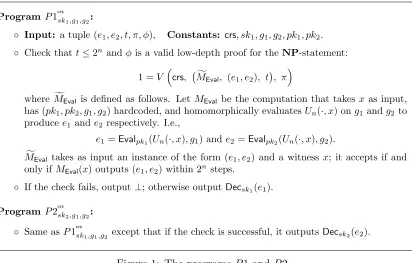
4. Generate an obfuscation of the NC1-programP1crssk1,g1,g2 given in figure 1:
P0 ← ONC1 1n, P1
crs
sk1,g1,g2
.
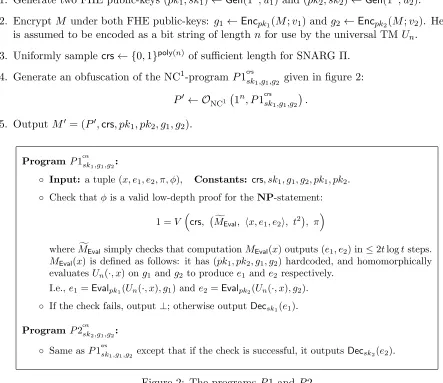
Program P1crssk 1,g1,g2:
◦ Input: a tuple (e1, e2, t, π, φ), Constants: crs, sk1, g1, g2, pk1, pk2.
◦ Check that t≤2n and φis a valid low-depth proof for theNP-statement:
1 =Vcrs, MfEval, (e1, e2), t
, π
where MfEval is defined as follows. LetMEval be the computation that takes xas input,
has (pk1, pk2, g1, g2) hardcoded, and homomorphically evaluatesUn(·, x) ong1andg2to
producee1 ande2 respectively. I.e.,
e1=Evalpk1(Un(·, x), g1) ande2=Evalpk2(Un(·, x), g2).
f
MEval takes as input an instance of the form (e1, e2) and a witnessx; it accepts if and
only ifMEval(x) outputs (e1, e2) within 2n steps.
◦ If the check fails, output ⊥; otherwise outputDecsk1(e1).
Program P2crssk 2,g1,g2: ◦ Same as P1crssk
1,g1,g2 except that if the check is successful, it outputsDecsk2(e2).
Figure 1: The programsP1 andP2
Evaluation of M0: Evaluate M0= (P0,crs, pk1, pk2, g1, g2) on inputx as follows:
1. Compute (e1, e2) =MEval(x). This takes at most n2c steps. See fig. 1 forMEval.
2. Compute a SNARK proofπ usingx as the witness and t=n4cas the time-bound:
π ←P
crs, MfEval,(e1, e2), t
, x
3. Compute a low-depth proofφfor theNP-statement 1 =V crs, (MfEval,(e1, e2), t), π
. This can be done by providing the entire computation ofV on these inputs.
4. Execute P0(e1, e2, t, π, φ) and output the result.
The construction is now analyzed in the proof below. We denote byakb the concatenation of two bit stringsaand b.
Proof of theorem 4.1. The correctness and succinctness of this construction are relatively straight-forward to verify, and in particular, closely follow the analyses in [ABG+13, BCP14]. We analyze its security.
Security. Fix any public-coin differing-inputs sampler Sam = {Samn} for the family M and any
efficient distinguisher D={Dn}. For a bit b, letXn(b) denote the output of the following experiment over a random choice ofr and the coins of O:
Xn(b) :=
(M0, M1)←Samn(r), M0← O(1n, Mb), output Dn(r, M0)
We need to show that Xn(0)≈cXn(1). Consider the following sequence of hybrid experiments.
• H0: This hybrid corresponds to an honest sampling of Xn(0). In this case,M0 creates two FHE
• H1: Same as H0 except that the second FHE ciphertext is now generated as an encryption of M1, i.e., g2=Encpk2(M1) (whereM1 is the second output of Samn).
• H2: Same as H1 except that the obfuscated program P0 is now generated as an obfuscation of P2crssk
2,g1,g2 which decrypts thesecond ciphertext usingsk2, i.e., P
0 ← O
NC1(1n, P2
crs
sk2,g1,g2).
• H3: Same asH2 except that thefirst FHE ciphertextg1 is now also generated as an encryption
of M1, i.e., g1 ←Encpk1(M1).
• H4: Same asH3except that the obfuscated programP0is once again generated as an obfuscation
of P1crssk
1,g1,g2, i.e., P
0 ← O
NC1(1n, P1 crs
sk1,g1,g2). Note thatH4 is identical to Xn(1).
We now prove that each hybrid in this sequence is indistinguishable from the previous one.
Step 1: H0 ≈cH1. This follows from the IND-CPA security of FHE. Formally, consider an adversary AFHE, who receives a challenge public-keypk, then samples (M0, M1)←Samn(r) for a randomr, and
receives an honestly generated ciphertext g to either M0 or M1 under pk. AFHE then generates an
obfuscation of M0 following the instruction of O except that it sets pk2 =pk and g2 =g. Note that
all instructions of O can indeed be performed efficiently knowing only (pk2, g2). Let M0 denote the
resulting obfuscation which includes an NC1-obfuscation P0 of program P1crssk
1,g1,g2=g. AFHE outputs
whateverDn(r, M0) outputs. The output ofAFHE is distributed identically to that ofHb wheng is an
encryption ofMb whereb∈ {0,1}. BecauseSamn andDnare of polynomial-size, it follows thatAFHE
is a polynomial-size circuit violating IND-CPA security of FHE unless H0 ≈cH1.
Step 2: H1 ≈c H2. We use the soundness of SNARK and diO-security of ONC1 to argue that
H1≈cH2. Suppose thatH1 and H2 are not computationally indistinguishable. We use Samnand Dn
to construct a public-coin differing-inputs sampler SamNCn 1 along with a distinguisherDNC1
n such that
SamNCn 1 outputs circuits in NC1 and DNC1
n violates the security ofONC1 w.r.t. SamNC 1
n . We start by
constructing SamNCn 1.
Sampler SamNCn 1(ρ).
1. Parse ρas ρ= (r, ρ1, , u1, u2, v1, v2).
2. Sample (M0, M1)←Samn(r). // comment: this is the given sampler.
3. Setcrs=ρ1, (pk1, sk1)←Gen(1n;u1), (pk2, sk2)←Gen(1n;u2).
4. Setg1 ←Encpk1(M0;v1) andg2 ←Encpk2(M1;v2).
5. Output (C0, C1) corresponding to the programs
P1crssk
1,g1,g2, P2
crs
sk2,g1,g2
.
Note that input to the circuitsC0, C1 above are of the formm= (e1, e2, t, π, φ).
Claim 4.2. ∀n∈N SamNC
1
n is a public-coin differing-inputs sampler for a family C ∈NC1.
Proof. We have to show that every non-uniform PPT attacker {ANCn 1} fails to find a differing-input for circuits sampled by SamNCn 1. Given an attacker ANC1
n which succeeds against our sampler, we
construct an attacker An which will succeed against the given sampler Samn We shall rely on the
soundness of SNARK to prove this.
Formally, suppose that the claim is false, and there exists a polynomial-size attacker family{ANC1
n },
a polynomialp, and infinitely manyns.t.
Pr
ρ
h
C0(x)6=C1(x) : (C0, C1)←SamNC
1
n (ρ), x←ANC
1
n (ρ)
i
We start by defining a prover family which receives a uniformly random auxiliary input, denoted by
z, and then use it to define an attacker Aen which also receives a uniform auxiliary input. Later on, this auxiliary input will be completely removed from Aen.
Prover Pn∗(crs, z): String z is of the form (r, u1, u2, v1, v2) and the circuit has adversary ANC
1
n
hardcoded in it. The circuit proceeds as follows:
1. Define ρ:= (r,crs, u1, u2, v1, v2) using z and crs.
2. Compute m ← ANCn 1(ρ) which is of the form m = (e1, e2, t, π, φ). Recall that ANC
1
n (ρ)
defines a TM MfEvaland π is a SNARK proof for the statementy:= (MfEval, (e1, e2), t).
3. Output (y, π).
Let{E∗
n}be a family of extractor circuits w.r.t. the prover family{Pn∗} defined above. Now we define
the following attacker circuitAen which receives a uniformly random auxiliary inputz∗ and outputs a differing input for the given samplerSamn. Later we will choose an appropriatez∗ and hardcode it as
part of the circuit description to achieve an attacker circuit without auxiliary input.
Circuit Aen(r, z∗): Stringz∗ is of the form (ρ1, u1, u2, v1, v2) and extractor circuitEn∗ is hardcoded in this circuit. The circuit computes as follows:
1. Define crs=ρ1 and z= (r, u1, u2, v1, v2) using r and z∗.
2. Compute (y, w)← En∗(crs, z) wherey is of the formy:= (MfEval, (e1, e2), t).
3. Outputx=w as the differing input.
For any given r, z∗, the concatenation ρ = rkz∗ is of the form (r, ρ1, u1, u2, v1, v2), and defines a
valid random string for ANC1
n . We say that a fixed string z∗ is good if, the success probability of
ANCn 1(ρ) is at least 21p over the choice ofr. Formally, a string z∗ is good if for a randomly chosenr, defining the tape ρ=rkz∗, the probability thatANCn 1(ρ) outputs m such thatC0(m)6=C1(m) where
(C0, C1)←SamNC
1
n (ρ) is at least 1/2p. By simple averaging, at least 21p fraction ofz
∗ are good.
Now let us definesoundstrings. Roughly speaking, we say thatz∗ is soundif the probability that the output of ANC1
n (ρ) contains a valid proof π but the output of the extractor (in step 2 above) is
not a valid witness, is less than 1/4p.
Formally, we say that a fixed string z∗ = (ρ1, u1, u2, v1, v2) is sound if for a randomly chosen r,
defining the tape ρ =rkz∗, the probability of the following event, taken over r, is at most 1/4p: the output ofE∗(crs, z) (in step 2 ofAen(r, z∗)) is (y, w) and output ofANC
1
n (ρ) ism= (e1, e2, t, π, φ) such
that V accepts the proof π for the statementy butw is not a valid witness, i.e. (y, w)∈ R/ 2c.
A randomly chosenz∗ contains a uniformly distributedcrsstring; therefore, it follows that at least 1−ε0 fraction ofz∗ aresoundwhere ε0 is the soundness error of SNARK.
Therefore, at least 21p−ε0 ≥ 1
4p fraction ofz
∗ are bothgoodandsound. Fix such az∗. By definition
ofgoodit follows that w.r.t. thisz∗, at least 1/2pfraction of inputsrare such thatANCn 1(rkz∗) outputs a differing-input for C0, C1. Further, by definition ofsound, at most a 1/4p fraction of such inputs r
are such that the extractor E∗
n (in step 2 above) will not output a valid witness w. Therefore, at least
1 2p−
1 4p ≥
1
4p of inputsr result in a differing-input where the extractor’s output is a valid witness. We
call such inputsnice.
By construction, fornice r, we have that:
C0(m)6=C1(m) =⇒ P1 crs=ρ1
sk1,g1,g2(m)6=P2
crs=ρ1
where x = w is the differing-input output by Aen, and the last implication follows because x is a valid witness, i.e. if m contains ciphertexts e1, e2 then the values in these ciphertexts will indeed
be M0(x) and M1(x) respectively. Here M0, M1 are the TMs sampled in (step 2 of) the execution
of SamNCn 1(rkz∗). We now observe that, by construction, (M0, M1) are also the output of Samn(r).
Therefore, the output of Aen outputs a differing input x for the outputs ofSamn whenever z∗ is good and soundand r is nice.
To have a deterministic attackerAn which on inputr outputs a differing-input x, we choose az∗
that is good and sound, and hardcode it in the description of Aen. It follows that, since the fraction of nice strings r is at least 1/4p, An violates the public-coin differing-input property of Samn with
noticeable property. The proof is completed by observing that circuits output by SamNCn 1 are indeed in the complexity class NC1.
We now present distinguisher DNC1
n which violates the security of ONC1 w.r.t. samplerSam NC1
n .
Distinguisher DNC1
n (ρ, C0). The input consists a string ρ and an obfuscated circuit C0. C0 is an
obfuscation of either C0 orC1 which are output by SamNC
1
n (ρ). The distinguisher attempts to
create a valid obfuscationM0of the TM implicitly present inC0. Since entire stringρis available, it can be efficiently done as follows.
1. Parseρ asρ= (r, ρ1, u1, u2, v1, v2), and setcrs=ρ1, (pk1, sk1)←Gen(1n;u1), (pk2, sk2)← Gen(1n;u2), g1←Encpk1(M0;v1) and g2←Encpk2(M1;v2), where (M0, M1)←Sam(1
n;r).
2. DefineM0 = (C0,crs, pk1, pk2, g1, g2), and output whateverDn(r, M0) outputs. (Recall that Dn is the given distinguisher).
By construction ofSamNCn 1, we can see that ifC0is a correctly generated obfuscation ofCb, thenM0 is
distributed as in hybrid Hb+1. It follows that if outputs of H1 and H2 are distinguishable then DNC
1
n
is a good distinguisher againstONC1 w.r.t. SamNC 1
n .
Final step: H2 ≈cH3 and H3 ≈cH4. Proof for the claim H2 ≈cH3 is nearly identical to step 1.
The proof for H3 ≈cH4 is nearly identical to step 2. We omit the details.
5
Functional Encryption for Turing Machines
In this section, we shall construct a functional encryption scheme. The scheme can encrypt messages of arbitrary polynomial length. The secret keySKM is given corresponding to a TMMof polynomial
size which can accept inputs of arbitrary polynomial length and halts in polynomial time. The holder ofSKM can learn the value ofM(x) given an encryption ofx. The size of the public-parameters of our
scheme is polynomial in the security parameter, and the size of secret-keys, say SKM, is polynomial
in the security parameter, |M|, and logtwhere tis an arbitrary polynomial bounding the worst case running time of M.
We assume familiarity with the definition of functional encryption (FE) schemes. Our scheme will satisfy indistinguishability based notion of security in the selective model of security which we recall here. In this model, we consider the following experimentExptbetween an attackerAand a challenger. The experiment takes a bit bas input, and proceeds as follows:
Init Asends two messagesx∗0, x∗1 such that|x∗0|=|x∗1|.
Phase 2 A adaptively asks polynomially secret-key queries where in each query it sends the description of a TM M ∈ M such that M(x∗1) = M(x∗2).2 The challenger responds with
SKM ←F.KeyGen(pp,msk, M).
Challenge The challenger sends an encryption e=F.Enc(pp, x∗b).
Phase 3 Phase 2 is repeated.
Output The outputA is the output of the experiment, which is a bit without loss of generality.
The scheme is said to be selectively secure if AdvA is negligible in n where we define AdvA := |Pr [Expt(0) = 1]−Pr [Expt(1) = 1]|.
Our construction. LetO be a public-coin differing-inputs obfuscation for the class of polynomial-size and polynomial-time TMs taking inputs of arbitrary polynomial length. Let Π = (CRSGen, P, V) be a statistically sound, non-interactive, strong witness-indistinguishable proof system for NPwhere CRSGensimply outputs its own random coins—therefore, we are in the commonrandomstring model where any random string of sufficient length can act as the CRS. Let H = {Hn} be a family of
collision-resistant hash functions such that every h∈ Hn maps strings from{0,1}∗ to{0,1}n.
Let PKE = (Gen,Enc,Dec) be an ordinary, semantically secure public-key encryption scheme, and combe a statistically binding commitment scheme.3 We assume that PKE (resp.,com) encrypts (resp., commits) to a string of unbounded polynomial length by individually encrypting (resp., committing) to each bit. We assume w.l.o.g. that PKE (resp., com) uses randomness of length nto encrypt (resp., commit) to a single bit (and thereforesn random bits for a string of length swill be needed).
The algorithms of our functional encryption scheme are as follows. Recall that akb denotes the concatenation of two bit strings aand b.
• F.Setup(1n): Generate (pk1, sk1) ← Gen(1n), (pk2, sk2) ← Gen(1n), and (pk3, sk3) ← Gen(1n).
Generate two commitments α1 =com(0n;u1) andα2 =com(0n;u2). Sample crs←CRSGen(1n)
and h← Hn. Output (pp,msk) where:
pp:= (pk1, pk2, pk3, α1, α2,crs, h), msk:=sk1.
• F.Enc(pp, x): On input a message x ∈ {0,1}∗ of arbitrary polynomial length, generate two ciphertexts c1 = Encpk1(x;r1) and c2 = Encpk2(x;r2). Define string a := xkr1k0
n2
kxkr2k0n
2
and encrypt it under the third public-key to get ciphertext c3 = Encpk3(a;r3). Finally,
com-pute a proof π for the statement that y ∈ Lfe using w = (a, r3) as the witness where y =
(c1, c2, c3, pk1, pk2, pk3, α1, α2): i.e.,π←P(crs, y, w).4 HereLfe is is the language corresponding
to the relationRfe defined below.
Relaton Rfe:
Instance: y0 = (c01, c02, c03, pk01, pk20, pk30, α01, α02)
Witness: w0= (a0, r30) wherea0 =x01kr10ku01kx02kr20ku02
Rfe(y0, w0) = 1 if and only if the following condition holds:
1. c03=Encpk3(a
0;r0 3); and
2Recall that according to our convention, the output ofM on an inputxincludes its running time as well. 3
We viewcomas a non-interactive algorithm; we can also use two-round schemes where the first message is fixed as part of the public-parameters by the setup algorithm and thencomis viewed w.r.t. such a fixed message.
4
2. Theor of the following two statements is true:
(a) c01, c02 encrypt the same message which is one ofx01 orx02, i.e.:
c01 =Encpk0
1(x
0
1;r01) and c02=Encpk02(x01;r20)
;or
c01 =Encpk0
1(x
0
2;r01) and c02=Encpk02(x
0 2;r20)
;
(b) c01, c02 encrypt x01, x02 respectively, which may be different but then the hash of one them is committed inα01, α02; i.e.,
i. c01 =Encpk0
1(x
0
1;r10) and c02 =Encpk20(x
0 2;r02)
;and
ii. α01 =com(h(x01);u01) or α01 =com(h(x02);u01)
;and iii. α02 =com(h(x01);u02) or α02 =com(h(x02);u02)
.
Proof π is computed for the and of statements 1 and 2(a) of Rfe. The algorithm outputs e= (c1, c2, c3, π) as the ciphertext.
• F.KeyGen(pp,msk, M): The secret-keySKM corresponding to a TM M is an obfuscation of the
program ProgM,msk, i.e., SKM ← O 1n,ProgM,msk
, whereProgM,msk is the following program.
Program ProgM,msk:
◦ Input: a ciphertexte of the forme= (c1, c2, c3, π).
◦ Constants: msk=sk1 and pp= (pk1, pk2, pk3, α1, α2,crs, h).
◦ The program checks that 1 =V(crs, y, π) wherey= (c1, c2, c3, pk1, pk2, pk3, α1, α2).
◦ If the check fails, output⊥; otherwise output M(Decsk1(c1)).
• F.Dec(SKM, e): Evaluate the program SKM on inpute and output whatever it outputs.
Theorem 5.1. Let M be the class of all polynomial-time Turing machines accepting inputs of un-bounded polynomial length. If there exists a public-coin differing-inputs obfuscator for the class M, a non-interactive zero-knowledge proof system (i.e., with statistical soundness) forNP in the common randomstring model, a public-key encryption scheme, a non-interactive perfectly-binding commitment scheme, and a family of collision-resistant hash functions with publicly samplable index, then there ex-ists a selectively-secure functional encryption scheme with indistinguishability-based security for Turing machines in the class M.
Proof of theorem 5.1. The correctness and succinctness of our scheme is easy to verify, and in particular, is similar to analyses in [GGH+13b, ABG+13]. We shall provide this analysis in the full version. We now analyze the security of this construction. We prove that the scheme satisfies indistinguishability based security for FE in the selective security model. We prove this by considering the following sequence of hybrid experiments:
• HybridH0 : This hybrid is identical to experimentExpt(0). The public-parametersppin Phase 1
are of the formpp:= (pk1, pk2, pk3, α1, α2,crs, h) whereα1 =com(0n;u1) andα2=com(0n;u2).
• HybridH1: This hybrid is identical toH0 except thatα1 andα2 are computed as commitments
to h(x∗0) and h(x∗1) respectively: α1 =com(h(x∗0);u1) and α2 =com(h(x∗1);u2). We recall that
the challenge ciphertext is of the form (c1, c2, c3, π) where both c1, c2 encrypt x∗0, c3 encrypts a0 = x∗0kr1k0n
2
kx∗0kr2k0n
2
using randomness r3, and π is computed using w = (a0, r3) as the
witness. This is identical to how these values were computed in the previous hybrid.
• Hybrid H2 : Identical to H2 except that string a0 is now changed to a∗ = x∗0kr1ku1kx∗1kr2ku2.
Consequently, ciphertextc3 is an encryption ofa∗ which we denote byc∗3. Sincea∗ has changed,
• HybridH3 : Same asH2 except thatc2 now encryptsx∗1. Furthermore,π∗is computed w.r.t. the
and of statements 1 and 2(b) (see the description of Rfe). That is, the witness corresponding
to condition 2(b.i) will now be (x∗0, r1, x∗1, r2), and for 2(b.ii) and 2(b.iii) it will be (x∗0, u1) and
(x∗1, u2) respectively. Note thata∗, c∗3 and everything else remains the same.
• Hybrid H4 : Same as H3 except that the keys are generated differently. The challenger sets msk = sk2 and answers the secret-key queries corresponding to a TM M by obfuscating the
following program Prog∗M,msk:
Program Prog∗M,msk: The program is identical to ProgM,msk except that it decrypts the sec-ond ciphertext usingmsk=sk2 if the check succeeds. That is, the input to the program is
a ciphertext e= (c1, c2, c3, π), the constants are (msk,pp). The program outputs⊥ ifπ is
not a valid proof; otherwise it outputs M(Decsk2(c2)).
• HybridH5Same asH4except thatc1is now changed to encryptx∗1. Furthermore,π∗is computed
by using the witness corresponding to condition 2(a), i.e., using (x∗1, r1, r2).
• Hybrid H6 : Same as H5 except that all secret-key queries are now switched back to using msk=sk1 and the key for TM M is an obfuscation of the programProgM,msk.
• Hybrid H7: Same as H6 except that a∗ is changed to string a1 = x∗1kr1k0n
2
kx∗1kr2k0n
2
. The witness corresponding to 2(a) does not change, but corresponding to statement in 1 changes (see
Rfe). Therefore, proof π also changes.
• HybridH8: Same asH7except thatα1, α2are switched back to the commitments of 0n. Observe
that H8 is identical to the experimentExpt(1).
We now prove the indistinguishability of every two consecutive hybrids in this experiment.
Step 1: H0 ≈c H1. This follows from computational hiding of the commitment scheme. Formally,
we consider the following adversaryAcom, which internally executes the hybridH0 except that it does
not generate commitments (α1, α2) on its own. Instead, after receiving values (x∗1, x∗2) during Init
phase fromA, it sends two sets of strings, namely (0n,0n) and (h(x∗
1), h(x∗2)), to the outside challenger
and receives in return two commitments (α1, α2) corresponding to either the first or the second set
of strings. It is clear that Acom is a polynomial time machine, and violates the hiding of com unless
H0≈cH1.
Step 2: H1 ≈c H2. The proof of this claim relies on the semantic security of PKE and the strong
witness indistinguishability of the proof system Π for polynomially many statements.5 Recall that strong WI asserts the following: letD0 andD1 be distributions which output an instance-witness pair for anNP-relation R and suppose that the first components of these distributions are computation-ally indistinguishable, i.e., {y : (y, w) ← D0(1n)} ≈c {y : (y, w) ← D1(1n)}; then X0 ≈c X1 where
Xb :{(crs, y, π) :crs ←CRSGen(1n); (y, w) ← D0(1n);π ←P(crs, y, w)} for b∈ {0,1}. Strong WI for polynomially many statements is implied by any multi-theorem NIZK proof such as [FLS99].
Suppose thatH1 andH2 can be distinguished with noticeable advantageδ. Observe that both
distribu-tion internally sample the following values in an identical manner: z:= (h, pk1, pk2, pk3, c1, c2, α1, α2)
5
which is all butcrs, c3 and π. By simple averaging, there are at least δ/2 fraction of stringsts.t. the
two hybrids can be distinguished with advantage at least δ/2 when z =st. Call such a z good. Fix one such z, and denote the resulting hybrids by H1(z), H2(z). Note that the hybrids have inbuilt into them all other values used to samplez namely: (x∗0, x∗1) received fromA, randomnessu1, u2, r1, r2 for
(α1, α2, c1, c2) respectively, andmsk=sk1.
Define distributionD0(z) as follows: seta0 = (x∗0kr1k0n
2
kx∗0kr2k0n
2
), computec3 =Encpk3(a0;r3), and
let statementy= (c1, c2, c3, pk1, pk2, pk3, α1, α2), witnessw0= (a0, r3); output (y, w0). Note thatyhas
identical tozexcept thathhas been removed andc3 has been added. Now define a second distribution
D1(z)which is identical toD0(z)except that instead of stringa0, it uses stringa∗ = (x∗0kr1ku1kx∗0kr2ku2),
sets c3 =Encpk3(a
∗;r
3), and w = (a∗, r3). It follows from the security of the encryption scheme that
the distribution ofysampled byD(0z) is computationally indistinguishable from when it is sampled by
D(1z). Therefore, we must have that X0 ≈ X1 w.r.t. these distributions. We show that this is not the
case unlessH1(z) ≈cH2(z).
Consider an adversary for strong WI who incorporates A and z (along with sk1 and all values for
computing z described above), and receives a challenge (crs, y, π) distributed according to eitherD0(z)
or D(1z); here y has a component c3 (and all other parts of y are identical to the respective parts of z\ {h}). The adversary uses crs to completely define pp and feeds it to A; it uses sk1 to complete
phase 2 and 4, and (c3, π) to define the challenge ciphertext e = (c1, c2, c3). The adversary outputs
whatever A outputs. We observe that the output of this adversary is distributed according to H1(z)
(resp.,H2(z)) when it receives a tuple from distributionX0 (resp.,X1). A randomly sampledz isgood with probability at least δ/2, and therefore it follows that with probability at least δ2/4 the strong
WI property will be violated unless δ is negligible.
Step 3: H2 ≈c H3. The proof of this part follows exactly the same ideas as in step 2, and relies
on the semantic security of encryption and strong WI property of Π. Roughly speaking, changing c2
to encrypt x∗1 results in a computationally indistinguishable distribution over the statement (to be proven by proof π). Due to this, although the resulting proof π will use a different witness, strong WI guarantees that the joint distribution of statement and proof (present in the challenge ciphertext) remains computationally indistinguishable in these two hybrids. The details are omitted.
Step 4: H3 ≈cH4. This is the key part of our proof where we shall rely on the indistinguishability
security of public-coin diO. Suppose that the claim is false andA’s output inH3 is noticeably different
from its output in H4. Suppose that A’s running time is bounded by a polynomial t so that there
are at most t secret-key queries it can make in phase 2 and 3 combined. We consider a sequence oft
hybrid experiments between H3 and H3 such that hybridH3i, fori∈[t] is as follows.
Hybrid H3i is identical toH3except that it answers the secret-key queries as follows. Forj∈[t],
ifj≤i, the secret-key corresponding to thej-th query, denotedMj, is an obfuscation of program
ProgMj,sk1; otherwise, forj > i, it is an obfuscation of program Prog∗Mj,sk2. We define H30 to be
H3 and observe that H3t is the same as H4.
By simple calculation, we see that ifA’s advantage in distinguishingH3 and H4 isδ, then there exists
an i∈[t] such thatA distinguishes between H3i−1 andH3i with advantage at leastδ/t. We show that if δ is not negligible than we can us A to violate the indistinguishability of O. To do so, we define a sampling algorithm SamiA and a distinguishing algorithmDi
A and prove thatSam i
differing-input sampler outputting a pair of differing-input TMs yetDi
Acan distinguish an obfuscation
of left TM from that of right output bySamiA. The description of these two algorithms is as follows:
Sampler SamiA(ρ):
1. Receive (x∗0, x∗1) fromA.
2. Parse ρas (crs, h, τ).
3. Proceed identically toH4 usingτ as randomness for all tasks except for sampling the hash
function which is set to h, and the CRS, which is set to crs. This involves the following steps:
(a) Parseτ = (τ1, τ2, τ3, r1, r2, r3, u1, u3).
(b) Useτi as randomness to generate (pki, ski) ←Gen(1n;τi) fori∈[3], r1, r2 to generate c1=Encpk1(x
∗
0;r1), c2 =Encpk1(x
∗
1;r2), andu1, u2to generateα1=com(h(x∗0);u1), α2= com(h(x∗1);u2).
(c) Use a∗ = x∗0kr1ku1kx∗1kr2ku2 and r3 to compute c∗3 = Encpk3(a
∗;r
3), and then use w= (a∗, r3) to compute proofπ∗ corresponding to conditions 1 and 2(b) inRfe.
4. Define pp= (pk1, pk2, pk3, α1, α2,crs, h) and challengee= (c1, c2, c∗3, π∗).
5. Send pp toA and answer its secret-key queries as follows. For all queriesMj until j < i,
send an obfuscation of ProgM,sk1.
6. Ifi-th secret-key query comes in phase 2, send ciphertextein the challenge phase.
7. Upon receiving the i-th secret-key query Mi, output (M0, M1) and halt where:
M0 :=ProgMi,sk1, M1 :=Prog
∗
Mi,sk2.
Distinguisher Di
A(ρ, M0): on input a random tape ρ and an obfuscated TM M0, the
distin-guisher simply executes all steps of the sampler SamiA(ρ), answering secret-keys for all j < i, as described above. The distinguisher, however, does not halt when i-th query is sent, and continues the execution of A answering secret-key queries forMj as follows:
– ifj=i: sendM0 (which is an obfuscation of eitherM0 or M1)
– ifj > i: send an obfuscation of Prog∗Mj,sk2
The distinguisher outputs whateverA outputs.
It is straightforward to see that if M0 is an obfuscation of M1, the output of DiA is identical to A’s
output in H3i−1; and ifM0 is an obfuscation of M0, it is identical to A’s output inH3i. We have that
Di
A distinguishes H i−1
3 and H3i with at least δ/t advantage. All that remains to prove now is that SamiA is a public-coin differing-inputs sampler.
Claim 5.2. SamiA is a public-coin differing-inputs sampler.
Proof. We show that if there exists an adversary B who can find differing-inputs to the pair of TMs sampled bySamiA with noticeable probability, sayµ, we can useB andSamiA to construct an efficient algorithm CollFinderB,Sami
A which finds collisions in h with probability µ−negl(n). The algorithm
works as follows:
CollFinderB,Sami A(h):
• sample uniformly random strings (crs, τ) to define a random tape ρ:= (crs, h, τ).
• sample (M0, M1)←SamiA(ρ) and e← B(ρ).
• recall thateis of the form (c1, c2, c3, π) wherec3 is an encryption underpk3where (pk3, sk3)
are sampled using parts of the randomnessτ.
• let x∗0 6=x1∗ be the strings output by Aduring theInit phase in the execution of SamiA.
• ifπ is a valid proof, compute a=Decsk3(c3) and leta=x
0
1kr10ku01kx02kr20ku02.
• ifh(x∗0) =h(x∗1), output (x∗0, x∗1) as the collisions; otherwise, if∃m1∈ {x01, x02}and ∃m2 ∈
{x∗0, x∗1} s.t. m1 6=m2 andh(m1) =h(m2) output (m1, m2) as collisions; if none of the two
conditions hold, output ⊥.
Let us now analyze the success probability of this algorithm. Sinceh is uniformly sampled,ρis a uni-form random tape, and therefore with probabilityµ,Boutputs anesuch that M0(e)6=M1(e). Recall
thatM0=ProgMi,sk1 andM2 =Prog
∗
Mi,sk2 for some TMMisuch thatMi(x
∗
0) =Mi∗(x∗1). Furthermore,
both of these programs output ⊥ if proof π is not valid. Since the output these two programs differ on e, it must be thatπ is a valid proof so thatM0(e) =Mi(Decsk1(c1)) andM1(e) =Mi(Decsk2(c2)).
By construction, since π is a statistically sound proof, except with negligible probability it holds that x01 = Decsk1(c1)) and x
0
2 = decsk2(c2) where x
0
1, x02 are part of the string a obtained by the
collision finding algorithm by decrypting c3 above. Therefore, we have that M0(e) = Mi(x01) and M1(e) = Mi(x02). However, we also have that M0(e) 6=M1(e) =⇒ Mi(x01) 6=Mi(x02) =⇒ x01 6=x02.
Since Mi(x∗0) =Mi(x∗1) it holds that the sets{x01, x02} 6={x∗0, x∗1}.
Sinceπis valid, andc1, c2are encryptions of (unequal strings)x01, x02, from the statistical soundness
of π statements 2(b.ii) and 2(b.iii) must be true. That is, α1 (likewise α2) must be a commitment
to one of h(x01) or h(x02). But α1 is a commitment to h(x∗0) and α2 is a commitment to h(x∗1) and
commitment is statistically binding. Since at least one of x01, x02 is not equal to any of x∗0, x∗1 the collision must occur on one of the four possible pairs of these strings.
Step 5: Indistinguishability of H4–H8. Hybrids H4 to H8 are applying changes very similar
to the first four hybrids except in the reverse order. The proof of their indistinguishability can be obtained by following previous proofs in a near identical fashion. In particular we can proveH4 ≈cH5
by relying on the security of encryption and strong WI (following the proof in step 2 or 3),H5 ≈cH6
following the proof in step 4, H6 ≈c H7 following the proof in step 2, and H7 ≈c H8 following the
proof in step 1.
This completes the proof of security of our functional encryption scheme.
References
[ABG+13] Prabhanjan Ananth, Dan Boneh, Sanjam Garg, Amit Sahai, and Mark Zhandry. Differing-inputs obfuscation and applications. IACR Cryptology ePrint Archive, 2013, 2013.
[AIK06] Benny Applebaum, Yuval Ishai, and Eyal Kushilevitz. Cryptography in nc0. SIAM J. Comput., 36(4):845–888, 2006.
[App11] Benny Applebaum. Randomly encoding functions: A new cryptographic paradigm -(invited talk). InICITS, pages 25–31, 2011.
[BCC+14] Nir Bitansky, Ran Canetti, Alessandro Chiesa, Shafi Goldwasser, Huijia Lin, Aviad Ru-binstein, and Eran Tromer. The hunting of the SNARK.IACR Cryptology ePrint Archive, 2014:580, 2014.
[BCCT12] Nir Bitansky, Ran Canetti, Alessandro Chiesa, and Eran Tromer. From extractable collision resistance to succinct non-interactive arguments of knowledge, and back again. In Innovations in Theoretical Computer Science 2012, Cambridge, MA, USA, January 8-10, 2012, pages 326–349, 2012.
[BCCT13] Nir Bitansky, Ran Canetti, Alessandro Chiesa, and Eran Tromer. Recursive composition and bootstrapping for SNARKS and proof-carrying data. In Symposium on Theory of Computing Conference, STOC’13, Palo Alto, CA, USA, June 1-4, 2013, pages 111–120, 2013.
[BCKP14] Nir Bitansky, Ran Canetti, Yael Tauman Kalai, and Omer Paneth. On virtual grey box obfuscation for general circuits. InAdvances in Cryptology - CRYPTO 2014 - 34th Annual Cryptology Conference, Santa Barbara, CA, USA, August 17-21, 2014, Proceedings, Part II, pages 108–125, 2014.
[BCP14] Elette Boyle, Kai-Min Chung, and Rafael Pass. On extractability (a.k.a. differing-inputs) obfuscation. InTCC, 2014. Preliminary version on Eprint 2013: http://eprint.iacr. org/2013/650.pdf.
[BCPR14] Nir Bitansky, Ran Canetti, Omer Paneth, and Alon Rosen. On the existence of extractable one-way functions. InSymposium on Theory of Computing, STOC 2014, New York, NY, USA, May 31 - June 03, 2014, pages 505–514, 2014.
[BG02] Boaz Barak and Oded Goldreich. Universal arguments and their applications. InAnnual IEEE Conference on Computational Complexity (CCC), volume 17, 2002. Preliminary full version available as Cryptology ePrint Archive, Report 2001/105.
[BGI+12] Boaz Barak, Oded Goldreich, Russell Impagliazzo, Steven Rudich, Amit Sahai, Salil P. Vadhan, and Ke Yang. On the (im)possibility of obfuscating programs. J. ACM, 59(2):6, 2012.
[BGK+14] Boaz Barak, Sanjam Garg, Yael Tauman Kalai, Omer Paneth, and Amit Sahai. Protecting obfuscation against algebraic attacks. InEUROCRYPT, 2014.
[BGT14] Nir Bitansky, Sanjam Garg, and Sidharth Telang. Succinct randomized encodings and their applications. Cryptology ePrint Archive, Report 2014/771, 2014. http://eprint. iacr.org/.
[BHK13] Mihir Bellare, Viet Tung Hoang, and Sriram Keelveedhi. Instantiating random oracles via uces. InAdvances in Cryptology - CRYPTO 2013 - 33rd Annual Cryptology Conference, Santa Barbara, CA, USA, August 18-22, 2013. Proceedings, Part II, pages 398–415, 2013.
[BHR12] Mihir Bellare, Viet Tung Hoang, and Phillip Rogaway. Foundations of garbled circuits. In the ACM Conference on Computer and Communications Security, CCS’12, Raleigh, NC, USA, October 16-18, 2012, pages 784–796, 2012. Cryptoglogy Eprint Archive Report 2012/265.