ISSN (Print) : 2320 – 3765 ISSN (Online): 2278 – 8875
I
nternational
J
ournal of
A
dvanced
R
esearch in
E
lectrical,
E
lectronics and
I
nstrumentation
E
ngineering
(An ISO 3297: 2007 Certified Organization)
Vol. 5, Issue 5, May 2016
Design of Optimal Wavelet for Reduction of
Noise in Speech
Priya Kulkarni S1, Mani.C2
PG Student, Department of DECS, Maratha Mandal Engineering College Belgaum, Karnataka, India1
Assistant Prof, Department of ECE, Maratha Mandal Engineering College Belgaum, Karnataka, India2
ABSTRACT: Due to the tremendous growth of technology that has led to noisy engines, heavy machinery, pumps,
high speed wind buffeting and a myriad other noise sources. Exposure to high decibels of sound proves damaging to humans from both a physical and a psychological aspect. The problem of controlling the noise level in the environment has been the focus of a tremendous amount of research over the years. This paper describes a study of techniques for noise cancellation which can be applied at the input to standard receivers trained on noise-free speech. Such methods have been used in various applications, including communication systems, biomedical engineering, and industrial applications. In this review, we have classified the existing noise cancellation schemes and comprehensively explore various suggestions in each category as to demonstrate limitations of the existent techniques as well as effective contributions.
KEYWORDS: Wavelet Transform (WT), Wavelet Packet Transform(WPT), Discrete Wavelet Transform (DWT),
Thresholding Algorithm, Savitzky-Golay smoothing, Multi Resolution Analysis (MRA).
I. INTRODUCTION
The noise in speech can reduce the intelligibility of speech and also automatically degrade the speech performance recognition. The noise may be introduced in signal during transmission of speech signal by transmission media or may be environmental back ground noise get added to the signal in audio communication system in which speaker is speaking. Therefore the denoising in speech is necessary in audio communication systems.
Many methods for removing noise from speech have been introduced. The earliest and simplest method for denoising from speech is the spectral subtraction method[2], in this technique there is direct approximation of the short term spectral magnitude. Even though it has ability to remove the back ground noise from the signal, but it introduces some additional noise know as musical noise. This problem occurred due to lack of accuracy in the estimation of short term noise spectrum. When reference noise is correlated to the corrupting noise an adaptive method[3], is introduced to reduce the noise from speech. However corrupting noise is random in nature so it is very difficult to estimate such this type of noise. In recent years Discrete Fourier Transform(DFT) is one of method which is widely used for analysis of the signal, because of many inconveniences DFT fails to implement for non periodic time varying signals.
Wavelet Transforms overcomes all these limitations due to its multi-resolution property, it concentrates all the information in time and as well in frequency plane. Many researchers have implemented this wavelet transform technique for denoising of speech signal. The reduction of noise in speech signal using this technique is based on thresholding and wavelet packet decomposition of noisy signals.
Wavelet analysis is new method for solving problems in engineering, mathematics, physics with modern applications like data compression, signal processing, image processing. Wavelet allows complex information like speech, music to be decomposed into elementary forms with different position and scales and subsequently reconstructed with high precision. In recent years, wavelet transform has become a powerful tool for the multi scale representation and analysis of signals. Wavelet transform localizes the information in the time-frequency plane, in particular, they are capable of trading one type of resolution for another that make them especially suitable for speech signal analysis.
ISSN (Print) : 2320 – 3765 ISSN (Online): 2278 – 8875
I
nternational
J
ournal of
A
dvanced
R
esearch in
E
lectrical,
E
lectronics and
I
nstrumentation
E
ngineering
(An ISO 3297: 2007 Certified Organization)
Vol. 5, Issue 5, May 2016
II. WAVELET TRANSFORMS
The function of wavelets are produced from two units called Father wavelet ϕ(t) also known as scaling functionand
Mother wavelet ѱ(t) known as translation function. Mainly there are two types of wavelet transforms, discrete and continuous. The key equation common to all wavelets is given by:
( ) = ∑ ℎ( )√2 (2 − )
( ) = ∑ ℎ (n) √2 (2 − )
Here h(n) and ℎ( )take finite number of values and are respectively known as low pass or average and high pass or
detail filter coefficients.
Wavelet transform is mainly applied to non- stationary signal processing and it is used as an alternative to the short time Fourier transform (STFT). For whole signal analysis STFT uses a single window. Whereas, at high frequencies the wavelet transform uses short windows and long windows at low frequencies. This results in a high time resolution in low frequency band and low time resolution in high frequency band. This makes wavelet transform a very powerful tool for modelling non - stationary signal. An example of non-stationary signal is speech that exhibits abrupt temporal changes at high frequency and slow temporal variation at low frequency.
The continuous wavelet transform (CWT) is defined as:
( , ) = ∫∞ ( )ψ( − / )
∞
where C denotes the resulting coefficient dependent on time t, and scale s. f(t) is the signal in time, and ψ is the scaled and shifted base wavelet function.
III. DISCRETE WAVELET TRANSFORMS
The multi – resolution analysis is performed by continuous wavelet transform (CWT) by using contraction and dilatation of the wavelet functions and discrete wavelet transform (DWT) uses filter banks for the construction of the multi-resolution time-frequency plane. For reconstruction of signals the DWT uses Multi resolution filter banks and special wavelet filters.
At different frequency bands DWT analyse the signal at with different resolutions. The signal is decompose the into a coarse approximation(A) and detail information(D). Decomposition of the signal is obtained by passing time domain signal through low pass and high pass filters.
Fourier Transform gives the information of frequency content of the signal, but at what time frequency components occur that could not find by Fourier transform. So to avoid this problem wavelet transform for analysis of signals like speech are used. If anyone from these two transforms is chosen, the preference is given to the wavelet transform because it analyses the signal at different frequency with different resolutions.
IV.WAVELET DECOMPOSITION
Wavelet decomposition results in levels of approximated (A) and detailed (D) coefficients. The maximum level to apply wavelet transform depends on how many data points are contained in dataset since there is down sampling by two from one level to next one. The decomposition process can be iterated with successive approximations being decomposed in turn, so that one signal is broken down into many lower resolution components. This is called Wavelet decomposition tree.
V. MULTIRESOLUTION ANALYSIS USING FILTER BANK
ISSN (Print) : 2320 – 3765 ISSN (Online): 2278 – 8875
I
nternational
J
ournal of
A
dvanced
R
esearch in
E
lectrical,
E
lectronics and
I
nstrumentation
E
ngineering
(An ISO 3297: 2007 Certified Organization)
Vol. 5, Issue 5, May 2016
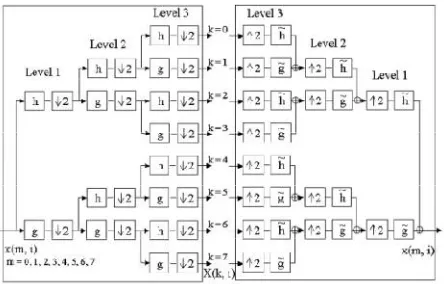
coefficient are again combined to reconstruct the denoised signal.the fig 1 shows the multi-resolution analysis up to Level 3.
Fig 1 Mutiresolution Analysis Of Level 3
VI. WAVELET PACKET TRANSFORM
Wavelet packet transform gives high and low frequency resolution, the high frequency band of the signal also better resolved. Thresholding is used to remove the noise from signal in wavelet domain. There are two main thresholding algorithms. The first case is the hard thresholding in which the coefficient values are set to zero whose absolute value is below the threshold value. Second case is the soft thresholding in which magnitude of remaining coefficient is reduced by threshold value. Due to discontinuity in coefficient of wavelets the hard thresholding is not being used in the reconstruction of the non – stationary signal.
Fig 2 Three Level Wavelet Packet Transform
VII. PROPOSED METHOD
ISSN (Print) : 2320 – 3765 ISSN (Online): 2278 – 8875
I
nternational
J
ournal of
A
dvanced
R
esearch in
E
lectrical,
E
lectronics and
I
nstrumentation
E
ngineering
(An ISO 3297: 2007 Certified Organization)
Vol. 5, Issue 5, May 2016
The proposed method is implemented using following steps: (1) Consider a noise free speech signal a(n).
Generate a random white Gaussian noise w(n) and add it to the original signal a(n) mathematically it can be written as
b(n) = a(n) + w(n).
(2) Apply the savitzky-Golay filter for smoothing he noisy signal b(n) and compute the wavelet packet transform
for the noisy speech signal.
(3) Apply the Super Soft Threshold to the Wavelet Packet Co-efficients. Also kept low frequency coefficients
as it is, do not threshold them.
(4) The original speech signal is reconstructed by taking the inverse wavelet packet transform.
VIII. SAVITZKY- GOLAY FILTER
Savitzky and Golay proposed a method for smoothing the data based on local least-squares polynomial approximation. They showed that fitting a polynomial to a set of input samples and then evaluating the resulting polynomial at a single point within the approximation interval is equivalent to discrete convolution with a fixed impulse response. The low pass filters obtained by this method are widely known as Savitzky-Golay filters. S-G filters are often preferred because, when they are appropriately designed to match the waveform of an oversampled signal corrupted by noise, they tend to preserve the width and height of peaks in the signal waveform.Savitzky and Golay were interested in smoothing noisy data.
.
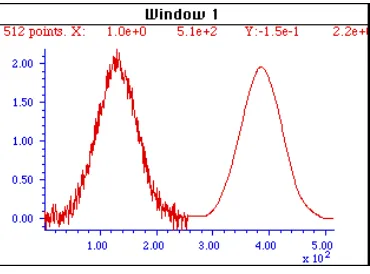
Fig 4 Savitzky-Golay Filter Smoothing
The left half of this signal is a noisy peak. The right half is the same peak after undergoing a smoothing algorithm. The noise is greatly reduced while the peak itself is hardly changed, making it easier to measure the peak position, height, and width directly by graphical or visual estimation. The larger the smooth width, the greater the noise reduction, but also the greater the possibility that the signal will be distorted by the smoothing operation.
IX. UNIVERSAL THRESHOLD
Now, we want to find threshold value that will use to remove noise from noisy signal, but also recover the original signal efficiently. If the threshold value is too high, it will also remove the contents of original signal and if the threshold value is too low, denoising will not work properly.
One of the first methods for selection of threshold was developed by Donoho and Jonstone and it is called as universal threshold.
thr = 2log( )
ISSN (Print) : 2320 – 3765 ISSN (Online): 2278 – 8875
I
nternational
J
ournal of
A
dvanced
R
esearch in
E
lectrical,
E
lectronics and
I
nstrumentation
E
ngineering
(An ISO 3297: 2007 Certified Organization)
Vol. 5, Issue 5, May 2016
X. HARD AND SOFT THRESHOLDING
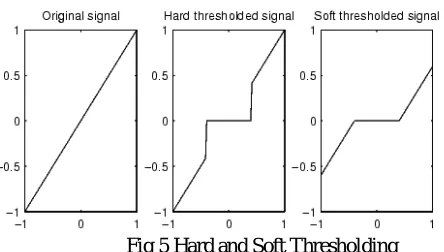
Fig 5 Hard and Soft Thresholding
Hard thresholding is a typical “keep or kill” method, where all coefficients with modulus less than threshold λ are set to
be zero, the other coefficients remain unchanged, i.e.
ℎ (x) = {| | }.x
= , | | >
0 , ℎ
The function ℎ (x) andSoft thresholding ( ), is shown in figure 5. In soft thresholding no coefficient remains
unchanged. Any modulus larger than the threshold is shrunken by , i.e. soft thresholding is given by
( ) = ( )(| |− )
= ( − ( ) )
=
⎩ ⎪ ⎨ ⎪ ⎧
− , >
+ , <−
0, |− , |
XI. SIMULATION AND RESULTS
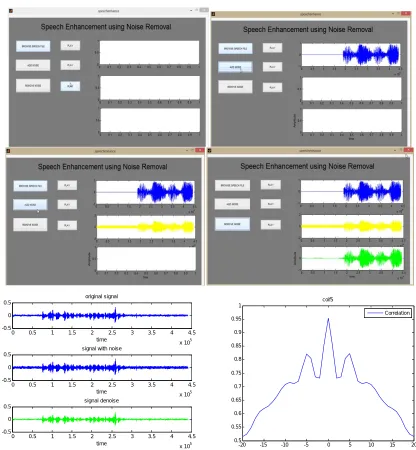
The following snapshots define the results or outputs that we will get after step by step execution of all the modules of the system.
ISSN (Print) : 2320 – 3765 ISSN (Online): 2278 – 8875
I
nternational
J
ournal of
A
dvanced
R
esearch in
E
lectrical,
E
lectronics and
I
nstrumentation
E
ngineering
(An ISO 3297: 2007 Certified Organization)
Vol. 5, Issue 5, May 2016
Fig 6 simulation result for design of optimal wavelet for reduction of noise in speech.
XII.CONCLUSION
In this paper,the noise from speech is removed using coif wavelet. we used wavelet transform for denoising speech signal corrupted with additive white Gaussian noise. Speech denoising is performed in wavelet domain by thresholding wavelet coefficients. We found that by using modified universal threshold, we can get the better results of de-noising, especially for low level noise. During different analysis we found that soft thresholding is better than hard thresholding because soft thresholding gives better results than hard thresholding. Higher threshold removes noise well, but the part of original signal is also removed with the noise. It is generally not possible to filter out all the noise without affecting the original signal. We can analyze the noise free signal by signal to noise ratio (SNR) and mean square error (MSE) analysis.
0 0.5 1 1.5 2 2.5 3 3.5 4 4.5
x 105 -0.5 0 0.5 time A m p lit u d e original signal
0 0.5 1 1.5 2 2.5 3 3.5 4 4.5
x 105 -0.5 0 0.5 time A m p li tu d e
signal with noise
0 0.5 1 1.5 2 2.5 3 3.5 4 4.5
x 105 -0.5 0 0.5 time A m p lit u d e signal denoise
ISSN (Print) : 2320 – 3765 ISSN (Online): 2278 – 8875
I
nternational
J
ournal of
A
dvanced
R
esearch in
E
lectrical,
E
lectronics and
I
nstrumentation
E
ngineering
(An ISO 3297: 2007 Certified Organization)
Vol. 5, Issue 5, May 2016
REFERENCES
[1] DESIGN OF OPTIMALWAVELETS FOR DETECTING IMPULSE NOISE IN SPEECH”, R. C. Nongpiur, D.J. Shpak, and P. Agathoklis,
2014 IEEE International Conference on Acoustic, Speech and Signal Processing.
[2] Ekaterina Verteletskaya and Boris Simak , “Noise Reduction Based on Modified Spectral Subtraction Method”, IJCS, 2011. [3] Simon Haykin , “Adaptive Filter Theory”, Kindersley Publication , 1995.