Cryptanalysis of Reduced-round SIMON32 and SIMON48
⋆Qingju Wang1,2, Zhiqiang Liu1,2⋆⋆, Kerem Varıcı2,3⋆⋆, Yu Sasaki4⋆⋆,
Vincent Rijmen2⋆⋆, and Yosuke Todo4⋆⋆
1
Department of Computer Science and Engineering, Shanghai Jiao Tong University, China
2
KU Leuven, ESAT/COSIC and iMinds, Belgium
3
ICTEAM-Crypto Group, Universite catholique de Louvain, Belgium
4 NTT Secure Platform Laboratories, Japan
{qingju.wang,vincent.rijmen}@esat.kuleuven.be, ilu [email protected], [email protected], {sasaki.yu,todo.yosuke}@lab.ntt.co.jp
Abstract. SIMON family is one of the recent lightweight block cipher designs introduced by NSA. So far there have been several cryptanalytic results on this cipher by means of differential, linear and impossible differential cryptanalysis. In this paper, we study the security of SIMON32, SIMON48/72 and SIMON48/96 by using integral, zero-correlation linear and impossible differential cryptanalysis. Firstly, we present a novel experimental approach to construct the best known integral distinguishers of SIMON32. The small block size, 32 bits, of SIMON32 enables us to experimentally find a 15-round integral distinguisher, based on which we present a key recovery attack on 21-round SIMON32, while previous best results published in FSE 2014 only achieved 19 rounds. Actually, our approach provides a very efficient way to elaborate good integral distinguishers of block ciphers with small block size. Moreover, by applying the divide-and-conquer technique delicately, we attack round SIMON32, 20-round SIMON48/72 and 21-20-round SIMON48/96 based on 11 and 12-20-round zero-correlation linear hulls of SIMON32 and SIMON48 respectively. The results for SIMON32 and SIMON48/96 are better than the known results published in FSE 2014. Finally, we propose impossible differential attacks on 18-round SIMON32, 18-18-round SIMON48/72 and 19-18-round SIMON48/96, which significantly improve the previous impossible differential attacks. Our analysis together with the previous results show that SIMON maintains enough security margin even if various approaches of cryptanalysis are considered.
Keywords:SIMON, block cipher, cryptanalysis, integral, zero-correlation, impossible differential
1 Introduction
In cryptography, lightweight primitives are designed to be efficient for limited resource environments, but they should also ensure that the message is transmitted confidentially. Therefore, the vital motivation in the development of new lightweight cryptographic primitives is to maintain a reasonable trade-off between the security and performance. During recent years, many lightweight ciphers have been designed to meet these needs. Prominent examples are included but it is not limited to these: ICEBERG [2], mCrypton [3], HIGHT [4], PRESENT [5], KATAN [6], LED [7], Piccolo [8], KLEIN [9], EPCBC [10], PRINCE [11] and TWINE [12].
In 2013, NSA also proposed two families of highly-optimized block ciphers, SIMON and SPECK [13], which are flexible to provide excellent performance in both hardware and software environments. Moreover both families offer large variety of block and key sizes such that the users can easily match the security requirements of their applications without sacrificing the performance. However, there are no cryptanalysis results included in the specification of these algorithms.
Related Work and Our Contributions. Due to their simple but elegant structures, SIMON
and SPECK have already become the target of various cryptanalytical efforts immediately after their release. On the one hand, several external cryptanalysis results on SIMON and SPECK were published. In [14,15], differential attacks are presented on various state sizes of SIMON and SPECK, while the best linear attacks on SIMON are given in [16]. In [17] Biryukov et al. exploit the threshold
search technique [18], where they showed better differential characteristics and proposed attacks with better results on several versions of SIMON and SPECK. Very recently, there are some differential attack results about SIMON32 and SIMON48 in ePrint [19]. These results need to be further verified although they seem interesting. On the other hand, applying various types of attacks with enough optimization to SIMON is interesting and important since this will help evaluate the security of the cipher in different aspects.
In this paper, we investigate the security of SIMON32, SIMON48/72 and SIMON48/96 by using integral, zero-correlation linear and impossible differential cryptanalysis. We firstly evaluate these SIMON variants by means of integral cryptanalysis. Regarding SIMON32, because the block size is only 32 bits, we can experimentally observe the behaviors of all the plaintexts under a fixed key. Our experiments show that the number of distinguished rounds rapidly increases when the number of active bits becomes close to the block size. On the contrary, exploiting such an integral distinguisher with a large number of active bits for recovering the key is hard in general. To recover the key, the integral attack usually requires several sets of the integral distinguisher by changing the values of inactive bits. When the number of active bits is too many, the number of inactive bits becomes too small, and thus cannot produce many sets of the distinguisher. Indeed, our distinguisher needs 31 active bits, and thus has only one inactive bit. To make the data complexity smaller than the code book, we cannot iterate the analysis even for two sets of the distinguisher. We solve the problem by exploiting the fact that the key schedule consists of simple linear equations, and show that reducing any fraction of subkey space can immediately reduce the main key space by solving the linear equations with Gaussian elimination. This enables us to make the attack valid only with one set of the distinguisher. By combining several cryptanalytic techniques such as the partial-sum [20] and the meet-in-the-middle techniques exploiting the linearity [21], we present an attack on 21-round SIMON32/64 which improves the results on FSE 2014 by two rounds. In fact, this novel experimental approach provides a very efficient way to elaborate good integral distinguishers of block ciphers with small block size. As for SIMON48, the approach cannot be applied due to the large search space. However, according to the experimental results for SIMON32, we may expect that there exist good integral distinguishers of SIMON48 when the number of active bits is near the block size.
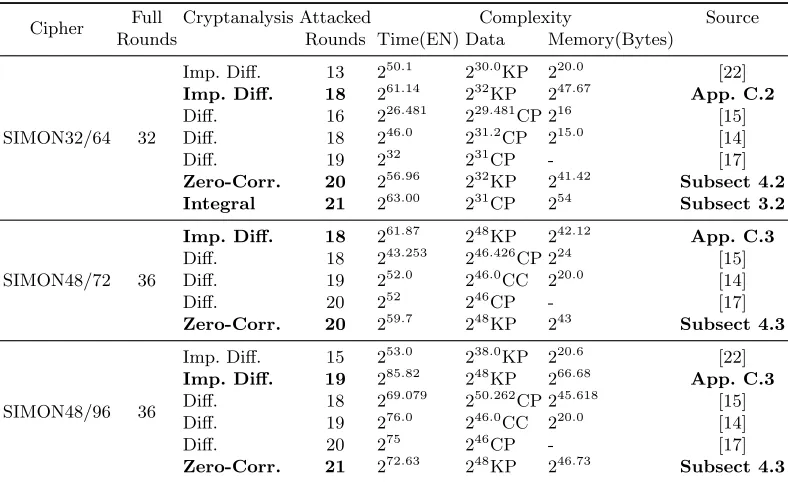
Moreover, we construct 11 and 12-round zero-correlation linear hulls of SIMON32 and SIMON48 respectively by using miss-in-the-middle technique. Then based on these distinguishers, we mount attacks on 20-round SIMON32, 20-round SIMON48/72 and 21-round SIMON48/96 delicately with the help of divide-and-conquer technique. Our results improve the best known cryptanalytic results on SIMON32 and SIMON48/96 published in FSE 2014. Finally, we demonstrate impossible differential attacks on 18-round SIMON32, 18-round SIMON48/72 and 19-round SIMON48/96. Although these results are not better than the ones achieved by using differential, integral and zero-correlation linear cryptanalysis, they are the currently best impossible differential attacks for SIMON32 and SIMON48. Our work together with the previous results show that SIMON maintains enough security margin even if various cryptanalytic approaches are taken into account. Our improvements upon the state-of-the-art cryptanalysis for SIMON are given in Table 1.
Organization. The remainder of this paper is organized as follows. In Section 2, we give a brief
description of SIMON. Section 3 covers the integral attack. In Section 4, zero-correlation cryptanalysis is studied. Finally, we conclude the paper in Section 5. Our impossible differential attacks are shown in Appendix. Table 2 contains the notations that we will use throughout this paper.
2 Brief Description of SIMON
Table 1. Summary of Attack Results on SIMON
Cipher Full Cryptanalysis Attacked Complexity Source Rounds Rounds Time(EN) Data Memory(Bytes)
SIMON32/64 32
Imp. Diff. 13 250.1
230.0
KP 220.0
[22] Imp. Diff. 18 261.14 232KP 247.67
App. C.2 Diff. 16 226.481
229.481
CP 216
[15] Diff. 18 246.0
231.2
CP 215.0
[14] Diff. 19 232
231
CP - [17]
Zero-Corr. 20 256.96
232
KP 241.42
Subsect 4.2 Integral 21 263.00 231CP 254
Subsect 3.2
SIMON48/72 36
Imp. Diff. 18 261.87
248
KP 242.12
App. C.3 Diff. 18 243.253 246.426CP 224 [15]
Diff. 19 252.0
246.0
CC 220.0
[14]
Diff. 20 252 246CP - [17]
Zero-Corr. 20 259.7
248
KP 243
Subsect 4.3
SIMON48/96 36
Imp. Diff. 15 253.0 238.0KP 220.6 [22]
Imp. Diff. 19 285.82
248
KP 266.68
App. C.3 Diff. 18 269.079 250.262CP 245.618 [15]
Diff. 19 276.0
246.0
CC 220.0
[14]
Diff. 20 275 246CP - [17]
Zero-Corr. 21 272.63
248
KP 246.73
Subsect 4.3 CP: Chosen Plaintext; KP: Known Plaintext; CC: Chosen Ciphertext; EN: Encryptions
Table 2.Notations: Top 8 are for general purpose and bottom 4 are particular for integral attack.
Lr, Rr left(L) and right(R) branches of the input state to ther-th round Lr,{i∼j}, Rr,{i∼j} the bits from bitito bitjofLr andRr
∆Lr, ∆Rr the left(L) and right(R) branches of the input difference of state to ther-th round Γ Lr, Γ Rr the left(L) and right(R) branches of the input linear mask of state to ther-th round ∆F(·) the output difference after round functionF
kr the subkey in ther-th round kr,{i∼j} the bits from bitito bitjofkr
? an undetermined difference or linear mask
LetΛbe a collection of state vectorsX= (x0, . . . , xn−1) wherexi∈F2 is thei-th word ofX:
A if alli-th wordsxiinΛare distinct,xiis called active
B if the sum of alli-th wordsxi inΛcan be predicted,xiis called balanced C if the values of alli-th wordsxi inΛare equal,xi is called passive/constant * if the sum of alli-th wordsxi inΛcan not be predicted
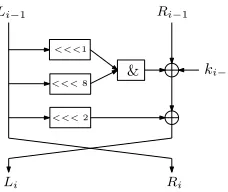
SIMON is a two-branch balanced Feistel network with simple low complexity round functions consisting of three operations: AND (&), XOR (⊕) and rotation (≪). In round i−1, by using a
functionF(x) = (x≪1)&(x≪8)⊕(x≪2), (Li−1, Ri−1) are updated to (Li, Ri) as follows:
Li=F(Li−1)⊕Ri−1⊕ki−1, Ri =Li−1
The output of the last round (Lr, Rr) (ris the number of rounds) yields the ciphertext. The structure
of the round function of SIMON is depicted in Figure 8 in Appendix A.
The key schedule of SIMON processes three different procedures depending on the key size. The first mn round keys are directly initialized with the main key, while the remaining key words are generated by three slightly different procedures depending on the key words value m:
ki+m=c⊕(zj)i⊕ki⊕Ym⊕(Ym≪1), Ym =
ki+1≪3, ifm= 2,
ki+2≪3, ifm= 3,
Here, the value c is constant 0xff. . .fc, and (zj)i denotes the i-th (least significant) bit from one
of the five constant sequences zj (0 ≤ j ≤ 4). The main key can be derived if any sequence of m
consecutive subkeys are known. For more detailed specification, we refer to [13].
3 Integral Cryptanalysis of SIMON
The integral attack [23, 24] first constructs an integral distinguisher, which is a set of plaintexts such that the states after several rounds have a certain property, e.g. the XOR sum of all states in the set is 0. Then, several rounds are appended to the distinguisher for recovering subkeys. In this section, we investigate the integral properties and give integral attacks on 21-round SIMON32/64.
3.1 Integral Distinguishers of SIMON32
We experimentally find the integrals of SIMON32. The results are shown in Table 3. Here the active bits are the ones in the input of round 1. An interesting observation is that the number of rounds increases rapidly when the number of active bits becomes close to the block size. Giving a theoretical reasoning for this observation seems hard. In other words, experiment-based approaches are useful especially for a small block size such that all plaintexts can be processed in a practical time.
Table 3.The Number of Rounds of SIMON32 Integral Distinguishers with Active Bits in the Input
Num. of Active Bits 16 17 18 19 20 21 22 23 24 25 26 27 28 29 30 31
Num. of Rounds 9 9 9 9 10 10 10 10 11 11 11 12 13 13 14 15
We explain the algorithm of our experiments as follows:
1. Firstly, we generate 2t plaintexts (t≥16) by setting the right half (16 bits) and (t−16) bits of the left half of the input in round 1 to be active, while keeping the remaining bits as constant. 2. (a) Choose the main key randomly. Encrypt 2t plaintexts r rounds and check whether certain
bits of the output are balanced (i.e., for each of these bits, the XOR sum of the bit over 2t
output states is 0). If yes, keep this as an integral candidate.
(b) Repeat (a) 213 times and verify if the integral candidate always holds. If not, discard it. 3. If there is an integral candidate for all the structures with the same pattern (i.e., with the same
tactive bits), we regard this as an r-round integral distinguisher of SIMON32.
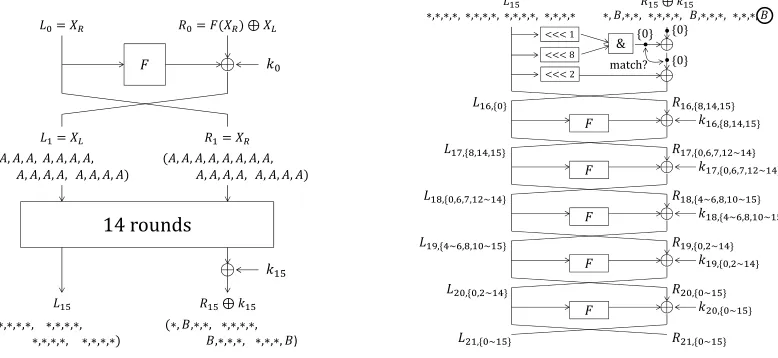
As a result, we obtain a 15-round integral distinguisher (Figure 1) with 31 active bits:
(CAAA, AAAA, AAAA, AAAA, AAAA, AAAA, AAAA, AAAA)
→(∗ ∗ ∗∗,∗ ∗ ∗∗,∗ ∗ ∗∗,∗ ∗ ∗∗, ∗B∗ ∗,∗ ∗ ∗∗, B∗ ∗∗,∗ ∗ ∗B). (1)
The distinguisher in (1) is not ensured for all of the 264keys. Because our experiment did not return any failure, we expect that the success probability of this distinguisher is at least 1−2−13. More integral distinguishers can be constructed by using the following property
Property 1 (Rotational Invariance of Integrals). Assume that (An1, A16) → (∗, Bn2) is a r-round integral over SIMON32, where An1, A16,∗, Bn2 ∈ F16
(ܥ, ܣ, ܣ, ܣ, ܣ, ܣ, ܣ, ܣ, ܣ, ܣ, ܣ, ܣ, ܣ, ܣ, ܣ, ܣ)
(ܣ, ܣ, ܣ, ܣ, ܣ, ܣ, ܣ, ܣ, ܣ, ܣ, ܣ, ܣ, ܣ, ܣ, ܣ, ܣ)
ܮଵ= ܺ ܴଵ= ܺோ
݇
ܨ
ܮ= ܺோ ܴ= ܨ(ܺோ) ⊕ ܺ
14 rounds
݇ଵହ
(∗,∗,∗,∗, ∗,∗,∗,∗, ∗,∗,∗,∗, ∗,∗,∗,∗)
(∗, ܤ,∗,∗, ∗,∗,∗,∗, ܤ,∗,∗,∗, ∗,∗,∗, ܤ)
ܮଵହ ܴଵହ⊕ ݇ଵହ
Fig. 1. 15-round Integral Distinguisher
&
∗,∗,∗,∗, ∗,∗,∗,∗, ∗,∗,∗,∗, ∗,∗,∗,∗ ∗, ܤ,∗,∗, ∗,∗,∗,∗, ܤ,∗,∗,∗, ∗,∗,∗, ܤ
ܮଵହ ܴଵହ⊕ ݇ଵହ
݇ଵ,{଼,ଵସ,ଵହ}
ܨ
ܴଵ,{଼,ଵସ,ଵହ}
ܮଵ,{}
݇ଵ,{,,,ଵଶ~ଵସ}
ܨ
ܴଵ,{,,,ଵଶ~ଵସ}
ܮଵ,{଼,ଵସ,ଵହ}
݇ଵ଼,{ସ~,଼,ଵ~ଵହ}
ܨ
ܴଵ଼,{ସ~,଼,ଵ~ଵହ}
ܮଵ଼,{,,,ଵଶ~ଵସ}
݇ଵଽ,{,ଶ~ଵସ}
ܨ
ܴଵଽ,{,ଶ~ଵସ}
ܮଵଽ,{ସ~,଼,ଵ~ଵହ}
݇ଶ,{~ଵହ}
ܨ
ܴଶ,{~ଵହ}
ܮଶ,{,ଶ~ଵସ}
ܮଶଵ,{~ଵହ} ܴଶଵ,{~ଵହ}
<<< 8 <<< 2 <<< 1
match? {0}
{0} {0}
Fig. 2. Computations for 6-round Key-Recovery
3.2 21-round Integral Attack of SIMON32/64
We use a 15-round integral distinguisher shown in Figure 1. We first prepare 231 internal state values (XLkXR) in which 31 bits are active, then compute the corresponding plaintext (L0kR0) as
L0 ← XR and R0 ← F(XR)⊕XL. Those 231 plaintexts yield balanced bits in 3 positions after 15
rounds, i.e. (L15, R15). Moreover, the subsequent subkey XOR to R15 in round 16 never breaks the balanced property as long as the number of plaintexts in a set is even. We then mount a key recovery attack on 21-round SIMON-32/64 by adding six rounds after the distinguisher, which is illustrated in Figure 2.
3.2.1 Overall Strategy. The attacker guesses a part of the last 5-round subkeysk16, k17, . . . , k20.
Then he partially decrypts the 231ciphertexts up to the stateR15⊕k15, and computes their XOR sum at the balanced bits. The 15-round distinguisher in Figure 1 has 3 balanced bits. However, the partial decryption up to all of those 3 bits requires too much subkey guesses. Then we only use 1 balanced bit at bit-position 0. Thus, the subkey space can be reduced by 1 bit per set of 230 plaintexts. In Figure 2, bit-position 0 of (R15⊕k15) is circled and the related bits to the partial decryption from the ciphertext are shown. 3 bits ofk16, 6 bits ofk17, 10 bits of k18, 14 bits ofk19, 16 bits of k20, in total 49 subkey bits are related. Because the block size of SIMON32 is 32 bits, the analysis with 231 plaintexts can be iterated at most twice, which implies that the 49-bit subkey space can be reduced at most 2 bits. Hence, the correct subkey value cannot be determined only with this procedure.
To detect the correct subkey, we further utilize the key schedule. The knowledge of 4 consecutive subkey values can reveal the main key value. Hence, we aim to recover 64 bits ofk17, . . . , k20. Among 64 bits, 46 bits are suggested from the 6-round partial decryption. Moreover, because 5 subkeys from k16, . . . , k20 are linked only with linear equations, 3 bits of k16,{8,14,15} can be converted to 3-bit information for the remaining 18 bits ofk17, . . . , k20 by solving linear equations with Gaussian elimination. Thus, for each of 49 subkey bits suggested by the 6-round partial decryption, the attacker can obtain 64 bits of k17, . . . , k20 only by guessing 15-bit information of k17, . . . , k20. In summary, reducing the subkey space for 49 subkey bits immediately reduces the subkey space fork17, . . . , k20, which leads to a faster key recovery attack than the exhaustive search.
3.2.2 Efficient Subkey Recovery. We explain the strategy for efficiently performing the 6-round
&
݇ଵ,{଼,ଵହ}
ܨ
ܴଵ,{଼,ଵହ}
݇ଵ,{,,,ଵଷ,ଵସ}
ܨ
ܴଵ,{,,,ଵଷ,ଵସ}
ܮଵ,{଼,ଵହ}
݇ଵ଼,{ସ~,଼,ଵଶ~ଵହ}
ܨ
ܴଵ଼,{ସ~,଼,ଵଶ~ଵହ}
ܮଵ଼,{,,,ଵଷ,ଵସ}
݇ଵଽ,{,ଶ~,ଵ~ଵସ}
ܨ
ܴଵଽ,{,ଶ~,ଵ~ଵସ}
ܮଵଽ,{ସ~,଼,ଵଶ~ଵହ}
݇ଶ,{~,଼~ଵହ}
ܨ
ܴଶ,{~,଼~ଵହ}
ܮଶ,{,ଶ~,ଵ~ଵସ}
ܮଶଵ,{~,଼~ଵହ} ܴଶଵ,{~ଵହ}
<<< 8
<<< 1 {0} ܶଵ
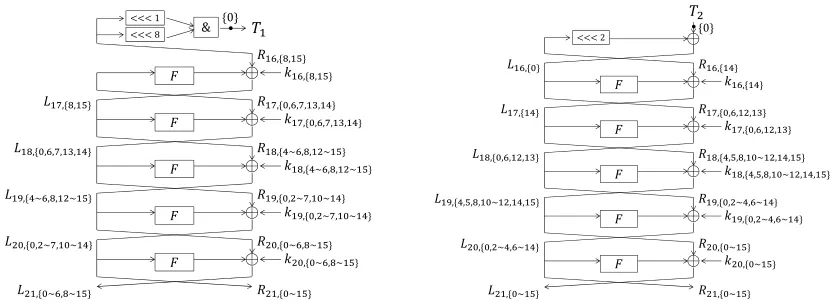
Fig. 3.Computations ofL
(L15,{15}&L15,{8})
݇ଵ,{ଵସ}
ܨ
ܴଵ,{ଵସ}
ܮଵ,{}
݇ଵ,{,,ଵଶ,ଵଷ}
ܨ
ܴଵ,{,,ଵଶ,ଵଷ}
ܮଵ,{ଵସ}
݇ଵ଼,{ସ,ହ,଼,ଵ~ଵଶ,ଵସ,ଵହ}
ܨ
ܴଵ଼,{ସ,ହ,଼,ଵ~ଵଶ,ଵସ,ଵହ}
ܮଵ଼,{,,ଵଶ,ଵଷ}
݇ଵଽ,{,ଶ~ସ,~ଵସ}
ܨ
ܴଵଽ,{,ଶ~ସ,~ଵସ}
ܮଵଽ,{ସ,ହ,଼,ଵ~ଵଶ,ଵସ,ଵହ}
݇ଶ,{~ଵହ}
ܨ
ܴଶ,{~ଵହ}
ܮଶ,{,ଶ~ସ,~ଵସ}
ܮଶଵ,{~ଵହ} ܴଶଵ,{~ଵହ}
<<< 2 {0}
ܶଶ
Fig. 4.Computations ofL
(L15,{14}⊕L16,{0})
than the exhaustive search. Several methods are known to reduce the complexity. Here, we use partial-sum [20], meet-in-the-middle match [25], and exploiting linearity for meet-in-the-middle match [21].
The goal of the partial decryption is to find 49 subkey bits satisfyingL
(R15⊕k15){0}= 0, which is equivalent toL
((L15,{15}&L15,{8})⊕L15,{14}⊕L16,{0}) = 0. This is further converted to
M
(L15,{15}&L15,{8}) =M(L15,{14}⊕L16,{0}). (2)
Hence, we can compute the left-hand side and right-hand side of Equation (2) independently, and later find the match between two independent computations as the meet-in-the-middle attack. In Figure 2, the computation in round 16 is detailed and the approach is illustrated. The computation of the left-hand side of Equation (2) is shown in Figure 3, in which 42 bits of subkeys are involved. The computation of the right-hand side of Equation (2) is shown in Figure 4, in which 42 bits of subkeys are involved. Compared to the original 6-round partial decryption in Figure 2, the number of related subkey bits are reduced from 49 to 42, which contributes to reduce the attack complexity. Inside computations of the left-hand side and the right-hand side of Equation (2), the complexity is reduced by the partial-sum technique. Namely, every time subkey bits are guessed and state values are updated, we compress the amount of data only by keeping the state values appearing odd times.
3.2.2.1 Computation of L
(L15,{15}&L15,{8}). Given a set including 231 plaintexts, L
(L15,{15}
&L15,{8}) for 242 distinct subkey values can be computed with 250.55 21-round SIMON32 compu-tations. The computed results along with 42-bit guessed subkeys are stored in a table T1. We first initialize the following counters which remembers the parity of internal state values.
– 227 countersTx
20, each corresponding to the value x= (L20,{0,2∼7,10∼14}, R20,{0∼6,8∼15}).
– 220 countersT19x, each corresponding to the value x= (L19,{4∼6,8,12∼15}, R19,{0,2∼7,10∼14}).
– 213 countersTx
18, each corresponding to the value x= (L18,{0,6,7,13,14}, R18,{4∼6,8,12∼15}).
– 27 countersT17x, each corresponding to the valuex= (L17,{8,15}, R17,{0,6,7,13,14}).
We then computeL
(L15,{15}&L15,{8}) by the following procedure.
1. For 215 guesses of k20,{0∼6,8∼15} and for each 231 ciphertext values, calculate 27 bits of (L20,{0,2∼7,10∼14}, R20,{0∼6,8∼15}), and increase the relevant counter T20x by 1. Keep the values of (L20,{0,2∼7,10∼14}, R20,{0∼6,8∼15}) which appear odd times.
2. For 212guesses ofk19,{0,2∼7,10∼14}and for each 227remaining values, calculate 20 bits of (L19,{4∼6,8,12∼15},
3. For 28guesses ofk18,{4∼6,8,12∼15}and for each 220remaining values, calculate 13 bits of (L18,{0,6,7,13,14},
R18,{4∼6,8,12∼15}) and increase the counter T18x. Keep the values which appear odd times.
4. For 25 guesses of k17,{0,6,7,13,14} and for each 213 remaining values, calculate 7 bits of (L17,{8,15}, R17,{0,6,7,13,14}) and increase the counterTx
17. Keep the values which appear odd times. 5. For 22 guesses ofk
16,{8,15} and for each 27 remaining values, calculate 2 bits ofL15,{8,15} and then 1-bit of (L15,{15}&L15,{8}). Store it in a tableT1 along with the guesses for 42-bit subkeys. We then evaluate the computational cost. The unit is a single execution of 21-round SIMON32. Updating one bit of the state is equivalent to 1/(16·21) 21-round SIMON32 computation.
Step 1.231·215·15/(16·21)≈241.51.
Step 2.227·215·212·12/(16·21)≈249.19.
Step 3.220·215·212·28·8/(16·21)≈249.61.
Step 4.213·215·212·28·25·5/(16·21)≈246.93.
Step 5.27·215·212·28·25·22·3/(16·21)≈242.19.
The sum of the above 5 steps is 250.55 21-round SIMON32 computations. The tableT1 contains 242 elements of 43-bit information, which is less than 245 bytes.
3.2.2.2 Computation of L
(L15,{14}⊕L16,{0}). For each of 231 plaintexts set,L
(L15,{14}⊕L16,{0}) for distinct 242 subkey values can be computed with 254.01 21-round SIMON32 computations. The computed results along with 42-bit guessed subkeys are stored in a tableT2. Because the procedure is similar to the computation ofT1, the attack is explained shortly.
1. For 216 guesses of k20,{0∼15} and 231 ciphertext values, calculate 29 bits of (L20,{0,2∼4,6∼14},
R20,{0∼15}).The complexity of this step is 231·216·16/(16·21)≈242.61.
2. For 213guesses ofk19,{0,2∼4,6∼14}and 229remaining values, calculate 21 bits of (L19,{4,5,8,10∼12,14,15}, R19,{0,2∼4,6∼14). The complexity of this step is 229·216·213·13/(16·21)≈253.31.
3. For 28 guesses ofk
18,{4,5,8,10∼12,14,15} and 221 remaining values, calculate 12 bits of (L18,{0,6,12,13},
R18,{4,5,8,10∼12,14,15}). The complexity of this step is 221·216·213·28·8/(16·21)≈252.61. 4. For 24guesses ofk
17,{0,6,12,13}and 212remaining values, calculate 5 bits of (L17,{14}, R17,{0,6,12,13}). The complexity of this step is 212·216·213·28·24·4/(16·21)≈246.61.
5. For 2 guesses of k16,{14} and 25 remaining values, calculate 2 bits of L15,{14} and then 1-bit of (L15,{14}⊕L16,{0}). Store it in a tableT2 along with the guesses for 42-bit subkeys. The complexity of this step is 25·216·213·28·24·2·2/(16·21)≈239.61.
The tableT2 contains 242 elements of 43-bit information, which is less than 245 bytes.
3.2.2.3 Matching T1 and T2. After T1 and T2 are independently generated, we derive valid 49-bit subkey candidates. Because both ofT1 andT2 contain 242elements, the number of pairs is 284. From Equation (2), the valid candidates will match the 1-bit result inT1 and T2. Moreover, 42-bit subkeys used in T1 and 42-bit subkeys in T2 overlap in 35 bits. Thus, 284−1−35 = 248 valid candidates are generated, which reduces the entire 49-bit space by one bit.
3.2.3 Entire Attack Procedure and Complexity Evaluation
1. Represent the three subkey bitsk15,{8,14∼15}by usingk16kk17kk18kk19according to the key sched-ule of SIMON32/64 and keep these three linear equations.
2. Generate a set of 231 plaintexts.
3. For each of 231 plaintexts, compute T1 and T2 as explained before, and identify the correct key candidates to reduce the subkey space of 49 bits in the last 6 rounds.
4. For each of remaining subkey candidates, guess the 15 bits k19,{1,15}kk18,{0∼3,7,9}kk17,{1∼5,11,15}
The data complexity of the attack is 231chosen-plaintexts. The time complexity for Step 3 is 250.55+ 254.01 ≈ 254.13 21-round SIMON32 computations. After Step 3, 248 subkey candidates remain. In Step 4, the cost of Gaussian elimination is much smaller than 21-round SIMON32, and thus is ignored. The check with two plaintext-ciphertext pairs can be done one by one, that is, the check for the second pair is performed only with the first check is passed with probability 2−32. Hence, the time complexity is 248·215(1 + 2−32)≈263 21-round SIMON32 computations. In total, the time complexity is 254.13 + 263 ≈ 263.00 21-round SIMON32 computations. The memory complexity is 2·245 bytes for constructingT1 and T2 and 248 49-bit subkey candidates after analyzing a plaintext set, which is less than 251 bytes. The success probability is 1−2−13 due to the probability of the 15-round distinguisher.
4 Zero-Correlation Linear Cryptanalysis of SIMON
The zero-correlation attack is one of the recent cryptanalytic method introduced by Bogdanov and Rijmen [26]. The attack is based on linear approximations with zero correlation (i.e. linear ap-proximations with probability exactly 1/2). We introduce 11 and 12-round zero-correlation linear approximations of SIMON32 and SIMON48, based on which we present key recovery attacks on 20-round SIMON32, 20-round SIMON48/72 and 21-round SIMON48/96 respectively.
4.1 Zero-Correlation Linear Distinguishers of SIMON
0??1,0000,??00,000?
0000,0000,1000,0000 ?0??,?000,0???,??10
?100,000?,0000,0000 0000,0000,0000,0000
?0??,?000,0???,??10
0??1,0000,??00,000?
0???,???1,????,??0?
????,????,????,????
0??0,0000,?0??,1000
?000,0000,0?10,0000
0000,0000,1000,0000
0000,0000,0000,0000 0000,0000,1000,0000 0000,0000,0000,0001
0000,0000,0000,0000
0000,0000,0000,0001
0000,0000,0000,0001
F
F
F
F
F
F
F
F
F
F
F
0000,0000,0000,0000 ?000,0000,0?10,0000
0??0,0000,?0??,1000 ???,???0,?0??,????
?100,000?,0000,0000
????,?10?,0???,0000
????,?10?,0???,0000
???,???1,????,??0?
0
1
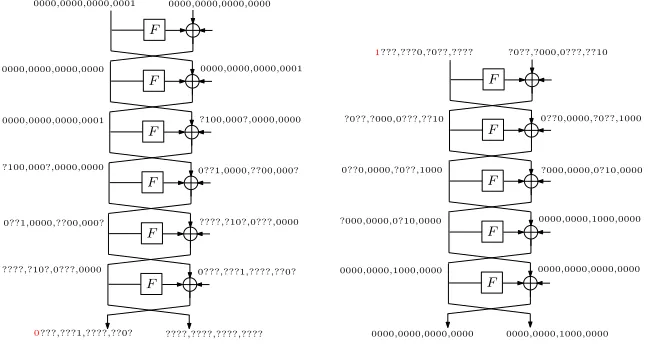
Fig. 5. Zero-Correlation Linear Approximations of 11-round SIMON32. The ‘0’ at bottom left and
the ‘1’ at top right (in red) constitute the contradiction that ensures correlation zero.
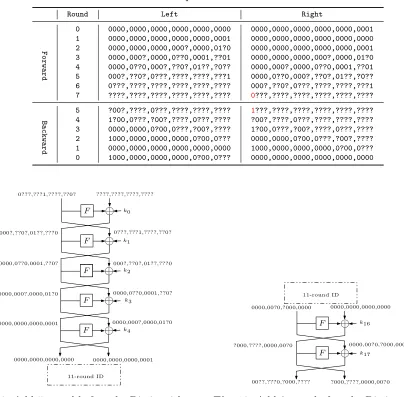
By applying miss-in-the-middle technique, we construct 11-round zero-correlation linear hull for SIMON32 (see Figure 5). More specifically, this distinguisher consists of two parts: forward part (along the encryption direction) and backward part (along the decryption direction). For the for-ward part, we find that for any 6-round non-zero correlation linear hull with input mask being
(0x0001,0x0000), the most significant bit of the left half of its output mask must be 0. As to the
Moreover, due to the simplicity of SIMON’s round function, we observe the following rotational property which can be used to generate more zero-correlation linear hulls of SIMON.
Property 2 (Rotational Invariance of zero-correlations).Assume that (Γ Li,0)9(0, Γ Rj) is a (j−i
)-round zero-correlation linear approximation for SIMON whereΓ Li, Γ Rj ∈Fn2\{0}. Then for anyr, where 0≤r≤n−1, one can construct a set of (j−i)-round zero-correlation linear approximations
as (Γ Li≪r, 0)9(0, Γ Rj ≪r).
4.2 Zero-Correlation Linear Attack on 20-round SIMON32
⊕
F k4,{0} L4,{8,14∼15} R4,{0}
⊕
F L3,{0,6∼7,12∼14}
⊕
F L2,{4∼6,8,10∼15}
⊕
F L1,{0,2∼14}
⊕
F L0,{0∼15}
R3,{8,14∼15} R2,{0,6∼7,12∼14}
k2,{0,6∼7,12∼14}
k3,{8,14∼15} R1,{4∼6,8,10∼15}
k1,{4∼6,8,10∼15} R0,{0,2∼14}
k0,{0,2∼14}
11-round ZC Distinguisher
0000,0000,0000,0000 0000,0000,0000,0001
L5,{0}
Fig. 6. Add 5-round before the Distinguisher
F ⊕
⊕
⊕
F
F
⊕
F k16,{7}
k17,{5∼6,15}
k18,{3∼5,7,13∼14}
k19,{1∼6,11∼13,15}
L20 R20
11-round ZC Distinguisher
0000,0000,0000,0000 0000,0000,1000,0000
R16,{7}
Fig. 7. Add 4-round after the Distinguisher
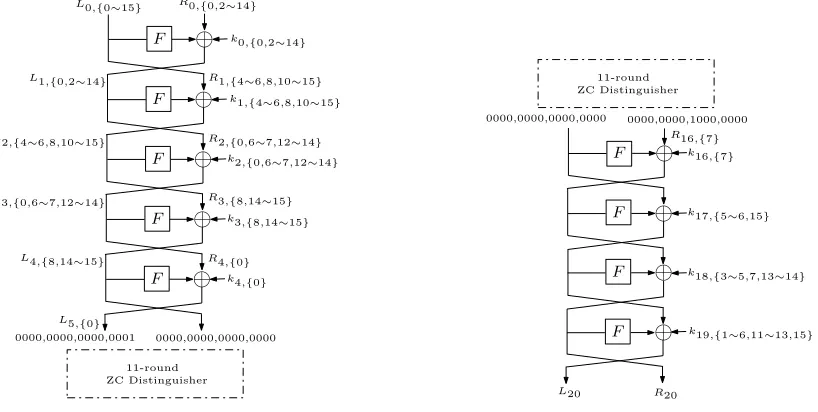
LetEdenote the 20-round SIMON32 from round 0 to round 19. Suppose that the 11-round zero-correlation linear distinguisher given in Figure 5 covers from round 5 to round 15. We now present an attack onE based on this distinguisher by adding five rounds before the distinguisher and four rounds after the distinguisher, which is illustrated in Figure 6 and Figure 7.
4.2.1 Overall Strategy. For each of the 232 plaintext-ciphertext pairs, the attacker first guesses
a part of the last 4-round subkeys k16, k17, k18, k19 and partially decrypts the ciphertext up to the stateR16,{7}. Then he guesses a part of the first 5-round subkeysk0, k1, . . . , k4 and partially encrypts the plaintext up to the stateL5,{0}. Finally, the attacker computes the value of L5,{0}⊕R16,{7}. The subkey bits related to the above partial encryption and partial decryption are shown in Figure 6 and Figure 7. We can see that 14 bits ofk0, 10 bits ofk1, 6 bits of k2, 3 bits of k3, one bit of k4, one bit ofk16, 3 bits ofk17, 6 bits of k18, 10 bits ofk19, in total 54 subkey bits are related.
For a guessed value of the 54 subkey bits, if the event thatL5,{0}⊕R16,{7} is equal to 0 happens 231 times (i.e., the correlation of the linear equationL5,{0}⊕R16,{7} = 0 is exactly 0), then we take this guessed subkey information as a correct subkey candidate. According to [26] and the Wrong-Key Randomization Hypothesis given in [27], for a wrong subkey candidate, the probability that the correlation ofL5,{0}⊕R16,{7} = 0 is 0 can be estimated as √12π2
4−32
2 ≈2−15.33. Thus the 54-bit subkey space can be reduced by a factor of 215.33 approximately.
k16, k17, k18, k19 can be derived from the master key by using linear equations, therefore, one bit of
k4, one bit ofk16, 3 bits ofk17, 6 bits ofk18and 10 bits ofk19(totally 21 subkey bits) can be converted to 21-bit information for the remaining 31 bits of the master key. More specifically, for each of the 33 master key bits suggested above, the attacker can guess 10-bit information of the master key and then obtain 21 linear equations of 21 variables (i.e., the remaining 21 bits of the master key). By solving these linear equations with Gaussian elimination, the attacker can retrieve the master key value.
4.2.2 Efficient Subkey Recovery. We now explain the strategy for efficiently performing 4-round
partial decryption and 5-round partial encryption with 54-bit subkey guess. By using a straight-forward approach, we need to do the partial decryption and partial encryption for 232 plaintext-ciphertext pairs with 254 subkey guesses. This requires 232+54 = 286 computations, which is much more than the exhaustive key search. In our attack, we adopt the divide-and-conquer technique delicately to reduce the time complexity. More specifically, checking whether L5,{0}⊕R16,{7} = 0 has a zero correlation or not can be done by counting the number of occurrences of the event that
L5,{0}kR16,{7}is equal to “00” or “11” (If this number is 231, then the correlation ofL5,{0}⊕R16,{7} = 0 is exactly zero). To do this, we first guess the 20 bits of the last four-round subkeys relevant toR16,{7}
and get the value of L0,{0∼15}kR0,{0,2∼14}kR16,{7} (regarded as the starting state), based on which, we set a starting counter and update the state bit-by-bit for the first six rounds (the counters cor-responding to the states are obtained accordingly). Eventually we derive the counter with respect to the value ofL5,{0}kR16,{7}. Note that all the bit-by-bit state transitions are chosen elaborately to make the time complexity of our attack optimal, and all the counters involved in this attack need to be initialized firstly. The reason why we do not use all the plaintext-ciphertext bits related toL5,{0}
andR16,{7} as the starting state is that the size of this state is too large for us to mount an efficient attack. The detailed attack procedure is given as below.
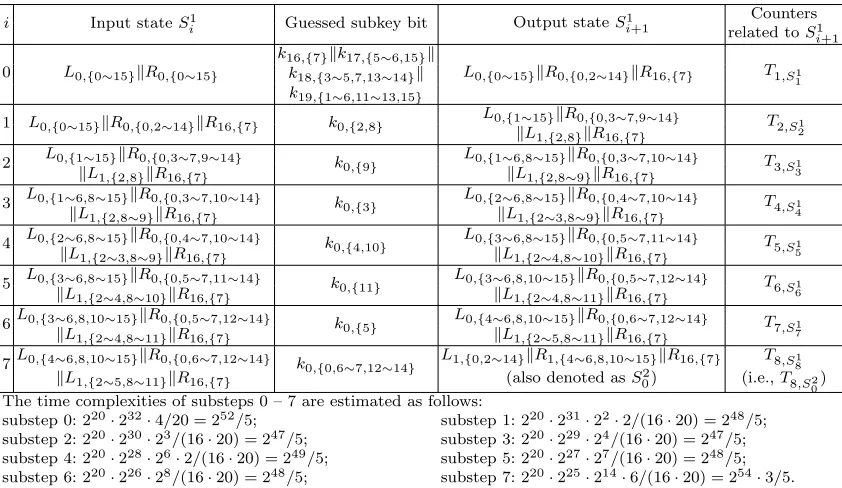
1. Collect all the 232plaintext-ciphertext pairs ofE. LetT1 be a vector of 231 counters which corre-spond to all possible values ofL0,{0∼15}kR0,{0,2∼14}kR16,{7} (denoted asS11). Guess the 20 subkey bitsk16,{7}kk17,{5∼6,15}kk18,{3∼5,7,13∼14}kk19,{1∼6,11∼13,15}. Then for each plaintext-ciphertext pair: (a) Do partial decryption to get the value ofR16,{7} and increase the corresponding counterT1,S1
1 by one according to the value of S11. After that, we will do bit-by-bit state transitions based on S1
1 and update the counters corresponding to the intermediate states.
(b) LetT2be a vector of 230counters which correspond to all possible values ofL0,{1∼15}kR0,{0,3∼7,9∼14}
kL1,{2,8}kR16,{7} (denoted as S1
2). Guess the subkey bits k0,{2,8}. Encrypt partially for each possible value of S1
1 to obtain the value of L1,{2,8}, then add T1,S1
1 to the relevant counter
T2,S1
2 according to the value ofS 1 2.
(c) Guess the subkey bitsk0,{9},k0,{3},k0,{4,10},k0,{11},k0,{5}andk0,{0,6∼7,12∼14}step by step (see Table 5 in Appendix B). Do similarly to the above and finally get the values of the counters corresponding to the state L1,{0,2∼14}kR1,{4∼6,8,10∼15}kR16,{7} (denoted as S2
0).
2. Let X1 be a vector of 224 counters which correspond to all possible values of L1,{0,2∼7,9∼14}
kR1,{4∼6,8,11∼15}kL2,{10}kR16,{7} (denoted asS12). Guess the subkey bit k1,{10}. For each possible value ofS2
0, do partial encryption to derive the value ofL2,{10} and addT8,S2
0 to the correspond-ing counter X1,S2
1 according to the value of S 2
1. After that, guess the subkey bits k1,{4},k1,{11},
k1,{12},k1,{13}, k1,{5}, k1,{6} and k1,{8,14∼15} sequentially (see Table 6 in Appendix B). Do sim-ilarly to the above and eventually obtain the values of the counters corresponding to the state
L2,{4∼6,8,10∼15}kR2,{0,6∼7,12∼14}kR16,{7} (denoted asS03).
3. Let Y1 be a vector of 216 counters which correspond to all possible values of L2,{4∼6,8,11∼15}
kR2,{0,6∼7,13∼14}kL3,{12}kR16,{7} (denoted asS13). Guess the subkey bit k2,{12}. For each possible value of S03, do partial encryption to gain the value of L3,{12} and add X8,S3
counter Y1,S3
1 according to the value of S 3
1. Then guess the subkey bits k2,{13}, k2,{14}, k2,{6},
k2,{7} andk2,{0} step by step (see Table 7 in Appendix B). Do similarly to the above and finally derive the values of the counters corresponding to the state L3,{0,6∼7,12∼14}kR3,{8,14∼15}kR16,{7}
(denoted asS4 0).
4. Let Z1 be a vector of 29 counters which correspond to all possible values of L3,{0,6∼7,12∼13}k
R3,{8,15}kL4,{14}kR16,{7} (denoted as S4
1). Guess the subkey bitk3,{14}. For each possible value of
S04, do partial encryption to get the value of L4,{14} and add Y6,S4
0 to the corresponding counter
Z1,S4
1 according to the value of S 4
1. After that, guess the subkey bits k3,{15} and k3,{8} step by step (see Table 8 in Appendix B). Do similarly to the above and eventually get the values of the counters corresponding to the state L4,{8,14∼15}kR4,{0}kR16,{7} (denoted asS05).
5. LetW be a vector of 22 counters which correspond to all possible values ofL5,{0}kR16,{7}. Guess the subkey bitk4,{0}. For each possible value ofS05, do partial encryption to obtain the value of
L5,{0}and addZ3,S5
0 to the relevant counter inW according to the value ofL5,{0}kR16,{7}. IfW0+
W3 = 231 (Note that W0, W3 are the counters corresponding to the cases that L5,{0}kR16,{7} = “00” and L5,{0}kR16,{7} = “11”, respectively), keep the guessed 54-bit subkey information (i.e.,
k0,{0,2∼14}kk1,{4∼6,8,10∼15} kk2,{0,6∼7,12∼14}kk3,{8,14∼15}kk4,{0}kk16,{7}kk17,{5∼6,15}kk18,{3∼5,7,13∼14}
kk19,{1∼6,11∼13,15}, denoted as η) as a possible subkey candidate, and discard it otherwise. According to [26] and the Wrong-Key Randomization Hypothesis given in [27], the probability that a wrong subkey candidate forη is kept after Step 5 can be approximated as √1
2π2−
14≈2−15.33, thus
about 254×2−15.33= 238.67 subkey candidates forη will be left after the above procedure.
4.2.3 Master Key Recovery.
1. Represent the subkey bits k4,{0}, k16,{7}, k17,{5∼6,15}, k18,{3∼5,7,13∼14} and k19,{1∼6,11∼13,15} by using k0,{0∼15},k1,{0∼15},k2,{0∼15} and k3,{0∼15} according to the key schedule of SIMON32 and keep these 21 linear equations.
2. For each of the remaining 238.67 values ofη, do the following to recover the 64-bit master key: (a) Guess the 10 subkey bitsk0,{1,15},k1,{0∼3,7,9} andk2,{1∼2} and obtain 21 linear equations with
respect tok2,{3∼5,8∼11,15} and k3,{0∼7,9∼13}.
(b) Solve the linear equations by means of Gaussian elimination so as to get the value ofk2,{3∼5,8∼11,15}
kk3,{0∼7,9∼13}, thus all bits of master key can be gained. Verify whether the master key is cor-rect or not by using two plaintext-ciphertext pairs (the verification is done for one pair firstly, if the master key can pass the test, then do the verification for the other pair).
4.2.4 Complexity of the Attack. The data complexity of this attack is 232 known plaintexts.
The memory complexity is primarily owing to keeping the remaining subkey candidates forηin Step 5 of theEfficient subkey recovery phase, thus it can be estimated as 238.67·54/8≈241.42 bytes.
Regarding the time complexity of this attack, it is mainly dominated by Steps 1–4 of theEfficient subkey recoveryphase and Step 2(b) of theMaster key recoveryphase, which can be derived as follows.
1. In Step 1 of theEfficient subkey recovery phase, the time complexity can be estimated as 252/5 + 3·248/5 + 2·247/5 + 249/5 + 254·3/5≈253.42 20-round SIMON32 encryptions (See Table 5 in Appendix B).
2. In Step 2 of the Efficient subkey recovery phase, the time complexity can be estimated as 7·
254/5 + 255·3/5≈255.38 20-round SIMON32 encryptions (See Table 6 in Appendix B).
3. In Step 3 of the Efficient subkey recovery phase, the time complexity can be measured as 3·
256/5 + 2·255/5 + 254/5≈255.77 20-round SIMON32 encryptions (See Table 7 in Appendix B). 4. In Step 4 of the Efficient subkey recovery phase, the time complexity can be measured as 2·
5. In Step 2(b) of the Master key recovery phase, solving 21 linear equations with 21 variables by using Gaussian elimination needs about13·213≈3087 bit-XOR operations, which can be measured by 163087·4·20 ≈21.2720-round SIMON32 encryptions (Note that there are three XOR operations and one AND operation in the round function of SIMON. For simplicity, we approximate them as four XOR operations in our analysis), thus the time complexity of this step can be approximated as 238.67·210·21.27+ 238.67·210≈250.44 20-round SIMON32 encryptions.
Therefore, the total time complexity of this attack is about 253.42+255.38+255.77+254+250.44≈256.96 20-round SIMON32 encryptions.
4.3 Zero-Correlation Linear Attacks on SIMON48
Similarly, by using the 12-round zero-correlation linear distinguisher in Table 4 in Appendix, we can mount key recovery attacks on 20-round SIMON48/72 and 21-round SIMON48/96. For the former, the data, memory and time complexities are about 248known plaintexts, 243bytes and 259.7 20-round SIMON48/72 encryptions, respectively. As to the latter, the data, memory and time complexities are about 248 known plaintexts, 246.73 bytes and 272.63 21-round SIMON48/96 encryptions, respectively.
5 Discussion and Conclusion
Discussion. As mentioned before, applying our experiments to SIMON48 is hard due to the large
block size especially when the number of active bits is close to the block size. We then did experiments in which the number of active bits is 24 (i.e., half of the state) and 30 (i.e., 5/8 of the state), and found 9 and 10-round distinguishers, respectively. Interestingly, according to the experimental results for SIMON32 in Table 3, we observed that if half of the state (16 bits) are active, 9-round distinguishers can be found, and if 5/8 of the state (20 bits) are active, 10-round distinguishers can be derived. It seems that the ratio between the number of active bits and the block size for SIMON48 matches with SIMON32 well, thus we may find 13-round distinguisher with 7/8 of the state (42 bits) being active and 15-round distinguisher with 47 active bits for SIMON48. It remains an open problem to apply this experimental approach efficiently to block ciphers with larger block size.
It was recently shown by Blondeau et al. [28] that zero-correlation linear and impossible differ-ential attacks are closely related for Feistel ciphers, while our paper demonstrated that for SIMON, the former is much better than the latter in terms of the number of attacked rounds. Actually, our results do not contradict the observations given in [28] due to the following facts:
– Blondeau et al. investigated the relation between impossible differential and zero-correlation linear hull without considering the details of round functions. More specifically, they assumed that theF -function adopted in a Feistel cipher is an invertible -function. In this case, only 5-round impossible differentials and 5-round zero-correlation linear hulls can be found for a balanced Feistel cipher. While in our paper, we do take into account the details of the F-function adopted in SIMON when constructing impossible differentials and zero-correlation linear hulls of the cipher.
– They focused on the relation between impossible differential and zero-correlation linear hull (i.e., two kinds of distinguishers), while our results are the key recovery attack results with respect to impossible differential and zero-correlation linear cryptanalysis.
not meet the definition of integral distinguisher specified in [29], thus can not be used to generate a zero-correlation linear hull.
Conclusion. In this paper, we investigated the security of SIMON32 and SIMON48 by using
inte-gral, zero-correlation linear and impossible differential cryptanalysis, and obtained some new results on these ciphers. Firstly, we introduced a novel approach to find a 15-round integral distinguisher of SIMON32, with which an efficient attack was mounted on 21-round SIMON32. This approach gives a new way of constructing integral distinguishers for block ciphers with small block size. Secondly, we presented attacks on 20-round SIMON32, 20-round SIMON48/72 and 21-round SIMON48/96 deli-cately based on 11 and 12-round zero-correlation linear hulls of SIMON32 and SIMON48 respectively. Our attacks improved the previous best results (appeared in FSE 2014) in terms of the number of attacked rounds. Moreover, we proposed improved impossible differential attacks on SIMON32 and SIMON48. It is expected that our results could be beneficial to the security evaluation of SIMON.
Acknowledgments The authors are grateful to all anonymous reviewers for their valuable
com-ments. We also thank Lauren De Meyer, Tomer Ashur and Andras Boho for helping with the in-tegral distinguishers. Moreover, the authors are supported by the National Natural Science Foun-dation of China (no. 61202371), Major State Basic Research Development Program (973 Plan, no. 2013CB338004), China Postdoctoral Science Foundation (no. 2012M521829) and Shanghai Postdoc-toral Research Funding Program (no. 12R21414500).
References
1. Qingju Wang, Zhiqiang Liu, Kerem Varıcı, Yu Sasaki, Vincent Rijmen, and Yosuke Todo. Cryptanalysis of Reduced-round SIMON32 and SIMON48. INDOCRYPT 2014.
2. Fran¸cois-Xavier Standaert, Gilles Piret, Ga¨el Rouvroy, Jean-Jacques Quisquater, and Jean-Didier Legat. ICEBERG : An Involutional Cipher Efficient for Block Encryption in Reconfigurable Hardware. In Bimal K. Roy and Willi Meier, editors,FSE, volume 3017 ofLecture Notes in Computer Science, pages 279–299. Springer, 2004.
3. Chae Hoon Lim and Tymur Korkishko. mCrypton - A Lightweight Block Cipher for Security of Low-Cost RFID Tags and Sensors. In JooSeok Song, Taekyoung Kwon, and Moti Yung, editors, WISA, volume 3786 of Lecture Notes in Computer Science, pages 243–258. Springer, 2005.
4. Deukjo Hong, Jaechul Sung, Seokhie Hong, Jongin Lim, Sangjin Lee, Bonseok Koo, Changhoon Lee, Donghoon Chang, Jaesang Lee, Kitae Jeong, Hyun Kim, Jongsung Kim, and Seongtaek Chee. HIGHT: A New Block Cipher Suitable for Low-Resource Device. In Louis Goubin and Mitsuru Matsui, editors,CHES, volume 4249 ofLecture Notes in Computer Science, pages 46–59. Springer, 2006.
5. Andrey Bogdanov, Lars R. Knudsen, Gregor Leander, Christof Paar, Axel Poschmann, Matthew J. B. Robshaw, Yannick Seurin, and C. Vikkelsoe. PRESENT: An Ultra-Lightweight Block Cipher. In Pascal Paillier and Ingrid Verbauwhede, editors,CHES, volume 4727 ofLecture Notes in Computer Science, pages 450–466. Springer, 2007. 6. Christophe De Canni`ere, Orr Dunkelman, and Miroslav Knezevic. KATAN and KTANTAN - A Family of Small and Efficient Hardware-Oriented Block Ciphers. In Christophe Clavier and Kris Gaj, editors,CHES, volume 5747 ofLNCS, pages 272–288. Springer, 2009.
7. Jian Guo, Thomas Peyrin, Axel Poschmann, and Matthew J. B. Robshaw. The LED Block Cipher. In Preneel and Takagi [32], pages 326–341.
8. Kyoji Shibutani, Takanori Isobe, Harunaga Hiwatari, Atsushi Mitsuda, Toru Akishita, and Taizo Shirai. Piccolo: An Ultra-Lightweight Blockcipher. In Preneel and Takagi [32], pages 342–357.
9. Zheng Gong, Svetla Nikova, and Yee Wei Law. KLEIN: A New Family of Lightweight Block Ciphers. In Ari Juels and Christof Paar, editors, RFIDSec, volume 7055 ofLecture Notes in Computer Science, pages 1–18. Springer, 2011.
10. Huihui Yap, Khoongming Khoo, Axel Poschmann, and Matt Henricksen. EPCBC - A Block Cipher Suitable for Electronic Product Code Encryption. In Dongdai Lin, Gene Tsudik, and Xiaoyun Wang, editors, CANS, volume 7092 ofLecture Notes in Computer Science, pages 76–97. Springer, 2011.
12. Tomoyasu Suzaki, Kazuhiko Minematsu, Sumio Morioka, and Eita Kobayashi. TWINE: A Lightweight Block Cipher for Multiple Platforms. In Knudsen and Wu [34], pages 339–354.
13. Ray Beaulieu, Douglas Shors, Jason Smith, Stefan Treatman-Clark, Bryan Weeks, and Louis Wingers. The SIMON and SPECK Families of Lightweight Block Ciphers. Cryptology ePrint Archive, Report 2013/404, 2013.
14. Farzaneh Abed, Eik List, Jakob Wenzel, and Stefan Lucks. Differential Cryptanalysis of round-reduced Simon and Speck. In Carlos Cid and Christian Rechberger, editors, International Workshop on Fast Software Encryption -FSE 2014, Lecture Notes in Computer Science. Springer, 2104.
15. Hoda A. Alkhzaimi and Martin M. Lauridsen. Cryptanalysis of the SIMON Family of Block Ciphers. Cryptology ePrint Archive, Report 2013/543, 2013. http://eprint.iacr.org/.
16. Javad Alizadeh, Nasour Bagheri, Praveen Gauravaram, Abhishek Kumar, and Somitra Kumar Sanadhya. Linear Cryptanalysis of Round Reduced SIMON. Cryptology ePrint Archive, Report 2013/663, 2013.
http://eprint.iacr.org/.
17. Alex Biryukov, Arnab Roy, and Vesselin Velichkov. Differential Analysis of Block Ciphers SIMON and SPECK. In Carlos Cid and Christian Rechberger, editors, International Workshop on Fast Software Encryption - FSE 2014, Lecture Notes in Computer Science. Springer, 2104.
18. Alex Biryukov and Vesselin Velichkov. Automatic Search for Differential Trails in ARX Ciphers. In Josh Benaloh, editor,CT-RSA, volume 8366 ofLecture Notes in Computer Science, pages 227–250. Springer, 2014.
19. Ning Wang, Xiaoyun Wang, Keting Jia, and Jingyuan Zhao. Improved Differential Attacks on Reduced SIMON Versions. Cryptology ePrint Archive, Report 2014/448, 2014. http://eprint.iacr.org/.
20. Niels Ferguson, John Kelsey, Stefan Lucks, Bruce Schneier, Michael Stay, David Wagner, and Doug Whiting. Improved Cryptanalysis of Rijndael. In Bruce Schneier, editor,FSE, volume 1978 ofLecture Notes in Computer Science, pages 213–230. Springer, 2000.
21. Yu Sasaki and Lei Wang. Bitwise Partial-sum on HIGHT: A New Tool for Integral Analysis against ARX Designs. InICISC, Lecture Notes in Computer Science. Springer, 2013.
22. Farzaneh Abed, Eik List, Stefan Lucks, and Jakob Wenzel. Differential and Linear Cryptanalysis of Reduced-Round Simon. Cryptology ePrint Archive, Report 2013/526, 2013. http://eprint.iacr.org/.
23. Joan Daemen, Lars R. Knudsen, and Vincent Rijmen. The Block Cipher Square. In Eli Biham, editor,FSE, volume 1267 ofLecture Notes in Computer Science, pages 149–165. Springer, 1997.
24. Lars R. Knudsen and David Wagner. Integral Cryptanalysis. In Joan Daemen and Vincent Rijmen, editors,FSE, volume 2365 ofLecture Notes in Computer Science, pages 112–127. Springer, 2002.
25. Yu Sasaki and Lei Wang. Meet-in-the-Middle Technique for Integral Attacks against Feistel Ciphers. In Knudsen and Wu [34], pages 234–251.
26. Andrey Bogdanov and Vincent Rijmen. Linear hulls with correlation zero and linear cryptanalysis of block ciphers.
Des. Codes Cryptography, 70(3):369–383, 2014.
27. Carlo Harpes, Gerhard G. Kramer, and James L. Massey. A Generalization of Linear Cryptanalysis and the Appli-cability of Matsui’s Piling-Up Lemma. In Louis C. Guillou and Jean-Jacques Quisquater, editors,EUROCRYPT, volume 921 ofLecture Notes in Computer Science, pages 24–38. Springer, 1995.
28. C´eline Blondeau, Andrey Bogdanov, and Meiqin Wang. On the (In)Equivalence of Impossible Differential and Zero-Correlation Distinguishers for Feistel- and Skipjack-Type Ciphers. In Ioana Boureanu, Philippe Owesarski, and Serge Vaudenay, editors,ACNS, volume 8479 ofLecture Notes in Computer Science, pages 271–288. Springer, 2014.
29. Andrey Bogdanov, Gregor Leander, Kaisa Nyberg, and Meiqin Wang. Integral and Multidimensional Linear Distinguishers with Correlation Zero. In Wang and Sako [33], pages 244–261.
30. Eli Biham, Alex Biryukov, and Adi Shamir. Cryptanalysis of Skipjack Reduced to 31 Rounds Using Impossible Differentials. In Jacques Stern, editor,Advances in Cryptology - EUROCRYPT ’99, volume 1592 ofLNCS, pages 12–23. Springer, 1999.
31. Lars Knudsen. DEAL - A 128-bit Block Cipher. NIST AES Proposal, 1998.
32. Bart Preneel and Tsuyoshi Takagi, editors. Cryptographic Hardware and Embedded Systems - CHES 2011 - 13th International Workshop, Nara, Japan, September 28 - October 1, 2011. Proceedings, volume 6917 ofLecture Notes in Computer Science. Springer, 2011.
33. Xiaoyun Wang and Kazue Sako, editors.Advances in Cryptology - ASIACRYPT 2012 - 18th International Confer-ence on the Theory and Application of Cryptology and Information Security, Beijing, China, December 2-6, 2012. Proceedings, volume 7658 ofLecture Notes in Computer Science. Springer, 2012.
A Round Function of SIMON
Li−1
<<<8
&
<<<2
Ri−1
Ri
ki−1 <<<1
Li
Fig. 8. The Round Function of SIMON
B Zero-Correlation Linear Cryptanalysis of SIMON32 and SIMON48
Table 4.Zero-Correlation Linear Approximations of 12-round SIMON48
Round Left Right
F
o
r
w
a
r
d
0 0000,0000,0000,0000,0000,0001 0000,0000,0000,0000,0000,0000 1 0000,0000,0000,0000,0000,0000 0000,0000,0000,0000,0000,0001 2 0000,0000,0000,0000,0000,0001 ?100,000?,0000,0000,0000,0000 3 ?100,000?,0000,0000,0000,0000 0??1,0000,??00,000?,0000,0001 4 0??1,0000,??00,000?,0000,0001 ?0??,?10?,0???,0000,??00,000? 5 ?0??,?10?,0???,0000,??00,000? ????,????,????,??0?,0???,0001 6 ????,????,????,??0?,0???,0001 ????,????,????,????,????,??0? 7 ????,????,????,????,????,??0? ????,????,????,????,????,????
B
a
c
k
w
a
r
d
5 ????,????,????,?0?0,???0,001? 0???,10?0,???0,000?,?000,00?? 4 0???,10?0,???0,000?,?000,00?? ??10,000?,?000,00?0,0000,0010 3 ??10,000?,?000,00?0,0000,0010 1000,00?0,0000,0000,0000,000? 2 1000,00?0,0000,0000,0000,000? 0000,0000,0000,0000,0000,0010 1 0000,0000,0000,0000,0000,0010 0000,0000,0000,0000,0000,0000 0 0000,0000,0000,0000,0000,0000 0000,0000,0000,0000,0000,0010
C Impossible Differential Cryptanalysis of SIMON32 and SIMON48
The impossible differential attack was independently proposed by Biham et al. [30] and Knudsen [31]. The attack starts with finding an input difference that can never result in a certain output difference, which makes up an impossible differential. After that, an adversary adds several rounds before and/or after the distinguisher, and collects plaintext pairs with certain differences. If there exists a pair that meets the input and output values of the impossible differential under some guessed subkeys, discard these subkeys. Finally, exhaustively search the rest of subkeys to recover the main key.
In this Section, we propose 11 and 12-round impossible differentials of SIMON32 and SIMON48, based on which we attack 18-round SIMON32, 18-round SIMON48/72 and 19-round SIMON48/96.
C.1 Impossible Differentials of SIMON32 and SIMON48
Table 5. Attack Procedure in Step 1
i Input stateS1
i Guessed subkey bit Output stateS
1
i+1
Counters related toS1
i+1
0 L0,{0∼15}kR0,{0∼15}
k16,{7}kk17,{5∼6,15}k
L0,{0∼15}kR0,{0,2∼14}kR16,{7} T1,S1 1 k18,{3∼5,7,13∼14}k
k19,{1∼6,11∼13,15}
1 L0,{0∼15}kR0,{0,2∼14}kR16,{7} k0,{2,8} L0,{1∼15}kR0,{0,3∼7,9∼14} T2,S1 2
kL1,{2,8}kR16,{7}
2 L0,{1∼15}kR0,{0,3∼7,9∼14} k
0,{9} L0,{1∼6,8∼15}kR0,{0,3∼7,10∼14} T3,S1 3
kL1,{2,8}kR16,{7} kL1,{2,8∼9}kR16,{7}
3 L0,{1∼6,8∼15}kR0,{0,3∼7,10∼14} k
0,{3} L0,{2∼6,8∼15}kR0,{0,4∼7,10∼14} T4,S1 4
kL1,{2,8∼9}kR16,{7} kL1,{2∼3,8∼9}kR16,{7}
4 L0,{2∼6,8∼15}kR0,{0,4∼7,10∼14} k
0,{4,10} L0,{3∼6,8∼15}kR0,{0,5∼7,11∼14} T5,S1 5
kL1,{2∼3,8∼9}kR16,{7} kL1,{2∼4,8∼10}kR16,{7}
5 L0,{3∼6,8∼15}kR0,{0,5∼7,11∼14} k
0,{11} L0,{3∼6,8,10∼15}kR0,{0,5∼7,12∼14} T6,S1 6
kL1,{2∼4,8∼10}kR16,{7} kL1,{2∼4,8∼11}kR16,{7}
6L0,{3∼6,8,10∼15}kR0,{0,5∼7,12∼14} k
0,{5} L0,{4∼6,8,10∼15}kR0,{0,6∼7,12∼14} T7,S1 7
kL1,{2∼4,8∼11}kR16,{7} kL1,{2∼5,8∼11}kR16,{7}
7L0,{4∼6,8,10∼15}kR0,{0,6∼7,12∼14} k
0,{0,6∼7,12∼14} L1,{0,2∼14}kR1,{4∼6,8,10∼15}kR16,{7} T8,S 1 8
kL1,{2∼5,8∼11}kR16,{7} (also denoted asS20) (i.e.,T8,S2 0) The time complexities of substeps 0 – 7 are estimated as follows:
substep 0: 220 ·232
·4/20 = 252/5; substep 1: 220 ·231
·22
·2/(16·20) = 248/5; substep 2: 220
·230 ·23/(16
·20) = 247/5; substep 3: 220 ·229
·24/(16
·20) = 247/5; substep 4: 220
·228 ·26
·2/(16·20) = 249/5; substep 5: 220 ·227
·27/(16
·20) = 248/5; substep 6: 220
·226 ·28
/(16·20) = 248
/5; substep 7: 220 ·225
·214
·6/(16·20) = 254 ·3/5.
Table 6. Attack Procedure in Step 2
i Input stateS2
i
Guessed
Output stateS2
i+1
Counters
subkey bit related toS2
i+1 0L1,{0,2∼14}kR1,{4∼6,8,10∼15}kR16,{7} k1,{10} L1,{0,2∼7,9∼14}kR1,{4∼6,8,11∼15} X1,S2
1
kL2,{10}kR16,{7}
1 L1,{0,2∼7,9∼14}kR1,{4∼6,8,11∼15} k
1,{4} L1,{0,3∼7,9∼14}kR1,{5∼6,8,11∼15} X2,S2 2
kL2,10kR16,{7} kL2,{4,10}kR16,{7}
2 L1,{0,3∼7,9∼14}kR1,{5∼6,8,11∼15} k
1,{11} L1,{0,3∼7,10∼14}kR1,{5∼6,8,12∼15} X3,S2 3
kL2,{4,10}kR16,{7} kL2,{4,10∼11}kR16,{7}
3 L1,{0,3∼7,10∼14}kR1,{5∼6,8,12∼15} k
1,{12} L1,{0,3∼7,11∼14}kR1,{5∼6,8,13∼15} X4,S2 4
kL2,{4,10∼11}kR16,{7} kL2,{4,10∼12}kR16,{7}
4 L1,{0,3∼7,11∼14}kR1,{5∼6,8,13∼15} k
1,{13} L1,{0,3∼7,12∼14}kR1,{5∼6,8,14∼15} X5,S2 5
kL2,{4,10∼12}kR16,{7} kL2,{4,10∼13}kR16,{7}
5 L1,{0,3∼7,12∼14}kR1,{5∼6,8,14∼15} k
1,{5} L1,{0,4∼7,12∼14}kR1,{6,8,14∼15} X6,S2 6
kL2,{4,10∼13}kR16,{7} kL2,{4∼5,10∼13}kR16,{7}
6 L1,{0,4∼7,12∼14}kR1,{6,8,14∼15} k
1,{6} L1,{0,6∼7,12∼14}kR1,{8,14∼15} X7,S2 7
kL2,{4∼5,10∼13}kR16,{7} kL2,{4∼6,10∼13}kR16,{7}
7 L1,{0,6∼7,12∼14}kR1,{8,14∼15} k
1,{8,14∼15}L2,{4∼6,8,10∼15}kR2,{0,6∼7,12∼14}kR16,{7} X8,S 2 8
kL2,{4∼6,10∼13}kR16,{7} (also denoted asS30) (i.e.,X8,S3 0) The time complexities of substeps 0 – 7 are estimated as follows:
substep 0: 220 ·214
·225
·2/(16·20) = 254
/5; substep 1: 220 ·214
·224 ·22
/(16·20) = 254
/5; substep 2: 220
·214 ·223
·23/(16
·20) = 254/5; substep 3: 220 ·214
·222 ·24/(16
·20) = 254/5; substep 4: 220
·214 ·221
·25/(16
·20) = 254/5; substep 5: 220 ·214
·220 ·26/(16
·20) = 254/5; substep 6: 220
·214 ·219
·27
/(16·20) = 254
/5; substep 7: 220 ·214
·217 ·210
·3/(16·20) = 255 ·3/5.
By applying the miss-in-the-middle approach together with Property 3, we obtain 11-round, 12-round impossible differential characteristics of SIMON32 and SIMON48 respectively (see Table 9 and 10).
Property 3 (Rotational Invariance of Impossible Differentials).Assume that (0, ∆Ri)9(∆Lj,0) is
a (j−i)-round impossible differential for SIMON where∆Ri, ∆Lj ∈Fn2\{0}. Then for anyr, where 0≤r ≤n−1, one can construct a set of (j−i)-round impossible differentials as (0, ∆Ri ≪r)9