Comment on “Realization of a scalable Shor algorithm”
Zhengjun Cao1, Lihua Liu2
Abstract. Recently, Monz, et al. [arXiv:1507.08852] have reported the demon-stration of factoring 15 using a scalable Shor algorithm with an ion-trap quantum computer. We remark that the report is flawed because there are three flaws in the
proposed circuit diagram of Shor algorithm. We also remark that the principles be-hind the demonstration have not been explained properly, including its correctness
and complexity.
Keywords. quantum computer; Shor algorithm; quantum Fourier transforma-tion; quantum modular exponentiatransforma-tion; continued fraction expansion
1
Introduction
It is well known that factoring an integerncan be reduced to finding the order of some integer
x modulo n, i.e., ordn(x). So far, there is not a polynomial time algorithm run on classical
computers which can be used to compute ordn(x). In 1994, Shor [1] proposed an algorithm
running on quantum computers which can compute ordn(x) and was claimed to be polynomial.
The Shor algorithm requires two quantum registers. At the beginning of the algorithm, one has
to find q = 2s for some integer s such that n2 ≤ q < 2n2, where n is to be factored. It then
proceeds as follows.
• Initialization. Put register-1 in the uniform superposition √1 q
Pq−1
a=0|ai|0i.
• Quantum modular exponentiation. Keep a in register-1 and compute xa in register-2 for
some randomly chosen integerx. It gives the state √1 q
Pq−1
a=0|ai|xai.
• Quantum Fourier Transformation. Performing Fourier transform on register-1, we obtain the state 1
q
Pq−1
a=0 Pq−1
c=0exp(2πiac/q)|ci|xai.
• Observation. It suffices to observe register-1. The probability pthat the machine reaches the state|c, xki is
1
q X
a:xa≡xk
exp(2πiac/q)
2
,
1Department of Mathematics, Shanghai University, Shanghai, China.
2Department of Mathematics, Shanghai Maritime University, Shanghai, China.
where 0≤k < r= ordn(x), the sum is over all a(0≤a < q) such thatxa≡xk.
• Continued Fraction Expansion. If there is a d such that −2r ≤ dq−rc ≤ r
2, then the
probability of seeing|c, xki is greater than 1/3r2. Sinceq ≥n2, we have
c q −
d r
≤
1 2q ≤
1 2n2 <
1 2r2.
Thend/r can be obtained by rounding c/q.
Since 2001, some teams [2, 3, 4, 5] have reported that they had successfully factored 15 into 3×5 using Shor algorithm. We [6] have argued that all these demonstrations are false and
misleading, because they violate the necessary condition that the selected numberq must satisfy
n2 ≤ q < 2n2. Otherwise, one can not complete the step of Continued Fraction Expansion in
Shor algorithm. Essentially, these demonstrations have no relation to the Shor algorithm.
In 2015, Monz, et al. [7] have reported a new demonstration of factoring 15 using a scalable Shor algorithm with an ion-trap quantum computer. In this note, we want to remark that the
report is flawed because there are three flaws in the proposed circuit diagram of Shor algorithm. The claim [7] that the scalable Shor algorithm is based on the Kitaev’s result [8] is false. In fact,
Kitaev only claimed that factoring can be reduced to the Abelian Stabilizer Problem (ASP). He did not claim that 2` qubits subject to a Quantum Fourier Transformation (QFT) can be replaced by a single qubit if only the classical information of the QFT (such as the period r)
is of interest. We also remark that the demonstration has no relation to Shor algorithm. Its principles have not been explained elaborately, including its correctness and complexity.
2
The complexity of Shor algorithm
At the end of the Shor factoring algorithm, one should observe the first register and denote
the measured result as an integerc. Its complexity argument comprises:
(1) The probabilitypof seeing a quantum state|c, xk(modn)isuch thatr/2≥ {rc}
qis greater
than 1/3r2, wherenis the integer to be factored,q is a power of 2 satisfyingn2 ≤q <2n2
andr = ordn(x). For convenience, the notation modn will be omitted henceforth.
(2) There are φ(r) possible cwhich can be used to compute the order r.
(3) The measured number in the second register, i.e.,xk, takesrpossible values 1, x, x2,· · · , xr−1.
(4) The success probability of running the algorithm once is greater than r·φ(r)· 1 3r2. By φ(r)/r > ξ/log logr for some constantξ, it concludes that the algorithm runs in polyno-mial time.
The Shor complexity argument can be depicted by the following Graph-1. 1 1 2 / 0 0
1
|
|
q qiac q a
a c
e
c
x
q
| ,
c x
k(mod
n
)
( ) different r c
( ) / 3
r
r
different
kr
x
measured observed
2 collapse with 1 / 3
probability to the state
r
Graph-1: Shor complexity argument
3
Review of the demonstration of Shor algorithm
Very recently, Monz et al. [7] have reported the demonstration of factoring 15 using a scalable
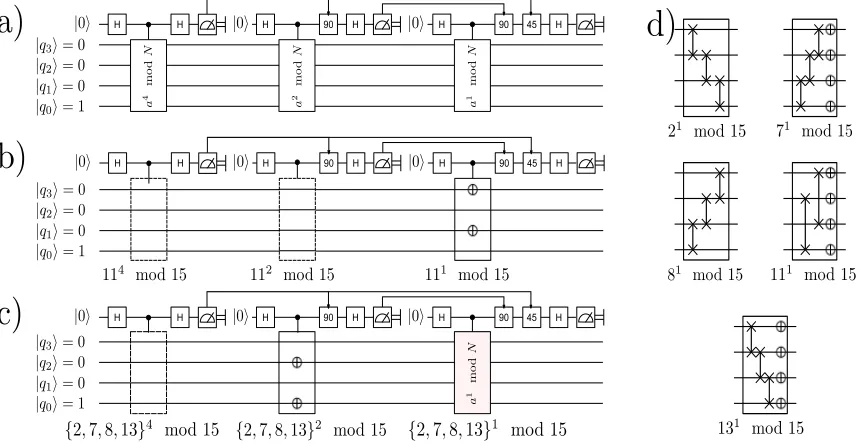
Shor algorithm with an ion-trap quantum computer. See the following Figure 1 for the circuit
diagram of the demonstration. 2
H H H 90 H H 90 45 H
H H H 90 H H 90 45 H
H H H 90 H H 90 45 H
FIG. 1: Circuit diagram of Shor’s algorithm for factoring 15 based on Kitaev’s approach for: a) a generic basea; and the specific circuit representations for the modular multipliers; b) The actual implementation for factoring 15 to base 11, optimised for the single input state it is subject to; c) Kitaev’s approach to Shor’s algorithm for the bases{2,7,8,13}: the optimised map of the first multiplier is identical in all 4 cases, the last multiplier is implemented with full modular multipliers as depicted in d); d) Circuit diagrams of the modular multipliers of the forma modNfor bases a={2,7,8,11,13}.
sults of ax modN) and generally about 2n qubits in
the period-register [10]. Thus even a seemingly simple example such as factoring 15 (an n = 4 -bit number), would require 3n= 12 qubits when implemented in this straightforward way. These qubits then would have to be manipulated with high fidelity gates. Given the current state-of-the-art control over quantum systems [11], such an approach likely yields an unsatisfying performance. However, a full quantum implementation of this part of the algorithm is not really necessary. In Ref. 9 Ki-taev notes that, if only the classical information of the QFT (such as the periodr) is of interest, 2nqubits sub-ject to a QFT can be replaced by a single qubit. This approach, however, requires qubit-recycling (specifically: in-sequence single-qubit readout and state reinitializa-tion) paired with feed-forward to compensate for the re-duced system size.
In the following, Kitaev’s QFT will be referred to as KQFT(M). It replaces a QFT acting onM qubits with
a semiclassical QFT acting repeatedly on a single qubit. Similar applications of Kitaev’s approach to a semiclas-sical QFT in quantum algorithms have been investigated in Refs. [12–14]. For the implementation of Shor’s algo-rithm, Kitaev’s approach provides a reduction from the previousncomputational qubits and 2nQFT qubits (in total 3n qubits) to only n computational-qubits and 1 KQFT(2n)qubit (in totaln+ 1 qubits).
A notably more challenging aspect than the QFT, and
ular exponentiation, which admits these general simplifi-cations:
(i) Considering Kitaev’s approach (see Fig. 1), the in-put state |1i(in decimal representation) is subject to a conditional multiplication based on the most-significant bit kof the period register. At most there will be two results after this first step. It follows that, for the very first step it is sufficient to implement an optimized oper-ation that conditionally maps|1i → |a2k
modNi. Con-sidering the importance of a high-fidelity multiplication (with its performance being fed-forward to all subsequent qubits), this efficient simplification improves the overall performance of experimental realizations.
(ii) Subsequent multipliers can similarly be replaced with maps by considering only possible outputs of the previous multiplications. However, using such maps will become exponentially more challenging, as the number of input and output states to be considered grows exponen-tially with the number of steps: afternsteps, 2n > N
4
Flaws in the demonstration of Shor algorithm
As we see, the original Shor algorithm requires at lest 3`qubits, where ` =dlog2(n)e, n is to be factored. Among them, 2` qubits are used in the register-1 and ` qubits are used in the
register-2. That is, the register-1 uses 8 qubits and the register-2 uses 4 qubits for factoring 15. We find the demonstration of Shor algorithm does not satisfy the necessary condition. It only uses one qubit for the register-1 and four qubits for the register-2. We here want to stress
that
(1) If less qubits are used in the register-1, then the step of Continued Fraction Expansion (CFT) in Shor algorithm can not be accomplished. In the new demonstration, the
register-1 has only one qubit. Thus, the observed valuecis either 0 or 1. q= 2. It directly violates the necessary condition for CFT.
(2) If less qubits are used in the register-1, then the Shor complexity argument fails because the probabilitypof seeing a quantum state|c, xk(modn)isuch thatr/2≥ {rc}
qis greater
than 1/3r2 can not be properly estimated using the original Shor argument.
Here is a brief description of the original Shor complexity argument. Setting a=br+k
for some integerband the order r= ordn(x), the probabilitypis
1 q
b(q−k−1)/rc
X
b=0
e2πi(br+k)c/q 2 .
Then it argues that the probabilityp equals to
1 q
b(q−k−1)/rc
X
b=0
e2πib{rc}q/q
2 .
Writing the above sum into an integral, we obtain
1
q
Z b(q−k−1)
r c
b=0
e2πib{rc}q/qdb+O
b(q−k−1)/rc
q (e
2πi{rc}q/q−1)
.
Takingu=rb/q, we have
1
r
Z rqbq−k−r 1c 0
exp
2πiu{rc}q r
du
Taking into account thatk < r, we can obtain the approximation
1 r Z 1 0 exp
2πiu{rc}q r
du.
Hence, we have
1
r Z 1
0
exp
2πiu{rc}q r
du
≥
2/(πr)
Therefore,
p≥ 4
π2r2 >1/3r 2.
(3) To modulate the wanted quantum state in the register-2, one has to find an efficient
and universal quantum modular exponentiation method, which does not depend on any special bases. But the proposed circuit diagram shows that the method does depend on the
different bases. It is not universal. Concretely, for base 11 one has to use the circuit b). For bases 2, 7, 8, 13, the circuit c) should be used. But even worse, both two circuits cannot generate the wanted quantum state in the register-2 in the original Shor’s algorithm.
5
Further discussions
It claims [7] that the scalable Shor algorithm is based on the Kitaev’s result [8]. In the page 2 (left column) of [7], it writes:
In Ref. 9 Kitaev notes that, if only the classical information of the QFT (such as the periodr) is of interest, 2nqubits subject to a QFT can be replaced by a single qubit.
This approach, however, requires qubit-recycling (specifically: in-sequence single-qubit readout and state reinitialization) paired with feed-forward to compensate for
the reduced system size.
But we find the claim is wrong. In fact, Kitaev only claimed that factoring can be reduced to the Abelian Stabilizer Problem (ASP). Throughout the paper [8], He did not claim that 2`
qubits subject to a Quantum Fourier Transformation (QFT) can be replaced by a single qubit
if only the classical information of the QFT (such as the periodr) is of interest.
We here want to stress that the authors [7] misunderstand the purpose of using QFT in
Shor algorithm. The aim of applying QFT to the register-1 is to accumulate the wanted state
|c, xk(modn)i such that it is possibly observed with significant probability. QFT has no direct
relation to the orderr. In fact,r is deduced by rounding cq.
Finally, we would like to stress that if the implementation is indeed credible then it would be a new quantum factoring algorithm, not the Shor algorithm, because all requirements of the
original Shor’s algorithm are not satisfied.
6
Conclusion
We remark that the demonstration of quantum factorization proposed by Monz et al. does not conform to the Shor algorithm. The necessary step of Continued Fraction Expansion in Shor
algorithm can not be accomplished. The original Shor complexity argument does not apply to the demonstration. It does not specify a universal quantum modular exponentiation method. In view of these flaws, we do not think that the demonstration is believable. Naturally speaking,
it has no relation to the Shor algorithm.
References
[1] P. Shor: Polynomial-time algorithms for prime factorization and discrete logarithms on a quantum computer. SIAM J. Comput. 26 (5): 1484-1509 (1997)
[2] L. Vandersypen, et al.: Experimental Realization of Shor Quantum Factoring Algorithm Using Nu-clear Magnetic Resonance, Nature 414 (6866): 883-887, arXiv:quant-ph/0112176 (2001)
[3] B. Lanyon, et al.: Experimental Demonstration of a Compiled Version of Shor Algorithm with Quan-tum Entanglement”, Physical Review Letters 99 (25): 250505. arXiv:0705.1398 (2007)
[4] C.Y. Lu, et al.: Demonstration of a Compiled Version of Shor Quantum Factoring Algorithm Using Photonic Qubits, Physical Review Letters 99 (25): 250504, arXiv:0705.1684 (2007)
[5] E. Lucero, et al.: Computing Prime Fctors with a Josephson Phase Qubit Quantum Processor. Nature Physics 8, 719-723, 2012. arXiv:1202.5707 (2012)
[6] Z.J. Cao, Z.F. Cao and L.H. Liu: Remarks on Quantum Modular Exponentiation and Some Experi-mental Demonstrations of Shor Algorithm,http://arxiv.org/abs/1408.6252 (2014)
[7] T. Monz, et al.: Realization of a scalable Shor algorithm.http://arxiv.org/abs/1507.08852(2015) [8] A. Kitaev: Quantum measurements and the Abelian Stabilizer Problem.
http://arxiv.org/abs/quant-ph/9511026(1995)