Cost Analysis in Context of Change Management in Software
Development
1
Iqra Ikram,
2Fatima Ikram,
3Samia Rafique
1Iqra Ikram, CS/IT Department, Govt. College Women University Sialkot, Sialkot Pakistan 1[email protected]
2Fatima Ikram, CS/IT Department, Govt. College Women University Sialkot, Sialkot Pakistan 2
3
Samia Rafique, CS/IT Department, Govt. College Women University Sialkot, Sialkot Pakistan
3
ABSTRACT:
Software development is considered to be the most important field in software engineering. As many researchesfocused on the issues related to accurate and efficient software cost and effort estimation in software development project.
Software development projects have a high dynamic nature so accurate software cost estimation in context of change management
is a highly difficult task. Also because of accurate software cost estimation is the project manager’s responsibility so estimating
cost at early stages of software development life cycle is considered to be most challenging task. Hence this paper address the
issues related to consistent cost estimation in context of change management in software development. This research conducted
survey and structured interview to collect the data from different software industries of Pakistan. Based on descriptive analysis of
data, collected from different software industries of Pakistan this research proposed a solution for estimating cost in context of
change management.
Keywords— cost estimation model, change management, software project, software cost estimation, software effort estimation
1. INTRODUCTION
Software cost estimation (SCE) is a method of estimating
software’s cost being developed. Tracing and planning of
software projects involves in Software cost estimation [6].
In software engineering, accurate software cost estimation is
most highly concerned topic. In order to successively
complete a project scheduling and applied effort refers as
software development cost [10]. Hence Software cost
estimation and the software effort estimation is very difficult
job for large scale projects [1].
In order to maintain the cost and budget many techniques
are available such as Computational Intelligence techniques
[11]. From past four eras many cost estimation models have
been developed. Function point analysis and constructive
cost model (COCOMO) are mostly used models for
software development efforts [12].
The process of measuring the scope and intricacy of
software system based on the function that the system offers
to the end-user is known as Function point analysis [13].
COCOMO model was developed by berry
bohem[14].COCOMO model is algorithmic models and
other algorithmic models are “SDC model (Nelson, 1966),
Boeing model (Black et al., 1977), GRC model (carriere and
Thinodeau, 1979), Meta model (bailey and Basili, 1981),
TRW Wolverton model (Wolverton, 1974), Putnam SLIM
(Software Lifecycle Management) model (Putnam, 1978),
Doty model (Herd et al.,1977) , RCA PRICE S model
(Freiman and Park, 1979), IBM-FSD model (Walston and
Felix, 1977)”[15].
Changing needs of customers and computer technology are
the dynamic factors that affect the development of software
[16]. Many requirement are changed within the software
changing requirement so that software successfully lead to
its required results [17].
Software maintenance refer to the software that can be
configured once it is launched in the actual environment in
order to correct the faults and error, and another attributes so
that product can be adopted in changing environment [18].
The purpose of this paper is to provide correct estimation for
change management. This research provide information of
recent work that is mentioned in section 2. Section 3
describes methodology as well as analysis of result and
proposed solution. At the end section 4 conclude this paper
and future work indicated in section 5.
2. LITERATURE REVIEW
Software cost estimation methods [1] are writing algorithms,
judgment of the expertise and machine learning. Cost
estimation techniques are organized into two central groups
one is parametric models and 2nd is Non-parametric models. Many algorithmic model under parametric models and
machine learning under non-parametric models are
established. COCOMO model consist of Intermediate
COCOMO, Basic COCOMO and Detailed COCOMO.
Basic COCOMO is mostly used model for software cost
estimation. Expert Judgment based Methods is also used to
study the past progress of the project and this technique is
better than the Algorithmic approach (Poonam Pandey,
2013). In 2012, Anupama Kaushik et al use the back
propagation neural networks for software cost estimation.
This research used “Feed Forward Back Propagation model of neural network” to maps the COCOMO model. This
model used identity function at the input layer and sigmoidal
function at the hidden and output layer [4]. In 2010, Iman
Attarzadeh et al proposed a “novel constructive cost model (COCOMO)” based on “soft computing approach” and
include some structure of neural networks. As accurately
evaluating the cost of software development require a
premeditated planning so, Experiment result of neural
network on algorithmic and non-algorithmic software cost
estimation model showed that proposed neural network
based software cost estimation model produced better and
more accurate cost estimation “in view of MMRE,
Pred(0.25) evaluation criteria” than COCOMO model[6].
In 2013, D.Manikavelan et al used Differential evolutionary
Algorithm for proper estimation of cost as Software cost
estimation Categorized in two types one is Algorithmic cost
estimation and second is Non- Algorithmic cost estimation.
The example of Algorithmic cost estimation method and
non-Algorithmic cost estimation method are functional point
model & COCOMO model [19]. Cost of the software [2]
can be calculated through Regression Equation. Regression
Equation perform Regression and Correlation investigation.
The requirements of the user are varied at every phase of
SDLC and change in requirement disturbed Schedule,
Quality and Cost of the software project. The change in
requirements effected the whole phases of SDLC. The
authors explain experimental study of changing requirement
and also explain its effect on the cost of the software project
they also suggested intangible frame work and systematic
analyze of change and its effect on cost estimation according
to generic regression equation and phase of SDLC (Bushra
Sharif et al, 2012). In 2011 Hemanta Kumar Doloi find out
the issues related to the observations of board stakeholders
.This study organize structured interview to collect data
from different organizations and to form a big picture on
each stage of project development. This big picture is then
converted into concept model using soft system
methodology approach. However factors effecting cost
estimation are “political, economic, financial, technical and attitudinal concerns”. However conceptual model in this
study is not validated with international practices and
mentioned factors need to be tested and hypothesized on
interactive and basic links [7].
In 2015 Manal El et al perform systematic mapping study
(SMS) to sum the software cost estimation in the
environment of Global software development. This study
perform the systematic review of considered software
development and maintenance cost and effort estimation.
The techniques which are used for the software cost
estimation are non-machine learning models, Expert
judgment and machine learning model. Infect they discuss
drivers for GSD projects. Future research would explore
how these challenges and factors affect cost estimation
techniques [3]. In 2012, Narayan Ramasubbu et al inspect
the challenges by firstly examine the core cause of cost
estimation error from the perspective of worldwide
distributed software projects. The observation showed the
problems related to standard matrix-based estimation tools
that managers use(a) did not integrate varied project
characteristics and configurations, (b) inclusive data
required at early phase that are not available at the start of
projects, and (c) and important field experience required to
make estimates. To these problems authors suggested the
“semi-automated solution” in term of “case-based reasoning”. The overall result of six-month field-study for
three large ISO-9001 proficient companies at CMMI-level 5
showed that learning-based cost estimation approaches
reduce estimation errors up to 60% and increase the
economic benefit of 20% per project on average. To address
various software environment this research yet working on
expanding the method [8]. “Integrity of maintenance,
Adaptability maintenance, and correction of maintenance”
[18] are the fundamentals types of software maintenance.
Moreover “application experience, staff stability, application
time, the external environment, support environment, and
user requirements” are non-technical factors and density of
software, human ability development, efficiency of
documentation and conditions of modern programming are
technical factors that influence the software maintenance
cost. This study also improving the cost estimation model
for software maintenance (Yongchang Ren et al, 2011).
In 2010, Violeta Bozhikova et al classify the method of
software cost estimation in term of basic functionality and
important features. The authors presented a cost estimation
model that combine basic, intermediate COCOMO model
and COCOMO II with function point estimation features.
This proposed model estimate cost by identifying the aims
and requirements, by estimating the size of product and
complexity and by estimating the schedule, resources and
applied efforts. Correctly estimating large and typical
software projects yet not present this research [9]. In 2006,
Stein Grimstad et al explain that how poor cost estimation
analysis technique central to incorrect. The cost of the
project is estimated through two ways first through “self-developed estimation model” and second by “expert estimation”. According to these consequences they suggest a
framework for correct cost estimation. Through this
framework the cost of the software project can easily be
measured. [5].
Table 2.1: Results of literature review
Year Methodology, Design and statistical analysis
Result, proposed solution Limitations of study
2010
Experiments at original COCOMO dataset and artificial dataset.
Proposed a “new novel (COCOMO) based on soft computing approach” include some features of neural network approach
2011
Structured interviews in construction industries of Australia.
developed a concept model on cost overrun
Conceptual model was not validated with international practices
2012
observations of three software development companies
six-months field-study of three large firms to test the proposed solution
baseline comparison
variation reduction
Development of a new “learning-oriented and semi-automated early-stage cost estimation solution” learning-based cost estimation approaches reduce estimation inaccuracies up to 60% and increase the financial benefit of 20% per project on average
sensitivity analysis
2011 Descriptive Analysis forms to list the cost factors.
Improving the cost estimation model for software
maintenance.
Proposed the formula for improving the cost estimation model for software
maintenance as cost of basic maintenance factor multiplied by each of mass.
Proposed method was not applied to secondary development of cost estimation.
2010
presented a cost estimation model that combine basic, intermediate COCOMO model and COCOMO II with function point analysis
proposed model estimate cost by identifying the aims and requirements, by estimating the size of product and complexity and by estimating the schedule, resources and applied efforts
Module’s operations were only verified for a limited number of small-size students Projects.
Correctly estimating large and typical software projects not presented this research.
2013
1)Expert Judgment based Methods
2) Algorithmic models
Cost estimates can be explain through algorithmic models
The models are formed by historical data and it will not be capable to reflect current hardware, programming languages and software engineering.
2012 Regression Equation
Authors proposed intangible frame work.
Systematically analyzed the change and also its effect on cost through generic regression equation.
2015
Systematic mapping study (SMS).
non-machine learning models
Expert judgment.
Machine learning model.
Systematically examined software development and effort estimation.
SMS having deficiency of primary studies.
2012 “Feed Forward Back
Propagation model” of neural network which can be maps the COCOMO model
Due to COCOMO model and neural network approach enhance the cost estimation.
2006
Self-developed estimation model Unfortunate cost estimation will fundamental to improper
Analysis of existing literature indicate that in many
countries researchers have conducted surveys,
interviews[1,2,3,4,5,6,7,8,9,18,19] in which researchers
have identified some software development cost estimation
model and many technical and non-technical factors that
influence accurate software cost estimation. But no one
discuss any cost estimation method for change management.
Hence need of software cost estimation model for change
management become essential. Therefore, this research
result in software cost estimation model for change
management
3. RESEARCH METHODOLOGY
This research apply “mix-method” research approach. This
research review the literature to identify some software cost
estimation model [1, 19, 9] and many technical and
non-technical factors [18] that influence accurate software cost
estimation. In second stage of research we conducted the
survey and interviews to understand how software industries
face the problem of change management on Software cost
estimation. The survey process take place in the duration o
One and half month. This research also mentioned some
factors that are the main cause of change management. We
also conducted the structured interviews from different
software industries to collect data.
Questionnaire was designed to know what problem software
industries face because of change management on software
cost estimation. The questionnaires were disturbed among
100 software industries of Pakistan to collect data based on
software industry’s needs. Only 12% software industries of
Pakistan result in respond to questionnaire and interview.
Questionnaire consist of both open ended and close ended
questions so that software industries can easily mentioned
the challenges that they encountered.
3.1
Analysis of data and Results
Statistical approach is use to analyze and evaluate results.
Table 3.4.1: Questionnaire Response Question Criteria Yes No Other
Cost Benefit analysis 40 % 60% 0
Statistics of Table 3.4.1 shows that 40% software industries
conduct cost benefit analysis using different tools and
techniques such that Traceability Matrix, ROI, BCR, NPV,
COCOMO model, Functional point analysis. 60% of
industries does not conduct cost benefit analysis. (Fig: 3.4.1)
Fig 3.4.1: cost benefit analysis conducted by industries
Table 3.4.2: Questionnaire Response
Questio n criteria
Capacity-related, price-to-win
Expert judgmen
ts
Analo gy
Model based metho ds
Depen ds on scenari o to scenari
o
Estimati on Methods
16.7% 27.3% 1% 33.3% 8.3%
Statistics of Table 3.4.2 shows that 16.7% estimation
methods used in the industry for Capacity-related
price-to-win,27.3% for Expert judgments,1% for Analogy base ,
33.3% for Model based methods, three estimation methods
are being used, top-down estimation, bottom-up estimation,
Parametric model, 8.3% estimating Depends on scenario to
scenario. (Fig: 3.4.2)
40% 60%
Cost Benefit analysis
Yes No
Figure 3.4.2: cost estimation methods used in industries
Table 3.4.3: Questionnaire Response
Question criteria yes No
Project Size effect Effort and schedule estimation accuracy
83.3 8.3
Statistics of Table 3.4.3 shows that 83.3% of software industries responses that project size effect schedule and effort estimation accuracy. 8.3% of industries responses were in No. (Fig: 3.4.3).
Figure 3.4.3: Project size effect effort and schedule estimation accuracy
Table 3.4.4: Questionnaire Response
Question Criteria
Requirement are volatile
Requirement are unclear
Changing in technology
Causes of inaccurate estimation
27.3 18.2 2
Resources are unavailable
Absence of applicable cost estimation methods and process
Use rolling wave planning instead of planning at once.
9.1 27.3 27.3
Statistics of Table 3.4.4 shows causes of inaccurate
estimation as 27.3 % of Requirement are volatile, 18.2% of
Requirement are unclear, 2% Changing in technology, 9.1%
Resources are unavailable, 27.3% absence of applicable cost
estimation methods and process 27.3 % industries use
rolling wave planning instead of planning at once for large
projects(Fig: 3.4.4).
Figure 3.4.4: Causes of inaccurate estimation
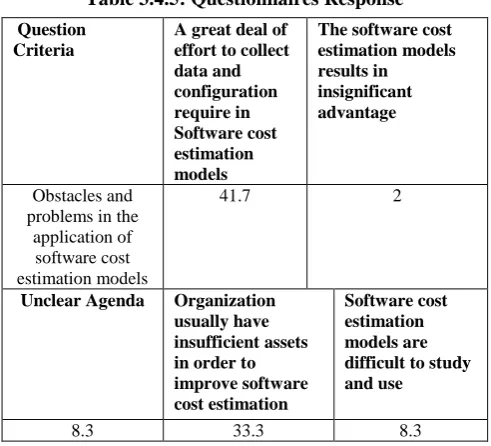
Table 3.4.5: Questionnaires Response
Question Criteria
A great deal of effort to collect data and configuration require in Software cost estimation models
The software cost estimation models results in
insignificant advantage
Obstacles and problems in the
application of software cost estimation models
41.7 2
Unclear Agenda Organization usually have insufficient assets in order to improve software cost estimation
Software cost estimation models are difficult to study and use
8.3 33.3 8.3
Statistics of Table 3.4.5 shows Obstacles and problems in
the application of software cost estimation models result in
41.7% great deal of effort to collect data and configuration
require in Software cost estimation models, 2% software
cost estimation models results in insignificant advantage,
8.3% Software cost estimation models are difficult to study
and use, 8.3% Unclear Agenda, 33.3% Organization usually
have insufficient assets in order to improve software cost
estimation (Fig: 3.4.5).
16.7
27.3
1
33.3
8.3
0 10 20 30 40
Estimation Methods
83.3
8.3
0 50 100
yes No
Project size effect effort and schedule estimation accuracy
27.3 18.2
2
9.1
27.3 27.3
0 5 10 15 20 25 30
Figure 3.4.5: Obstacles and problems in the application of software cost estimation models
Table 3.4.6: Questionnaires Response
Questio n Criteria By using appropriat e cost estimation models On Experienc e base innovative projects requires detailed study scope baseline, mostly scope is poorly defined Time and Man Power Handle change in software project cost
33.3 50 8.3 8.3
Table 3.4.6 indicate how industries Handle change in
software project cost 33.3% By using appropriate cost
estimation models ,50% On Experience base,8.3%
innovative projects requires detailed study scope baseline,
mostly scope is poorly defined,8.3% Time and Man
Power(Fig: 3.4.6).
Figure 3.4.6: Handle change in software project cost
Table 3.4.7: Questionnaire Response
Question Criteria Increase delivery time Increase human effort Already keep margin in time and cost
Approach to risk management
1 16.7 66.78
Integrated Change control process
Change Control Management
83.3 8.3
Statistics of Table 3.4.7 indicate industry’s approaches to risk
management that are result in 1% Increase delivery time,16.7%
Increase human effort,66.78% Already keep margin in time and
cost,83.3% Integrated Change control process,8.3% Change
Control Management(Fig: 3.4.7).
Figure 3.4.7: Approach to risk management
Table 3.4.8: Questionnaire Response
Question Criteria Deliver project within time project complete within estimated cost both :Deliver project within time,
project complete within estimated cost Critical success factors
8.3 8.3 66.7
integrated change control process
None
8.5 8.6
Statistics of Table 3.4.8 indicate Critical success factors of
industries as 8.3% industries indicate that project deliver
within time is critical success factor as well as 8.3% project
complete within estimated cost, 66.7% both: Deliver project
within time, project complete within estimated cost, 8.5 %
integrated change control process all are critical success
factors for industries. 8.6% responses were in none. (Fig:
3.4.8).
41.7
2 8.3 8.3 33.3 0 10 20 30 40 50
A great deal of effort to collect data and configuration require in Software
cost estimation models
The software cost estimation models results in insignificant advantage
Software cost estimation models are difficult to study and use
Unclear Agenda
Organization usually have insufficient assets in order to improve software
cost estimation
Obstacles and problems in the application of software cost estimation models
33.3
50
8.3 8.3
0 10 20 30 40 50 60 By using appropriate cost estimation models On Experience base innovative projects requires detailedstudy scope basline, mostly scope ispoorly defined
Time and Man Power
Handle change in software project cost
1 16.7 66.78 83.3 8.3 0 20 40 60 80 100
Figure 3.4.8: critical success factor for industries
Table 3.4.9: Questionnaire Response Question Criteria RAD
model
Scrum model
Water Fall
model used in industry for software development
32.3 66.7 1
Statistics of Table 3.4.9 indicate that 32.3% of industries
used RAD model for software development, 66.7%
industries used Scrum model and 1% Water Fall model for
software development. (Fig: 3.4.9).
Figure 3.4.9: Model used in industry for software development
Table 3.4.10: Questionnaire Response
Question Criteria
business values
Budgeting Risk analysis
purpose to use cost estimations
8.3 58.3 1
Project planning and control
To create project cost baseline and project
budget
24 10
Statistics of Table 3.4.10 indicate the purpose to use cost
estimations 8.3% used cost estimation for business
values,58.3% for Budgeting, 1% for Risk analysis, 24% for
Project planning and control and 10% to create project cost
baseline and project budget (Fig:3.4.10).
Figure 3.4.10: purpose to use cost estimations Table 3.4.11: Questionnaire Response
Question criteria
Initial project proposal stage
Feasibilit y study
Requireme nt gathering
Desig n
Organizatio ns usually make cost estimations
45.5 27.3 9.1 9.1
Implementati on
Integrati on & testing
planning process group
2 0.5 9.1
Statistics of Table 3.4.11 indicate 45.5% Organizations
usually make cost estimations during initial project proposal
stage, 27.5% use during feasibility study.
3.2
Proposed Solution
3.2.1
Q1. Overcome change in management
By using same techniques like Pessimistic Estimates, Workbreakdown structure, decomposition, estimate resource
requirements, estimates duration and then estimate cost one
can overcome change in management. Moreover one can
impose restriction in change requests by limiting the number
of revisions a client can ask. Additional revisions are
analyzed and quoted separately.
Finalize requirements before starting project and by
mentioning timelines one can easily overcome change in
management.
3.2.2
Q2. Estimate cost in context of change
management
8.3 8.3
66.7 8.5
8.6
0 20 40 60 80
Deliver project within time project complete within…
both :Deliver project… integrated change…
none
Critical success factors
32.3
66.7
1 0
20 40 60 80
RAD model Scrum model Water Fall Model used in industry for software
development
0 10 20 30 40 50 60 70
business values
Budgeting Risk analysis
Project planning and control
To create project cost
baseline andproject
Risk management is input to every estimating process. Plan
risk management by creating risk management plan, then
identify risk to build risk register, then perform qualitative
& quantitative risk analysis and then advise risk strategies
for positive (Enhance, Exploit, Accept, Share) and negative
(Mitigate, Transfer, Avoid, Accept) risks. Moreover if
change occur within milestone then it can be overcome
according to intended requirements within each milestone.
However, PMI PMBOK5, Managing Change in
Organizations: A PMI Practice guide, Change Management
Control and Scrum model are best practices or
methodologies for change management.
4. CONCLUSION
This research investigated the effect of change management
on software cost estimation. As accurate software cost
estimation is project manager’s responsibility so estimating
cost at initial phase of software development life cycle is a
challenging task. So, this research conducted a survey and
Structured interview from different software industries of
Pakistan. From the analysis of data collected from different
software industries, this research proposed a solution to
minimize the impact of change management on software
cost estimation. This research also indicate factors that are
main reason for change management. By applying the best
practices the impact of these factors can be minimized as
well as accurate software cost estimation can be made
possible.
5. FUTURE WORK
As Changes during software development are obvious, so
accurate software cost estimation in context of change
management is considered to be difficult task. As many cost
estimation models used now a day, but there is no model
available to accurately estimate cost in context of change
management. Hence future work involve proposed a new
model based on change management.
6. ACKNOWLEDGMENT
We would like to thanks all software industries that participated in interview and survey for their time and kind response. Also we would like to thanks some secret referees for their positive remarks that supported us to increase the excellence of this paper.
REFERENCES
[1]. Poonam Pandey:”A nalysis Of the Techniques for
Software Cost Estimation “-Third International
Conference on Advanced Computing &
Communication Technologies-2013.
[2]. Bushra Sharif, Dr. Shoab A.Khan , Muhammad
Wasim Bhatti:” Measuring the Impact of Changing
Requirements on Software Project Cost: An
Empirical Investigation” IJCSI International
Journal of Computer Science Issues, Vol. 9, Issue
3, No 1, May 2012.
[3]. Manal El Bajta1, Ali Idri1, Jos´e Luis
Fern´andez-Alem´an2, Joaquin Nicolas Ros2 and Ambrosio
Toval2:” Software Cost Estimation for Global
Software Development A Systematic Map and
Review Study” ACM SIGCOMM 2015.
[4]. Anupama Kaushik , A.K. Soni And Rachna Soni:”
An Adaptive Learning Approach to Software Cost
Estimation, National Conference on Computing
and Communication Systems (NCCCS) 2012
[5]. Stein Grimstad and Simula Research:” A
Framework for the Analysis of Software Cost
Estimation Accuracy”, Copyright 2006 ACM
1-59593 218-6/2006
[6]. Iman Attarzadeh, and Siew Hock Ow.” A Novel
Soft Computing Model to Increase the Accuracy of
Software Development Cost Estimation.”
Department of Software Engineering. In Computer
and Automation Engineering (ICCAE), The 2nd
International Conference on (Volume:3), pp-
603-607, 26-28 Feb. 2010.
[7]. Hemanta Kumar Doloi⁎.”Understanding
stakeholders' perspective of cost estimation in
Building and Planning, The University of
Melbourne, Parkville Campus, Melbourne, Victoria
3010, Australia. In the International Journal of
Project Management 29 (2011) pp-622–636
[8]. Narayan Ramasubbu, and Rajesh Krishna Balan.”
Overcoming the Challenges in Cost Estimation for
Distributed Software Projects” School of
Information Systems Singapore Management
University Singapore. In Proceeding ICSE
'12 Proceedings of the 34th International
Conference on Software engineering (2012)
pp-91-101
[9]. Violeta Bozhikova, and Mariana Stoeva.” An
Approach for Software Cost Estimation”. In
Proceedings of the 11th International Conference
on Computer Systems and Technologies and
Workshop for PhD Students in Computing on
International Conference on Computer Systems and
Technologies (2010) pp- 119-124
[10]. A.J. Albrecht and J.E. Gaffney, “Software
function, source lines of code, and development
effort prediction: a software science validation,”
IEEE Transactions on Software Engineering, 1983,
pp. 639–647.
[11]. J.S.Pahariya V. Ravi* M. Carr,” Software
Cost Estimation using Computational Intelligence
Techniques”. Institute for Development and
Research in Banking Technology, Castle Hills
Road #1, Masab Tank, Hyderabad 500 057, AP,
India. In Nature & Biologically Inspired
Computing, 2009. NaBIC 2009. Pp.849-854.
[12]. J.E. Matson, B.E Barrett and J.M.
Mellichamp, “Software development cost
estimation using function points,” IEEE
Transactions on Software Engineering, 1994, pp.
275–287
[13]. B. Kitchenham, L.M. Pickard, S. Linkman
and P.W. Jones, “Modeling software bidding
risks,” IEEE Transactions on Software
Engineering, 2003, pp. 542–554.
[14]. B.W.Boehm, “Software Engineering
Economics,” PrenticeHall, Englewood Cliffs, NJ,
USA, 1981.
[15]. Poonam Pandey,” Analysis Of the
Techniques for Software Cost Estimation”.
Assistant Professor, GLA University ,Mathura. In
Advanced Computing and Communication
Technologies (ACCT), 2013 Third International
Conference .pp. 16-19
[16]. Jameleddine Hassine, Juergen Rilling,
Jacqueline Hewitt.” Change Impact Analysis for Requirement Evolution using Use Case Maps”.
Department of Computer Science, Concordia
University. 5-6 Sept. 2005.pp-81-90
[17]. Muhammad Wasim Bhatti, Nadeem
Ehsan, Azam Ishaque, Farah Hayat, Sohail Ahmed,
and Sheikh Zahoor Sarwar.” An Investigation of
Changing Requirements with respect to
Development Phases of a Software Project”
Engineering Management Department CASE,
Center for Advanced Studies in Engineering
Islamabad, Pakistan. In Computer Information
Systems and Industrial Management Applications
(CISIM), 2010 International Conference pp.
324-327
[18]. Yongchang Ren, Xiaoji Chen, Tao Xing,
Xuguang Chai.” Research on Software
Maintenance Cost of Influence Factor Analysis and
Estimation Method”. In Intelligent Systems and
Applications (ISA), 2011 3rd International
Workshop.pp-1-4, 28-29 May 2011.
[19]. Da Yang, Qing Wang Mingshu Li, Ye
Yang, Kai Ye1, and Jing Du.”A Survey on
Software Cost Estimation in the Chinese Software
industry”. Published in proceeding ESEM
international symposium on Empirical software
engineering and measurement. 2008, Pp-253-262
[20]. D.Manikavelan and Dr.R.Ponnusamy:” To
find the accurate software cost estimation using
Differential Evaluation algorithm”, IEEE
International Conference on Computational