Scholarship@Western
Scholarship@Western
Electronic Thesis and Dissertation Repository
9-10-2014 12:00 AM
Proxy-based Mobile Computing Infrastructure
Proxy-based Mobile Computing Infrastructure
Azade Khalaj
The University of Western Ontario
Supervisor
Dr. Hanan Lutfiyya
The University of Western Ontario
Graduate Program in Computer Science
A thesis submitted in partial fulfillment of the requirements for the degree in Doctor of Philosophy
© Azade Khalaj 2014
Follow this and additional works at: https://ir.lib.uwo.ca/etd
Part of the OS and Networks Commons, Other Computer Sciences Commons, and the Systems Architecture Commons
Recommended Citation Recommended Citation
Khalaj, Azade, "Proxy-based Mobile Computing Infrastructure" (2014). Electronic Thesis and Dissertation Repository. 2497.
https://ir.lib.uwo.ca/etd/2497
This Dissertation/Thesis is brought to you for free and open access by Scholarship@Western. It has been accepted for inclusion in Electronic Thesis and Dissertation Repository by an authorized administrator of
by
Azade Khalaj
Graduate Program in Computer Science
A thesis submitted in partial fulfillment
of the requirements for the degree of
Doctor of Philosophy
The School of Graduate and Postdoctoral Studies
The University of Western Ontario
London, Ontario, Canada
c
In recent years, there has been a huge growth in mobile applications. More mobile users are
able to access Internet services via their mobile devices e.g., smartphones and tablets. Some
of these applications are highly interactive and resource intensive. Mobile applications, with
limited storage capacity, slow processors and limited battery life, could be connected to the
remote servers in clouds for leveraging resources. For example, weather applications use a
remote service that collects weather data and make this data available through a well-defined
API. This represents a static partitioning of functionality between mobile devices and a remote
server that is determined at run-time.
Regardless of the network distance between the cloud infrastructure and the mobile device,
the use of a remote service is well suited for mobile device applications with relatively little
data to be transferred. However, long distances between a mobile device and remote services
make this approach unsuitable for applications that require larger amounts of data to be
trans-ferred and/or have a high level of interactiveness with the user This includes mobile video communications (e.g., Skype, Face-Time, Google-Hangout), gaming applications that require
sophisticated rendering and cloud media analysis that can be used to offer more personalized services. The latency incurred with this architecture makes it difficult to support real-time and interactive applications. A related problem is that the static partitioning strategy is not always
suitable for all network conditions and inputs. For example, let us consider a speech
recogni-tion applicarecogni-tion. The performance depends on the size of the input and the type of connectivity
to the backbone. Another challenge is that the communication medium between the mobile
application and the remote service includes wireless links. Wireless links are more error prone
and have less bandwidth than wired links. Often a mobile application may be disconnected.
One approach to addressing these challenges is the use of a proxy. A proxy is computing
power that is located at the network edge. This allows it to address problems with latency. It
is possible for a proxy to have services that allow for offloading tasks from either the cloud or the mobile device and to deal with communication challenges between the mobile application
and the mobile device.
This work proposes a proxy-based system that acts as a middleware between the mobile
application and the remote service. The proposed middleware consists of a set of proxies
that provide services. The proposed middleware includes services for proxy discovery and
selection, mechanisms for dealing with balancing loads on proxies and handoff. A prototype was developed to assess the effectiveness of the proposed proxy-based system.
Keywords: Mobile Computing, Mobile Cloud, Proxy, Cloudlet
Certificate of Examination ii
Abstract ii
List of Figures ix
List of Tables x
1 Introduction 1
1.1 Offloading from Mobile Devices . . . 1
1.2 Using Proxies . . . 2
1.3 Challenges in Using Proxies . . . 3
1.3.1 Scalability of a Proxy-based System . . . 3
1.3.2 Proxy Discovery . . . 3
1.3.3 Static Association between Mobile Device and Proxy . . . 4
1.3.4 Specific-purpose Proxies . . . 5
1.3.5 Summary of Limitations . . . 5
1.4 Contributions . . . 6
2 Literature Review 8 2.1 Offloading Computation . . . 8
2.1.1 Offload General Computing Tasks . . . 9
2.1.1.1 MAUI . . . 9
2.1.1.2 SuMMIT . . . 10
2.1.1.3 Economic Mobile Cloud Computing . . . 11
2.1.1.4 Cuckoo . . . 12
2.1.1.5 Interdroid . . . 13
2.1.1.6 Offload to a Cluster . . . 14
2.1.1.7 Energy Saving: Local Processing vs. Offloading . . . 14
2.1.1.8 A Proxy on the Local Network . . . 15
2.1.1.11 Energy-aware Broker . . . 17
2.1.2 Offload Specific Services . . . 17
2.1.2.1 Elastic HTML5 . . . 17
2.1.2.2 Self-Adaptive Data Link Layer HandoffManager . . . 18
2.1.2.3 i5 Multimedia Cloud Architecture . . . 19
2.1.2.4 DYNAMO . . . 20
2.1.2.5 MAPGrid . . . 21
2.2 Reducing Latency . . . 22
2.2.1 CloneCloud . . . 22
2.2.2 Transient Customization of Cloudlets . . . 23
2.2.3 Interactive Applications and Cloudlets . . . 24
2.2.4 Partial Offload to Cloudlet . . . 25
2.2.5 Integration of Public Clouds with Cloudlets . . . 26
2.2.6 Pocket Cloudlet . . . 27
2.2.7 Proximal Workspace . . . 27
2.2.8 Data Placement on Nearby proxies . . . 28
3 Proxy-based System 30 3.1 Proposed System . . . 30
3.2 Components . . . 31
3.2.1 Proxy . . . 31
3.2.2 Proxy Services . . . 33
3.2.2.1 Example Proxy Services . . . 34
3.2.2.2 Provider of Proxy Services . . . 35
3.2.2.3 Finding Proxy Services . . . 36
3.2.2.4 Deployment of Proxy Services . . . 36
3.2.3 Proxy Finder Server(PFS) . . . 37
3.2.4 Client Side Component . . . 38
3.2.5 Remote Services . . . 38
3.3 Using the Proxy-based System . . . 38
3.3.1 Remote Printing in a Campus . . . 39
3.3.1.1 How the Proxy-based System Helps This Scenario . . . 40
3.3.1.2 Proxy Services for Remote Printing . . . 41
3.3.1.3 Remote Printing Application Using Proxy Services . . . 42
3.3.2.2 Proxy Services Used for the Tourist Assistance Application . 46
3.3.2.3 Implementing Tourist Assistance Application via Help of Proxy
Services . . . 46
3.4 Analysis . . . 48
3.4.1 Dynamic vs. Static partitioning . . . 48
3.4.2 Solution generality . . . 49
3.4.3 Compatibility with old systems . . . 50
3.4.4 Application mobility . . . 50
3.5 Summary . . . 52
4 Proxy Discovery 53 4.1 Related Work . . . 54
4.1.1 Service Discovery Protocols . . . 55
4.1.2 Proxy Discovery in Other Work . . . 55
4.1.3 Gap Analysis . . . 57
4.2 Proxy Discovery Mechanism . . . 58
4.2.1 Proxy Registration . . . 58
4.2.2 Proxy Discovery . . . 59
4.2.3 PFSAlgorithm for Selecting Proxies . . . 63
4.2.3.1 Attributes . . . 63
4.2.3.2 Preferences of Mobile Application . . . 64
4.2.3.3 The Algorithm . . . 64
4.3 Prototype of the Proposed System . . . 66
4.4 Experiments . . . 67
4.4.1 Design Goals . . . 67
4.4.2 Evaluation Metrics . . . 68
4.4.3 Experimental Setup . . . 68
4.4.4 Remote Services . . . 69
4.4.5 Mobile Applications . . . 69
4.4.6 Using Proxy or Not Using Proxy: Retransmission vs Recovery . . . 70
4.4.6.1 Disconnection Simulation . . . 71
4.4.6.2 CallingPrinter Finder . . . 71
4.4.6.3 CallingPrinting Service . . . 71
4.4.6.4 Measuring the Overhead . . . 73
4.4.7.1 Proximity . . . 75
4.4.7.2 Effect of RTT between Mobile Device and Proxy . . . 76
4.4.7.3 Effect of Proxy Discovery Factors . . . 78
4.4.7.4 Overhead of Proxy Discovery Operation . . . 81
4.4.8 Conclusion . . . 81
4.5 Summary . . . 82
5 Handoff 83 5.1 Related Work . . . 83
5.1.1 Mobile Service Clouds . . . 84
5.1.2 Change of Proxy in Data Link Layer HandoffManager . . . 85
5.1.3 Task Transfer between Cloud Providers . . . 86
5.1.4 Mobility Support in Proximal Community Network . . . 87
5.1.5 Gap Analysis . . . 87
5.2 HandoffOperation . . . 88
5.2.1 HandoffDecision . . . 88
5.2.2 Selecting the Mobile Application for Handoff . . . 89
5.2.3 HandoffManagement Process . . . 89
5.2.4 State of Proxy Services . . . 91
5.2.4.1 RelayProxy Service . . . 92
5.2.4.2 DataTransfer Proxy Service . . . 92
5.2.4.3 FileStreamer Proxy Service . . . 92
5.2.4.4 CodeExec Proxy Service . . . 93
5.2.5 Common Tasks of Proxy Services . . . 93
5.2.6 Notifying the Mobile Application of Proxy Change . . . 93
5.3 Experiments and Results . . . 94
5.3.1 Application and Used Proxy Service . . . 94
5.3.2 Evaluation Metrics . . . 95
5.3.3 Experimental Setup . . . 95
5.3.4 Effect of HandoffUnder Various Conditions . . . 96
5.3.4.1 Linear Increase in RTT . . . 97
5.3.4.2 Spike Increase in RTT . . . 97
5.3.5 Results Assuming a Linear Increase in RTT . . . 98
5.3.6 Results Assuming a Spike Increase in RTT . . . 100
6 Programming Model 102
6.1 Related Work . . . 102
6.2 Programming Model . . . 104
6.2.1 Bridge . . . 104
6.2.1.1 findProxy Operation . . . 104
6.2.1.2 ProxyFindRequest . . . 105
6.2.1.3 byeProxy Operation . . . 105
6.2.2 PFSAPI . . . 105
6.2.2.1 registerProxy Operation . . . 105
6.2.2.2 findProxy Operation . . . 106
6.2.3 Proxy API . . . 106
6.2.3.1 isAvailable Operation . . . 106
6.2.3.2 helloProxy Operation . . . 106
6.2.3.3 byeProxy Operation . . . 107
6.2.4 Proxy Services API . . . 107
6.2.4.1 RelayProxy Service API . . . 107
6.2.4.2 DataTransferProxy Service API . . . 108
6.2.4.3 CodeExecProxy Service API . . . 109
6.2.4.4 FileStreamerProxy Service API . . . 110
6.2.4.5 Common HandoffAPI . . . 110
6.2.5 How Mobile Applications Use the API . . . 111
6.2.5.1 Finding a Proxy . . . 112
6.2.5.2 Calling Printer Finder throughRelayproxy service . . . 112
6.2.5.3 Calling Printing Service through DataTransfer and Code-ExecProxy Services . . . 113
6.2.5.4 Calling AR Service throughFileStreamerandCodeExecProxy Services . . . 114
6.3 Summary . . . 115
7 Conclusion and Future Work 116 7.1 Future Work . . . 117
7.1.1 Improve Functionality of System . . . 117
7.1.2 New Features . . . 118
A Standard Deviations 126
Curriculum Vitae 129
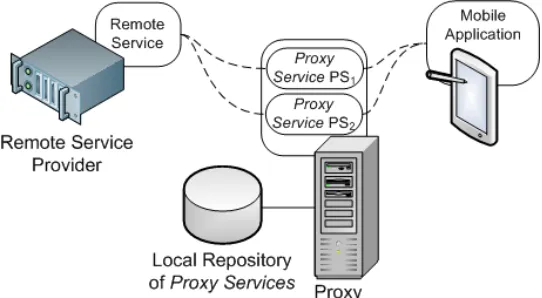
3.1 Proxy Use - Model 1 . . . 32
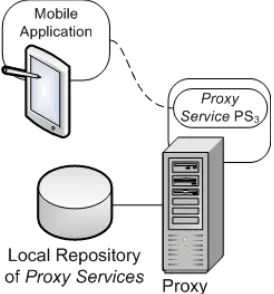
3.2 Proxy Use - Model 2 . . . 33
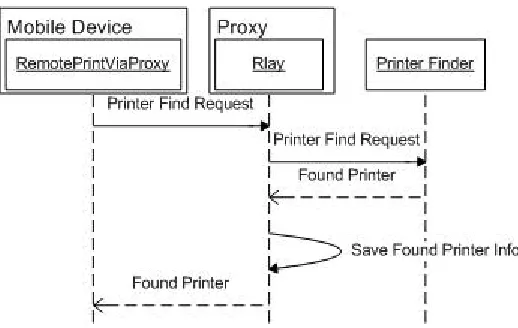
3.3 CallPrinter FinderVia Proxy . . . 43
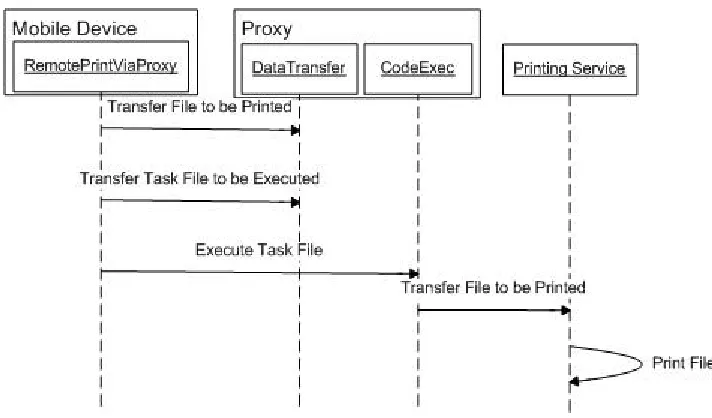
3.4 CallPrinting ServiceVia Proxy . . . 44
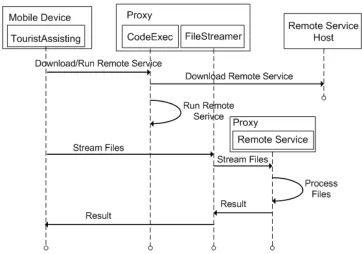
3.5 Run Tourist Assistance Application Via Proxy . . . 47
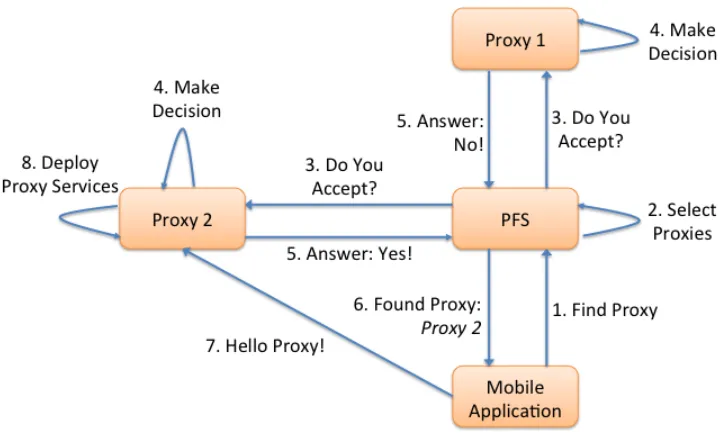
4.1 Proxy Discovery . . . 60
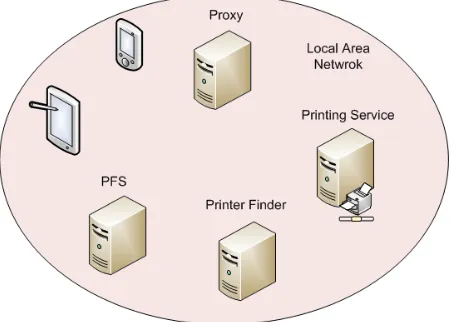
4.2 Experimental Setup for Proxy Discovery Experiments . . . 68
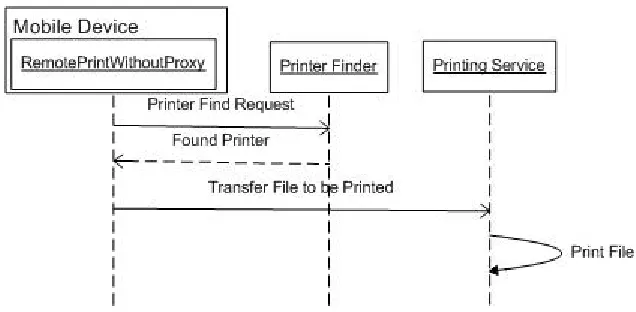
4.3 CallPrinter FinderandPrinting ServiceWithout Proxy . . . 70
5.1 HandoffOperation . . . 90
5.2 Experimental Setup for HandoffExperiments . . . 96
5.3 Linear Increase of RTT . . . 97
5.4 Spike Increase in RTT . . . 98
5.5 Linear increase of delay . . . 99
5.6 Spike increase of delay . . . 100
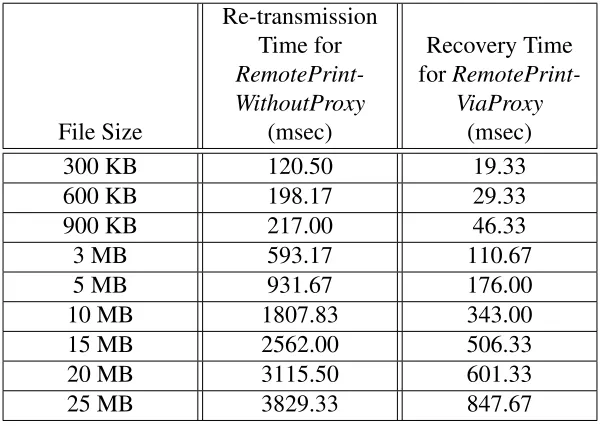
4.1 Retransmission (RemotePrintWithoutProxy) vs. Recovery
(RemotePrinteVi-aProxy) . . . 73
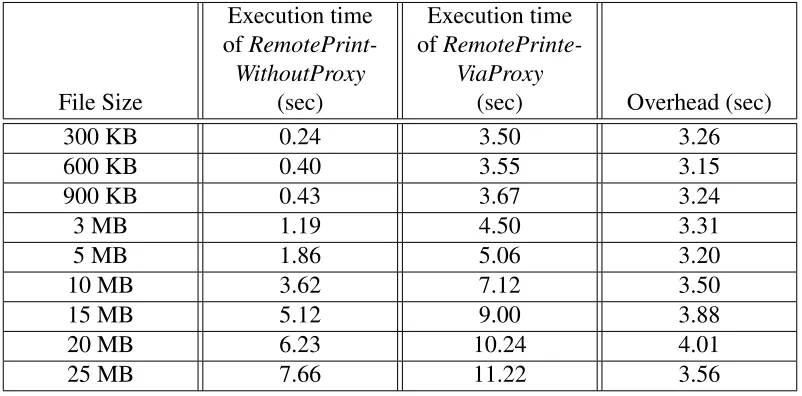
4.2 Execution Time with No Disconnection and the Overhead . . . 74
4.3 Execution Time of AdaptiveRemotePrint Application . . . 75
4.4 Time for Calling Printing Service with Various RTT values . . . 78
4.5 Time for Calling Matrix Multiplication Service - Proxy CPU Load is not a Proxy Discovery Factor . . . 80
4.6 Time for Calling Matrix Multiplication Service - Proxy CPU Load is a Proxy Discovery Factor . . . 80
6.1 BridgeAPI . . . 105
6.2 PFSAPI . . . 106
6.3 ProxyAPI . . . 107
6.4 RelayPSAPI . . . 108
6.5 DataTransferPSAPI . . . 109
6.6 CodeExecPSAPI . . . 109
6.7 FileStreamerPSAPI . . . 110
6.8 HandoffAPI . . . 111
A.1 Standard Deviations for table 4.1 . . . 126
A.2 Standard Deviations for table 4.2 . . . 127
A.3 Standard Deviations for table 4.3 . . . 127
A.4 Standard Deviations for table 4.5 . . . 127
A.5 Standard Deviations for figure 5.5 . . . 128
A.6 Standard Deviations for figure 5.6 . . . 128
Introduction
The use of mobile devices such as smart phones and tablets is ubiquitous. It is relatively easy
to install and run applications on these devices. Some applications are well-suited for mobile
devices e.g., Gmail, Google Maps, Yahoo stocks. Many of these applications communicate
with a remote software service hosted on a server that processes data and/or collects data. Typ-ically the data transferred between the mobile application and the remote service is relatively
small.
Mobile devices have the potential to be suitable for many applications including e-health
[24], e-learning [62], mobile TV [32], and augmented reality. These applications may be
interactive or require large amounts of data transfer. However, the limited computing and
storage resources on a mobile device limits the type of applications that can be executed on
a mobile device. In this chapter we discuss limitations of current approaches to dealing with
limited resources and provide a problem statement.
1.1
O
ffl
oading from Mobile Devices
One approach for enabling users of mobile devices to be able to use resource-intensive
appli-cations is to have part of the application run on remote servers, which may be part of a cloud
infrastructure. The application component that executes on the remote server typically has high
computational needs and/or requires access to data. These high computational needs are not easily available on the mobile device. The application component on the mobile device, which
we will refer to as themobile application, communicates with the application component on
the remote server, which we will refer to as remote service. Typically the mobile application
sends a request to the remote service and receives a result. The return of a result may be
im-mediate e.g., a real-time translator. If the request is to receive a notification when a specific
event occurs then the result, i.e. a notification, is returned when the event occurs e.g., an email
application that generates a notification when there is new email in the inbox.
Currently mobile applications represent a split of functionality that runs on the mobile
device and on a remote server. The split is determined during application development. There
are also methods that dynamically partition the applications. With dynamic partitioning, the
two partitions, on the mobile device and on the server, dynamically change during program
execution. The partitioning is done based on one or more factors. These factors include type of
connectivity (e.g., WiFi or cellular), communication link load, or the load on the mobile device
and the server. During the execution of the application some partitions might migrate from the
mobile device to the server, or vice versa.
There are several examples of dynamic partitioning in the literature e.g., [23, 29, 55].
How-ever, there is currently no example of employing dynamic partitioning for commercial
applica-tions. The reason for this is most likely due to the complicated methods used in the proposed
dynamic partitioning approaches that add unacceptable time and computational overhead.
Communication between mobile applications and remote services takes place over wireless
and wired links. Wireless links have lower bandwidth capacity than wired links. Furthermore,
wireless links are more error prone. This results in data loss and disconnections. Although
wired links are more reliable and have higher bandwidth capacity, the remote servers could
be anywhere on the wired network and thus there could be high latency incurred for data
transfers. The implication is that the model described earlier is effective when there is a small amount of data transferred between the mobile application and the remote service, and
real-time interaction is not needed. Applications that are delay sensitive or involve a large amount of
data to be transferred, such as applications involving video processing, are negatively impacted.
Corradi et al. [22] argue that services offered by public cloud providers, such as Amazon EC2 [1], Windows Azure [13], Google Compute Engine [4], are not suitable for applications on
mobile devices. The current model of partitioning an application between a mobile device and
a remote server is not sufficient.
1.2
Using Proxies
To address some of the described challenges, the use of a proxy has been proposed [16, 31, 51,
60]. All communication between the mobile application and remote service passes through the
proxy. In the literature, the proxy may range from a machine to a cluster. One proposed use
of a proxy is to provide a diversity of services for mobile applications. These services may be
used to ease the communication between the mobile application and the remote service. These
Proxies are also proposed to reduce the communication delay between the mobile application
and the remote service. Examples of systems employing proxies are presented in chapter 2.
The proxy concept is similar to other terms that have recently been introduced in the
liter-ature e.g., cloudlets [25, 60, 66], edge clouds [19, 39, 68].
1.3
Challenges in Using Proxies
Existing work shows that the use of proxies improves the quality of service provided for mobile
applications. However, there are several challenges that need to be addressed to be able to make
the use of proxies viable. In this section some of the challenges are presented and discussed.
1.3.1
Scalability of a Proxy-based System
In some of the work presented in the research literature, such as [21, 23, 44, 51, 60], there is
an assumption that only one proxy is responsible for servicing all clients and that the access
information of the proxy is known apriori by the mobile application. The use of a single proxy
is not scalable as the number of mobile applications increases. In addition, the use of a single
proxy introduces a single point of failure to the system. The presence of multiple proxies along
with a load balancing mechanism addresses the limitations of using a single proxy.
1.3.2
Proxy Discovery
Factors that could affect the selection of a proxy for a mobile application, include the close-ness of the proxy to the mobile device and to the remote service, the current proxy load, the
security preferences of the mobile application and the mobile device e.g., if the provider of
proxy is trusted or not. When multiple proxies are present, proxy selection will depend on the
importance of specific factors. The importance of specific factors will depend on the users.
Some of the existing work on proxies discuss mechanisms for making available the access
information of a proxy, or selecting a proxy from several available proxies. This includes the
work that emphasizes on lowering the latency by employing a nearby proxy e.g., [21, 60].
There is a body of work (e.g., [25, 30, 58, 59]) that assumes that the mobile device should
be connected directly to the local network the proxy machine is on. This means that if the
mobile application wants to use the service provided by the proxy, it should stay connected to
the same network until it no longer needs the proxy. To increase the flexibility with respect to
associating mobile devices with applications, it is not desirable to assume that the proxies and
TheCuckoosystem [40] assumes that theResource Managercomponent of the mobile
ap-plication has all the necessary information for all proxies. This does not scale if there is a large
number of proxies since the information could consume a considerable amount of memory.
The literature shows that various factors are used in selecting a proxy. For example,
avail-able resources of proxies [34, 56, 57, 64], the cost of user/the revenue of service provider [48, 64], and the condition of communication links [54, 56, 65].
The distance between the mobile device and the proxy, and sometimes the distance between
the proxy and the remote service, is an important factor when selecting a proxy for interactive
mobile applications or mobile applications that involve the transfer of large amounts of data
e.g. video to the proxy, or the remote service. Samimi et al. [58, 59] use the round trip time
(RTT), as a measure of distance between the mobile device, the proxy and the remote service
when selecting the proxy. The RTT is defined as “the length of time it takes for a signal to be
sent plus the length of time it takes for an acknowledgment of that signal to be received” [9].
In Rajachandrasekar et al. [56] server nodes are chosen based on the RTT to the proxy.
Proxy discovery mechanisms proposed for mobile computing environment need to be
scal-able and should not limit the mobility of the mobile devices. It is also important to consider
the condition of proxies e.g. current load on the proxy, the preferences of mobile application
e.g. the time limits, and the condition of the wireless network, especially the distance between
endpoints. None of the existing work considers a comprehensive view of proxy selection.
1.3.3
Static Association between Mobile Device and Proxy
A mobile device may move, the condition of wireless communications changes dynamically, or
the proxy load may increase. A proxy that is initially suitable for the current environment and
the requirements of the mobile application, might not be suitable after a period of time. As a
result, even if the mechanism of discovering the most suitable proxy for the mobile application
is defined in a system, it is crucial to monitor the conditions and change the associated proxy
of a mobile client when needed. There is a need to dynamically associate mobile devices and
proxies.
The mobility management approach presented by Bellavista et al. [17] defines the
mo-bility as movement of the mobile device between domains. This approach does not take into
consideration other factors such as changes in network or proxy conditions.
The mobility of the mobile device in Bellavista et al. [16] and Samimi et al. [59], which is
defined as the change of IP address and the result of the mobile device leaving a network and
joining another network, is supported by moving the proxy along with the mobile device to the
the communication latency and data traffic. Although, in general situations, the deployment of proxies in the local network of the mobile device might not be possible as the result of not
having administrative access to the network that the mobile device is connected to.
The work proposed by Liang et al. [48] involves task migration between proxies. When
migrating a task between hosts, there may be a need to transfer the state of the task as well.
The tasks used in this work are stateless and there is no discussion on transmission of state.
The work described above provide some support for adapting to changes in the
environ-ment. However, support is limited. Methods are needed that do not add limitations, while
providing adaptation mechanisms that respond to changes in the environment.
1.3.4
Specific-purpose Proxies
Most existing work assumes that the provider of the service is responsible for providing the
proxy hardware and its services. Typically the services are installed on the proxy apriori. The
implication is that the proxy is dedicated to a limited set of services that are pre-defined and
makes the proxy a specific-purpose utility.
A more general approach is to decouple the responsibility of providing and maintaining
the proxy system from the responsibility of providing services. Decoupling simplifies service
provisioning for mobile applications by proxy providers and also improves the utilization of
proxies, since a larger number of service providers will be able to exploit the resources available
on a proxy.
1.3.5
Summary of Limitations
We address the following issues related to the use of proxies.
Proxy Scalability: In the majority of the research literature, there is an assumption that only
one proxy is responsible for servicing all mobile applications and that the access information of
the proxy is known apriori by the mobile application. The use of a single proxy is not scalable
for a large number of mobile devices and the single proxy is a single point of failure. Multiple
proxies and the use of load balancing approaches addresses the limitations of using a single
proxy.
Proxy Discovery: The use of multiple proxies requires a mechanism for discovering and
selecting proxies. Selection criteria include the closeness of the proxy to the mobile device and
to the remote service, the current proxy load, security preferences of the mobile device e.g., if
Dynamic Association between Mobile Device and Proxy: The association between the
mobile device and a proxy should be dynamic. The mobile device may move, the state of
the wireless communications medium may change or the proxy load changes. These changes
could imply that another proxy should be used.
Static Proxy Services: In much of the related work, the proxy is designed and implemented
to provide specific services. Typically a service is installed on the proxy apriori. The
implica-tion is that the proxy is dedicated to a limited set of services that are pre-defined.
Multipurpose Proxy: Most existing work assumes that the provider of the remote service
used by a mobile application is responsible for providing the proxy hardware and software.
This approach makes the proxy a specific purpose utility, and other services are not able to
benefit from the resources made available by the proxy. A more general approach is to decouple
the responsibility of providing and maintaining the proxy system from the responsibility of
providing services. A proxy can provide generic services that are commonly needed by various
remote services, such as disconnection handling or reducing latency. Subsequently, service
providers can use services available on the proxies to service their mobile applications. The
task of decoupling services from the proxy functionality, simplifies service provisioning for
mobile applications by service providers and also improves the utilization of proxies since a
larger number of mobile applications will be able to use the resources available on the proxy.
1.4
Contributions
This work addresses the limitations discussed earlier. We propose a proxy-based mobile
com-puting infrastructure that tries to handle all of these requirements.
• The system includes multiple proxies, geographically distributed to enable the load
dis-tribution and also provide lower latency in the communication. The description of the
proposed mobile computing system is presented in chapter 3.
• The use of multiple proxies requires a proxy discovery mechanism that finds the most
appropriate proxy for a mobile application. The proxy discovery mechanism introduced
for the proposed infrastructure is described is chapter 4.
• As described earlier there is a need to be able to change the proxy associated with a
of the associated proxy of a mobile application. The handoffmechanism designed for the system is introduced in chapter 5.
• The programming model introduced for the system simplifies the creation of mobile
applications that use proxy services. The functionality of a proxy is modularized as
independent services that can be installed/un-installed based on the requirements of the mobile application and the remote service. These independent services can be used by
various services and mobile applications. The proposed programming model is presented
in chapter 6.
• A prototype of the proposed infrastructure is implemented along with some example
Literature Review
Several approaches and frameworks are proposed for mobile computing that employ a
re-sourceful wired machine to empower mobile applications. In some application this machine
is called theproxy, while in more recent work it is called thecloudlet. In fact both terms, i.e.
proxyandcloudlet, in the mobile computing literature are used to name the same entity. In this
work we use theproxyterm, except for referring to, or describing the work that employed the
cloudletterm. In this section we present some of more notable work in this area. The work is
categorized into several categories based on the functionality of the proxy and services that a
proxy provides in the proposed frameworks. We categorize the mobile computing frameworks
into the following categories:
• Offloading computation from mobile device – Offload general computing tasks – Offload service specific task
• Reducing latency
This chapter presents representative work in each of the categories.
2.1
O
ffl
oading Computation
Executing compute-intensive tasks on behalf of mobile devices is the most common task of
proxies in mobile computing frameworks. By offloading the compute-intensive tasks to a pow-erful proxy, the resources of the mobile device, including the battery power, memory and CPU
cycles are saved, and also the capabilities of proxy is exploited by the mobile application. We
that proposes to offload the computation from mobile device, regardless of the functionality of the offloaded task. The work in the second category use proxies to provide a specific-purpose service for the mobile applications.
2.1.1
O
ffl
oad General Computing Tasks
The work presented in this section usually involves code migration from the mobile device to
the proxy.
2.1.1.1 MAUI
The MAUI system, presented by Cuervo et al. [23], involves a fine-grained offloading mech-anism to the remote server. The system is designed with the goal of maximising the energy
savings on the mobile device when running applications. It can be used for applications made
to run on the Microsoft .NET Common Language Runtime.
The developer annotates the migratable methods. The MAUI solver component
periodi-cally is executed to find the best partitioning of the application between the mobile device and
the remote server that minimizes the energy consumption on the mobile device. The
charac-teristics of the device, methods of the application, and the network are measured by the MAUI
profiler component. The input to the solver is provided by the profiler. The profiling of the
device is done off-line, at the initialization phase and special hardware, not available on the mobile devices, is needed. The profiling of methods and the network is performed periodically
during the program execution to find the up-to-date network shipping cost of methods to the
remote server.
Two versions for migratable methods should be provided: one for local execution on the
phone and the other for the remote execution. The latter version could be saved on a cloud
storage and downloaded to the proxy whenever needed.
The MAUI framework provides a failure tolerance method. If a timeout occurs during the
execution of a method on the remote server, the control returns to the mobile device. This could
either invoke the method on the mobile device or find another MAUI server.
The methods can migrate from the device to the remote server during the runtime. As a
result, it is necessary to find the state of the application and transfer the state between
mo-bile device and remote server. A wrapper method is defined for each remote method that has
one extra input parameter and one extra return value. The extra input parameter is used for
transferring the application state to the proxy when offloading the method and transferring the new application state to the mobile device after finishing the method execution. In the MAUI
including simple types and nested complex types. The state of all static classes of the
applica-tion, along with the state of the public static member variables are included in the transferred
state. The state is transferred using XML-based serialization.
The results of experiments that include the execution of four different applications shows that MAUI is able to save on energy consumption and improve the performance of applications
by offloading partitions of application to the remote server.
Giurgiu et al. [29] proposed a system similar to MAUI for offloading partitions of applica-tions from mobile devices to cloud resources. In their system the offloading unit is a module, unlike MAUI where the offloading is at the level of a method. In addition, in this work, the application initially is located only on the cloud and during the execution, some partitions of
the application might be migrated to the mobile device to increase the application response
time.
The Odessa framework [55] is another example of dynamic partial offloading from mobile device. Odessa combines partial offload with parallelism for interactive perception applica-tions. Examples of interactive perception applications are face recognition, object and pose
recognition and gesture recognition. The functionality of these application can be implemented
as stages. The Odessa framework continuously decides which stages should be offloaded to the cloud to reduce the response time and increase the accuracy of application.
2.1.1.2 SuMMIT
The SuMMIT (Submission, Monitoring and Management of Interaction of Tasks), presented
by Rosseto et al. [57] is a framework, which controls the execution of applications that are
composed of multiple tasks and submitted from mobile devices to the available servers. A
GUI component is installed on the mobile device that allows the user to submit requests to the
framework and check the status of execution of tasks included in the submitted application.
The other parts of the framework reside on a machine on the wired network which plays the
role of a proxy.
A component named theResource Selectoruses an ontology-based approach for describing
resources, policies, and requests to perform matchmaking for received requests. The authors
claimed that their approach is flexible for adding more characteristics for resources, however in
the provided use case, the characteristics used to describe the resources are available memory,
processor capacity, installed software, and available databases. The request coming from
mo-bile application should specify the number of servers that are needed, along with the required
values for the above characteristics.
of tasks submitted by the mobile device, and dispatching tasks to servers. The proxy is also
responsible for collecting results from the servers, which execute dispatched tasks, and send the
results to the mobile device. TheAgentcomponent on the proxy is responsible for monitoring
the connection to the mobile device. If theAgentfinds that the connection to a mobile device
is broken, it decides whether the submitted tasks, belonging to the disconnected mobile device,
should be continued, stopped, or aborted, based on the options set by the user of the mobile
device. Options are declared in a file submitted to the framework on the proxy, as part of the
user’s request.
If the user’s option is to continue the execution of the application in the case of a
discon-nection, the results obtained after the completion of the application will be saved on the proxy
to be delivered to the mobile device after the reconnection. If the user’s option is to stop the
execution of the application after discovering a disconnection, the application execution will be
stopped and the state of the application will be saved in a checkpoint file on the proxy. When
the mobile device connects again to the proxy, the proxy will notify the mobile device about
an uncompleted application. If the user of the mobile device decides to continue the
execu-tion of the applicaexecu-tion in case of the disconnecexecu-tion, the state of applicaexecu-tion is loaded from the
checkpoint file and the execution of the application will be continued.
2.1.1.3 Economic Mobile Cloud Computing
An economic mobile cloud computing model is presented by Liang et al. [48]. The system is
composed of multiple clouds with different providers. The goal of a cloud service provider is to maximize its resource utilization and also its revenue. The model takes into consideration the
cloud computing capacity, the overall cloud system gain, and expenses of mobile users using
cloud services. The cost of a mobile device is defined in terms of battery consumption and
the cost of using cloud services. It is assumed that several cloud providers exist in the form of
different cloud service provider domains.
Mobile applications are implemented as weblets. Weblets can be executed on the mobile
device or can be migrated to the cloud and executed on the cloud. On a cloud, the service nodes
(SNs) are responsible for managing the loading or unloading ofweblets. Each SN handles only
one weblet. A mobile device can migrate itsweblets to a cloud by contacting an SN on the
cloud. The SN decides to accept the migration request, or transfer it to another domain. On the
cloud,webletscan be executed on one or more virtual nodes in the domain of a cloud provider.
An SN accepts three types of requests: i) new - a new weblet migration request from a
mobile device, or transferred from another cloud provider domain, ii) intra-domain - an existing
transferred from an SN on another domain.
The transfer ofwebletsto another domain means a loss of revenue for a domain. As a result,
a domain tries to maximize its resource utilization and accept more migration requests from
mobile devices. The authors presented a Semi-Markov Decision Process (SMDP) economic
model to find the optimal resource allocation, and maximize the gain of cloud providers and
reduce the expense of mobile user. The most revenue is obtained from the intra-domain transfer
ofweblets, rather then from accepting newweblets. Inter-domain transfer means revenue loss
and a cloud provider tries to avoid it.
2.1.1.4 Cuckoo
The Cuckoo framework, introduced by Kemp et al. [40], is targeted at the Android platform.
When developing Android applications, it is possible to separate the UI activities from
com-putational activities. The Cuckoo framework provides a programming model that allows the
computational part of an Android application be offloaded to a remote resource. The remote resource that runs the offloaded task can be on a commercial cloud or a private computer. The remote resource should have the JVM available, as well as a Java application called theserver
which is used to run tasks offloaded from the phone.
The Cuckoo framework is integrated with Eclipse and parts of the application development
are automated. The Cuckoo framework helps the developer to develop the local and remote
implementation of the application and bundles them in one package. Eclipse builders provided
by the Cuckoo framework are used for this purpose. The local implementation of an application
should be created by the developer. The Cuckoo framework uses the local implementation to
create the template for the remote implementation. It is the responsibility of the developer
to implement the methods of the remote implementation. The local implementation can be
different from the remote one to allow the application to use resources available at the resource-rich cloud, such as multiprocessor capability.
A component, named the Resource Manager, on the mobile device, maintains the
infor-mation about registered remote resources. Before running the compute-intensive activity, the
Cuckoo framework decides whether to offload the services or not. The Cuckoo framework contacts theResource Managerto see if any registered remote resource is accessible. If there
is a remote resource available, the application is offloaded to it. The jar file of the application is sent to the remote resource and the remote resource installs the application. After the
instal-lation, the client on the phone can call offloaded methods of the application. The methods that interact with sensors of the phone, such as camera, should be marked by the developer to never
The Cuckoo framework only supports the offloading of stateless tasks and no state transfer is done. If after offloading a task to the remote resource a timeout occurs and no response is received from the remote server, the Cuckoo framework assumes that the remote server is not
accessible anymore and tries to find another remote resource and offload the task to it. If there is no available remote resource, the service is executed locally on the phone.
An object recognition application and a face detection application are used to evaluate the
performance of the Cuckoo framework.
2.1.1.5 Interdroid
Interdroid, a framework for integrating mobile application with the cloud, introduced by Kemp
et al. [41], is created based on the Cuckoo framework (section 2.1.1.4). Authors have shown the
challenges in mobile-cloud integration using a scenario and have realized several integration
problems.
Employing the proposed approaches for offloading the computation from mobile device to the cloud, results in the situation that the mobile device users are dependent on the cloud
providers. As a result, when there is no access to the part of the application running on the
cloud, the application turns out to be unusable.
The first problem is that applications of mobile-cloud environments are designed to have
some components running on the mobile device and some components on the cloud. The
communication between components on the mobile device and cloud has cost and sometimes
there is no connectivity available. The authors believe that all components should be available
as well on the mobile device, and the application should be configurable so that the user has
the ability to decide which components run on the mobile device or on the cloud.
The second problem is that if the application is divided into two parts, i.e. the client and
the service, while the client runs on the mobile device and the service runs on the cloud, the
mobile device user has no control of the service component. If the cloud owner turns out to be
untrustworthy e.g., degrades the service quality or increase the price, the mobile device user
can not do anything. The authors propose to have both client and service components of the
application bundled on the mobile device. Thus the user always has the ability to install the
service part on another cloud and use it.
The third problem is related to accessing data. The authors believe that the user should be
able to get data on and offthe cloud. This means that the user will be able to move to another cloud without being locked into a contract with a cloud. In addition, the local replication of
data should be available whenever no connection is available to the cloud.
Cuckoo is about bundling the client and service in one package that the user owns. In addition,
the decision is made at runtime to run the service part locally, or on the cloud.
There is a class of mobile applications that need to periodically poll software services for
getting up-to-date information e.g., weather, traffic, stock market information. This polling consumes large amounts of battery power on the mobile device. The authors proposed to
provide cloud services that can be used for polling the required services and if there is a change
in the information, the service pushes a notification to the mobile application on the mobile
device. These services are also bundled with the client part of the application and the user has
the ability to install the service on any cloud.
The authors introduced a project named Raven that is a framework for synchronizing and
replicating data between mobile device and the cloud. This framework is designed to give the
control over data to the user of the mobile device. While the data is kept on the cloud, the
mobile device can replicate part of data locally when is online and keep data to use even when
the devices goes offline. 2.1.1.6 Offload to a Cluster
The work described by Rajachandrasekar et al. [56] allows a smartphone to ask for the
exe-cution of a compute-extensive applications on remote computing resources. The remote
com-puting resource is a cluster of machines based on the Alchemi framework, which is a .NET
Grid computing framework. The application used to evaluate the proposed system calculates
the first n digits of the number Pi.
A PC is used as a proxy. The PC listens for requests coming from the mobile device
con-taining the parameters needed for running the task. Based on the input parameters, the proxy
divides the task into threads. The PC proxy then finds the most suitable of available resources
on the cluster and distributes threads among them. The proxy waits for the completion of all
threads, collects and combines the results returned from the cluster nodes and sends the final
results to the mobile application.
It is assumed that the task is located on the proxy and the mobile application on the mobile
device is only responsible for providing the input parameters. The functionality of dividing
the task into threads, finding the best resources and submitting the threads to the cluster node
should be available on the proxy.
2.1.1.7 Energy Saving: Local Processing vs. Offloading
bandwidth, the amount of transferred data, and the processing power of the remote server
impacts the energy consumption when the computation is offloaded from the mobile device to the cloud.
The paper shows that if the amount of transferred data is small and the wireless bandwidth
is large enough, it is beneficial to offload computation from the mobile device. The result is based on the assumption that there is always a high processing capacity available on the cloud.
The cloud can also be used as a storage to save the user data and, as a result, the amount of
data transferred between the mobile device and the cloud can be reduced.
For applications that need to have access to real-time data, such as image retrieval based
on the newly captured images, the paper proposes pre-processing on the real-time data on the
mobile device. The results of pre-processing are then transferred to the cloud to reduce the size
of transferred data.
2.1.1.8 A Proxy on the Local Network
The work proposed by Guan et al. [30, 31] uses a proxy to offload compute-intensive tasks from resource constrained mobile devices to more powerful resources. A module on the mobile
device, named theDevice Proxy Module, which works based on the Universal Plug and Play
(UPnP) protocol, is responsible to discover nearby proxies upon entering a local network.
After finding a proxy, the mobile device can send a request to run an application to the
proxy. If the proxy has enough resources, it downloads application code from an online
repos-itory, installs and runs it. Otherwise, the proxy invokes the related service on the remote server
hosting the requested service. After completion of the application, the proxy sends the result
to the mobile device.
To keep requests of different mobile devices independent from each other and also to make the management of requests easier, the virtual machine technology is used on proxies.
Guan et al. [31] argued that context-awareness is an important factor in pervasive
applica-tions which is one of the applicaapplica-tions that needs the infrastructure of the mobile computing.
An ontology-based model is proposed in Guan et al. [31] to describe the context.
2.1.1.9 Chroma
The Chroma system proposed by Balan et al. [15] splits applications between the mobile
phone and a remote server. The system is designed to enable the developer to modify existing
applications for being partitioned. The Chroma takes into consideration the preference of the
For each application several tactics are recognized. Each tactic shows a way of splitting
the application between the mobile phone and the remote server. Tactics are added manually
to the application by the developer. At runtime, Chroma chooses the best tactic based on the
availability of resources and the resource usage. There is a need to find the resource usage of
each tactic to choose the best tactic. The resource usage patterns of tactics are calculated by
recording the resource usage of each tactic during the execution of the application.
The resource availability on the mobile phone is measured by the Chroma system. The
resources measured include memory and CPU usage, available bandwidth, network latency
and battery power level. The system uses a utility function to choose the best tactic. The utility
function is defined as the ratio of accuracy/latency and the goal is to maximize the utility function.
The authors proposed to use over-provisioning to improve the performance of system. The
over-provisioning is provided by replicating the same task on several remote servers and using
the result from the fastest remote server. The other way of over-provisioning is to partition the
input data between multiple remote server and integrating the results received from all servers.
The example applications used for evaluating the Chroma system are a translator, a speech
to text and a face recognition applications. The results show that the Chroma sometimes has
not chosen the best tactic because of the inaccurate initial values for the the resource usage
of tactics. In addition, the time needed for choosing an appropriate tactic increases drastically
when the number of tactics increases.
2.1.1.10 Improving the Reliability Using Replication
To provide higher reliability in mobile computing Trung et al. [64] proposed to offload a task to multiple proxies. Delegating a job from a wireless device to a proxy could fail for
several reasons, such as overloading of the proxy, a failure in the proxy hardware/software or disconnections in the wireless link.
To increase the reliability, this work proposes to replicate a submitted task and send it to
several proxies which are called Replication Gateways (RGs). A primary RG is responsible
for accepting requests. This responsibility includes collecting information about the requested
service from the mobile device, choosing RGs, and submitting tasks to chosen RGs. The RGs
try to discover the requested service and send the request along with the input data, received
from the mobile device, to the service. Upon completion of the request and having the result,
RGs send the result back to the mobile device. If one of the gateways fails, the mobile device
can still receive the result from other gateways.
authors provided an algorithm which is used to calculate the number of RGs based on the user’s
budget and the cost. The cost is calculated based on the cost of creating a new replica.
2.1.1.11 Energy-aware Broker
An energy-aware scheduler for the mobile computing is proposed in Park et al. [54]. A
cen-tralized scheduler, residing on a machine called the Broker, decides whether a mobile device
has enough battery power to execute a task or not. If not, the scheduler decides to which server
node the task can be migrated and executed on. The scheduler is aware of the cost of the
exe-cution of a task on the mobile device and on all server nodes, in addition to the migration cost
of the task from mobile device to the server nodes. The information about the the hardware
characteristics of the mobile device and the residual energy at the mobile device should be
known by the scheduler.
2.1.2
O
ffl
oad Specific Services
The work presented in this section introduces the use of proxies that provide services for
spe-cific tasks, such as multimedia streaming. In this work, it is commonly assumed that services
are installed beforehand on the proxies and mobile applications on the mobile devices use those
services for accessing to specific remote resources.
2.1.2.1 Elastic HTML5
The work presented in Zhang et al. [67] proposes to distribute the execution of web browsers,
using HTML5 API, between the mobile device and cloud. The work uses the web worker
component introduced in HTML5. Aweb workeris a script that runs in the background within
the browser. It can communicate with the HTML page. Everyweb workerhas its own database
to save the web page related information. In Elastic HTML5 web workers are enabled to be
executed on the mobile device or on the cloud. The database of a web worker can reside on
the mobile device or on the cloud as well.Web workersshould be able to migrate transparently
between mobile device and the cloud.
A pair of specifically designed web workers, as proxies, are used for the communication
between components of web application on the mobile device and the cloud. The proxyweb
workeron the mobile device is called the Elastic Web Worker Manager (EWWM). The proxy
web worker on the cloud is called the Cloud Web Worker Service (CWWS). Whenever an
HTML5 application invokes aweb worker, the EWWM decides on whether to launch it on the
CWWS by transferring the code of theweb workerand the parameters. The CWWS launches
the transferredweb workerand returns the end-point address of theweb workerin the form of
a URL to the EWWM. When theweb workerwants to create its database for the first time, the
database is created locally, regarding the location of theweb worker.
To enable the operation of the web application during offline periods, a device-side database that is kept synchronized with the cloud-side database can be used.
In this work it is assumed that the cloud can be either a home/enterprise cloud or a public cloud.
2.1.2.2 Self-Adaptive Data Link Layer HandoffManager
The work described by Bellavista et al. [16] introduces an application layer infrastructure for
self-adaptive handoff management in the data link layer of the OSI model [8]. The authors proposed a proxy service for mobile devices that is specifically made to manage the data link
layer handoff at the application layer. The data link layer handoff happens between access points of the mobile device to the wired network. The proposed infrastructure can be used for
horizontal handoff, when two access points work based on the same radio technology, as well as the vertical handoff, when handoffhappens between two different radio technologies e.g., WiFi and Bluetooth.
The interruption as the result of the handoff has a negative impact on the quality of the multimedia content streamed from a server to the mobile device. One way to eliminate the
delay added by the handoff is by having a larger buffer at the mobile device. However, the mobile devices often do not have enough memory for a large buffer. Also, this method does not work for live multimedia streams. To solve this problem, using an additional buffering proxy between the streaming server and the mobile device is proposed. Large buffers can be kept at this proxy. The proxy is usually installed close to the mobile device.
Another way to mitigate the negative impact of the handoff, is to employ soft handoff. During a soft handoff, the mobile device continues to be connected to the original access point until the connection to the target access point is ready. At that time, the mobile device starts
to use the connection to the target access point and releases the connection to the original
access point. It is unlike the hard handoff that as soon as the handoff starts, the connection to the original access point is released and the mobile device waits for the completion of the
connection to the target access point. The soft handoff is faster than the hard handoff, but it consumes more battery power.
specifi-cation of the multimedia service, decides if a hard handoff is sufficient or a soft handoff is needed. The paper allows multimedia service providers to specify the requirements of their
service. This service specification is used during the handoffmanagement process. The spec-ification of multimedia service is expressed as the expected quality, using the Video Quality
Metric (VQM) standard and the expected delay. The value of metrics along with values taken
from the mobile device about the condition of network connectivity are used to calculate the
size of buffer at the proxy. If the server proxy decides to do a hard handoff, the system decides on the size of the buffer at the proxy server. By increasing the size of buffer, the system tries to mitigate the impact of the delay because of the handoff.
2.1.2.3 i5 Multimedia Cloud Architecture
Kovachev et al. [44] argue that mobile devices generate lots of multimedia content. Mobile
applications for processing multimedia content are highly specialized and expensive. It is
not easy for amateur users to use those applications. On the other hand, cloud computing
technology focuses on scalability of businesses and not on users. As a result, the facilities
provided in the cloud computing are not suited for requirements of users of mobile devices.
The paper provides a framework for developing multimedia applications for mobile devices
combined with cloud computing. The authors proposed three perspectives that a mobile
mul-timedia platform should consider: technology, mobile mulmul-timedia, and user and community.
Based on the requirements that arise from these perspectives an architecture is designed for
mobile multimedia.
The platform, named i5 Multimedia Cloud Architecture, consists of four layers:
infrastruc-ture layer, platform layer, multimedia services layer, and application layer. The infrastrucinfrastruc-ture
layer is provided by a private cloud. The virtual machine technology is used in this layer to
separate the hardware from software. The platform layer consists of engines that are used by
the services in the upper layer, multimedia services layer, as well as Deltacloud API [2]. The
Datacloud enables the system to provide access to public cloud facilities along with the access
to the private cloud.
The paper used the cloudlet concept, introduced by Satyanarayanan et al. [60], to decrease
the latency by hosting some services on a nearby private cloud. The multimedia services layer
includes services that are commonly used by various multimedia applications, such as
Seman-tic Metadata services, Collaborative Multimedia services, Transcoding, Bitrate Adjustment,
etc. Finally the last layer, Application layer consists of applications that are made by users,
exploiting the services in the lower layer.
Applications are used for sharing multimedia content and metadata. A user can record video,
annotate it and send it to services provided by the platform. The video is transcoded and other
video processing, such as object detection, is done by multimedia services available on the
platform. The video can then be streamed to other users that can modify or add new annotation
to the video online.
2.1.2.4 DYNAMO
Mohapatra et al. [51] propose a proxy-based real-time transcoding of multimedia data that
is streamed from a multimedia server to mobile devices. The system tries to find a trade-off between power consumption and the quality of the video played on the mobile device. The
proxy is located close to the mobile device and is responsible for buffering and transcoding. All communication between mobile device and media server passes through the proxy server.
The system is made of a middleware layer, distributed on the mobile device and the proxy
server. The middleware part on the proxy uses end-to-end system state e.g., network noise,
mobility, and proxy server load, along with the feedback received from the mobile device, to
decide about video transcoding and the network traffic shaping. Admission control is done on the proxy. Based on the feedback from the mobile device, the proxy decides if a request for a
multimedia streaming service can be scheduled or not. The proxy performs the admission
con-trol based on the request of the mobile device, including the minimum video quality accepted
by the user, the residual battery power, and the length of the video. The proxy is also able to
buffer data and regulate the data transmission to the mobile device with the purpose of reducing power consumption on the mobile device. When the proxy adapts the video transcoding, the
middleware on the mobile device might adapt some settings on the mobile device, such as the
backlight, the CPU and network adapter sleep time.
The system has the “local state awareness” as well as the “global state awareness”. The
“local state” is the condition on the mobile device, i.e. residual power, backlight setting, CPU
and memory information. The “global state” is the information not available in the mobile
device, i.e. bandwidth availability, network condition and the mobility information. The mobile
device is responsible for monitoring the “local state” and reporting it to the proxy. The proxy
is responsible for determining the “global state”.
A system utility function is defined based on the energy consumption on the mobile device
and the quality of the video played on the mobile device. The goal is to maximize the quality
of video by choosing the appropriate transcoding while taking into consideration the residual
2.1.2.5 MAPGrid
Huang et al. [34, 35] propose to use the idle resources available in the system, to stream
multimedia content from repositories to mobile devices. The introduced middleware has three
components: the mobile device, the Broker, and the Volunteer Server (VS). VSs volunteer to
dedicate their idle resources, i.e. storage and communication resources, to this multimedia
streaming system. VSsdownload segments of the requested multimedia file from repositories
and after transcoding the multimedia content to suit the capabilities of the requesting mobile
device, transmit it to the requesting mobile device. The set ofVSs to fulfill the request of a
mobile device is chosen by theBrokerwhich maintains information about availableVSs. Upon
receiving a request from a mobile device, the Broker tries to create a schedule to stream the
requested multimedia content to the requesting mobile device, based on the availability ofVSs.
If the Broker cannot create a schedule, it rejects the request. Otherwise, theBroker informs
VSs about the schedule and the segments that the VSs are responsible for downloading and
transcoding.
This middleware is power-aware and takes the device specification into consideration. The
mobile device should announce the level of its residual battery power, along with its request to
theBroker. TheBrokeruses this information to decide if the mobile device is able to receive the
requested service or not. If yes, theBroker decides the level of the quality of the transmitted
multimedia based on the residual battery power and capabilities of the mobile device. This
means that if the mobile device has more capable equipment or has a higher level of energy
available, it will receive a better quality content. The Brokerand VSsmonitor the conditions
and dynamically change the schedule. If aVSnotices that the load of tasks on the host machine
has increased and the host machine is not able to serve some of the requests, it can notify the
Broker and request the migration of some tasks to anotherVS. TheBroker also monitors the
activities ofVSsand in the case of a failure in aVS, it arranges a new schedule to complete the
processing of the request of mobile device. If theBroker cannot find a new schedule, rejects
the request.
The MAPGrid introduced by Huang et al.[36, 38] is an architecture based on [34] and [35].
It uses techniques that take into consideration the intermittent availability of resources atVSs
that are called proxies. A two-tier design is proposed. One tier is responsible for determining
the availability and capacity of proxies, and the other tier is responsible for determining the
pattern of data requests sent by mobile clients. By having this information, an optimal mapping
between proxies and segments of the requested multimedia file can be calculated. This mapping
changes dynamically with changes in the availability of proxies. To evaluate the performance
client to proxies in terms of network hops during a service period. The second metric is the
data replication cost which is done to download segments of multimedia file from a repository
server to the proxies selected by the theBrokerto accomplish a service. The last metric is the
percentage of load saved on repository server in comparison to the situation where there is no
Brokerand no proxies.
2.2
Reducing Latency
Access to services provided by the proxy adds network latency to the interaction between
the mobile application and the service which is not acceptable especially for delay sensitive
applications. This section describes some of the work that focuses on mitigating the negative
impact of network latency.
2.2.1
CloneCloud
The overall description of the CloneCloud framework is presented by Chun et al. [20]. The
CloneCloud is designed for the mobile phone applications that runs on a VM, such as Android
applications that run on the Dalvik VM. In this system the entire smartphone image is cloned
on a proxy that can be a nearby desktop or laptop computer. The application is automatically
partitioned and the computational intensive part of application is offloaded to the proxy, along with its state. Upon the completion of the offloaded task, the state of the offloaded task is sent to the primary application on the phone and is merged with the state of the primary application.
The detailed description of the system, including finding the migration points in the
appli-cation, building the cost model, collecting the state, and performing the migration is presented
by Chun et al. [21]. The granularity of migration in the CloneCloud is at the thread level. A
computationally heavy thread can be offloaded to the clone on the cloud, while other threads of an application continue to run concurrently on the phone. If a thread running on the phone
needs to access the state of an offloaded thread, the thread on the phone will be blocked until the offloaded thread finishes and returns the new state to the phone.
Native system operation can be used both on the phone and on the clone running on the
cloud, provided that the underlying OS on the cloud permits. This characteristic of CloneCloud
allows the phone application to exploit the capabilities of the cloud resources that do not exist
on the phone, such as high-bandwidth network and powerful API’s available on the cloud.
The task migration in the CloneCloud is done using application level VM migration. The
migration of a thread in the application level includes transferring the instruction set of the
includes virtual stack, virtual registers, and the native stack of the thread. To find the possible
migration points, an offline partitioning process is done. In the offline phase, thestatic analyzer
finds the legal migration points. Thedynamic profilerthen profiles the application to find cost
models for both running the application on the phone and on the cloud. The profiler is executed
several times for different input values and different conditions to generate a database of various partitionings and their cost models for different conditions. At runtime, the condition of the system, including the availability of cloud resources and the network bandwidth, is looked up
in the database of partitionings and an appropriate partitioning is chosen.
To evaluate the CloneCloud, authors modified the Dalvik VM to enable it for partitioning
and migration of Android applications. Three applications are used for the evaluation: a virus
scanner, an image search, and a privacy-preserving targeted advertising. The static analyzer
is run on a desktop computer and takes on average 20 seconds which is fairly long. However,
this static analysis is done once for each application. The experiments are designed for running
applications on the phone and on the cloud. To offload to the cloud, both WiFi and 3G network connectivity are used. Three different sizes of input data are tested for all applications. Ex-perimental results shows that the partitioner decided to offload the computational heavy thread of all applications when the size of input is larger, but it decides to run the entire application
locally on the phone for small input sizes. The speedup and energy consumption for all offl oad-ing cases is improved over local execution except for one case that offloading happens over the 3G network. The results achieved from runs on the WiFi network surpass all results taken on
the 3G network.
2.2.2
Transient Customization of Cloudlets
The use of cloudlet is proposed by Satyanarayanan et al. [60]. The proposed approach employs
local clouds, named cloudlets, to decrease the communication latency when processing is
of-floaded from mobile device to the cloud. The cloudlet is hosted on the LAN that the mobile
device is connected to. The VM technology is used to offload computation to the cloudlet. The authors claim that mobile devices will remain resource poor since the producers
typ-ically work on improving the size, weight and battery power. On the other hand, the obstacle
for using cloud in mobile computing is latency. The delay in communication over WANs
hurts the usability of applications. Interactive applications are suffering even with moderate RTT of 100 ms. The authors claim that the latency of WANs will not improve in future since
network providers focus on other targets, i.e. security, bandwidth, energy consumption, etc.,
while achieving improvements for these targets will increase the latency. The bandwidth is