Volume 2010, Article ID 215352,9pages doi:10.1155/2010/215352
Research Article
Implementation and Validation of a New Combined Model for
Outdoor to Indoor Radio Coverage Predictions
Guillaume de la Roche,
1Paul Flipo,
2Zhihua Lai,
3Guillaume Villemaud,
2Jie Zhang,
1and Jean-Marie Gorce
21CWiND, University of Bedfordshire, Park Square Campus, Luton LU1 3JU, UK 2CITI Laboratory/INSA, University of Lyon, 69621 Villeurbanne, France 3Ranplan Wireless Network Design Ltd, 1 Kensworth Gate, Luton LU6 3HS, UK
Correspondence should be addressed to Guillaume de la Roche,[email protected]
Received 2 July 2010; Accepted 13 August 2010 Academic Editor: Nicolai Czink
Copyright © 2010 Guillaume de la Roche et al. This is an open access article distributed under the Creative Commons Attribution License, which permits unrestricted use, distribution, and reproduction in any medium, provided the original work is properly cited.
A new model used to compute the outdoor to indoor signal strength emitted from an outdoor base station is presented. This model is based on the combination of 2 existing models:IRLA(Intelligent Ray Launching), a 3D Ray Optical model especially optimized for outdoor predictions, andMR-FDPF(Multiresolution Frequency Domain ParFlow), a 2D Finite Difference model initially implemented for indoor propagation. The combination of these models implies the conversion of the ray launching paths on the border of the buildings, into virtual source flows that will be used as input for the indoor model. The performance of the new combined model is evaluated via measurements at 2 frequencies (WiMAX and WiFi). This solution appears to be efficient for radio network planning, in term of both accuracy and computational cost.
1. Introduction
Indoor networks planning is increasingly important; that is why tools have been developed to help operators to optimize their networks. For example, such tools are necessary to find the best parameters like the positions of the emitters, the optimal radiated power, and the best channels. Moreover, the quality of such tools relies for an important part on the quality of the propagation model.
1.1. Context. Recently, attention has been given to
optimiz-ing the indoor radio coverage by usoptimiz-ing specific indoor solu-tions such as Femtocells [1]. Such femtocells are deployed directly inside buildings, thus efficiently enhancing both the indoor radio capacity and coverage. However it is also important to notice that femtocell users, since the femtocells share the same spectrum than the other outdoor cells, can be highly interfered by the outdoor cells [2]. Hence accurate outdoor to indoor propagation tools, that are able to compute the in-building signal due to outdoor cells, are currently highly demanded by mobile operators. The aim of
this paper is to propose a new combined propagation model, which could be a good approah for this purpose.
1.2. Related Work. Some works related to outdoor to indoor
1.3. Contribution. In [8], we recently proposed a combi-nation of two propagation models for outdoor to indoor radio propagation predictions, as well as an initial evaluation giving promising results. This paper, in addition to the preliminary results presented in [8], has two major contri-butions:
(i) the details about the implementation of the com-bined model are given;
(ii) the validation of the model with two measurement campaigns is presented.
The paper will be organized as follows: inSection 2an overview of the main approaches for deterministic radio propagation will be presented, then inSection 3the combi-nation of two carefully chosen models will be proposed. In Section 4, the 2 measurement campaigns will be described, followed by an evaluation of the performance of the model in Section 5. Finally, perspectives and conclusions will be developed inSection 6.
2. Approaches for Deterministic
Radio Propagation
As explained in the introduction, the context of the present work is to compute environment-specific radio coverage maps that take as accurately as possible into account the geometries of the environment. Approaches for deterministic simulation of radio waves can be divided into two main families, depending on the theoretical laws on which they are based on.
(i) RO models use Descartes laws, where the reflections and diffractions of the signal on the obstacles are computed by tracing all the possible paths between the emitters and the receivers.
(ii) FD models use partial differential equations in order to numerically solve the Maxwell’s equations on a discrete grid.
In the following, properties related to these two families of models will be investigated.
2.1. Ray-Optical-Based Models. RO models, has been widely
used for predicting radio propagation [9, 10]. At each receiving point, the signal level is computed as the sum of all the rays (due to transmissions, reflections, and diffractions) passing through this point. RO models are nowadays a com-mon approach for deterministic radio coverage simulation, hence they have been implemented in commercial software such as [11,12]. The two most common implementations are Ray Tracing and Ray Launching where:
(i) ray Launching emits the rays from the transmitter. Signal strength degenerates as the rays propagate and additional loss is added when rays reflect or diffract from walls;
(ii) ray Tracing traces the rays backwards, that is, it searches all the possible paths arriving at each receiving positions.
It is important to notice that the complexity of such models can be very high in scenarios where the number of walls is high, thus where numerous reflections/diffractions occur. This is especially the case in 3D environments. That is why most of the recent research has been focused on the reduction of the complexity of RO models. Recently, a Ray Launching model called IRLA [13] has been proposed in which the following optimizations are used:
(i) a cube approach where the initial environment is divided into cubes. In this approach the rays between faces of cubes are computed, thus avoiding to compute all the rays between all the points inside the cubes [13];
(ii) an optimized approach for reducing the angular dispersion which is often a concern in Ray Launching when the distance from the emitter becomes large, since the number of rays to be launched has to be limited [14];
(iii) a parallel implementation where the computation of the rays is distributed among processes thus reducing a lot the simulation time [15].
IRLA is one component of the combined approach proposed in this paper.
2.2. Finite-Difference-Based Models. The most common
approach is the well known FDTD proposed in [16] which numerically solves Maxwell’s equations and thus provides a high accuracy. However, a disadvantage is that the size of the pixels of the spatial grid has to be very small compared to the wavelength of the signal, leading to a high complexity for large scenarios. That is why, due to its high memory require-ments, such FD models used to be applied only to antenna design or electronic circuits. Nevertheless, since computers become more and more powerful, researchers have started to use such models for radio coverage predictions as well, and more especially for indoor areas [17, 18]. Moreover, and in order to reduce the complexity, another FD model called ParFlow has been proposed [19]. In this approach, restricted to 2D, the magnetic fields are approximated with a unique scalar field thus reducing the number of variables (there is only one field to take into consideration instead of E and H fields). Recently, a similar approach called MR-FDPF based on a transposition of the ParFlow equations in the frequency domain has been proposed [20], in which the following optimizations have been proposed:
(i) a multiresolution approach, in which most of the complexity of the resolution of the equations is gathered into a unique preprocessing. Therefore the time duration for simulating each source becomes very fast compared to usual FD models in the time domain [20];
(ii) an calibration of the parameters of the model in order to make it suitable for indoor simulation even if the model is restricted to 2D [21];
MR-FDPF model is the second component of the combined approach of this paper.
2.3. Comparison. RO models and FD models are very
different and both of them have advantages and drawbacks. Comparisons between them have been developed in [23] the main properties can been summarized as follows depending on 3 criteria:
(i) complexity: For FD models, it depends mainly on the size of the scenario, whereas for RO models it depends mainly on the number of walls;
(ii) accuracy: FD is in general more accurate because the number of reflections/diffractions is not limited unlike RO;
(iii) 3D extension: RO is in general less computational demanding than FD; that is why 3D RO models are commonly implemented in 3D whereas FD models are usually in 2D in order to simulate large enough scenarios.
3. Combination of 2 Models
3.1. Concept. Taking into consideration the properties
described in Section 2.3, it appears as an optimal choice to select the most appropriate approach depending on the location, that is:
(i)indoors: the scenario is not very large, and made
of numerous walls; that is why the number of reflections/diffractions is very high. Moreover, in case of multifloored buildings, the scenario at each floor is quite flat, that is, a 2D approximation of the propagation is a suitable assumption. Hence in this case a 2D FD model such as MR-FDPF appears to be the most favorable;
(ii)outdoors: the environment is not flat and cannot be
easily approximated with a 2D model, in particular in scenarios with high buildings where antennas can be located on the roofs. Furthermore, there is more open space areas and the number of reflections to compute is smaller than that indoors. Finally the size of the scenario is too large to be computed with FD model. That is why in this case a 3D RO model such as IRLA is preferred.
Hence the new model for outdoor to indoor predictions proposed in this paper combines IRLA (for the outdoor propagation part) with MR-FDPF (for the in-building propagation). It is to be noticed that, in the literature, other combined RO/FD models such as [24–26] have been proposed. However these models were restricted to indoors, and a FD model was used only for the parts of the scenario requiring more details. Thus, at the knowledge of the authors, no combined RO/FD approach for outdoor to indoor has been already proposed.
3.2. Implementation. The method is illustrated in Figure 1
and can be divided into the following steps:
Diffracted rays
Figure1: Schematic representation of the combined approach. First the outdoor part is simulated, then the incoming indoor flows are computed and used for the indoor simulation.
3.2.1. Outdoor IRLA Prediction. The outdoor IRLA
predic-tion is performed. 3D rays are launched in all the direcpredic-tions and recursively reflected and diffracted on the obstacles. The tool is based on a maximum number of 15 reflections and 15 diffractions, which provides high accuracy. Since IRLA has a cube approach, a resolution of 5 cm is chosen, that is, the received signal power is computed every 5 centimeters. The 3D antenna pattern is generated from horizontal and vertical 2D antenna pattern obtained from the data sheets [15].
3.2.2. MR-FDPF Equivalent Sources Computations. In each
cube located on the borders of the building (at the height corresponding to the floor), the amplitudes and directions of all theNrays reaching the cube are stored. Each arriving ray is represented by a vectorviand the equivalent ParFlow source (flows are represented by complex numbers [20].) can be computed from the vector V corresponding to all the rays, that is,V =N−1
i=0 vi. In this case, the amplitude of the equivalent source corresponds to the amplitude ofVand the phase of the equivalent source corresponds to the direction ofV.
3.2.3. Indoor MR-FDPF Prediction. The indoor radio
cov-erage is computed in 2D (a 5 cm resolution 2D cut of the scenario at the height of the floor is taken) using the MR-FDPF model and using the previously calculated equivalent sources. It is to be noticed that, due to the properties of MR-FDPF model, the complexity of simulating many sources (i.e., all the borders of the building) is in the same oder than for one source only.
3.3. Calibration. In the case when the parameters
2D, it is important to compensate for this approximation by properly adapting the parameters of the model based on measurements as explained in [21]. In this paper, it was show that, by modifying the attenuation of air, it was possible to fit a 3Dfree-space model with a 2Dmodeling.
Since the number of materials could be high it is not possible to test all the possible values in a short time. That is why meta heuristic methods have been implemented.
(i) Calibration of IRLA is based on Simulated Annealing [27].
(ii) Calibration of MR-FDPF is calibrated using the Direct Search algorithm [28].
The choice of a search method is due to the fact that IRLA has few parameters to optimize (since the buildings are represented by a single material) which can be solved in a short time using Simulated Annealing. On the contrary MR-FDPF models all the materials of the different walls (for example, as we be detailed later, there are 8 parameters to calibrate in this scenario, which cannot be optimized in a short time using Simulated Annealing. Therefore Direct Search is chosen providing a less accurate result but in a shorter time. Let us remind that the model we propose in this paper is aimed at wireless network planners, that is, the calibration of the materials has to be performed in a short time, and since all the elements of the scenario (such as passing users, furnitures) are not simulated, reaching the absolute global minimum is not of practical use.
The function to minimize during the calibration is the RMSE defined as:
where: N is the number of comparison points, Mi is the measured received signal at locationi, andSiis the simulated received signal at locationi.
Typically, calibration of IRLA takes few seconds (since all the rays as stored in the memory it is not required to run numerous simulations), whereas MR-FDPF is calibrated in few minutes because multiple independent predictions have to be run. Based on our experience, calibration is important mostly outdoors where database information of the environment is limited, and due to more frequent unpredictable phenomenas such as moving vehicles and fast fading.
4. Scenario and Measurements
The scenario for the evaluation of the model is the INSA university campus in Lyon, France (see Figure 2). The size of the scenario is 800×560 meters. The size ofCITIbuilding (surrounded in red in Figure 2), where the indoor radio coverage is simulated, is approximately 110×100 meters. Its height is 11 meters.
The combined models requires to work at two scales, that is, an outdoor scale where a database of the buildings without their content is used, and an indoor scale where the details of
E1
E2
Figure2: Outdoor to indoor scenario. In red: the building where the indoor measurements were performed. E1 and E2 represent the position of each emitter and the black arrows show the directions where the directive antennas were pointing.
the building to simulate are taken into consideration. Hence two databases of the scenario were generated:
(i) The outdoor database, required by IRLA, was created using google maps for extracting the shapes of the buildings, and a laser meter to measure the height of each building. Hence it is not a real full 3D database but a 2.5D database, in a .dat format similar to the one used by commercial RO software. After calibration based on the approach detailed in Section 3.3, it was verified that it was suitable to use the same unique material for all the buildings. Hence there was three parameters to calibrate for the ray launching, corresponding to the losses for transmission, reflection and diffraction.
(ii) The indoor database containing all the walls of the floors used by MR-FDPF was generated from the .dx f format architect files. A 2D cut of the floor in the horizontal plane was used. The environment was modeled using one material corresponding to airplus 3 other materials for the obstacles:concrete for the main walls,plasterfor the internal walls and glass for the windows. In MR-FDPF there are two parameters to define a material, that is, the refraction indexnand the electrical permittivity on which the attenuation coefficient α relies. That is why in this case there was 8 parameters in total to calibrate.
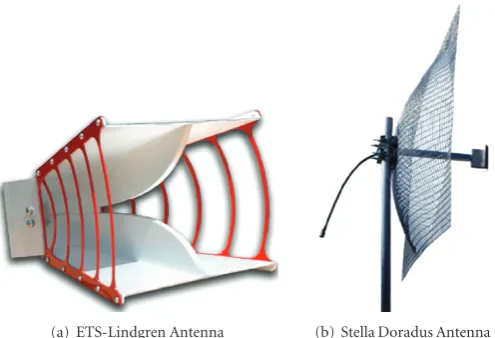
(a) ETS-Lindgren Antenna (b) Stella Doradus Antenna
Figure3: Directive antennas used at the emitter.
Table1: Measurement campaigns.
Experiment 1 Experiment 2 Frequency 3.5 GHz 2.4 GHz Emitted power 0 dBm 0 dBm Position on map E1 E2
Emitting antenna
ETS-Lindgren Stella Doradus Horn antenna Parabolic antenna
Model 3115 Model 24 SD21 Gain 10 dBi 20.5 dBi HPBW 38◦(V), 45◦(H) 15◦(V), 15◦(H)
Polarization Vertical Vertical
Table2: Measurement equipment.
Emitter Agilent Digital RF Signal Generator Receiver N9340A Handheld RF Spectrum Analyzer
The directive antennas (seeFigure 3), located at approx-imately 3 m hight, were pointing on CITI building in the directions represented inFigure 2(represented by arrows).
The equipment for the measurements is detailed in Table 2. A total of 104 measurement points were chosen (32 indoors and 72 outdoors). At the receiver’s side, omni-directionnal antennas were used. Moreover, in order to avoid fading effects, these antennas were slightly moved and the mean value after continuous 20 second measurements was recorded.
Before running the MR-FDPF simulations, IRLA has been calibrated for both measurement campaigns, providing a RMSE of 8 dB, which is acceptable considering the arguments given in Section 3.3 and also the fact that the points where distributed in the scenarios and some of them far from the building of interest (see Figure 4(b) for the location of these points).
Table3: Accuracy of the model: RMSE/ME in dB. X Experiment 1 Experiment 2 No calibration 2.80/0.301 2.28/−0.53 Calibration (4 points) 2.61/−0.22 1.77/−0.32 Calibration (all points) 2.39/0.09 1.17/0.21
5. Results
As an illustration, the rays and the coverage map computed with IRLA and corresponding to experiment 1 are plotted in Figure 4.
The simulated signal inside theCITIbuilding based on the new combined model is plotted in Figure 5 (Exper-iment 1) and Figure 6 (Experiment 2), as well as the comparison between simulation and measurements for the received signals (before calibration of MR-FDPF). It is seen on these figures that the effects of the windows are well taken into account, and that the measurements and simulation are well in accordance. Moreover, and especially in Experiment 1 (due to the height of the buildings) the reflections of the signal on neighboring buildings coming through the windows is visible.
(a) Outdoor Rays
−40
−150
(dBm)
(b) Outdoor coverage map
Figure4: IRLA simulation (Experiment 1).
−70
−100
(dBm)
(a) Radio coverage map
0 5 10 15 20 25 30 35 75
80 85 90 95 100
Measurement ID
R
ec
ei
ved
po
w
er
(dBm)
Measurements Simulations
(b) Comparison between measurements and simulation
Figure5: Outdoor to Indoor simulation results (Experiment 1).
order to save time due to radio measurement campaigns that is why such calibration using all the points has no practical meaning. Nevertheless it is proven in this experiment that only few measurement points suffice to improve the model and reach a high accuracy (Less than 2 dB in the case of WiFi). Finally, let us just notice that in practice it makes no sense to reach lower values of accuracy (typically less than 2 dB), since the accuracy of the measurement equipment (even after the small scale fading is removed) may have larger variations.
−60
−90
(dBm)
(a) Radio coverage map
0 5 10 15 20 25 30 35 65
70 75 80 85 90 95
Measurement ID
R
ec
ei
ved
po
w
er
(dBm)
Measurements Simulations
(b) Comparison between measurements and simulation
Figure6: Outdoor to Indoor simulation results (Experiment 2).
Table 4: Performance of the model: simulation times (on PC, 2.4 GHz, 2 GbRAM).
X IRLA MR-FDPF Total Preprocessing 0 s 41 s 41 s Simulation 58 s 57 s 115 s
5.1. Advantages of the Model. It is important to notice that,
without combining MR-FDPF with IRLA, it would not have been possible to compute the whole scenario with MR-FDPF only, due to high memory requirements during the preprocessing step. However, by supposing that this amount of memory is large enough, it is then possible to interpolate the simulation time duration it would take for simulating the whole scenario with MR-FDPF. Indeed, and as detailed in [20], the complexity of the propagation phase of MR-FDPF varies in O(log2(N)·N2), where N is the smallest
dimension of the scenario in pixels. Thus a simulation of the full environment (560 meter large) at the same resolution would be log2(560/100)· (560/100)2 = 78 times slower, that is, it would take approximately 2.5 hours instead of less than 2 minutes (115s) with the proposed combined model. Furthermore, such simulation would only simulate a 2D cut, where the height of the outdoor emitters would not be properly taken into account, hence it would provide a low accuracy, compared to the approach we use where the outdoor signal effects are simulated in 3D. Consequently, the new model proposed in this paper is advantageous both in term of speed and accuracy.
6. Conclusions and Perspectives
The solution provided in this paper has been shown to efficiently compute the outdoor to indoor radio propagation in one building due to the following reasons:
(i) it combines the advantages of a full 3D geometric model for the outdoor part, and an indoor accurate FD model where 2D is sufficient due to the flatness of the floors;
(ii) only the details of the considered buildings have to be known, whereas the other buildings are only represented by their shape and height;
(iii) it is a deterministic model, that is, the propagation effects such as the losses through windows are well taken into account, offering a RMSE between simula-tion and measurements of less than 3 dB indoors for a simulation time of less than 2 minutes;
(iv) is can be easily implemented on a standard PC and does not require the use of expensive powerful computers;
(v) the combined approach gives the opportunity to use the MR-FDPF for large scenarios, which would have not been possible based on MR-FDPF only.
This model, due to is performance will thus be used in a network planning tool in particular to study the interference produced by outdoor cells on indoor femtocells. However it is to be noticed that this paper only provides information about the expected mean power, which cannot be sufficient to completely characterize a complex radio link for modern systems. Hence our future work include the two following tasks:
(ii) ongoing work [22] gives us the possibility to perform wideband simulations, leading to more information such as Power Delay Profiles, delay spread, Doppler spread. Thus new measurements have to be per-formed in order to verify if such features are also true in outdoor to indoor scenarios using the combined model.
Acronyms
FDTD: Finite Difference Time Domain, FD: Finite Difference,
IRLA: Intelligent Ray Launching, ME: Mean Error,
MR-FDPF: Multi Resolution Frequency Domain ParFlow, OFDM: Orthogonal Frequency Division Multiplexing, RMSE: Root Mean Square Error,
RO: Ray Optical, WiFi: Wireless Fidelity,
WiMAX: Worldwide Interoperability for MicrowaveAccess.
Acknowledgments
This paper is supported by 2 European FP7 funded research projects: “CWNETPLAN” on Combined Indoor and Out-door radio propagation and “IPLAN” on inOut-door wireless network planning. The authors would like to thank Malcolm Foster for his useful comments and suggestions.
References
[1] J. Zhang and G. de la Roche, Femtocells: Technologies and Deployment, John Wiley & Sons, New York, NY, USA, 2010. [2] D. L ´opez-P´erez, A. Valcarce, G. de la Roche, and J. Zhang,
“OFDMA femtocells: a roadmap on interference avoidance,”
IEEE Communications Magazine, vol. 47, no. 9, pp. 41–48, 2009.
[3] Y. Miura, Y. Oda, and T. Taga, “Outdoor-to-indoor prop-agation modelling with the identification of path passing through wall openings,” in Proceedings of the 13th IEEE International Symposium on Personal, Indoor and Mobile Radio Communications (PIMRC ’02), vol. 1, September 2002. [4] S. Stavrou and S. Saunders, “Factors influencing outdoor
to indoor radiowave propagation,” in Proceedings of the 12th International Conference on Antennas and Propagation (ICAP ’03), vol. 2, April 2003.
[5] S. Wyne, N. Czink, J. Karedal, P. Almers, F. Tufvesson, and A. F. Molisch, “A cluster-based analysis of outdoor-to-indoor office MIMO measurements at 5.2 GHz,” inProceedings of the 64th IEEE Vehicular Technology Conference (VTC ’06), pp. 22–26, September 2006.
[6] T. K¨urner and A. Meier, “Prediction of outdoor and outdoor-to-indoor coverage in urban areas at 1.8 Ghz,”IEEE Journal on Selected Areas in Communications, vol. 20, no. 3, pp. 496–506, 2002.
[7] S. Reynaud, M. Mouhamadou, K. Fakih et al., “Outdoor to indoor channel characterization by simulations and measur-ments for optimising WiMAX relay network deployment,” in
Proceedings of the 69th IEEE Vehicular Technology Conference (VTC ’09), April 2009.
[8] G. de la Roche, P. Flipo, Z. Lai, G. Villemaud, J. Zhang, and J.-M. Gorce, “Combination of geometric and finite difference models for radio wave propagation in outdoor to indoor scenarios,” inProceedings of the European Conference on Antennas and Propagation (EuCAP ’10), Barcelona, Spain, April 2010.
[9] V. Degli-Esposti, F. Fuschini, E. M. Vitucci, and G. Falciasecca, “Speed-up techniques for ray tracing field prediction models,”
IEEE Transactions on Antennas and Propagation, vol. 57, no. 5, pp. 1469–1480, 2009.
[10] D. N. Schettino, F. J. S. Moreira, and C. G. Rego, “Efficient ray tracing for radio channel characterization of urban scenarios,”
IEEE Transactions on Magnetics, vol. 43, no. 4, pp. 1305–1308, 2007.
[11] Y. Corre and Y. Lostanlen, “3D urban propagation model for large ray-tracing computation,” inProceedings of the Inter-national Conference on Electromagnetics in Advanced Appli-cations (ICEAA ’07), pp. 399–402, Torino, Italy, September 2007.
[12] G. Woelfle, B. E. Gschwendtner, and F. M. Landstorfer, “Intelligent ray tracing—a new approach for field strength prediction in microcells,” in Proceedings of the 47th IEEE Vehicular Technology Conference (VTC ’97), vol. 2, pp. 790– 794, 1997.
[13] Z. Lai, N. Bessis, G. DelaRoche, H. Song, J. Zhang, and G. Clapworthy, “An intelligent ray launching for urban prediction,” in Proceedings of the 3rd European Conference on Antennas and Propagation (EuCAP ’09), pp. 2867–2871, Berlin, Germany, March 2009.
[14] Z. Lai, N. Bessis, G. de la Roche, P. Kuonen, J. Zhang, and G. Clapworthy, “A new approach to solve angular dispersion of discrete ray launching for urban scenarios,” inProceedings of the Loughborough Antennas and Propagation Conference (LAPC ’09), pp. 133–136, Loughborough, UK, November 2009.
[15] Z. Lai, N. Bessis, P. Kuonen, G. de la Roche, J. Zhang, and G. Clapworthy, “On the use of an intelligent ray launching for indoor scenarios,” inProceedings of the 4th European Con-ference on Antennas and Propagation (EuCAP ’10), Barcelona, Spain, April 2010.
[16] K. Yee, “Numerical solution of initial boundary value prob-lems involving Maxwell’s equations in isotropic media,”IEEE Transactions on Antennas and Propagation, vol. 14, no. 13, pp. 302–307, 1966.
[17] G. Kondylis, F. DeFlaviis, G. J. Pottie, and Y. Rahmat-Samii, “Indoor channel characterization for wireless communica-tions using reduced finite difference time domain,” in Proceed-ings of IEEE Vehicular Technology Conference (VTC ’99), vol. 3, pp. 1402–1406, May 1999.
[18] A. Lauer, I. Wolff, A. Bahr, J. Pamp, J. Kunisch, and I. Wolff, “Multi-mode FDTD simulations of indoor propagation including antenna properties,” in Proceedings of the 45th IEEE Vehicular Technology Conference (VTC ’95), pp. 454–458, Chicago, Ill, USA, July 1995.
[19] M. Pahud, F. Guidec, and T. Cornu, “Performance evaluation of a radiowave propagation parallel simulator,” inProceedings of the 3rd International Conference on Massively Parallel Computing System, April 1998.
[21] G. de la Roche, K. Jaffr`es-Runser, and J.-M. Gorce, “On predicting in-building WiFi coverage with a fast discrete approach,”International Journal of Mobile Network Design and Innovation, vol. 2, no. 1, pp. 3–12, 2007.
[22] J.-M. Gorce, G. Villemaud, and P. Flipo, “On simulating propagation for OFDM/MIMO systems with the MRFDPF model,” in Proceedings of the 4th European Conference on Antennas and Propagation (EuCAP ’10), Barcelona, Spain, April 2010.
[23] L. Nagy, R. Dady, and A. Farkasvolgyi, “Algorithmic complex-ity of FDTD and ray tracing method for indoor propagation modelling,” inProceedings of the 3rd European Conference On Antennas and Propagation, Berlin, Germany, March 2009. [24] Y. Wang, S. Safavi-Naeini, and S. K. Chaudhuri, “A hybrid
technique based on combining ray tracing and FDTD methods for site-specific modeling of indoor radio wave propagation,”
IEEE Transactions on Antennas and Propagation, vol. 48, no. 5, pp. 743–754, 2000.
[25] S. Reynaud, C. Guiffaut, A. Reineix, and R. Vauzelle, “Model-ing indoor propagation us“Model-ing an indirect hybrid method com-bining the UTD and the FDTD methods,” inProceedings of the 7th European Conference on Wireless Technology (ECWT ’04), pp. 345–348, Amsterdam, The Netherlands, October 2004. [26] M. Thiel and K. Sarabandi, “3D-wave propagation analysis
of indoor wireless channels utilizing hybrid methods,”IEEE Transactions on Antennas and Propagation, vol. 57, no. 5, pp. 1539–1546, 2009.
[27] V. Granville, M. Krivanek, and J.-P. Rasson, “Simulated annealing: a proof of convergence,” IEEE Transactions on Pattern Analysis and Machine Intelligence, vol. 16, no. 6, pp. 652–656, 1994.
[28] D. R. Jones, C. D. Perttunen, and B. E. Stuckman, “Lipschitzian optimization without the Lipschitz constant,” Journal of Optimization Theory and Applications, vol. 79, no. 1, pp. 157– 181, 1993.