Volume 2010, Article ID 605421,13pages doi:10.1155/2010/605421
Research Article
Lower Bounds on the Maximum Energy Benefit of Network
Coding for Wireless Multiple Unicast
Jasper Goseling,
1, 2Ryutaroh Matsumoto,
3Tomohiko Uyematsu,
3and Jos H. Weber
1 1Faculty of Electrical Engineering, Mathematics and Computer Science, Delft University of Technology, Mekelweg 4,2628 CD Delft, The Netherlands
2Faculty of Electrical Engineering, Mathematics and Computer Science, University of Twente, Drienerlolaan 5,
7522 NB Enschede, The Netherlands
3Department of Communication and Integrated System, Tokyo Institute of Technology, Tokyo 152-8552, Japan
Correspondence should be addressed to Jasper Goseling,[email protected]
Received 28 September 2009; Accepted 21 April 2010
Academic Editor: Heung-No Lee
Copyright © 2010 Jasper Goseling et al. This is an open access article distributed under the Creative Commons Attribution License, which permits unrestricted use, distribution, and reproduction in any medium, provided the original work is properly cited.
We consider the energy savings that can be obtained by employing network coding instead of plain routing in wireless multiple unicast problems. We establish lower bounds on the benefit of network coding, defined as the maximum of the ratio of the minimum energy required by routing and network coding solutions, where the maximum is over all configurations. It is shown that if coding and routing solutions are using the same transmission range, the benefit ind-dimensional networks is at least 2d/√d. Moreover, it is shown that if the transmission range can be optimized for routing and coding individually, the benefit in 2-dimensional networks is at least 3. Our results imply that codes following adecode-and-recombinestrategy are not always optimal regarding energy efficiency.
1. Introduction
Emerging applications in wireless networks, like environ-ment monitoring in rural areas by ad hoc networks, require more and more resources. One of the most important limitations is formed by battery life. Since battery technology is not keeping up with the increasing demand from resource-consuming applications, it is imperative that more efficient use is made of the available energy. There has been significant recent attention to the problem of minimizing energy consumption in networks. Some of the topics considered are minimum cost routing [1–3], power control algorithms [4–
6], and cross-layer protocol design for energy minimization [7]. In this work, we are interested in the use of network cod-ing [8–14] for reducing the energy consumption in wireless networks. We compare the reduction with traditional routing solutions. The contributions of this work are lower bounds on the energy reduction that can be achieved by using network coding for multiple unicast problems in wireless networks.
In recent years, there has been significant interest in net-work coding with the aim of reducing energy consumption in networks. More generally, network coding with a cost criterion has been considered. Much progress has been made in understanding the case of multicast traffic. In fact, it has been shown by Lun et al. that a minimum-cost network coding solution can be found in a distributed fashion in polynomial time [15]. The fact that the complexity of finding this solution is polynomial in time is surprising, since the corresponding routing problem is a Steiner tree problem that is known to be NP-complete [16].
by a constant. The problem of reducing energy consumption for many-to-many broadcast traffic in wireless networks has been studied by Fragouli et al. in [18] and Widmer and Le Boudec in [19], providing lower bounds on the energy benefit of network coding for specific topologies. More importantly, algorithms have been presented in [18,19] that allow to exploit these benefits in practical scenarios, that is, in a distributed fashion.
The above demonstrates that for multicast traffic and for many-to-many broadcast traffic, there is some under-standing of the energy benefits of network coding and how to exploit them. In order to reduce energy consumption in practical networks, however, it is important to consider also multiple unicast traffic. Indeed, in practice a large part of the data will be generated by unicast sessions. For the case of multiple unicast traffic, contrary to multicast and broadcast, not much is known. This paper deals with the energy benefits of network coding for wireless multiple unicast. Remember from the above that for multicast, the problem of minimum-cost routing is hard, whereas minimum-cost network coding is easy. In stark contrast, the problem of minimum-cost multiple unicast routing is easy. One constructs the minimum-cost solution, that is, the shortest path, for each session individually. The minimum-cost multiple unicast network coding problem, however, seems hard and in general very little is known.
Network coding for the multiple unicast problem was first studied by Wu et al. in [20], in which it was shown that in the information exchange problem on the line network, the energy saving achieved by network coding is a factor two. The network codes that we construct in this work are in a sense a generalization of the results on one-dimensional networks [20], to higher-dimensional networks. The networks considered in this work are lattices. More specifically, the hexagonal lattice and the rectangular lattice. Effros et al. [21] and Kim et al. [22] have considered energy-efficient network codes on the hexagonal lattice. We improve the lower bounds on the energy savings of network on the hexagonal lattice given in [21]. More precisely, we improve the previously known bound of 2.4 and obtain a new bound of 3.
Kramer and Savari have developed techniques that can be used to upper bound the achievable throughputs in a multiple unicast problem [23]. No methods are known, however, to lower bound the cost of network coding solutions for a configuration. A lower bound to the ratio of the minimum energy consumption of routing and coding solutions for a given multiple unicast configuration was provided by Keshavarz-Haddad and Riedi in [24]. For the type of configurations used in this paper, however, the results from [24] give the trivial lower bound of one. We will see, however, that network coding has large energy savings for these configurations.
An important class of network codes operates according to a principle that we will refer to in the remainder as
decode-and-recombine. These codes satisfy the constraint that each symbol in each linear combination that is transmitted is explicitly known by the node transmitting that linear combination. Note, that this is a restriction from the
general linear coding strategy, in which linear combinations of coded messages can be retransmitted. The motivation behind using decode-and-recombine codes is that it prevents information from spreading too much in the network, away from the path between source and destination, a heuristic introduced by Katti et al. [25]. The use of a decode-and-recombine strategy results in reduced complexity. However, an important question that has to be addressed is whether the use of decode-and-recombine codes leads to a higher energy consumption than is strictly necessary. We answer this question affirmatively. An upper bound of three on the energy benefit of decode-and-recombine codes has been given by Liu et al. [26]. One of the contributions of this work is to show that larger energy benefits can be obtained by considering also other types of codes.
This paper is organized as follows. In Section 2 we specify our model and problem statement more precisely. Our main results are presented inSection 3. Constructions of configurations that allow a large energy benefit for network coding and proofs of our results are given in Sections4and
5. InSection 6, finally, we discuss our work.
2. Model and Problem Statement
LetV ⊂ Rd be the nodes of a d-dimensional wireless
net-work. We consider a wireless network model with broadcast, where all nodes within ranger of a transmitting node can receive, and nodes outside this range cannot. More precisely, given a transmission ranger, a nodevis broadcasting to all nodes in the set
{u∈V | u−v ≤r}, (1)
whereu−vdenotes the Euclidean norm ofu−v. The energy required to transmit one unit of information to all other nodes within ranger equalscrα, whereαis the path
loss exponent andcis some constant. In analyzing the energy consumption of nodes, we will consider only the energy consumed by transmitting. Receiver energy consumption as well as energy consumed by processing are assumed to be negligible compared to transmitter energy consumption. In particular, note that little additional processing is required for network coding, compared to the processing that is performed in a traditional wireless protocol stack.
The traffic pattern that we consider is multiple unicast. All symbols are from the fieldF2, that is, they are bits and addition corresponds to the xor operation. The source of each unicast session has a sequence of source symbols that need to be delivered to the corresponding destination. Let
Mbe the set of unicast sessions. We call{V,M,r}a wireless multiple unicast configuration.
a configuration {V,M,r}. The energy consumption of a coding or routing scheme is defined as the time-average of the total energy spent by all nodes in the network to deliver one symbol for each unicast session. In analyzing coding schemes, we will ignore the energy consumption in an initial startup phase and consider only steady-state behavior.
Note that since energy consumption per transmission equalscrα, the transmission ranger is an important factor
in the energy consumption. Therefore, it is of particular interest to optimize the transmission range such that energy consumption is minimized. In this work, we consider two different quantities: (1) Bfixed, denoting the energy benefit
that can be obtained if the transmission range is given and fixed and (2) Bvar, denoting the energy benefit that can
be obtained if one is allowed to optimize the transmission range. Note that the transmission range can be individually optimized for the routing and network coding scenarios. More precisely, the goal of this work is to establish lower bounds on
Bfixed(d)=max V,M,r
Erouting(V,M,r)
Ecoding(V,M,r), (2)
where the maximization is over all node locationsV ⊂Rd,
multiple unicast sessionsM, and transmission rangesr, with the transmission range equal for the routing and network coding solutions, and
Bvar(d)=max V,M
minrErouting(V,M,r)
minrEcoding(V,M,r), (3)
where the maximization is over all node locationsV ⊂ Rd
and multiple unicast sessionsM, with the transmission range being optimized individually for the routing and network coding solutions. If no confusion can arise, we will omit dependency ondin the notation forBfixedandBvar.
Since inBfixed,ris equal forEroutingandEcoding, the energy
per transmission is equal inEroutingandEcodingand the benefit is equal to the ratio of the number of transmissions required in routing and network coding solutions.
Since we are interested in energy consumption only, we can assume that all transmissions are scheduled sequentially and/or that there is no interference. All coding and routing schemes that we consider proceed in time slots or rounds. In each time slot, all nodes are allowed to transmit one or more messages. We assume that the length of the time slot is large enough to accommodate sequential transmission of all messages in that round. Coding operations will be based on messages received in previous time slots only. Finally, we assume that all nodes have complete knowledge of the network topology and the network code that is being used.
To conclude this section, we introduce here some of the notation that will be used in the remainder of the paper. The symbol transmitted by a nodev∈Vin time slottis denoted byxt(v). If vtransmits more than one symbol in time slot
t, these will be distinguished by a superscript, giving, for instance,x1
t(v) andxt2(v). Nodes are represented by vectors.
Given vectors u = (u1,. . .,ud) and v = (v1,. . .,vd), let
ulk (uk,. . .,ul), (u,v)(u1,. . .,ud,v1,. . .,vd), andu\i
(u1,. . .,ui−1,ui+1,. . .,ud)=(ui1−1,udi+1).
Unicast sessions are denoted bymi(u), with ibeing an
integer andua vector. We will see in Sections4and5thatu
defines the location of the source andithe relative location of the destination, that is, the direction of the session. In some casesmi(u) will be denoted asmi(u
1,ud2) or similar forms.
Thetth source symbol of a sessionmi(u) is denoted bymi t(u).
The source and destination of sessionmi(u) are denoted by
si(u) andri(u), respectively.
3. Results
We provide lower bounds onBvarandBfixed.
Theorem 1. The ratio of the minimum energy consumption of routing solutions and the minimum energy consumption of network coding solutions, maximized over all node locations, multiple unicast sessions, and transmission ranges, with the transmission range equal for the routing and network coding solutions, is at least2d/√d, that is,
Bfixed(d)≥√2d
d. (4)
The result states that Bfixed is at least 2, 4, and 6 for
1-, 2- and 3-dimensional networks, respectively. The result that Bfixed is at least 2 in one-dimensional networks also
follows from the results in [20]. The lower bound 4 for 2-dimensional networks exceeds the previously known bound of 2.4 [21]. This new lower bound is of particular interest, since it exceeds the upper bound of 3 for decode-and-recombine type network codes [26]. Indeed, the code that we construct does not follow a decode-and-recombine strategy. This shows that energy can be saved by considering strategies other than decode-and-recombine. No lower bounds for three-dimensional networks have been previously estab-lished.
Before proving Theorem 1 in Section 5, we provide some intuition. The configuration used to proofTheorem 1
has nodes placed at a d-dimensional rectangular lattice, connectivityr = √dand is parameterized by an integerK
controlling the size of the network. The network is given in Figure 1for d = 2 and K = 5. For d = 2, the result ofTheorem 1is obtained as follows. First consider the case of routing. Note, that the minimum-energy solution is to route all packets along the shortest path between source and destination. Therefore, all nodes in the interior of the network will need to transmit four times. Now, for the case of network coding, we will show inSection 5that it is possible to construct a network code in which each node in the interior of the network is transmitting only once in each time slot. Therefore, by considering largeKand neglecting the energy consumption at the borders of the network, the obtained energy benefit is 4.
InSection 5we will consider the general case of arbitrary
d. Again, the network coding solution will be such that each of the Kd + O(Kd−1) nodes in the interior of the network
K+ 1 nodes
(a) (b)
Figure1: Configuration for whichErouting/Ecoding=2d/ √
d, withd=2 depicted here, is achievable. Nodes are located at integer coordinates in ad-dimensional space, with connectivity given byr=√d, as depicted in (a). Unicast sessions are placed according to (b).
(a) (b)
Figure2: Configuration for whichErouting/Ecoding=3 is achievable. Nodes are a subset of the hexagonal lattice, with connectivity as depicted
in (a). Unicast sessions are placed according to (b).
between source and destination equalsK/√d. By noting that the number of sessions is roughly equal to the number of nodes at the border of the network, that is, 2dKd−1+O(Kd−2),
and ignoring all transmission from nodes at the border of the network, we establish
Bfixed(d)≥ lim K→ ∞
2dKd−1+OKd−2K/√d
Kd+O(Kd−1)
= lim
K→ ∞
2d/√dKd+OKd−1
Kd+O(Kd−1)
=√2d
d.
(5)
Details of the configuration and a proof ofTheorem 1 are given inSection 5.
The configuration and network code construction used forTheorem 1are not useful for obtaining bounds onBvar.
Since r = √d, the cost per transmission in the network coding scheme is cdα/2. One can verify, however, that the
optimal transmission range under routing is r = 1. This requiresKhops per session, with the cost per transmission being equal toc. Using the network code described above and the optimal routing solution atr=1 gives
Bvar(d)≥ lim K→ ∞
cK2dKd−1+OKd−2
cdα/2[Kd+O(Kd−1)]
=2d1−α/2,
(6)
which is at most 2, since α ≥ 2. Note that it was already shown in [20] thatBvar(1)≥2 and in [21] thatBvar(2)≥2.4.
By considering a different configuration, we show that
Bvar(2)≥3.
Theorem 2. For2-dimensional wireless networks, the ratio of the minimum energy consumption of routing solutions and the minimum energy consumption of network coding solutions, maximized over all node locations and multiple unicast sessions, with the transmission range optimized individually for the routing and network coding solutions, is at least3, that is,
Bvar(2)≥3.
Here we provide an intuitive explanation of this result; details of the configuration and a proof of Theorem 2
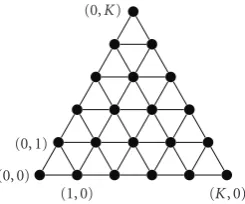
are provided in Section 4. The result is established using a multiple unicast configuration on a subset of the 2-dimensional hexagonal lattice as depicted in Figure 2. The minimum cost routing solution on this network follows shortest paths for all sessions and will require all nodes in the interior of the network to transmit three times in order to deliver one symbol for each session. In Section 4, we construct a network code in which each node in the interior is only transmitting once per delivered symbol. By making the size of the network large, the influence of the borders becomes negligible. Hence, the energy benefit is 3.
Finally, even though the cased > 3 is not of any practical relevance, the bounds as well as the code constructions might lead to a better insight for lower-dimensional networks.
4. An Efficient Code on the Hexagonal Lattice
In this section, we present a multiple unicast configuration in which the nodes form a subset of the hexagonal lattice. It will be shown that the energy benefit on this configuration is 3, proving Theorem 2. Since the code construction used here is less involved then the construction used to prove
Theorem 1, we start with the proof of Theorem 2. This section is organized as follows. In Section 4.1 we present the configuration in more detail after which we give the construction of the network code inSection 4.2.Section 4.3
is used to prove that the code is valid. Finally, inSection 4.4
we analyze the energy consumption of the network code and proveTheorem 2.
4.1. Configuration. The size of the configuration is parame-terized by a positive integerK. The nodesVform a subset of the hexagonal lattice. We index nodes with a tuple (v1,v2)∈ N2.Vis given by
V= {(v1,v2)|v1,v2≥0,v1,v2≤K,v1+v2≤K}. (7)
The location of nodev∈VinR2is given byvG, where
G=
⎡ ⎣11 0
2
√
3 2
⎤
⎦. (8)
LetV◦ denote the interior of the network, that is,
◦
V= {v∈V|v1,v2>0,v1,v2< K,v1+v2< K}. (9)
The transmission range that we are interested in isr=1. This leads to connectivity between the six nearest neighbours.
Hence, the neighbours of a node (u1,u2)∈ ◦
Vare
(u1−1,u2+ 1), (u1,u2+ 1), (u1−1,u2),
(u1+ 1,u2), (u1,u2−1), (u1+ 1,u2−1).
(10)
The nodesVand the connectivity are depicted inFigure 3. There are 3(K−1) unicast sessions, denoted bym1(i),
m2(i), andm3(i), 1≤i≤K−1. Sources and destinations of
the sessions are positioned as follows:
m1(i) :s1(i)=(0,i), r1(i)=(K−i,i),
m2(i) :s2(i)=(i,K−i), r2(i)=(i, 0),
m3(i) :s3(i)=(K−i, 0), r3(i)=(0,K−i),
(11)
as depicted inFigure 4. Remember fromSection 2, that ses-sionmj(i) has the sequence of source symbolsmj
0(i),m j 1(i),
m2j(i),. . .to be transferred.
(0,K)
(0, 1) (0, 0)
(1, 0) (K, 0)
Figure 3: Nodes at a subset of the hexagonal lattice with the connectivity induced by a transmission ranger = 1. The size of the network is controlled byK, withK=5 in this figure.
4.2. Network Code. The network code is such that in each time slot a new source symbol from each session is transmitted. Also, one symbol of each session is decoded by its destination in each time slot. After successfully decoding a symbol, it is retransmitted by the destination in the next time slot. Nodes at the border will, therefore, transmit twice in each time slot. Nodes in the interior of the network transmit only once. The symbol that they transmit is a linear combination of one symbol from each of the sessions for which the shortest path between source and destination includes that node.
The operation of the network code is demonstrated in
Figure 5in which the transmissions of all nodes in the first four time slots are depicted. Different transmissions by the same node are separated by a comma. Note, moreover, that there is a startup phase, time slots 0 to 2, in which not all destinations are able to decode a symbol. From time slot 3 onwards, all destinations decode one symbol in every time slot. In analyzing the energy consumption of the coding scheme, we will ignore the startup phase.
The symbol transmitted att = 3 by the node with the dotted border can be obtained by summing all transmissions from nodes with a dashed border in earlier time slots. Indeed
m1
1(3) +m21(2) +m10(1) +m30(2) +m22(1)
+m1
1(3) +m12(2) +m30(2) +m10(1) +m21(2)
+m3
1(1)=m12(2) +m22(1) +m31(1).
(12)
This coding operation (i.e., in time slott, a node transmits the sum of what was transmitted by its top-left neighbour in time slot t − 2, by its top right-neighbour in time slott−1, and so forth, as visualized inFigure 5) is performed by all nodes that are in the interior of the network. The idea behind the coding operation is to cancel, by means of the XOR operation, all symbols that should not be retransmitted. In (12), for instance, we have m11(3) + m11(3) = 0. The
exact operation of the network code is made more precise in the remainder of this subsection. The coding operation for interior nodes is given in exact form in (17).
s1(1),r3(4) s1(2),r3(3)
s1(3),r3(2) s1(4),r3(1)
s2(4),r1(1) s2(3),r1(2) s2(2),r1(3) s2(1),r1(4)
s3(4) r2(1)
s3(3) r2(2)
s3(2) r2(3)
s3(1) r2(4)
Figure4: The unicast sessions on the network fromFigure 3.
x1
t(0,u2) andx3t(0,u2), where
Left border:
x1
t(0,u2)=m1t(u2),
x3
t(0,u2)=m3t−u2(K−u2).
(13)
Since (0,u2) is the source of session m1(u2) it has source
symbol m1t(u2), available. Also, (0,u2) is the destination
for session m3(K − u
2). It remains to be shown that
symbolm3t−u2(K−u2) can be decoded by (0,u2) using the
information obtained from its neighbours up to time slott. For notational convenience, let
Left border:
xt(0,u2)x1t(0,u2) +xt3(0,u2). (14)
In a similar fashion, we have the following transmissions at the right and bottom borders of the network.
Right border:
x1
t(v1,v2)=m1t−v1(v2),
x2
t(v1,v2)=m2t(v1),
xt(v1,v2)x1t(v1,v2) +xt2(v1,v2),
(15)
Bottom border:
x2t(u1, 0)=m2t−K+u1(u1),
x3t(u1, 0)=m3t(K−u1),
xt(u1, 0)x2t(u1, 0) +xt3(u1, 0),
(16)
whereu1,v1,v2>0,u1,v1,v2< K, andv1+v2=K. Moreover,
xt(v1,v2) andxt(u1, 0) are not symbols that are transmitted,
but only notational shortcuts.
Nodes in the interior of the network transmit once in each time slot. Let (u1,u2) ∈
◦
V. The coding operation it performs is given by
xt(u1,u2) =xt−1(u1−1,u2) +xt−2(u1−1,u2+ 1)
+xt−1(u1,u2+ 1) +xt−3(u1,u2)
+xt−2(u1+ 1,u2) + xt−2(u1,u2−1)
+xt−1(u1+ 1,u2−1).
(17)
4.3. Validity of the Network Code. We need to show that destinations can decode in time in order to retransmit the required symbols according to (13), (15), and (16). In order to do so we first analyze how data propagates through the network. If we look at the nodes in the network that transmit linear combinations that contain a certain source symbol, we see that symbols propagate exactly along the shortest paths between source and destination. This is made more precise in the following two lemmas.
Lemma 1. Let 0 < u2 < K. Assume that the only nonzero
source symbol transmitted in the network ism1
0(u2)by node
(0,u2)in time slot0. Then, for allt≥0and(v1,v2)∈ ◦
V
xt(v1,v2)= ⎧ ⎨ ⎩
m1
0(u2) ifv1=t,v2=u2,
0, otherwise. (18)
Proof. We use induction over time. The base case is time slot
t = 0, for which it is readily verified that the statement is true. Now, for the induction step, suppose that the lemma holds for alltsmaller thant. This implies that for allτ >0 and (v1,v2)∈
◦
V,
xt−τ(v1,v2)=xt−τ−1(v1−1,v2). (19)
Hence,
xt(v1,v2)=xt−1(v1−1,v2) +xt−2(v1−1,v2+ 1)
+xt−1(v1,v2+ 1) +xt−3(v1,v2) +xt−2(v1+ 1,v2)
+xt−2(v1,v2−1) +xt−1(v1+ 1,v2−1)
=xt−1(v1−1,v2) +xt−2(v1−1,v2+ 1)
+xt−2(v1−1,v2+ 1) +xt−3(v1,v2) +xt−3(v1,v2)
+xt−2(v1,v2−1) +xt−2(v1,v2−1)
=xt−1(v1−1,v2),
(20)
which by the induction hypothesis is equal tom10(u2) ifv1=t
andv2=u2and zero otherwise.
Lemma 2. Let(u1,u2)∈ ◦
V.
xt(u1,u2)=m1t−u1(u2) +m2t−K+u1+u2(u1)
+m3
t−u2(K−u1−u2).
Proof. From Lemma 1, the time-invariance of the system, and the symmetry of the coding operation (17) of the internal nodes.
We are now ready to prove that the destinations can correctly decode source symbols. We present the decoding procedure for nodes on the right border of the network. The decoding procedures at the other borders can be obtained by exploiting the symmetry of the system.
Lemma 3. Consider(u1,u2), withu1+u2 =K,0< u2 < K,
that is, the destination of sessionm1(u
2). It can decode symbol
m1
t−u1(u2)at the end of time slott−1as
x2
t−2(u1−1,u2+ 1) +xt−1(u1−1,u2) +xt2−3(u1,u2)
+xt−2(u1,u2−1) +x1t−1(u1+ 1,u2−1).
(22)
Proof. FromLemma 2, (15), it follows that (22) equals
m1
t−u1(u2) +m1t−u1−2(u2−1) +m1t−u1−2(u2−1)
+m2
t−2(u1−1) +m2t−2(u1−1) +m2t−3(u1)
+m2
t−3(u1)m3t−u2−1(1) +mt3−u2−1(1)=m1t−u1(u2).
(23)
4.4. Energy Consumption. The energy consumption of the network coding scheme presented above is given in the following lemma.
Lemma 4. minrEcoding(V,M,r) ≤ Ecoding(V,M, 1) ≤ (c/
2)K2+O(K).
Proof. From (13)–(17), we have that each of the 3(K −
1) nodes at the border that are source or destination are transmitting twice in each time slot. Each of the (K−1)(K−
2)/2 internal nodes is transmitting once in each time slot. Sincer =1, the energy consumption per transmission isc. This gives
Ecoding(V,M, 1)≤6c(K−1) +c(K−1)(K−2) 2
= c
2K
2+ O(K).
(24)
Next, we give the minimum energy required by a routing solution.
Lemma 5. minrErouting(V,M,r) = Erouting(V,M, 1) =
(3c/2)K2+O(K).
Proof. Since we consider routing, we need to take the shortest path for each session. Since the energy consumption per hop equals crα, the energy consumption under routing
is minimized for r = 1. Now, we see that the number of transmissions required to deliver a symbol for the
sessionsm1(1),. . .,m1(K−1) equalsK(K−1)/2. Adding the
transmissions for sessions of type 2 and 3 gives
Erouting(V,M, 1)=3c
2K(K−1)= 3c
2K
2+ O(K). (25)
Using the above two lemmas, we are able to prove
Theorem 2.
Proof ofTheorem 2. Remember that Bvar is defined as the
maximum of minrErouting(V,M,r)/minrEcoding(V,M,r) over
V andM. Hence, minrErouting(V,M,r)/minrEcoding(V,M,r) for any specificVandMwill provide a lower bound toBvar.
In addition, any upper bound to minrEcoding(V,M,r) will result in a lower bound toBvar. Hence, from Lemmas4and 5, we have
Bvar(2)≥ lim K→ ∞
minrErouting(V,M,r) minrEcoding(V,M,r)
≥ lim
K→ ∞
Erouting(V,M, 1)
Ecoding(V,M, 1)
≥ lim
K→ ∞
(3c/2)K2+ O(K)
(c/2)K2+ O(K) =3.
(26)
5. An Efficient Code on the
d
-Dimensional
Rectangular Lattice
In this section, we present a multiple unicast configuration in which the nodes are placed at integer coordinates in ad -dimensional space, that is, at the rectangular lattice.
5.1. Configuration. The size of the configuration is parame-terized by a positive integerK. We have
V = {(v1,. . .,vd)|0≤vi≤K,i=1,. . .,d}. (27)
The interior of the network is given by
◦
V = {v∈V|0< vi< K,i=1,. . .,d}. (28)
We will make use of
V =v∈V | ∃uniquei:vi∈ {0,K}
, (29)
which corresponds to those nodes that are part of exactly one face of the network.
The transmission range that will be used isr =√d. This transmission range induces a neighbourhood consisting of all neighbours within distance√d. The coding operation of our network code is based on only part of the neighbour-hood, that is, it uses
Nv= {u∈V | |ui−vi| ≤1∀i,u /=v}. (30)
Note, that ford≤3,Nvcorresponds to the complete
neigh-bourhood of v. We will be using dist(u,v) u−v1 = d
m1
Figure5: Example operation of the network code ofSection 4, withK =4. The transmissions of all nodes in the time slots 0,. . ., 3 are depicted. Different transmissions by the same node are separated by a comma. Note, that the symbol transmitted att=3 by the node with dotted border can be obtained by summing all transmissions from nodes with a dashed border in earlier time slots. All nodes in the interior of the network perform this simple coding operation.
distance from uto v. The network and its connectivity are depicted ford=2 inFigure 6.
A source is located at each v ∈ V. Therefore, there are |V| = 2d(K −1)d−1 sessions. If vi = 0, we denote
the session corresponding to this source by mi(v\i). Recall
fromSection 2thatv\i denotes thed-1 dimensional vector
obtained by removing theith element from v. Ifvi = K,
we denote the session bymd+i(v\i). The destination of each
session is located at the other side of the network, that is, we haveri(v\i)=sd+i(v\i) andrd+i(v\i)=si(v\i). The positions
of sources and destinations are depicted ford=2 inFigure 7.
It can be seen that mi(v\i) and md+i(v\i) form oppositely
directed sessions.
5.2. Network Code. We introduce setsΘδ⊂ {1,. . ., 2d}, 0≤
δ≤d, which are defined recursively as follows:
Θd= {d},
Θδ=(Θδ+1−1)Δ(Θδ+1+ 1), 0< δ < d,
Θ0=(Θ1−1)Δ(Θ1+ 1)\ {0},
(0,K)
(0, 1) (0, 0)
(1, 0) (K, 0)
Figure6: Nodes at a subset of thed-dimensional rectangular lattice, d =2 depicted in the figure, with the connectivity induced by a transmission ranger=√d. The size of the network is controlled by K, withK=5 in this figure.
s1(1),r3(1) s1(2),r3(2) s1(3),r3(3) s1(4),r3(4)
s3(1),r1(1) s3(2),r1(2) s3(3),r1(3) s3(4),r1(4)
s2(1) r4(1)
s2(2) r4(2)
s2(3) r4(3)
s2(4) r4(4) s4(1)
r2(1) s4(2) r2(2)
s4(3) r2(3)
s4(4) r2(4)
Figure7: The unicast sessions on the network fromFigure 6.
whereΔdenotes symmetric difference andΘδ±1= {τ±1|
τ ∈ Θδ}. Note that irrespective ofd we have 1 ∈ Θ1. As
an example ford = 2 we haveΘ2 = {2},Θ1 = {1, 3}and Θ0= {4}.
The scheme is very similar in flavour to the scheme presented in Section 4; its operation is demonstrated in
Figure 8in which, ford =2 andK =3, the transmissions of all nodes in the first four time slots are depicted. The operation of the scheme is such that in time slottsources transmit the tth source symbol and destinations decode the (t−K)th source symbol. Besides transmitting a new source symbol in each time slot, sources/destinations will also retransmit the symbol that has been decoded in that time slot, that is, they transmit two different symbols in each time slot. In the figure, different transmissions by the same node are separated by a comma. Nodes in the interior of the network transmit only once. The symbol that they transmit is a linear combination of one symbol from each of the sessions for which the shortest path between source and destination includes that node. The symbol transmitted att =3 by the node with the dotted border can be obtained by summing all transmissions from nodes with a dashed border in earlier time slots. This coding operation is performed by all nodes that are in the interior of the network. The exact operation of the network code is made more precise in the remainder
of this subsection. The coding operation for interior nodes is given in exact form in (34).
Let nodev∈V. Remember thatv∈Vimplies that there exists a uniqueisuch thatvi∈ {0,K}. Nodevtransmits
xit(v)=mit−vi
v\i,
xd+it (v)=md+it−K+vi
v\i. (32)
For notational convenience, let
xt(v)xit(v) +xtd+i(v). (33)
The coding operation performed by an internal node is as follows:
xt(v)= u∈Nv∪{v}
τ∈Θdist(u,v)
xt−τ(u). (34)
5.3. Validity of the Network Code. The following result follows directly from the definition of the sets Θδ, but is
stated here as a lemma because of its importance in the remainder of the paper.
Lemma 6. Let{xt}be a sequence of symbols fromF2and let
0< δ < d. We have
τ∈Θδ
xt−τ=
τ∈Θδ+1
[xt−τ+1+xt−τ−1],
τ∈Θ0
xt−τ=
τ∈Θ1\{1}
xt−τ+1+
τ∈Θ1
xt−τ−1.
(35)
Lemma 7. Consider node(0,ud
2)∈ V. Assume that the only
nonzero source symbol transmitted in the network ism1 0(ud2)by
node(0,ud
2)in time slot0. Then
xt(v)= ⎧ ⎪ ⎨ ⎪ ⎩
m1 0
ud 2
, ifv1=t,vd2=ud2,
0, otherwise, (36)
for allv∈Vandt≥0.
Proof. We use induction overt. At time t = 0, the lemma holds, giving us our base case. Now suppose that the lemma holds for all time slots smaller than t. If v ∈ V, the lemma follows directly from (32)–(33). In the remainder we consideru ∈ V◦. From the induction hypothesis, it follows that for anyt< t
xt(u)=xt−1
u1−1,ud2
. (37)
If u1 = K −1, it follows from (32) and the induction
hypothesis that
xt−1(u)=xt
u1+ 1,ud2
. (38)
Now, attthe coding operation performed byucan be decomposed as
xt(u)=
w∈Nu∪{v}
τ∈Θdist(w,u)
xt−τ(w)=
w∈Nu:
w1=u1
m4
Figure8: Example operation of the network code ofSection 5, withK =3. The transmissions of all nodes in the time slots 0,. . ., 3 are depicted. Different transmissions by the same node are separated by a comma. Note, that the symbol transmitted att=3 by the node with dotted border can be obtained by summing all transmissions from nodes with a dashed border in earlier time slots. All nodes in the interior of the network perform this simple coding operation.
where
In the remainder, we show that
g(w)=
which proves the lemma, since by the induction hypothesis
Forw /=uwe, have
where the second equality follows fromLemma 6, the third equality follows from (37)-(38), and the last equality holds because we work overF2.
Forw=u, we have
Proof. By linearity, time-invariance and symmetry of (34) together withLemma 7.
We are now ready to prove that the destinations can correctly decode source symbols. We present the decoding procedure for nodes on the right border of the network, that is, for nodes of type (K,ud2) ∈ V. The decoding
procedures at the other borders can be obtained by exploiting the symmetry of the system.
Lemma 9. Consider nodeu=(K,ud2)∈V. At the end of time
where (a) holds, because for dist(u,v)>0,Lemma 6gives
The proof of the lemma follows by adding the final expres-sions from (46), (49) and (50) observing that the outcome is
m1 t−K(ud2).
5.4. Energy Consumption. The energy consumption of the network coding scheme presented above provides an upper bound to minrEcoding(V,M,r).
Lemma 10. Ecoding(V,M,√d) ≤ 4cd1+α/2(K − 1)d−1
+
cdα/2(K−1)d.
Proof. All transmissions are over distance√dand costcdα/2.
The nodes in V are transmitting twice. On each of the 2d
sides of the network, there are (K−1)d−1 nodes fromV; hence|V| =2d(K−1)d−1. This gives 2|V| =4d(K−1)d−1 transmissions. In addition, there are (K−1)d nodes in the interior, that are all transmitting once.
Next, we give the minimum energy required by a routing solution.
Lemma 11. Erouting(V,M,√d) = 2cd1+α/2K/√d(K −
1)d−1.
Proof. Since the transmission range is equal to√d, a routing solution requiresK/√dtransmissions per session. More-over, there are|V| =2d(K−1)d−1sessions.
Using the above two lemmas, we are able to prove
Theorem 1.
Proof ofTheorem 1. Lemmas10and11give
Bfixed(d)≥ lim
We have given several constructions of energy-efficient network codes. These constructions serve to show that compared to plain routing, network coding has the potential of reducing energy consumption in wireless networks. Since we have provided only codes that are based on a centralized design, it remains to be shown in future work if and how this potential can be exploited using practical codes. Moreover, it would also be of interest to consider the energy-benefit in topologies in which the nodes are not positioned at a lattice, for instance, random networks.
In this work we have provided lower bounds on the energy benefit of network coding for wireless multiple unicast. Another open problem is to find upper bounds on the benefit.
References
[1] S. Chen and K. Nahrstedt, “An overview of quality of service routing for next-generation high-speed networks: problems and solutions,”IEEE Network, vol. 12, no. 6, pp. 64–79, 1998. [2] L. Tassiulas and J. Chang, “Energy conserving routing in
wireless ad hoc networks,” inProceedings of the 5th Annual ACM/IEEE International Conference on Mobile Computing and Network (MobiCom ’98), Dallas, Tex, USA, August 1998. [3] V. Rodoplu and T. H. Meng, “Minimum energy mobile
wireless networks,”IEEE Journal on Selected Areas in Commu-nications, vol. 17, no. 8, pp. 1333–1344, 1999.
[4] R. Ramanathan and R. Rosales-Hain, “Topology control of multihop wireless networks using transmit power adjust-ment,” inProceedings of the IEEE 19th Annual Joint Conference of the IEEE Computer and Communications Societies (INFO-COM ’00), pp. 404–413, March 2000.
[5] C. E. Jones, K. M. Sivalingam, P. Agrawal, and J. C. Chen, “A survey of energy efficient network protocols for wireless networks,”Wireless Networks, vol. 7, no. 4, pp. 343–358, 2001. [6] C. U. Saraydar, N. B. Mandayam, and D. J. Goodman, “Efficient power control via pricing in wireless data networks,”
IEEE Transactions on Communications, vol. 50, no. 2, pp. 291– 303, 2002.
[8] R. Ahlswede, N. Cai, S.-Y. R. Li, and R. W. Yeung, “Network information flow,”IEEE Transactions on Information Theory, vol. 46, no. 4, pp. 1204–1216, 2000.
[9] S.-Y. R. Li, R. W. Yeung, and N. Cai, “Linear network coding,”
IEEE Transactions on Information Theory, vol. 49, no. 2, pp. 371–381, 2003.
[10] R. Koetter and M. M´edard, “An algebraic approach to network coding,”IEEE/ACM Transactions on Networking, vol. 11, no. 5, pp. 782–795, 2003.
[11] T. Ho, M. M´edard, R. Koetter et al., “A random linear network coding approach to multicast,”IEEE Transactions on Information Theory, vol. 52, no. 10, pp. 4413–4430, 2006. [12] R. W. Yeung and N. Cai, “Network coding theory,”Foundations
and Trends in Communications and Information Theory, vol. 2, no. 4, pp. 241–381, 2006.
[13] C. Fragouli and E. Soljanin, “Network coding fundamentals,”
Foundations and Trends in Networking, vol. 2, no. 1, pp. 1–133, 2007.
[14] C. Fragouli and E. Soljanin, “Network coding applications,”
Foundations and Trends in Networking, vol. 2, no. 2, pp. 135– 269, 2007.
[15] D. S. Lun, N. Ratnakar, M. M´edard et al., “Minimum-cost multicast over coded packet networks,”IEEE Transactions on Information Theory, vol. 52, no. 6, pp. 2608–2623, 2006. [16] P. Winter, “Steiner problem in networks: a survey,”Networks,
vol. 17, no. 2, pp. 129–167, 1987.
[17] A. Goel and S. Khanna, “On the network coding advantage for wireless multicast in Euclidean space,” inProceedings of the International Conference on Information Processing in Sensor Networks (IPSN ’08), pp. 64–69, April 2008.
[18] C. Fragouli, J. Widmer, and J.-Y. Le Boudec, “Efficient broadcasting using network coding,”IEEE/ACM Transactions on Networking, vol. 16, no. 2, pp. 450–463, 2008.
[19] J. Widmer and J.-Y. Le Boudec, “Network coding for efficient communication in extreme networks,” inApplications, Tech-nologies, Architectures, and Protocols for Computer Communi-cation, pp. 284–291, ACM Press, New York, NY, USA, 2005. [20] Y. Wu, P. A. Chou, and S.-Y. Kung, “Information exchange
in wireless networks with network coding and physical-layer broadcast,” inProceedings of the 39th Annual Conference on Information Sciences and Systems (CISS ’05), 2005.
[21] M. Effros, T. Ho, and S. Kim, “A tiling approach to network code design for wireless networks,” inProceedings of the IEEE Information Theory Workshop (ITW ’06), pp. 62–66, IEEE, punta del Este, Uruguay, March 2006.
[22] S. Kim, M. Effros, and T. Ho, “On low-power multiple unicast network coding over a wireless triangular grid,” inProceedings of the 45th Annual Allerton Conference on Communication, Control and Computing, 2007.
[23] G. Kramer and S. A. Savari, “Edge-cut bounds on network coding rates,”Journal of Network and Systems Management, vol. 14, no. 1, pp. 49–66, 2006.
[24] A. Keshavarz-Haddad and R. Riedi, “Bounds on the benefit of network coding: throughput and energy saving in wireless networks,” in Proceedings of the 27th IEEE Communications Society Conference on Computer Communications (INFOCOM ’08), pp. 376–384, April 2008.
[25] S. Katti, H. Rahul, W. Hu, D. Katabi, M. M´edard, and J. Crowcroft, “XORs in the air: practical wireless network coding,” in Proceedings of the Conference on Applications, Technologies, Architectures, and Protocols for Computer Com-munications (ACM SIGCOMM ’06), pp. 243–254.
[26] J. Liu, D. Goeckelt, and D. Towsley, “Bounds on the gain of network coding and broadcasting in wireless networks,”