Volume 2007, Article ID 16907,10pages doi:10.1155/2007/16907
Research Article
Broadband Beamspace DOA Estimation: Frequency-Domain
and Time-Domain Processing Approaches
Shefeng Yan
Institute of Acoustics, Chinese Academy of Sciences, 100080 Beijing, China
Received 1 November 2005; Revised 11 April 2006; Accepted 12 May 2006
Recommended by Peter Handel
Frequency-domain and time-domain processing approaches to direction-of-arrival (DOA) estimation for multiple broadband far field signals using beamspace preprocessing structures are proposed. The technique is based on constant mainlobe response beam-forming. A set of frequency-domain and time-domain beamformers with constant (frequency independent) mainlobe response and controlled sidelobes is designed to cover the spatial sector of interest using optimal array pattern synthesis technique and optimal FIR filters design technique. These techniques lead the resulting beampatterns higher mainlobe approximation accuracy and yet lower sidelobes. For the scenario of strong out-of-sector interfering sources, our approaches can form nulls or notches in the direction of them and yet guarantee that the mainlobe response of the beamformers is constant over the design band. Nu-merical results show that the proposed time-domain processing DOA estimator has comparable performance with the proposed frequency-domain processing method, and that both of them are able to resolve correlated source signals and provide better res-olution at lower signal-to-noise ratio (SNR) and lower root-mean-square error (RMSE) of the DOA estimate compared with the existing method. Our beamspace DOA estimators maintain good DOA estimation and spatial resolution capability in the scenario of strong out-of-sector interfering sources.
Copyright © 2007 Hindawi Publishing Corporation. All rights reserved.
1. INTRODUCTION
Broadband direction-of-arrival (DOA) estimation has found numerous applications to radar, sonar, wireless communica-tions, and other areas. Incoherent signal-subspace methods
such as [1,2] perform narrowband DOA estimation for each
frequency bin and then statistically combine the resulting es-timates to form a broadband DOA estimate. However, co-herent signal sources cannot be handled by this approach. The coherent signal subspace (CSS) method was proposed
by Wang and Kaveh [3] as an alternative method to deal with
coherent signal sources. It decomposes the broadband data into several narrowband frequency bins and finds focusing matrices that transform the covariance matrices of each bin into the one corresponding to the reference frequency bin. Conventional narrowband DOA estimation methods such as
MUSIC [4] may then be directly applied to find the
direc-tions of arrival. CSS methods have been found to exhibit bet-ter resolution at low signal-to-noise ratio (SNR) and lower estimate variance than incoherent methods. However, the de-sign of focusing matrices in the CSS method requires prelim-inary DOA estimates in the neighborhood of the true direc-tions of arrival.
Other broadband DOA estimation methods based on
the beamspace preprocessing are proposed in [5, 6]. The
beamspace preprocessing is performed by using frequency-invariant beamformers (FIBs) that transform the ele-mentspace into the beamspace. The beamforming matrices perform the same operation as focusing matrices in the CSS
method, but without preliminary DOA estimates. In [5], Lee
constructs a beamforming matrix for each frequency bin such that the resulting beampatterns are essentially identi-cal for all frequencies by solving a least squares optimiza-tion problem. However, the least squares fit is employed not only in the mainlobe but also in the sidelobe regions, which leads to suboptimal designs since the sidelobes only need to be guaranteed to remain below the prescribed threshold
value. In [6], Ward et al. present a DOA estimator that
per-forms broadband focusing using time-domain processing, in which a set of appropriately designed beam-shaping
fil-ters [7] ensure that the similar array pattern is produced for
all frequencies within the design band. The estimator need not perform frequency decomposition. However, the FIBs may not be achieved for arrays with arbitrary geometry and
nonuniform interelement spacing. Moreover, it is difficult to
the robustness of the beamformers designed in [5,6] may decrease since the beamforming weights can be very large. We will refer to the beamspace preprocessing approaches in
[5,6] as frequency-domain frequency-invariant beamspace
(FD-FIBS) approach and time-domain frequency-invariant beamspace (TD-FIBS) approach, respectively.
In this paper, new broadband DOA estimation ap-proaches are proposed by designing a set of frequency-domain and time-frequency-domain beamformers with constant main-lobe response over the design band to cover the spatial sector of interest. We will refer to the beamformer with constant
mainlobe response asconstant mainlobe response beamformer
(CMRB). The frequency-domain weight vector of CMRB is designed using optimal array pattern synthesis techniques to ensure that the resulting beampattern is constant within the mainlobe over the design band while guarantee the side-lobes to be below the prescribed values. For our array pattern synthesis problems, the least squares fit process is only per-formed within the mainlobe, which can lead to higher main-lobe approximation accuracy. For our time-domain beam-former, a bank of FIR filters corresponding to the input chan-nels are designed to provide the frequency responses that ap-proximate the frequency-domain array weights for each sen-sor. Both the array pattern synthesis and the FIR filter de-sign problems are formulated as the second-order cone
pro-gramming (SOCP), which can be solved efficiently using the
well-developed interior-point methods [8,9]. The SOCP
ap-proach has been exploited in robust array interpolation [10]
and robust beamforming [11,12]. The proposed DOA
esti-mators are able to resolve correlated source signals and can be applicable to arrays of arbitrary geometry. For the sce-nario of strong out-of-sector interfering sources, our esti-mators can maintain good DOA estimation and spatial res-olution capability by forming nulls or notches in the corsponding directions and yet guarantee that the mainlobe re-sponse of the broadband beamformer is constant over the design band.
The paper is organized as follows. A brief review of broadband beamspace DOA estimation is presented in
Section 2. In Section 3, the frequency-domain and time-domain CMRBs are designed using SOCP approach. In
Section 4, the frequency-domain and time-domain process-ing methods for beamspace DOA estimation are presented.
Section 5 presents simulation results confirming the effi
-ciency of the proposed methods, andSection 6concludes the
paper.
2. BACKGROUND
Consider anN-element array with a known arbitrary
geome-try. Assume thatD < N far field broadband sources impinge
on the array from directionsΘ = [θ1,. . .,θd,. . .,θD]. The
time series received at thenth element is
xn(t)= D
d=1
sd
t−ξn
θd
+vn(t), n=1,. . .,N, (1)
wheresd(t) is thedth source signal,ξn(θd) is the propagation
delay to thenth sensor associated with thedth source, and
vn(t) is the additive white noise. With suitable data
segmen-tation and Fourier transform, the frequency response of the
N×1 complex array data snapshot vector is given by
xfj
=AΘ,fj
sfj
+vfj
, (2)
where the argument fjdenotes the dependence of the array
data on different frequency bins,s(fj)=[s1(fj),. . .,sD(fj)]T
is theD×1 source signal vector. Here (·)Tdenotes the
trans-pose.v(fj) is theN×1 additive noise vector, andA(Θ,fj)=
[a(θ1,fj),. . .,a(θD,fj)] is theN ×Dsource direction
ma-trix with a(θd,fj) = [e−i2π fjξ1(θd),. . .,e−i2π fjξN(θd)]T (d =
1,. . .,D) being the array manifold vector. Herei=√−1. In beamspace eigen-based methods, multiple beams are formed over the spatial sector of interest by using a set of K (D < K < N) beamforming weight vectors wjk =
[w1(fj,k),. . .,wn(fj,k),. . .,wN(fj,k)]T, j = 1,. . .,J,k =
1,. . .,K. Herewn(fj,k) is the weight of thekth beamformer
associated with thenth sensor employed at the frequency bin
fj. Assume that the pointing directions of theK
beamform-ers areΦ = [φ1,. . .,φk,. . .,φK]. The received elementspace
data snapshot vectors are converted into a reduced dimen-sion beamspace data snapshot vector via the matrix transfor-mation
yfj
=WH jx
fj
=WH jA
Θ,fj
sfj
+WH
j v
fj
=BΘ,fj
sfj
+vB
fj
,
(3)
whereB(Θ,fj) = WHjA(Θ,fj) andvB(fj) = WHjv
fj
are the beamspace DOA matrices and noise vectors, respectively.
Here (·)H denotes the Hermitian transpose. And W
j =
[wj1,wj2,. . .,wjK] is theN×Kbeamforming matrices
em-ployed at the frequency bin fj.
Assume that we apply the constant (frequency indepen-dent) mainlobe response beamforming technique. Then the response of the beamformer may be made approximately constant within the mainlobe over the design band, that is,
pk
θ,fj
=wHjkaθ,fj
≈pCMR,k(θ),
j=1,. . .,J,k=1,. . .,K, θ∈ΘM,
(4)
where pCMR,k(θ) is the constant mainlobe response
associ-ated with thekth beamformer,ΘM is the mainlobe angular
region, in contrast to the methods in [5,6], where the
beam-formers are designed to ensure that the resulting beampat-tern is constant over both the mainlobe and the sidelobe re-gions.
Because the constant response property of the beam-formers, the beamspace DOA matrices are approximately constant for all frequencies, that is,
BΘ,fj
≈B(Θ), j=1,. . .,J. (5)
Hence, the broadband source directions are completely
Assuming the source signals and the noise are uncorre-lated, the constant mainlobe response beamspace (CMRBS) data covariance matrix is
Ry
fj
=Eyfj
yHf j
=B(Θ)Esfj
sHfj
BH(Θ)
+WHjEvfj
vHfj
Wj
=B(Θ)Rs
fj
BH(Θ) +R v
fj
,
(6)
whereRs(fj)=E{s(fj)sH(fj)}is theD×Dsource covariance
matrix, and Rv(fj) = WHjE{v(fj)vH(fj)}Wj is the K×K
CMRBS noise covariance matrix. The broadband CMRBS data covariance matrix can be formed as
Ry= J
j=1
Ry
fj
=
J
j=1
B(Θ)Rs
fj
BH(Θ)+
J
j=1
Rv
fj
=B(Θ)
J
j=1
Rs
fj
BH(Θ) +Rv,
(7)
whereRv =
J
j=1Rv(fj) is the broadband beamspace noise
covariance matrix.
The broadband CMRBS data covariance matrix (7) is
now in a form in which conventional eigen-based DOA es-timators may be applied. Denote the eigen-decomposition of
matrix pencil (Ry,Rv) as (see also [3])
RyE=ΛRvE, (8)
whereΛ is the diagonal matrix of sorted eigenvalues,E =
[Es,Ev] contains the corresponding eigenvectors withEsand
Ev being the eigenvectors corresponding to the largest D
eigenvalues and to the smallest K–D eigenvalues,
respec-tively.
For the MUSIC algorithm [4], the source directions are
given by theDpeak positions of the following spatial
spec-trum:
P(θ)= bH(θ)b(θ)
bH(θ)EvEH vb(θ)
, (9)
whereb(θ) is the transformed steering vector in beamspace.
It is defined asb(θ)=WH(f)a(θ,f) for some f = f
j,j =
1,. . .,J.
3. DESIGN OF CONSTANT MAINLOBE RESPONSE BEAMFORMER
Concentrate on one of theKbeamformers, for example, the
kth beamformer, and omit theksymbol temporarily for
con-venience. The other beamformers can be designed by the same procedure.
3.1. Frequency-domain beamformer
For a reference beampattern, it is preferable to employ beam-formers exhibiting high gain within the desired spatial sec-tor and yet uniformly low sidelobes in order to suppress
un-wanted out-of-sector interfering sources. Let f0be the
refer-ence frequency, which need not be one of fj (j =1,. . .,J).
Letθs∈ΘS(s=1,. . .,S) andθm ∈ΘM (m=1,. . .,M) be
a chosen grid that approximates the sidelobe regionΘS, and
the mainlobe regionΘM, respectively, using a finite number
of angles. The design of reference beampattern, saypd(θ,f0),
can be stated as
min w0 w
H
0Rnw0,
subject topd
φ0,f0
=1, pd
θs,f0≤δ, ∀θs∈ΘS,
(10)
wherew0is the optimal weight vector, that is, design
vari-able, andpd(θ,f0)=wH0a(θ,f0),Rnis the noise covariance
matrix at the reference frequency f0which becomes an
iden-tity matrix for the special case of spatially white noise,φ0is
the pointing direction of the beamformer, andδis the
pre-scribed sidelobe value.
The optimal weight vector employed at the frequency bin
fj, say wj0, can be obtained by solving the following least
squares optimization problem:
min wj0
M
m=1 pd
θm,fo
−pθm,fj2
, θm∈ΘM,
subject topθs,fj≤δs, ∀θs∈ΘS,
wj0≤Δ,
(11)
wherep(θ,fj)=wHj0a(θ,fj) is the so-obtained beampattern
at the frequency bin fj,δs(s=1,. . .,S) are the desired
side-lobe values which can be prescribed to satisfy various re-quirements. It can even be prescribed to provide nulls or notches to suppress strong out-of-sector interferences. The
constraintwj0 ≤Δlimits the white-noise gain to improve
the beamformer robustness against random errors in array
characteristics [13].
The optimization problems (10) and (11) can be
formu-lated as the SOCP problem, which can be efficiently solved
using the well-established interior point algorithms, for
ex-ample, by SeDuMi MATLAB toolbox [8]. A review of the
ap-plications of SOCP can be found in [9].
3.2. Time-domain beamformer
Time-domain broadband beamformers can be implemented by placing a tapped delay line or FIR filter at the output of
each sensor [14–16]. Each sensor feeds an FIR filter and the
filter outputs are summed to produce the beam output time series. In a time-domain CMRB, the sensor filters perform the role of beam shaping and ensure that the beam shape is constant as a function of frequency within the mainlobe.
Assume that the FIR filter associated with thenth sensor
Sensors Delays
FIR filterh1
FIR filterhN
Output .
. .
. . .
. . .
. ..
Optimal design of FIR filters 1
N
τ1(φ0)Ts
τN(φ0)Ts
Figure1: FIR broadband beamformer structure.
the filter andhnis a real vector. Its corresponding frequency
response at frequencyfjisHn(fj), and should equal
approxi-mately the array weightwn(fj) employed at frequencyfj. The
key problem of the time-domain broadband beamformer is how to design the FIR filters.
The inherent group delay (unit in taps) of an FIR filter of
lengthLis nearly (L−1)/2. The group delay of the desired
FIR filter is not exactly equal to (L−1)/2 in general, and
can be decomposed into an integer part plus a decimal part. We assume that the needed presteering delay (unit in taps)
that aligns the desired signal arrived fromφ0 (the pointing
direction of the beamformer) for channel nis ζn(φ0). The
array weight can be thus rewritten as [17]
wn
fj
=e−i2π fjint[ζn(φ0)−(L−1)/2]Ts
·wn
fj
ei2π fjint[ζn(φ0)−(L−1)/2]Ts,
(12)
whereTsis the sampling interval and int[·] denotes round
towards nearest integer. The first part of (12) can be
imple-mented by a tapped delay-line delay ofτn(φ0)=int[ζn(φ0)−
(L−1)/2] taps (when it is minus, a plus integral number can
be added for all channels), and the second part by an FIR filter. Thus, the desired frequency response of an FIR filter
associated with thenth sensor can be expressed as
Hn,d
fj
=wn
fj
ei2π fjτn(φ0)Ts,
j=1, 2,. . .,J,n=1, 2,. . .,N, (13)
The structure of FIR broadband beamformer with pointing
directionφ0is shown inFigure 1.
The complex frequency response corresponding to the
impulse responsehnis given by
H(f)=
L
l=1
hn(l)e−i(l−1)2π f / fs=eT(f)hn, (14)
where e(f) = [1,e−i2π f / fs,. . .,e−i(L−1)2π f / fs]T and fs is the
sampling frequency.
LetFpbe the stopband, which is discretized using a finite
number of frequencies fp∈FP(p=1, 2,. . .,P). The design
problem of FIR filter associated with thenth sensor is then
stated as
min hn
J
j=1 Hn,d
fj
−eTfj
hn2
,
subject toeTfp
hn≤ε, ∀fp∈FP,
(15)
whereεis the prescribed stopband attenuation.
The optimization problems (15) can also be formulated
as a second-order cone programming problem. An SOCP-based solving procedure for an FIR filter design can be found
in our earlier paper [18].
4. CONSTANT MAINLOBE RESPONSE BEAMSPACE DOA ESTIMATION
4.1. Frequency-domain processing
The frequency-domain processing structure for DOA
estima-tion is shown inFigure 2(a). Assume we apply CMRBs to the
received array data in frequency domain. TheK-dimensional
time series of theKconjunctive beamformer outputs at the
frequency bin fjis given by
yfj,q
=WHjxfj,q
, (16)
whereqis the snapshot index. TheK×K beamspace data
covariance matrix of theKbeamformer outputs at the
fre-quency bin fjcan be estimated from the data vectory(fj,q)
over a finite series of snapshotsq=1, 2,. . .,Q,
Ry(fj)= 1
Q
Q
q=1
yfj,q
yHf j,q
, (17)
The broadband beamspace data covariance matrix is then constructed by coherently combining the sample covariance matrices
Ry= J
j=1
Ry
fj
. (18)
Assuming the element space noise covariance matrix,
that is, E{v(fj)vH(fj)}, is known, then the broadband
beamspace noise covariance matrix can be formed as
Rv= J
j=1
WH jE
vfj
vHf j
Wj
. (19)
In the specific case in which the noise is spatially white and uncorrelated from sensor to sensor, the beamspace noise covariance matrix is
Rv=σ
2
J
J
j=1
WHf j
Wfj
, (20)
where σ2 is the noise power. If W is not unitary, then the
x1(t)
x2(t)
xN(t)
Bu ff er Bu ff er Bu ff er FFT FFT FFT
x(f1)
x(f2)
x(fJ)
x(f1)
x(f2)
x(fJ)
x(f1)
x(f2)
x(fJ)
w11
w21
wJ1
w12
w22
wJ2
w1K
w2K
wJK y(f1)
Ry(f1)
Ry(f2)
Ry(fJ) Ry Rv . . . . . . . . . . . . . . . . . . . . . . . . N ar ro w band D O A estimat o r (e.g ., M USIC) (a) Delays Filters
x1(t)
x2(t)
xN(t)
y1(t)
yK(t)
τ1(φ1)Ts
τ2(φ1)Ts
τN(φ1)Ts
τ1(φ2)Ts
τ2(φ2)Ts
τN(φ2)Ts
τ1(φK)Ts
τ2(φK)Ts
τN(φK)Ts
h11
h21
hN1
h12
h22
hN2
h1K
h2K
hNK Ry Rv . . . . . . . . . . . . . . . N ar ro w band D O A estimat o r (e.g ., M USIC) (b)
Figure2: Broadband DOA estimation using CMRBs. (a) Frequency-domain processing structure. (b) Time-domain processing structure.
4.2. Time-domain processing
The time-domain processing structure for DOA
estima-tion is shown inFigure 2(b). Lethnk =[hnk(1),. . .,hnk(l). . .,
hnk(L)]Tbe the filter associated with thenth sensor employed
at the kth beamformer. The time series of the kth
beam-former output is given by
yk(t)= N n=1 L l=1
hnk(l)xn
t−(l−1)−τn(φk)
, (21)
wheretis the time index.
The K-dimensional time series of the K conjunctive
beamformer outputs is given by
y(t)=yT
1(t),. . .,yTk(t),. . .,yKT(t) T
, (22)
whereyk(t) is the discrete-time analytic signal ofyk(t), which
can be obtained via a Hilbert transform. Note that since fo-cusing is performed by a set of FIR filters in the time do-main, it is unnecessary to perform frequency decomposition in order to form the beamspace data covariance matrix. The broadband beamspace data covariance matrix can be formed
from theK-dimensional beamformer outputs over a finite
time periodt=1, 2,. . .,T.
Ry=
1 T T t=1
y(t)yH(t). (23)
From (13), we see that the virtual beamforming weights
employed at frequency f associated with thenth sensor and
thekth beamformer is
wn(f,k)=Hnk(f)e−i2π f τn(φk)Ts, (24)
whereHnk(f)=eT(f)hnkis the resulting frequency response
of the FIR filters associated with thenth sensor and thekth
beamformer.
The broadband beamspace noise covariance matrix can now be formed as
Rv= fU
fL
WH(f)Ev(f)vH(f)W(f)df, (25)
where
W(f)=
⎡ ⎢ ⎢ ⎢ ⎣
w1(f, 1) · · · w1(f,K) ..
. . .. ...
wN(f, 1) · · · wN(f,K) ⎤ ⎥ ⎥ ⎥
⎦ (26)
is the virtual N ×K beamforming matrix and [fL,fU] is
the design band. The integral operation can be represented approximately in a sum form by discretizing the frequency band.
In the specific case in which the noise is spatially white and uncorrelated from sensor to sensor, the broadband beamspace noise covariance matrix is
Rv= σ
2
fU−fL fU
fL
WH(f)W(f)df . (27)
4.3. Summary of DOA estimation algorithms
We will refer to the proposed frequency-domain and time-domain constant mainlobe response beamspace processing DOA estimators as the FD-CMRBS approach and the TD-CMRBS approach, respectively.
(1) DesignKreference beamformers (10) and thenK
CM-RBs (11) that cover the spatial region of interest.
(2) Calculate the broadband beamspace noise covariance
matrixRv(19) or (20).
(3) Calculate theK-dimensional beamformer outputs at
each frequency bin (16), and estimate the broadband
beamspace data covariance matrix Ry (18) from the
beamformer outputs over a finite snapshot period.
(4) Estimate the DOA of the sources fromRyandRv
us-ing a conventional narrowband DOA estimator such as
MUSIC (9).
For the FD-CMRBS DOA estimator, the
beamform-ing matrix can be calculated offline, and the broadband
beamspace noise covariance matrix needs only to be
cal-culated once, also offline, if the noise covariance does not
change over the observation time.
An outline of the TD-CMRBS broadband DOA estimator is given as follows.
(1) DesignKreference beamformer (10) and thenK
CM-RBs (11) that cover the spatial region of interest.
(2) Calculate the desired frequency response of the FIR
filters associated with each sensor for each of the K
beamformers from frequency-domain weight vectors
(13), and then design the filters (15).
(3) Calculate the virtual beamforming weights (24) from
the FIR filters.
(4) Calculate the broadband beamspace noise covariance
matrixRv(25) or (27).
(5) Calculate the K-dimensional time series of the K
beamformer outputs (22), and estimate the broadband
beamspace data covariance matrix Ry (23) from the
beamformer outputs over a finite time period.
(6) Estimate the DOA of the sources fromRyandRv
us-ing a conventional narrowband DOA estimator such as
MUSIC (9).
For the TD-CMRBS DOA estimator, the FIR filters can
be calculated offline, and the broadband beamspace noise
co-variance matrix can also be calculated once, also offline.
4.4. Computational complexities
The major computational demand of the broadband beamspace DOA estimators comes from the implementation of broadband beamformers.
For the frequency-domain implementation, we assume
the FFT length is, which is assumed to be a power of 2. The
computation of the FFT for the data obtained from all theN
sensors requires a computational complexity ofN××log2
complex multiplications. In the weight-and-sum stage, to
formKbeams, it requires a complexity ofN×J×Kcomplex
multiplication. The overall complexity of frequency-domain
broadband beamforming for a block of data samples is
N××log2+N×J×Kcomplex multiplication.
If the percentage of the overlap among the input blocks
is α, the overall complexity will be (N××log2+N ×
J×K)/(1−α) complex multiplication. If the sliding window
technique is used, in which the FFT is computed each time
a new sample enters the buffer, the complexity of
frequency-domain broadband beamforming for thedata samples will
be (N××log2+N×J×K)×complex multiplication.
For the time-domain implementation, the beam output time series is produced when each new data sample arrives, in contrast to the FFT beamformer, which requires a block of samples to perform the FFT. Since the tap weights of the
FIR filters are real, to formK beams, the overall
complex-ity of time-domain broadband beamforming for the data
samples isN××L×K real multiplication, in which the
computational complexity of a real multiplication is 4 times less than that of a complex multiplication.
Therefore, if the parameters are chosen to be some
rea-sonable values (such as those used in Section 5), the
time-domain implementation has a higher computational com-plexity as compared to the frequency-domain implementa-tion without overlap, while less than that of the frequency-domain implementation with the sliding window technique.
5. SIMULATIONS
5.1. DOA estimation for correlated sources
Consider a linear array of N = 15 uniformly spaced
el-ements, with a half-wavelength spacing at the center
fre-quency, also chosen as the reference frefre-quency, f0 =0.3125
(The normalized sampling frequency was 1). The
normal-ized design band [fL,fU] = [0.25, 0.375] is decomposed
into J = 33 uniformly distributed subbands.K = 4
CM-RBs are designed to cover the spatial sector [0◦, 22.5◦] with
respect to the broadside of the array, that is, {φk}4k=1 =
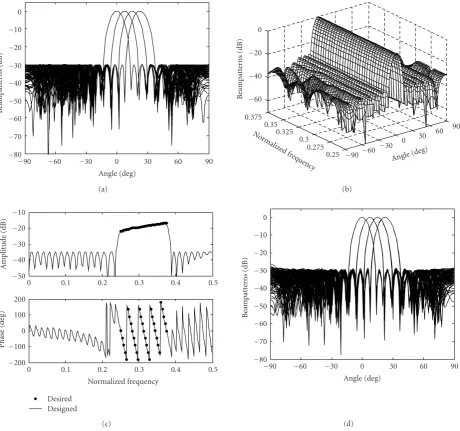
{0◦, 7.5◦, 15◦, 22.5◦}. The corresponding beampatterns at all
the 33 frequency bins are shown inFigure 3(a). The
varia-tion with frequency of the beampattern directed towards 0◦is
shown inFigure 3(b), from which it is seen that the resulting
beampattern within the mainlobe is approximately constant over the frequency band and the sidelobes are strictly
guaran-teed to be below−30 dB. Just as we desired, the SOCP-based
optimal array pattern synthesis approach provides small syn-thesized errors to CMRBs.
The desired frequency response of the FIR filters associ-ated with each sensor for each beamformer is calculassoci-ated from
the array weights via (13). The desired magnitude and phase
responses within the design band associated with the 5th
sen-sor for the first beamformer is shown in Figure 3(c)(with
“·”). Assume that the length of each FIR filter isL = 64.
By solving the optimization problem (15), the magnitude
and phase responses of the resulting FIR filter are shown in
Figure 3(c). Similar results were obtained for the other FIR filters.
The beampatterns of the time-domain FIR beamformer are calculated at the same 33 frequency bins and shown in
90 60 30 0 30 60 90
Angle (deg) 80
70 60 50 40 30 20 10 0
Beampatt
er
ns
(dB)
(a)
90 60 30 0 30 60
90 Angle (deg)
0.25 0.275 0.3 0.325 0.35 0.375
Normaliz ed
freque ncy 60
40 20 0
Beampatt
er
ns
(dB)
(b)
0.5 0.4
0.3 0.2
0.1 0
50 40 30 20 10
A
m
plitude
(dB)
0.5 0.4
0.3 0.2
0.1 0
Normalized frequency 200
100 0 100 200
Phase
(deg)
Desired Designed
(c)
90 60 30 0 30 60 90
Angle (deg) 80
70 60 50 40 30 20 10 0
Beampatt
er
ns
(dB)
(d)
Figure3: Design of the CMRBs. (a) Superposition of the beampatterns of frequency-domain CMRBs inK = 4 directions atJ = 33 frequencies. (b) Variation of beampattern with frequency for the beamformer of 0◦. (c) Frequency response of the FIR filter associated with the 5th sensor of the first beamformer. (d) Superposition of the beampatterns of time-domain CMRBs inK =4 directions calculated at
J=33 frequencies.
beampatterns since there exist some errors, which are very small and acceptable, between the desired and the designed filters.
A set of simulations was performed to compare the performance of the proposed FD-CMRBS and TD-CMRBS DOA estimators with the FD-FIBS DOA estimator proposed
by Lee in [5]. Signals from two correlated sources arrived
at θ1 = 8◦ and θ2 = 11◦. The first source signal is
as-sumed to be a bandpass white Gaussian process with flat spectral density over the design band. The second source signal is a delayed version of the first one. The delay at the
first sensor (the spatial reference point) is 10Ts. A spatially
white Gaussian bandpass noise with flat spectral density, in-dependent of the received signals, was present at each array
element. The received data was decomposed intoJ=33
fre-quency bins using an unwindowed FFT of length = 256.
For our frequency-domain processing approach, 30 snap-shots were used to calculate each DOA estimate. Thus, a total
of 256×30=7680 data samples were used for each DOA
esti-mation. The same amount of data samples was used for each DOA estimator. The conventional MUSIC DOA estimator is used on the beamformer outputs for each approach.
30 25 20 15 10 5 0 5 10
Angle (deg) 60
50 40 30 20 10 0
MUSIC
spatial
spect
ru
m
(dB)
FD-FIBS FD-CMRBS TD-CMRBS
Figure4: DOA estimation result for two correlated sources using FD-FIBS, FD-CMRDS, and TD-CMRDS.
20 10
0 10
20
SNR (dB) 0
0.2 0.4 0.6 0.8 1
P
robabilit
y
o
f
resol
ution
FD-FIBS FD-CMRBS TD-CMRBS
(a)
20 15
10 5
0 5
SNR (dB) 0
0.1 0.2 0.3 0.4 0.5
RMSE
(deg)
FD-FIBS FD-CMRBS
TD-CMRBS CRB (b)
Figure5: Performance comparison of FD-FIBS, FD-CMRBS, and FD-CMRBS for several SNR values. (a) Comparison of the resolution performance. (b) Comparison of the RMSEs.
The probability of resolution versus SNR for the two
sources is shown inFigure 5(a). Results are based on 100
in-dependent trials for each SNR, using the same array data for each approach. The signal sources are said to be resolved in a
trial if [19]
2
d=1
θd−θd<θ1−θ2, (28)
whereθdis the DOA estimate of thedth source in the trial.
The resulting sample root-mean-squared error (RMSE)
of the DOA estimate of the source atθ1=8◦, obtained from
100 independent trials, is shown in Figure 5(b). These
re-sults also show that the performance of TD-CMRBS is com-parable with that of FD-CMRBS, and that our approaches exhibit better resolution performance than that of FD-FIBS.
Also plotted inFigure 5(b)is the square root of Cramer-Rao
bound (CRB) of the source at 8◦, which is numerically
calcu-lated by the procedure given in the appendix of [3]. The
RM-SEs of our DOA estimators (FD-CMRBS and TD-CMRBS) are seen to be very close to the square root of CRB, which
60 30
0 30 60
90
Angle (deg) 0
5 10 15 20 25 30
Si
gn
al/int
erfer
enc
e-t
o
-noise
(dB)
Interfering source
Two correlated sources
(a)
60 30
0 30 60
90
Angle (deg) 40
35 30 25 20 15 10 5 0
MUSIC
spatial
spect
ru
m
(dB)
(b)
90 60 30 0 30 60 90
Angle (deg) 80
70 60 50 40 30 20 10 0
Beampatt
er
ns
(dB)
(c)
60 30
0 30 60
90
Angle (deg) 60
50 40 30 20 10 0
MUSIC
spatial
spect
ru
m
(dB)
(d)
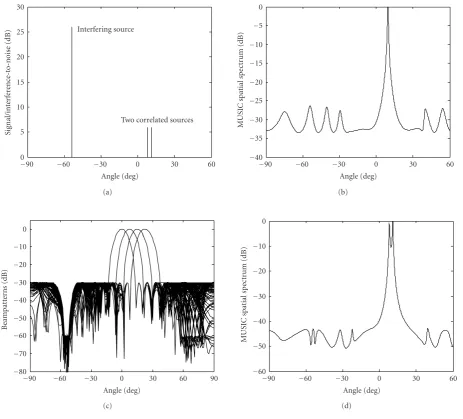
Figure6: DOA estimation for the scenario of strong out-of-sector interfering source. (a) Directions of the two correlated sources and the interfering source. (b) DOA estimation result using the beamformers with uniform sidelobes. (c) Superposition of the notch beampatterns. (d) DOA estimation result using the notch beamformers.
5.2. Interference rejection via notch beamformers
Consider the scenario of strong out-of-sector interfering sources. For the above linear array, the two correlated sources
arrived at 8◦and 11◦with SNR=6 dB. An interfering source,
independent of the wanted sources, arrived at −54◦ with
the interference-to-noise ratio (INR) of 26 dB, as shown in
Figure 6(a).
Figure 6(b) shows the spatial spectrum of beamspace
MUSIC using the beamformers shown in Figure 3(a). It is
seen that the CMRBs with uniformly sidelobe level of−30 dB
cannot resolve the correlated sources in the scenario of strong out-of-sector interfering sources.
TheK = 4 CMRBs that cover the same spatial sector
[0◦, 22.5◦] are designed by setting a notch with the depth of
−60 dB and the width of 4◦in the direction of the interfering
source. The resulting beampatterns are shown inFigure 6(c),
from which it is seen that the mainlobe response is constant over the design band and the prescribed notch is formed on each beampattern. The MUSIC DOA estimation method is
used on the K beamformer outputs. The spatial spectrum
of the frequency-domain processing approach is shown in
Figure 6(d), from which it is seen that our approach is able to resolve correlated source signals in the scenario of strong out-of-sector interfering sources.
6. CONCLUSION
frequency-domain broadband beamformers with constant mainlobe response are designed. The MUSIC method is then applied to the beamformer outputs to perform the DOA estimation. Computer simulations results show that our frequency-domain and time-domain broadband beamspace DOA estimators exhibit better resolution performance than the existing method. Our DOA estimators maintain good DOA estimation and spatial resolution capability in the sce-nario of strong out-of-sector interfering sources by setting a notch in the direction of the interfering source.
ACKNOWLEDGMENT
This project was supported by China Postdoctoral Science Foundation.
REFERENCES
[1] G. Su and M. Morf, “The signal subspace approach for multi-ple wide-band emitter location,”IEEE Transactions on Acous-tics, Speech, and Signal Processing, vol. 31, no. 6, pp. 1502– 1522, 1983.
[2] M. Wax, T.-J. Shan, and T. Kailath, “Spatio-temporal spec-tral analysis by eigenstructure methods,”IEEE Transactions on Acoustics, Speech, and Signal Processing, vol. 32, no. 4, pp. 817– 827, 1984.
[3] H. Wang and M. Kaveh, “Coherent signal-subspace process-ing for the detection and estimation of angles of arrival of multiple wide-band sources,”IEEE Transactions on Acoustics, Speech, and Signal Processing, vol. 33, no. 4, pp. 823–831, 1985. [4] R. O. Schmidt, “Multiple emitter location and signal param-eter estimation,”IEEE Transactions on Antennas and Propaga-tion, vol. 34, no. 3, pp. 276–280, 1986.
[5] T.-S. Lee, “Efficient wideband source localization using beam-forming invariance technique,” IEEE Transactions on Signal Processing, vol. 42, no. 6, pp. 1376–1387, 1994.
[6] D. B. Ward, Z. Ding, and R. A. Kennedy, “Broadband DOA estimation using frequency invariant beamforming,” IEEE Transactions on Signal Processing, vol. 46, no. 5, pp. 1463–1469, 1998.
[7] D. B. Ward, R. A. Kennedy, and R. C. Williamson, “FIR fil-ter design for frequency invariant beamformers,”IEEE Signal Processing Letters, vol. 3, no. 3, pp. 69–71, 1996.
[8] J. F. Sturm, “Using SeDuMi 1.02, a MATLAB toolbox for op-timization over symmetric cones,”Optimization Methods and Software, vol. 11, no. 1, pp. 625–653, 1999.
[9] M. S. Lobo, L. Vandenberghe, S. Boyd, and H. Lebret, “Appli-cations of second-order cone programming,”Linear Algebra and Its Applications, vol. 284, no. 1–3, pp. 193–228, 1998. [10] M. Pesavento, A. B. Gershman, and Z.-Q. Luo, “Robust array
interpolation using second-order cone programming,”IEEE Signal Processing Letters, vol. 9, no. 1, pp. 8–11, 2002. [11] S. A. Vorobyov, A. B. Gershman, and Z.-Q. Luo, “Robust
adap-tive beamforming using worst-case performance optimiza-tion: a solution to the signal mismatch problem,”IEEE Trans-actions on Signal Processing, vol. 51, no. 2, pp. 313–324, 2003. [12] S. Yan and Y. L. Ma, “Robust supergain beamforming for
circular array via second-order cone programming,”Applied Acoustics, vol. 66, no. 9, pp. 1018–1032, 2005.
[13] H. Cox, R. Zeskind, and M. Owen, “Robust adaptive beam-forming,”IEEE Transactions on Acoustics, Speech, and Signal Processing, vol. 35, no. 10, pp. 1365–1376, 1987.
[14] R. T. Compton Jr., “The relationship between tapped delay-line and FFT processing in adaptive arrays,”IEEE Transactions on Antennas and Propagation, vol. 36, no. 1, pp. 15–26, 1988. [15] L. C. Godara, “Application of the fast Fourier transform to
broadband beamforming,”Journal of the Acoustical Society of America, vol. 98, no. 1, pp. 230–240, 1995.
[16] H. L. Van Trees,Detection, Estimation, and Modulation Theory, Part IV, Optimum Array Processing, John Wiley & Sons, New York, NY, USA, 2002.
[17] S. Yan, “Optimal design of FIR beamformer with frequency invariant patterns,”Applied Acoustics, vol. 67, no. 6, pp. 511– 528, 2006.
[18] S. Yan and Y. L. Ma, “A unified framework for designing FIR filters with arbitrary magnitude and phase response,”Digital Signal Processing, vol. 14, no. 6, pp. 510–522, 2004.
[19] A. B. Gershman, “Direction finding using beamspace root es-timator banks,”IEEE Transactions on Signal Processing, vol. 46, no. 11, pp. 3131–3135, 1998.
Shefeng Yan received the B.S., M.S., and Ph.D. degrees in electrical engineering from Northwestern Polytechnical Univer-sity, Xi’an, China, in 1999, 2001, and 2005, respectively. He is currently a Postdoctoral Fellow with the Institute of Acoustics, Chi-nese Academy of Sciences, Beijing, China. His current research interests include array signal processing, statistical signal process-ing, adaptive signal processprocess-ing,