A SCHEMATIC FOR BROADBAND BEAM
FORMATION USING TIME-DELAY TECHNIQUE
Q. M. Alfred and K. Bishayee
Department of Electronics & Communication Engineering University Institute of Technology
Burdwan, West Bengal, India T. Chakravarty
Embedded Systems Innovation Laboratory Tata Consultancy Services
Abhilash, Bangalore, India S. K. Sanyal
Department of Electronics & Telecommunication Engineering Jadavpur University
Kolkata, India
Abstract—Simultaneous multiple beam generation by phased array antennas have great importance in recent time, e.g., multiple access satellite communication systems, MIMO (multiple input and multiple output), target tracking radars etc. Here in this article a novel yet simple wideband multiple beam formation network (BFN) has been proposed. Unlike the conventional phase shifter based system, this scheme is based on true time-delay units which is potential for wideband application.
1. INTRODUCTION
array needs to transmit multiple beams simultaneously in prefixed directions.
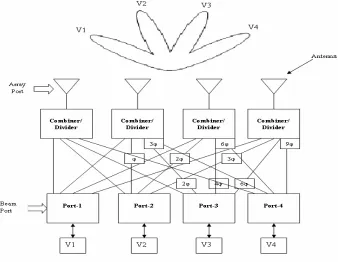
For understanding the principle of multiple beamforming, here one basic BFN having multiple beams is briefly explained with the help of Fig. 1. Suppose the BFN produces four simultaneous beams V1, V2, V3 and V4 corresponding to the feeds at beam port respectively. Necessary condition to generate these multiple beams is that, the beams must be mutually orthogonal is mentioned later in this section.
Let us consider the excitation weight vectors at the array port are [w1,w2,w3,w4], [x1,x2,x3,x4], [y1,y2,y3,y4] and [z1,z2,z3,z4]
corresponding to beams V1, V2, V3 and V4 respectively.
Figure 1. Basic beam forming network.
The beams will be mutually orthogonal if it satisfies the following condition.
4
i=1
wixi∗= 4
i=1
wiyi∗= 4
i=1
Without any loss of simplicity, excitation vectors at each beam port can be expressed by the Eq. (2) to Eq. (5) considering their amplitude as uniform.
[w1, w2, w3, w4] = [1,exp (−jφw),exp (−j2φw),exp (−j3φw)] (2)
[x1, x2, x3, x4] = [1,exp (−jφx),exp (−j2φx),exp (−j3φx)] (3)
[y1, y2, y3, y4] = [1,exp (−jφy),exp (−j2φy),exp (−j3φy)] (4)
[z1, z2, z3, z4] = [1,exp (−jφz),exp (−j2φz),exp (−j3φz)] (5)
whereφwis the phase difference between the adjacent antenna elements
for beamV1. Similarly,φx,φy and φz are the phase difference for the
other three constituent beams, V2, V3, V4 respectively.
It can be shown [1] that, putting these values of excitation vectors in Eq. (1) generates the criteria for orthogonality, as followed by Eq. (6) to Eq. (8).
φx = φw+
1
2π (6)
φy = φw+π (7)
φz = φw+
3
2π (8)
It is clear form the above formulations that, for the four beam case, the phase gradient between any two beam ports is π2. More generally, forN numbers of orthogonal beams, the phase difference between any two consecutive ports is 2Nπ. It can be implemented by phase shifters, power divider/power combiner etc. but simple beam forming increases the size of the array antenna.
loss. There are several digital beam forming techniques [7–13], which mainly discuss adaptive beamforming.
Here in this communication, a phase-shifterless schematic is explained for the purpose of orthogonal beam formation. Instead of using phase-shifter, time delay units (delay lines) are judiciously exploited in order to make the system bandwidth efficient and less complex.
2. IMPLEMENTATION WITH TIME DELAY
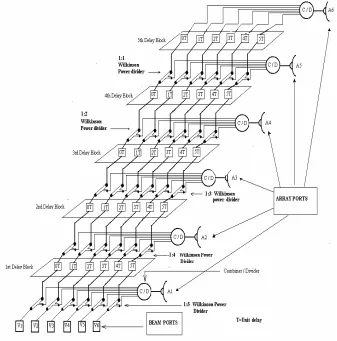
Consider a linear array of six (6) isotropic radiating elements (A1− −A6) fed by six different signals (V1, V2, V3, V4, V5 &V6) to the beam ports in the transmitting mode as shown in the Fig. 2.
Conventionally, signals fed in each port are to be equally subdivided into numbers of antenna elements so that they can be fed to the each array element. According to the orthogonality criteria (derived in the previous section), the phase difference between the equally divided signals in each port must be 2π/6 and also the same is true for in-between any two ports.
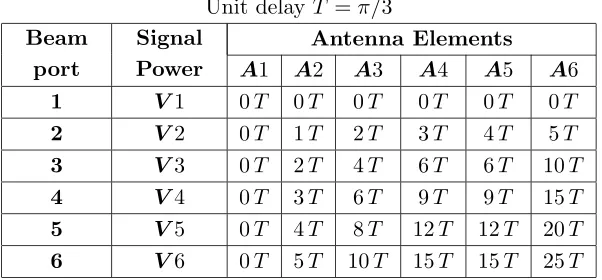
Unlike the phase-shifters, delay line of unit delay T is chosen (calibrated) to provide phase difference ofπ/3. In Table 1, the required delays (in terms of unit delayT) for the antenna elements are given in matrix form.
Table 1. Required delays for multiple beam formation. Unit delay T =π/3
Beam port
Signal Power
Antenna Elements A1 A2 A3 A4 A5 A6
1 V1 0T 0T 0T 0T 0T 0T
2 V2 0T 1T 2T 3T 4T 5T
3 V3 0T 2T 4T 6T 6T 10T
4 V4 0T 3T 6T 9T 9T 15T
5 V5 0T 4T 8T 12T 12T 20T
6 V6 0T 5T 10T 15T 15T 25T
It is obvious from the above table that, realization using time delay requires long section of delay lines which may make the system bulky and lossy.
fed to the antennaA2 and remaining 4/5 power is passed to the 2nd delay block. In this way, before reaching the 5th element the power is equally (3 dB) divided into two parts, one is fed to the 5th element and other is to 6th element. Here, Wilkinson divider [14–16] is proposed for unequal power division as they have better port to port isolation and provide zero (0) degree phase difference between through port and coupled port. Moreover it is simple to design and shows broadband property in operating frequency range. Finally, power from all the beam ports with different phase shift are combined to provide multiple beams in the space. The same is also valid for receiving antenna, where Wilkinson power dividers acts as an asymmetric combiner who combines the power is coming from two arms. As a result, the signal powers impinging from different prefixed direction are collected by the beam ports. In the array port combiners are replaced by the dividers. 3. RESULTS
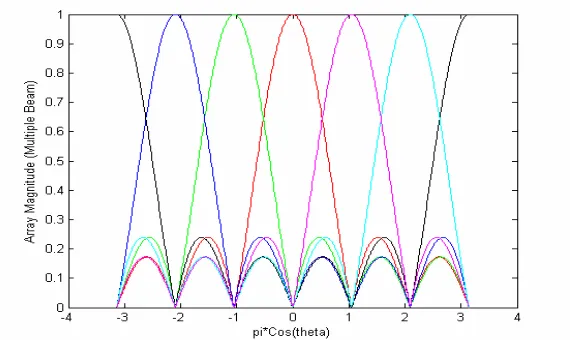
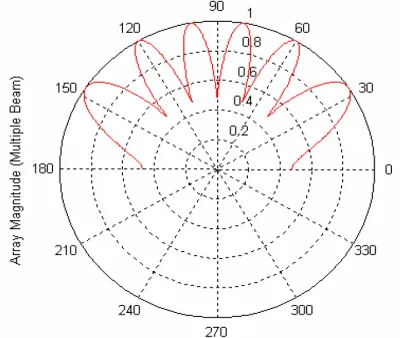
Justification of the proposed scheme is shown by the results obtained in the Matlabc simulation. Simulation is performed for six beam ports and an array of six antenna elements. The radiation pattern by the array is shown in Fig. 3.
Figure 3. Array pattern for six individual sources.
Figure 4. Scalloped pattern (polar plot).
4. PERFORMANCE OF DELAY LINE TECHNIQUE AND CONCLUSION
For a long time, Butler matrix realized with phase shifters has been widely used for analog beam formation. But as said earlier the phase shifters are inherently narrowband and so this matrix is not suitable for broadband operation.
Though the proposed scheme is comparatively bulky with respect to the Butler matrix but its main advantage is that, delay lines made with phase shifter compensate with varying frequency and does not shifts the main beam direction, or suitable for wideband application. REFERENCES
1. Bhattacharyya, A. K., Phased Array Antennas, John Wiley, NJ, 2006.
2. Butler, J. L. and R. Lowe, “Beam forming matrix simplifies design of electronically scanned antennas,” Electronic Design, Vol. 9, 170–173, Apr. 12, 1961.
3. Levy, R., “High power X-band butler matrix simplifies,”
Microwave J., Vol. 27, 153, Apr. 1984.
5. Blass, J., “Multi-directional antenna — A new approach to stacked beams,”IRE Nat. Conv. Record, Pt. 1, 48–60, 1960. 6. Mosca, S., F. Bilotti, A. Toscano, and L. Vegni, “A novel design
method for blass matrix beam-forming network,”IEEE Trans. for Antennas and Propagation, Vol. 50, 225–232, Feb. 2002.
7. Steyskal, H. and J. F. Rose, “Digital beam forming for radar,”
IEE Proc., Vol. 127, Pt. F, No. 4, Aug. 1980.
8. Dessouky, M., H. Sharshar, and Y. Albagory, “A novel tapered beamforming window for uniform concentric circular arrays,”
Journal of Electromagnetic Waves and Applications, Vol. 20,
No. 3, 409–415, 2006.
9. Dessouky, M., H. Sharshar, and Y. Albagory, “Improving the cellular coverage from a high altitude platform by novel tapered beamforming technique,” Journal of Electromagnetic Waves and Applications, Vol. 21, No. 13, 1721–1731, 2007.
10. Liu, W. and R. Langley, “Adaptive wideband beamforming with combined spatial/temporal subband decomposition,”PIERS Online, Vol. 3, No. 7, 2007.
11. Liao, G. S., H. Q. Liu, and J. Li, “A subspace-based robust adaptive capon beamforming,”PIERS Online, Vol. 2, No. 4, 374– 379, Cambridge, USA, Mar. 26–29, 2006.
12. Singh, A. Kr., P. Kumar, T. Chakravarty, G. Singh, and S. Bhooshan, “A novel digital beamformer with low angle reso-lution for vehicle tracking radar,” Progress In Electromagnetics Research, Vol. 66, 229–237, 2006.
13. Fakoukakis, F. E., S. G. Diamantis, A. P. Orfanides, and G. A. Kyriacou, “Development of an adaptive and a switched beam smart antenna system for wireless communications,”
Journal of Electromagnetic Waves and Applications, Vol. 20,
No. 3, 399–408, 2006.
14. Wilkinson, E. J., “An N-way hybrid power divider,” IRE Trans. Microwave Theory Tech., Vol. 8, 116–118, Jan. 1960.
15. Lim, S., S.-W. Lee, C.-S. Kim, J.-S. Park, D. Ahn, and S.-W. Nam, “A 4 : 1 unequal wilkinson power divider,” IEEE Microwave and Wireless Components Letters, Vol. 11, No. 3, 124–126, Mar. 2001. 16. Lim, J.-S., G.-Y. Lee, Y.-C. Jeong, D. Ahn, and K.-S. Choi, “A 1 : 6 unequal wilkinson power divider,” 36th European Microwave Conference Proceedings, 200–203, Manchester, Sept. 2006.
17. Gu, Y.-J., Z.-G. Shi, K. S. Chen, and Y. Li, “Robust adaptive beamforming for a class of Gaussian steering vector mismatch,”
18. Sanyal, S. K., Q. M. Alfred, and T. Chakravarty, “A novel schematic for calibration of large phased array antenna using programmable time-delay units,” Progress In Electromagnetics Research, PIER 65, 81–91, 2006.
19. Sanyal, S. K., Q. M. Alfred, and T. Chakravarty, “A novel beam-switching algorithm for programmable phased array antenna,”
Progress In Electromagnetics Research, PIER 60, 187–196, 2006. 20. Mouhamadou, M., P. Vaudon, and M. Rammal, “Smart
antenna array patterns synthesis: Null steering and multi-user beamforming by phase control,” Progress In Electromagnetics Research, PIER 60, 95–106, 2006.
21. Song, M. and T. Hong, “Sum and difference multiple beam modulation transmitted by multimode horn antenna for inverse monopulse direction-finding,” Progress In Electromagnetics Re-search, PIER 82, 367–380, 2008.
22. Varlamos, P. K. and C. N. Capsalis, “Electronic beam steering using switched parasitic smart antenna arrays,” Progress In Electromagnetics Research, PIER 36, 101–119, 2002.
23. Ismail, T. H., M. J. Mismar, and M. M. Dawoud, “Linear array pattern synthesis for wide band sector nulling,” Progress In Electromagnetics Research, PIER 21, 91–101, 1999.
24. Eldek, A. A., “Design of double dipole antenna with enhanced usable bandwidth for wideband phased array applications,”
Progress In Electromagnetics Research, PIER 59, 1–15, 2006. 25. Sotiriou, A. I., P. K. Varlamos, P. T. Trakadas, and C. Capsalis,
“Performance of a six-beam switched parasitic planar array under one path Rayleigh fading environment,” Progress In Electromagnetics Research, PIER 62, 89–106, 2006.
26. Sotiriou, A. I., P. T. Trakadas, and C. Capsalis, “Uplink carrier-to-interference improvement in a cellular communication system when a six-beam switched parasitic array is implemented,”
Progress In Electromagnetics Research B, Vol. 5, 303–321, 2008. 27. Yuan, H.-W., S.-X. Gong, P.-F. Zhang, and X. Wang, “Wide