Energy Saving Transmission for LTE Base stationBased on
Optimized Rate and Power control
A.Gopal & Anjaneyulu.Borelli
1Associate Professor in NallaNarasimha Reddy Education Society's Group of Institutions, Hyderabad.
2Asst.Prof in NallaNarasimhareddy education society's group of institutions, Hyderabad.
Abstract
As of late, the use of records is extra than available belongings. Because of quickly growing necessities and development of the inexperienced correspondence innovation may spark off cross for a few, energy sparing plans in structures, the extra speedy[1] growing system is LTE(4G), in order to give greater hobby, because of the patron conditions, so the problems in the versatile systems are (1) movement in systems (2) extra power utilization of offering hubs (3) effective and solid hub preference. [5] To enhance the system framework, LETDR – Location, Energy, Throughput and Delay proportion calculation is proposed to choose gifted hub hand-off hub. Above proposed fashions fulfills the consumer prerequisites with expanding range of customers. Recreation comes approximately had been shown the power utilization exhibit and moreover the proposed framework is superior to the contemporary plans.
Key words: - Energy sparing, Green
correspondence, LTE (Long term Evolution), Network, Resource distribution, Component transporter, Network motion.
1 INTRODUCTION
distribution is determined to quality of service (QOS). In [8] the effective pass layer parcel booking and asset management calculation is proposed and for all intents and purposes completed. Presents gifted designation of subcarriers and electricity asset. In quantized water filling calculation is actualized. Has the quick calculations to discern the right asset designation. Be that as it is able to, it did not taken into consideration strength task or energy usage. The problem is stressed and remote correspondence, energy sparing transmissions associated topics has been alluded from and, it displays computationally productive energy sparing framework for downlink transmission changed into proposed in OFDMA based totally multi bearer phase frameworks. The decency idea isn't considered in. Indeed, even it functions admirably, have an trouble in facts fee at the same time as organize motion hundreds. [10] So in view of the above benefits and disadvantages of present fashions, the point of this paper is to decrease the aggregate power utilization in every sub edges and moreover to preserve up the character of management and reasonableness of correspondence. So the blockading likelihood and records fee has been considered to preserve up the QOS. The inspiration of the paintings is to provide productive vitality designation framework and transfer hub preference inside
the LTE correspondence and the large subject is to present consumer conditions.
2.RELEGATED WORK 2.1Existing System
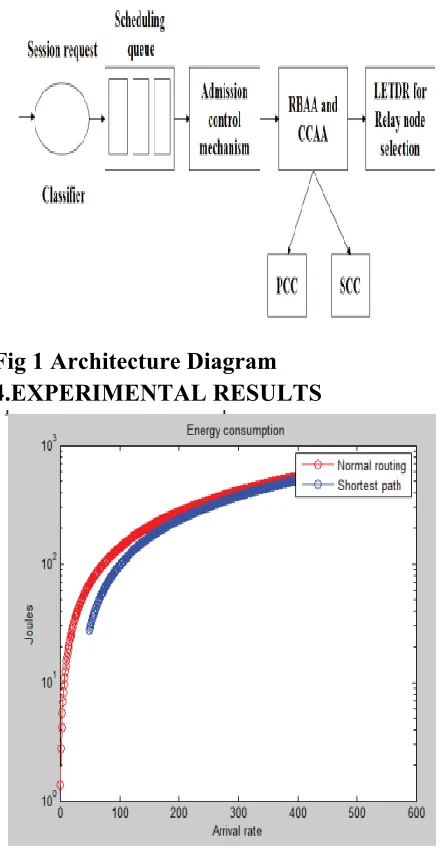
The taken into consideration gadget display is skillfully confirmed up. The session-stage transmission is normal within the model. Expect that the nice number of classes that each CC can suit is predictable established as S. Right while a consultation request arrives, the classifier within the gadget will to start with bunch it into both RT or NRT consultation, and after that it will likely be sent to the reserving line. [9] Next, the confirmation manage section is proposed to be used to make feel of if to deter the consultation request inside the reserving line and in addition which CC ought to be consigned to the consultation if it's miles allowed to get to the framework.
2.2Proposed System
asset restrict inside the nthtime space and ithsub channel. Tsf is the time period of each sub outline in seconds. [3] At that factor wk is the association of all asset hinder in each sub fringe of transporter segments. Okay esteem can be as 1(Less interest utilizing PCC) and a couple of (heavy movement utilising SCC). So the vitality required for the prevailing consultation is figured via following circumstance.
3.IMPLEMENTATION
3.1 Resource block allocation algorithm (RBAA):
Asset rectangular element calculation considers type of allocation,hey may be transfer pace and vitality. [8] This calculation works for each sub outlines on consumer classes. In view of the necessities of person,it will dispense the belongings in keeping with the rest of the assets. Once the asset distribution calculation finishes its operation and the consultation will goes into the bearer section enactment calculation.
3.2 Carrier component activation
algorithms(CCAA):
CCAA has sorts of bearer components.They are intended to fulfill the purchaser necessities whilst the hobby changes.[4]PCC will actuated at the bottom station for purchaser session in low stage pastime. SCC might be initiated at base station for the customer consultation in bizarre nation movement.
3.3 LETDR algorithm:
Area, Energy, Throughput and Delay Ratio calculation based totally parameter is computed for every final hub to figure effectiveness of transfer hub. [7] In this calculation, the limit esteems for all parameters are appointed to make enough the correspondence can accomplish Quality of Service.
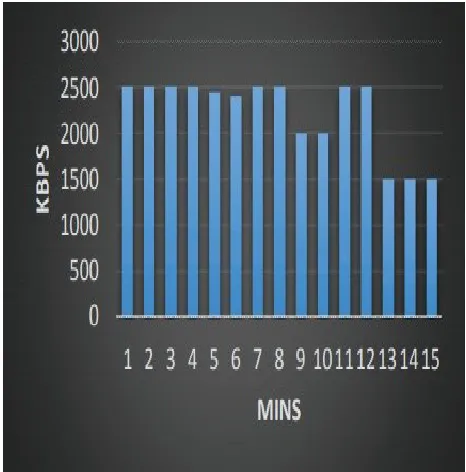
Fig 2.Shows the energy consumption based on thepath selection with the comparison.Energy consumption comparison withrouting.
Fig 3.Shows the energy consumption comparisongraph between the existing and
proposed scheme.Energy consumption
comparison with routing.
Fig 4.Fairness index for proposed scheme.
Fig 5.Data arrival rate of proposed scheme 5.CONCLUSION
In this paper, a scheme for energy saving downlink transmission and relay node choice set of rules LETDR become efficiently proposed. Our proposed model can efficaciously allocate useful resource for every users.[6] Could able to satisfy the person requirement even as the site visitors is heavy in community with the aid of effectively utilizing the CCAA. LETDR might improve the conversation system by using choosing green nodes. In destiny work and analysis, we can enable the running features and benefits of multihop networks.
6.REFERENCE
LTE Base–station,”IEEECommun. Mag., vol. 48, no. 2, pp. 88–93, Feb. 2010.
[2] A. Ghosh, R. Ratasuk, B. Mondal, N. Mangalvedhe, and T.Thomas, “LTE-advanced: Next-generation wireless broadbandtechnology,” IEEE Wireless Commun., vol. 17, no. 3, pp. 10– 22,
Jun. 2010.
[3] L. M. Correia, D. Zeller, O. Blume, D. Ferling, Y. Jading, I.Go`idor, G. Auer, and L.
Van der Perre, “Challenges and
enablingtechnologies for energy aware mobile radio networks,” IEEECommun. Mag., vol. 48,no. 11, pp. 66–72, Nov. 2010.
[4] V. Mancuso and S. Alouf, “Reducing costs and pollution incellular networks,” IEEE Commun. Mag., vol. 49, no. 8, pp. 63–71,Aug. 2011.
[5] J. Baliga, R. Ayre, K. Hinton, and R. S. Tucker, “Energyconsumption in wired and wireless access networks,” IEEECommun. Mag., vol. 49, no. 6, pp. 70–77, Jun. 2011.
[6] C. Y. Wong, R. S. Cheng, K. B. Lataief, and R. D. Murch,“Multiuser OFDM with adaptive subcarrier, bit, and powerallocation,” IEEE J. Select. Areas Commun., vol. 17, no. 10, pp.1747–1758, Oct.1999.
[7] Z. Shen, J. G. Andrews, and B. L. Evans, “Optimal powerallocation in multiuser OFDM
systems,” in Proc. IEEEGLOBECOM, San Francisco, CA, USA, Dec. 2003, pp. 337–341. [8] S. S. Jeong, D. G. Jeong, and W. S. Jeon, “Cross-layer designof packet scheduling and
resource allocation in OFDMA
wirelessmultimedia networks,” in Proc. IEEE VTC Spring, Melbourne,Vic., May 2006, pp.309–313.
[9] D. Kivanc, G. Li, and H. Liu, “Computationally ef¿cientbandwidthallocation and power control for OFDMA,” IEEE Trans. WirelessCommun., vol. 2, no. 6, pp. 1150–1158, Nov. 2003.
[10] Y.-L. Chung and Z. Tsai, “A quantized
water-¿llingpacketscheduling scheme for
downlink transmissions in
LTE-advancedsystems with carrier aggregation,” in Proc. 18th IEEE Int. Conf.
Software Telecommun.Comp.Netw. (IEEE
SoftCOM), Split, Croatia, Sep. 2010, pp. 275– 279.
A.Gopal hailed from RajannaSiricilla(Dist) born on 7th June 1981. He received B-Tech in Electronics and Communication Engineering from JNTUH, Hyderabad, T.S. He received M-Tech in Systems and Signal Processing from JNTUH, Hyderabad, T.S, India. His research interests include Green Communications, Analog VLSI Design and Image Processing. He has published one international journal. Presently he is working as Associate Professor in NallaNarasimha Reddy Education Society's Group of Institutions, Hyderabad, T.S. He is having 12 years of experience in teaching field in Communications and Electronics related areas.
ANJANEYULU.BORELLI. hailed from
JANGAON (Dist.) born on 3rd August. He received B. Tech in Electronics and
Communication Engineering from VBIT