Multi -Stage Smart Web Crawler Engine for Mining
Deep web Databases
P. D. Thakre & Sonali J. Rathod
Prof, Department of CSE, JCOET Yavatmal, Maharashtra, India,
PG Student, Department of CSE, JCOET Yavatmal, Maharashtra, India,
[email protected],
Abstract
-
As deep web grows at a very fast pace,there has been increased interest in techniques that
help efficiently locate deep-web interfaces. However,
due to the large volume of web resources and the
dynamic nature of deep web, achieving wide
coverage and high efficiency is a challenging issue.
We propose a three-stage framework, for efficient
harvesting deep web interfaces.Project experimental
results on a set of representative domains show the
agility and accuracy of our proposed crawler
framework, which efficiently retrieves deep-web
interfaces from large-scale sites and achieves higher
harvest rates than other crawlers using Naïve Bayes
algorithm. In this paper we have made a survey on
how web crawler works and what are the
methodologies available in existing system from
different researchers.
Keywords :
Deep web, web mining, feature
selection, ranking
1. Introduction
The deep (or hidden) web refers to the contents
lie behind searchable web interfaces that cannot
be indexed by searching engines. Based on
extrapolations from a study done at University
of California, Berkeley, it is estimated that the
deep web contains approximately 91,850
terabytes and the surface web is only about 167
terabytes in 2003. More recent studies estimated
that 1.9 petabytes were reached and 0.3
petabytes were consumed worldwide in 2007.
An IDC report estimates that the total of all
digital data created, replicated, and consumed
will reach 6 petabytes in 2014. A significant
portion of this huge amount of data is estimated
to be stored as structured or relational data in
web databases deep web makes up about 96% of
all the content on the Internet, which is 500-550
times larger than the surface web. These data
contain a vast amount of valuable information
and entities such as Infomine, Clusty, Books In
Print may be interested in building an index of
the deep web sources in a given domain (such as
book). Because these entities cannot access
the
proprietary web indices of search engines
(e.g., Google and Baidu), there is a need for
an efficient crawler that is able to accurately
and quickly explore the deep web databases.
It is challenging to locate the deep web
databases, because they are not registered with
any search engines, are usually sparsely
distributed, and keep constantly changing. To
address this problem, previous work has
proposed two types of crawlers, generic
crawlers and focused crawlers. Generic
focus on a specific topic. Focused crawlers such
as Form-Focused Crawler (FFC) and Adaptive
Crawler for Hidden-web Entries (ACHE) can
automatically search online databases on a
specific topic. FFC is designed with link, page,
and form classifiers for focused crawling of web
forms, and is extended by ACHE with
additional components for form filtering and
adaptive link learner.
The link classifiers in these crawlers play a
pivotal role in achieving higher crawling
efficiency than the best-first crawler. However,
these link classifiers are used to predict the
distance to the page containing searchable
forms, which is difficult to estimate, especially
for the delayed benefit links (links eventually
lead to pages with forms). As a result, the
crawler can be inefficiently led to pages without
targeted forms. Besides efficiency, quality and
coverage on relevant deep web sources are also
challenging.
The propose work, achieve both wide coverage
and high efficiency for a focused crawler. Our
main contributions are:We propose a novel
three-stage framework to address the problem of
searching for hidden-web resources. Our site
locating technique employs a reverse searching
technique (e.g., using Google’s”link:” facility to
get pages pointing to a given link) and
incremental three-level site prioritizing
technique for unearthing relevant sites,
achieving more data sources. During the in-site
exploring stage, design a link tree for balanced
link prioritizing, eliminating bias toward web
pages in popular directories.
In the propose work an adaptive learning
algorithm that performs online feature selection
and uses these features to automatically
construct link rankers. In the site locating stage,
high relevant sites are prioritized and the
crawling is focused on a topic using the contents
of the root page of sites, achieving more
accurate results. During the in-site exploring
stage, relevant links are prioritized for fast
in-site searching
2.Literature survey
There is a rich literature, here we discuss the
most related work.
Feng Zhao et al. [1] proposeda two-stage
Crawler for Efficiently Harvesting Deep-Web
Interfaces. Deep web grows at a very fast pace,
there has been increased interest in techniques
that help efficiently locate deep-web interfaces.
However, due to the large volume of web
resources and the dynamic nature of deep web,
achieving wide coverage and high efficiency is
a challenging issue.
Jianxiao Liu et al.[2] proposed an Approach of
Semantic Web Service Classification Based on
Naive Bayes ,proposed a method to classify and
organize the semantic Web services to help
users find the services to meet their needs
quickly and accurately is a key issue to be
solved in the era of service-oriented software
Bo Tang, presents an approach toward Optimal
Feature Selection In Naive Bayes For Text
Categorization [3].
Author proposed that, automated feature
selection is important for text categorization to
reduce the feature size and to speed up the
learning process of classifiers.
AmrutaPandit and Prof. ManishaNaoghare[4],
proposed work for Efficiently Harvesting Deep
Web Interface with Reranking and
Clustering.The rapid growth of the deep web
poses predefine scaling challenges for general
purpose crawler and search engines. There are
increasing numbers of data sources now become
available on the web, but often their contents are
only accessible through query interface. Here
author proposed a framework to deal with this
problem, for harvesting deep web interface.
Anand Kumar et al. [5] presents a two-phase
system, to be specific Smart Crawler, for
productive gathering profound web interfaces.In
this paper, author proposed, web develops at a
quick pace, there has been expanded enthusiasm
for procedures that assistance effectively find
profound web interfaces. Be that as it may,
because of the expansive volume of web assets
and the dynamic way of profound web,
accomplishing wide scope and high proficiency
is a testing issue. In the primary stage, Smart
Crawler performs site-based hunting down
focus pages with the assistance of web crawlers,
abstaining from going to a substantial number of
pages
.
AkshayaKubba[7] mentioned that, Web mining
is an important concept of data mining that
works on both structured and unstructured data.
Search engine initiates a search by starting a
crawler to search the World Wide Web (WWW)
for documents .Web crawler works in a ordered
way to mine the data from the huge repository.
The data on which the crawlers were working
was written in HTML tags, that data lags the
meaning.
Monika Bhide et al. focus on accessing relevant
web data and represents significant algorithm
i.e. adaptive learning algorithm, reverse
searching and classifier[8].the web stores huge
amount of data on different topics.The main
goal is to locating deep web interfaces. To
locating deep web interfaces uses techniques
and methods.The locating deep web interfaces
system works in two stages. In the first stage
apply reverse search engine algorithm and
classifies the sites and the second stage ranking
mechanism use to rank the relevant sites and
display different ranking pages.
RajuBalakrishnan et al.[10] proposed, selecting
the most relevant web databases for answering a
given query. The existing database selection
methods (both text and relational) assess the
source quality based on the
query-similarity-based relevance assessment.
D. Shestakov, address the accurate estimation of
deep web by sampling one national web
results obtained when surveying Russian
web.The Host-IP clustering sampling technique
addresses the drawback of previous deep web
surveys and allow to characterize a national
segment of deep web.Heaiso got an insights on
the sight of Russian deep Web by calculating
upper bound estimate for the total number of
entity in online database.
SuryakantChouthary et al. [12] worked for
model-based rich internet applications crawling
in which they they design methods based on
menu and probability models. Strategies for
crawling Web sites efficiently have been
described more than a decade ago. Since then,
Web applications have come a long way both in
terms of adoption to provide information and
services and in terms of technologies to develop
them.
3. Proposed Architecture:
Fig.1 Proposed system Architecture
To efficiently and effectively discover
deep web data sources, Crawler is designed with
a three-stage architecture, as shown in above
Figure. The first site locating stage finds the
most relevant site for a given topic, the second
in-site exploring stage uncovers searchable
forms from the site and then the third stage
apply naïve base classification ranked the result.
Specifically, the site locating stage starts with a
seed set of sites in a site database. Seeds sites
are candidate sites given for Crawler to start
crawling, which begins by following URLs
from chosen seed sites to explore other pages
and other domains. When the number of
unvisited URLs in the database is less than a
threshold during the crawling process, Crawler
performs “reverse searching” of known deep
web sites for center pages (highly ranked pages
that have many links to other domains) and
feeds these pages back to the site database. Site
Frontier fetches homepage URLs from the site
database, which is ranked by Site Ranker to
prioritize highly relevant sites.
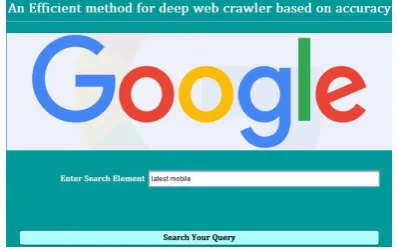
Fig.2 : GUI Design for Crawling System
The above figure is the first form of design for
proposed system. In this page user needs to
enter the query that’s gets searched on Google
search engine with help of Google API
framework. Using this first 5 results of Google
search engine can be searched. This is an
example for searching this keyword on Google.
As the keyword is entered it is send to google
search engine using query based JSON API. The
User Quer
y
Preprocess orRule
Ranking
Algorith m
R A N K E D
R E S U L T JSON service
Classifier algorithm(TF*IDF
) HTML Extraction/ Processor Google API web
nexr form shows the result of searching this
keyword on proposed system.
Fig. 3: Data access from Google
Figure shows results that are fetched from
Google Search Engine. Basic preprocessing is
done as Google API return not only link but
page details like meta tag titles URL Images and
promotional links. All have been removed and
original ranked results are showed.
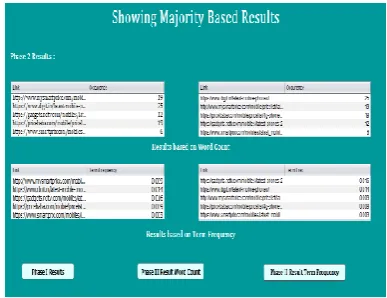
Fig.4: word count on top results
As we move on to the next phase the proposed
algorithm starts re-ranking the results based on
k-NN and Naïve Bayes algorithm. Using this
algorithm two different frequencies is
calculated. First is word-count and second is
term frequency.
Fig.5 :Original Link Ranked Result
The above graph shows the ranking of links
as provided by Google search engine. The
bar chart has been drawn using JFreechart
library of java and is always changing based
on results provided by Google.
Fig.6 :Link Result With Word Count
The above graph shows the ranking of links
based on wordcount based k-NN algorithm in
which all the links are searched based on the
keyword being searched in the first phase of
algorithm. Using this we can verify the results
Fig.7: Link Result with Term Frequency
The above graph shows the ranking of links
based on TF based NB algorithm in which
all the links are searched based on the
keyword being searched in the first phase of
algorithm. Using this we can verify the
results of Google using NB algorithm.
4.Results and discussion
Consider an example, When
a
search engine
returns 30 pages only 20 of
which were relevant while failing to return
40 additional relevant pages, its precision is
20/30 = 2/3 while its recall is 20/60 = 1/3.
So, in this case, precision is "how useful the
search results are", and recall is "how
complete the results are".
We consider here 100 queries.
For one query the top 5 result will fetch out
of 10 results from Google. Thus for 100
queries 500 results will fetch out of 1000
results. The recall, precision and accuracy
of a system are calculated from the results
taken from the Google and observing
results. These experimental results indicate
that use of Naïve Bayes Algorithm having
better performance than KNN Algorithm for
accuracy.
5. Conclusion
We
propose
an
effective
harvesting
framework for deep-web interfaces. We
have shown that our approach achieves both
wide coverage for deep web interfaces and
maintains highly efficient crawling. This is
a focused crawler consisting of two stages:
efficient site locating and balanced in-site
exploring.Based on the obtained results
from study, we conclude that, the approach
has better accuracy than the other crawling
method. The proposed crawler based on
Naïve Bayes classifier. Past frameworks
have numerous issues and difficulties. To
overcome this Crawler achieves more
accurate results and reranks link to prioritize
highly relevant ones for a given topic