227 | P a g e
GAIT RECOGNITION FOR HUMAN
IDENTIFICATION USING HIGH ORDER SHAPE
CONFIGURATION
Prof. Aware
S. P.
1, Dr. Sedani
C. M.
2, Mr. Sedani
J.C.
3 1ETC Dept.
2Mech. Dept. MSSCET, Jalna. Dr. BAMU Aurangabad, MS, (India)
3
CSE Dept. PRMITR. Badnera SGBAU Amaravati MS, (India)
ABSTRACT
This paper put forward Different from gait classification which classifies human motion into categories, such as
walking, running, and jumping, gait recognition, also called gait-based human identification, is a relatively new
research direction in biometrics. It aims to discriminate individuals by the way they walk. In comparison with
other first-generation biometric features such as fingerprint and iris, gait has the advantage of being
unobtrusive, i.e., it requires no subject. Human identification at a distance has recently gained growing interest
from computer vision researchers. Gait recognition aims essentially to address this problem by identifying
people based on the way they walk. In this paper, a simple but efficient gait recognition algorithm using Higher
Order Shape Configuration Gait has been known as an effective biometric feature to identify a person at a
distance. However, variation of walking speeds may lead to significant changes to human walking patterns. It
causes many difficulties for gait recognition. A comprehensive analysis has been carried out in this paper to
identify such effects. Based on the analysis, Procrustes shape analysis is adopted for gait signature description
and relevant similarity measurement.
Key words: Human Motion Analysis, Biometrics, Principle Component Analysis, Differential
Composition Model (DCM), Gait Recognition, High Order Derivative, Human Identification,
Procrustes Shape Analysis (PSA), Walking Speed Variation.
I.
INTRODUCTION
In a real-world environment, there are various factors significantly affecting human gait, including dressing
different clothes, walking while carrying different objects, walking on different surfaces, walking with different
shoes, walking under variable speeds, and walking while being observed from arbitrary views [2]. Among these
factors, speed change has been regarded as one of most commonly seen challenging factors. The change of
walking speed can significantly change the gait shape description. Human identification at a distance has
recently gained growing interest from computer vision researchers. Gait recognition aims essentially to address
this problem by identifying people based on the way they walk. In this paper, a simple but efficient gait
recognition algorithm using high order shape configuration. For each image sequence, a background subtraction
algorithm and a simple correspondence procedure are first used to segment and track the moving silhouettes of a
228 | P a g e
time-varying distance signals derived from a sequence of silhouette images to reduce the dimensionality of the
input feature space. Supervised pattern classification techniques are finally performed in the lower-dimensional
eigenspace for recognition. This method implicitly captures the structural and transitional characteristics of gait.
Extensive experimental results on outdoor image sequences demonstrate that the proposed algorithm has an
encouraging recognition performance with relatively low computational cost. This interest is strongly driven by
the need for automated person identification systems for visual surveillance and monitoring applications in
security-sensitive environments such as banks, parking lots, and airports. VISUAL analysis of human motion
[17], [25] attempts to detect, track, and identify people, and, more generally, to understand human behaviors
from image sequences involving humans. Biometrics is a technology that makes use of the physiological or
behavioral characteristics to authenticate the identities of people [18]. An ongoing research project, the Human
ID program [1] initialized by DARPA(Defense Advanced Research Project Agency), aims to develop a full
range of multimode surveillance technologies for successfully detecting, classifying, and identifying humans to
enhance the protection of facilities from terrorist attacks. Its focus is on dynamic face recognition and
recognition from body dynamics including gait. In recent years, several methods [4]–[9] have been proposed for
cross-speed gait recognition from different perspectives. Based on their published results, it is observed that they
can sort out the problem to some extent, particularly when the speed changes are small. However, it is still
challenging to them when the speed changes are significant. The proposed method will tackle this problem as
one of the core research objectives in this paper. To demonstrate the performance improvements by the
proposed method, the relevant comparisons have been conducted in this paper.
II.
RELATED
WORK
In this paper, we propose a novel PSA-based method for speed-invariant gait recognition. It has the following
significant points, which are different from the traditional PSA framework [10]–[12], [16]–[21]. First, prior
knowledge of human shape structure is embedded in the resampling process to more precisely address the point
correspondences. Three key positions of human body (i.e., the head and feet) are automatically detected and
adopted as the reference points for the resampling. This assumption is reasonable for gait shape analysis since
they are visible normally for standing posture under any speed and view. Second, to describe gait shape, we
propose the HSC to replace the traditional CSC in the PSA scheme, which is not efficient to handle the speed
change problem. HSC describes gait shape using high order information of the shape boundary such as tangent
and curvature. Such information is consistent to describe gait shape regardless of global appearance change
caused by speed change. We apply the derivatives [22]. Gait includes both the body appearance and the
dynamics of human walking motion [34]. Intuitively, recognizing people by gait depends greatly on how the
silhouette shape of an individual changes over time in an image sequence. So, we may consider gait motion to
be composed of a sequence of static body poses and
Expect that some distinguishable signatures with respect to those static body poses can be extracted and used for
recognition by considering temporal variations of those observations. Also, eigenspace transformation based on
PCA has actually been demonstrated to be a potent metric in face recognition (i.e., eigenface) and gait analysis
[6], [7], [11], [31]. Based on these observations, this paper proposes a silhouette analysis-based gait recognition
algorithm using the traditional PCA. The algorithm implicitly captures the structural and transitional
229 | P a g e
decomposes gait shape boundary into segments. Such segmentation reflects various efforts caused by speed
changes on different body parts. Each segment is assigned a weight to differentiate each other. Fisher
discriminate is used to calculate the weight values. Then, the final similarity measurement between any two
gaits is a weighted sum of distance of each corresponding pair of boundary segments. Current studies on
cross-speed gait recognition fall into two categories: 1) identifying cross-speed-invariant gait features, and 2) transforming
gait features under various walking speeds onto a common walking speed. Some interesting studies in the first
category are briefed below. Liu et al. [4] developed an hidden Markov model (HMM)-based time-normalized
gait feature. Similarity between two normalized gait features was measured using a sum of shape distances
corresponding to gait stances in linear discriminate analysis gait dynamics, which is based on a
population-based generic walking model, has shown its effectiveness to compensate the hard covariates caused by the
walking speed change. Tan et al. [5] used eight kinds of projective features to describe human gait, and PCA
was applied for reduction of raw gait feature dimension. Mahalanobis distance was used to measure gait
similarity. Projective normalization was used to improve the robustness of projective frieze patterns against
speed variation. Kusakunniran et al. [6] applied a partial local binary patterns (LBP) concept on gait energy
images and proposed adaptive weighting techniques to discriminate significant bits of partial LBP in gait
features.
III.
PSA-BASED
GAIT
RECOGNITION:
PSA [10], [20], [21] is a process of performing shape preserving Euclidean transformation on a set of shapes. It
is able to achieve similarity measurement between two sets of shapes by properly superimposing. This property
is useful for gait recognition. During superimposition, the positions and them sizes of gait shapes are adjusted by
proper translation, rotation, and scaling. The core idea of PSA is to find the best way to superimpose one shape
onto another shape, by minimizing the Euclidean distance of their shape configurations (Z1 and Z2) [21] as
Where α1k represents translation and |β| and ∠β represent scaling and rotation of Z2, respectively. To simplify
the discussion, we consider an easy case where two shapes in (1) have been registered at their centroids, i.e.,
translation can be ignored. The solution of (1) can be obtained [21] as
Where the superscript ∗ represents a complex conjugation transpose. The β presents the similarity between two
shape configurations. Therefore, in the framework of PSA, Procrustes distance (PD) dP (Z1, Z2) is used to
230 | P a g e
where the β has been normalized as a value between 0 and 1.In this paper, PSA is employed for gait recognition.
According to our research, PSA is helpful for analyzing gait shapes, which may be inconsistent due to several
factors such as:1) various poses and sizes throughout a walking cycle and/or a camera’s viewpoint; 2)
inconsistency of individual walking patterns; and 3) change of walking patterns caused by the change of
walking speed. In this research paper, we will show that PSA can tolerate these inconsistencies after additional
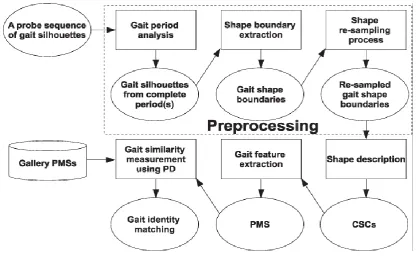
efforts proposed in this paper. First of all, in this section, the existing PSA adopted for gait recognition is
introduced in order to demonstrate the challenges of this research paper.
Fig. 1. Framework of PSA-Based Gait Recognition
Model-based approaches [28], [4], [8], [12], [14], [19], [32] aim to explicitly model human body or motion, and
they usually perform model matching in each frame of a walking sequence so that the parameters such as
trajectories are measured on the model. An early such attempt [4] modeled gait an articulated pendulum and
used the dynamic Hough transform to extract the line representing the thigh in each frame. Fourier analysis was
performed on the inclination data of the thigh and phase-weighted magnitude spectra formed gait signatures for
recognition. Johnson and Bobick [14] used activity-specific static body parameters for gait recognition without
directly analyzing gait dynamics. Yam et al. [19] first tried the running action of gait to recognize people as well
as walking. Later, they further explored the intimate relationship between walking and running that was
expressed as a mapping based on the idea of phase modulation [28]. Recovery from a walking video is still
limited allowing for current imperfect vision techniques (e.g., tracking and localizing human body accurately in
2D or 3D space has been a long-term challenging and unsolved problem). Further, the computational cost of
model-based methods is relatively high.3D space has been a long-term challenging and unsolved problem).
231 | P a g e
IV.
PURPOSE
AND
CONTRIBUTION
OF
THIS
WORK:
Gait has been known as an effective biometric feature to identify a person at a distance. However, variation of
walking speeds may lead to significant changes to human walking patterns. It causes many difficulties for gait
recognition. A comprehensive analysis has been carried out in this paper to identify such effects. Based on the
analysis, Procrustes shape analysis is adopted for gait signature description and relevant similarity measurement.
To tackle the challenges raised by speed change, this paper proposes a higher order shape configuration for gait
shape description, which deliberately conserves discriminative information in the gait signatures and is still able
to tolerate the varying walking speed. Instead of simply measuring the similarity between two gaits by treating
them as two unified objects, a differential composition model (DCM) is constructed. The DCM differentiates the
different effects caused by walking speed changes on various human body parts. In the meantime, it also
balances well the different discriminabilities of each body part on the overall gait similarity measurements. In
this model, the Fisher discriminant ratio is adopted to calculate weights for each body part.
V.
FEATURE
EXTRACTION
Before training and recognition, each image sequence including a walking figure is converted into an associated
Temporal sequence of distance signals at the preprocessing stage.
VI:
HUMAN
DETECTION
AND
TRACTING
Human detection and tracking is the first step to gait analysis. Although it is not a main part of our work, in
contrast to gait signature extraction and recognition, we still give a detailed introduction for completeness. To
extract and track moving silhouettes of a walking figure from the background image in each frame, the change
detection and tracking algorithm is adopted which is based on background subtraction and silhouette correlation.
The main assumption made here is that the camera is static, and the only moving object in video sequences is
the walker. Although this integrated method basically performs well on our data set, it should be noted that
robust motion detection in unconstrained environments is an unsolved problem for current vision techniques
because it concerns a number of difficult issues such as shadows and motion clutter. A new gait database, called
the NLPR database, is established for our experiments. A digital camera (Panasonic NV-DX100EN) fixed on a
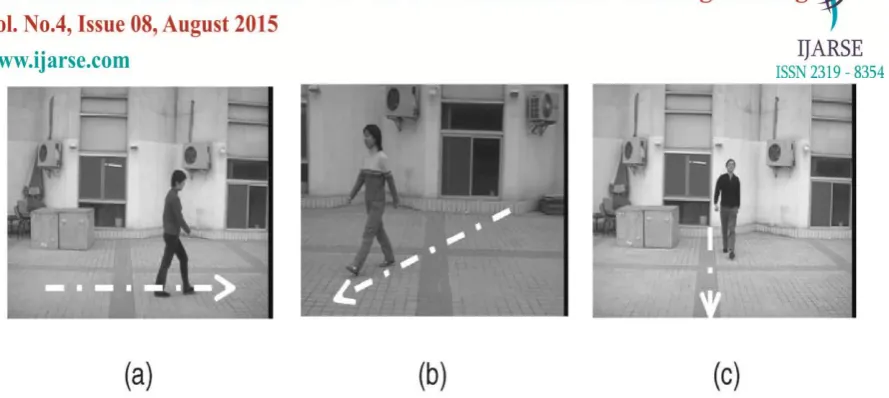
tripod is used to capture gait sequences on two different days in an outdoor environment. All subjects walk
along a straight-line path at free cadences in three different views with respect to the image plane, namely,
laterally (0_), obliquely (45_), and frontally (90_). The resulting NLPR database includes20 subjects and four
sequences for each viewing angle per subject. For instance, when the subject is walking laterally to the camera,
the direction of walking is from left to right for two of the four sequences, and from right to left for the
remaining. The database therefore includes a total of 240 gait sequences (20 _ 4 _ 3). These sequence images
with 24-bitfull color are captured at a rate of 25 frames per second and the original resolution is 352 _ 240. The
length of each image sequence varies with the pace of the walker, but the average is about 90 frames. To the
best of our knowledge, our database is probably one of the concurrent gait databases available in the public domain,
232 | P a g e
Fig. 2. Some Sample Images in the NLPR Gait Database: (a) Lateral View, (b) Oblique View,
and (c) Frontal View
VII.
DISCUSSION
AND
FUTURE
WORK
To provide a general approach to automatic person identification in unconstrained environments, much remains
to be done. We cannot conclude much about gaits. Further evaluation on a much larger and most-varied
database is still needed. We are planning to set up such a database with more subjects, more sequences, and
more variations in conditions. The across-day condition represents the hardest test of performance evaluation of
a gait recognition method. This is due to same-subject differences caused by changing clothing (bulky versus
thin), especially in different seasons. Our method is based on silhouette analysis; In fact, most past work is
subject to the effect of shape Information due to the direct use of motion segmentation results. Creating more
reference sequences with different shape may be of use to solve this problem. is The lack of generality of
viewing angles is a limitation to most gait recognition algorithms. Our present method is view dependent like
most previous work, so a useful experiment would be to determine the sensitivity of the features to different
views, whose results would enable a multicamera tracking system to select an optimal view for recognition [5].
Another obvious way to generalize the algorithm itself is to store training sequences taken from multiple
viewpoints and to classify both the subject and the viewpoint [22].
Also, seeking better similarity measures, designing more sophisticated classifiers, gait segmentation, and the
evaluation of different scenarios deserve more attention in future work.
VIII.
CONCLUSION
With the increasing demands of visual surveillance systems, human identification at a distance has recently
gained more interest. Gait is a potential behavioral feature and many allied studies have demonstrated that it has
a rich potential as a biometric for recognition. The development of computer vision techniques has also assured
that vision based automatic gait analysis can be gradually achieved. This paper has described Different from
gait classification which classifies human motion into categories, such as walking, running, and jumping, gait
recognition, also called gait-based human identification, is a relatively new research direction in biometrics. It
aims to discriminate individuals by the way they walk. In comparison with other first-generation biometric
features such as fingerprint and iris, gait has the advantage of being unobtrusive, i.e., it requires no subject.
233 | P a g e
recognition aims essentially to address this problem by identifying people based on the way they walk. In this
paper, a simple but efficient gait recognition algorithm using High Order Shape Configuration Gait has been
known as an effective biometric feature to identify a person at a distance. However, variation of walking speeds
may lead to significant changes to human walking patterns. It causes many difficulties for gait recognition. A
comprehensive analysis has been carried out in this paper to identify such effects. Based on the analysis,
Procrustes shape analysis is adopted for gait signature description and relevant similarity measurement.
Although accomplished under some simplified assumptions like previous work, this work has been proven to be
an encouraging progress to gait-based human identification.
REFERENCE
[1] J. Little and J. Boyd, “Recognizing people by their gait: The shape of motion,” Videre, vol. 1, no. 2, pp.
1–33, 1998.
[2] J. Shutler,M. Nixon, and C. Carter, “Statistical gait description via temporal moments,” in Proc. IEEE 4th
Southwest Symp. Image Analysis Int., 2000, pp. 291–295.
[3] A. Bobick and A. Johnsson, “Gait recognition using static, activity-specific parameters,” in Proc. IEEE
Conf. Computer Vision Pattern Recognition, 2001, pp. I:423–I:430.
[4] G. Shakhnarovich, L. Lee, and T. Darrell, “Integrated face and gait recognition from multiple views,” in
Proc. IEEE Conf. Computer Vision Pattern Recognition, 2001, pp. I:439–I:446.
[5] P. J. Phillips, H. Moon, S. Rizvi, and P. Rauss, “The FERET evaluation methodology for
face-recognition algorithms,” IEEE Trans. Pattern Anal. Mach. Intell., vol. 22, no. 10, pp. 1090–1104, Oct.
2000.
[6] N. Cuntoor, A. Kale, and R. Chellappa, “Combining multiple evidences for gait recognition,” in Proc.
IEEE Int. Conf. Acoustics, Speech Signal Processing, vol. 3, 2003, pp. 113–116.
[7] B. DeCann and A. Ross. Gait curves for human recognition, backpack detection, and silhouette correction
in a nighttime environment. In Proceedings of SPIE conference on Biometric Technology for Human
Identification, pages 76670Q1– 6670Q–13, 2010.
[8] Y. Guan, C.-T. Li, and S. D. Choudhury. Robust gait recognition from extremely low frame-rate videos.
In Proceedings of International Workshop on Biometrics and Forensics (IWBF), April, 2013. (In Press).
[9] Y. Guan, C.-T. Li, and Y. Hu. Random subspace method for gait recognition. In Proceedings of IEEE
International Conference on Multimedia and Expo Workshops (ICMEW), pages 284–289, July 2012.
[10] Y. Guan, C.-T. Li, and Y. Hu. Robust clothing-invariant gait recognition. In Proceedings of International
Conference on Intelligent Information Hiding and Multimedia Signal Processing (IIH-MSP), pages 321–
324, July 2012.
[11] J. Han and B. Bhanu. Individual recognition using gait energy image. IEEE Transactions on Pattern
Analysis and Machine Intelligence, 28(2):316–322, Feb. 2006.
[12] T. K. Ho. The random subspace method for constructing decision forests. IEEE Transactions on Pattern
Analysis and Machine Intelligence, 20(8):832–844, Aug. 1998.
[13] A. Iosifidis, A. Tefas, and I. Pitas. Activity-based person identification using fuzzy representation and
234 | P a g e
[23] D. Xu, Y. Huang, Z. Zeng, and X. Xu. Human gait recognition using patch distribution feature and
locality-constrained group sparse representation. IEEE Transactions on Image Processing, 21(1):316–
326, Jan. 2012.Security, 7(2):530–542, April 2012.
AUTHOR’S
Author – 1
Ms. Sunita P. Aware
ETC Dept. MSSCET, Jalna. (Dr. BAMU Aurangabad) MS, India.
Author – 2
Dr. Chetan M. Sedani
MECH. Dept. MSSCET, Jalna. (Dr. BAMU Aurangabad)MS, India
Author -3
Mr. Jatan C. Sedani
CSE Dept. PRMITR,Badnera (SGBAU Amaravati) MS, India