Node Consistency Estimation Using MIMO
Network
V.Bharathi, T.Parthiban
ME(CSE) –II Year, Department of Computer Science and Engineering, Kongunadu College of Engineering and
Technology, Tamil Nadu, India
Assistant Professor, Department of Computer science And Engineering, Kongunadu College of Engineering and
Technology, Tamil Nadu, India
ABSTRACT: An energy-efficient virtual multiple-input multiple output (MIMO)-based communications style is
projected for energy-limited, distributed and cooperative wireless device networks. Assumptive a reference system block secret writing (STBC) primarily based MIMO system, the energy and delay efficiencies of the projected MIMO-based communications theme square measure derived victimization analytic techniques. Multiple-input multiple-output (MIMO) technology will offer significantly higher rate in impromptu networks wherever nodes square measure equipped with multi-antenna arrays. Though MIMO technique itself will support diversity transmission once channel condition degrades, the utilization of diversity transmission typically compromises the multiplexing gain and is additionally not enough to handle very weak channel. Instead, during this work, we have a tendency to exploit the utilization of cooperative relay transmission (which is commonly employed in one antenna setting to enhance reliability) in an exceedingly MIMO-based impromptu network to wear down harsh channel condition. we have a tendency to style each centralized and distributed programming algorithms to support adaptive use of cooperative relay transmission once the transmission mechanism cannot be with success performed. Our formula effectively exploits the cooperative multiplexing gain and cooperative diversity gain to realize higher rate and better dependability below numerous channel conditions. Our programming theme will expeditiously invoke relay transmission While not introducing significant sign overhead as typical relay schemes, and seamlessly integrate relay transmission with multiplexed MIMO transmission. we have a tendency to conjointly style a Macintosh protocol to implement the distributed formula. Our performance results demonstrate that the utilization of cooperative relay in an exceedingly MIMO framework may usher in a significantly turnout improvement altogether the situations studied, with the variation of node density, link failure quantitative relation, packet arrival rate and retransmission threshold.
KEYWORD: space-time continuum blocks secret writing (STBC), MIMO network, Relay nodes (RNs).
I. INTRODUCTION
it's attainable to implement MIMO techniques in wireless device networks while not physically having multiple antennas at the device nodes via cooperative communications techniques. As according in such distributed MIMO techniques offers substantial energy savings in cooperative wireless device networks even once allowing for further circuit power, communications and training overheads. In this paper we tend to propose a replacement virtual MIMO-based cooperative communications design for energy-limited wireless sensor networks. during this distributed MIMO technique, virtual multiple transmit antenna arrays square measure created out of single antenna sensor nodes via native transmissions. We develop techniques for evaluating the energy and delay efficiencies of the projected virtual MIMO-based sensing element network. The dependance of those energy and delay efficiencies on system and propagation parameters equivalent to transmission distance, constellation size (transmission rate) and channel path loss parameter is investigated. Our numerical results counsel that with even handed system style, projected virtual MIMO-based communications theme will give vital energy savings and delay efficiencies in wireless sensing element networks. While our work extends the add, it's many novel ideas and refinements. First, we tend to modify the essential virtual MIMO conception to suit to a selected sensing element spec consisting of a {collection} of information collection nodes and an information gathering node followed by analytical energy potency analysis. Second, we introduce many realistic modifications to the simplified energy analysis technique developed by taking into account further coaching overheads and therefore the impact of the channel path loss parameter.
II. EXISTING SYSTEM
Cooperative multiple input multiple output (Co-MIMO) ways represent one approach to fulfill the growing necessities (i.e., higher turnout, increased coverage, low latencies, and reduced cost) of wireless communication services. In Co-MIMO networks, low-power relay nodes (RNs) are recruited by mobile users to join forces as virtual antenna arrays. though Co-MIMO architectures can give vital improvement in each the performance and security of wireless networks, they're at risk of attacks. during this paper, we tend to propose a unique node responsibility analysis theme to reinforce the safety of Co-MIMO networks. investment the probe signal transmissions concerned in physical-layer secret key generation schemes, 2 distributed node level responsibility observeion strategies (one-shot and dynamic) are projected to detect RNs that are non-cooperative. supported the fusion of data from the RNs, AN overall responsibility analysis is accomplished at a central server. Mobile users curious about collaboration will access this central server to see that nodes to recruit for cooperation. each the theoretical analysis and therefore the simulation results ar conferred maybe the projected node responsibility analysis schemes.
Disadvantages
Misbehavior of relay nodes
Time delay distribution of internal links
III. PROPOSED SYSTEM
In this projected System, another to MIMO technique, recent efforts are created to change cooperative relay transmission to handle channel degradation, with the idea that network nodes have single antenna. Our projected strategy is called as Cooperative Relayed special Multiplexing (CRSM). The most contributions of this paper are as follows.
We mathematically model the matter and supply a centralized algorithmic program with proved approximation magnitude relation to function the performance reference of the distributed algorithmic program.
We much divide the matter into 2 phases and supply easy however effective distributed programming algorithms that seamlessly incorporate the utilization of cooperative relay into MIMO transmission, which might guide the sensible protocol design;
We propose a straightforward relay theme to formulate relay set and invoke relay transmission while not further sign overhead;
We style associate economical raincoat protocol to support our distributed algorithmic program. Advantages
Throughput
Fast Transmission
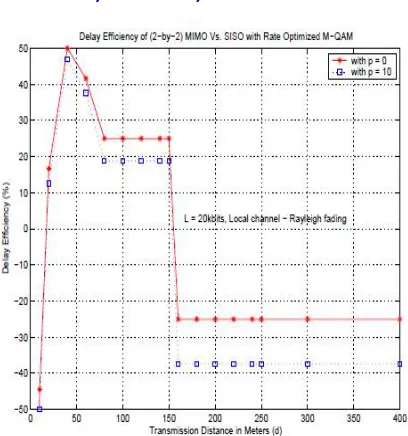
In less delay restrictive applications however, it is possible to operate outside the delay-efficient distance window and achieve even higher energy efficiencies.
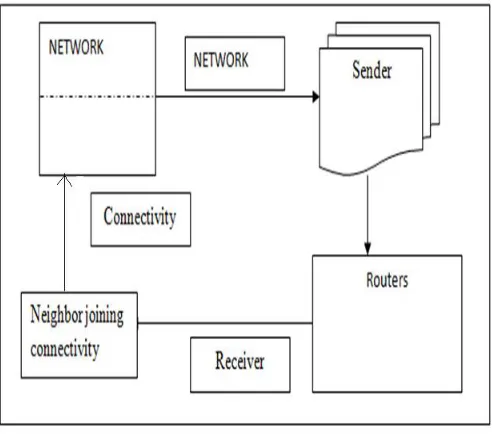
Fig 1: System Architecture
IV. METHODOLOGY USED
a set of such virtual multiple-transmit antenna systems as represented of these teams are going to be human action with either one or multiple DGN’s. In our energy potency analysis below, however, we have a tendency to concentrate on an easy model wherever we've solely one DGN and every one data-collection sensors kind one virtual transmit antenna array.
NETWORK MODEL
The sensing element nodes are indiscriminately distributed during a sensing field. We have a tendency to are victimization MIMO network . This is the infrastructure network and a node can move severally. In a MIMO, every node not solely works as a number and conjointly acts as a router. We will notice the communication vary for all nodes. Each node communicates solely at intervals the vary. If suppose any node out of the vary, node won't communicate those nodes or drop the packets.
PACKET PROGRAMMING WITH RELAY TRANSMISSION Easy formulation of a candidate relay set for a packet
In this module, the nodes in a very neighborhood collaboratively confirm if a relay transmission is required while not refined sign.
Easy priority-based relay choice while not additional sign
In this module, a candidate relay node schedules the transmissions of relay packets with its own packets supported their relevant priorities. because the relevant priority of relay packets to existing packets completely different candidate relay nodes are different, our programming naturally selects the relay transmission among a bunch of candidate relay nodes.
Support of load leveling and reduction of delay impact on relay nodes
In this module, in our programming, a packet that experiences a extended delay as a results of recurrent transmission failures of its supply node has its priority multiplied, which can be beyond some packets at a candidate relay node (especially once the relay node features a lower load). it's thus a lot of seemingly for a relay node with lower traffic to forward the relay packets, which might balance the load of nodes during a neighborhood and therefore the relay transmission wouldn't significantly impact the transmission of an full candidate relay node. additionally, with additional packets buffered to forward for alternative nodes, a candidate relay node may have a better priority of being regular for transmission.
Receiver-facilitated reduction of redundant relay transmission
In this module, as a node self-determines if it are often a relay in a very interval supported the priority of the cached packet to avoid sign overhead, there's a chance that multiple nodes could conceive to perform relay transmission.
V. EXPERIMENTAL RESULT
Fig 2: Delay Efficiencies of Virtual 2 × 2 MIMO and SISO with Rate Optimized M-QAM
VI. CONCLUSION
In we have planned a replacement virtual MIMO communications architecture for energy-limited wireless device networks. We have provided analytical ways to get the energy consumption values for such virtual MIMO communications design based device networks taking under consideration transmission, circuit and extra coaching energy necessities. Our results show that even with additional energy overhead necessities, virtual MIMO-based techniques offers substantial energy and delay efficiencies in wireless device networks provided the system is meant judiciously. These embody careful thought of transmission distance necessities and rate improvement.
REFERENCES
[1] H. Yang, H.-Y. Shen, and B. Sikdar, “A MAC protocol for cooperative MIMO transmissions in sensor networks,” in Proc. IEEE Global Telecommun. Conf. (GLOBECOM), Nov. 2007, pp. 636–640.
[2] M. R. Ahmad, E. Dutkiewicz, and X. Huang, “MAC protocol for cooperative MIMO transmissions in asynchronous wireless sensor networks,” in Proc. Int. Symp. Commun. Inf. Technol. (ISCIT), Oct. 2008, pp. 580–585.
[3] A. Nosratinia, T. E. Hunter, and A. Hedayat, “Cooperative communication in wireless networks,” IEEE Commun. Mag., vol. 42, no. 10, pp. 74– 80, Oct. 2004.
[4] M. Yang, Y. Li, D. Jin, L. Zeng, X. Wu, and A. V. Vasilakos, “Software-defined and virtualized future mobile and wireless networks: A survey,” Mobile Netw. Appl., vol. 20, no. 1, pp. 4–18, Feb. 2015. [Online]. Available: http://dx.doi.org/10.1007/s11036-014-0533-8.
[5] Z. Zhang, X. Chai, K. Long, A. V. Vasilakos, and L. Hanzo, “Full duplex techniques for 5G networks: Self-interference cancellation, protocol design, and relay selection,” IEEE Commun. Mag., vol. 53, no. 5, pp. 128–137, May 2015.
[6] Z. Zhang, X. Wang, K. Long, A. V. Vasilakos, and L. Hanzo, “Largescale MIMO-based wireless backhaul in 5G networks,” IEEE Wireless Commun., vol. 22, no. 5, pp. 58–66, Oct. 2015.
[7] Y. Niu, Y. Li, D. Jin, L. Su, and A. V. Vasilakos, “A survey of millimeter wave communications (mmWave) for 5G: Opportunities and challenges,” Wireless Netw., vol. 21, no. 8, pp. 2657–2676, Nov. 2015. [Online]. Available: http://dx.doi.org/10.1007/s11276-015-0942-z. [8] K. Chen, B. Natarajan, and S. Shatti, “Relay-based secret key generation in LTE-A,” in Proc. IEEE Conf. Commun. Netw. Secur., Oct. 2014,
pp. 139–144.
[9] K. Chen, B. B. Natarajan, and S. Shattil, “Secret key generation rate with power allocation in relay-based LTE-A networks,” IEEE Trans. Inf. Forensics Security, vol. 10, no. 11, pp. 2424–2434, Nov. 2015.
[10] K. Chen and B. B. Natarajan, “Mimo-based secret key generation strategies: Rate analysis,” Int. J. Mobile Comput. Multimedia Commun., vol. 6, no. 3, pp. 22–55, Jan. 2015.
[12] B. Wang, J. Zhang, and A. Høst-Madsen, “On the capacity of MIMO relay channels,” IEEE Trans. Inf. Theory, vol. 51, no. 1, pp. 29–43, Jan. 2005.
[13] Y. Fan and J. Thompson, “MIMO configurations for relay channels: Theory and practice,” IEEE Trans. Wireless Commun., vol. 6, no. 5, pp. 1774–1786, May 2007.
[14] S. Pan, B. Ji, and Y. Luan, “Reliability research of wireless sensor network node,” in Proc. 14th Int. Conf. Comput. Supported Cooperat. Work Design (CSCWD), Apr. 2010, pp. 444–447.
[15] M. Kubo, M. Sun, K. Yanagihara, and S. Hara, “A multiple cooperative nodes selection method for reliable wireless multi-hop data transmission,” in Proc. Int. Symp. Wireless Commun. Syst. (ISWCS), Aug. 2012, pp. 486–490.
[16] M. Kubo, D. Anzai, and S. Hara, “Selection criteria of cooperative nodes for reliable wireless multi-hop data transmission,” in Proc. 7th Int. Symp. Wireless Commun. Syst. (ISWCS), Sep. 2010, pp. 345–349.
[17] B. Mainaud, V. Gauthier, and H. Afifi, “Cooperative communication for wireless sensors network: A MAC protocol solution,” in Proc. 1st IFIP Wireless Days (WD, Nov. 2008, pp. 1–5.
[18] B. Zhao, Y. Liu, and Y. Xiao, “Obdd-based algorithm for reliability evaluation of wireless sensor networks,” in Proc. IEEE Conf. Prognostics Syst. Health Manage. (PHM), May 2012, pp. 1–4.
[19] F. Huang, Z. Jiang, S. Zhang, and S. Gao, “Reliability evaluation of wireless sensor networks using logistic regression,” in Proc. Int. Conf. Commun. Mobile Comput. (CMC), vol. 3. Apr. 2010, pp. 334–338.