95
A Study to Spot and Authenticate the Critical
Factors in SME ERP Systems Implementation in
Kenya
P
1
P
Betty Jepkemei, P 2
P
Kipkebut Andrew
P
1
P
Schoool of Business Kabarak university Kenya
P
2
P
School of Computer Science Kabarak university Kenya
Many organizations in Kenya struggle with their current systems' architecture that produce inaccurate data and require redundant or manual processes. As a result, IT staff often spends significant time maintaining obsolete or disparate systems instead of creating new value or implementing strategic applications. Companies implement ERP systems to integrate the business processes and help them obtain an edge in their business. Enterprise Resource Planning (ERP) is one of the solutions for the Small and Medium Enterprises (SMEs) in order to face the global challenges in Kenya. This paper explores to identify issues affecting Enterprise Resource Planning (ERP) implementation in Kenya Small and Medium Enterprises (SMEs). This paper attempts to highlight those specific issues where different factors needs to be addressed while implementing the ERP.A proper system implementation, clearly defined scope of implementation procedure, proper project planning and minimal customization of the system selected for implementation.
Keywords: Enterprise Resource Planning, System Implementation, Small and Medium Enterprises
1.0INTRODUCTION
An ERP implementation takes many years to complete and requires a large amount of IT infrastructure investment and their effectiveness is hard to evaluate. In Kenya today organizations of have implemented or in the process of implementing Enterprise Resource Planning (ERP) including banks, universities, and some government institutions. There has been diffusion of ERP systems in large and small-medium scale enterprises (SME), as from late 90’s most pertinent phenomenon since nineties in the sector of the business processes of a company, Most Companies implement ERP systems to integrate to existing software components and obtain a competitive advantage and to increase productivity for their employees. To achieve all of this, companies
have realized the necessity to implement ERP software to achieve integration of business activities. ERP systems can also be an mechanism for transforming organizations functions into process-oriented ones, When properly implemented,ERP can supports process-oriented businesses effectively (Al-Mashari, 2003). Although ERP applications constitute well – structured, reliable information technology (IT) backbones of fortune 500 companies worldwide (Hofmann,P, 2008). A recent study finds SME companies focusing on growth strategies and customer services sometimes balancing between the two, but more often focusing exclusively on one or the other. A Gartner group study was carried out in 1300 European and American companies and being found that 32% of ERP projects were delivered late and thus unable to achieve the true benefits of implementation.
2.0 OBJECTIVE OF THE STUDY:
The Implementation of new technologies especially the information technology part is crucial in a nation’s economic growth.ERP has not been left out however ERP has a lot of resistance in its adoption and implementation because of its higher investments ,failures and challenges associated with it. The study of ERP implementation issues is necessary to encourage and convince small and medium scale industries to adopt it as ERP is vital in their future growth. The objective of this paper is to spot and authenticate the critical success factors for ensuring successful implementation of Enterprise Resource Planning (ERP) in organizations in Kenya.
• To analyze the Implementation of ERP in
SMEs.
96
• To determine the best methods of counter
measuring the ERP issues identified
3.0 LITERATURE REVIEW
A significance work has been done over the world to identify the critical success factors for ERP implementations. ERP implementations usually involve broad organizational transformation processes, with significant implications on the organization’s management model, structure, management style and culture, and particularly, on people (Caldas & Wood, 1999). ERP systems have been widely used in developed countries all over the world. With the opening up of the Kenyan market to the global market, the Kenyan enterprises have implemented ERP systems or in the process of implementing ERP systems.
Initially, implementation of an ERP package was possible only for very large multinational companies and infrastructure companies due to the high cost involved. However, today, many companies around the globe have implemented ERP software and it is expected in the near future that a great percentage of companies will implement one of the ERP packages. Recognizing that ERP software is the "must-have" for gaining competitive advantage, Uchumi supermarkets completed the installation of their very own satellite-based ERP IT system few years ago. “The decision to implement the IT system was made in July 2002 and after months of designing and installing, the Lawson-based solution, which is a US product, went live in October 2003. The Lawson application had been already used by many retail outlets in the US. However, these chains usually adopted the HR and financial functionalities whereas Uchumi had further supplementary functionalities, like supply, procurement, inventory, management, etc. PWC was the consulting group contracted to manage the procurement process of the ERP implementation. “The implementation was carried out by a South African company called Solit Innovations. Studies have found that factors like limited capital, lack of proper infrastructure, lack of skilled resources, absence of ERP awareness and poor implementation planning are critical factors
97 and shortened product life cycles. Corporations
had to move towards agile manufacturing,
continuous improvement of business processes and business process reengineering.
3.0 METHODOLOGY
The research employs mixed methods to research . In this research I have used stratified survey method to collect data from online resources and books , I have categorized the critical design issues and the challenges faced by ERP implementers from the survey data followed by qualitative data analysis. This research will help ERP implementers to understand the challenges therefore formulate a good strategy prior to Adopting an ERP system.
3.1 ISSUES AND CHALLENGES:
Though the market for ERP seems to be growing, there are several issues and challenges one
Has to contend with when implementing an ERP system in the SME segment. Some of these are:
3.1.1 Awareness:
There is a low level of awareness amongst SMEs for ERP vendors, applications etc.
Most of the time they do not even know what ERP systems are and what they can do. They consider ERP systems to be a magic wand, which will help solve all their business problems, be it in terms of Quality, or process defects. ERP brings in a more disciplined execution of business process giving More transparency and visibility to the working of the organization.
3.1.2 Perception:
SMEs have the perception that ERP is meant only for large firms mainly owing to the
High costs of acquisition, implementation and maintenance as also the complexity. Some of the SMEs even feel they do not need ERP.
3.1.3 Earlier Implementations:
SMEs have heard of the much-publicized failures in ERP implementation,
Which have led firms to bankruptcy. Some SMEs who have implemented ERP earlier have failed.
This has led SMEs to believe that ERP implementations are a waste of time and effort and can even
lead to the demise of company.
3.1.4 Approach to implementation:
ERP vendors advice SMEs to mould the business to ERP’s way of working. Considering that ERP systems will bring it best business practices i.e. the plain vanilla approach would bring down the cost of implementation. But most SMEs have processes that they have evolved over time and hold very dear to their hearts. As a result, SMEs are having the entire ERP system customized to meet their requirements. This would increase the overall cost of implementation. A good approach would be to keep the customization to a minimum.
3.1.5 Cost:
SMEs have less of capital than their larger counterparts.
Change management: One of the major reasons why ERP implementations nationwide have been
known to fail is due to the implementation being considered as an automation project instead of one that involves change management. This results in the system being put in place but not being used
effectively due to people not ready to accept the change.
3.1.6 Change management:
One of the major reasons why ERP implementations nationwide have been
known to fail is due to the implementation being considered as an automation project instead of one that involves change management. This results in the system being put in place but not being used effectively due to people not ready to accept the change.
3.1.7 Limited resources:
Most SMEs do not have an in-house IT team. Due to this they have to rely on
external agencies to help them and this adds to the implementation costs.
3.2 FACTORS AFFECTING ERP IMPLEMENTATION:
The major factors can be classified into four subheadings namely, the top management,
training, the data collection & Software design and Testing. The 8 factors affecting the ERP
implementation are determined. The consensus among the ERP team and top management is very
98 fallows-
1. Data provided: Adequate and correct data should be provided
A strong management direction is needed for the managers at each of the branches so that adequate and appropriate data is duly provided.
2. Parallel systems: When issues began to crop up after implementation of ERP in Finance
module, sales and distribution module was completely ignored, they shifted work with these
modules back to the old system. This hampered the proper integration of organization data
and led to data mismatch in other modules as well. As a result, support system provided by the
vendor became obsolete and difficult to implement. Hence, use of parallel systems should be
avoided outright.
3. Training and testing: Training and testing of the system should be done properly by the ERP
Consultants, that is, the vendor is provided as part of the implementation procedure to only a
35% group of people from the clients’ side known as the Core Team. This core team in turn
trains a rest of people who are actually responsible for day-to-day transactions called the End
Users. It was observed that the 50% second leg of training which is provided to the end users
was not carried out mainly due to lack of computer literacy, not will to accept the
responsibility this triggered a strong resistance to change for the new system being installed
and caused reduction in employee motivation.
4. Expectations from the ERP System: Clarity in management objectives and expectations
from the ERP System are clearly stated to the vendors. This led to a belief of the systems’
power to integrate the company actual functions. According to the vendor, management
expected a quick return on investment which was not practical since it takes around three to
four months to notice any significant returns. Hence, top management should be patient with
the new system and any fear of failure should be done with for a successful running system.
5. Employee Retention: It was observed that after the completion of ERP training provided to
the staff and within some days of the system going live, many of the trainees from the
organization quit the company causing great losses to organization in the form of shortage of
key resources i.e. trained staff. This was a big percentage of employee attrition rate and it is
not possible for a company to hold back any of its employees even with the most stringent
contract.
6. Design & Testing: is a very important part of software testing and should not be neglected
the computer work stations are set up in a room to represent each of the major tasks of
customer service /order entry, planning, goods-in, stores and finance. A simplified data set is
loaded and the company operations run through. The data is gradually increased as first the
project team, then managers and finally users get more familiar with the software. This is
conducted just before the ERP becomes fully functional in the organization.
7. Customization should be less than 30%- Customization Services involves any
modifications or extensions that change how the out-of-the-box ERP system works.
Customizing an ERP package can be very expensive and complicated. Some ERP packages
have very generic features, such that customization occurs in most implementations.
Customization work is usually undertaken as "changes requested beforehand" software
development on a time and materials basis. But ideally, experts in the ERP implementation
field have suggested that customization should be less than 30%..
8. Stakeholders shall be identified in the initial phase including customers and vendors:
Stakeholders are all those who are directly or indirectly affected by a company implementing
any new ERP system be it organizations like those of the supplier as well as the vendors. A
failure to identify the stakeholders gives the implementing company a major setback when the concerned people or organizations work against the new system. So identification of all
99 3.3ERP IMPLEMENTATION MODEL
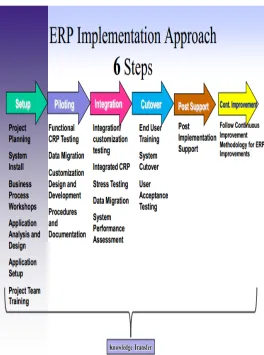
The following model/approach is a Simplification of traditional implementation process ,It Streamlines methodology for efficient implementation and Knowledge transfer throughout the ERP project,It consists of six steps:-Fig 1
1. Setup
2. Piloting 3. Integration
4. Cutover
5. Post support
6. continuous Improvement.
Fig 1: An ERP implementation approach.
CONCLUSION:
Th Comitment of top management has been recognized as one of the most important elements in the successful implementation of ERP system. Since the primary responsibility of top management is to provide sufficient financial support and adequate resources for building a successful system,
Implementing an ERP package is a complex and costly undertaking, so it's
essential to choose the appropriate vendor, adequate scalability features, suitability of H/W and user
friendliness of product depending on the size and structure of an organization Project management related factors like Clear goal and objective, Effective project management, Reasonable expectation, Other dept. participation, Change request, Implementation strategy, Data conversion,Clear& effective communication are very critical for a successful ERP implementation. Team member should understand the inner workings of their respective departments thoroughly. And the team must have can do attitude. In Kenya, SMEs are the backbone of the economy and are today faced with global competition. Therefore it becomes imperative for them to look for means of responding to the dynamic markets. ERP systems have become the most common IT strategy for most large companies. SMEs too are moving towards ERP systems. They need to adopt a proactive approach towards ERP and consider it as a business solution rather than a mere IT solution.
REFERENCES
Al-Mashari,M., Al-Mudimigh, A and Zairi, M.(2003),“Enterprise Resource planning: a taxonomy of critical factors “, European journal of operational research, Vol 146, pp. 352-64.
Caldas Miguel P., Wood Thomaz Jr. (1999). How consultants can help organizations survive the
ERP frenzy. Paper submitted to the Managerial consultation division (August 1999) p.7.
Caruso Dave (1998.) ERP vendors - AMR Research's Top 20 Roundup, the report on Enterprise
Applications. AMR Research Inc., (Premiere issue 1998) p. 2.
Caldas Miguel P., Wood Thomaz Jr. (1999). How consultants can help organizations survive the
ERP frenzy. Paper submitted to the Managerial consultation division (August 1999) p.7.
Chen, R., Sun, C., Helms, M.M.and Jih, W. (2008), "Role negotiation and interaction: an in SMEs in Taiwan", Information Systems Management, Vol. 25 No.2, pp.159-73
100 -J ournal of Arts, Science & Commerce E-ISSN
2229-4686 ISSN 2231-4172
International Refereed Research Journal www .researchersworld.com Vol.– II, Issue –2,April 2011 85
Falkowski, G., Pedigo, P., Smith, B. and Swanson, D. (1998),``A recipe for ERP success’’,
Beyond Computing, pp. 44-5
Hofmann,P, (2008). ―ERP is Dead, Long Live ERP, Internet Computing, IEEE, August 2008,
12(4), pp. 84-88 Huang Qiang (1999). Developing Trends of ERP software and ERP practice in China. (1999)
IFAC.
Huin, S.F. (2004), ―Managing deployment of ERP systems in SMEs using multi-agents,
International Journal of Project Management, Vol. 22 No. 6, pp. 511-17.
Kumar, K., and Hillegersberg, J. (2000). ERP experiences and evolution. Communications of the ACM, 43(4),23-26.
Kirchmer Mathias (1999) Business Driven implementation of ERP systems. (February 12, 1999). www.PlanetIT.com/docs/PIT19981104S0001
Marion, Larry. 1998. Systems sizing: nobody gets it right. Datamation, (December 1998).
Munjal Shefali, (2006), “Small is beautiful: ERP for SMEs’, http :// www.domainb.com/
infotech/ itfeature/20060601_beautiful.htm.
Parijat Upadhyay et al , “An explorative study to identify the Critical Success Factors for ERP
implementation in Kenyan small and medium scale enterprises”, 978-0-7695-3513-5/08 $25.00 ©
2008 IEEE, DOI 10.1109/ICIT.2008.66 pp 295-299 Parijat Upadhyay and Pranab K. Dan (2009), ―ERP in Kenyan SME’s: A Post Implementation
Study of the Underlying Critical Success Factors‖, International Journal of Management
Innovation System ISSN 1943-1384, Vol. 1, No. 2: E1 Ranzhe Jing et al, (2007) “A Study on Critical Success Factors in ERP Systems implementation”, 1-4244-0885-7/07/$20.00 ©2007 IEEE.
Rashmi Jha, M. N. Hoda, A. K. Saini, “ Implementing Best Practices in ERP for Small & Medium Enterprises”, 978-1-4244-2972-1/08/$25.00 ©2008 IEEE.
Wee, S. (2000),”Juggling toward ERP success: Keepkey success factors high”,ERP News.
Yen D. C., Chou D. C., Chang J., (2002),“A synergic analysis for Web-based enterprise resource