Moisture and
Temperature
Requirements
Adventitious Root Development in Blue
Grama Seedlings
D. D. BRISKE AND A. M. WILSON
Highlight: The environmental requirements for adventitious root initiation and growth in 22-day-old blue grama (Bouteloua grucilis) seedlings were determined under controlled temperature and soil moisture conditions. The seminal root was maintained in moist soil; but surface soil (in which adventitious roots may develop) was independently maintained at various degrees of drought. Drought treatments were imposed by controlling the relative humidity of air above the soil and around seedling crowns. In the 100% humidity treatment, elongation rates of the longest root per seedling at temperatures of 15,20,25, and 30°C were 0.40, 0.74,1.04, and 1.22 cm per day, respectively. In the 96% humidity treatment, elongation rates at these temperatures were 0.28,0.36, 0.38, and 0.44 cm per day, respectively. When the seminal root is growing in moist soil, blue grama seedlings can initiate adventi- tious roots during severe drought conditions in the surface soil. However, adventitious root growth adequate for seedling estab- lishment will probably not occur at moisture and temperature conditions of less than 96% humidity (-50 bars) and 15°C.
Blue grama (Bouteloua grucilis) is the dominant perennial grass throughout much of the Great Plains. However, new seedlings are rare: in the past 40 years, workers at the Central Plains Experimental Range, in northeast Colorado, have failed to find natural reproduction of blue grama from seed (Hyder et al. 1975). Many attempts to establish plantings of blue gramaon the 5 million acres of abandoned cropland in the Central Great Plains have failed (Bement et al. 1961; 1965).
Blue grama seedlings have a single short-lived seminal root. Therefore, seedling establishment requires the development and extension of adventitious roots (Esau 1960). In the field, seedlings failing to extend adventitious roots die at approxi- mately 6 to 10 weeks of age (Hyder et al. 1971).
The poor seedling success of blue grama has been related to its seedling morphology. Blue grama seedlings have a short coleoptile and an elongated subcoleoptile internode, which places the coleoptilar node and all tillering crowns, from which adventitious roots may arise, on or very near the soil surface (Hyder et al. 197 1). Consequently, seedlings often fail to develop adventitious roots because of rapid drying of the soil surface. Adventitious roots grow out of tillering crowns and become successfully established when damp, cloudy weather persists for 2 or 3 days (van der Sluijs and Hyder 1974).
The authors are, respectively, graduate research assistant, Department of Range Science, Colorado State University, and plant physiologist, U.S. Department of Agri- culture, Agricultural Research Service, Crops Research Laboratory, Colorado State Uni- versity, Fort Collins 80523. Briske currently is assistant professor, Dep. Range Science, Texas A&M Univ., College Station, Texas.
The study involved cooperative investigations of the Agr. Res. Serv., U.S. Dep. Agr., and the Colorado State Univ. Experiment Station, Fort Collins 80523. (Scientific Series Paper No. 2269.) The authors thank John A. Sarles for valuable technical assistance during this study.
Manuscript received October IO, 1977.
174
for
Olmsted (1941) recognized a similar situation with sideoats grama (Bouteloua curtipendulu). Elongation of the first inter- node (subcoleoptile internode) elevated the coleoptilar node to the soil surface or as much as 8 mm above it. He also observed that approximately three consecutive wet days were required for the successful establishment of adventitious roots. Hoshikawa ( 1969) examined three genera of the tribe Chlorideae and found them all to exhibit subcoleoptile internode elongation.
Adventitious roots are rapidly initiated and possess rapid growth rates, enabling them to become established during periods of adequate surface soil moisture. Initiation of the first adventitious root occurred when blue grama seedlings were 11 days old (van der Sluijs and Hyder 1974). Similar results have been observed with sideoats grama (Hopkins 1941; Olmsted
1942). When tillering crowns of 2 1 -day-old blue grama
seedlings were exposed to moist soil, roots developed within a few hours (van der Sluijs and Hyder 1974). The average maximum rate of adventitious root growth was 3 cm in 24 hours. Briske and Wilson (1977) found a maximum elongation rate of 2.6 cm per day; Olmsted (1941), working with sideoats grama, reported an elongation rate of 2 cm per day.
Adventitious roots may fail to develop at low temperatures, even though moisture conditions at the soil surface are favorable (Briske and Wilson 1977). Therefore, we conducted an experi- ment to define the moisture and temperature conditions required for initiation and growth of adventitious roots. The experiment was designed to simulate field conditions in which the seminal primary root extends into moist soil but the seedling crown remains in contact with surface soil at various degrees of drought.
Methods
Blue grama seed of accessions PM-K-1482 and PM-K-1483 were obtained from the Soil Conservation Service, Manhattan, Kans. Accession 1482 is a synthetic blend of six accessions from the Central Plains (Nebraska and northern Kansas); accession 1483 is a synthetic blend of 12 accessions from the Southern Plains (southern Kansas and Texas). Each of the blends was produced by planting the accessions, from the respective regions, together in 1971 at the Plant Materials Center, Manhattan, Kans. Seed for this study was harvested in 1974.
Seed were planted at a depth of 2 cm in plastic pots (15 cm diameter by 15 cm deep) filled with autoclaved sandy loam soil. During seedling development in the greenhouse, the pots were subirrigated to promote growth of the seminal primary root and to maintain a dry surface soil layer of 1.5 cm that would prevent initiation of adventi- tious roots. At 22 days, soil was removed from the top of each pot to
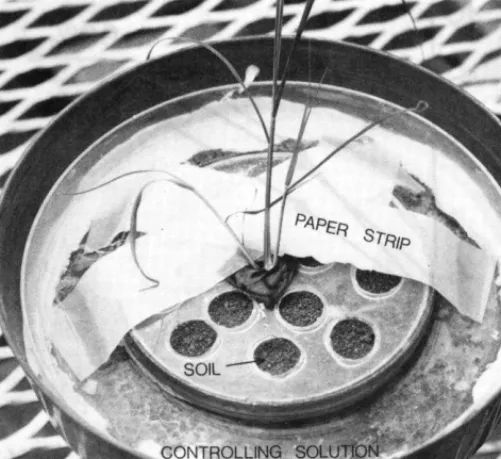
expose the seedling crown and a portion of the subcoleoptile internode. A large plastic petri dish, with a small petri dish fastened within it, was placed over the seedling and fastened to the rim of the pot with latex calking compound (Fig. 1). The seedling protruded through a hole in
average value was considered as a single observation in the statistical analy8is.
The experiment was conducted in a split Plot design and included five reolications. The five rwlications represented five sequential repetitions of the experiment: Analysis df variance and D&an’s
multiple range test were used to determine significant differences between accessions and among treatments.
A test was also conducted to determine if the soil surrounding seedling crowns had reached equilibrium with the controlling solu- tions by the end of the 5.day growth test. For this purpose, soil was placed in constant humidity trays (Wilson and Harris 1968), where it absorbed water vapor from distilled water or from saturated solutions
of KzSOa N&O+ KCI, (NH>), SO+ or NaCI. Water content was determined gravimetrically after 7, 14, and 21 days. Because soil did not reach equilibrium with vapor from distilled water during the 5-day groth test, the soil water potential in that treatment was measured with a thermocouple psychrometer (Campbell and Wilson 1972).
the center of the two dishes. The large dish, with a duct tape seal around the subcoleoptile internode of the seedling, formed a water- proof barrier. The barrier separated the lower soil zone, in which the seminal root had developed, from the upper soil zone. The lower soil zone (depth of 12 cm) was kept near field capacity throughout the experiment. The small petri dish was filled ith 0.5 cm of air-dry soil (upper soil zone) to test for adventitious root initiation and growth at various temperatures and relative humidities in a 5-day test.
At the beginning of the S-day test, we counted tillers and measured green leaf-blade length. Constant relative humidities of approximately
100, 96, 93, 86, 81, and 76% were maintained above the soil in the upper zone with the use of distilled water or saturated aqueous
solutions of KzSO+ N&O+ KCI, (NHJzSO~, and NaCl, respec- tively (Table I). Strips of chromatography paper were placed o&r a perforated lid covering soil in the upper zone, and both ends of the strips were immersed in the solution(Fig. 1). Waterorsaltsolutiondid not come in contact with either the soil or the seedlings, but water vapor moved from moistened paper strips to seedling cmwns and to soil in the upper zone. Tops of pots were covered with aluminum foil to reduce evaporation. Leaves protruded through a hole in the center of the foil cover. Pots were placed in a growth chamber set for constant temperatures of 15, 20, 25, or 30°C, daylength of 15 hours, and radiation intensity of 480 microeinsteins/m’/ sec. Relative humid- ity within the growth chamber varied from 55 to 65%.
After 5 days, we counted tillers; measured green leaf-blade lengths; counted and measured all adventitious roots; and separated, dried, and weighed adventitious roots and shoots. Moisture content of the soil around the seedling crown (i.e., upper soil zone) was measured gravimetrically. Shoot water potentials of seedlings in the lasl replication were measured with a pressure chamber (Waring and Cleary 1967).
Results and Discussion Soil Equilibration Test
At the end of the 5-day test, water content of soil surrounding seedling crowns was similar in all relative humidity treatments (except 100%) to that of soil that had reached equilibrium in constant humidity trays (Table 1). Therefore, except for the 100% humidity treatment, water potentials of soil around seedling crowns were equivalent to the osmotic potentials of the controlling solutions. Equilibrium was not attained in the 100% humidity treatment because of the large amount of water vapor that had to be transferred from the moist chromatography paper to soil in the upper zone. After S days, the water potential in this treatmentwasnotObarsaswehadanticipated,butwasabout-15
ban. However, soil in all treatments remained drier than the equilibrium water potentials during the early part of the S-day growth test because of the time required for transfer of water vapor.
Table 1. Effect of the relative humidity (95) and water potential (ban) of controttii~ solutions on the wster ecmtent (%)
of
soil in the upper acme (around seedling crowns) and of soil that h*d reached equilibrium in eanstant humidity trays.Number of Roots
Crowns of some seedlings developed one or two areas of swelling (adventitious root apices) before the constant humidity
. . . . <
Growth of adventitious roots was tested one temperature at a time,
with the four temperatures being arranged in a random sequence. Each treatments were tmposeo, DUf tney remamea Less Ina” 1 mm Ill temperature treatment included four seedlings for each of the WO length. These apices continued to grow during the 5.day test and x-ce~inn~ and fnr ench of the six relative humiditv treatments. were considered to be adventitious rcwts when they had ex- ____ II ._.. I _.._ ._. ._... .~ .~~~
Growth parameters for the four seedlings were averaged, and the tended through the base of the leaf sheath and had reached a
length of 1 mm or more.
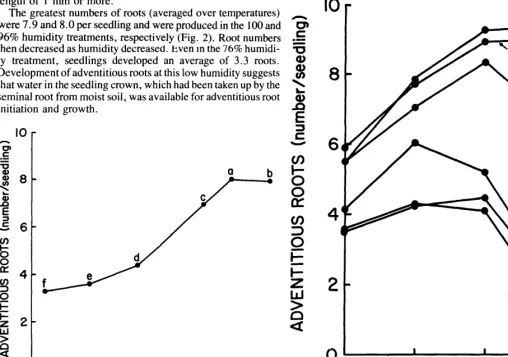
The greatest numbers of roots (averaged over temperatures) were 7.9 and 8.0 per seedling and were produced in the 100 and 96% humidity treatments, respectively (Fig. 2). Root numbers then decreased as humidity decreased. bven in the 76% humidi- ty treatment, seedlings developed an average of 3.3 roots. Development of adventitious roots at this low humidity suggests that water in the seedling crown, which had been taken up by the seminal root from moist soil, was available for adventitious root initiation and growth.
OL
75
80
85
90
95
100
RELATIVE HUMIDITY 1%)
Fig. 2. Effects of relative humidity on the number of adventitious roots pro- duced by blue grama seedlings during a 5-day test. Values represent number of roots per seedling for accessions 1482 and 1483 averaged over tempera- tures of 15, 20, 25, and 30°C. Means associated with the same letter are not significantly different at the 0.01 level.
In the 100 and 96% humidity treatments, root numbers increased as the temperature increased from 15 to 30°C (Fig. 3). But root numbers in the 93, 86, 81, and 76% humidity treat- ments reached a maximum at 20 or 25°C and then decreased sharply at 30°C. The decrease may have been caused by a reduction in seedling water potential in response to increased transpiration rates at 3O”C, even though the seminal root remained in moist soil. Shoot water potentials averaged - 12.1 to - 12.5 bars at temperatures of 15,20, and 25”C, but averaged
- 14.5 bars at 30°C. The combined effects of a low shoot water potential and low humidity around seedling crowns may have increased the resistance of the epidermis and leaf sheath to the rupturing forces of developing root apices. Moreover, low humidity around seedling crowns probably increased evapo- ration rates from developing roots and, consequently, reduced cell turgidity and rate of cell enlargement.
A small but significant (P < 0.01) accession difference for number of roots per seedling was observed. When averaged over all temperature and humidity treatments, seedlings of the Central and Southern Plains accessions produced an average of 6.0 and 5.4 roots per seedling, respectively.
Longest Root per Seedling
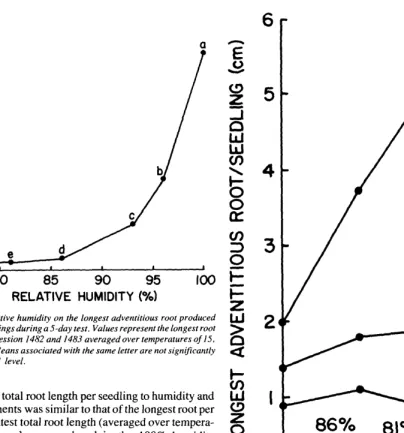
The longest root per seedling (averaged over temperatures) was 4.3 cm and was produced in the 100% humidity treatment
0
I5
20
25
30
TEMPERATURE (C)
Fig. 3. Interaction between humidity and temperature for number of adven- titious roots produced by blue grama seedlings during a 5-day test. Values represent the average number of roots per seedling for accessions 1482 and 1483. CoefJicient of variation was 2.8%.
(Fig. 4). Root length decreased to an average of 0.16 cm as humidity decreased to 8 1 or 76%. The greatest reduction in root length occurred between the 100 and 96% humidity treatments.
In the 100 and 96% humidity treatments, the longest root per seedling increased in length with each increase in temperature (Fig. 5). Root lengths in the 93, 86, 81, and 76% humidity treatments reached maximum values at 20 or 25°C and de- creased at 30°C. Again, this decrease may have resulted from the combined effects of low shoot water potential at 30°C and low humidity around seedling crowns.
In the 5-day test, longest root per seedling for the Central and Southern Plains accessions (averaged over all temperature and humidity treatments) was 1.1 and 1.4 cm, respectively. This significant difference among accessions (P < 0.01) was mainly evident in the two highest humidity treatments. Riegel (1940), working with blue grama collected throughout the Great Plains, reported that roots of plants that originated in the Southern Plains penetrated to greater depths than roots of plants that originated in the Central Plains. Because accessions 1482 (Central Plains) and 1483 (Southern Plains) were both de- veloped from superior plant materials, we had not expected a great difference between accessions in root growth character- istics. However, the great variation that exists among individual seedlings in growth of adventitious roots may be of practical significance in plant breeding and in seedling establishment (Briske and Wilson 1977).
d
75
80
85
90
95
100
RELATIVE
HUMIDITY (%I
Fig. 4. Effects of relative humidity on the longest adventitious root produced by blue grama seedlings during a 5-day test. Values represent the longest root per seedling for accession 1482 and 1483 averaged over temperatures of 15, 20, 25, and 30°C. Means associated with the same letter are not significantly different at the 0.01 level.
Total Root Length
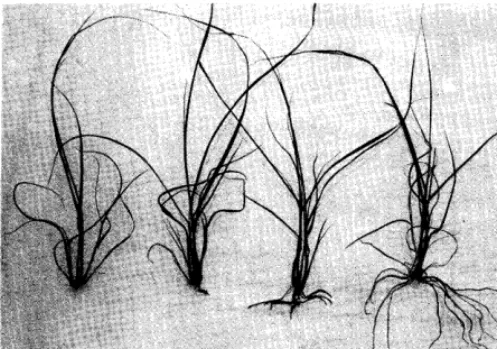
The response of total root length per seedling to humidity and temperature treatments was similar to that of the longest root per seedling. The greatest total root length (averaged over tempera- tures was 21 cm and was produced in the 100% humidity treatment (Fig. 6). Total root length for the 96, 93, 86, 81, and
76%
humidity treatments were 9.2, 4.8, 1.1, 0.7, and 0.8 cm, respectively.A significant accession times humidity interaction (P < 0.0 1) occurred for total root length. In the 100 and 96% humidity treatments, seedlings of the Southern Plains accession produced a greater total length of roots than seedlings of the Central Plains accession; however, in the 93, 86, 8 1, and 76% humidity treatments, only minor differences between accessions were observed.
Weight of Roots
The greatest root weight (averaged over temperatures) was 16.5 mg per seedling and was produced in the 100% humidity treatment (Table 2). Root weight decreased sharply with de- creasing humidity to a minimum of 1.1 mg in the 8 1% humidity treatment. In contrast, weight per unit length of root gradually increased as humidity decreased. In the 100,96,93,86,8 1, and 76% humidity treatments, weight per unit length (averaged over temperatures) was0.9, 1.1, 1.3, 2.2, 2.1, and2.7mgpercm, respectively. Thus, low humidity inhibited elongation of roots more than it inhibited the transport of carbohydrates and other materials to roots.
Shoot Growth
Increase in green leaf-blade length and tiller number during the 5-day test was not affected by humidity treatments. How- ever, both leaf growth and tiller number decreased as temperature decreased.
Shoot dry weight per seedling (averaged over temperatures) increased with decreasing humidity around the seedling crown
6
20
25
TEMPERATURE
(cl
30
Fig. 5. Interaction between humidity and temperature for longest adventitious root produced by blue grama seedlings during a j-day test. Values represent the average of longest root per seedling for accessions 1482 and 1483. Co- ejkient of variation as 4.6%.
(Table 2). Shoot weight varied from 61.5 mg in the 100% humidity treatment to 72.6 mg per seedling in the 76% humidity treatment. This response was opposite to that observed with root weight. The contrasting response suggests that at higher hu- midities (conditions which favored the development of adventi- tious roots) carbohydrates and other photosynthetic products were used for root growth at the expense of shoot dry weight. If
Table 2. Weight of blue grama shoots (mg) produced during 27 days and weight adventitious roots (mg) produced during a 5-day test as affected by constant relative humidities (70) around seedling crowns.
Humidity of controlling solutions Growth parameter 100% 96% 93% 86% 81% 76%
Weight of adven-
titious roots 16Sa’ IO.+ 6.0c 1.7d l.le 1.3e Weight of shoots 61Sf 64.0e 67.7d 70.8 c 71.9b 72.6a [Values represent weights of roots and shoots per seedling for accessions 1482 and
1483 averaged over temperatures of 15,20,25, and 30°C. Means within each growth parameter associated with the same letter are not significantly different at the 0.01 level.
at very low soil water potentials when the seminal root is growing in moist soil, but adventitious root growth adequate for seedling establishment will probably not occur at moisture and temperature conditions of less than -50 bars and 15°C. Second, when selecting planting dates, both moisture and temperature requirements for seedling establishment must be considered. If only one of these requirements is met, adventitious root growth will be severely reduced and a planting failure is likely to occur.
Literature Cited
Bement, R. E., D. F. Hervey, A. C. Everson, and L. 0. Hylton, Jr. 1961.
Use of asphalt-emulsion mulches to hasten grass seedling establishment. J. Range Manage. 14:102-109.
Bement, R. E., R. D. Barmington, A. C. Everson, L. 0. Hylton, Jr., and
E. E. Remmenga. 1965. Seeding of abandoned croplands in the Central Great Plains. J. Range Manage. 1853-58.
Briske, D. D., and A. M. Wilson. 1977. Temperature effects on adventitious
Fig. 6. Effects of relative humidity on total length of adventitious roots pro-
root development in blue grama seedlings. J. Range Manage. 30:276-280.
duced in the j-day test at 30°C. Relative humidity treatments Cfrom left to Campbell, G. S., and A. M. Wilson. 1972. Water potential measurements of right) were 86, 93, 96, and 100%. In thejield adventitious roots grow almost soil
samples. p. 142-149. In: R. W. Brown and B. P. van Haveren (ed.)
vertically into the soil. The horizonal appearance in thephotograph is a result
Psychrometry in Water Relations Research. Utah Agr. Exp. Sta., Logan.
of the experimental procedure.
&au, K, 1960. Anatomy of Seed plants. John Wiley and sons, I,.,~_, New York. 170 p.
Hopkins, Harold. 1941. Variations in the growth of side-oats grama grass at
adventitious roots had been growing in soil with amore favorable Hays, Kansas, from seed produced in various parts of the Great Plains region.
moisture content, they would have contributed to an increase in Trans. Kans. Acad. of Sci. 44:86-95.
ater uptake and seedling water potential; the improved water Hoshikawa, Kiyochika. 1969. Underground organs of the seedlings and the
status of’ seedlings probably Would have promoted, rather than
systematics of Gramineae. Bot. Gaz. 130:192-203.
retarded, the increase in shoot dry weight.
Hy&r, D. N., A. c. Everson, and R. E. Bement. 1971. Seedling morphology and seeding failures with blue grama. J. Range Manage. 24:287-292.
Hyder, D. N., R. E. Bement, E. E. Remmenga, and D. F. Hervey. 1975. Requirements for Seedling Establishment Ecological responses of native plants and guidelines for management of
Successful seedling establishment depends on a rate of root
shortgrass range. U.S. Dep. Agr. Tech. Bull. 1503. 87 p.
elongation that is sufficient to keep a portion of the root in moist
Olmsted, Charles E. 1941. Growth and development in range grasses. I. Early development of Bouteloua curtipendula in relation to water supply. Bat. soil ahead of the drying soil front. Therefore, we should be Gaz. 102:499-5 19.
concerned primarily with elongation rates. In the 100% humidi- Olmsted, Charles E. 1942. Growth and development in rHnge grasses. II. Early ty treatment, elongation rates of the longest root per seedling at development of Bouteloua curtipendula as affected by drought periods. Bot. temperatures of 15,20,25, and 30°C were0.40,0.74,1.04, and Gaz. 103:53 l-542.
1.22 cm per day, respectively. In the 96% humidity treatment,
Riegel, Andrew. 1940. A study of the variations in the growth of blue grama
grass from seed produced in various sections of the Great Plains region.
elongation rates at these temperatures were 0.28, 0.36, 0.38, Trans. Kans. Acad. of Sci. 43:155-167.
and 0.44 cm per day, respectively. Seedlings with the lower van der Sluijs, D. H., and D. N. Hyder. 1974. Growth and longevity of blue elongation rates probably would not become successfully estab- grama seedlings restricted to seminal roots. J. Range Manage. 27: 117-l 19. lished because of the rapid rates at which surface soil dries. Waring, R. H., and B. D. Cleary. 1967. Plant water stress: evaluation by
On the basis of this study, we can make the following con-
pressure bomb. Science 155: 1248- 1254.
Wilson, A. M., and G. A. Harris. 1968. Phosphorylation in crested wheat-
elusions: First, adventitious roots of blue grama can be initiated grass seeds at low water potentials. Plant Physiol. 43:61-65.